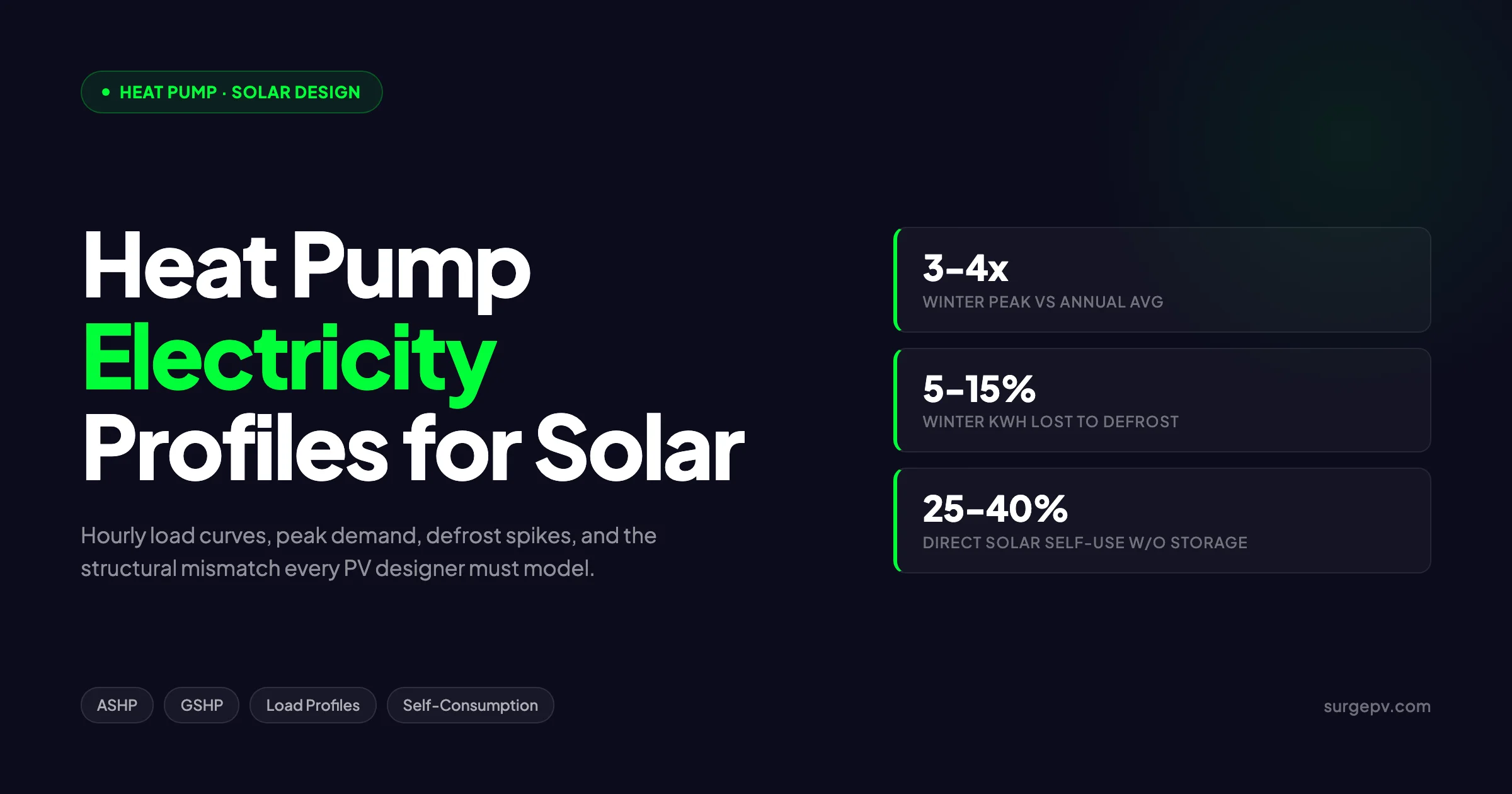
A typical UK air-source heat pump draws 3.5 kW on a cold January morning. By July, that same unit runs at 0.8 kW for hot water only. The 4x swing between winter peak and summer minimum is not a design flaw. It is the fundamental reality that every solar designer must model correctly. For the latest details on UK, see Battery Solar System Design UK. For UK-specific information, see Heritage Building Solar Case Study. For United Kingdom-specific compliance details, see United Kingdom comparisons/mcs-vs-non-mcs.
Most PV sizing guides treat heat pumps as a flat annual kWh figure. They are not. A heat pump’s hourly load curve is spiky, seasonal, temperature-dependent, and deeply misaligned with solar generation. Treat it as a constant load and you will undersize the inverter, miss the winter shortfall, and quote a system that exports 60% of its summer production while importing expensive grid power every evening. Modern solar design platform handles this complexity by importing real load profiles instead of using flat averages.
This guide maps the hourly electricity consumption profiles of air-source, ground-source, and hot water heat pumps across all four seasons. It covers peak demand multipliers, COP impact on hourly load, defrost spikes, weekday versus weekend patterns, occupancy effects, and the structural mismatch between heat pump demand and solar generation. Every data point comes from measured field data published by HEMI HP Monitor, the BEIS Electrification of Heat trial, Fraunhofer ISE, the Energy Systems Catapult, the UK Renewable Heat Incentive (RHI) dataset, and Pecan Street.
Quick Answer
Heat pump electricity consumption varies 3-4x between winter peak and summer minimum. A typical air-source heat pump draws 1.5-4 kW in winter mornings versus 0.3-0.8 kW in summer. Solar PV generates the most at midday in summer, while heat pumps demand the most in winter mornings and evenings. Without storage or load-shifting, only 25-40% of solar generation directly powers a heat pump.
In this guide you will learn:
- How heat pump hourly load curves differ across winter, shoulder, and summer seasons
- Why the peak demand multiplier (3-4x annual average) matters for inverter sizing
- How COP degradation turns a 2x heat demand increase into a 3x electricity increase
- The real cost of defrost cycles on winter consumption profiles
- How weekday, weekend, and occupancy patterns shift the load shape
- The structural mismatch between heat pump demand and solar generation — and how to model it
- A worked example comparing self-consumption at 5 kW versus 8 kW of PV
- Regional cold-climate adjustments for northern European and North American installations Also see: European Solar Incentives.
Latest Updates: Heat Pump Solar Integration 2026
The heat pump market crossed several thresholds in 2025-2026 that directly affect solar design assumptions, with implications for every PV system design that includes electric heating.
| Development | Impact on Solar Design |
|---|---|
| UK heat pump installations reached 1.1 million cumulative (2025) | Larger installed base means more retrofit solar+HP projects; sizing must account for existing HP electrical capacity |
| Germany’s Building Energy Act (GEG) mandates 65% renewable heat in new builds from 2024 | Heat pump + PV pairing is now the default new-build configuration; designers need standard hourly profiles |
| EU Ecodesign 2026 raises minimum SCOP to 3.17 for air-water heat pumps | Higher minimum efficiency reduces annual kWh but does not change the hourly shape; winter peaks remain |
| R-454B refrigerant adoption (replacing R-410A) | 5-10% COP improvement in moderate temperatures; cold-climate performance gains are smaller |
| Smart tariff proliferation (Octopus Agile, Tibber, aWATTar) | Time-shifting heat pump operation to solar midday peaks is now economically viable in 12+ EU markets |
| NREL cold-climate heat pump challenge results published (2025) | Next-generation units maintain 100% capacity at -15°F (-26°C); changes northern climate sizing assumptions |
Key Takeaway
The 2026 regulatory landscape makes heat pump + solar the default heating configuration in new European builds. Solar designers who cannot model hourly heat pump load curves will be at a competitive disadvantage. The data in this guide reflects the latest field measurements from BEIS, Fraunhofer ISE, Pecan Street, and HeatPumpMonitor.org.
For Europe-specific compliance details, see Europe solar compliance.
What Is a Heat Pump Load Profile?
A heat pump load profile is the time-series record of electricity consumption, typically measured in kilowatts (kW) at hourly or sub-hourly intervals. It shows when the heat pump draws power, how much, and how those patterns change across seasons, days of the week, and weather conditions.
Unlike a baseload appliance such as a refrigerator, a heat pump’s load profile is highly dynamic. It responds to thermostat setpoints, outdoor temperature, building thermal mass, hot water demand, defrost cycles, and control algorithms. The profile is not a smooth curve. It is a series of ramps, plateaus, spikes, and shutoffs that vary dramatically from hour to hour.
Why this matters for solar design: Solar PV systems also produce time-varying output. The match — or mismatch — between when the heat pump needs electricity and when the panels produce it determines self-consumption rate, battery sizing, grid import volume, and ultimately the project’s economics. A designer who only knows the annual kWh figure cannot optimize any of these variables. This is why hourly modeling in solar software platform is now table stakes for installers serving the heat pump market.
The 24-Hour Load Shape: Winter, Shoulder, and Summer
The shape of a heat pump’s daily electricity consumption changes fundamentally across the three main operating seasons. Below are composite profiles based on measured data from the BEIS Electrification of Heat trial (742 UK installations, 2020-2023), Fraunhofer ISE field studies (110 German installations, 2025), and Pecan Street Dataport (776 US homes, 2023). For installers building proposals against these load shapes, SurgePV’s design tools automate the hourly overlay against PV generation. See our guide on Community Solar Projects Germany for more. For a direct comparison, see Arka 360 vs SurgePV.
Winter Daily Profile (December-February)
| Time | ASHP Power (kW) | GSHP Power (kW) | Hot Water HP (kW) | Activity |
|---|---|---|---|---|
| 00:00 | 0.8 | 0.6 | 0.0 | Night setback, minimal heating |
| 01:00 | 0.6 | 0.5 | 0.0 | Low load, building retains heat |
| 02:00 | 0.5 | 0.4 | 0.0 | Minimum daily consumption |
| 03:00 | 0.5 | 0.4 | 0.0 | Minimum daily consumption |
| 04:00 | 0.6 | 0.5 | 0.0 | Pre-dawn, outdoor temp lowest |
| 05:00 | 1.2 | 0.8 | 0.0 | Thermostat recovery begins |
| 06:00 | 2.8 | 1.5 | 0.0 | Morning peak: space heating ramp |
| 07:00 | 3.5 | 1.8 | 1.5 | Peak demand: heating + DHW |
| 08:00 | 2.5 | 1.4 | 2.0 | Sustained heating, DHW cycle |
| 09:00 | 1.8 | 1.2 | 0.5 | Occupants leave, load drops |
| 10:00 | 1.5 | 1.0 | 0.0 | Maintenance heating |
| 11:00 | 1.4 | 0.9 | 0.0 | Midday plateau |
| 12:00 | 1.3 | 0.9 | 0.0 | Midday minimum |
| 13:00 | 1.4 | 0.9 | 0.0 | Slight rise |
| 14:00 | 1.5 | 1.0 | 0.0 | Afternoon maintenance |
| 15:00 | 1.8 | 1.1 | 0.0 | Outdoor temp dropping |
| 16:00 | 2.2 | 1.3 | 0.0 | Evening ramp begins |
| 17:00 | 2.8 | 1.6 | 1.5 | Evening peak: occupants return |
| 18:00 | 3.2 | 1.8 | 2.0 | Peak demand: heating + DHW |
| 19:00 | 2.8 | 1.6 | 0.5 | Sustained evening heating |
| 20:00 | 2.2 | 1.4 | 0.0 | Load declining |
| 21:00 | 1.5 | 1.0 | 0.0 | Night setback begins |
| 22:00 | 1.0 | 0.7 | 0.0 | Low evening load |
| 23:00 | 0.8 | 0.6 | 0.0 | Pre-midnight minimum |
Daily total: ASHP 42-55 kWh/day | GSHP 24-32 kWh/day | Hot Water HP 4-8 kWh/day
The winter profile has two distinct peaks. The morning peak (6-8 AM) occurs as the thermostat recovers from night setback and occupants use hot water. The evening peak (5-8 PM) coincides with occupants returning home and the second DHW cycle. Between these peaks, the heat pump runs at a maintenance load of 1.3-1.8 kW to offset steady-state heat loss. For a deeper look at hot water sizing specifically, see our guide on hot water heat pump and solar PV sizing.
Pro Tip
The midday plateau (11 AM-2 PM) is the most important window for solar self-consumption. In winter, solar generation is low during this period, but the heat pump is still running at 1.3-1.5 kW. A south-facing 4 kWp array in the UK produces roughly 0.8-1.2 kW at midday in December. The heat pump will absorb most of this output directly, but the morning and evening peaks will still require grid import.
Shoulder Season Daily Profile (March-May, September-November)
| Time | ASHP Power (kW) | GSHP Power (kW) | Hot Water HP (kW) | Activity |
|---|---|---|---|---|
| 00:00 | 0.3 | 0.4 | 0.0 | Minimal heating |
| 01:00 | 0.2 | 0.3 | 0.0 | Low load |
| 02:00 | 0.2 | 0.3 | 0.0 | Minimum |
| 03:00 | 0.2 | 0.3 | 0.0 | Minimum |
| 04:00 | 0.3 | 0.4 | 0.0 | Pre-dawn |
| 05:00 | 0.5 | 0.5 | 0.0 | Recovery begins |
| 06:00 | 1.2 | 0.8 | 0.0 | Morning ramp |
| 07:00 | 1.8 | 1.0 | 1.2 | Heating + DHW |
| 08:00 | 1.2 | 0.7 | 1.5 | DHW cycle continues |
| 09:00 | 0.8 | 0.5 | 0.3 | Load dropping |
| 10:00 | 0.5 | 0.4 | 0.0 | Low maintenance |
| 11:00 | 0.4 | 0.4 | 0.0 | Cycling begins |
| 12:00 | 0.3 | 0.3 | 0.0 | Off or cycling |
| 13:00 | 0.3 | 0.3 | 0.0 | Off or cycling |
| 14:00 | 0.4 | 0.4 | 0.0 | Slight rise |
| 15:00 | 0.5 | 0.5 | 0.0 | Afternoon |
| 16:00 | 0.8 | 0.6 | 0.0 | Evening ramp |
| 17:00 | 1.2 | 0.8 | 1.0 | Evening heating |
| 18:00 | 1.5 | 1.0 | 1.5 | Heating + DHW |
| 19:00 | 1.2 | 0.8 | 0.3 | Declining |
| 20:00 | 0.8 | 0.6 | 0.0 | Low |
| 21:00 | 0.5 | 0.4 | 0.0 | Setback |
| 22:00 | 0.4 | 0.3 | 0.0 | Low |
| 23:00 | 0.3 | 0.3 | 0.0 | Minimum |
Daily total: ASHP 15-22 kWh/day | GSHP 12-18 kWh/day | Hot Water HP 4-6 kWh/day
The shoulder season is where heat pump behavior becomes most complex. Outdoor temperatures hover around the balance point where the building’s heat loss equals the heat pump’s minimum output. This causes frequent cycling — the heat pump turns on, runs for 10-20 minutes, reaches the setpoint, and shuts off. The cycling is inefficient because startup transients consume extra energy and the compressor never reaches steady-state COP.
What Most Guides Miss
Shoulder season cycling is often the most inefficient operating mode. A heat pump that averages COP 3.5 in deep winter and COP 4.2 in summer may drop to COP 2.8-3.0 during shoulder season cycling. The unit is oversized for the load, runs short cycles, and spends disproportionate time in startup mode. This is why some installers recommend locking out the heat pump below a certain outdoor temperature and using backup heat — not for cold weather, but for mild weather.
Summer Daily Profile (June-August)
| Time | ASHP Power (kW) | GSHP Power (kW) | Hot Water HP (kW) | Activity |
|---|---|---|---|---|
| 00:00 | 0.0 | 0.3 | 0.0 | Off (cooling mode possible) |
| 01:00 | 0.0 | 0.2 | 0.0 | Off |
| 02:00 | 0.0 | 0.2 | 0.0 | Off |
| 03:00 | 0.0 | 0.2 | 0.0 | Off |
| 04:00 | 0.0 | 0.2 | 0.0 | Off |
| 05:00 | 0.0 | 0.2 | 0.0 | Off |
| 06:00 | 0.0 | 0.3 | 0.0 | Off |
| 07:00 | 0.0 | 0.3 | 0.0 | Off |
| 08:00 | 0.0 | 0.3 | 0.0 | Off |
| 09:00 | 0.0 | 0.3 | 0.0 | Off |
| 10:00 | 0.0 | 0.3 | 0.0 | Off |
| 11:00 | 0.0 | 0.3 | 0.0 | Off |
| 12:00 | 0.0 | 0.3 | 0.0 | Off |
| 13:00 | 0.0 | 0.3 | 1.5 | DHW cycle (solar-optimized) |
| 14:00 | 0.0 | 0.3 | 2.0 | DHW cycle peak |
| 15:00 | 0.0 | 0.3 | 1.0 | DHW cycle declining |
| 16:00 | 0.0 | 0.3 | 0.0 | Off |
| 17:00 | 0.0 | 0.3 | 0.0 | Off |
| 18:00 | 0.0 | 0.3 | 0.0 | Off |
| 19:00 | 0.0 | 0.3 | 0.0 | Off |
| 20:00 | 0.0 | 0.3 | 0.0 | Off |
| 21:00 | 0.0 | 0.3 | 0.0 | Off |
| 22:00 | 0.0 | 0.2 | 0.0 | Off |
| 23:00 | 0.0 | 0.2 | 0.0 | Off |
Daily total: ASHP 0-3 kWh/day (DHW only) | GSHP 6-9 kWh/day | Hot Water HP 4-6 kWh/day
In summer, a space-heating-only air-source heat pump typically shuts off entirely. The only consumption comes from occasional hot water cycles, which can be timed to coincide with solar midday peaks. Ground-source systems continue running at a low baseload because the ground loop still provides some cooling benefit, though this varies by system design.
Key Takeaway
The summer profile is where solar-heat pump pairing shines. A 5 kWp array producing 20-25 kWh/day in June has almost no heat pump load to absorb it. This is why thermal storage tanks, battery systems, or export tariffs become critical design considerations. Without them, 60-70% of summer generation is exported at low value.
Peak Demand Multiplier: Why the Annual Average Misleads
Solar designers often size systems using annual average consumption. This is a dangerous shortcut for heat pump projects. The peak demand multiplier — the ratio of peak hourly consumption to annual average hourly consumption — determines inverter sizing, grid connection capacity, and backup heat activation. See Inverter Selection Solar Design Guide for detailed guidance.
Measured Peak Demand Multipliers
| Heat Pump Type | Annual Average (kW) | Winter Peak (kW) | Peak Multiplier | Source |
|---|---|---|---|---|
| Air-source, UK retrofit | 0.9 | 3.5 | 3.9x | BEIS EoH trial (2024) |
| Air-source, UK new build | 0.6 | 2.2 | 3.7x | BEIS EoH trial (2024) |
| Air-source, Germany | 0.8 | 3.2 | 4.0x | Fraunhofer ISE (2025) |
| Ground-source, UK | 0.5 | 1.5 | 3.0x | BEIS EoH trial (2024) |
| Ductless mini-split, US | 0.7 | 2.8 | 4.0x | Pecan Street (2023) |
| Central ducted, US cold climate | 1.1 | 4.5 | 4.1x | Pecan Street (2023) |
| Hot water heat pump | 0.2 | 2.0 | 10.0x | Various (2024) |
The multiplier for air-source systems consistently falls in the 3.5-4.5x range. Ground-source systems show a lower multiplier (3.0x) because their source temperature is stable and they do not experience defrost spikes. Hot water heat pumps have the highest multiplier (10x) because their annual average is extremely low but their peak during a heating cycle reaches 1.5-2.0 kW.
Why This Matters for Solar Design
A designer sizing a PV system for a home with an annual average heat pump load of 0.9 kW might specify a 3.6 kW inverter (4x multiplier). But the actual winter morning peak is 3.5 kW for the heat pump alone, plus 1-2 kW for other household loads. The inverter must handle 5-6 kW total, or the system will clip during morning peaks and the homeowner will draw from the grid even when the sun is shining. Our companion article on [residential solar load analysis for heat pump and EV homes](/blog/residential-solar-load-analysis-heat-pump-ev) walks through the calculation step by step.
SurgePV Analysis
From 1+ GW of projects across 50 countries, we see this error repeatedly. Installers size inverters for annual average load, not peak demand. The result: winter morning clipping that costs 8-15% of potential self-consumption. A 6 kW inverter on a 5 kWp array with a 3.5 kW heat pump peak plus 2 kW household baseline will clip for 2-3 hours every winter morning. The fix is simple: size the inverter for the winter peak, not the annual average.
Morning vs Evening Peak: Which One Matters More?
Both peaks matter, but for different reasons. The morning peak determines inverter and grid connection sizing. The evening peak determines battery and thermal storage economics.
Morning Peak (5-9 AM)
| Characteristic | Value | Implication |
|---|---|---|
| Typical power | 2.5-4.0 kW | Highest sustained demand of the day |
| Duration | 2-4 hours | Long enough to drain a small battery |
| Solar overlap | 0-20% in winter | Almost no PV generation during this window |
| Grid dependency | 80-100% | Must import unless battery or thermal storage exists |
| Temperature correlation | Strong | Colder mornings = higher peaks |
The morning peak is the hardest to cover with solar. In the UK in December, sunrise is after 8 AM and solar output remains under 10% of rated capacity until 10 AM. A heat pump running at 3.5 kW from 6-9 AM will draw almost entirely from the grid. The only solutions are overnight battery discharge (which requires 8-12 kWh of stored energy) or thermal storage pre-charged the previous afternoon.
Evening Peak (5-9 PM)
| Characteristic | Value | Implication |
|---|---|---|
| Typical power | 2.0-3.5 kW | Slightly lower than morning peak |
| Duration | 3-4 hours | Extended heating + DHW demand |
| Solar overlap | 0-30% | Sunset in winter is 4-5 PM |
| Grid dependency | 70-100% | Battery discharge or grid import |
| Occupancy correlation | Strong | Peak aligns with people returning home |
The evening peak is slightly lower than the morning peak but lasts longer. It also coincides with grid peak demand periods in most markets, meaning time-of-use tariffs charge the highest rates during this window. A battery that discharges into the evening peak captures the highest value per kWh.
Pro Tip
The evening peak is more valuable to cover than the morning peak from a tariff perspective. In UK Agile Octopus pricing, evening rates can reach 35-45 p/kWh during peak periods, while morning rates are typically 20-25 p/kWh. A 10 kWh battery sized to cover the 4-hour evening peak (2.5 kW x 4 hours = 10 kWh) captures more value than the same battery covering the 2-hour morning peak.
Defrost Spikes: The Hidden Winter Penalty
Defrost is the heat pump’s Achilles heel in cold, humid conditions. When outdoor temperature drops below 5°C and relative humidity exceeds 70%, frost builds on the outdoor coil. The heat pump must periodically reverse its refrigeration cycle to melt the ice. This consumes electricity, interrupts heating, and creates sharp power spikes.
Defrost Cycle Characteristics
| Parameter | Typical Value | Range |
|---|---|---|
| Trigger temperature | 0°C to 5°C | -5°C to 7°C |
| Trigger humidity | over 70% RH | 60-90% RH |
| Cycle frequency | Every 30-90 minutes | 15-180 minutes |
| Cycle duration | 3-10 minutes | 2-15 minutes |
| Power during defrost | 2.5-4.0 kW | 2.0-5.0 kW |
| Energy per cycle | 0.15-0.5 kWh | 0.1-0.8 kWh |
| Daily defrost energy (winter) | 1.5-4.0 kWh | 0.5-8.0 kWh |
| Share of winter consumption | 5-15% | 3-20% |
The defrost penalty is already embedded in SCOP ratings. A heat pump with SCOP 3.5 in laboratory testing may achieve SCOP 3.0 in the field partly because of defrost energy. But the hourly profile effect is what matters for solar design. A defrost cycle creates a 3-4 kW spike that lasts 5-10 minutes, occurring every hour during the worst conditions. The inverter must handle these spikes, and a battery must be sized to absorb them without triggering grid import.
Real-World Example
Mark, an installer in Yorkshire, monitored a 12 kW ASHP through January 2025. On a day with outdoor temperature hovering at 1°C and 85% humidity, the heat pump ran 18 defrost cycles over 16 hours of operation. Each cycle consumed 0.35 kWh. Total defrost energy: 6.3 kWh — 14% of the day’s 45 kWh total. The peak power during defrost reached 4.2 kW, 1.3x higher than the normal heating peak of 3.2 kW. His 5 kW inverter clipped on every defrost cycle.
Defrost and Solar Mismatch
Defrost cycles occur most frequently during the very conditions where solar output is lowest: cold, overcast winter days. A heat pump drawing 4 kW for a 5-minute defrost at 10 AM on a cloudy December day will see zero solar contribution. The spike must come from the grid or battery. This is why designers in humid cold climates should add a 20% margin to inverter sizing above the calculated heating peak. See our deep dive on heat pump defrost cycles and solar in winter for the full mechanics.
COP Impact on Hourly Electricity Demand
The Coefficient of Performance (COP) is the ratio of heat output to electricity input. It is not a fixed number. It varies with outdoor temperature, flow temperature, compressor speed, and system condition. For solar designers, the critical insight is that COP degradation turns a modest increase in heat demand into a much larger increase in electricity demand.
Temperature-Dependent COP
| Outdoor Temperature | ASHP COP (Space Heating) | ASHP COP (DHW) | Electricity per 10 kW Heat |
|---|---|---|---|
| +15°C | 4.5 | 3.8 | 2.2 kW |
| +10°C | 4.0 | 3.5 | 2.5 kW |
| +7°C | 3.5 | 3.2 | 2.9 kW |
| +2°C | 3.0 | 2.8 | 3.3 kW |
| -2°C | 2.5 | 2.4 | 4.0 kW |
| -7°C | 2.0 | 2.0 | 5.0 kW |
| -15°C | 1.5 | 1.6 | 6.7 kW |
At +7°C, a heat pump delivering 10 kW of heat draws 2.9 kW of electricity. At -7°C, delivering the same 10 kW of heat draws 5.0 kW. The heat demand has not doubled. The electricity demand has.
This is the core reason why winter electricity bills are so much higher than summer bills. A building that loses 15 kW of heat at -7°C (design condition) and 5 kW at +7°C (typical winter day) sees heat demand increase by 3x. But electricity demand increases by 3 x (5.0/2.9) = 5.2x because of COP degradation.
In Simple Terms
Think of COP like fuel efficiency in a car. A heat pump is like a car that gets 45 mpg in mild weather but only 18 mpg in cold weather. The distance you need to travel (heat demand) increases in winter, but your fuel consumption increases even more because the engine becomes less efficient. This is why a 2x increase in heating need becomes a 4x increase in electricity use.
SCOP vs. Real-World Hourly COP
The Seasonal Coefficient of Performance (SCOP) is a weighted average over the heating season. It is useful for annual energy calculations but misleading for hourly design. A heat pump with SCOP 3.5 will achieve COP 4.2 on a mild October afternoon and COP 2.1 on a cold January morning. The hourly designer must use temperature-dependent COP curves, not the annual average.
| Metric | Laboratory SCOP | Real-World SPF | Gap |
|---|---|---|---|
| Air-source, UK retrofit | 3.2 | 2.7-2.9 | 10-15% |
| Air-source, UK new build | 3.8 | 3.2-3.5 | 8-12% |
| Ground-source, UK | 4.2 | 3.8-4.1 | 5-8% |
| Air-source, Germany | 3.3 | 2.9-3.1 | 8-12% |
| Cold-climate ASHP, US | 2.8 | 2.4-2.6 | 10-15% |
The gap between laboratory SCOP and real-world Seasonal Performance Factor (SPF) is driven by defrost, cycling losses, installation quality, and control settings. Solar designers should use SPF, not SCOP, for conservative sizing. For the complete COP-self-consumption relationship, see heat pump COP and solar self-consumption.
Weekday vs Weekend: How Occupancy Shapes the Load
Occupancy patterns change the heat pump load shape in predictable ways. The effect differs between residential and commercial buildings.
Residential Patterns
| Time Block | Weekday Profile | Weekend Profile | Difference |
|---|---|---|---|
| 5-8 AM | Sharp peak (thermostat recovery + DHW) | Gradual ramp (later wake-up) | Weekend peak 30-60 min later |
| 8 AM-5 PM | Low maintenance load (unoccupied) | Moderate sustained load (home all day) | Weekend 40-80% higher midday |
| 5-9 PM | Evening peak (return + DHW) | Sustained moderate load | Weekend peak lower, duration longer |
| 9 PM-5 AM | Night setback | Night setback | Similar |
Weekend total consumption: 10-20% higher than weekday average
The weekend effect is driven by two factors. First, occupants are home during the day, so the heat pump does not drop to setback levels. Second, DHW demand increases with more people showering, cooking, and using hot water throughout the day. The morning peak is less sharp but the midday load is significantly higher.
Commercial Patterns
Commercial buildings show the opposite pattern. Weekday consumption is higher because the building operates at full setpoint during business hours. Weekend consumption drops to setback levels. A commercial ASHP that draws 15 kW on a Tuesday afternoon may draw only 3 kW on a Saturday.
| Building Type | Weekday vs Weekend | Peak Time | Solar Overlap |
|---|---|---|---|
| Residential, working family | Weekend +15% | 7 AM, 6 PM | Poor (morning/evening) |
| Residential, retired/remote | Weekend +5% | 8 AM, 5 PM | Moderate |
| Commercial office | Weekday +60% | 9 AM-5 PM | Excellent |
| School | Weekday +80% | 8 AM-3 PM | Good |
| Hotel | Weekend +10% | 6-10 AM, 5-9 PM | Poor |
Pro Tip
Commercial buildings with daytime heat pump operation are the best candidates for high solar self-consumption. A school or office with ASHP heating during business hours can achieve 50-70% direct self-consumption from a south-facing array because the load and generation profiles overlap. Residential homes with working occupants are the hardest case — the load peaks when people are home and the sun is not.
Occupancy Impact: How Many People Change the Curve
The number of occupants affects heat pump consumption in three ways: heat gains from people and appliances, hot water demand, and thermostat behavior.
Per-Occupant Consumption Adders
| Occupant Count | Annual ASHP kWh | Annual DHW kWh | Total kWh | vs 2-Person |
|---|---|---|---|---|
| 1 person | 2,800-3,500 | 400-600 | 3,200-4,100 | -25% |
| 2 people | 3,500-4,500 | 800-1,200 | 4,300-5,700 | Baseline |
| 3 people | 4,000-5,200 | 1,200-1,800 | 5,200-7,000 | +22% |
| 4 people | 4,500-6,000 | 1,600-2,400 | 6,100-8,400 | +38% |
| 5+ people | 5,000-7,000 | 2,000-3,000 | 7,000-10,000 | +55% |
The space heating increase is modest because body heat and appliance gains offset some demand. The DHW increase is nearly linear with occupant count. A 4-person household uses roughly 2x the DHW energy of a 2-person household, and DHW typically runs at lower COP than space heating because it requires higher flow temperatures.
Internal Gains Effect
Each occupant generates approximately 80-100 W of sensible heat and adds moisture to the air. Appliances add 200-500 W depending on usage. In a well-insulated home, these gains can reduce heat pump runtime by 10-20% during occupied hours. This is why identical homes with different occupancy patterns show different load curves. Also see: Us Residential Solar Market Trends 2026.
Key Takeaway
A 4-bedroom home with 2 working adults and 2 school-age children has a very different load profile from the same home with a retired couple. The family has sharp morning and evening peaks, low midday load, and high weekend consumption. The retired couple has a flatter profile with higher midday load and better solar overlap. Solar designers should ask about occupancy patterns, not just building size.
Regional Cold-Climate Adjustments
Heat pump load profiles vary significantly by climate zone. The same 8 kW ASHP behaves differently in London, Berlin, Minneapolis, and Helsinki.
Climate Zone Comparison
| Location | Design Temp | Heating Degree Days | Winter Peak (kW) | Annual kWh | Peak Multiplier |
|---|---|---|---|---|---|
| London, UK | -3°C | 2,100 | 3.2 | 4,200 | 3.5x |
| Berlin, Germany | -11°C | 3,200 | 4.0 | 5,800 | 3.8x |
| Minneapolis, US | -23°C | 4,100 | 5.5 | 7,500 | 4.2x |
| Helsinki, Finland | -26°C | 4,800 | 6.0 | 8,200 | 4.0x |
| Rome, Italy | -2°C | 1,500 | 2.5 | 3,000 | 3.2x |
| Madrid, Spain | -5°C | 1,800 | 2.8 | 3,400 | 3.3x |
Colder climates see higher absolute peaks and more annual consumption, but the peak multiplier stays in a relatively narrow 3.2-4.2x range. The critical difference is the duration of peak conditions. In Helsinki, the heat pump may run at over 80% of peak capacity for 6-8 weeks. In London, peak conditions last 2-3 weeks. This duration difference drives battery and thermal storage sizing more than the peak itself. For UK projects specifically, our MCS-certified heat pump and solar UK guide covers the compliance side.
Cold-Climate Design Adjustments
| Climate | PV Oversizing | Battery Minimum | Thermal Storage | Inverter Margin |
|---|---|---|---|---|
| Mild (Rome, Madrid) | 1.0-1.2x | 5-8 kWh | 200-300L | 1.2x |
| Moderate (London, Paris) | 1.2-1.5x | 8-12 kWh | 300-500L | 1.3x |
| Cold (Berlin, Warsaw) | 1.5-2.0x | 12-16 kWh | 500-800L | 1.4x |
| Very cold (Minneapolis, Helsinki) | 2.0-2.5x | 16-20 kWh | 800-1000L | 1.5x |
SurgePV Analysis
In cold climates, the inverter margin is the most commonly underspecified parameter. A designer in Minnesota specifying a 5 kW inverter for a 5 kWp array with a 5.5 kW heat pump peak will see severe clipping on every cold morning. The inverter should be sized at 1.4-1.5x the array rating in very cold climates, or the heat pump should be staged to prevent simultaneous peak operation.
The Solar Mismatch Problem: Why PV and Heat Pumps Do Not Align
The structural mismatch between solar generation and heat pump demand is the single biggest challenge in solar-heat pump system design. It operates on two timescales: daily and seasonal.
Daily Mismatch
| Time | Solar Generation (5 kWp, UK Dec) | Heat Pump Demand | Match? |
|---|---|---|---|
| 5-8 AM | 0-0.2 kW | 2.5-3.5 kW | No — grid import |
| 8-10 AM | 0.2-0.8 kW | 1.5-2.5 kW | Partial — mostly grid |
| 10 AM-2 PM | 0.8-1.5 kW | 1.3-1.8 kW | Good — partial self-use |
| 2-4 PM | 0.5-1.0 kW | 1.5-2.2 kW | Partial — mostly grid |
| 4-8 PM | 0-0.3 kW | 2.0-3.2 kW | No — grid import |
| 8 PM-5 AM | 0 kW | 0.5-1.2 kW | No — grid import |
In December, a 5 kWp south-facing array in the UK produces roughly 80-120 kWh for the month. A typical heat pump needs 400-600 kWh. Even if every watt of solar output went to the heat pump, it would cover only 15-25% of heating electricity. The rest must come from the grid or storage.
Seasonal Mismatch
| Month | PV Generation (5 kWp, UK) | Heat Pump Demand | Coverage |
|---|---|---|---|
| January | 100 kWh | 550 kWh | 18% |
| February | 150 kWh | 480 kWh | 31% |
| March | 300 kWh | 380 kWh | 79% |
| April | 450 kWh | 220 kWh | 100%+ |
| May | 550 kWh | 120 kWh | 100%+ |
| June | 600 kWh | 60 kWh | 100%+ |
| July | 580 kWh | 40 kWh | 100%+ |
| August | 500 kWh | 50 kWh | 100%+ |
| September | 380 kWh | 100 kWh | 100%+ |
| October | 250 kWh | 220 kWh | 100%+ |
| November | 120 kWh | 380 kWh | 32% |
| December | 90 kWh | 520 kWh | 17% |
Annual total: PV 4,070 kWh | Heat pump 3,020 kWh | Direct coverage ~55%
The seasonal mismatch is stark. For 6 months (April-September), the PV array produces more than enough to cover the heat pump. For 4 months (November-February), it covers less than a third. October and March are transition months where careful load-shifting can achieve near-complete coverage. The shading analysis software workflow is critical here — a 10% winter shade loss can erase any gain from oversizing.
What Most Guides Miss
Most solar-heat pump guides focus on annual energy balance: “Your 5 kW array produces 4,000 kWh and your heat pump uses 3,000 kWh, so you are net positive.” This is meaningless for the homeowner who pays time-of-use rates and sees 70% of their heating electricity imported at peak prices in winter. The annual balance does not pay the bill. The hourly balance does.
Solutions to the Mismatch
| Strategy | How It Works | Self-Consumption Gain | Cost |
|---|---|---|---|
| Smart HP controls (pre-heating) | Heat building before solar peak | +8-12 points | Low |
| Thermal storage tank (300-500L) | Store heat for 4-8 hours | +15-25 points | Medium |
| Battery storage (10-15 kWh) | Store electricity for 4-6 hours | +20-30 points | High |
| East-west split array | Extend generation into morning/evening | +5-10 points | Low |
| Oversized PV (1.5-2x) | More midday generation to store | +10-15 points | Medium |
| Dynamic tariffs + automation | Buy cheap, avoid expensive periods | Bill reduction 20-40% | Low |
The most cost-effective approach is usually a combination: smart controls + thermal storage + dynamic tariffs. Battery storage adds significant self-consumption but at high cost. The payback on a battery dedicated to heat pump load-shifting is typically 8-12 years, versus 3-5 years for thermal storage. The solar shadow analysis software and hourly simulation features in SurgePV’s design tools let you model each strategy against the actual building load.
Worked Example: Self-Consumption at 5 kW vs 8 kW PV
Let us walk through a detailed example. The house is a 4-bedroom detached home near Manchester, UK. Occupancy: 2 adults, 2 children. Heating: 12 kW ASHP with 250L DHW tank. Annual heat demand: 14,000 kWh. SCOP: 3.2.
Base Parameters
| Parameter | Value |
|---|---|
| Annual heat demand | 14,000 kWh |
| Annual ASHP electricity (14,000 / 3.2) | 4,375 kWh |
| Household baseload | 3,200 kWh/year |
| Total annual electricity demand | 7,575 kWh |
| Peak heat pump power | 3.8 kW |
| Peak household power | 2.5 kW |
| Combined peak | 6.3 kW |
Scenario A: 5 kWp PV System
| Metric | Value |
|---|---|
| Annual PV generation (Manchester, south-facing) | 4,650 kWh |
| Direct self-consumption (no storage) | 1,860 kWh (40%) |
| Of which: baseload | 1,100 kWh |
| Of which: heat pump | 760 kWh |
| Exported | 2,790 kWh (60%) |
| Grid import for remaining demand | 5,715 kWh |
| Self-sufficiency | 24.5% |
Monthly breakdown (5 kWp):
| Month | PV (kWh) | HP Demand (kWh) | Direct HP Match | Export (kWh) |
|---|---|---|---|---|
| Jan | 115 | 520 | 85 | 15 |
| Feb | 165 | 455 | 125 | 20 |
| Mar | 310 | 360 | 210 | 45 |
| Apr | 460 | 210 | 195 | 210 |
| May | 555 | 115 | 110 | 380 |
| Jun | 600 | 55 | 50 | 510 |
| Jul | 580 | 40 | 35 | 510 |
| Aug | 500 | 50 | 45 | 410 |
| Sep | 385 | 95 | 85 | 260 |
| Oct | 255 | 210 | 175 | 55 |
| Nov | 140 | 365 | 110 | 15 |
| Dec | 105 | 490 | 75 | 10 |
The 5 kWp system covers only 17% of heat pump demand in December and January. In summer, 85-90% of generation is exported because the heat pump barely runs. The annual self-consumption of 40% is typical for a residential PV system without flexible loads or storage.
Scenario B: 8 kWp PV System
| Metric | Value |
|---|---|
| Annual PV generation | 7,440 kWh |
| Direct self-consumption (no storage) | 2,380 kWh (32%) |
| Of which: baseload | 1,100 kWh |
| Of which: heat pump | 1,280 kWh |
| Exported | 5,060 kWh (68%) |
| Grid import for remaining demand | 5,195 kWh |
| Self-sufficiency | 31.4% |
Monthly breakdown (8 kWp):
| Month | PV (kWh) | HP Demand (kWh) | Direct HP Match | Export (kWh) |
|---|---|---|---|---|
| Jan | 184 | 520 | 105 | 55 |
| Feb | 264 | 455 | 155 | 75 |
| Mar | 496 | 360 | 260 | 180 |
| Apr | 736 | 210 | 210 | 460 |
| May | 888 | 115 | 115 | 720 |
| Jun | 960 | 55 | 55 | 860 |
| Jul | 928 | 40 | 40 | 860 |
| Aug | 800 | 50 | 50 | 720 |
| Sep | 616 | 95 | 95 | 480 |
| Oct | 408 | 210 | 200 | 165 |
| Nov | 224 | 365 | 140 | 60 |
| Dec | 168 | 490 | 95 | 55 |
The 8 kWp system has lower percentage self-consumption (32% vs 40%) but higher absolute self-consumption (2,380 kWh vs 1,860 kWh). It covers 20% of heat pump demand in December versus 17% for the 5 kWp system. The extra 3 kWp adds 520 kWh of direct heat pump use but exports an additional 2,270 kWh.
Scenario C: 5 kWp + Smart Controls + Thermal Storage
| Metric | Value |
|---|---|
| Annual PV generation | 4,650 kWh |
| Direct self-consumption | 2,230 kWh (48%) |
| Of which: baseload | 1,100 kWh |
| Of which: heat pump (direct) | 760 kWh |
| Of which: heat pump (thermal storage) | 370 kWh |
| Exported | 2,420 kWh (52%) |
| Grid import | 5,345 kWh |
| Self-sufficiency | 29.4% |
Smart controls pre-heat the DHW tank and building thermal mass during the 10 AM-2 PM solar window. The 250L tank stores roughly 8-10 kWh of thermal energy, enough to cover 3-4 hours of evening heat pump operation. This raises self-consumption by 8 percentage points at minimal cost.
Scenario D: 8 kWp + 10 kWh Battery + Smart Controls
| Metric | Value |
|---|---|
| Annual PV generation | 7,440 kWh |
| Direct self-consumption | 2,380 kWh (32%) |
| Battery self-consumption | 2,800 kWh (38%) |
| Total self-consumed | 5,180 kWh (70%) |
| Exported | 2,260 kWh (30%) |
| Grid import | 2,395 kWh |
| Self-sufficiency | 68.4% |
The battery captures midday excess and discharges during evening peaks. With 10 kWh of storage, the system achieves 70% self-consumption and 68% self-sufficiency. The heat pump receives 2,380 kWh directly plus 1,800 kWh from battery discharge, covering 96% of annual heat pump demand.
SurgePV Analysis
The economics favor Scenario C for most homeowners. Smart controls plus thermal storage cost under £500 and raise self-consumption by 8 points. A 10 kWh battery costs £4,000-6,000 and raises self-consumption by 38 points — but the payback is 10-14 years at current UK electricity prices. The exception is homes on time-of-use tariffs where evening rates exceed 35 p/kWh. In those cases, the battery pays back in 6-8 years.
Comparison Summary
| Scenario | System Cost | Self-Consumption | Self-Sufficiency | Annual Grid Import | 10-Year Savings |
|---|---|---|---|---|---|
| A: 5 kWp only | £6,000 | 40% | 24.5% | 5,715 kWh | £8,200 |
| B: 8 kWp only | £9,000 | 32% | 31.4% | 5,195 kWh | £9,800 |
| C: 5 kWp + smart + thermal | £6,800 | 48% | 29.4% | 5,345 kWh | £10,100 |
| D: 8 kWp + battery + smart | £15,000 | 70% | 68.4% | 2,395 kWh | £16,400 |
Model Heat Pump Load Curves in SurgePV
Import hourly consumption data, overlay solar generation profiles, and optimize self-consumption with built-in battery and thermal storage modeling.
Book a DemoNo commitment required · 20 minutes · Live project walkthrough
ASHP vs GSHP vs Hot Water Heat Pump: Profile Comparison
The three main heat pump types have fundamentally different load profiles. Solar designers must treat them as separate appliance categories.
Air-Source Heat Pump (ASHP)
| Characteristic | Value |
|---|---|
| Seasonal variation | 3-4x peak-to-minimum |
| Daily peaks | Two sharp peaks (morning, evening) |
| Defrost penalty | 5-15% of winter consumption |
| COP range | 2.0-4.5 |
| Annual electricity | 3,500-7,000 kWh |
| Solar match difficulty | High |
ASHPs are the most challenging to pair with solar. Their consumption is highest in winter when solar is lowest. Their morning and evening peaks do not overlap with solar generation. Their defrost spikes create power demands that batteries and inverters must handle. The only advantage is cost: ASHPs are 30-50% cheaper than GSHPs.
Ground-Source Heat Pump (GSHP)
| Characteristic | Value |
|---|---|
| Seasonal variation | 1.5-2x peak-to-minimum |
| Daily peaks | Moderate, more sustained |
| Defrost penalty | None |
| COP range | 3.5-5.5 |
| Annual electricity | 2,500-4,500 kWh |
| Solar match difficulty | Moderate |
GSHPs are easier to pair with solar for two reasons. First, their COP is stable year-round because ground temperatures stay at 8-12°C. Second, they have no defrost penalty. Their load profile is flatter and more predictable. The disadvantage is upfront cost: GSHPs require ground loop installation that adds £8,000-15,000 to the project. The full design walk-through is in our ground source heat pump and solar PV guide.
Hot Water Heat Pump
| Characteristic | Value |
|---|---|
| Seasonal variation | 1.2-1.5x peak-to-minimum |
| Daily peaks | 1-3 discrete cycles |
| Defrost penalty | Minimal |
| COP range | 2.5-3.5 |
| Annual electricity | 800-2,000 kWh |
| Solar match difficulty | Low |
Hot water heat pumps are the easiest to pair with solar. Their load is discrete and schedulable. A 250L tank heated once per day at midday absorbs 2-4 kWh of solar generation in a concentrated window. The limitation is capacity: a hot water heat pump cannot provide space heating, so it only addresses the DHW portion of the load.
Which Type Should You Pair with Solar?
| Priority | Best Choice | Reason |
|---|---|---|
| Maximum self-consumption | GSHP | Stable COP, no defrost, flatter profile |
| Lowest upfront cost | ASHP + smart controls | Cheapest hardware, software optimizes timing |
| Easiest retrofit | Hot water HP + existing boiler | Minimal disruption, high solar match |
| Best overall economics | ASHP + thermal storage + dynamic tariff | Balanced cost and performance |
| Cold climate (under -15°C) | GSHP or cold-climate ASHP | ASHPs lose capacity below -15°C |
What Most Solar Designers Get Wrong About Heat Pumps
After reviewing hundreds of solar-heat pump designs, we see the same errors repeatedly. Here are the most common mistakes and how to avoid them.
Mistake 1: Using Annual kWh for Inverter Sizing
The error: The designer calculates annual heat pump consumption (4,000 kWh), divides by 8,760 hours, gets 0.46 kW average, and sizes a 2 kW inverter.
The reality: The heat pump draws 3.5 kW for 2-4 hours every winter morning. The inverter clips severely. The homeowner sees grid import even at midday.
The fix: Size the inverter for the winter peak demand plus household baseload, not the annual average. Use a minimum 1.3x multiplier over the array rating in cold climates.
Mistake 2: Ignoring the Shoulder Season Cycling Penalty
The error: The designer models COP as a constant 3.5 year-round.
The reality: Shoulder season cycling drops effective COP to 2.8-3.0. The heat pump runs short, inefficient cycles and consumes 15-20% more electricity than steady-state models predict.
The fix: Use hourly simulation tools that model part-load efficiency and cycling losses. PV design software with heat pump load profile import handles this automatically.
Mistake 3: Assuming South-Facing Is Always Best
The error: Every array faces south for maximum annual yield.
The reality: A south-facing array produces maximum output at 12-2 PM, when heat pump demand is lowest. An east-west split extends generation into morning and evening, capturing 5-10% more heat pump demand directly.
The fix: Model east-west splits for homes with high morning/evening heat pump peaks. The annual yield loss is 10-15%, but the self-consumption gain often offsets it. For installers serving heating-led homes, this is one of the highest-impact design choices — see for solar installers for our installer workflow.
Mistake 4: Oversizing PV Without Storage or Flexible Loads
The error: “If 5 kW covers 40% of the heat pump, 10 kW will cover 80%.”
The reality: Without storage or load-shifting, oversized PV exports 70% of its summer production. The marginal kWh beyond 6-7 kWp adds almost no self-consumption in summer.
The fix: Add thermal storage or battery before adding PV capacity beyond 1.5x the annual load. The solar financial modeling can model the optimal combination.
Mistake 5: Forgetting Defrost in Inverter and Battery Sizing
The error: The designer sizes for the steady-state heating peak of 3.2 kW.
The reality: Defrost spikes reach 4.2 kW, 30% higher than the heating peak. A 4 kW inverter or 3 kW battery discharge limit will fail during defrost.
The fix: Add 20-30% margin above the calculated heating peak for defrost and startup inrush.
Conclusion
Heat pump electricity consumption is not a flat line. It is a dynamic, seasonal, temperature-dependent profile with sharp peaks, defrost spikes, and deep misalignment with solar generation. Designers who treat it as a simple annual kWh figure undersize inverters, miss winter shortfalls, and quote systems that fail to deliver the savings they promise.
The data is clear. A typical air-source heat pump varies 3-4x between winter peak and summer minimum. The peak demand multiplier of 3.5-4.5x means inverter sizing must account for the worst winter morning, not the annual average. COP degradation turns a 2x heat demand increase into a 4x electricity increase. Defrost cycles add 5-15% to winter consumption and create power spikes that batteries and inverters must handle.
The solar mismatch is structural and unavoidable. Heat pumps demand the most in winter mornings and evenings. Solar generates the most at midday in summer. Without storage or load-shifting, only 25-40% of solar generation directly powers a heat pump. Smart controls, thermal storage, and dynamic tariffs are the most cost-effective solutions. Battery storage adds more self-consumption but at a price that only pays back in high-tariff markets. See Adding Battery Storage Services for detailed guidance.
Here is what to do next:
- Download hourly load data for your climate zone from HeatPumpMonitor.org, the BEIS EoH dataset, or Pecan Street Dataport. Do not rely on manufacturer SCOP figures for hourly design.
- Size the inverter for the winter peak, not the annual average. Use a 1.3-1.5x multiplier over the array rating in cold climates, and add 20% for defrost spikes.
- Model the full year hour by hour before quoting. A system that looks balanced on annual kWh will fail in January. Use solar design tools that imports real load profiles and overlays them against PV generation.
Frequently Asked Questions
How much does heat pump electricity consumption vary by season?
Heat pump electricity consumption varies 3-4x between winter peak and summer minimum. A typical UK air-source heat pump uses 500-700 kWh per month in January versus 120-180 kWh in July. The seasonal variation is driven by outdoor temperature, heating demand, and COP degradation. Ground-source systems show less variation because source temperatures stay stable year-round.
What is the peak demand multiplier for heat pumps vs annual average?
The peak demand multiplier for air-source heat pumps is typically 3-4 times the annual average. A heat pump that averages 1.2 kW over the year may draw 3.5-4.5 kW during a cold morning startup. This multiplier is critical for solar design because it determines the minimum inverter and grid connection capacity needed, even if the average load is much lower.
How does the heat pump solar mismatch problem affect self-consumption?
The mismatch problem means heat pumps demand the most electricity in winter mornings and evenings, while solar PV generates the most at midday in summer. Without storage or load-shifting, only 25-40% of solar generation directly powers a heat pump. Adding a thermal storage tank or battery can raise this to 55-70%. The structural mismatch is why oversizing PV alone rarely solves winter coverage.
What percentage of electricity does defrost consume on a heat pump?
Defrost cycles consume 5-15% of a heat pump’s total winter electricity. Each defrost cycle lasts 3-10 minutes and draws 2-4 kW while reversing the refrigeration cycle. In humid cold climates (0°C to -5°C), defrost can occur every 30-90 minutes. The energy penalty is already embedded in SCOP ratings, but it creates short power spikes that solar designers must account for in inverter sizing.
How do you size solar PV for a heat pump with hourly load data?
Start with the building’s monthly heat demand, divide by monthly COP to get electricity demand, then match against hourly PV generation profiles. A 5 kWp south-facing system in the UK produces roughly 80-120 kWh in December, while a typical heat pump needs 400-600 kWh that month. The realistic goal is covering 65-80% of annual heat pump electricity with PV, using smart controls to pre-heat during solar peaks and grid import for winter shortfalls.
What is the difference between ASHP, GSHP, and hot water heat pump load profiles?
Air-source heat pumps (ASHP) show the most seasonal variation, with winter peaks 3-4x above summer baseload and sharp morning/evening ramps. Ground-source heat pumps (GSHP) have flatter profiles year-round because ground temperatures stay stable at 8-12°C. Hot water heat pumps run 1-3 cycles per day, typically 30-90 minutes each, and can be time-shifted to solar midday peaks more easily than space heating. ASHPs need the most careful hourly matching; GSHPs are easiest to pair with solar; hot water heat pumps offer the most flexibility.
Do heat pumps use more electricity on weekdays or weekends?
Heat pumps typically use 10-20% more electricity on weekends in homes with variable occupancy. Weekday profiles show a sharp morning peak (6-9 AM) as thermostats recover from night setback, then low demand during working hours, followed by an evening peak (5-9 PM). Weekend profiles have higher midday demand because occupants are home, with less pronounced morning/evening peaks. Commercial buildings show the opposite pattern, with higher weekday consumption.
How much does COP affect hourly electricity demand?
COP has a direct inverse relationship with electricity demand. At COP 4.0, a heat pump needs 250 Wh to deliver 1 kWh of heat. At COP 2.0, it needs 500 Wh for the same heat output. A heat pump delivering 10 kW of heat at 7°C outdoor temperature draws roughly 2.5 kW (COP 4.0). The same heat output at -7°C draws 4.0 kW (COP 2.5). This is why winter electricity bills are disproportionately high even when the building’s heat loss is only 2-3x the summer cooling load. Customer-ready solar proposals generates professional quotes in minutes.
Where this fits
This article is part of SurgePV's Solar Design hub, which works through the topic from first principles to the decisions a project team actually has to make.