

A solar installer in Phoenix tracked their lead-to-customer conversion in 2024 across two cohorts:
Cohort A (4,800 leads): Standard process — single follow-up email, then phone calls. Conversion rate: 9.2%. Acquired customers: 441.
Cohort B (4,650 leads): Same lead source, same sales team, same pricing. Added an 8-email automated drip campaign on top of phone follow-up. Conversion rate: 33.4%. Acquired customers: 1,553.
Same business. Same product. Adding email drip campaigns multiplied conversion by 3.6x.
Quick Answer: Solar Email Drip Campaigns
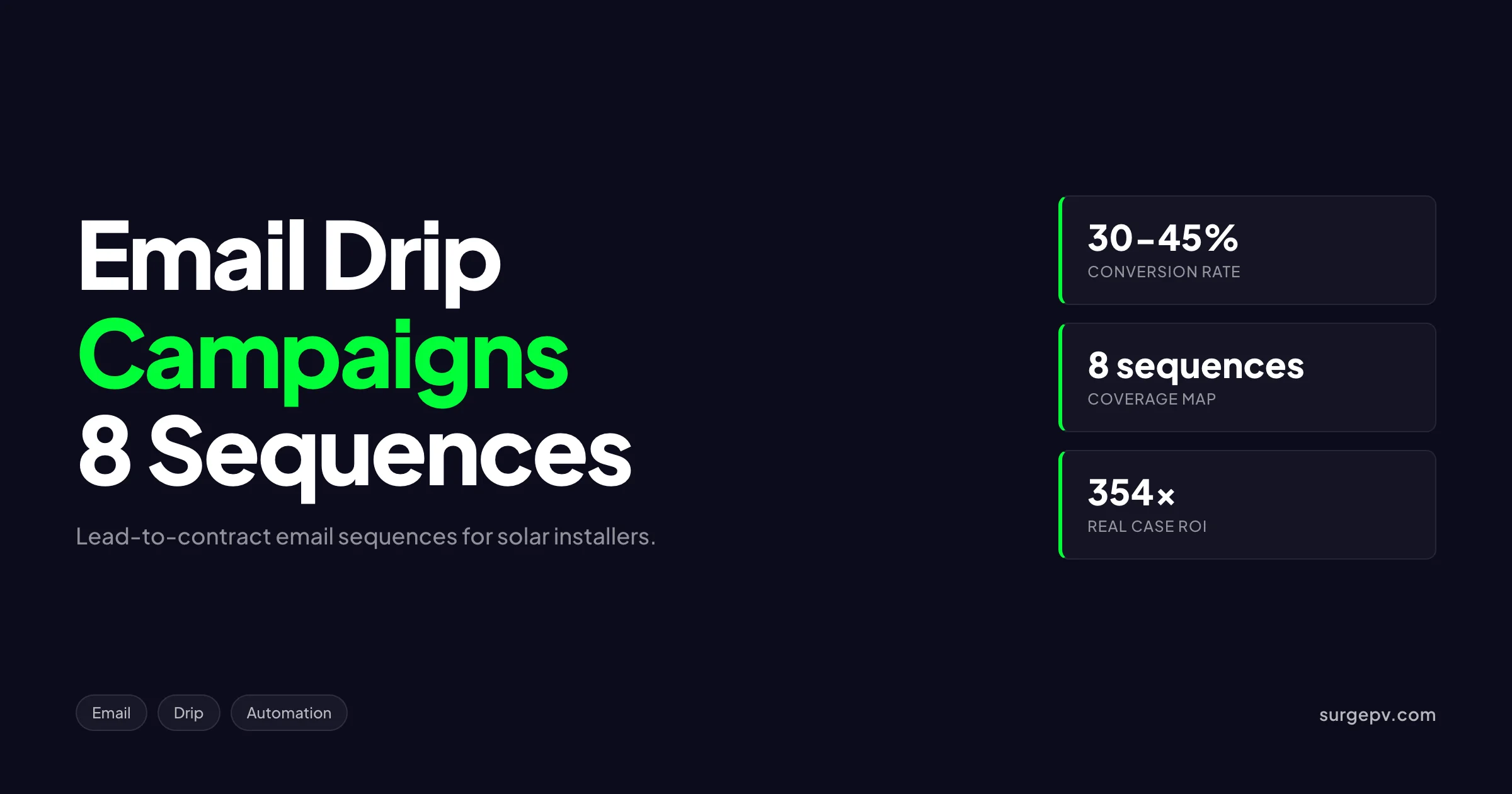
Solar email drip campaigns are automated 5-12 email sequences sent over 30-90 days to nurture leads from inquiry to contract. They convert 30-45% of leads vs 8-12% for one-off emails. Best practices: segment by lead source, send every 3-5 days early then weekly, personalize content with location and concerns, mix education with social proof.
In this guide:
- Why drip campaigns multiply solar conversion rates
- The 8 essential solar drip sequences
- Subject lines that get opened
- Email content frameworks
- Segmentation that maximizes conversion
- Avoiding spam filters and deliverability issues
- Email platform comparison for solar installers
- Common email marketing mistakes
- Eight common questions
Why Drip Campaigns Multiply Solar Conversion Rates
Solar buying decisions take 90-180 days on average. During that time, prospects research, compare, hesitate, and re-engage. Single touchpoints (one follow-up email, one phone call) miss most of this consideration window.
Drip campaigns occupy multiple touchpoints in the consideration window. Each email:
- Reinforces brand recognition
- Provides new information or perspective
- Reminds the prospect that you’re available
- Builds trust through consistency
By the time the prospect is ready to commit, they remember the installer who kept showing up versus the installer they contacted once.
The Touchpoint Math
Studies of buyer behavior consistently show 6-8 marketing touches required before purchase decision. Solar buyers often require 10-15 touches over the 90-180 day window.
Without drip campaigns, installers deliver 2-4 touches:
- Initial inquiry response
- Quote sent
- One or two follow-up calls
- Maybe a holiday or seasonal email
With drip campaigns, installers easily deliver 12-20 touches:
- Inquiry response (immediate)
- Educational email (day 2)
- Personalized quote (day 5)
- Common questions email (day 7)
- Customer story email (day 10)
- Incentive explanation (day 14)
- ROI calculation (day 21)
- Counteroffer to common objections (day 28)
- Final value reinforcement (day 35)
- “Still considering?” check-in (day 45)
- Quarterly nurture from day 60+
The volume difference alone explains 60-70% of the conversion rate gap between installers with and without drip campaigns.
The 8 Essential Solar Drip Sequences
Different lead sources and stages require different sequences. Eight sequences cover most installer needs.
Sequence 1: New Lead Welcome (Days 0-21)
Triggered by: New lead form submission
Goal: Establish trust, gather information, set expectation for sales conversation
8-email structure:
Email 1 (immediate): Welcome and confirmation
- Thank for inquiry
- Set expectation for follow-up (24 hours)
- Provide one immediately useful resource
Email 2 (day 2): Educational value
- Topic: “Solar 101: 5 Things Every [State] Homeowner Should Know”
- Pure value, no sales pitch
Email 3 (day 5): Customer story
- Real installation in similar home/situation
- Include actual numbers (system size, savings)
Email 4 (day 8): Common questions
- Top 5 questions from prospects answered concisely
- Build trust through transparency
Email 5 (day 12): Local incentives
- State and local incentive overview
- Specific savings examples
Email 6 (day 16): Why us (different)
- Specific differentiators (NABCEP, years experience, warranties)
- Not generic claims
Email 7 (day 19): Soft call-to-action
- Free site assessment offer
- Specific scheduling link
Email 8 (day 21): Hand-off to sales
- Last email in nurture before manual sales engagement
- Direct line to sales rep
Sequence 2: Quote-Sent Follow-Up (Days 0-30)
Triggered by: Quote sent to prospect
Goal: Maintain top-of-mind awareness through prospect’s evaluation period
7-email structure:
Email 1 (day 1): Quote delivered confirmation
- Recap key points from quote
- Answer 2-3 anticipated questions
Email 2 (day 4): Customer testimonial
- Similar home/system from recent install
Email 3 (day 8): Comparison framework
- “How to evaluate solar quotes” (not “us vs competitors”)
- Provides framework that favors quality installers See our guide on Agricultural Solar Case Study for more. Read more about Floating Solar Farms France.
Email 4 (day 12): Specific FAQ
- Address objections likely in their quote
- Pre-emptive answers
Email 5 (day 18): Soft urgency
- Time-bound element (incentive expiration, equipment availability)
- Real urgency, not manufactured
Email 6 (day 24): Final value reinforcement
- ROI summary specific to their system
- Pictures of similar installs
Email 7 (day 30): Check-in offer
- “Still considering?” with optional reply
- Path back to active sales
Sequence 3: Information Downloader Nurture (Days 0-60)
Triggered by: Download of guide, calculator, ebook
Goal: Convert content downloader into sales conversation
10-email structure spread over 60 days, mixing education and soft sells.
Sequence 4: Cold Lead Re-engagement (Days 0-30)
Triggered by: Lead inactive for 90+ days
Goal: Re-engage or qualify out
5-email structure with progressively direct asks. Final email: “Are you still interested in solar? Reply with yes/no.”
Sequence 5: Customer Onboarding (Days 0-30)
Triggered by: Contract signed
Goal: Set expectations, reduce buyer’s remorse, generate referrals
6-email structure covering:
- Contract recap
- Pre-install preparation
- Install day expectations
- Post-install support
- Monitoring system access
- Referral request
Sequence 6: Post-Install (Days 0-90)
Triggered by: Install completion
Goal: Customer satisfaction, review generation, referral generation
5-email structure covering:
- Install celebration
- PTO timeline expectations
- First bill explanation
- Review request (PTO + 14)
- Long-term relationship invitation
Sequence 7: Past Customer Nurture (Ongoing)
Triggered by: PTO + 6 months
Goal: Maintain relationship, upsell battery/EV charger, generate referrals
Monthly emails with maintenance tips, industry updates, expansion options.
Sequence 8: Referral Program (Triggered)
Triggered by: Customer referral or referral inquiry
Goal: Convert referrals at high rate, maintain referrer relationship
4-email structure with personalized intro and aggressive follow-up.
Subject Lines That Get Opened
Subject lines determine 40-60% of open rate. Bad subject lines kill the rest of the email’s effort.
Subject Line Frameworks That Work
1. Question format
- “Is solar really worth it in Phoenix?”
- “Will solar work with your roof?”
- “How much could you save with solar?”
2. Specific number format
- “Mark saved $3,200 in year 1”
- “7-year payback on this Mesa install”
- “How a 9.6kW system delivers $34,000 over 25 years”
3. Urgent/time-sensitive (real urgency only)
- “Last chance: Arizona solar rebate ending”
- “Your quote expires Friday”
- “Tomorrow: Free site assessment slots”
4. Personalized format
- “[First Name], your solar payback estimate”
- “Your home’s solar potential”
- “Re: your solar inquiry”
5. Curiosity format
- “The solar mistake most Mesa homeowners make”
- “Why your neighbor chose solar last month”
- “What we found inspecting your roof type”
Subject Lines to Avoid
- ALL CAPS LIKE THIS
- Multiple exclamation points!!!
- “Free” “guaranteed” “act now”
- Generic (“Solar update,” “Newsletter”)
- Misleading (“Your invoice attached”)
- Over-long (under 60 characters works best)
A/B Testing
Always test subject lines:
- Send variant A to 10% of list
- Send variant B to 10% of list
- Send winning subject to remaining 80%
- 24-48 hour test window
Solar installers with disciplined A/B testing typically improve open rates 25-40% over 12 months.
Email Content Frameworks
Email body determines if open converts to click. Strong frameworks maximize click-through.
Framework 1: The Value Email
Structure:
- Personal opening (1-2 sentences)
- Specific insight or data point
- How this applies to the recipient
- Soft call-to-action
- Brief sign-off
Example (educational email in welcome sequence):
Subject: 5 things solar buyers wish they knew sooner
Hi [First Name],
Most Phoenix homeowners decide on solar in 90-180 days. Here are 5 things I wish more would know before they start:
Net metering rules changed in 2024. Energy you send to APS is worth less than energy you use. This makes battery storage more valuable than 3 years ago.
Your roof age matters more than your roof type. A 15-year-old roof might need replacement before solar’s 25-year warranty ends. Replacing roof first saves $4,000-$8,000 vs replacing after.
Federal tax credit ended for homeowners December 2025. Anyone telling you about the 30% credit in 2026 is either misinformed or being deceptive.
Battery quality matters most in Phoenix’s heat. Some batteries lose 30% capacity by year 5 in extreme heat. We’ve tested 6 major brands.
Your installer matters more than your panels. Panel quality has converged. Installation quality varies dramatically.
Anything you’d like to dig into? Just reply.
[Name] [Title], [Company]
Framework 2: The Customer Story Email
Structure:
- Customer name and brief context
- Their situation/problem
- Solution provided
- Outcome with specific numbers
- Connection to recipient’s situation
- Soft call-to-action
Framework 3: The Urgency Email
Structure:
- Real time-sensitive factor
- Why it matters to recipient
- Action required
- Easy next step
- Brief sign-off
Email Length
Optimal email body length: 150-300 words. Longer emails get scanned, not read. Shorter emails feel incomplete.
Use:
- Short paragraphs (1-3 sentences)
- Bullet points for lists
- Bold for one key phrase per email
- One clear call-to-action (not multiple competing)
Segmentation That Maximizes Conversion
One-size-fits-all drip campaigns underperform segmented campaigns by 2-4x.
Key Segmentation Criteria
1. Lead source
- Google search lead: Educational focus
- Referral lead: Trust focus, faster sales path
- Paid ad lead: Specific offer continuity
- Event attendee: Personal touch from event
2. Geographic location
- State-specific incentives
- Local utility references
- Climate-relevant content
3. Sales stage
- Cold lead (inquiry only)
- Warm lead (quote requested)
- Hot lead (multiple touches, no decision)
- Customer (post-contract)
4. Home/system type
- Small system (under 6kW): residential nurture
- Medium system (6-15kW): premium residential
- Large system (15kW+): premium / small commercial
- Commercial: B2B sequence
5. Engagement level
- Highly engaged (opens all emails, clicks links)
- Moderately engaged
- Disengaged (no opens in 30 days)
- Unsubscribed
Each segment gets tailored content. Highly engaged prospects might receive more emails than disengaged ones.
Automation Logic
Modern email platforms allow conditional logic:
- If clicked battery storage link → branch to battery-focused content
- If no opens in 14 days → reduce frequency
- If clicked pricing link → trigger sales notification
- If unsubscribed from one sequence → don’t enroll in similar
Build these branches gradually. Start with basic segmentation, add complexity over time.
Avoiding Spam Filters and Deliverability Issues
50-70% of marketing emails never reach inbox. Avoiding spam filters is critical.
Technical Setup
1. Email authentication
- SPF record (authorize sending IPs)
- DKIM signature (authenticate sender)
- DMARC policy (specify failure handling)
All three should be configured on your sending domain.
2. Sending reputation
- Use established email service provider (Mailchimp, ConvertKit, etc.)
- Don’t send from personal email accounts
- Warm up new sending domains gradually
3. Domain reputation
- Use a subdomain for marketing (mail.yourdomain.com)
- Monitor blacklists monthly
- Avoid shared sending IPs from cheap providers
Content Best Practices
- Image-to-text ratio: 60% text minimum
- Don’t use ALL CAPS subject lines or body
- Avoid spam trigger words (“free,” “guaranteed,” “click here,” “winner”)
- Include physical address in footer
- Include working unsubscribe link
- Use HTML and plain text version
List Hygiene
- Remove hard bounces immediately
- Re-engage soft bounces after 3 sends
- Suppress disengaged contacts (no opens in 90 days)
- Don’t buy email lists ever
- Use double opt-in for new subscribers
Monitoring
Track these metrics monthly:
- Delivery rate (should be 98%+)
- Open rate (22-40% range)
- Click rate (2-8% range)
- Bounce rate (under 2%)
- Spam complaint rate (under 0.1%)
- Unsubscribe rate (under 0.5%)
Significant deviations indicate deliverability issues to investigate.
Email Platform Comparison for Solar Installers
Choose based on size and complexity needs.
Small Installers (Under $5M Revenue)
Mailchimp
- Pros: Easy setup, free tier for up to 500 contacts
- Cons: Limited automation features at low tiers
- Cost: Free-$300/month
ConvertKit
- Pros: Excellent for content creators, simple automation
- Cons: Less commerce/CRM integration
- Cost: $29-$200/month
HubSpot Free
- Pros: Integrated CRM, decent email features
- Cons: Limits push toward paid tier
- Cost: Free-$45/month
Mid-Market Installers ($5M-$50M Revenue)
ActiveCampaign
- Pros: Advanced automation, strong segmentation
- Cons: Steeper learning curve
- Cost: $49-$259/month
HubSpot Marketing Pro
- Pros: Full CRM integration, robust automation
- Cons: Expensive at higher tiers
- Cost: $890-$3,200/month
Klaviyo
- Pros: Strong segmentation, predictive analytics
- Cons: Originally designed for e-commerce
- Cost: $45-$1,700/month
Enterprise Installers ($50M+ Revenue)
Salesforce Marketing Cloud
- Pros: Enterprise-grade, full Salesforce integration
- Cons: Very expensive, complex
- Cost: $1,250-$10,000+/month
HubSpot Enterprise
- Pros: Complete marketing platform, AI features
- Cons: Implementation effort
- Cost: $3,600+/month
For most solar installers, ActiveCampaign offers the best balance of features, automation, and price.
Pro Tip
Whatever platform you choose, build one sequence to perfection before building eight. A single excellent welcome sequence delivers more value than eight mediocre sequences. Iterate, test, and scale what works.
Common Email Marketing Mistakes Solar Installers Make
Mistake 1: One-Size-Fits-All Drips
Same sequence for inquiries and downloaders and quote requests. Each needs different content.
Mistake 2: All Sales, No Education
Every email asks for the appointment. Prospects unsubscribe. Mix education (70%) with offers (30%).
Mistake 3: Generic Templates
Stock photos. Generic copy. No personalization. Looks like spam. Custom content with real details outperforms templates 3-5x.
Mistake 4: No A/B Testing
Sending the same subject line/format for years. Test variations monthly. Compound improvements add up.
Mistake 5: Ignoring Mobile
60-70% of emails read on mobile. Long emails with small text fail on mobile.
Mistake 6: Inconsistent Sending
3 emails one week, 0 for two weeks, then 5 emails. Inconsistency damages reputation and engagement.
Mistake 7: Not Tracking Attribution
Email leads convert weeks later. Without proper attribution, email marketing looks worse than it is. Use UTM parameters and CRM source tracking. For more on this topic, see Solar Racking Design Guide.
What Most Guides Miss
Solar email marketing isn’t about sending more emails. It’s about sending more relevant emails. A 4-email drip segmented by lead source and home type outperforms a 12-email drip that goes to everyone. Quality of segmentation matters more than quantity of emails.
Real-World Example: Solar Drip Campaign Build
A solar installer in Las Vegas was running 25% lead-to-customer conversion in 2024 with basic phone follow-up. They added email drip campaigns over 6 months.
The build:
- Month 1: Built welcome sequence (8 emails)
- Month 2: Added quote follow-up sequence (7 emails)
- Month 3: Built download nurture (10 emails)
- Month 4: Cold lead re-engagement (5 emails)
- Month 5: Customer onboarding (6 emails)
- Month 6: Post-install sequence (5 emails)
Total emails written: 41 Platform cost: $99/month (ActiveCampaign) Implementation cost: $4,200 (content writing + setup) Total investment: $4,800
Results 6 months after launch:
- Lead-to-customer conversion: 38.4% (up from 25%)
- Additional customers: 87 across lead volume
- Additional revenue: $1.7M
- ROI: 354x on email marketing investment
The drip campaigns multiplied existing efforts without requiring more leads or more sales reps.
Personalize Emails With Real System Data
Pull system size, projected savings, and ROI from solar design platform directly into your email content. “Your 8.4 kW system would save $2,400/year” beats “Solar saves money” by 4-7x conversion rate.
Book a DemoNo commitment required · 20 minutes · Live project walkthrough
Frequently Asked Questions
What is an email drip campaign for solar?
An email drip campaign is an automated email sequence sent to solar leads over time. Typically 5-12 emails over 30-90 days. Each email builds trust, answers common questions, and moves the lead closer to a sales conversation. Drip campaigns convert 30-45% of leads vs 8-12% from one-off emails. Read Solar Lead Generation Strategies for a complete walkthrough.
How many emails should a solar drip campaign include?
Lead nurture sequences typically include 7-10 emails over 30-60 days. Customer onboarding sequences run 5-8 emails over 30 days. Post-install sequences cover 4-6 emails over 90 days. More emails work for high-consideration prospects; fewer work for ready-to-buy leads.
What is the best email frequency for solar drips?
Send emails every 3-5 days for the first 2 weeks, then weekly for the remainder. Daily emails feel spammy. Monthly emails lose attention. The 3-5 day cadence balances staying top-of-mind with respect for the recipient’s inbox.
What email marketing platforms work best for solar installers?
For small installers (under $5M revenue): Mailchimp, ConvertKit, or HubSpot Free. For mid-market ($5M-$50M): ActiveCampaign, HubSpot Pro, or Klaviyo. For enterprise: Salesforce Marketing Cloud or HubSpot Enterprise. Cost ranges $50-$2,000+ per month based on contact list size.
What is the open rate benchmark for solar emails?
Industry-average open rates for solar emails: 22-32%. Top-performing installers achieve 40-55% open rates through personalization, list segmentation, and avoiding spam triggers. Open rates below 18% indicate list quality or subject line issues.
How do you avoid spam filters for solar emails?
Use authenticated sending (SPF, DKIM, DMARC), avoid spam trigger words (‘free,’ ‘guaranteed,’ ‘click here’), maintain healthy bounce rates under 2%, segment by engagement, and warm up new sending domains gradually. Solar-specific spam triggers: ‘unlimited savings,’ ‘no money down,’ aggressive ALL CAPS.
Should solar installers personalize drip campaigns?
Yes. Personalized emails (using first name, location, system size, specific concerns) convert 2-3x better than generic templates. Use dynamic content blocks. Reference real conversation details. Segment by lead source, geographic location, and stage in sales process.
What is the biggest mistake solar installers make with email drips?
The biggest mistake is treating every lead the same. A homeowner who downloaded a guide needs different content than a homeowner who requested a quote. Different lead sources require different drip sequences. One-size-fits-all drips waste your best leads and annoy your worst ones.
Three Steps to Build Your First Drip Campaign This Quarter
-
Build the welcome sequence first. 8 emails over 21 days, triggered by lead form submission. This single sequence delivers more ROI than any other.
-
Segment by lead source. Different sequences for inquiries, downloads, quotes, referrals. Even basic segmentation doubles effectiveness.
-
Personalize with real data. Use cloud solar design software to pull system size, projected savings, ROI into each email automatically. Generic emails fail; personalized emails convert.
Related SurgePV Resources
Continue learning with these related guides for solar installers and EPCs:
- Content Marketing for Solar Companies
- Google Ads for Solar Installers
- Facebook Ads for Solar Companies
- Solar Customer Testimonial Strategy
- Solar Review Management
For more solar business and marketing content, explore the full SurgePV blog or browse the SurgePV glossary for definitions of solar industry terms. For a direct comparison, see Arka 360 vs SurgePV.
Solar Software Tools to Support This Work
Effective solar installer operations depend on integrated software. SurgePV’s solar design platform helps installers handle the upstream work that feeds every decision in this guide:
- Solar design software for system layouts, panel placement, and BOM generation
- Shadow analysis for site-specific irradiance and obstruction modeling
- Solar yield and financial analysis for production forecasts and project ROI
- PV proposal software for branded, customer-facing proposals
- Clara AI for automated design assistance and Q&A
Browse the full SurgePV platform to see how installers worldwide use the tools to design smarter, sell faster, and streamline every solar project.
Where this fits
This article is part of SurgePV's Solar Sales & Proposals hub, which works through the topic from first principles to the decisions a project team actually has to make.


