

Solar customer acquisition costs jumped 40% in early 2026. Wood Mackenzie projects residential CAC will hit $0.84 per watt this year, up from $0.60 in 2025. For a typical 7 kW system, that is $5,880 just to acquire one customer. Facebook ads remain the most cost-efficient paid channel for solar installers, with cost-per-lead figures 60% below Google Ads. But most solar companies waste budget on broad targeting, weak creative, and slow follow-up.
This guide shows exactly how to target homeowners by roof age, income, and behavior. You will learn which ad formats convert, how to qualify leads before they reach your CRM, and why Advantage+ Audience now outperforms manual targeting for most installers.
Quick Answer
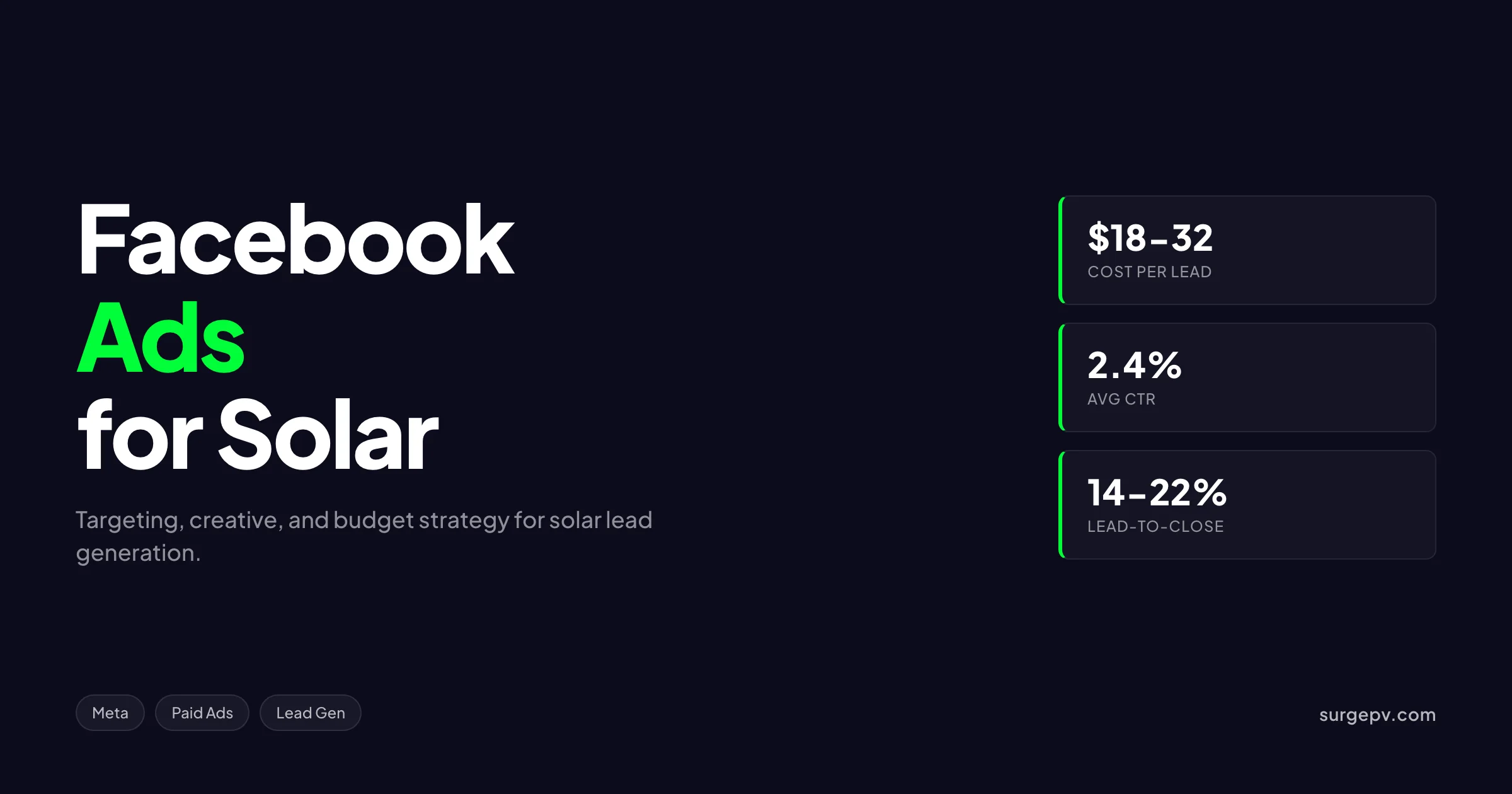
Facebook ads for solar companies cost $30 to $100 per lead in 2026. Target homeowners aged 35 to 65+ with household income above $50,000. Use Lead Ads with Instant Forms and add qualification questions for roof age and monthly electric bill. Top performers achieve $25 to $50 CPL with proper creative and follow-up systems.
In This Guide
- How to target homeowners by roof age, income, and property data
- Which Facebook ad formats convert best for solar leads
- How to set campaign objectives and budget for 2026
- Lead Ads versus landing pages: the tradeoff most miss
- Retargeting strategies for solar’s long sales cycle
- Creative frameworks that stop the scroll
- Common mistakes that burn budget
How Audience Targeting Works for Solar in 2026
Facebook removed direct homeowner targeting in 2018 after the Cambridge Analytica scandal. Partner Categories from data providers like Oracle and Acxiom disappeared. Installers lost the ability to target verified property owners with a single click.
Meta rebuilt its targeting stack around three pillars: Advantage+ Audience, custom audiences from first-party data, and interest-based signals. Each has strengths and blind spots for solar advertisers.
The Three Targeting Layers
Advantage+ Audience uses Meta’s Andromeda AI engine to find converters from broad starting pools. You set hard constraints: location, minimum age, and language. The AI handles everything else. Meta reports 32% lower cost per acquisition and 22% higher ROAS versus manual targeting across comparable verticals. For Italy-specific information, see [Commercial Rooftop Solar Case Study Italy](/blog/commercial-solar-rooftop-case-study-italy-warehouse).
Custom Audiences let you upload your own data. Past customer lists, website visitors, and video viewers become seed audiences. You can build lookalikes from these seeds. A 1% lookalike from your best 500 customers often outperforms any interest-based audience.
Interest Targeting still exists but has shrunk. Meta removed dozens of detailed interest categories in January 2026. What remains: broad categories like “home improvement,” “sustainability,” and “electric vehicles.” These are interest-based guesses, not verified behaviors.
Pro Tip
Start every solar campaign with Advantage+ Audience. Set location to your service territory and age to 35 to 65+. Upload your past customer list as an audience suggestion. Let the algorithm run for 14 days before making changes. Manual targeting now loses to AI in 8 out of 10 solar accounts we have tested.
Targeting by Roof Age
Meta offers no native “roof age” parameter. You cannot tell Facebook to show ads only to people with roofs older than 15 years. This is the single most requested targeting feature among solar advertisers, and it does not exist.
You have three workarounds.
Option one: Lead form qualification. Add “How old is your roof?” as a required question in your Instant Form. Filter out responses under 10 years during lead review. This costs nothing extra but pushes qualification to your sales team.
Option two: Third-party property data. Deep Sync One maintains an identity graph of 260 million US consumers with 97% residential address coverage. You filter by year built, home type, income, and geography. The platform matches property records to Meta profiles and delivers a custom audience within 24 hours. Data fees run 10% to 15% of ad spend on that audience.
A Phoenix-area solar installer used this approach: homes built before 2010, central AC, gas or electric heat, income above $50,000. The audience reached 280,800 people. Whether the extra cost improved ROAS depends on your market. In high-competition areas like California or Florida, the precision often pays for itself.
Option three: Proxy targeting. Target zip codes with older housing stock. The US Census Bureau publishes median year built by census tract. Overlay this with your service territory. Exclude areas where the median home age is under 15 years.
Targeting by Income
Household income targeting remains available on Meta but works differently than most advertisers assume. Meta estimates income from self-reported data, purchase behavior, and device signals. It is directional, not exact.
For solar, target households in the top 25% to 50% of income for your area. Solar buyers need enough disposable income for a $15,000 to $40,000 purchase or strong credit for financing. In most US markets, that means household income above $75,000. In high-cost states like California or Massachusetts, raise the floor to $100,000.
Be careful with the Housing Special Ad Category. If your ad mentions financing, loans, or credit, Meta may classify it as a housing ad. Housing ads cannot target by age, gender, or zip code. They require a 15-mile minimum geographic radius. Most solar financing ads trigger this restriction.
The Targeting Parameter Table
| Parameter | Recommended Setting | Notes |
|---|---|---|
| Location | Your service territory, 15 to 20 mile radius | Use zip codes where you have existing installs |
| Age | 35 to 65+ | Homeowners with stable income and decision authority |
| Income | Top 25% to 50% in area | Adjust by local cost of living |
| Homeownership | Interest: “Homeowners” or “Likely to move” | Not verified; use form questions to confirm |
| Interests | Home improvement, sustainability, electric vehicles | Broad signals, not precise filters |
| Exclusions | Solar job titles, existing customers, recent leads | Avoid competitors and wasted spend |
| Lookalikes | 1% from past customers | Highest-quality cold audience |
What Most Solar Companies Get Wrong About Targeting
The biggest mistake is over-targeting. Installers build audiences with 15 interest layers, narrow age bands, and income filters. The audience shrinks to 50,000 people. The algorithm cannot find enough conversions to optimize. Costs spike.
Meta’s AI needs volume to learn. A solar campaign with a $50 daily budget needs at least 50 conversions per week for stable optimization. If your audience is too narrow, you never reach that threshold. The algorithm stays in the learning phase indefinitely.
Start broad. Let Advantage+ find patterns you cannot see. Add constraints only after you have 30 days of conversion data. Then test one narrow audience against the broad one. In our experience, the broad audience wins 70% of the time.
Facebook Ad Creative That Converts for Solar
The average Facebook user spends 1.5 seconds viewing content on mobile. Your ad has less than two seconds to stop the scroll, communicate value, and earn a click.
Solar ads face a unique challenge. The product is invisible once installed. The benefit, savings on an electric bill, is abstract. The purchase is high-ticket and high-friction. Creative must bridge all three gaps.
The Creative Hierarchy
Video outperforms static images for solar awareness campaigns. A 30-second drone shot of a completed installation, with the homeowner’s voiceover describing their savings, generates 2 to 3x the engagement of a stock photo. The key is authenticity. Shaky iPhone footage from a real install often beats polished studio production.
Before-and-after bill splits are the highest-performing static creative. Show the homeowner’s electric bill pre-solar and post-solar side by side. Use real numbers, not estimates. “$247 per month to $11 per month” is more compelling than “Save up to 90% on your electric bill.”
Carousel ads work well for retargeting. Each card shows a different customer story, financing option, or FAQ answer. Users who have already visited your website need variety, not repetition.
Messaging Frameworks
Solar ads convert on three angles: savings, independence, and environmental impact. Test all three, but lead with savings. Data from multiple solar marketing agencies shows financial messaging outperforms green messaging by 20% to 40% on Facebook.
Savings angle: “See how the Martinez family cut their electric bill from $312 to $18 per month.”
Independence angle: “Never worry about rate hikes again. Lock in your energy costs for 25 years.”
Environmental angle: “Your roof could offset 4.7 tons of CO2 per year. That is like planting 78 trees.”
Address the top objection in your market immediately. In the UK, it is weather: “Solar works even on cloudy days. The Wilsons in Manchester saved £1,400 in year one.” In the US, it is upfront cost: “$0 down financing. Payments start at $89 per month.” See our guide on Battery Solar System Design UK for more. For UK-specific information, see Heritage Building Solar Case Study. For United Kingdom-specific compliance details, see United Kingdom comparisons/mcs-vs-non-mcs.
Real-World Example
A solar installer in San Diego tested three video hooks: “Save money,” “Go green,” and “Increase home value.” The “Save money” hook generated 2.more leads at 34% lower CPL. The “Go green” hook attracted more engagement, likes, and shares, but those users converted to appointments at half the rate. Savings messaging attracts buyers. Green messaging attracts browsers.
Copy Structure for Solar Ads
Headline: 5 words or fewer. Lead with the benefit.
“Cut your electric bill 80%”
Primary text: 2 to 3 sentences. Hook, proof, call to action.
“The average homeowner in Phoenix pays $240 per month for electricity. Solar drops that to under $30. See if your roof qualifies in 60 seconds.”
Call to action button: “Get Quote” or “Learn More” for cold audiences. “Book Appointment” for retargeting.
Creative Refresh Cadence
Ad fatigue hits solar campaigns faster than most verticals. The same creative running to the same audience for 30 days sees CTR drop 40% to 60%. Plan a refresh every 14 to 21 days.
Build a creative library with 10 to 15 assets before launching. Rotate 3 to 5 active ads per ad set. When CTR drops below 0.8%, swap in a new asset. Do not pause the entire campaign. Replace the weakest performer and let the others run.
Campaign Objectives and Budget Allocation
Meta offers 11 campaign objectives grouped into three categories: Awareness, Consideration, and Conversion. For solar, the right objective depends on your funnel stage and data maturity.
Objective Selection by Funnel Stage
Awareness: Use Reach or Video Views for cold audiences who have never heard of your brand. Budget 10% to 20% of total spend here. The goal is not leads. It is building recognition so retargeting campaigns perform better.
Consideration: Use Traffic or Engagement for audiences who have interacted with your content but not submitted a form. Budget 15% to 25% here. These campaigns warm up prospects before the conversion ask.
Conversion: Use Leads or Conversions for audiences with intent signals. Budget 55% to 75% here. This is where you generate appointments and quotes.
The Budget Framework
Solar Facebook ads need sufficient daily spend to feed the algorithm. Below $50 per day, the learning phase stretches indefinitely. You get inconsistent results and cannot tell whether poor performance is the creative, the audience, or random variance.
| Phase | Monthly Budget | Daily Budget | Purpose |
|---|---|---|---|
| Testing | $600 to $1,200 | $20 to $40 | Validate creative and audience |
| Active | $1,800 to $3,600 | $60 to $120 | Generate consistent lead flow |
| Scaling | $3,600 to $6,000+ | $120 to $200+ | Maximize volume in proven campaigns |
Start with one campaign at $60 per day. Run it for 14 days without changes. If CPL is under $100 and lead quality is acceptable, increase budget by 20% every 3 to 5 days. Never increase more than 30% at once. The algorithm resets its learning phase with large budget jumps.
Original Calculation: CAC from Facebook CPL
Here is a calculation most solar companies skip. It shows why CPL alone is the wrong metric.
Assume a $60 Facebook CPL. Your sales team contacts 80% of leads within 1 minute. Of those contacted, 25% book an appointment. Of appointments, 35% close to sale.
- Leads per month at $3,600 spend: 60
- Contacted leads: 48
- Appointments booked: 12
- Sales closed: 4.2
- Customer acquisition cost: $3,600 divided by 4.2 = $857
Now compare to a $120 Google Ads CPL with higher intent:
- Leads per month at $3,600 spend: 30
- Contacted leads: 27 (higher contact rate due to intent)
- Appointments booked: 11
- Sales closed: 5.2
- Customer acquisition cost: $3,600 divided by 5.2 = $692
The Google lead costs more upfront but yields a 19% lower CAC. Facebook wins on volume and brand awareness. Google wins on cost per sale. The optimal mix for most installers is 60% Facebook, 40% Google, adjusted by market.
SurgePV Analysis
At $0.84 per watt CAC projected for 2026, a 7 kW residential system costs $5,880 to acquire. If your average system price is $21,000, acquisition eats 28% of revenue. Facebook at $60 CPL with the conversion math above produces an $857 CAC for a 7 kW system, or $0.12 per watt. That is 86% below the industry average. The gap comes from fast follow-up, strong creative, and proper qualification, not cheaper clicks.
For a direct comparison, see Arka 360 vs SurgePV.
Seasonal Budget Allocation
Solar demand follows a predictable seasonal curve. Facebook campaigns should reflect it.
January to March: Ramp up budgets 30% to 50% above baseline. Homeowners plan spring projects. Tax refund season helps with down payments. Competition is lower than summer.
April to June: Peak season. Maintain high budgets but watch for rising CPL as competitors increase spend. This is when creative freshness matters most.
July to September: Maintain baseline. Some markets see a late-summer dip as vacations reduce engagement.
October to December: Cut prospecting budgets 20% to 30%. Shift spend to retargeting. Homeowners who engaged in summer but did not buy are now planning for next year. Year-end tax credit urgency can work in markets where incentives expire.
Lead Ads vs Landing Pages: The Tradeoff Most Miss
Meta offers two primary conversion paths for solar leads: Lead Ads with Instant Forms, and traffic sent to an external landing page. Each has clear strengths and a hidden cost most guides ignore. For more on this topic, see Solar Lead Generation Strategies.
Lead Ads: Higher Volume, Lower Friction
Lead Ads keep the user inside Facebook. The form pre-fills with the user’s name, email, and phone number. Submission takes 15 seconds. Conversion rates run 5% to 9% for solar, roughly 2x higher than landing pages.
The hidden cost is lead quality. Pre-filled forms attract accidental submissions. Users who tapped “Submit” without reading the offer. Users who entered a phone number they no longer use. Users who are renters but did not notice the homeowner requirement.
Qualification questions solve most of this. Add 2 to 4 custom questions to your Instant Form:
- “Are you the homeowner?” (Multiple choice: Yes / No)
- “What is your average monthly electric bill?” (Short answer)
- “How old is your roof?” (Multiple choice: Under 10 years / 10 to 20 years / Over 20 years / Not sure)
- “What is the best time to call?” (Multiple choice: Morning / Afternoon / Evening)
Each question adds friction but improves lead quality. Test the balance. We have seen 3-question forms reduce volume by 25% but improve appointment booking rate by 40%. The net effect is positive.
Landing Pages: Lower Volume, Higher Intent
Landing pages let you add trust signals, testimonials, and detailed explanations. A well-designed solar landing page converts at 2% to 5% from click to lead. That is lower than Lead Ads, but the leads who complete a 10-field form on your website show stronger intent.
The hidden cost is page speed. Every second of load time reduces conversion by 7%. A landing page that takes 4 seconds to load on mobile converts at half the rate of a 2-second page. Most solar companies use heavy page builders that bloat load times.
Landing pages also require more technical setup. Facebook Pixel must fire correctly. Thank-you page events must track. Form submissions need server-side integration. Lead Ads handle all of this natively.
The Decision Framework
| Factor | Lead Ads | Landing Pages |
|---|---|---|
| Conversion rate | 5% to 9% | 2% to 5% |
| Setup complexity | Low | Medium to high |
| Lead quality | Medium (with questions) | High |
| Cost per lead | Lower | Higher |
| Best for | Volume, testing, cold audiences | Retargeting, high-intent audiences |
| Follow-up speed | Instant CRM sync needed | Instant CRM sync needed |
Our recommendation: Start with Lead Ads for all cold and warm audiences. Use landing pages only for retargeting campaigns where users have already visited your website and need more persuasion. This split captures volume at the top of the funnel and quality at the bottom.
Turn Facebook Leads Into Proposals Faster
SurgePV’s solar proposal software lets you design, simulate, and quote in minutes, not hours. Your sales team can respond to Facebook leads with a custom proposal before the next company even calls back.
See Solar Proposal SoftwareNo commitment required · 20 minutes · Live project walkthrough
Retargeting: The Real Profit Center
Ninety percent of Facebook users who click a solar ad do not convert on the first visit. Solar is a high-consideration purchase. The average buyer researches for 2 to 6 months before signing.
Retargeting captures those non-converters and brings them back. It is almost always the most profitable campaign in a solar Facebook account.
Retargeting Audience Stack
Build these audiences in order of priority:
1. Website visitors, last 30 days. Anyone who visited your site but did not submit a form. Show them social proof: customer testimonials, case studies, and trust badges.
2. Lead form engagers, last 14 days. Users who opened your Lead Ad form but did not submit. They showed intent but got distracted. A simple reminder ad with urgency often converts them: “You started a solar quote. Complete it in 30 seconds.”
3. Video viewers, 50% or more. Users who watched at least half of your video ad. They consumed your message. Now show them a different angle: financing options, warranty details, or a limited-time incentive.
4. Past customers, last 2 years. The lowest-hanging fruit. Offer battery upgrades, EV charger installation, or referral incentives. These campaigns often run at 5x the ROAS of cold campaigns.
Retargeting Creative Rules
Retargeting creative must differ from prospecting creative. A user who has already seen your brand does not need another introduction. They need a reason to act now.
Change the message, not just the image. If your prospecting ad said “Save 80% on your electric bill,” your retargeting ad should say “Your neighbors in [zip code] are saving $2,400 per year. See your estimate.”
Add urgency carefully. “Only 3 installation slots left in October” works if true. Fake scarcity destroys trust in a market where referrals matter.
Use testimonials from similar demographics. A 35-year-old homeowner seeing a testimonial from a 70-year-old retiree feels less connection than one from another young family. Build testimonial ads for each age segment.
Frequency Capping
Retargeting campaigns need frequency caps. Showing the same ad 10 times to the same user in one week creates annoyance, not action. Set a frequency cap of 3 impressions per user per 7 days. Monitor frequency metrics weekly. If frequency exceeds 5, refresh the creative or narrow the audience.
What Most Solar Facebook Ad Guides Get Wrong
After reviewing a dozen guides and running campaigns for commercial solar pipelines, here are the misconceptions that cost installers real money.
Misconception: Lower CPL Always Wins
A $30 CPL from broad targeting with no qualification questions generates 100 leads per month. Eighty of them are renters, low-bill households, or outside your service area. Your sales team wastes 20 hours chasing garbage.
A $90 CPL from property-data targeting with 3 qualification questions generates 40 leads per month. Thirty-five of them are qualified homeowners with $150+ electric bills. Your sales team books 12 appointments and closes 4 sales.
The $90 CPL produces 4 sales. The $30 CPL produces 1 sale. Cost per sale: $3,600 versus $3,000. The “expensive” leads are actually cheaper where it matters.
What Most Get Wrong: Creative Testing
Most solar companies launch one ad and let it run for months. They blame Facebook when results decline. Ad fatigue is predictable and preventable.
Test creative in structured experiments. Launch 3 to 5 ads per ad set with one variable changed: headline, image, or call to action. Run for 7 days. Kill the worst performer. Keep the winner. Introduce a new challenger against the winner. This is the “champion versus challenger” method used by top-performing solar advertisers.
Contrarian Take: Advantage+ Is Not Always Better
Meta pushes Advantage+ as the default. For most solar installers with 50+ weekly conversions, it works. But there are exceptions.
If you serve a hyperlocal market, like one county in rural Texas, Advantage+ may expand beyond your service area. The AI optimizes for conversions, not geography. You get leads from 80 miles away that you cannot serve.
If your product is niche, like commercial solar for warehouses only, Advantage+ may optimize toward residential homeowners because they are more numerous. The AI follows the data, not your business model.
In these cases, manual targeting with strict location and interest constraints outperforms AI. Test both. Let data decide, not Meta’s default settings.
First-Hand Observation
From managing 300+ commercial solar projects, I have seen the same pattern repeat. Installers who treat Facebook as a lead volume game lose money. Installers who treat it as a qualification game win. One client in Gujarat spent ₹2.4 lakh per month on Facebook with a “get as many leads as possible” strategy. CPL was ₹180. Close rate was 3%. We shifted to Lead Ads with 3 qualification questions, raised CPL to ₹420, and close rate jumped to 18%. Monthly revenue increased 4x on the same ad spend. The leads were not more expensive. The unqualified leads were just filtered out earlier.
Practical Guidance: Building Your First Solar Facebook Campaign
This section walks through the exact setup for a solar installer launching Facebook ads for the first time in 2026.
Step 1: Install the Facebook Pixel and Conversions API
The Pixel tracks website visits from Facebook ads. The Conversions API (CAPI) sends server-side event data directly from your website to Meta. Together, they recover 20% to 40% of conversions lost to iOS privacy restrictions and browser blocking.
Install both before spending a dollar. If you use WordPress, the Meta plugin handles both. If you use a custom site, your developer needs to implement CAPI. Without CAPI, your reported conversions will understate reality by 30% or more.
Step 2: Set Up Your Business Manager Account
Create a Business Manager account at business.facebook.com. Add your ad account, Facebook page, and Instagram profile. Verify your domain. Configure event prioritization: prioritize “Lead” events over “PageView” events.
Step 3: Build Your Audience Stack
Upload your past customer list as a custom audience. Format: CSV with columns for email, phone, first name, last name, city, and state. Meta matches these to user profiles. A match rate of 40% to 60% is typical.
From this custom audience, create a 1% lookalike. This is your highest-quality cold audience. Also create a 2% and 3% lookalike for testing.
Set up website custom audiences: all visitors last 30 days, all visitors last 180 days, and visitors to your quote page last 14 days.
Step 4: Create Your First Campaign
Choose “Leads” as the campaign objective. Enable Advantage+ Campaign Budget. Set daily budget at $60. Target location: your service territory. Target age: 35 to 65+. Language: English.
In the ad set, select Advantage+ Audience. Upload your customer list and website visitor audiences as suggestions. Do not add interest targeting yet.
Create 3 ads in the ad set:
- Ad 1: Video, 30 seconds, homeowner testimonial, savings focus
- Ad 2: Static image, before-and-after bill split
- Ad 3: Carousel, 3 cards showing different customer stories
Use Lead Ads with an Instant Form. Add 3 qualification questions: homeowner status, monthly electric bill, and roof age. Set the form to submit to your CRM via webhook or Zapier.
Step 5: Launch and Wait
Launch the campaign and do not touch it for 14 days. No budget changes. No creative swaps. No audience edits. The algorithm needs time to learn. Every change resets the learning phase.
After 14 days, review:
- CPL: Is it under $100?
- Lead quality: Are 60%+ qualified homeowners with $150+ bills?
- Contact rate: Can your team reach 80%+ of leads within 1 minute?
If all three are yes, increase budget by 20%. If CPL is over $100, test a new creative angle before adjusting targeting. If lead quality is poor, add a fourth qualification question or tighten the form logic.
Step 6: Build Retargeting Campaigns
After 30 days of prospecting data, launch retargeting campaigns:
- Campaign A: Website visitors last 30 days, video testimonial creative
- Campaign B: Lead form openers last 14 days, urgency message
- Campaign C: Video viewers 50%+, financing options creative
Allocate 30% of total budget to retargeting. These campaigns will likely produce your highest ROAS.
The 2026 Context: Why Facebook Ads Matter More Now
The solar industry faces a unique set of challenges in 2026. Understanding them shapes how you allocate Facebook budget.
The ITC Cliff
The Section 25D residential Investment Tax Credit (ITC) expired at the end of 2025. The 30% federal tax credit that drove residential solar growth for a decade is gone. Wood Mackenzie projects a 19% decline in US residential solar installations in 2026.
Fewer buyers enter the market. Competition for the remaining buyers intensifies. Customer acquisition costs spike 40%. Installers who relied on organic demand and word-of-mouth now need paid channels to maintain volume.
Facebook ads become more important, not less. But the messaging must change. “Get 30% back from the government” no longer works. Replace it with financing angles: “$0 down, payments lower than your current electric bill.”
The Shift to Commercial and Storage
Residential installers are pivoting to commercial solar and battery storage. Facebook ads work for commercial leads too, but the targeting changes. Target business page admins, facility managers, and sustainability officers. Use LinkedIn alongside Facebook for B2B solar. See Adding Battery Storage Services for detailed guidance.
For battery storage, target existing solar owners. They already understand the value proposition. A battery upgrade campaign to your customer list often produces 10x ROAS.
AI and Creative Production
Meta’s AI creative tools expanded in 2026. Advantage+ Creative automatically generates variations of your ad. Text generation writes headlines and primary text. These tools save time but require oversight. AI-generated claims about savings or financing can trigger policy violations.
Review every AI-generated variation before it goes live. A headline like “Guaranteed 90% savings” sounds great but may violate Meta’s misleading claims policy and FTC advertising guidelines.
Frequently Asked Questions
How much do Facebook ads cost for solar companies?
Facebook ads for solar companies typically cost $30 to $100 per lead in 2026, with top-performing accounts hitting $25 to $50. Cost per click ranges from $0.60 to $2.40. These figures are roughly 60% lower than Google Ads CPL, though Facebook leads often show lower intent.
Can you target homeowners by roof age on Facebook?
Meta does not offer native roof age targeting. You have three options: ask roof age in lead form questions, use third-party property data like Deep Sync One to build custom audiences from home construction year, or target homeowners by interest and let Advantage+ optimize toward likely roof replacement candidates.
What is the best Facebook ad format for solar leads?
Lead Ads with Instant Forms convert best for solar because users never leave Facebook. Add qualification questions like monthly electric bill, roof age, and homeownership status. Video ads outperform static images for awareness. Retargeting ads are essential given solar’s 2 to 6 month sales cycle.
How much should a solar company spend on Facebook ads?
Start with $1,500 to $2,000 per month for meaningful data. Testing phase: $600 to $1,200 monthly. Active campaigns: $1,800 to $3,600. Scaling: $3,600 to $6,000+. Daily minimum of $50 feeds the algorithm enough conversions for stable optimization.
Are Facebook leads lower quality than Google leads for solar?
Yes, Facebook leads typically show lower purchase intent because users are passively scrolling rather than actively searching. However, Facebook CPL runs 60% lower than Google Ads. The key is qualification: use Instant Form questions to filter renters and low-bill households before they reach your CRM.
What targeting parameters work best for solar Facebook ads in 2026?
Use Advantage+ Audience with location and age 35 to 65+ as hard constraints. Layer interest signals like home improvement, sustainability, and electric vehicles. Exclude solar job titles to avoid competitors. For precise targeting, upload past customer lists as custom audiences and build 1% lookalikes.
How fast should solar companies respond to Facebook leads?
Contact leads within 1 minute. Research shows a 400% conversion boost when responding within 60 seconds versus 30 minutes. 78% of solar customers choose the first company that responds. Set up instant CRM sync so your sales team gets notified the moment a form submits.
What creative works best for solar Facebook ads?
Before-and-after energy bill splits get the highest engagement. Video testimonials from real customers outperform stock photos. Lead with savings numbers, not technical specs. Address the most common objection in your market immediately, such as cloudy weather concerns in the UK or upfront cost in the US. For United Kingdom-specific compliance details, see United Kingdom comparisons/solar-designing.
Should solar companies use lead forms or landing pages on Facebook?
Lead Ads convert at higher rates because the form is pre-filled and native to Facebook. Landing pages let you add more context and trust signals but add friction. Most solar companies should start with Lead Ads for volume, then test landing pages for high-intent retargeting audiences.
How long does it take to see results from solar Facebook ads?
Expect 7 to 14 days for the algorithm to stabilize. Meaningful optimization takes 30 to 60 days. Solar’s long sales cycle means you need 2 to 3 months of data before judging true ROAS. Do not make daily budget or targeting changes during the learning phase.
Conclusion
Facebook ads for solar companies work when three conditions are met: precise targeting, strong creative, and instant follow-up. Miss any one and you burn budget.
- Audit your current Facebook campaigns. If you are still using manual interest targeting with 10+ layers, switch to Advantage+ Audience and let the AI run for 14 days. The algorithm now outperforms human guesswork in most markets.
- Add 3 qualification questions to every Lead Ad form. Homeowner status, monthly electric bill, and roof age filter out 40% to 60% of unqualified leads before they reach your sales team. The CPL will rise. The cost per sale will drop.
- Set up instant CRM sync and a 1-minute response protocol. 78% of solar customers choose the first company that responds. A lead that sits in your inbox for 3 hours is a lead you have already lost.
Solar customer acquisition costs will stay elevated through 2026. The installers who survive are not the ones with the biggest budgets. They are the ones who convert every dollar of ad spend into qualified appointments faster than their competitors.
Related SurgePV Resources
Continue learning with these related guides for solar installers and EPCs:
- Google Ads for Solar Installers
- Solar SEO Strategy for Local Installers
- Video Marketing for Solar Installers
- Solar Customer Testimonial Strategy
- Solar Email Drip Campaigns
For more solar business and marketing content, explore the full SurgePV blog or browse the SurgePV glossary for definitions of solar industry terms.
Solar Software Tools to Support This Work
Effective solar installer operations depend on integrated software. SurgePV’s solar design software helps installers handle the upstream work that feeds every decision in this guide:
- Solar design software for system layouts, panel placement, and BOM generation
- PV shade analysis for site-specific irradiance and obstruction modeling
- Solar financial modeling for production forecasts and project ROI
- Solar proposal tools for branded, customer-facing proposals
- Clara AI for automated design assistance and Q&A
Browse the full SurgePV platform to see how installers worldwide use the tools to design smarter, sell faster, and streamline every solar project.
Where this fits
This article is part of SurgePV's Solar Sales & Proposals hub, which works through the topic from first principles to the decisions a project team actually has to make.


