

Quick Answer
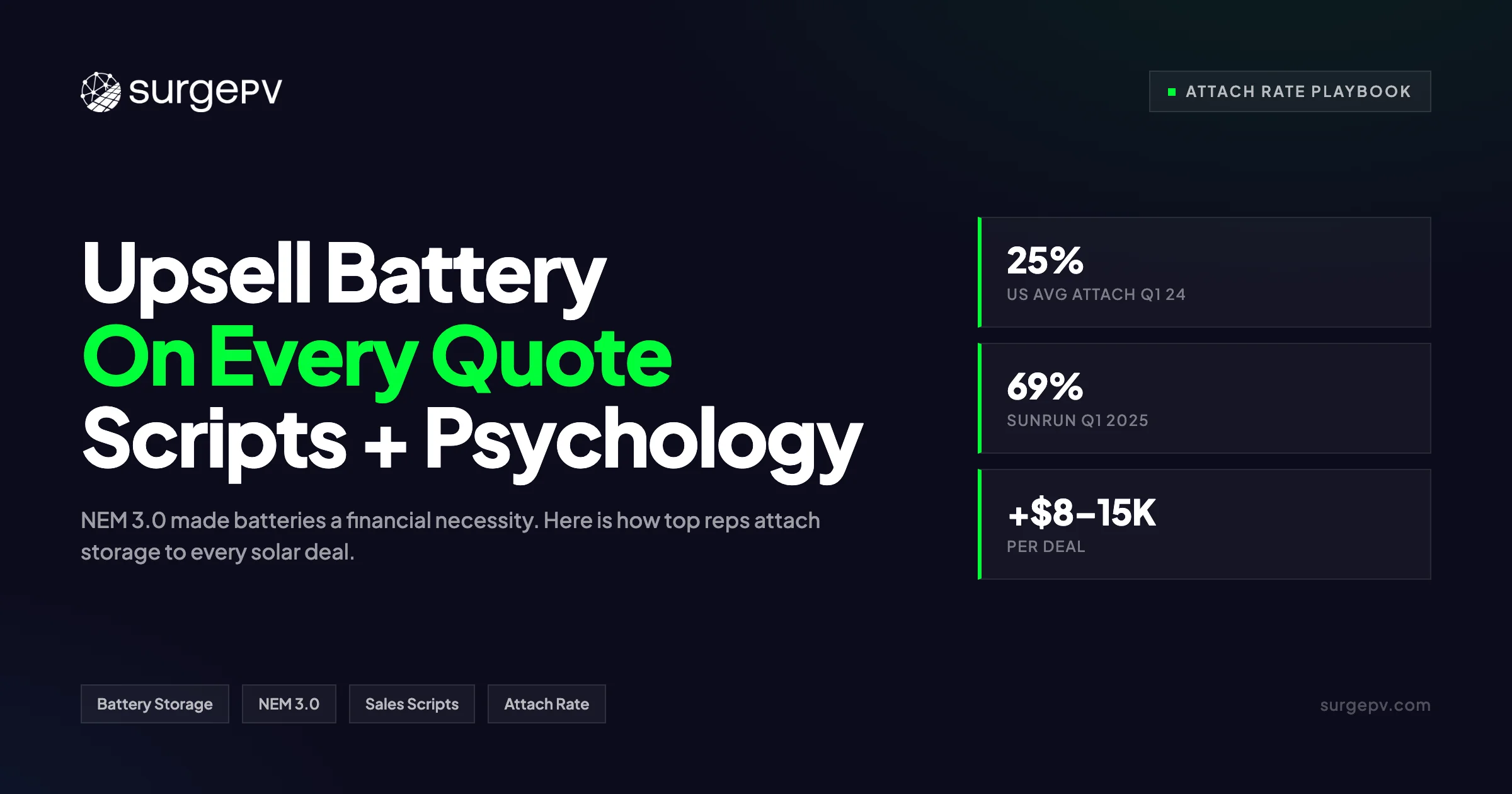
Wood Mackenzie and SEIA data show US residential storage attachment rates quadrupled from 6% in Q1 2020 to 25% in Q1 2024 (Wood Mackenzie/SEIA, 2024). Wood Mackenzie and SEIA data show US residential storage attachment rates quadrupled from 6% in Q1 2020 to 25% in Q1 2024 (Wood Mackenzie/SEIA, 2024).
Battery storage used to be an afterthought. Reps would tack it onto the final line of a proposal. Then they would hope the homeowner asked questions. That era is over. For more on this topic, see Adding Battery Storage Services.
Wood Mackenzie and SEIA data show US residential storage attachment rates quadrupled from 6% in Q1 2020 to 25% in Q1 2024 (Wood Mackenzie/SEIA, 2024). Wood Mackenzie and SEIA data show US residential storage attachment rates quadrupled from 6% in Q1 2020 to 25% in Q1 2024 (Wood Mackenzie/SEIA, 2024).
Wood Mackenzie and SEIA data show US residential storage attachment rates quadrupled from 6% in Q1 2020 to 25% in Q1 2024 (Wood Mackenzie/SEIA, 2024). Sunrun now attaches batteries to 69% of new systems (Sunrun, 2025). The gap between top performers and everyone else is not product knowledge. It is process.
This guide gives you that process. You will learn how to qualify homeowners for battery fit. You will get rebuttals for the six objections that kill most deals. You will see how to present a side-by-side proposal that closes visually. And you will build a follow-up cadence that rescues maybes. Every tactic is field-tested. Every number is sourced.
TL;DR — How to Upsell Battery Storage
US battery attachment rates quadrupled to 25% since 2020. Top installers hit 69%. The fastest way to close battery upsells is to qualify early, present a side-by-side bill comparison, and follow up within 5 minutes with a 5-touch cadence.
See our guide on Agricultural Solar Case Study for more. For the latest details on France, see Floating Solar Farms France.
In this guide:
- Why battery attachment rate is your most important KPI
- How to qualify homeowners for battery fit before you pitch
- The six most common objections and exact rebuttal scripts
- Proposal psychology: presenting solar-only vs solar-plus-storage
- The 5-touch follow-up cadence for battery-softened leads
- Sales manager playbook: commissions, KPIs and team training
- Market-specific closes for NEM 3.0, UK SEG and flat-rate regions See our guide on Battery Solar System Design UK for more. For United Kingdom-specific compliance details, see United Kingdom comparisons/mcs-vs-non-mcs.
Why Battery Storage Attachment Rate Is Your Most Important KPI
Battery attachment rate is the percentage of solar quotes that include energy storage. The US average reached 25% in Q1 2024. Top performers now exceed 60%. For sales managers, this single metric predicts revenue per install, rep profitability, and long-term customer value better than any other KPI. Track it daily to spot training gaps and revenue leaks.
Wood Mackenzie and SEIA data show US residential storage attachment rates quadrupled from 6% in Q1 2020 to 25% in Q1 2024 (Wood Mackenzie/SEIA, 2024). The national average stayed above 25% through most of 2024.
EnergySage reports quoted storage prices hit a record low of $1,133 per kWh in the first half of 2024 (EnergySage, 2024). Storage has never been cheaper for installers to source. Yet many reps still treat it as a luxury add-on. That mindset costs money.
SEIA and Wood Mackenzie expect 28% of all new distributed solar capacity will be paired with storage by 2028. That is up from under 12% in 2023 (SEIA/Wood Mackenzie, 2024). Homeowners are asking for batteries more often. The only question is whether your team is ready to answer.
Sunrun grew storage customer additions by 46% year-over-year in Q1 2025 (Sunrun, 2025). Over 20,000 of their customers now participate in 16 virtual power plant programs. Batteries are not a niche product. They are becoming the default.
Sales managers should track attachment rate daily. Reps should know their personal number by heart. A rep who closes 15 deals per month at a $20,000 average system size adds $3,000–4,500 in revenue per battery attachment. Multiply that across a 10-person team. The math is simple.
The best solar software platforms now include battery sizing and financial modeling as standard. If your design tool still forces you to export to a spreadsheet to model battery payback, you are already slower than competitors. Read Solar Battery Sizing Guide for a complete walkthrough.
How to Qualify Homeowners for Battery Storage Before the Pitch
The best battery upsells happen before you mention the word “battery.” Check three signals on every lead. Look for time-of-use rate differentials above $0.20 or 15p per kWh. Check outage history in the last 12 months. Ask about plans to buy an EV or heat pump in the next 24 months. These factors predict battery value with high accuracy.
Elevation Energy runs a home energy audit before every solar pitch. They save 10–20% on consumption immediately. Then they deploy those savings toward an upgraded solar-plus-storage system. The audit builds trust before the upsell begins.
Signal 1: Rate structure. Pull the homeowner’s last 12 months of utility bills. Look for time-of-use plans, demand charges, or export tariffs. In California, SCE peak rates hit $0.58–0.74 per kWh in summer evenings (Solar.com, 2025). Off-peak rates sit at about $0.24 per kWh. That 142–208% differential is pure battery profit.
In the UK, Octopus Intelligent Flux pays 32.17p per kWh for peak export between 4 PM and 7 PM. Octopus Flux pays 29.32p per kWh at the same window (Sunsave, 2026). A battery that stores cheap midday solar and exports at peak earns real money.
Signal 2: Outage history. Ask directly: “How many power cuts did you have last year?” Even one outage opens the door to backup security. Most homeowners have never calculated the cost of a freezer full of spoiled food or a day of lost remote work.
Signal 3: Electrification plans. EVs and heat pumps double household consumption. A battery future-proofs the home. Frame it as infrastructure, not an accessory. “You are buying an electric car in 18 months. The battery makes sure you are not pulling peak-rate power to charge it.”
Use your solar design tools to model these three scenarios visually. Show the battery filling from solar at noon. Show it discharging to the EV at 6 PM. Homeowners understand pictures faster than spreadsheets.
The 6 Most Common Battery Storage Objections and Exact Rebuttal Scripts
Homeowners reject batteries for six predictable reasons. Price. Payback period. Backup expectations. Spousal approval. Existing net metering. And hesitation. Each objection has a specific rebuttal rooted in financial math or visual comparison. Generic reassurance does not work. Specific numbers and side-by-side bill comparisons win deals. Also see: Us Residential Solar Market Trends 2026.
Financial framing works better than environmental pitches. Specific dollar amounts build more trust than vague promises. Your rebuttals should lead with dollars, not feelings.
“The battery is too expensive.”
Rebuttal: Shift from total cost to monthly payment comparison.
“Adding this battery raises your monthly payment by $47. Last year your utility raised rates by $80 per month. You are already paying for a battery. You just don’t own it.”
If they are cash buyers, break the number into chunks. “This battery costs $12,000. It saves $2,200 per year. Over 10 years that is $22,000 in savings. You are buying $22,000 for $12,000.”
“The payback is too long.”
Rebuttal: Reframe payback as protection against rate hikes.
“Solar-only payback under NEM 3.0 is about 11 years. Solar-plus-storage is 10–12 years. But the battery saves $2,200–2,600 per year versus $1,528 for solar alone. You hit breakeven at roughly the same time. After that, the battery earns an extra $700–1,000 per year.”
Add the SGIP rebate if they are in California. “The state pays a rebate that varies by battery size and program step. A typical 10 kWh battery currently qualifies for about $1,500–$2,000 under standard SGIP rates as of early 2025. That cuts your payback by months.”
“I want 100% whole-home backup.”
Rebuttal: Start with their ask. Then show sticker shock. Offer tiered options.
“Whole-home backup for 2–3 days requires three batteries. That is $30,000. Most homeowners choose our Essential Circuits package. It keeps your fridge, lights, Wi-Fi and one HVAC zone running for 8–12 hours. The cost is one battery, not three.”
Let them self-select down. People who ask for 100% backup usually want certainty, not capacity. Give them certainty with a smaller price tag.
“I need to talk to my spouse.”
Rebuttal: Get finance approval first. Create a second appointment.
“Let’s make sure you qualify for the 0% plan. Then I will call back tomorrow evening when you are both home. I will bring a side-by-side comparison printed out so you can decide together in 10 minutes.”
Never leave without a scheduled follow-up. A “maybe” without a calendar invite is a “no.”
“I already have net metering. I don’t need a battery.”
Rebuttal: Show the rate gap.
“Under NEM 3.0 you sell excess power for 4–8 cents per kWh. You buy it back at 30–55 cents. You are selling low and buying high. A battery stores that midday power so you use it at night. Self-consumption jumps from 25–40% to 60–90%.”
For flat-rate regions, pivot to resilience and future-proofing. “Net metering helps today. But utilities change rates. A battery protects you no matter what they do next year.”
“I just want to think about it.”
Rebuttal: Isolate the objection.
“Is it the battery, the company, or the price?” Address the specific issue. If it is the battery, offer a tiered option. If it is the price, show financing. If it is the company, share a local reference. Local references build trust. Neighbor references lower resistance.
Powow in Australia found product and ROI strategies “rarely work” for batteries (Powow, 2023). Payment plans work better. Spread savings over the full battery life. Layer benefits: control over costs, affordable power day and night, blackout protection, and a future all-electric home. For Australia-specific compliance details, see Australia comparisons/lgc-vs-stc.
Proposal Psychology: Presenting Solar-Only vs Solar-Plus-Storage
Homeowners understand visual comparisons faster than text-heavy explanations. A proposal that shows “2 days of backup” converts better than one listing “13.5 kWh capacity.” Side-by-side bill comparisons with specific dollar amounts help homeowners see the value immediately. Use real numbers from their actual bills. Generic examples feel like marketing. Real numbers feel like truth.
The proposal is not paperwork. It is the close itself.
Start with a single page showing three columns. Solar only. Solar plus storage. Current utility bill. Use exact numbers from their actual bills.
| Bill Component | Current Utility | Solar Only | Solar + Storage |
|---|---|---|---|
| Annual electricity cost | $2,840 | $1,312 | $612 |
| Export credits earned | $0 | $420 | $180 |
| Net annual energy cost | $2,840 | $892 | $432 |
| 25-year total cost | $71,000 | $22,300 | $10,800 |
| System + battery cost | $0 | $18,500 | $28,500 |
| Net 25-year savings | $0 | $48,700 | $60,200 |
Notice the framing. Solar-plus-storage shows higher upfront cost. But the 25-year savings are $11,500 higher than solar alone. The battery pays for itself and adds profit.
Use your customer-ready solar proposals to generate this table automatically. SurgePV’s proposal builder pulls live utility rates and TOU differentials. The numbers update in real time. For a direct comparison, see Arka 360 vs SurgePV.
Never lead with kWh or kW. Lead with hours of backup and dollars saved. “This keeps your essentials running for 14 hours during an outage. It saves you $460 per year by avoiding peak rates.”
Video proposals often convert better than static PDFs. Record a 90-second walkthrough of the side-by-side comparison. Send it within 30 minutes of the meeting.
Stop losing battery upsells to slow quotes
SurgePV lets you add a battery, rerun the financial model, and generate a client-ready proposal in a few minutes.
Book a DemoNo commitment required · 20 minutes · Live project walkthrough
The 5-Touch Follow-Up Cadence for Battery-Softened Leads
Most sales need several follow-up touches over 10–14 days. A structured 5-touch cadence recovers leads that would otherwise go cold. Responding within five minutes makes you 21 times more likely to qualify the prospect than waiting 30 minutes (InsideSales.com, 2007). Speed on the first contact matters more than perfect scripting.
First responders win most deals. Speed is not optional. It is the whole game.
Touch 1 — Same-day text (0–2 hours): Send the side-by-side bill comparison as a mobile-friendly image. “Hi [Name], here is the comparison we discussed. The battery saves $460 per year by avoiding peak rates. Let me know if you have questions.”
Touch 2 — Call within 24 hours: Address the specific objection they raised. Do not ask “Did you think about it?” Ask “Does the 14-hour backup cover the circuits you care about most?”
Touch 3 — Email with updated data (Day 3): “Your utility just filed a rate increase request. If it passes, the battery savings jump to $580 per year. Here is the updated comparison.” Use your energy and financial modeling tool to rerun the model in seconds.
Touch 4 — Voice note (Day 7): Record a 45-second message. Mention their specific concern. “Hi [Name], I was thinking about your question on payback. I ran the numbers with the new SGIP rebate. Your payback drops to 8.5 years. Here is the link.”
Touch 5 — Final call with time-bound incentive (Day 10–14): “We have one install slot left in March. If we book this week, I can lock in the current battery price. After Friday, the supplier is raising prices by 8%.”
Many customers say no several times before they say yes. Most salespeople give up too early. The fifth touch is where many deals close.
Sales Manager Playbook: Commission Structures, KPIs and Team Training
Reps earn 3–10% commission on total system value. A battery adds $8,000–15,000 per deal. At 5% commission, that is an extra $400–750 per sale. Tiered accelerators tie higher rates to attach-rate thresholds. Weekly role-play drills and daily KPI dashboards drive team behavior without micromanagement.
Commission math example:
A rep sells 12 deals per month at $20,000 average system size with no batteries. Commission at 5% = $1,000 per deal. Monthly total = $12,000.
Add a $10,000 battery to 6 of those 12 deals. System value rises to $30,000. Commission at 5% = $1,500 per battery deal. Monthly total = $18,000. The rep earns $6,000 more per month. The company earns $60,000 more in revenue.
Tiered accelerator example:
- 0–30% attach rate: 5% commission
- 31–50% attach rate: 6% commission
- 51%+ attach rate: 7% commission
A rep at 6% who sells a $30,000 system earns $1,800. At 5% they earn $1,500. The $300 gap is small. But the psychological pull of the next tier is huge.
Training drills:
Run weekly role-play sessions. Pair reps. One plays the homeowner with a specific objection. The other has 90 seconds to rebut. Rotate objections every week. Record the sessions. Reps who hear themselves fumble improve faster than those who read scripts alone.
Use Clara AI to prep reps before appointments. Clara can analyze 12 months of utility bills and flag high-fit customers. High TOU differential. Frequent outages. EV ownership. Reps walk in knowing which angle to lead with.
KPIs to track on a dashboard:
- Battery attach rate (team and individual)
- Average deal value with and without storage
- Time from battery mention to signed proposal
- Follow-up completion rate for battery-softened leads
- Objection-to-close rate by objection type
Review these numbers in a 15-minute weekly huddle. No 60-minute meetings. Just the numbers, one coaching point per rep, and a group drill.
Market-Specific Battery Closes for NEM 3.0, UK SEG and Flat-Rate Regions
California NEM 3.0 turned batteries into an arbitrage play by cutting export credits roughly 75% (Palmetto, 2024). UK time-of-use tariffs like Octopus Flux pay up to 32.17p per kWh for peak exports. In flat-rate regions, sell resilience and future-proofing instead of rate arbitrage. Match your close to the local rate structure.
Midday exports now earn $0.04–0.08 per kWh. Peak imports cost $0.58–0.74 per kWh. A battery shifts self-consumption from 25–40% to 60–90%. This is not a backup story. It is an arbitrage story.
California close: “You are selling energy for 6 cents and buying it back for 40 cents. The battery stops that. It stores your midday solar and feeds it back during peak hours. You keep the 34-cent spread.”
Add the SGIP rebate. “California pays a storage rebate that varies by battery size and program step. A typical 10 kWh battery currently qualifies for about $1,500–$2,000 under standard rates as of early 2025. The rebate pool shrinks every quarter.”
UK close: “Octopus Intelligent Flux pays 32.17p per kWh for exports between 4 PM and 7 PM. Your solar generates at 2 PM. Without a battery, you export at the midday rate. With a battery, you store that power and sell it at peak. Time-of-use tariffs add £150–300 per year in savings beyond self-consumption.”
Use your shadow analysis tool to show exact generation windows. A battery sized to actual output — not theoretical maximum — builds trust. Oversized batteries look like upsells. Right-sized batteries look like advice.
Flat-rate region close: In areas with simple net metering and flat rates, arbitrage math is weak. Sell resilience and future-proofing instead. “Your utility can change net metering rules. They have done it in 12 states in the last 3 years. A battery protects you from every future rate change.”
Add the electrification angle. “You will buy an EV in the next 3 years. Charging it from solar-plus-storage costs half what you would pay at a public charger. The battery turns your garage into a fuel station.”
Sunrun uses a storage-first strategy. They lead with Brightbox batteries and attach solar. Their retail partnerships and direct-to-consumer model now drive 65% of inquiries online. The future of solar sales is battery-first, not battery-last.
Conclusion
Battery upsells are won in the qualification and proposal phase. Run a three-signal qualification on every lead. Rebut objections with specific dollar amounts. Present side-by-side proposals. Build a 5-touch follow-up cadence. Train one rep this week. Track their attach rate for 30 days. Then roll it out to the whole team.
Battery upsells are won in the first 4 minutes of conversation. Not at the kitchen table. Not in the follow-up. In the design and proposal phase.
- Run a 3-signal qualification on every lead: rate structure, outage history, electrification plans
- Rebut objections with specific dollar amounts, not generic benefits
- Present side-by-side proposals that show 25-year savings, not just monthly payments
- Build a 5-touch follow-up cadence and enforce it through your CRM
Pick one rep this week. Train them on the six rebuttals. Track their attach rate for 30 days. Then roll it out to the whole team.
Frequently Asked Questions
These six FAQs cover the core questions sales reps and managers ask about battery upsells. Topics include how to qualify homeowners, what attachment rate to aim for, how NEM 3.0 affects battery economics, commission structures, and the best follow-up cadence. The answers mirror the detailed guidance in the body of this article.
How do I sell battery storage to homeowners?
Start with utility bill analysis. Show the exact dollar impact of time-of-use rates or export cuts. Use a side-by-side proposal comparing solar-only and solar-plus-storage. Lead with financial framing. It works better than environmental pitches. Then handle objections with specific data, not generic benefits.
What is a good battery storage attachment rate?
The US residential average was 25% in Q1 2024, up from 6% in Q1 2020. Top performers like Sunrun hit 69% in Q1 2025. If your team is below 25%, there is room to improve through better qualification, proposal psychology and follow-up cadence.
Does NEM 3.0 make battery storage mandatory?
No, but it makes batteries financially sensible. NEM 3.0 cut export credits by roughly 75%. Midday exports now earn $0.04–0.08/kWh while peak imports cost $0.58–0.74/kWh. A battery shifts self-consumption from 25–40% to 60–90%, protecting homeowners from that rate gap.
How much commission do solar sales reps make on batteries?
Typical solar commission is 3–10% of system cost. A battery adds $8,000–15,000 to the deal. At 5% commission, that is an extra $400–750 per sale. Many installers now use tiered accelerators where battery attach rate unlocks higher commission brackets.
What is the best follow-up cadence for battery storage leads?
Use a 5-touch sequence over 10–14 days. Touch 1 is a same-day text with a side-by-side bill comparison. Touch 2 is a call within 24 hours. Touch 3 is an email with updated rate data. Touch 4 is a voice note addressing their specific objection. Touch 5 is a final call with a time-bound incentive.
Where this fits
This article is part of SurgePV's Solar Sales & Proposals hub, which works through the topic from first principles to the decisions a project team actually has to make.


