Solar permits in Europe are simpler than most people expect - but the process varies significantly by country. In Germany, most residential systems under 30 kWp skip building permission entirely and go straight to grid notification. In Italy, the same system can take 10–20 weeks across three separate bureaucratic processes. Knowing which country you're in - and what the exact steps are - saves weeks of avoidable delay.
What you'll learn
- When you need a building permit for solar - and when you don't
- Step-by-step permit and grid connection process for 6 European countries
- UK: G98 vs G99 - which grid connection standard applies to your system
- Cost and timeline comparison table across all 6 countries
- Who to contact for each application
Do You Need a Permit for Solar Panels?
There are two separate processes: the building permit (dealt with by your local planning authority) and the grid connection (dealt with by your electricity network operator). They run in parallel and are completely independent of each other. Both are required.
Building Permit: Usually Not Required for Residential Solar
Most EU countries now exempt residential rooftop solar from full planning permission. The exemptions typically cover:
- Systems below a specified capacity threshold (commonly 30 kWp)
- Panels flush-mounted on an existing roof (not freestanding structures)
- Properties not on the national heritage register
- Properties not within a conservation area or National Park
If your installation falls outside these exemptions - large commercial system, listed building, conservation area - you will need formal planning approval. Allow 4–8 additional weeks in your timeline.
Grid Connection: Always Required
Every grid-connected solar installation needs a grid connection application, regardless of whether a building permit is required. This is separate from the building permit process and goes to your local electricity distribution network operator (DNO, DSO, or Netzbetreiber depending on country). A single-line diagram and inverter datasheet are typically required as part of the application.
Pro Tip
Submit your grid connection application on the day you sign the contract - before you order equipment. Grid connection approval is usually the longest part of the process, and starting it early saves weeks on the overall project timeline.
Germany: Marktstammdatenregister & Grid Notification
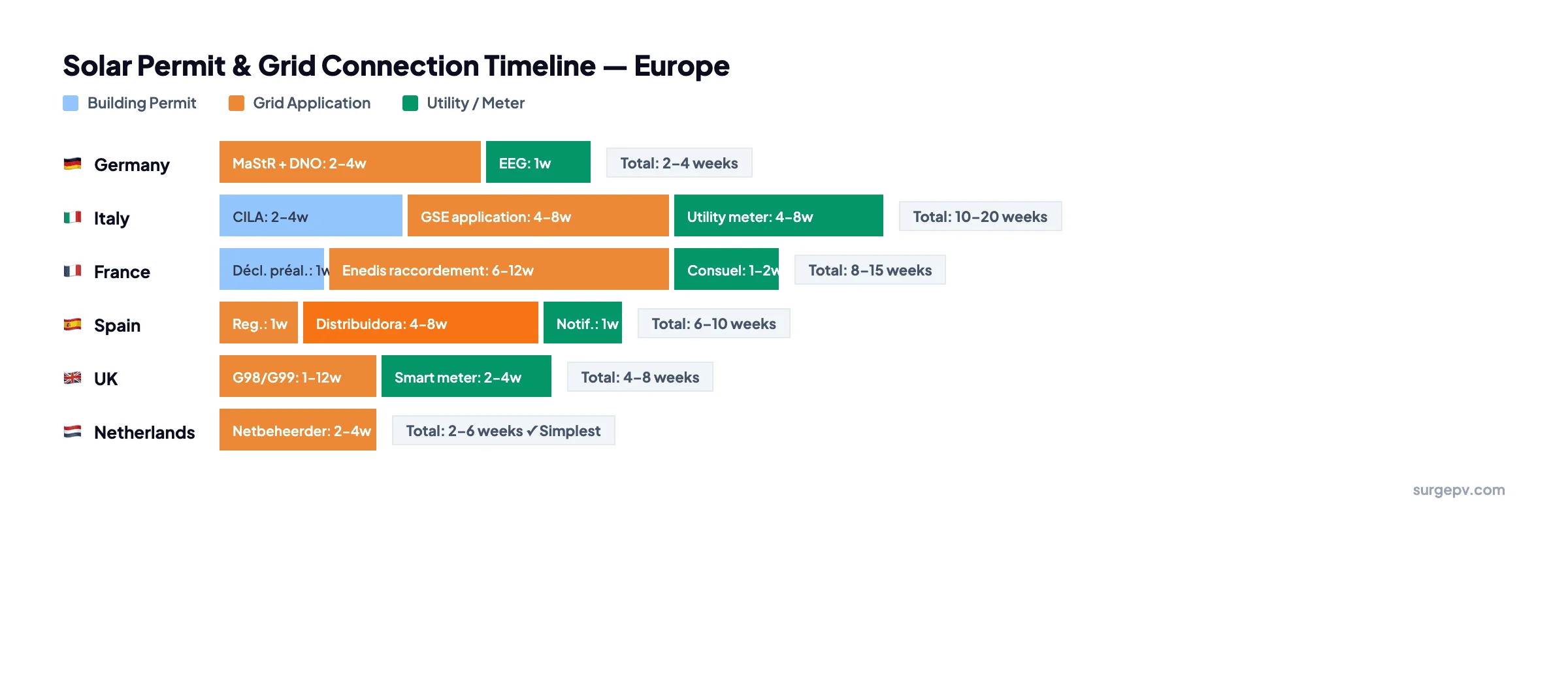
Germany has one of the most straightforward residential solar processes in Europe. Most systems go from installation to fully registered in 2–4 weeks.
Building Permit
Not required for most residential roof-mounted solar systems under 30 kWp. Some Bundesländer have specific rules for conservation areas (Naturschutzgebiete) and listed buildings (Denkmäler). Check with your local Bauamt if the property has any protected status.
Marktstammdatenregister (MaStR)
Every PV system in Germany must be registered in the Marktstammdatenregister - the national register of energy generation units. Registration is compulsory within 1 month of commissioning and is free of charge at marktstammdatenregister.de. The process takes approximately 30 minutes online. You'll need the inverter serial number and technical datasheet to hand.
Without MaStR registration, the system cannot receive the Einspeisevergütung (feed-in tariff) under the Erneuerbare-Energien-Gesetz (EEG).
Grid Connection Notification
Contact your local Netzbetreiber (grid operator) before or shortly after commissioning. The process depends on system size:
- Systems under 25 kWp: Simplified notification (Anzeige) - file a form, usually online. Typically acknowledged within 2–4 weeks.
- Systems 25–100 kWp: Formal application (Anmeldung). The Netzbetreiber checks whether the local grid can handle the additional generation. Allow 4–8 weeks.
Major Netzbetreiber by region: E.ON/Bayernwerk (Bavaria), E.ON Netz (various), Tennet (transmission), Bundesnetzagentur for MaStR registration.
EEG Feed-In Registration
To receive the Einspeisevergütung, register the system separately with the Bundesnetzagentur through the MaStR portal. This is the same registration portal - both happen in one process.
Germany Timeline
Most residential systems: 2–4 weeks total. MaStR registration (30 min) + grid notification (2–4 weeks). No building permit required for standard residential installs.
Italy: CILA, GSE Connection & Scambio sul Posto
Italy has the most complex residential solar process in Western Europe. Three separate processes run sequentially, making the total timeline 10–20 weeks. Starting the GSE application and CILA filing in parallel saves 2–4 weeks.
Building Permit: CILA
The Comunicazione di Inizio Lavori Asseverata (CILA) is required for most solar PV installations in Italy. It is filed with the local Comune (municipality) through the Sportello Unico Edilizia. A licensed technician (geometra, architetto, or ingegnere) must countersign the CILA - add their fee to your project budget.
- Filing cost: €0 (free at most Comuni) but the technician's fee typically runs €200–400
- Timeline: file online; acknowledgment within 1–4 weeks
- Work can begin when the CILA is filed and acknowledged - you don't need to wait for approval
Exception: systems that qualify as Edilizia Libera (free construction) - this covers some small battery storage additions but rarely full PV arrays. Check with your local Comune before assuming no permit is needed.
GSE Grid Connection & Net Metering
The Gestore Servizi Energetici (GSE) manages Italy's Scambio sul Posto (net metering) and Ritiro Dedicato (feed-in) programs. Apply online at gse.it.
- Application requires: technical drawings, inverter datasheet, single-line diagram, building permit reference
- Timeline: 4–8 weeks for GSE to process and approve the connection request
- Scambio sul Posto (net metering): available for systems up to 200 kWp for residential and commercial
The GSE application and CILA filing can run simultaneously - start both on the same day to reduce total project time.
Utility Meter Change
Your local electricity distributor (Enel Distribuzione or regional equivalent) must replace the existing meter with a bidirectional smart meter. This is a separate process from the GSE application and typically takes another 4–8 weeks.
Submit the meter change request to your distributor as soon as the GSE application is confirmed. The system cannot export to the grid without the bidirectional meter in place.
Italy Timeline
10–20 weeks total. CILA: 1–4 weeks. GSE application: 4–8 weeks. Utility meter change: 4–8 weeks. Tip: start CILA and GSE simultaneously to save 2–4 weeks.
France: Déclaration Préalable & Enedis Raccordement
France requires three steps for most solar installations: a planning declaration, a grid connection application to Enedis, and a Consuel electrical inspection.
Building Permit: Déclaration Préalable de Travaux
A Déclaration Préalable de Travaux (DP) is required for most residential solar installations that are visible from a public road. File with your local mairie using Form Cerfa 13703.
- Filing is free
- The mairie has 1 month to respond - if no response, the declaration is tacitly approved
- Exceptions: panels completely invisible from public roads; some local PLU (Plan Local d'Urbanisme) exemptions
- Listed buildings (monuments historiques) require a full Permis de Construire - allow 2–3 months
Enedis Raccordement (Grid Connection)
Apply for grid connection through Enedis (or your local equivalent, e.g. EDF in Corsica, or a local régie for some municipalities). Submit a technical dossier including:
- Single-line electrical diagram
- Inverter datasheet and certificate
- Roof layout plan
- Site address and cadastral reference
Timeline: 6–12 weeks, depending on DNO workload. Rural areas and Breton grid areas sometimes take longer. Enedis will issue a Proposition Technique et Financière (PTF) - accept it to formally initiate the connection.
Consuel Electrical Inspection
Consuel (Comité National pour la Sécurité des Usagers de l'Electricité) inspection is mandatory for all new AC solar installations in France. Consuel certifies that the electrical installation meets NF C 15-100 standards. Book the inspection well in advance - appointments can be 3–6 weeks out.
- Cost: approximately €200–300
- Required before Enedis will complete the final connection
- If the inspector finds a defect, you must remediate and request a second visit
France Timeline
8–15 weeks total. Déclaration préalable: 1–4 weeks (tacit approval at 1 month). Enedis raccordement: 6–12 weeks. Consuel: 1–3 weeks for appointment. Book Consuel at the same time as the Enedis application.
Spain: Autoconsumo Registration & Grid Connection
Spain simplified its solar permitting process significantly after the 2019 royal decree on self-consumption (Real Decreto 244/2019). Most residential installs now require only two steps: autoconsumo registration and a grid connection notification.
Building Permit
A Licencia de Obras is rarely required for residential rooftop solar in Spain. Most installs fall under obra menor (minor works) or are exempt altogether. Check with your Ayuntamiento (town council) if the property is in a protected zone or has a flat roof being used as a terrace.
Autoconsumo Registration
Within 1 month of commissioning, register the system on your Autonomous Community's (CCAA) online portal. This is required to receive the compensation mechanism under the simplified net billing scheme introduced by RD 244/2019.
- Each CCAA has its own portal - for example, Catalonia uses the Oficina Virtual de Tràmits; Madrid uses the Sede Electrónica de la Comunidad de Madrid
- Documents required: technical datasheet, single-line diagram, inverter certificate, and CUPS (Código Universal de Punto de Suministro) - your supply point code found on electricity bills
- Registration is free
Grid Connection Notification
Notify your local distribuidora (electricity distribution company: Endesa, Iberdrola, Naturgy, or EDP according to region). For systems below 100 kW, a simplified notification process applies.
- Submit: technical datasheet, single-line diagram, autoconsumo registration confirmation
- Timeline: 4–8 weeks for formal connection approval
- The distribuidora must confirm the grid can accept the generation - rarely an issue for residential systems
Spain Timeline
4–10 weeks total. Autoconsumo registration: 1 week. Distribuidora grid notification: 4–8 weeks. One of the simpler processes in Southern Europe.
UK: G98/G99 Notification & Smart Export Guarantee
The UK has a well-defined grid connection process through Engineering Recommendation G98 and G99. Most residential solar falls under G98 - which is a simple notification, not an approval process.
Planning Permission
Planning permission is not normally required for residential solar under Permitted Development rules, provided:
- Panels are installed on a house, not a flat or maisonette in some cases
- Panels do not protrude more than 200mm beyond the roof plane
- The property is not a listed building and not in a National Park, Area of Outstanding Natural Beauty, or World Heritage Site (though exceptions exist - check with your local planning authority)
Conservation areas allow solar but panels on the principal (front) elevation facing a highway may require planning permission depending on the local authority.
G98 vs G99: Which Applies?
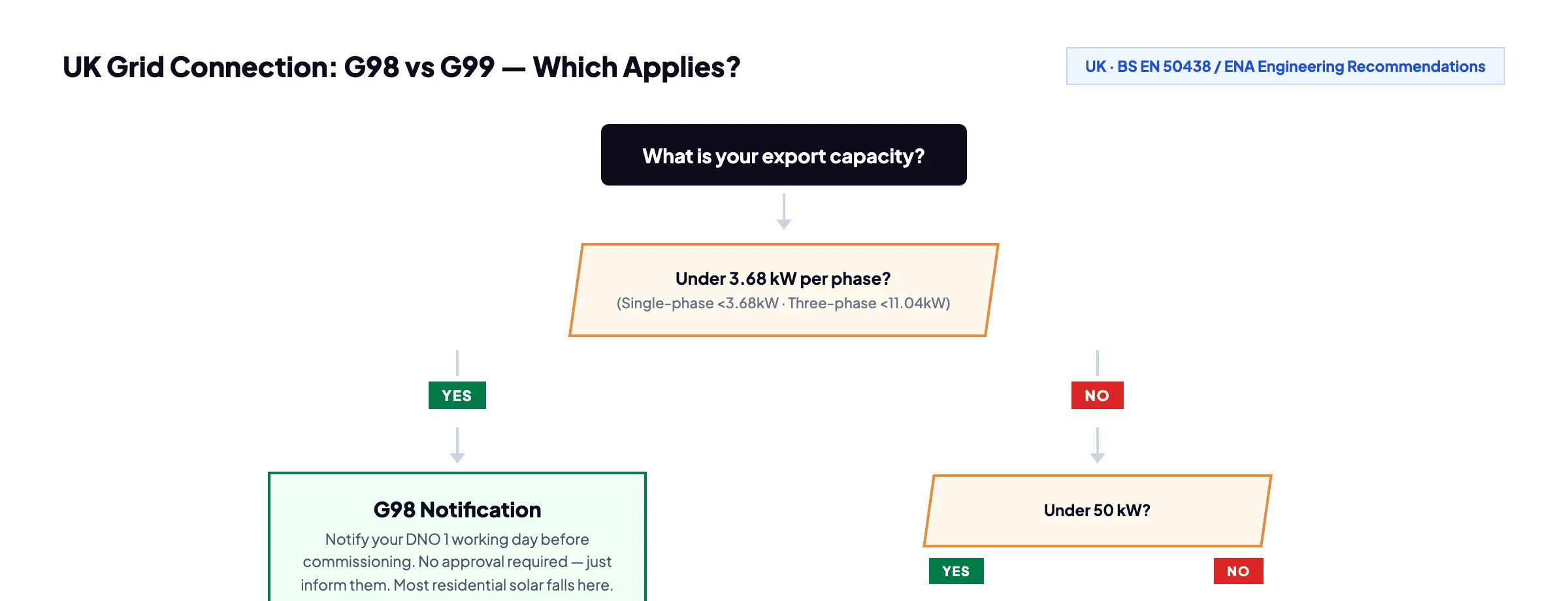
The decision depends on your export capacity:
- G98: Systems with export capacity below 3.68 kW per phase (single-phase: under 3.68 kW; three-phase: under 11.04 kW). Notify your DNO at least 1 working day before commissioning. No approval needed - just notification. This covers the vast majority of residential solar installations.
- G99: Systems with export capacity above 3.68 kW per phase and below 50 kW. Full application to your DNO required. Allow 6–12 weeks for approval.
- Engineering Review: Systems above 50 kW. Bespoke application required - contact the DNO directly for a pre-application discussion.
Major DNOs and their G98/G99 portals: UK Power Networks (South East, East England), Western Power Distribution / National Grid (Midlands, South West, Wales), SP Energy Networks (Scotland), Northern Powergrid (North East England), Electricity North West.
Smart Export Guarantee (SEG)
The Smart Export Guarantee requires electricity suppliers with more than 150,000 customers to offer export tariff payments. Register with an SEG licensee (Octopus Energy, E.ON, British Gas, OVO, Bulb etc.) after commissioning to receive payment for exported electricity.
- The system must be installed by an MCS-certified installer to be eligible for SEG payments
- The installation must use MCS-certified equipment
- Export rates vary by supplier - compare at the Ofgem SEG register
UK Timeline
4–8 weeks total for standard residential. G98 notification: 1 working day. Smart meter upgrade (if needed): 2–4 weeks. SEG registration: 1–2 weeks after commissioning.
Netherlands: Netbeheerder Notification
The Netherlands has the simplest solar connection process in Europe. There is no building permit requirement for most residential installs, and the grid notification is a single online form.
Building Permit
An Omgevingsvergunning is almost never required for residential rooftop solar in the Netherlands. Exceptions exist for listed buildings (rijksmonumenten) and some protected townscape areas. For standard residential properties, no planning interaction is needed at all.
Netbeheerder Notification
Notify your netbeheerder (grid operator: Stedin, Enexis, or Liander, depending on region) of the new generation installation. The process is a simple online form and takes approximately 30 minutes.
- Timeline: 2–4 weeks for the netbeheerder to process and confirm
- Required information: system capacity, inverter type, installation address, and connection point (EAN code, found on your energy bill)
- No fee for the notification
Salderingsregeling (Net Metering)
The Netherlands operates a salderingsregeling (net metering) system that allows households to offset their consumption against generation 1:1. Register with your energy supplier - the netbeheerder notification is separate from this commercial registration.
Note: the salderingsregeling is scheduled for gradual phase-out after 2027, with a transition to a different settlement mechanism. Check the current status with your supplier if you're planning a new installation.
Netherlands Timeline
2–6 weeks total - the fastest process in this guide. No building permit needed for standard residential. Netbeheerder online form: 30 minutes. Confirmation: 2–4 weeks. Net metering registration with supplier: 1–2 weeks.
Permit Costs & Timeline Summary
Here is the full comparison across all six countries covered in this chapter. All costs are approximate and do not include installer fees or technical consultant costs where required.
| Country | Building Permit | Grid Application | Smart Meter / Utility | Total Time | Approx. Cost |
|---|---|---|---|---|---|
| 🇩🇪 Germany | Not required | Free · 2–4 weeks | Usually included | 2–4 weeks | €0–200 |
| 🇮🇹 Italy | CILA · €300–500 | Free (GSE) · 4–8 weeks | Free (utility) · 4–8 weeks | 10–20 weeks | €300–600 |
| 🇫🇷 France | Free filing · 1–4 weeks | Free (Enedis) · 6–12 weeks | Consuel €200–300 | 8–15 weeks | €200–400 |
| 🇪🇸 Spain | Rarely needed | Free · 4–8 weeks | Included | 4–10 weeks | €0–200 |
| 🇬🇧 UK | Rarely needed | DNO fee varies · 1–12 weeks | Smart meter free | 4–8 weeks | £50–300 |
| 🇳🇱 Netherlands | Not required | Free · 2–4 weeks | Included | 2–6 weeks | €0–100 |
For a broader picture of solar energy policies across Europe, including incentive schemes and feed-in tariff rates by country, see our dedicated blog post.
Automate Solar System Documentation with SurgePV
Generate single-line diagrams, as-built drawings, and permit-ready technical dossiers directly from your design - in one platform.
Book Free Demo20 minutes · Live walkthrough · No commitment
Frequently Asked Questions
Do you need planning permission for solar panels in Europe?
In most EU countries, residential rooftop solar under 30 kWp does not require planning permission. Germany, Spain, and the Netherlands effectively have no building permit requirement for standard residential installs. France requires a Déclaration Préalable; Italy requires a CILA. Listed buildings and conservation areas are exceptions in all countries - always check local rules before assuming an exemption applies.
How long does it take to get solar connected to the grid?
From 2–6 weeks in the Netherlands to 10–20 weeks in Italy, depending on country and grid operator workload. The grid connection application is almost always the longest part of the process. Submit it on the day you sign the installation contract - not after installation is complete.
What is the Marktstammdatenregister in Germany?
The Marktstammdatenregister (MaStR) is Germany's national register of energy generation units, operated by the Bundesnetzagentur. Every solar PV system must be registered within 1 month of commissioning. Registration is free and takes about 30 minutes online. Without registration, the system cannot receive the Einspeisevergütung (feed-in tariff) under the EEG.
About the Contributors

CEO & Co-Founder · SurgePV
Keyur Rakholiya is identified by SurgePV as its CEO and a company co-founder. His SurgePV author page lists only role information that can be tied to the public profile below; credentials, project totals, testing claims, media appearances, and speaking engagements are not asserted without retained evidence.
