Most residential installations in Europe today use monocrystalline silicon panels. Monocrystalline panels now hold over 90% of the EU residential market share, according to SolarPower Europe's 2024 market report. The question is no longer which technology dominates - it's which variant gives you the best return on your roof.
The choice matters because a panel decision locks in your system's performance for 25 years or more. A panel with a slightly worse degradation rate or temperature coefficient quietly costs you money every summer for decades. This chapter breaks down each technology so you can make that decision on actual numbers.
What you'll learn
- The five main solar panel technologies and when each makes sense
- How efficiency translates into fewer panels and less roof space
- Why temperature coefficient matters more in hot climates
- How to calculate 25-year output and compare total cost of ownership
- What Tier 1 actually means and which brands qualify
- A decision framework for choosing panels on any roof
The Main Solar Panel Technologies in 2026
There are five technologies in the market, but three matter for most residential and commercial installations. Here is where each one stands in 2026.
Monocrystalline Silicon (Mono-Si)
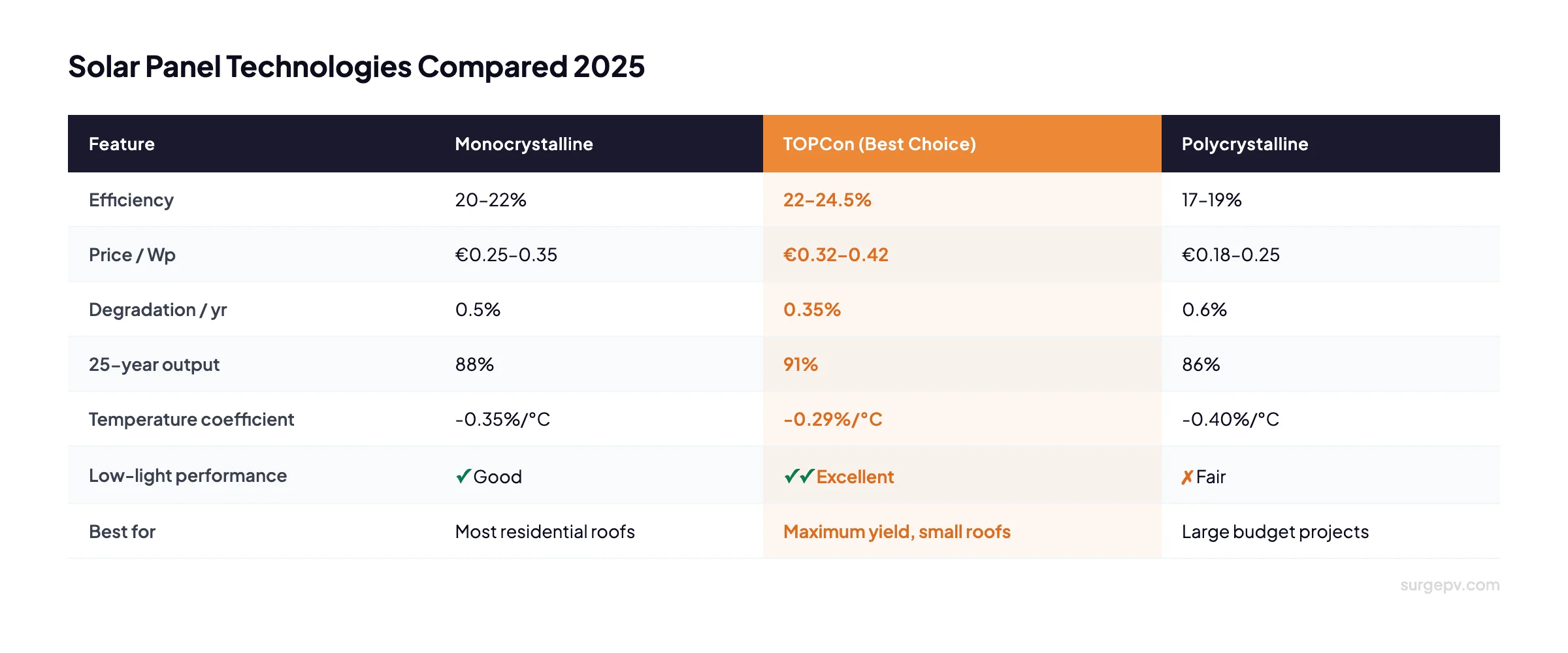
Monocrystalline panels are made from a single continuous silicon crystal. The manufacturing process produces highly uniform cells with fewer defects, which is why mono panels achieve 20–22% efficiency and are the default choice for European residential work. They have a uniform dark appearance and work well in low-light conditions.
Standard mono panels degrade at roughly 0.5% per year. After 25 years, a 400W panel is still producing about 88% of its rated output - around 352W. Most Tier 1 manufacturers guarantee this in writing with a 25-year linear performance warranty.
TOPCon (Tunnel Oxide Passivated Contact)
TOPCon is an evolution of monocrystalline technology. A thin tunnel oxide layer on the rear of the cell reduces electron recombination losses, pushing efficiency to 22–24.5%. It also improves performance in two areas that matter for real-world output: low-light conditions and high temperatures.
TOPCon panels degrade at around 0.35% per year - significantly better than standard mono. After 25 years, that means 91% of original output versus 88% for standard mono. Prices have fallen fast: TOPCon now costs only about 20% more than standard mono, down from a 50%+ premium three years ago.
For European installers, TOPCon is increasingly the default recommendation for roofs with limited space or customers who want to maximise 25-year yield.
Polycrystalline Silicon (Poly-Si)
Polycrystalline panels use silicon cast from multiple crystal fragments. The manufacturing process is simpler and cheaper, but the resulting cells have more defects, which limits efficiency to 17–19%. Most major manufacturers have stopped launching new polycrystalline product lines. The technology is still available but is being phased out of the premium residential market.
The main use case today is large ground-mount projects where cost per watt is the primary driver and roof space is not a constraint. Even there, TOPCon is increasingly competitive on total cost of ownership.
HJT (Heterojunction Technology)
HJT combines a crystalline silicon base with thin amorphous silicon layers on both sides. Efficiency reaches 24–25%, the highest of any commercial silicon technology. Temperature coefficient is also the best of any technology at around -0.24%/°C. The downside is cost: HJT panels still carry a significant premium and are mainly used in high-end residential or premium commercial projects where every square metre of roof space counts.
Thin-Film
Thin-film panels (CdTe, CIGS) are primarily used in utility-scale installations and building-integrated PV (BIPV) - for example, solar roof tiles or semi-transparent facade panels. They are not typically specified for standard residential pitched-roof installations in Europe.
Solar Panel Efficiency: What the Numbers Mean
Panel efficiency is the percentage of sunlight that gets converted into electricity. A 22% efficient panel converts 22% of the incoming solar energy into usable power. The remaining 78% is lost as heat or reflected light.
Why does efficiency matter in practice? Because higher efficiency means less roof space for the same output. A 22% panel produces the same power as a 20% panel in roughly 91% of the roof area. On a constrained roof, that can be the difference between a 5 kWp system and a 5.5 kWp system.
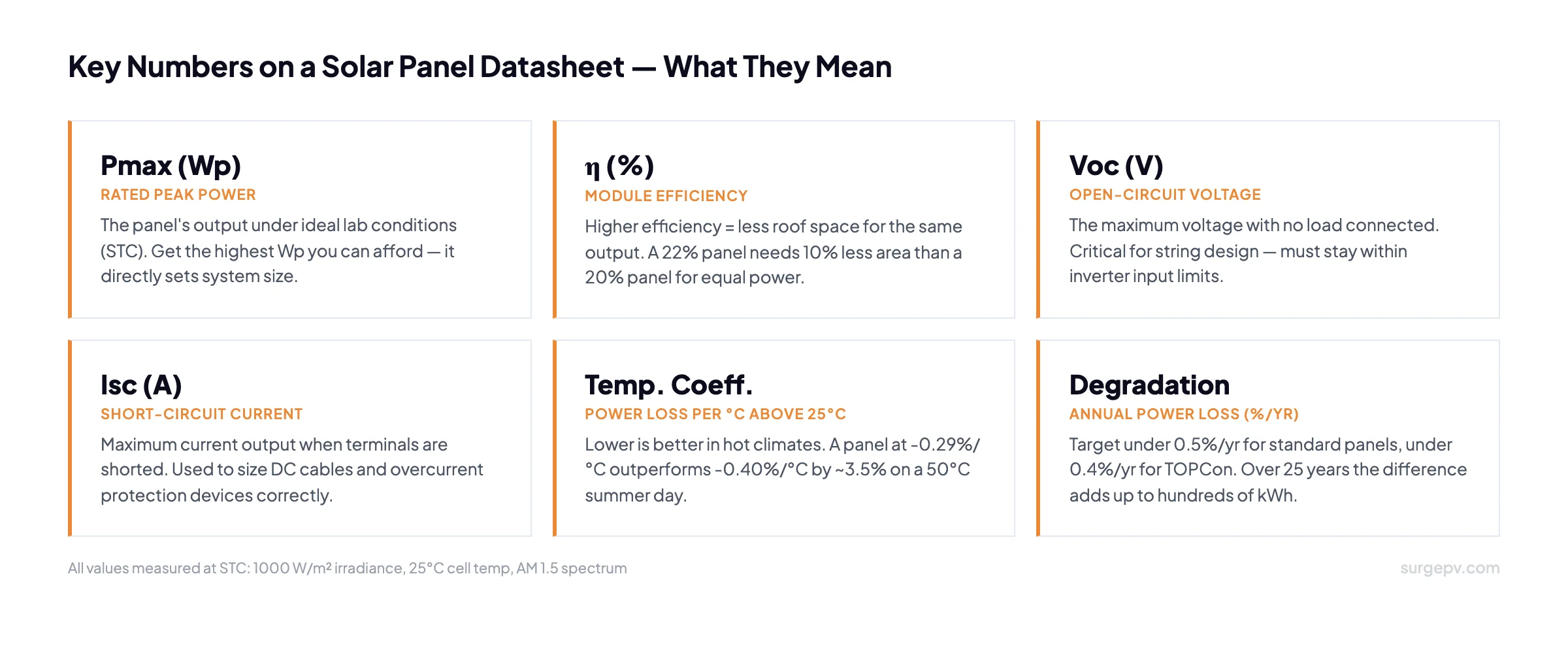
The datasheet illustration above shows the six numbers to check on any panel spec sheet. Pmax (peak power in watts) and efficiency are the headline figures. Voc and Isc are needed for string design. Temperature coefficient and annual degradation determine long-term performance.
Key Takeaway
Don't shop on efficiency alone. A 22% efficient panel from an unknown manufacturer with a weak warranty is a worse choice than a 20% panel from a Tier 1 manufacturer with a 25-year linear performance guarantee. The warranty is what protects the efficiency claim over time.
Use solar design software to model the exact number of panels that fit your roof at a given efficiency level. The difference between a 20% and 22% panel on a real roof often comes out to one or two additional panels - worth calculating before you commit.
Temperature Coefficient: The Hidden Performance Factor
Solar panels lose output as they heat up. The temperature coefficient measures this loss as a percentage per degree Celsius above 25°C - the reference temperature used in standard test conditions (STC).
Here are the typical temperature coefficients for each technology:
| Technology | Temp. Coefficient (%/°C) | Power at 50°C (400W panel) |
|---|---|---|
| HJT | -0.24%/°C | 376W |
| TOPCon | -0.29%/°C | 371W |
| Monocrystalline | -0.35%/°C | 365W |
| Polycrystalline | -0.40%/°C | 360W |
On a summer day where a panel's cell temperature reaches 50°C - which is common on south-facing roofs - a monocrystalline panel at -0.35%/°C loses 8.75% of its rated output. That 400W panel produces 365W. A TOPCon panel at -0.29%/°C only loses 7.25%, producing 371W. Over a full summer, that 6W difference adds up.
The temperature coefficient matters most in hot climates (Spain, Italy, southern France) and for panels installed flush against a roof with little airflow behind them. In Germany or the Netherlands, the effect is smaller but still measurable.
Pro Tip
If you're specifying panels for a southern European installation, prioritise temperature coefficient alongside efficiency. A panel that looks 0.5% less efficient on paper may actually outperform in July and August if it has a significantly better temperature coefficient.
Degradation Rate and 25-Year Output
Every solar panel loses a small amount of output each year due to chemical changes in the silicon cells. This gradual loss is called degradation.
Standard monocrystalline panels degrade at about 0.5% per year. TOPCon panels degrade at around 0.35% per year. The difference sounds small, but it compounds over 25 years:
| Technology | Year 1 Output | Year 10 Output | Year 25 Output |
|---|---|---|---|
| Standard Mono (0.5%/yr) | 400W | 381W (95.3%) | 352W (88.0%) |
| TOPCon (0.35%/yr) | 400W | 386W (96.5%) | 366W (91.5%) |
| Polycrystalline (0.6%/yr) | 400W | 377W (94.2%) | 344W (86.0%) |
On a 10 kWp system, the difference between TOPCon and standard mono at year 25 is about 350W of installed capacity. That translates to roughly 350 kWh more production per year by year 25. Over the full 25-year period, the cumulative difference is approximately 4,375 kWh.
At an electricity price of €0.20/kWh, that is about €875 in additional energy value over the system's life. TOPCon panels cost roughly €0.07–0.10/Wp more at purchase - about €700–1,000 extra on a 10 kWp system. The numbers are close to break-even at current prices, and TOPCon wins comfortably if electricity prices rise.
The generation and financial tool models degradation-adjusted production over the full system lifetime, so you can compare these scenarios for your specific location and tariff.
Cost Comparison: Price per Watt vs Total Cost of Ownership
Price per watt (€/Wp) is the standard way to compare panel costs, but it only tells part of the story. Total cost of ownership over 25 years is the number that actually matters.
| Technology | Price/Wp (2026) | 25-yr Output (10 kWp) | Effective €/kWh |
|---|---|---|---|
| Polycrystalline | €0.18–0.25 | ~225,000 kWh | Lower upfront, higher per kWh |
| Monocrystalline | €0.25–0.35 | ~243,000 kWh | Mid-range |
| TOPCon | €0.32–0.42 | ~252,000 kWh | Best per kWh lifetime |
The 25-year output figures above assume a 10 kWp system in central Europe with a specific yield of 1,050 kWh/kWp and the degradation rates listed in the previous section.
The key insight: polycrystalline costs less to buy but produces less over its lifetime. Per unit of energy produced, it is often not cheaper. For most European residential installations, standard monocrystalline or TOPCon offers better value over the full ownership period.
Key Takeaway
Ask your installer for a 25-year energy production estimate - not just the year-1 figure. The difference between panel technologies is most visible at year 20 and beyond. A good solar software platform models this automatically.
Tier 1 vs Tier 2 Manufacturers: What It Actually Means
You will hear installers recommend "Tier 1 panels" as a mark of quality. It is worth understanding what that term means - and what it doesn't.
Tier 1 is not an official certification or safety rating. It is a classification system created by Bloomberg NEF (BNEF) to assess the financial stability and bankability of solar panel manufacturers. A Tier 1 manufacturer is one that has had its panels financed by major banks in multiple utility-scale projects over the past two years. It signals financial strength and manufacturing scale - not necessarily that the panels are the best-performing.
What Tier 1 classification does give you:
- Higher probability that the manufacturer will still exist in 25 years to honour its warranty
- More liquidity in the secondary market if you ever sell the property
- Easier access to insurance-backed warranty products
- Confidence that the product has been rigorously tested by major project developers
Current Tier 1 manufacturers with strong European market presence include:
- LONGi Solar - the world's largest mono panel manufacturer; strong TOPCon line
- Jinko Solar - second largest globally; wide European distribution
- Trina Solar - consistent quality across mono and TOPCon ranges
- REC Group - Norwegian-owned, well-regarded in northern Europe; HJT specialist
- Canadian Solar - broad product range; strong installer support network
- Qcells (Hanwha) - German engineering heritage; popular choice for European residential
Pro Tip
For residential installations, always choose Tier 1 panels. The 25-year warranty is only worth something if the manufacturer is still trading in 2050. A cheaper panel from an unknown brand with a weak balance sheet carries real warranty risk that doesn't show up in the price per watt.
For a detailed comparison of solar software options used by installers working with these panel brands, see the solar software reviews section.
Design With Any Panel Brand in SurgePV
SurgePV's panel library includes all major Tier 1 manufacturers. Model real panel specs in your system design.
Book Free Demo20 minutes · Live walkthrough · No commitment
How to Choose: A Decision Framework
Panel selection comes down to three variables: roof space, budget, and how long the customer plans to stay in the property. Here is a straightforward framework:
Constrained roof space → TOPCon
If the roof limits how many panels fit, higher efficiency maximises output from the available area. TOPCon's 22–24.5% efficiency squeezes more kWp onto the same roof compared to standard mono. The price premium is now small enough that the extra output typically pays back within 5–7 years.
Budget-sensitive residential → Quality Monocrystalline (Tier 1)
Standard monocrystalline from a Tier 1 manufacturer is the default for good reason. It delivers reliable performance, a credible 25-year warranty, and a well-understood track record. If roof space is not a constraint and upfront cost matters, standard mono is the sensible choice.
Hot climate (Spain, Italy, southern France) → TOPCon or HJT
The better temperature coefficient on TOPCon and HJT panels means measurably more output on summer afternoons when panels get hottest. For southern European installations, the temperature coefficient deserves equal weight to efficiency.
Large commercial or ground-mount → Compare $/kWh over 25 years
At commercial scale, the right answer depends on full lifetime cost modelling. Run each panel option through a 25-year production model using actual degradation rates and your local specific yield. The lowest price-per-watt at purchase is rarely the lowest cost per kWh produced over the system's life.
Premium residential with small roof → HJT
HJT's 24–25% efficiency is the highest available in commercial silicon panels. For customers who need maximum power from a genuinely small roof and are willing to pay the premium, HJT is worth specifying. Most Tier 1 HJT production comes from REC Group and a small number of Chinese manufacturers.
| Situation | Recommended Technology | Why |
|---|---|---|
| Constrained roof, max yield | TOPCon | Best efficiency/price ratio in 2026 |
| Standard residential, good roof space | Monocrystalline (Tier 1) | Proven track record, lower upfront cost |
| Hot climate installation | TOPCon or HJT | Better temperature coefficient = more summer output |
| Very small roof, maximum power | HJT | Highest efficiency, best low-light and temp performance |
| Large budget project, cost sensitive | Model 25-yr TCO | Lowest $/Wp often not lowest $/kWh over 25 years |
Once you've selected a panel technology and brand, the next step is choosing your inverter - which is covered in Chapter 5: Solar Inverter Selection Guide. The inverter choice affects how well your panels perform, especially in partially shaded conditions.
Frequently Asked Questions
What is the best solar panel brand in 2026?
LONGi, Jinko Solar, Trina Solar, REC Group, and Canadian Solar consistently lead on efficiency, warranty strength, and financial stability. All are Bloomberg NEF Tier 1. Qcells is a strong choice for European residential installations, with German engineering heritage and good local support. The brand matters less than the warranty terms and the installer's familiarity with the product - an installer who rarely uses a particular brand will make more mistakes on installation day.
Are more expensive solar panels worth it?
For most European roofs, yes. A TOPCon panel costs roughly 20% more at purchase but produces 3–4% more energy annually and degrades more slowly. On a 10 kWp system over 25 years, that difference is approximately 4,375 kWh - worth about €875 at €0.20/kWh. The calculation shifts if your roof has unlimited space and you're working to a tight budget, where standard monocrystalline makes more sense.
How long do solar panels last?
Most Tier 1 manufacturers now offer 25–30 year product and performance warranties. Physical panels routinely last 30+ years, though output falls gradually. Standard monocrystalline reaches 88% of rated output after 25 years. TOPCon reaches around 91.5%. After 30 years, both technologies are still producing usable power - the system typically outlasts the warranty by a significant margin.
Compare Panels in a Real System Design
SurgePV lets you swap panel specs instantly and compare 25-year production and financial outcomes side by side.
Book Free DemoNo credit card · Full access · Unlimited projects
About the Contributors

CEO & Co-Founder · SurgePV
Keyur Rakholiya is identified by SurgePV as its CEO and a company co-founder. His SurgePV author page lists only role information that can be tied to the public profile below; credentials, project totals, testing claims, media appearances, and speaking engagements are not asserted without retained evidence.
