

In 2008, Wandee Kunchornyakong walked into a Thai bank to finance her first solar farm. The bankers had never funded a renewable energy project. They had certainly never taken a meeting with a woman who wanted to build one. She sold her land and her house to cover 40% of the cost. Her first plant, Korat 1, outperformed forecasts by 20%. Today she runs 36 solar farms across Thailand. Her company employs 60% women.
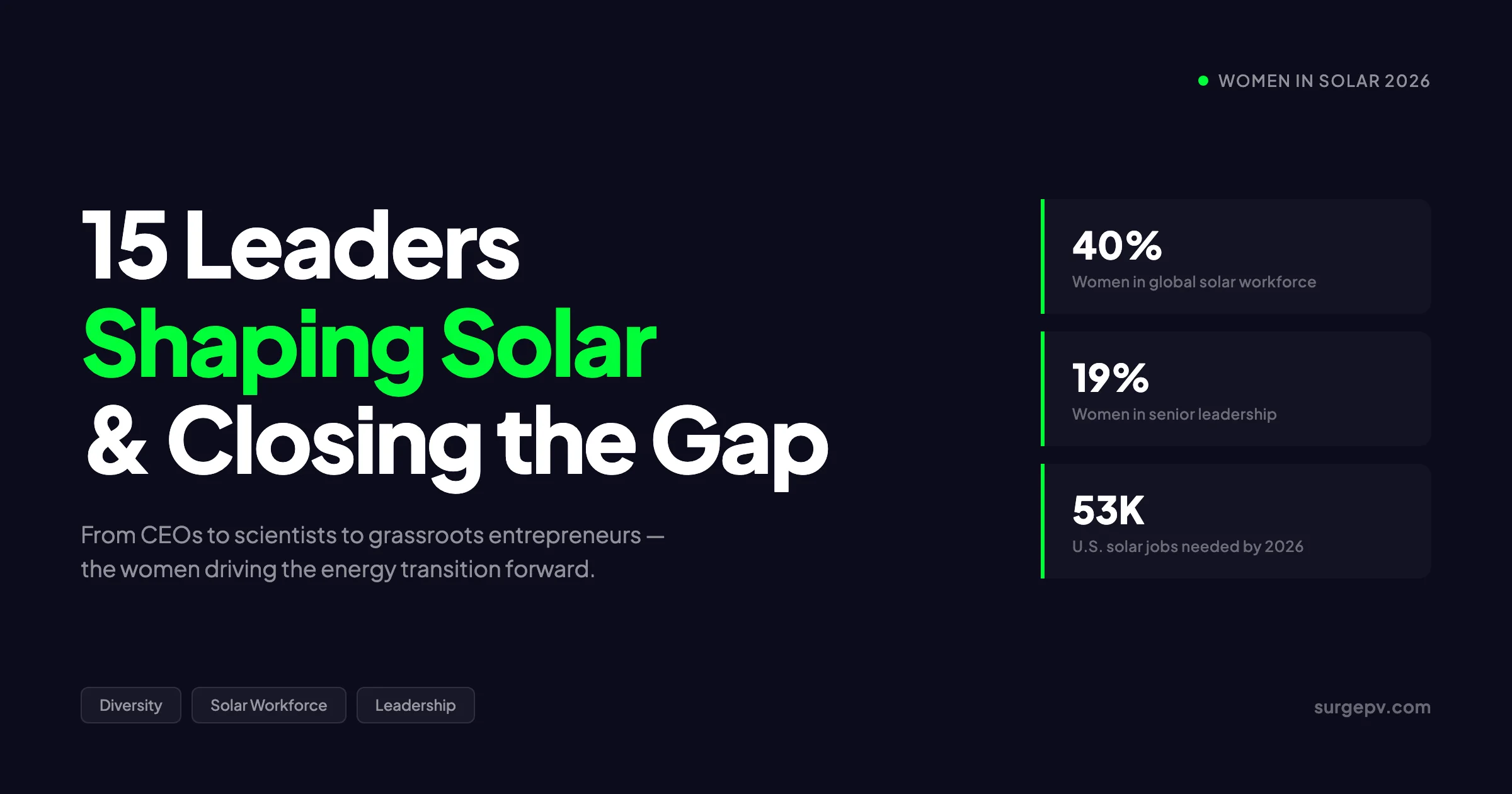
She sold her land and her house to cover 40% of the cost. Women make up 40% of the global solar PV workforce according to IRENA’s latest data. Women hold 45% of administrative roles, 28% of STEM positions, 22% of medium-skilled trades, and just 19% of senior management posts.
That story is not unusual in its obstacles. It is unusual in its outcome.
Women make up 40% of the global solar PV workforce according to IRENA’s latest data. That is the highest share of any renewable energy technology. Wind energy sits at 21%. Oil and gas at 23%. Solar is ahead. But the headline number hides a starker picture underneath. Women hold 45% of administrative roles, 28% of STEM positions, 22% of medium-skilled trades, and just 19% of senior management posts. Eighty percent of solar executives are men. Eighty-eight percent are white.
The solar industry needs workers. The U.S. alone faces a shortage of 53,000 solar workers by late 2026 to meet federal deployment targets. The global renewable workforce must double from 16.2 million to 30 million by 2030. This is not a side issue. It is a capacity issue. Companies that fail to recruit, retain, and promote women will fall behind.
This guide covers the full picture for 2026. Current workforce data. Fifteen profiles of women leading across every layer of the industry. The barriers that persist. The organizations fighting back. What companies can do differently. And what the next five years look like if the industry gets this right.
TL;DR — Women in Solar 2026
Women hold 40% of global solar PV jobs — highest in energy — but only 19% of senior roles. The U.S. solar workforce is 29–30% female. Pay gap: women earn 74 cents per male dollar (SEIA 2019). Solar needs 53,000 more U.S. workers by late 2026. Fifteen leaders profiled below span CEOs, scientists, policymakers, and grassroots entrepreneurs. Organizations like WRISE, WiRE, and Solar Sister are driving change. Without deliberate action, IRENA projects women’s share will remain flat at 32% across renewables through 2030.
In this guide:
- Current state: women in solar workforce by the numbers
- 15 women shaping the solar industry
- Barriers women face in solar careers
- Organizations and programs supporting women
- Mentorship and career development pathways
- The salary gap: data and analysis
- What most companies get wrong about diversity
- How solar companies can improve gender equity
- Success stories: companies that got it right
- 2026 outlook and the path to 2030
- Frequently Asked Questions
Current State: Women in Solar Workforce by the Numbers
Solar leads renewable energy in gender diversity. That is true. It is also a low bar.
IRENA’s 2025 report, Renewable Energy: A Gender Perspective (Second Edition), found women hold 32% of full-time renewable energy jobs globally. That figure has not moved since 2019. Six years of sector growth. Zero progress on gender parity. Solar PV is the bright spot within that flat line at 40% female workforce — but even that trails the global economy average of 43.4%.
Women in Solar by Role Type
| Role Category | Women’s Share | Source |
|---|---|---|
| Administrative / support | 45% | IRENA 2025 |
| Non-STEM technical (legal, policy, HR) | 36% | IRENA 2025 |
| STEM technical positions | 28% | IRENA 2025 |
| Medium-skilled trades (installers, electricians) | 22% | IRENA 2025 |
| Middle management | 26% | IRENA 2025 |
| Senior management / board | 19% | IRENA 2025 |
| Solar PV installers (U.S. field roles) | 1–3% | Industry estimates |
| Solar workforce overall (U.S.) | 29–30% | DOE 2025 / IREC |
| Solar workforce overall (global) | 40% | IRENA 2022 |
The pattern is vertical segregation. Women enter the industry. They cluster in administrative and non-technical roles. They rarely move into installation, engineering, or executive positions. The pipeline is not entirely blocked at the entry point. It narrows at every rung.
Regional Breakdown
| Region | Women’s Share of Solar Workforce |
|---|---|
| Asia-Pacific | 40% (driven by China’s manufacturing base) |
| Africa | 38% |
| Latin America & Caribbean | 33% |
| Europe & North America | 27% |
Regional variation is smaller than many assume. The 27–40% range suggests gender inequality is a structural feature of the industry, not a regional anomaly.
The Leadership Gap in Context
Eighty percent of senior executives in solar are men. Eighty-eight percent are white. Only 36% of solar companies track employee diversity at all. This matters beyond fairness. McKinsey research consistently links gender-diverse leadership to higher profitability. Companies in the top quartile for gender diversity on executive teams are 25% more likely to experience above-average profitability.
The solar industry sells a product that reduces emissions, cuts energy bills, and creates local jobs. It should not struggle to make the same case internally.
Key Takeaway
Solar’s 40% female workforce figure is the best in energy, but it masks severe underrepresentation in technical roles (28% STEM, 22% trades) and leadership (19% senior management). The numbers have not improved since 2019. Growth alone will not fix this.
15 Women Shaping the Solar Industry
The following profiles span corporate leadership, scientific research, policy advocacy, entrepreneurship, and grassroots organizing. Each woman has made measurable impact on the industry. Together they show what solar looks like when talent is not filtered by gender.
1. Mary Powell — CEO, Sunrun
Mary Powell became CEO of Sunrun in August 2021, succeeding co-founder Lynn Jurich. She took over America’s largest residential solar and battery storage provider at a critical moment. Since then, Sunrun has added over 500,000 customers and surpassed 1 million total. Battery storage installations grew over 800%. The battery attachment rate for new solar customers rose from 12% to 62%, well above the industry average of 28%. See Adding Battery Storage Services for detailed guidance.
Powell’s prior role was President and CEO of Green Mountain Power (GMP) in Vermont, which she transformed into the world’s first B Corp-certified utility. She is ranked #2 on Energy Digital’s 2026 Top 10 Women in Energy list and was named to the 2026 CNBC Changemakers list.
Her strategic pivot at Sunrun is worth watching. She calls it “storage-first.” Home batteries are not backup accessories. They are grid infrastructure. Sunrun’s Distributed Power Plant now has over 106,000 participants, up 400% year-over-year. Powell’s view: the future of energy is consumer-led, distributed, and software-managed.
2. Abigail Ross Hopper — Former President & CEO, SEIA; Founder, Solar Sisters
Hopper led the Solar Energy Industries Association (SEIA) from 2017 to January 2026. Under her tenure, U.S. solar capacity grew from 36 GW to over 255 GW. Annual investment rose from $16 billion to over $70 billion. The country’s global solar manufacturing rank climbed from 14th to 3rd.
Her diversity work may outlast her policy wins. She founded Solar Sisters, a network that creates safe spaces for women and gender-diverse professionals in clean energy. She launched the SEIA Women’s Empowerment Committee with 60+ industry leaders. She hosted Women’s Empowerment Summits starting in 2016. SEIA became a Washington Post Top Workplace under her leadership.
Hopper stepped down in January 2026 and is expanding Solar Sisters as an independent platform. Her LinkedIn following grew from 30,000 to over 70,000 through honest storytelling about balancing career with motherhood.
3. Lynn Jurich — Co-Founder and Former CEO, Sunrun
Jurich co-founded Sunrun in 2007 and pioneered the “solar-as-a-service” model. She took the company public in August 2015 while holding her one-month-old daughter at the Nasdaq bell. By 2019, Sunrun had overtaken Tesla’s SolarCity as the #1 U.S. residential solar installer.
In 2018, Sunrun became the first solar company to achieve 100% pay parity. Women made up 50% of senior management and 38% of the board. Jurich took the California Equal Pay Pledge in 2019. She stepped down as CEO in August 2021 and later co-founded the Female Longevity Institute.
Her legacy in solar is the proof that a consumer-friendly, no-upfront-cost model can scale. Sunrun now has over 800,000 customers and $2 billion in recurring revenue.
4. Professor Xiaojing Hao — Scientia Professor, UNSW Sydney
Hao is one of the world’s leading photovoltaic researchers. She holds multiple world records for kesterite (CZTS) solar cell efficiency, most recently 13.2% in 2025. Her collaboration with Soochow University achieved a world-leading 27% efficiency in perovskite solar cells. She has published over 220 peer-reviewed papers and secured over $46 million in research funding. See TOPCon vs HJT vs Perovskite Solar Panels for detailed guidance.
In 2025, she was elected a Fellow of the Australian Academy of Science. She won the Prime Minister’s Prize for Science in 2020 and the Pawsey Medal in 2021. She co-founded Tandem Art, a spinout commercializing transparent conductive adhesive technology for tandem cells. For Australia-specific compliance details, see Australia comparisons/lgc-vs-stc.
Hao’s work on perovskite stability is critical. She has more than doubled the working lifespan of perovskite cells through innovative approaches to ion migration. Her quote: “As a scientist, I feel my skills are best put to use in addressing how we can fix climate change as soon as we can.”
5. Dr. Sarah Kurtz — NREL Alumna, National Academy of Engineering
Kurtz spent over 30 years at NREL (1985–2017), where she co-developed the high-efficiency GaInP/GaAs tandem-junction solar cell with Jerry Olson. They achieved over 30% efficiency in concentrator solar cells in 1993. She is a world-renowned expert in concentrator PV, module reliability, and measurement science.
Her awards include the William R. Cherry Award (2012) — the highest honor in photovoltaics from IEEE — and the C3E Lifetime Achievement Award (2016). In 2020, she was elected to the National Academy of Engineering. She founded the HOPE (Hands-On Photovoltaic Experience) program in 2010, which has trained hundreds of graduate students at NREL.
Kurtz’s H-index of 90 places her among the top solar researchers globally. She now teaches at UC Merced while continuing her research.
6. Wandee Kunchornyakong — Founder, Chairwoman & CEO, SPCG Public Company Limited
Kunchornyakong is Thailand’s solar pioneer. She founded SPCG in 2008 after Thailand announced a feed-in tariff for renewable energy. Thai banks refused to fund her. She sold her land and house. She built 36 solar photovoltaic farms across 10 provinces totaling approximately 260 MW. Annual output: 345 million kWh, powering 287,500 households.
SPCG employs approximately 60% women — extraordinarily high for the energy sector. Kunchornyakong served as President of the National Council of Women of Thailand from 2015 to 2018. She received the UNFCCC Momentum for Change Award in 2014 and an honorary doctorate from Chiang Mai Rajabhat University in 2024.
Her personal history matters. She is the daughter of a rice farmer. She was the first woman in Thailand to own an electricity-generating business. She retired in 2006 to pursue a PhD. She returned to business when she saw the opportunity to transform her country’s energy mix.
7. Gauri Singh — Deputy Director-General, IRENA
Singh has led policy and advocacy at IRENA for over a decade. She previously directed India’s National Solar Mission policy in 2010. At the state level in Madhya Pradesh, she steered rural development initiatives that improved livelihoods for nearly 2 million poor women through decentralized renewable energy. Also see: Best Solar Design Software India. For the latest details on India, see 5kW Solar Panel Price in India.
Singh is a vocal advocate for women’s economic empowerment through clean energy. She argues that renewable energy is “women-friendly” because it is modular and customizable. At COP27, she spoke at the EmpowerHer event on advancing women energy entrepreneurs. Her advice to women: “Every woman has within her the potential to break boundaries. These boundaries are there to be broken.”
8. Olasimbo Sojinrin — CEO, Solar Sister
Sojinrin became CEO of Solar Sister on January 1, 2025, succeeding founder Katherine Lucey. She had built Solar Sister Nigeria from the ground up as its founding Country Director, expanding to over 30 states. She then served as COO of global operations before taking the top role.
Solar Sister now has over 12,100 women entrepreneurs in its network across Nigeria, Tanzania, and Kenya. They have reached over 5.5 million people with clean energy access. In September 2025, Solar Sister partnered with Koolboks to deploy 1,000 solar-powered productive use units and train 1,000 women entrepreneurs by 2028.
Sojinrin’s leadership represents a rare successful founder succession to local leadership in the social enterprise sector. She is a TechWomen Emerging Leader (2015), Nigerian Energy Forum Woman in Energy Award winner (2016), and Acumen West African Fellow (2020). For Africa-specific compliance details, see Africa solar compliance.
9. Joanna Osawe — Founder, President & CEO, WiRE (Women in Renewable Energy)
Osawe founded WiRE in October 2013 in Toronto. It now has 27+ chapters worldwide, with international launches in Turkey, Georgia, Azerbaijan, Jordan, the UAE, and planned expansion into the Caribbean and Africa. WiRE provides networking, mentoring, student bursaries, speed interviewing, and awards programs.
Osawe’s own entry into energy was accidental. A wind turbine developer needed a French/English translator. She took the job and advanced into business development for what was then the world’s largest wind farm. She has been appointed to Canada’s Federal Sustainable Development Advisory Council and serves on the IRENA Coalition for Action Steering Group. For France-specific information, see Agricultural Solar Case Study.
She describes WiRE as her legacy — her “baby daughter” that gives women worldwide a space to grow in the energy sector.
10. Rebecca Kujawa — Former President & CEO, NextEra Energy Resources
Kujawa led NextEra Energy Resources from 2022 until her retirement in May 2025. NextEra is the world’s largest generator of renewable energy from wind and solar. She managed $15–20 billion in annual capital investment and oversaw a roughly 300 GW project development pipeline.
In 2024, the company commissioned over 2.2 GW of new solar and added more than 12 GW to its backlog. Kujawa was named to Fortune’s “Next to Lead: The 25 Most Powerful Rising Executives in the Fortune 500.” She has spoken at COP28, CERAWeek, and the Milken Institute Global Conference.
She now runs Zerra Partners and sits on the Equinix Board of Directors. Her career path is notable: she started in equity research at Goldman Sachs before joining NextEra in 2007.
11. Joy Seitz — President & CEO, American Solar & Roofing
Seitz leads Arizona’s first solar installer, founded in 2001. American Solar & Roofing has completed over 13,000 solar panel installations and 6,000 combined solar and roofing jobs. Seitz joined in 2009 as a lobbyist, became President of the Arizona Solar Energy Industries Association (AriSEIA) in 2011, and CEO in 2014.
Her policy wins include increasing residential solar incentives to $40 million, eliminating sales tax on solar, securing property tax exemptions, and winning 20-year grandfathering for existing solar customers. She has been called the “Joan of Arc of Arizona” for her advocacy. She was named one of Arizona’s Most Influential Women of 2025.
Seitz is a fierce advocate for customer-owned solar over corporate-owned leasing models. She travels to Washington D.C. to protect the federal solar tax credit.
12. Kine Johanne Årdal — Chief Digital & Information Officer, Scatec
Årdal leads digital transformation at Scatec, a world-leading renewable energy company headquartered in Oslo. Her career spans Chevron (8 years as exploration geologist), Tullow Oil, Pandion Energy, and Cognite before joining Scatec.
She has been open about the challenges of being a woman in male-dominated energy environments. Early in her career, she was one of two women on an offshore platform with nearly 100 men. She was told she was “very ambitious” when she expressed leadership goals. A leadership program deemed her “no longer fit” when she became pregnant.
Årdal now advocates that increasing women’s participation is “not just a question of fairness — it is essential for innovation, resilience, and stronger teams.” She was featured in Future Power Technology’s “Women in Power” series in January 2026.
13. Katherine Lucey — Founder and Former CEO, Solar Sister
Lucey founded Solar Sister in 2009 after a 20-year career as a Wall Street investment banker. The organization invests in women entrepreneurs to bring clean energy to off-grid communities in sub-Saharan Africa. It has reached over 5.5 million people and kickstarted over 4,000 clean energy entrepreneurs.
She stepped down as CEO on January 1, 2025, handing leadership to Olasimbo Sojinrin. Lucey had always envisioned local women leading the organization. She now serves as Senior Advisor. Her recognitions include Schwab Foundation Social Entrepreneur of the Year, Ashoka Fellow, and Forbes “50 Over 50 Women of Impact.”
14. Penelope Hope — Co-Founder, Rebel Energy
Hope co-founded Rebel Energy approximately five years ago as a UK renewable energy supplier with a social mission: address fuel poverty while supplying clean power. She started with £1.5 million in funding and scaled to over £100 million in revenue. The company was profitable from day one. For UK-specific information, see Battery Solar System Design UK.
Her background as an equity analyst gave her the financial modeling skills to run a lean operation. She focused on automation, operational efficiency, and high-level partnerships. She has since stepped back from Rebel Energy to mentor other founders and advocate for founder-led innovation in the UK startup ecosystem.
15. Mary Werner — 2025 WISE Award Winner
Werner received the 2025 Women in Solar Energy (WISE) Award from the American Solar Energy Society (ASES). The WISE Award recognizes outstanding contributions by women to solar energy through technical innovation, education, leadership, or advocacy. Werner’s specific contributions highlight the range of ways women advance the field beyond executive roles — through hands-on technical work, training, and community building.
Key Takeaway
These 15 women span every layer of solar: residential and utility-scale CEOs, Nobel-caliber scientists, national policymakers, grassroots entrepreneurs, digital transformation leaders, and trade advocates. Their collective message is that talent in solar is not scarce. Opportunity is.
Barriers Women Face in Solar Careers
The solar industry talks about growth, deployment targets, and gigawatts. It talks less about why women who enter the field often do not stay, and why those who stay rarely reach the roof or the boardroom.
Vertical Segregation
Women enter solar at rates that exceed other energy sectors. Then they hit a wall. The data from IRENA and SEIA is consistent across regions: women cluster in administrative and support functions. They are underrepresented in STEM roles (28%), trades (22%), and senior leadership (19%).
This is not a pipeline problem alone. Women earn 44% of engineering degrees in some countries. They do not become 44% of solar engineers. Something happens between education and employment, and again between employment and promotion.
Workplace Discrimination
Forty-five percent of women in renewable energy report experiencing gender-based discrimination. Nearly half. The 2019 SEIA diversity study found that 80% of senior executives in solar are men. Eighty-eight percent are white. When hiring panels, promotion committees, and investment networks are homogenous, decisions reflect that homogeneity.
Kine Årdal’s story is instructive. A manager told her she was “very ambitious” when she stated a career goal. A leadership program dropped her when she became pregnant. She was one of two women on an offshore platform of nearly 100 men. These are not ancient history. They are recent career experiences of a woman now leading digital transformation at a major renewable energy company.
The Field Role Gap
Solar installation is physically demanding work on rooftops and job sites. It is also among the highest-paying entry-level roles in the industry, with clear paths to crew lead, project manager, and business owner. Women hold an estimated 1–3% of these field roles in the U.S.
The barriers are practical and cultural. Job sites often lack adequate restroom facilities. Safety gear is sized for male bodies. Harassment on male-dominated crews is common. Training programs are not marketed to women. These are fixable problems. Few companies fix them.
Caregiving and Inflexibility
Solar project timelines are unpredictable. Installation crews work long hours in peak season. Engineering roles may require site visits with irregular schedules. These demands conflict with caregiving responsibilities that still fall disproportionately on women.
Companies that offer flexible scheduling, predictable hours, and parental leave retain more women. Companies that do not lose them. This is not theory. The SEIA study found that women were less likely than men to report successfully moving up the career ladder.
What Most Get Wrong
The most common mistake companies make is treating diversity as a recruitment problem. They post jobs on diversity job boards. They attend WRISE events. They hire a few women and declare victory. Then those women leave because the culture, promotion process, and day-to-day experience have not changed.
Recruitment is the easy part. Retention and advancement are where the real work lives.
Organizations and Programs Supporting Women
Several organizations have built infrastructure specifically to advance women in solar and renewable energy. These are not affinity groups. They are professional networks with measurable outcomes.
WRISE (Women of Renewable Industries and Sustainable Energy)
WRISE was founded in 2005 as Women of Wind Energy (WoWE) and rebranded in 2017 to cover all renewable sectors. Its 2025 annual report, “Bold & Limitless,” celebrated 20 years of impact.
| Metric | Figure |
|---|---|
| Members | 2,650+ |
| Chapters | 48 |
| Allies in ecosystem | 15,000+ |
| Leadership Forum attendees | 725 |
| Participants mobilized | Nearly 5,000 |
WRISE runs fellowships, mentorship programs, a Speakers Bureau, and the annual Leadership Forum. Its Rising Women Solar Fellowship partners with GRID Alternatives to provide career opportunities for women from diverse backgrounds. The 2026 Leadership Forum will be held in Chicago.
WiRE (Women in Renewable Energy)
Founded by Joanna Osawe in Toronto in 2013, WiRE has grown to 27+ chapters worldwide. Programs include educational field trips, monthly networking, awards recognition, student bursaries, speed mentoring, and student chapters. International expansion has reached Turkey, Georgia, Azerbaijan, Jordan, and the UAE.
WiRE’s model is locally led. Each chapter adapts programming to its regulatory and cultural environment. Osawe calls this “glocal” — be global, act local.
Solar Sister
Solar Sister invests in women entrepreneurs to deliver clean energy to off-grid communities in sub-Saharan Africa. The model is simple: train women as clean energy sales agents. Give them inventory, support, and a commission structure. Let them sell solar lamps, phone chargers, and home systems in their own communities.
The results are substantial. Over 12,100 entrepreneurs. Over 5.5 million people reached. Operations in Nigeria, Tanzania, and Kenya. The 2025 transition to Olasimbo Sojinrin’s leadership marked a milestone: a social enterprise founded by a Wall Street banker is now led by a Nigerian woman who built the organization’s largest country operation from scratch.
SEIA Women’s Empowerment Committee
Launched during Abigail Ross Hopper’s tenure, the committee includes 60+ industry leaders. It focuses on recruiting, retaining, and promoting women; amplifying women’s voices at industry forums; and partnering with diversity-focused organizations. SEIA also hosts Women’s Empowerment Summits with panels on topics from running for office to diversity and the bottom line.
WISE Award (Women in Solar Energy)
Presented annually by the American Solar Energy Society (ASES), the WISE Award recognizes outstanding contributions by women to solar energy. The 2025 recipient was Mary Werner. The award highlights that women’s contributions to solar span technical innovation, education, advocacy, and entrepreneurship.
Other Notable Programs
- C3E Initiative (Clean Energy Education & Empowerment): A U.S. program that recognizes women leaders in clean energy through awards and mentorship
- TechWomen: A U.S. State Department program that brings emerging women leaders in STEM from Africa, Central Asia, and the Middle East to the U.S. for mentorship — Olasimbo Sojinrin is an alumna
- Female Future Programme (Norway): A leadership and board education initiative for women in business — Kine Årdal is a graduate
Mentorship and Career Development Pathways
Mentorship is not a nice-to-have in solar. It is a retention tool. Women who have mentors are more likely to stay in the industry, more likely to advance, and more likely to become mentors themselves.
Formal Mentorship Programs
WRISE and WiRE both run structured mentorship programs. WRISE’s program pairs emerging professionals with senior leaders for year-long relationships. WiRE offers speed mentoring events where mentees rotate through multiple mentors in a single session. Both models work. The key is structure. Informal mentorship tends to replicate existing networks — men mentor men.
The Sponsorship Gap
Mentorship is advice. Sponsorship is action. A sponsor puts their own credibility on the line to advocate for someone’s promotion, assignment, or funding. Women in solar report having mentors but lacking sponsors. This matters because sponsorship is what converts potential into position.
Companies that want to retain women should build sponsorship programs, not just mentorship programs. Identify high-potential women early. Pair them with senior leaders who have budget authority and hiring power. Measure outcomes: promotions, project assignments, pay increases.
Career Pathways into Solar
Solar offers multiple entry points. The solar installer career path starts with vocational training and leads to crew lead, project manager, or business owner. The solar sales career path starts with lead generation and leads to sales management or regional director roles. Engineering pathways require degrees but offer the highest long-term earning potential.
For women considering solar, the field is wide open in 2026. The industry needs 53,000 more U.S. workers by late 2026. Globally, renewable energy jobs will double by 2030. The constraint is not opportunity. It is access.
Build Your Solar Career with the Right Tools
Whether you are starting as an installer, moving into sales, or managing projects, solar software helps you work faster and smarter from day one.
Explore SurgePVSolar design, proposals, and financial modeling in one platform
For a direct comparison, see Arka 360 vs SurgePV.
The Salary Gap: Data and Analysis
The gender pay gap in solar is real, measurable, and persistent. It varies by role, region, and organization type. But it does not disappear anywhere.
U.S. Solar Pay Gap
The 2019 SEIA Solar Industry Diversity Study found:
| Metric | Men | Women | Gap |
|---|---|---|---|
| Median hourly wage | $29.19 | $21.62 | 26% |
| Earning $31–$74/hour | 37% | 28% | — |
| Cents per dollar | $1.00 | $0.74 | — |
This 26% gap is wider than the U.S. economy-wide gender pay gap of approximately 16–18%. The solar industry, despite its progressive image, pays women less than the national average.
NREL Salary Data (2026)
Even at a leading federal research laboratory with 50/50 gender balance, disparities exist:
| Gender | Average Salary Range |
|---|---|
| Female | $74,000 – $96,000 |
| Male | $87,000 – $103,000 |
Global Pay Gap by Region
| Country / Region | Role | Women’s Salary vs. Men’s |
|---|---|---|
| China | Solar Energy Systems Engineer | 92% (8% gap) |
| Japan | Solar Energy Systems Engineer | 94% (6% gap) |
| South Africa | Solar Energy Systems Engineer | 89% (11% gap) |
| Finland (Helsinki) | Solar Energy Systems Engineer | 96% (4% gap) |
| Saudi Arabia (Riyadh) | Solar Energy Systems Engineer | 90% (10% gap) |
| Tunisia | Solar Energy Systems Engineer | 86% (14% gap) |
| Switzerland (Zurich) | Solar Installation Manager | 95% (5% gap) |
| Australia | Solar Installation Manager | 91% (9% gap) |
Developed markets show smaller gaps (4–6%) than developing markets (10–14%). But no market shows parity.
Why the Gap Persists
Three factors drive the solar pay gap. First, occupational segregation. Women are concentrated in lower-paying administrative roles. Second, negotiation gaps. Women are less likely to negotiate starting salaries and less likely to receive them when they do. Third, promotion gaps. Men move into management faster. The SEIA study found men were more likely than women to hold manager, director, or president-level positions.
The Business Case for Closing the Gap
Sunrun’s experience under Lynn Jurich is instructive. In 2018, the company achieved 100% pay parity. Women made up 50% of senior management. The company did not collapse. It grew to over 800,000 customers and went public. Pay parity is not a cost. It is a competitive advantage in hiring and retention.
What Most Companies Get Wrong About Diversity
Most solar companies want to do better on gender diversity. Few know how. Here are the most common mistakes.
Mistake 1: Treating Diversity as HR’s Problem
Diversity is a business strategy, not an HR initiative. It affects who you hire, who you promote, who designs your products, and who sells them. When leadership delegates diversity to HR without personal involvement, it signals that the issue is peripheral. It is not.
Mistake 2: Focusing Only on Recruitment
Hiring women is the first step. Keeping them is harder. Companies that invest in recruitment but not in culture, mentorship, promotion pathways, and pay equity see women leave within two years. Then they hire more women to replace them. This is expensive and ineffective.
Mistake 3: Avoiding Pay Transparency
Only 36% of solar companies track employee diversity. Even fewer publish pay data by gender. Without transparency, there is no accountability. Companies that conduct pay equity audits and publish the results build trust. Companies that hide the data breed suspicion.
Mistake 4: One-Size-Fits-All Programs
A mentorship program designed for white-collar engineers will not work for field installers. A networking event in San Francisco will not reach women in rural Kenya. Effective diversity programs are tailored to the specific barriers women face in each role, region, and career stage.
Mistake 5: Expecting Women to Fix the Problem
Women’s empowerment groups, employee resource groups, and diversity committees are valuable. But they should not be the primary mechanism for change. The burden of fixing gender inequality should not fall on the people experiencing it. Male executives need to be active allies, sponsors, and advocates.
The Tradeoff Myth
Some executives believe there is a tradeoff between diversity and merit. This is false. The evidence consistently shows that diverse teams outperform homogenous ones on problem-solving, innovation, and financial returns. The tradeoff is not between diversity and merit. It is between the comfort of familiar networks and the performance of diverse ones.
How Solar Companies Can Improve Gender Equity
The following actions are based on research from IRENA, SEIA, WRISE, and successful company implementations. They are not theoretical. They have been tested.
1. Conduct a Pay Equity Audit
Analyze compensation by gender, role, and tenure. Identify gaps. Fix them. Publish the results internally. Sunrun achieved 100% pay parity through this process. It took work. It was worth it.
2. Set Public Targets with Accountability
Iberdrola targets 35% women in relevant positions by 2030. Boviet Solar targets 12.58% women in middle management by 2026. Public targets create accountability. They also signal to potential hires that the company is serious.
3. Build Mentorship and Sponsorship Programs
Pair emerging women with senior leaders. But go further. Ensure those senior leaders have the authority to assign projects, approve promotions, and allocate budget. Mentorship without sponsorship is conversation without consequence.
4. Redesign Job Descriptions and Hiring Panels
Research shows women apply for jobs only when they meet 100% of listed qualifications, while men apply at 60%. Long requirement lists filter out qualified women. Diverse hiring panels reduce unconscious bias in selection.
5. Offer Flexible Work and Parental Leave
Solar installation is seasonal. Engineering has deadlines. But not every role requires 60-hour weeks year-round. Flexible scheduling, remote work where possible, and parental leave for all genders improve retention.
6. Fix the Job Site
For field roles, this means adequate restroom facilities, safety gear sized for women’s bodies, zero-tolerance harassment policies, and female crew leads. These are basic conditions. Most job sites fail on at least two.
7. Partner with Women’s Organizations
WRISE, WiRE, and local tradeswomen organizations provide recruitment pipelines, training resources, and credibility. Partnership is cheaper than turnover.
8. Track and Publish Diversity Data
What gets measured gets managed. Publish annual diversity reports. Include gender breakdowns by role level, pay band, and promotion rate. Transparency builds trust and creates pressure to improve.
Success Stories: Companies That Got It Right
Theory is useful. Practice is better. Here are three examples of companies that improved gender equity with measurable results.
Sunrun: Pay Parity and Leadership
Under Lynn Jurich, Sunrun became the first solar company to achieve 100% pay parity in 2018. Women held 50% of senior management roles and 38% of board seats. The company took the California Equal Pay Pledge. These were not symbolic gestures. They were structural commitments backed by audits and accountability.
The result: Sunrun grew from a startup to America’s largest residential solar provider with over 800,000 customers. Mary Powell, the current CEO, has continued the focus. Sunrun remains a model for what is possible when diversity is treated as a business priority.
SPCG: Majority-Female Workforce
Wandee Kunchornyakong’s SPCG employs approximately 60% women. This was not an accident of hiring. It was a deliberate choice by a founder who faced gender discrimination herself and decided to build something different. SPCG’s success — 36 solar farms, 260 MW, $800 million in investment — proves that a majority-female energy company can outperform.
Green Mountain Power: B Corp Utility
Before joining Sunrun, Mary Powell led Green Mountain Power to become the world’s first B Corp-certified utility. B Corp certification requires rigorous assessment of social and environmental performance, including gender equity. GMP’s transformation showed that even a traditional utility — one of the most male-dominated sectors in energy — can change its culture and performance simultaneously.
2026 Outlook and the Path to 2030
The solar industry stands at a crossroads on gender equity. The next five years will determine whether the sector’s growth creates inclusive opportunity or reinforces existing inequality.
The Workforce Math
The U.S. solar industry needs to grow from approximately 280,000 workers to 355,000 by late 2026 to meet federal tax credit deadlines. That is 75,000 new jobs in under two years. The global renewable workforce must double from 16.2 million to 30 million by 2030. These are not incremental changes. They are massive expansions. Data from the SEIA National Solar Jobs Census and Bureau of Labor Statistics document this gap, while GRID Alternatives and similar workforce-development nonprofits are working to ensure that women and underrepresented groups gain access to these new roles.
If companies recruit intentionally from the full talent pool — including women, people of color, and career changers — they can fill these roles. If they recruit from the same narrow networks, they will face the same shortages.
The Stagnation Warning
IRENA’s 2025 report delivers a clear warning. Women’s share of the renewable energy workforce has remained flat at 32% since 2019. Six years. No progress. Solar’s 40% figure is better but not improving. Without deliberate intervention, the industry will grow without becoming more equitable.
What Would Meaningful Progress Look Like?
By 2030, a healthy solar industry would show:
- Women’s share of the solar workforce at or above the global economy average (43.4%)
- Women’s share of STEM roles above 40%
- Women’s share of senior leadership above 35%
- Pay parity within 5% across all role categories
- Field roles (installers, technicians) at 15%+ women
- Majority of companies tracking and publishing diversity data
These are ambitious but achievable targets. They require the same discipline the industry applies to module efficiency, project finance, and grid interconnection.
The AI Factor
AI adoption in solar is accelerating. Automated design tools, drone site surveys, and predictive maintenance systems are changing job requirements. This could help women enter technical roles by reducing physical barriers and emphasizing software skills. Or it could automate the roles women currently hold while leaving male-dominated leadership intact. The outcome depends on who designs and deploys the technology.
SurgePV’s Clara AI approach to solar design shows one path: AI that augments human capability rather than replacing it, making technical roles accessible to a broader range of professionals.
The Misconception That Needs to Die
The most damaging misconception in solar is that diversity is a social issue separate from business performance. It is not. The solar labor shortage analysis makes this clear: the industry cannot meet its deployment targets without expanding its talent pool. Excluding women is not just unfair. It is unprofitable.
Opinion: The Real Risk Is Complacency
Solar companies love to tout their environmental credentials. Many have weak records on internal equity. The risk is not that the industry will oppose gender diversity. It is that leaders will assume growth will solve the problem automatically. IRENA’s data proves it will not. The next five years require the same intentionality applied to module procurement, project development, and grid interconnection. Without it, solar will leave talent and revenue on the table.
Frequently Asked Questions
What percentage of the solar workforce is female in 2026?
Women hold 40% of full-time positions in the global solar PV workforce according to IRENA — the highest share of any renewable energy subsector. In the United States, women comprise 29–30% of the solar workforce. However, representation drops sharply in technical and leadership roles: only 28% of STEM positions, 22% of medium-skilled trades, and 19% of senior management roles are held by women.
Who are the most influential women in solar energy right now?
Key figures include Mary Powell (CEO, Sunrun), Abigail Ross Hopper (former SEIA President, founder of Solar Sisters), Lynn Jurich (co-founder, former CEO of Sunrun), Professor Xiaojing Hao (UNSW, perovskite solar cell pioneer), Dr. Sarah Kurtz (NREL alumna, National Academy of Engineering), Wandee Kunchornyakong (founder, SPCG Thailand), Gauri Singh (Deputy Director-General, IRENA), and Olasimbo Sojinrin (CEO, Solar Sister). Each has shaped the industry through leadership, research, policy, or grassroots entrepreneurship.
What is the gender pay gap in the solar industry?
The 2019 SEIA diversity study found women in solar earned 74 cents for every dollar men earned — a 26% gap. More recent data from 2025 shows persistent disparities: at NREL, women average $74K–$96K while men average $87K–$103K. Globally, pay gaps for equivalent solar engineering roles range from 4% in Finland to 14% in Tunisia.
What barriers do women face in solar careers?
Key barriers include: (1) workplace discrimination — 45% of women report gender-based discrimination; (2) concentration in administrative roles with limited advancement paths; (3) lack of female role models in technical and leadership positions; (4) inflexible work arrangements that conflict with caregiving responsibilities; (5) networking and hiring practices that favor existing male-dominated networks; and (6) safety and cultural concerns on male-dominated job sites.
What organizations support women in solar?
Major organizations include WRISE (Women of Renewable Industries and Sustainable Energy) with 2,650+ members across 48 chapters; WiRE (Women in Renewable Energy) founded by Joanna Osawe with 27+ global chapters; Solar Sister, which trains women entrepreneurs in sub-Saharan Africa; the SEIA Women’s Empowerment Committee; and the American Solar Energy Society’s WISE Award program.
How can solar companies improve gender diversity?
Effective strategies include: conducting pay equity audits and publishing results; implementing mentorship and sponsorship programs for women; using gender-neutral language in job descriptions; ensuring diverse hiring panels; offering flexible work arrangements and parental leave; setting public diversity targets with accountability; creating safe reporting channels for discrimination; and partnering with organizations like WRISE and WiRE for recruitment pipelines.
Is the solar industry doing better than other energy sectors on gender diversity?
Yes — solar leads all energy sectors. At 40% female workforce globally, solar outperforms wind (21%), oil and gas (23%), and nuclear (25%). It also exceeds the broader construction industry where women hold only 11% of jobs. However, solar still trails the global economy average of 43.4% female workforce, and the gap widens significantly in technical roles and senior leadership.
What is the outlook for women in solar through 2030?
The renewable energy workforce is projected to grow from 16.2 million to 30 million jobs by 2030, creating massive opportunity. The U.S. solar industry specifically needs 53,000 additional workers by late 2026 to meet deployment targets. If companies target recruitment intentionally, this expansion could accelerate gender parity. However, IRENA’s 2025 report shows women’s share has remained flat at 32% across all renewables since 2019, indicating that growth alone will not close the gap without deliberate intervention.
What is the WISE Award in solar?
The Women in Solar Energy (WISE) Award is presented annually by the American Solar Energy Society (ASES) to recognize outstanding contributions by women to the solar energy field. The 2025 recipient was Mary Werner. The award highlights technical innovation, leadership, education, and advocacy work that advances solar energy and women’s participation in the industry.
How does SurgePV support diversity in solar?
SurgePV’s solar design platform helps teams of all sizes work efficiently on project designs, proposals, and financial modeling. By reducing the technical barriers to entry and streamlining workflows, solar software enables more professionals — including women entering the field — to contribute meaningfully from day one. SurgePV also supports career development content for solar installers and sales professionals.
Conclusion: Three Actions to Take Now
The data is clear. The profiles are inspiring. The barriers are identifiable. What matters now is action.
If you lead a solar company: Conduct a pay equity audit this quarter. Set a public target for women’s representation in leadership. Partner with WRISE or WiRE for recruitment. These three actions cost little and signal serious intent.
If you are a woman considering solar: The industry needs you. The solar installer career path and solar sales career path both offer growth. Use solar design suite to build skills fast. Connect with WiRE or WRISE for mentorship. The barriers are real, but so is the opportunity.
If you are already in the industry: Be a sponsor, not just a mentor. Advocate for pay transparency. Challenge all-male panels and hiring committees. The culture changes when individuals act.
Solar energy is supposed to democratize power — literally and figuratively. The industry should reflect that mission in its own workforce. The technology is ready. The market is growing. The only question is whether the people building it will look like the people it serves. Customer-ready solar proposals generates professional quotes in minutes.
Where this fits
This article is part of SurgePV's Solar Business & Operations hub, which works through the topic from first principles to the decisions a project team actually has to make.


