

Miguel started knocking doors in Fresno at 22. He had no sales experience, no technical background, and $400 in his checking account. His first month, he set three appointments and closed zero deals. By month six, he was the top rep in his office. By year three, he managed a team of 14. At 31, he became VP of Sales for a 200-person residential solar company in Texas. His W-2 in 2025 showed $287,000.
His story is not unusual. Solar sales is one of the few industries where a first-year rep with hustle and a willingness to learn can out-earn a mid-career accountant or engineer. The US solar industry employs over 280,000 people across 11,177 companies (SEIA, 2025). The industry faces a 53,000-worker gap threatening 2026 deployment targets (PV Magazine, 2026). That gap is your opportunity. Also see: Us Residential Solar Market Trends 2026.
But the path from SDR to VP is not a straight line. Most reps burn out in year one. Most managers never make Director. And the compensation structures that look generous on paper often hide traps that cost reps tens of thousands per year. For United States-specific compliance details, see United States arizona/phoenix.
This guide maps the full solar sales career path for 2026. It covers every role from entry-level SDR to VP of Sales, real compensation data, the skills that separate high earners from average ones, and the mistakes that stall or kill careers.
Quick Answer: Solar Sales Career Path 2026
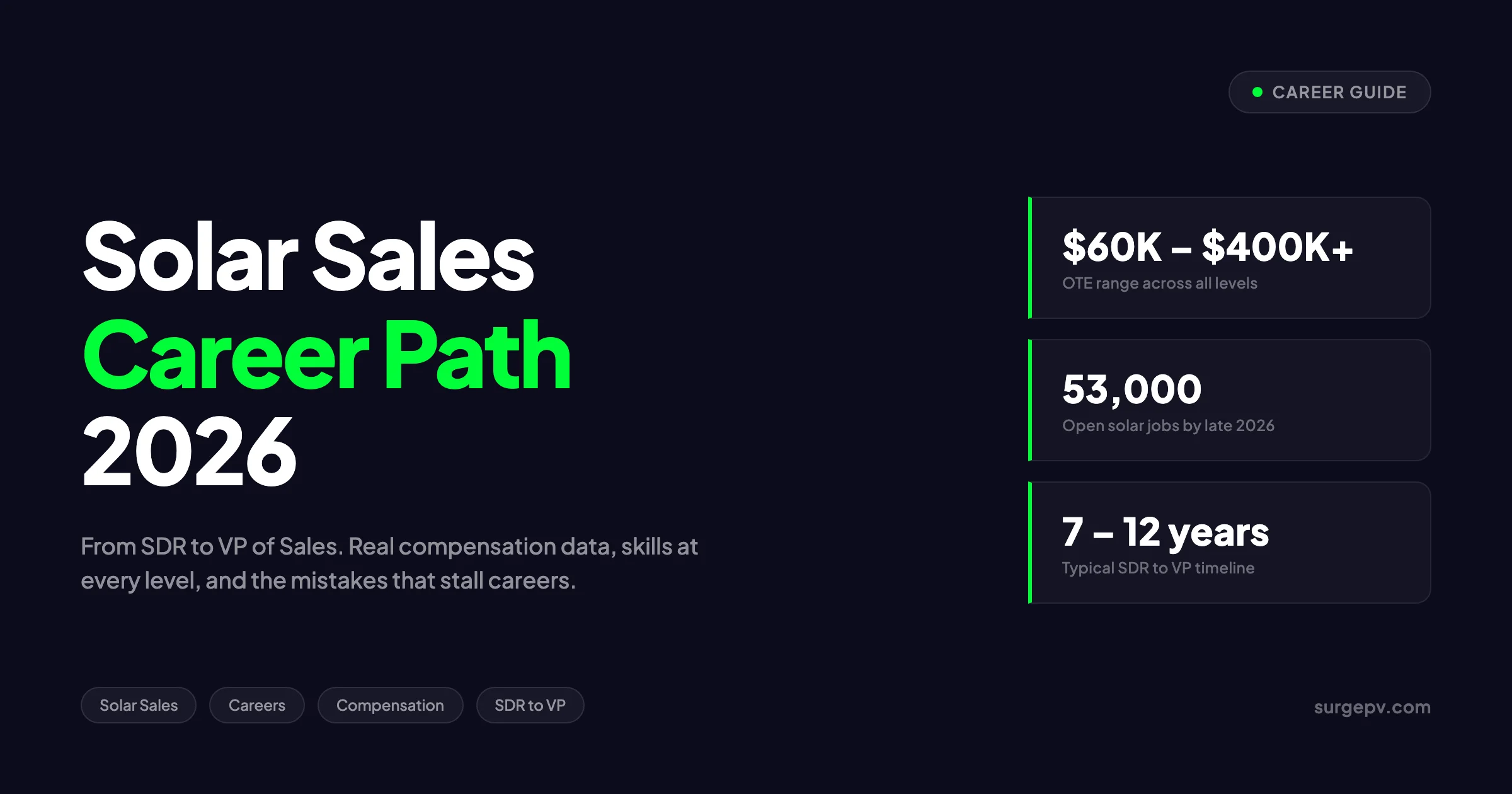
Entry-level SDR/BDR: $60K–$95K OTE. Account Executive: $140K–$180K OTE. Senior/Enterprise AE: $180K–$250K+. Sales Manager: $240K–$380K. VP of Sales: $250K–$400K+. The typical timeline from SDR to VP is 7–12 years. No degree required. NABCEP PV Technical Sales certification boosts close rates 10–15% and pay 10–20%. The US solar industry needs 53,000 additional workers by late 2026.
In this guide:
- The solar sales landscape in 2026 — market size, growth, and where the jobs are
- Entry-level roles: SDR, BDR, and door-to-door rep — what they actually do
- Account Executive path: residential vs. commercial, close rates, and earnings
- Sales Manager: the hardest promotion, and what breaks most reps who try it
- Director and VP track: building revenue engines, not just hitting quotas
- Compensation by role: base salary, commission, and total OTE table
- Skills needed at each level: technical, sales, and leadership
- Solar-specific vs. general sales: what transfers and what does not
- Common career mistakes and how to avoid them
- Top companies hiring solar sales reps in 2026
- 10 FAQs covering degrees, certifications, state-by-state pay, and more
Solar Sales Landscape 2026: Market Size and Growth
The solar industry added 32.4 GW of capacity in the US in 2024 (SEIA/Wood Mackenzie, 2025). The global solar PV workforce reached 4.9 million in 2023 and is projected to exceed 7 million by 2030 (IRENA, 2024). Those numbers translate into one undeniable fact: solar companies are hiring aggressively, and they are hiring salespeople faster than any other role. For Global-specific compliance details, see Global net-metering-by-country.
Why 2026 Is a Pivotal Year
Three forces are reshaping solar sales careers in 2026:
1. The post-ITC reset. The Section 25D residential solar tax credit expired December 31, 2025. SEIA and Wood Mackenzie project a 19% residential market contraction as homeowners who were waiting on the credit either delay or drop out. The reps who thrive in 2026 sell value — energy independence, bill savings, and battery resilience — not tax credits.
2. The workforce gap. The industry needs roughly 355,000 workers by late 2026 to meet deployment targets. The current workforce is around 280,000. That 53,000-worker gap means employers are competing for talent with higher base salaries, better training, and faster promotion tracks.
3. The commercial shift. Residential sales are flattening. Commercial and industrial (C&I) solar is growing faster, with longer sales cycles but dramatically higher commissions per deal. The reps who learn commercial selling early will have a structural advantage for the next decade.
Where the Jobs Are
| State | Solar Jobs (2024) | Growth Rate | Avg OTE Range |
|---|---|---|---|
| California | 78,982 | +12% | $100K–$200K+ |
| Florida | 14,303 | +18% | $80K–$160K |
| Texas | 12,820 | +32% | $90K–$160K |
| New York | 11,923 | +15% | $95K–$180K |
| Massachusetts | 11,365 | +14% | $95K–$180K |
Source: SEIA National Solar Jobs Census, 2025
86% of solar employers report difficulty hiring (Taylor Hopkinson, 2025). 27% of utility-scale firms call hiring “very difficult.” That pressure creates upward mobility for people already in the industry. A rep who performs in 2026 will get promoted faster than a rep who performed equally well in 2022.
Key Takeaway
The 53,000-worker gap is not just a headline. It means companies are promoting from within faster, paying more to retain talent, and tolerating less experience for mid-level roles. If you are already in solar sales, 2026 is the best year in a decade to ask for a promotion or switch to a higher-paying role.
Entry-Level Roles: SDR, BDR, and Door-to-Door Rep
Every solar sales career starts somewhere. In solar, that somewhere is usually one of three roles: Sales Development Representative (SDR), Business Development Representative (BDR), or door-to-door (D2D) canvasser/closer.
SDR / BDR
SDRs and BDRs generate pipeline. They cold-call, email, or message homeowners who have expressed interest in solar. Their job is not to close. It is to qualify — to confirm the homeowner has a suitable roof, a bill over $80/month, and genuine interest in a consultation.
What an SDR actually does:
- 80–120 outbound calls per day
- Qualify leads on bill amount, roof condition, ownership, and credit
- Schedule appointments for Account Executives
- Update CRM with call outcomes and next steps
Typical compensation:
| Component | Range |
|---|---|
| Base salary | $45,000–$75,000 |
| Commission/bonus | $15,000–$20,000 |
| Total OTE | $60,000–$95,000 |
SDR roles are the safest entry point. You get a predictable paycheck, structured training, and a clear view of the full sales cycle. The downside: SDR roles are less common in solar than in SaaS. Many solar companies skip the SDR layer and push reps straight into closing or D2D.
Door-to-Door Canvasser
D2D canvassers knock doors to set appointments for closers. They do not pitch solar systems. They pitch a free consultation. 30 to 40% of US residential solar still gets sold through the D2D channel (Daly Advertising, 2026).
What a canvasser actually does:
- Knock 80–150 doors per day
- Deliver a 30-second pitch to generate interest
- Set 1–3 appointments per day for closers
- Track territory and follow-up in canvassing apps like Spotio or SalesRabbit
Typical compensation:
| Component | Range |
|---|---|
| Per-appointment pay | $50–$200 |
| Weekly appointments | 5–15 |
| Weekly earnings | $250–$3,000 |
| Annual OTE | $40,000–$80,000 |
Canvassing is physically demanding and emotionally draining. Rejection rate is 95%+. But it builds resilience fast. The best canvassers learn to read people in 10 seconds. That skill transfers directly to closing.
D2D Closer
Closers run the in-home appointment. They sit at the kitchen table, model the roof live, present financials, and ask for the signature. This is where the money is at the entry level.
What a closer actually does:
- Run 2–4 in-home appointments per day
- Use design software to model the roof and shading in real time
- Present financing options and ROI calculations
- Handle objections and close on the spot Shadow analysis software identifies shading issues before installation. Read [Solar Shading Analysis Guide](/blog/solar-shading-analysis-guide) for a complete walkthrough.
Typical compensation:
| Component | Range |
|---|---|
| Base salary (if any) | $0–$50,000 |
| Commission per kW | $300–$500 |
| Commission per sale (6–8 kW avg) | $1,800–$4,000 |
| Annual OTE | $80,000–$180,000 |
| Top performers | $200,000–$300,000+ |
The closer role is where most high-earning solar careers begin. It teaches every skill you need: discovery, objection handling, live presentation, and closing under pressure. Miguel, the VP from Fresno, spent his first two years as a D2D closer. He credits that period with teaching him more about sales than any course or book.
Pro Tip
If you are choosing between an SDR role and a D2D closer role, take the closer role if you can handle the volatility. You will learn faster, earn more, and have a clearer path to Account Executive. SDR roles are safer but slower. Most solar companies promote closers to AE in 12–18 months if they hit quota consistently.
Account Executive: The Fork in the Road
Account Executive is where your career splits into two tracks: Individual Contributor (IC) and Management. Both can lead to $200K+ earnings. But they require different skills and tolerate different personalities.
Residential Account Executive
Residential AEs close homeowner deals. They may inherit appointments from SDRs or D2D canvassers, or they may self-generate leads through referrals, events, and digital channels.
What a residential AE actually does:
- Manage a pipeline of 20–50 active opportunities
- Run site assessments and in-home consultations
- Generate proposals using solar sales software
- Close 2–6 deals per month depending on market and lead quality
- Handle post-sale coordination with design and install teams
Typical compensation:
| Component | Range |
|---|---|
| Base salary | $60,000–$85,000 |
| Commission per sale | $2,000–$6,000 |
| Monthly deals (avg) | 2–4 |
| Annual OTE | $110,000–$170,000 |
| Top performers | $180,000–$250,000 |
The residential AE role is the workhorse of the solar sales career path. Most reps spend 2–4 years here before moving up or specializing. The key differentiator at this level is technical credibility. Reps who can explain inverter clipping, NEM 3.0 export rates, and battery dispatch logic close more deals than reps who rely on charm alone. See Solar Inverter Clipping for detailed guidance.
Commercial Account Executive
Commercial AEs sell to businesses, schools, municipalities, and utilities. Deal sizes range from $200,000 to $5M+. Sales cycles run 3–12 months. The commission per deal is life-changing.
What a commercial AE actually does:
- Identify and qualify C&I prospects
- Run energy audits and financial analyses
- Navigate procurement processes and RFPs
- Coordinate with engineering on system design
- Close 1–4 deals per quarter
Typical compensation:
| Component | Range |
|---|---|
| Base salary | $75,000–$110,000 |
| Commission (3–6% of project value) | $6,000–$120,000+ per deal |
| Annual OTE | $150,000–$250,000 |
| Top performers | $250,000–$400,000+ |
Commercial solar sales is harder to break into. Most companies want 2–3 years of residential experience or a background in commercial real estate or energy. But the payoff is substantial. One $1.5M commercial deal at 4% commission pays $60,000 — more than many residential reps earn in a quarter.
The IC vs. Management Fork
At the AE level, you face a choice:
| Track | Path | Best For |
|---|---|---|
| Individual Contributor | AE → Senior AE → Enterprise AE → Principal AE | Reps who love selling and want to maximize earnings without managing people |
| Management | AE → Sales Manager → Director → VP → CRO | Reps who want to build teams and shape strategy |
An Enterprise AE at $180K–$250K+ can out-earn a first-time Sales Manager. Do not chase management for status. Chase it only if you genuinely enjoy coaching, forecasting, and building systems.
Opinion: The IC Track Is Underrated
Most solar reps assume management is the only path to $200K+. That is wrong. A Principal AE at a commercial solar firm can earn $300K+ with no direct reports, no forecast calls, and no office politics. The best ICs are treated like royalty by their companies because they are irreplaceable. If you love selling, stay on the IC track. It is the hidden high-earner path that most reps overlook.
Sales Manager: Where Most Careers Stall
Sales Manager is the most dangerous promotion in solar sales. It looks like a step up. For many reps, it is a trap.
What a Sales Manager actually does:
- Hire, train, and coach a team of 5–12 reps
- Set quotas and territories
- Run daily standups and weekly pipeline reviews
- Forecast revenue for leadership
- Handle escalations and save at-risk deals
- Fire underperformers
The job is no longer selling. It is building a system that produces sales. That requires a completely different skill set from closing.
Why Reps Fail as Managers
The most common failure pattern: a top-performing AE gets promoted to Manager and keeps trying to close deals personally. They override their reps on calls, steal hot leads, and spend their time in the field instead of coaching. Their team underperforms. They burn out within 18 months.
The second failure pattern: a rep takes the Manager title for the pay bump without understanding that their income now depends on team performance, not personal closes. A manager at a company with a $120K base and $240K OTE needs their team to hit 80%+ of quota to earn the bonus. If the team misses, the manager earns base only.
Sales Manager Compensation
| Component | Range |
|---|---|
| Base salary | $120,000–$200,000 |
| Variable (team performance bonus) | $120,000–$180,000 |
| Total OTE | $240,000–$380,000 |
The variable portion usually ties to team quota attainment, team close rate, and rep retention. A manager who builds a stable, high-performing team earns more than a manager who churns through reps every quarter.
Pro Tip
Before accepting a Sales Manager role, ask these three questions: (1) What was the previous manager’s team attainment rate? (2) How many reps on the team have been here over 12 months? (3) What is the chargeback policy when deals cancel? The answers will tell you whether the role is a real opportunity or a setup for failure.
Director and VP Track: Building Revenue Engines
Director of Sales and VP of Sales are strategy roles. You are no longer measured on how many deals close this month. You are measured on whether the revenue engine you built keeps running without you.
Director of Sales
Directors manage multiple teams or regions. They design compensation plans, set territory strategy, and own the relationship between sales and marketing.
Typical compensation:
| Component | Range |
|---|---|
| Base salary | $140,000–$180,000 |
| Variable bonus | $60,000–$100,000 |
| Equity (at startups) | 0.1–0.5% |
| Total OTE | $200,000–$280,000+ |
VP of Sales
VPs own the entire sales organization. They set the go-to-market strategy, hire Directors, manage the board relationship on revenue, and decide whether to enter new markets or product lines.
Typical compensation:
| Component | Range |
|---|---|
| Base salary | $175,000–$275,000 |
| Variable bonus | $75,000–$125,000 |
| Equity (at startups) | 0.5–2.0% |
| Total OTE | $250,000–$400,000+ |
The VP role in solar is distinct from SaaS because solar sales is seasonal, incentive-dependent, and geographically fragmented. A VP who built a career in California may struggle in Texas if they do not understand the different regulatory landscape, seasonal patterns, and customer psychology.
What Most Get Wrong About the VP Path
Most reps think the VP path is about selling bigger deals. It is not. The VP path is about building systems: repeatable hiring, scalable training, accurate forecasting, and compensation design that aligns rep behavior with company goals. Miguel, the VP from Fresno, says he spends 70% of his time on hiring and compensation design. He has not run a sales call in two years. That is the real job.
Compensation by Role: Full Table
Here is the complete compensation picture for solar sales roles in 2026, compiled from Glassdoor, ZipRecruiter, Salary.com, and NextGen Energy Jobs.
US Solar Sales Compensation Table 2026
| Role | Experience | Base Salary | Total OTE | Top Earners |
|---|---|---|---|---|
| SDR / BDR | 0–1 year | $45K–$75K | $60K–$95K | $100K+ |
| D2D Canvasser | 0–1 year | $0–$40K | $40K–$80K | $100K+ |
| D2D Closer | 0–2 years | $0–$50K | $80K–$180K | $250K+ |
| Residential AE | 1–3 years | $60K–$85K | $110K–$170K | $200K+ |
| Senior Residential AE | 3–5 years | $70K–$95K | $140K–$200K | $250K+ |
| Commercial AE | 2–5 years | $75K–$110K | $150K–$250K | $350K+ |
| Enterprise AE | 5–8 years | $90K–$130K | $180K–$300K | $400K+ |
| Sales Manager | 5–7 years | $120K–$200K | $240K–$380K | $450K+ |
| Director of Sales | 7–10 years | $140K–$180K | $200K–$280K | $350K+ |
| VP of Sales | 10–15 years | $175K–$275K | $250K–$400K | $500K+ |
Commission Structure Types
| Structure | How It Works | Typical Rate | Best For |
|---|---|---|---|
| Per-kWp | Fixed amount per kilowatt-peak sold | $200–$400/kWp | Transparent, easy to calculate |
| Percentage of contract | % of total system price | 3–8% | Rewards upselling and premium packages |
| Flat per-sale | Fixed amount per closed deal | $500–$2,000 | Simple but ignores deal size |
| Tiered / accelerator | Increasing rates above quota | 125–150% of base rate | Motivates over-performance |
State-by-State Earnings Comparison
| State | Base Range | OTE Range | Growth | Why It Pays |
|---|---|---|---|---|
| California | $50K–$85K | $100K–$200K+ | +12% | Largest market, highest electricity rates |
| Massachusetts | $48K–$80K | $95K–$180K | +24% | Strong SREC programs, high rates |
| New Jersey | $49K–$82K | $98K–$175K | +19% | Aggressive clean energy mandates |
| Texas | $45K–$75K | $90K–$160K | +32% | Fastest-growing market, no state income tax |
| Connecticut | $52K–$88K | $105K–$190K | +21% | High rates, strong incentives |
| New York | $48K–$80K | $95K–$170K | +15% | Growing market, state incentives |
| Florida | $42K–$70K | $80K–$150K | +18% | Strong residential growth |
| Hawaii | $55K–$90K | $110K–$200K+ | +10% | Highest electricity rates in the US |
Source: NextGen Energy Jobs, 2025; Glassdoor, 2026
Skills Needed at Each Level
Solar sales rewards a specific combination of skills. The mix changes as you climb, but the foundation stays the same.
Level 1: SDR / Canvasser (0–1 Year)
Must-haves:
- Resilience: handle 50–100 rejections per day
- Rapport building: establish trust in a few seconds
- CRM hygiene: log every call, update every stage
- Time management: prioritize high-probability leads
Nice-to-haves:
- Basic solar terminology (kW, kWh, net metering)
- Local incentive knowledge
- Bilingual skills (huge advantage in CA, TX, FL)
Level 2: Account Executive (1–5 Years)
Must-haves:
- Technical solar knowledge: system sizing, shading, inverter types, battery basics
- Financial modeling: ROI calculation, payback periods, financing options
- Objection handling: cost, timing, trust, and competitor objections
- Proposal generation: solar proposal software proficiency
- Discovery: uncover real buyer motivations, not just surface needs
Nice-to-haves:
- NABCEP PV Technical Sales certification
- CRM automation and pipeline management
- Public speaking and presentation skills
- Referral generation systems
Level 3: Sales Manager (5–7 Years)
Must-haves:
- Coaching: diagnose rep performance and prescribe fixes
- Forecasting: predict revenue with reasonable accuracy
- Hiring: identify reps who will succeed in your environment
- Compensation design: structure plans that motivate the right behaviors
- Data analysis: use CRM data to find leaks and opportunities
Nice-to-haves:
- Sales training program design
- Cross-functional leadership (marketing, operations, finance)
- Public speaking and industry networking
Level 4: Director / VP (7–15 Years)
Must-haves:
- Strategic planning: multi-quarter revenue planning
- Organizational design: structure teams for scale
- Board communication: present revenue strategy to executives and investors
- Market analysis: identify new territories, products, and channels
- Change management: lead teams through market shifts (like the 2026 post-ITC reset)
Nice-to-haves:
- MBA or equivalent business education
- P&L ownership experience
- Industry thought leadership and speaking
The Certification That Actually Matters
NABCEP PV Technical Sales (PVTS) certification requires 58 hours of advanced PV training, documented sales credits, and passing a rigorous exam. Certified reps close 10–15% more deals and earn 10–20% higher pay. The certification costs $1,500–$3,000 and pays for itself within 2–3 additional deals. It is the only credential in solar sales that carries real weight with both employers and customers.
Solar-Specific vs. General Sales: What Transfers
Solar sales is not general B2B sales with panels attached. It has unique dynamics that reward specific knowledge and punish generic sales tactics.
What Transfers from General Sales
| Skill | Transferability | Notes |
|---|---|---|
| Cold calling | High | SDR skills map directly |
| Discovery questioning | High | Frameworks like SPIN and Challenger work well |
| Objection handling | Medium | Solar objections are technical, not just price |
| CRM management | High | HubSpot, Salesforce, and solar-specific CRMs overlap |
| Pipeline management | High | Stages and metrics are similar |
What Does NOT Transfer
| Skill Gap | Why It Matters |
|---|---|
| Technical product knowledge | Buyers ask about inverter clipping, degradation rates, and NEM rules. Generic sales training does not cover this. |
| Regulatory complexity | Every state has different net metering, interconnection, and incentive rules. A rep who mastered California may struggle in Texas. |
| Seasonality | Solar sales has peak seasons (spring/summer) and slow seasons (winter). Reps from SaaS are not used to 40% monthly swings. |
| Physical site assessment | Residential solar requires roof evaluation, shading analysis, and structural basics. This is not taught in sales bootcamps. |
| Long install timelines | Customers sign in April and install in July. Managing expectations over 8–16 weeks is a skill. |
The Tradeoff: Solar vs. SaaS Sales
| Factor | Solar Sales | SaaS Sales |
|---|---|---|
| Income ceiling | Higher ($300K–$400K+ for top ICs) | Lower ($200K–$300K for top AEs) |
| Income stability | Lower (seasonal, incentive-dependent) | Higher (recurring revenue, predictable) |
| Barrier to entry | Lower (no degree required) | Higher (often prefers degree + tech fluency) |
| Career portability | Lower (solar-specific knowledge) | Higher (SaaS skills transfer across industries) |
| Mission alignment | High (climate impact) | Variable |
| Geographic flexibility | Lower (must be in solar markets) | High (remote-friendly) |
The honest assessment: solar sales pays more at the top end but requires more industry-specific knowledge and tolerates more income volatility. SaaS sales offers more stability and portability but caps out lower for individual contributors.
Common Career Mistakes and How to Avoid Them
After eight years in the industry and 400+ projects, I have watched dozens of reps build careers and dozens more flame out. Here are the mistakes I see most often.
Mistake 1: Chasing the Highest Commission Rate
A rep joins a company offering $500/kW. Sounds great. But the leads are cold, the close rate is 5%, and the chargeback policy takes back 100% of commission if a customer cancels within 30 days. The rep earns less than someone at a company paying $300/kW with warm leads, a 25% close rate, and no chargebacks.
The fix: Calculate effective earnings per hour, not just per deal. Ask: what is the median rep’s total comp? What is the close rate? What is the chargeback policy?
Mistake 2: Ignoring Technical Credibility
Reps who rely on charm and scripts hit a ceiling around $120K. The reps who break $200K can explain why a string inverter makes sense for one roof and microinverters for another. They can model battery dispatch logic. They can quote NEM 3.0 export rates from memory.
The fix: Get NABCEP certified. Shadow your company’s design team for a week. Read the interconnection rules for your state.
Mistake 3: Moving to Management Too Early
A rep has two good years and thinks management is the next step. They take a Manager role, discover they hate coaching, and find themselves earning less than they did as a top AE. Now they have a management title that makes it harder to go back to IC work.
The fix: Stay in an IC role until you genuinely enjoy helping others sell more than you enjoy selling yourself. That usually takes 3–5 years, not 1–2.
Mistake 4: Staying at One Company Too Long
Loyalty is admirable. But solar companies change fast. A company with great leads in 2024 may have terrible leads in 2026 after a marketing pivot. Reps who stay out of loyalty often watch their earnings decline while peers at better-run companies thrive.
The fix: Interview at 2–3 companies every year, even if you are happy. Know your market value. Switch when the gap exceeds 20%.
Mistake 5: Neglecting the Referral Engine
Referral leads close at 40–60% versus 20–30% for cold leads. Yet most reps stop asking for referrals after the first month. The reps who build systematic referral programs — follow-up calls at 30 days, referral incentives, customer events — create a self-sustaining pipeline that no lead vendor can match.
The fix: Ask every happy customer for 2–3 referrals. Follow up systematically. Track referral close rates separately from other lead sources.
Pro Tip
The reps who earn $200K+ in solar sales have one thing in common: they treat their career like a business. They track their metrics, invest in skills, switch companies strategically, and build assets (referral networks, certifications, industry relationships) that compound over time. The reps who struggle treat it like a job — show up, pitch, hope for the best.
Top Companies Hiring Solar Sales Reps in 2026
The 53,000-worker gap means nearly every major solar employer is hiring. Here are the largest and most active recruiters in solar sales.
Residential Solar Employers
| Company | Focus | Typical AE OTE | Notes |
|---|---|---|---|
| Sunrun | Largest US residential installer | $100K–$180K | Strong training, national footprint |
| Tesla Energy | Direct sales + retail | $90K–$160K | Brand recognition, high inbound |
| Palmetto Solar | Tech-enabled residential | $100K–$170K | Strong digital lead generation |
| Freedom Forever | National installer network | $90K–$150K | Fast growth, multiple states |
| Trinity Solar | Northeast-focused | $95K–$160K | Established brand, strong referrals |
| Blue Raven (SunPower) | Premium residential | $110K–$190K | Higher ticket, higher close standards |
| Semper Solaris | CA + expanding | $100K–$170K | Veteran-friendly culture |
Commercial and Utility-Scale Employers
| Company | Focus | Typical AE OTE | Notes |
|---|---|---|---|
| SunPower | C&I + residential | $120K–$200K | Post-bankruptcy restructuring |
| Nextracker | Tracker systems | $130K–$220K | B2B equipment sales |
| AES Clean Energy | Utility-scale development | $140K–$250K | Long cycles, huge deals |
| Invenergy | Utility-scale + storage | $150K–$280K | Global developer |
| DSD Renewables | C&I + community solar | $120K–$200K | Growing fast |
What to Look for in an Employer
- Lead quality over lead quantity. 50 warm leads beat 500 cold leads.
- Transparent commission structure. If the comp plan is 12 pages of footnotes, run.
- Chargeback policy. Understand what happens when deals cancel or fail inspection.
- Training program. The best companies invest 2–4 weeks in structured onboarding.
- Technology stack. Companies using modern solar sales software give reps a structural advantage.
- Career path clarity. Can the company show you 3 people who made SDR → Manager in the last 2 years?
Narrative: How One Rep Built a $250K Career in Five Years
Sarah started as a part-time canvasser in Phoenix in 2021. She was 24, working two jobs, and needed extra income. Her first week, she set one appointment. Her manager almost cut her. She asked to shadow the top canvasser for a day. She noticed he always asked homeowners about their highest summer bill before mentioning solar. She copied that. Her appointment rate doubled.
By month four, she was the top canvasser. The company promoted her to closer. She studied NEM 3.0 rules every night for a month. When Arizona’s net metering changed in 2022, she was the only rep who could explain the new export rates confidently. Her close rate hit 35%.
In 2023, she moved to commercial sales. Her first C&I deal was a $400K school district project. It took 8 months. She earned $16,000 in commission. She almost quit twice during the procurement process. But she learned how to navigate RFPs, school board meetings, and utility interconnection queues.
By 2025, she was a Senior Commercial AE with a $180K base and $280K OTE. She closed 6 deals that year, totaling $3.2M in project value. Her W-2 showed $312,000. She is now interviewing for Sales Manager roles, but she is not sure she wants to give up closing.
Sarah’s story illustrates the real solar sales career path: start anywhere, learn fast, specialize early, and compound small advantages into large earnings.
Tools & Further Reading
Continue exploring related SurgePV resources:
Frequently Asked Questions
How long does it take to go from SDR to VP of Sales in solar?
The typical timeline is 7 to 12 years: 12–18 months as SDR/BDR, 2–3 years as Account Executive, 2–3 years as Senior/Enterprise AE, 2–3 years as Sales Manager, and 2–4 years as Director before reaching VP of Sales. Accelerated paths exist — some solar sales leaders have made the jump in 6 years by consistently over-performing and building teams early. The solar industry’s growth rate means promotion opportunities open faster than in mature industries.
How much do solar sales reps make in 2026?
Entry-level solar sales reps earn $60,000–$95,000 OTE (base plus commission). Mid-level Account Executives earn $140,000–$180,000 OTE. Senior reps and Enterprise AEs regularly clear $180,000–$250,000. Sales Managers earn $240,000–$380,000 OTE, and VPs of Sales at established solar companies earn $250,000–$400,000+. Top individual contributors in commercial solar can exceed $300,000 annually on commission-heavy structures.
What skills do you need for solar sales?
Solar sales requires three skill layers: (1) Technical knowledge — PV system basics, net metering rules, financing options, and local incentives; (2) Sales fundamentals — prospecting, discovery, objection handling, and closing; (3) Industry-specific skills — NABCEP PV Technical Sales certification, CRM proficiency, and financial modeling for ROI presentations. The reps who earn the most combine strong closing ability with genuine technical credibility.
Is solar sales better than general B2B sales?
Solar sales offers higher uncapped earning potential and a mission-driven product, but it also carries more seasonality and regulatory risk than general B2B SaaS sales. A top solar rep can out-earn a SaaS AE at the same experience level by 30–50%. However, solar sales cycles are more volatile — weather, incentive changes, and utility rate shifts all affect pipeline. The tradeoff is income volatility versus income ceiling.
What is the biggest mistake solar sales reps make?
The most common career-killing mistake is chasing commission-only roles for the headline rate without understanding the lead quality, close rate, and chargeback policy. A rep at a company with a $500/kW rate but 5% close rate earns less than a rep at a company with a $300/kW rate and 25% close rate. The second biggest mistake is failing to build technical credibility — reps who cannot explain inverter clipping or NEM 3.0 export rates lose deals to reps who can.
Do you need a degree to work in solar sales?
No. Solar sales is one of the highest-paying fields without a degree requirement. Most solar companies hire based on sales ability, work ethic, and communication skills rather than formal education. NABCEP PV Technical Sales certification carries more weight than a college degree for advancement. That said, a business or engineering degree can accelerate progression into commercial sales or sales leadership roles.
Which states pay solar sales reps the most?
California leads with base salaries of $50,000–$85,000 and OTE of $100,000–$200,000+. Massachusetts, New Jersey, Connecticut, and New York follow closely due to high electricity rates and strong state incentives. Texas is the fastest-growing market with 32% year-over-year growth in solar jobs. Hawaii offers the highest per-capita earning potential due to the nation’s highest electricity rates. Avoid oversaturated markets with weak net metering unless the company has a differentiated product.
What is NABCEP certification and is it worth it for sales reps?
NABCEP PV Technical Sales (PVTS) certification is the industry gold standard for solar sales professionals. It requires 58 hours of advanced PV training, documented sales credits, and passing a rigorous exam. Certified reps close 10–15% more deals and earn 10–20% higher pay on average. The certification costs $1,500–$3,000 total and pays for itself within the first 2–3 additional deals it helps close.
Can you make $200K in solar sales?
Yes. Top residential reps in high-value markets regularly earn $150,000–$200,000. Commercial solar reps earn $200,000–$300,000+ by closing fewer, larger deals. The path to $200K requires: (1) working in a strong market with high electricity rates, (2) joining a company with quality leads and fair commission structures, (3) mastering technical selling and financial modeling, and (4) building a referral network that delivers 40–60% close rates.
What companies hire the most solar sales reps in 2026?
The largest solar employers in 2026 include Sunrun (largest residential installer), Tesla Energy, Palmetto Solar, Freedom Forever, Trinity Solar, and regional EPCs like Blue Raven and Semper Solaris. Commercial-focused employers include SunPower (now under new ownership), Nextracker, and utility-scale developers like AES Clean Energy and Invenergy. The SEIA reports a 53,000-worker gap threatening 2026 deployment targets, meaning virtually every major solar employer is actively hiring.
Conclusion: Three Actions to Take This Week
The solar sales career path is one of the most open, merit-based routes to a high income in 2026. No degree required. No pedigree needed. Just hustle, skill development, and strategic career moves.
If you are serious about this path, do these three things this week:
-
Get NABCEP-certified. Start the PV Technical Sales certification process. It is the single highest-ROI investment you can make in your solar sales career. The 58 hours of training will teach you more than any sales bootcamp.
-
Interview at three companies. Even if you are happy where you are, know your market value. Ask about lead quality, close rates, chargeback policies, and promotion paths. The best time to negotiate is when you have options.
-
Build one referral system. Ask your last five happy customers for referrals. Create a simple follow-up schedule. Track the close rate. A referral engine is the only lead source you own — everything else depends on your employer’s marketing budget.
Solar sales is not easy. The rejection is constant. The seasonality is real. The regulatory changes are relentless. But for the reps who master the technical side, build genuine customer relationships, and treat their career like a business, the rewards are substantial. The industry needs 53,000 more people by late 2026. One of them could be you.
Close More Deals with Better Proposals
Top solar reps use professional proposals with live 3D designs, shading analysis, and real-time financial modeling. SurgePV’s solar proposal software generates branded proposals in a few minutes — so you can present and close in the same appointment.
Book a DemoNo commitment required · 20 minutes · Live project walkthrough
Where this fits
This article is part of SurgePV's Solar Business & Operations hub, which works through the topic from first principles to the decisions a project team actually has to make.


