

Quick Answer
The answer, according to installer surveys, is under 8%. Venture capital has poured over $2 billion into solar AI startups since 2022. McKinsey estimates AI-driven optimization can increase solar energy production by up to 20%. Aurora Solar, SurgePV Clara AI, OpenSolar Commercial EPC (under 5 MW). 5–10%.
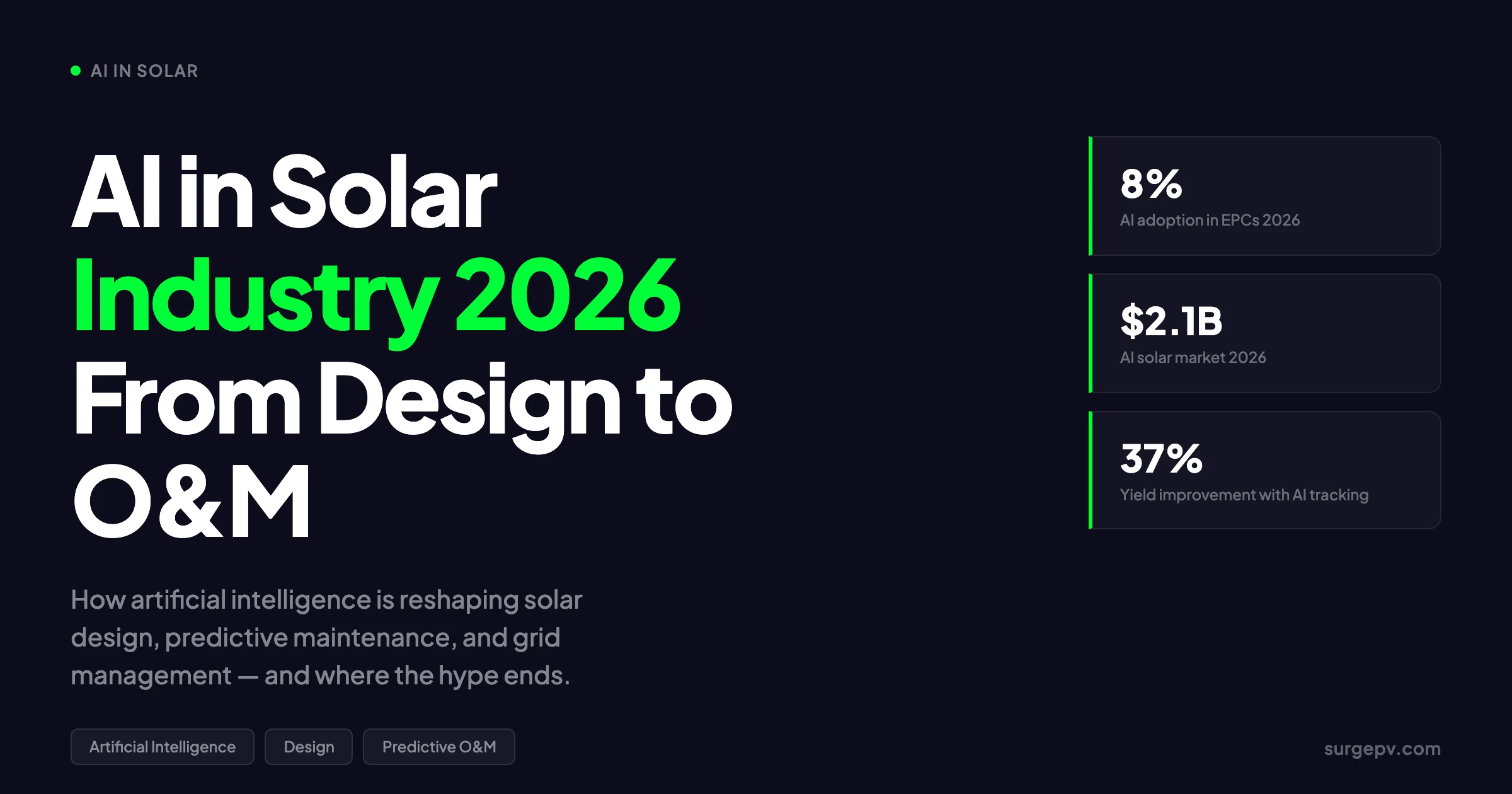
How many solar EPCs in 2026 are using AI for something other than roof line tracing? The answer, according to installer surveys, is under 8%. The AI narrative in solar is running far ahead of the reality.
The answer, according to installer surveys, is under 8%. Venture capital has poured over $2 billion into solar AI startups since 2022. McKinsey estimates AI-driven optimization can increase solar energy production by up to 20%.
Headlines promise that artificial intelligence will transform every corner of the solar industry — from automated design to self-healing power plants. Venture capital has poured over $2 billion into solar AI startups since 2022. McKinsey estimates AI-driven optimization can increase solar energy production by up to 20%. Deloitte calls AI and energy “the new power couple.” Yet walk onto most residential installation sites or into small EPC offices, and the tools on screen are the same ones from five years ago: AutoCAD, Excel, and a PDF markup tool.
This gap between promise and practice is the real story of AI adoption in solar in 2026. The technology works. The business cases are real. But deployment is concentrated in a narrow slice of the market — utility-scale asset owners with dedicated data science teams, large residential platforms with standardized workflows, and a handful of forward-leaning commercial EPCs. Everyone else is watching.
This guide covers where AI is actually making a difference in solar today, where the hype overshoots the evidence, and what the 2026–2030 roadmap looks like for installers, developers, and manufacturers who want to use AI rather than read about it.
TL;DR — AI Adoption in Solar 2026
AI adoption in solar is real but narrow: under 8% of EPCs use AI beyond basic automation. Utility-scale predictive maintenance ($0.9B market) and residential design AI (60–70% time savings) lead. Key players: NEXTracker TrueCapture (50+ GW), Aurora Solar SmartRoof, SurgePV Clara AI, Tigo module-level optimization (8.7% average energy reclaim). Barriers: data quality, integration costs, skills gaps, and trust. The 2026–2030 trajectory points to wider adoption as cloud costs fall and AI tools integrate into existing workflows rather than replacing them.
Read How to Design Residential Solar System for a complete walkthrough.
In this guide:
- Where AI is actually making a difference in solar 2026 — adoption rates by segment
- Automated design: PV layout, stringing, and wiring optimization
- Predictive O&M: Fault detection, drone inspection, and thermography
- Solar forecasting and grid management
- What most AI-in-solar reports get wrong — the contrarian view
- Sales and proposal AI: Automated quotes and lead scoring
- AI in solar manufacturing: Defect detection and yield optimization
- Adoption barriers and the real 2026–2030 roadmap
- Practical implications for installers and developers
Where AI Is Actually Making a Difference in Solar 2026
The solar industry is not a single market. AI adoption looks completely different across residential installation, commercial EPC, utility-scale development, and manufacturing. Understanding these segments is essential before evaluating any AI claim.
AI Adoption by Solar Segment 2026
| Segment | AI Adoption Rate | Primary AI Use Cases | Leading Platforms |
|---|---|---|---|
| Utility-scale asset management | 35–45% | Predictive maintenance, tracker optimization, forecasting | NEXTracker TrueCapture, GE Digital SmartSignal, Siemens Energy |
| Residential design/sales | 15–20% | Roof modeling, auto-layout, proposal generation | Aurora Solar, SurgePV Clara AI, OpenSolar |
| Commercial EPC (under 5 MW) | 5–10% | Design automation, financial modeling | HelioScope, PVsyst with plugins, custom Python |
| Solar manufacturing | 25–30% | Defect detection, yield optimization, predictive quality | Applied Materials, Meyer Burger, LONGi |
| Grid operations / ISOs | 40–50% | Forecasting, dispatch optimization, stability | Google DeepMind, NREL tools, AutoGrid |
The pattern is clear: AI adoption correlates with scale, data availability, and technical staff. A 500 MW utility plant generates enough performance data to train machine learning models. A residential installer doing 50 roofs a year does not. Grid operators have regulatory pressure to integrate variable renewables. Small EPCs have pressure to close the next sale.
The Concentration Problem
AI in solar is concentrated in two places: the very top of the market (utility-scale asset managers) and the software layer that serves high-volume residential platforms. The mid-market — commercial EPCs doing 1–10 MW projects, regional installers with 20–100 employees — is largely untouched by AI in 2026.
This matters because the mid-market represents the bulk of solar employment and installed capacity growth. BloombergNEF forecasts 649–753 GW of global solar additions in 2026. Most of that capacity will come from projects in the 100 kW–5 MW range, not gigawatt-scale plants. If AI stays concentrated at the extremes, its industry-wide impact will remain limited. For Global-specific compliance details, see Global net-metering-by-country. For Global-specific compliance details, see Global solar-permitting-speed-by-country.
Key Takeaway
AI adoption in solar follows a barbell pattern: heavy at the utility scale, growing in high-volume residential, thin everywhere else. The mid-market commercial EPC segment — where most solar gets built — has the lowest adoption and the most to gain.
Automated Design — PV Layout, Stringing, and Wiring Optimization
Automated solar design is the most visible AI application in solar. Every major design platform now claims some form of AI-assisted roof modeling, layout generation, or electrical optimization. The question is not whether AI can design a solar array — it can. The question is whether the output is good enough to use without significant human revision.
The Six-Layer AI Design Stack
Modern solar design AI operates across six layers, from vision to documentation:
| Layer | Function | AI Role | Time Saved |
|---|---|---|---|
| 1. Vision | Roof modeling from satellite/LiDAR | Computer vision detects planes, pitch, azimuth | 10–15 min |
| 2. Layout | Module placement with setbacks | Rules-based + generative placement | 15–25 min |
| 3. Generative | Multiple valid layout variations | ML scores variations by yield, cost, aesthetics | 5–10 min |
| 4. Validation | NEC/IEC compliance checking | Automated rule validation | 10–15 min |
| 5. Forecasting | P50/P90 yield simulation | Weather-adjusted energy modeling | 5–10 min |
| 6. Document | Permits, SLDs, proposals | Template generation from live data | 20–30 min |
The total time saving across all six layers: 60–70% for standard residential projects, dropping to 30–40% for complex commercial roofs with multiple HVAC obstructions and irregular shapes.
Clara AI: Integrated Design-to-Proposal Workflow
Clara AI, the built-in AI co-pilot for SurgePV, covers layers 2–4 of the design stack. It generates panel layouts based on roof geometry and shading constraints, applies NEC 690 fire setbacks and IEC 62548 compliance rules automatically, and produces up to 10 valid layout variations scored by annual yield.
What differentiates Clara AI from standalone roof detection tools is integration depth. The roof model feeds directly into compliance engines, yield simulation, and financial modeling in one continuous workflow. There are no manual handoffs between separate tools. For a standard residential project, the design-to-proposal cycle completes in a few minutes.
The accuracy benchmark is meaningful: SurgePV reports variance benchmarked against PVsyst, the industry-standard desktop simulator. For installer sales teams, this level of accuracy is sufficient for proposal generation. For bankable utility-scale projects, PVsyst remains the reference.
Aurora Solar SmartRoof: Market Leader in Volume
Aurora Solar’s SmartRoof technology is the most widely deployed AI roof modeling tool in U.S. residential solar. It generates 3D roof models from aerial and satellite imagery in a few seconds, detects obstructions automatically, and creates keep-out zones for vents and chimneys. For software options, see 7 Best Aurora Solar Alternatives in.
In 2026, Aurora optimized its AI pipeline using AI-assisted development techniques, reducing inference time from ~15 seconds to ~10 seconds per roof. The platform claims near-perfect accuracy for automated 3D modeling and shading analysis.
Aurora’s pricing reflects its market position: $2,640–$6,000+ per user per year, with a credit-based system that charges approximately $22 per residential project and $9 for the AI site modeling add-on. For high-volume installers doing 500+ projects per year, this cost is absorbed by time savings. For smaller firms, it represents a significant operational expense.
The Reality Check: What AI Design Gets Wrong
AI design tools are impressive for standard gable roofs with uniform pitch and minimal obstructions. They struggle with:
- Flat commercial roofs with parapet walls and multiple HVAC units — AI often misidentifies roof boundaries
- Irregular roof shapes — turrets, dormers, and curved surfaces defeat most computer vision models
- Local code variations — fire setbacks vary by jurisdiction; AI rule libraries are incomplete outside major markets
- Structural assumptions — AI cannot assess rafter spacing, roof load capacity, or electrical panel capacity without manual input
The most effective workflows in 2026 combine AI-generated first drafts with human validation of structural and code assumptions. Firms that try to eliminate designers entirely report higher revision rates and permitting rejections.
Pro Tip — Evaluating AI Design Tools
When testing an AI design platform, do not evaluate it on the demo roof. Test it on your five most complex recent projects — the ones with flat roofs, heavy shading, or irregular shapes. That is where the time savings either hold up or fall apart. Also verify that the platform’s electrical validation covers your local jurisdiction’s specific requirements, not just national codes.
Predictive O&M — Fault Detection, Drone Inspection, and Thermography
Predictive operations and maintenance is where AI delivers the clearest, most quantifiable ROI in solar. A utility-scale plant generating $5–10 million in annual revenue cannot afford unplanned downtime. Even a 1% energy loss from undetected faults represents $50,000–$100,000 in lost revenue.
The Predictive Maintenance Market
The solar farm predictive maintenance monitoring market reached $0.9 billion in 2026 and is projected to grow at 6.3% CAGR to $1.66 billion by 2036, according to Fact.MR. Inverter monitoring accounts for 32% of the market, followed by panel-level diagnostics and thermal inspection.
| Metric | Value |
|---|---|
| 2026 market size | $0.90 billion |
| 2036 forecast | $1.66 billion |
| CAGR (2026–2036) | 6.3% |
| Leading deployment type | Cloud-based (46% share) |
| Largest plant segment | Utility-scale over 50 MW (50% share) |
How AI Detects Solar Faults
AI predictive maintenance for solar combines multiple data sources:
- SCADA and inverter data — String-level current and voltage readings, analyzed for deviation from expected performance ratios
- Irradiance-normalized benchmarking — AI models adjust expected output for real-time weather conditions, reducing false positives by 60–85% versus raw SCADA alerts
- Thermography — Drone-mounted thermal cameras detect hot spots, PID degradation, and connection faults
- Visual inspection — High-resolution imagery identifies soiling, physical damage, and vegetation encroachment
- Electroluminescence — For manufacturing and commissioning, EL imaging reveals microcracks and cell defects
The machine learning pipeline trains on historical failure data to recognize patterns that precede known fault types. A string showing 3% underperformance on sunny days with normal irradiance may indicate a connection fault. A module with a 12°C temperature differential may have a bypass diode failure.
NEXTracker: From Tracking AI to Full Robotics
NEXTracker’s TrueCapture is the most deployed AI optimization system in utility-scale solar, active on over 50 GW across 300+ projects on five continents. TrueCapture goes beyond standard sun tracking with several AI-driven features:
- SmartCapture — 3D backtracking that addresses row-to-row shading on uneven terrain using digital twin modeling
- DiffuseBoost — AI-powered cloud tracking that divides sites into dynamic zones; only shaded areas switch to diffuse mode while others continue normal tracking
- Split Boost — Proprietary algorithm for half-cell modules that intentionally shades the bottom half to optimize angle of incidence on the top half during early morning and late evening
Independent validation by DNV, Black & Veatch, and other engineering firms confirms energy yield increases of 1–4% annually for most sites, and up to 6% on extreme terrain.
In 2025, NEXTracker made a major push into AI and robotics, appointing Dr. Francesco Borrelli as Chief AI and Robotics Officer and acquiring OnSight Technology (autonomous robotic inspection), SenseHawk (AI-enabled drone imagery), and Amir Robotics (water-free robotic cleaning). The 2026 trajectory points toward fully autonomous solar plant operation at multi-gigawatt scale. Also see: France solar feed-in tariffs. For the latest details on France, see Agricultural Solar Case Study.
Drone and Thermal Inspection: The Hardware Layer
The solar panel inspection drone market is growing at 8.7% CAGR (2026–2033), with AI-augmented thermal cameras improving defect detection accuracy to 97.3% while reducing inspection costs by approximately 18% over five years.
A typical utility-scale drone inspection workflow in 2026:
- Pre-programmed flight path captures thermal and visual imagery of all modules
- AI processes images in the cloud, flagging anomalies by severity
- Maintenance team receives prioritized work orders with GPS coordinates
- Follow-up inspection validates AI findings before dispatching repair crews
The economics are compelling for large plants. A 100 MW site that previously required two weeks of manual inspection can be surveyed in four hours by drone. At $500–$800 per MW for manual inspection versus $150–$300 per MW for drone inspection, the payback on drone hardware is under 12 months for asset managers with 500+ MW under management.
The Installer Story: Real Numbers from the Field
A regional O&M provider in Arizona managing 180 MW across 12 utility-scale sites deployed AI predictive maintenance in 2024. The results after 18 months:
- Fault detection rate improved from 73% (manual quarterly inspections) to 94% (AI + drone monthly surveys)
- Mean time to repair dropped from 14 days to 6 days due to precise GPS-tagged work orders
- Energy loss from undetected faults fell from 1.8% to 0.4% of annual production
- Total O&M cost per MW-year decreased from $12,500 to $9,800
The upfront investment was $340,000 for drone hardware, AI software licenses, and staff training. Annual savings of $486,000 produced payback in 8.4 months. This is the kind of case study that drives AI adoption in utility-scale O&M.
Key Takeaway — Predictive O&M ROI
For utility-scale asset managers, AI predictive maintenance pays back in 8–18 months through reduced downtime, faster repairs, and lower inspection costs. The barrier is not ROI — it is data infrastructure. Plants without granular SCADA data at the string level cannot train effective ML models.
Solar Forecasting and Grid Management
Solar forecasting is the quiet workhorse of grid AI. It does not make headlines like robot inspectors or generative design, but it determines whether grid operators can integrate solar at scale without massive curtailment or spinning reserve costs.
Why Forecasting Matters
Grid operators need to match supply and demand in real time. Solar output varies with cloud cover, season, and weather fronts. Without accurate forecasts, operators must over-procure flexible generation (gas peakers, batteries) to cover uncertainty. Every percentage point of forecast error translates directly into balancing costs.
The economic value is substantial. Google DeepMind’s wind prediction system, which uses similar techniques to solar forecasting, increased the value of wind energy by approximately 20% by enabling better scheduling 36 hours ahead. Applied to solar, equivalent improvements would save grid operators billions in balancing costs globally.
AI Forecasting Techniques
| Technique | Horizon | Accuracy Gain vs. Persistence | Application |
|---|---|---|---|
| Satellite-based cloud motion vectors | 5–30 minutes | 25–35% | Real-time dispatch |
| CNN on sky imagery | 15–60 minutes | 30–40% | Ramp event prediction |
| Hybrid LSTM-CNN on weather data | 1–6 hours | 20–30% | Unit commitment |
| Transformer-based weather models | 6–48 hours | 15–25% | Day-ahead markets |
| Physics-informed neural networks | 1–15 days | 10–20% | Maintenance scheduling |
NREL’s National Solar Radiation Database (NSRDB) remains the primary validation source for irradiance forecasting models. NREL research shows that AI forecasting integrated with battery energy storage systems can operate at nearly the same efficiency as perfect foresight scenarios — a remarkable result that validates the economic case for storage-plus-forecasting investments.
Google DeepMind and Open Climate Fix
Google DeepMind’s WeatherNext models represent the state of the art in AI weather forecasting. The GenCast model, released in late 2024, generates 15-day global forecasts at 0.25° resolution in 8 minutes on a single Google Cloud TPU. These forecasts feed into renewable energy prediction pipelines for both solar and wind.
The Open Climate Fix partnership, founded by ex-DeepMind employee Jack Kelly with Google.org funding, applies these models specifically to solar forecasting:
- UK grid operator NESO: 40% improvement in solar forecasting accuracy versus previous methods
- Indian state grid operators: 10% reduction in large errors, 5% reduction in mean error for 24–48 hour horizons Also see: Best Solar Design Software India.
These improvements translate directly into reduced curtailment and lower balancing costs. For a grid with 20 GW of solar capacity, a 5% forecast error reduction can save $10–$20 million annually in balancing and reserve procurement.
Siemens Energy: Grid-Scale AI Deployment
In April 2026, Siemens Energy opened an AI-powered grid facility in Central Florida specifically designed for seamless integration of solar and wind energy sources. The facility uses machine learning for:
- Predictive maintenance on grid infrastructure
- Automatic load balancing across distributed solar assets
- Real-time monitoring with thousands of data points per second
- Cybersecurity for critical grid infrastructure Also see: Us Residential Solar Market Trends 2026.
Siemens reports that 70% of new digital services for buildings now use ML or AI capabilities. Their Comfort AI product optimizes HVAC using solar radiation data among other inputs. For grid operators, the value proposition is clear: AI reduces the cost of integrating variable renewables by improving prediction accuracy and automating response.
Further Reading
For the broader context of how solar integrates with European grid policy and market design, see our guide to solar energy policies in Europe and European solar incentives. For community solar applications of AI-driven forecasting, see our community solar projects in Germany analysis.
See Community Solar Business Model for detailed guidance.
What Most AI-in-Solar Reports Get Wrong
The solar AI discourse in 2026 is dominated by three misconceptions that distort investment decisions and strategic planning. Addressing them directly is necessary for any installer or developer evaluating AI adoption.
Misconception 1: “AI Will Replace Solar Designers”
This is the most persistent and most damaging myth. AI does not replace solar designers. It removes repetitive tasks from their workflow, allowing them to handle more projects in the same time.
The evidence is clear. Firms that have adopted AI design tools report faster design times. None report corresponding headcount reductions. Instead, designers spend their time on complex commercial projects, custom engineering, client presentations, and quality assurance — the work that requires judgment and experience.
AI-generated layouts still require human validation of structural assumptions, local code compliance, and client-specific constraints. A computer vision model cannot assess whether a roof’s rafters can support a 25 kg/m² ballasted system. It cannot negotiate with a homeowner who wants panels hidden from street view. It cannot explain to a permitting office why a non-standard configuration meets code.
The replacement narrative sells software licenses. The augmentation narrative describes what actually happens.
Misconception 2: “AI Is Proven at Scale Across the Industry”
AI is proven at scale in specific niches: utility-scale predictive maintenance, high-volume residential design, and grid forecasting. It is not proven across the full solar value chain.
The 8% EPC adoption figure matters here. For every NEXTracker TrueCapture deployment on a 200 MW plant, there are a thousand residential installers who have never used AI. For every Aurora Solar design, there are five commercial EPCs still laying out arrays in AutoCAD.
The gap is not primarily technological. It is organizational. Small firms lack the data infrastructure, technical staff, and change management capacity to adopt AI tools. The tools exist. The ability to use them effectively does not.
Misconception 3: “AI Reduces Costs Automatically”
AI reduces specific costs in specific contexts. It does not automatically reduce total project costs.
Design AI reduces soft costs — the engineering and sales time that goes into producing a proposal. But soft costs are a fraction of total installed cost. For residential solar, soft costs account for approximately 55–65% of total cost in the U.S., but design time is only 10–15% of soft costs. Cutting design time by 70% reduces total installed cost by 4–7%. That is real money, but it is not a transformation.
For utility-scale plants, O&M AI can reduce costs by 10–15%. But O&M is 1–2% of total project cost. The impact on LCOE is measurable but modest.
Where AI has transformative potential is in enabling new business models: virtual power plants, dynamic tariff arbitrage, autonomous O&M at unmanned sites. These applications change what solar assets can do, not just what they cost.
The Tradeoff: Cloud AI vs. On-Device AI
A genuine tension in solar AI deployment is the choice between cloud-based processing and on-device inference. Each has clear tradeoffs:
| Factor | Cloud AI | On-Device AI |
|---|---|---|
| Computational power | Unlimited | Limited by hardware |
| Model complexity | Large, state-of-the-art | Smaller, optimized models |
| Data privacy | Data leaves premises | Data stays local |
| Latency | 100ms–2s | Under 50ms |
| Connectivity requirement | Requires internet | Works offline |
| Cost model | Subscription per user/project | Higher upfront hardware cost |
| Update frequency | Continuous | Manual firmware updates |
For design AI, cloud processing is standard — the models are large and the latency requirement is low. For inverter optimization and safety systems, on-device inference is preferred — latency matters and connectivity cannot be guaranteed. For predictive maintenance, a hybrid approach is emerging: edge devices preprocess data locally, with anomaly flags sent to cloud models for detailed analysis.
Data privacy is a growing concern. Commercial EPCs are reluctant to upload proprietary project designs to cloud AI platforms. Some firms require on-premise deployments or data residency guarantees. This friction slows adoption and increases cost.
Opinion — The Real AI Dividend
The near-term value of AI in solar is not cost reduction. It is speed and quality improvement. Faster design turnaround wins more deals. Earlier fault detection prevents larger failures. Better forecasting reduces curtailment. These benefits are real and measurable. But anyone selling AI as a magic cost-cutting tool is either naive or dishonest.
Design Solar Projects Faster with Clara AI
SurgePV’s Clara AI generates optimized PV layouts, applies compliance rules automatically, and produces permit-ready proposals — all in a few minutes for standard residential projects. Cut design time by 60–70% without sacrificing accuracy.
Book a DemoNo commitment required · 20 minutes · Live project walkthrough
Sales and Proposal AI — Automated Quotes, Lead Scoring, and CRM
The sales side of solar has seen rapid AI adoption, driven by a simple pressure: the cost of customer acquisition in residential solar has risen to $3,000–$5,000 per deal in many U.S. markets. Any tool that shortens the sales cycle or improves close rates delivers immediate ROI.
What Sales AI Does in Solar
| Function | AI Application | Typical Impact |
|---|---|---|
| Lead scoring | ML models predict conversion probability from demographic and behavioral data | 15–25% improvement in sales team productivity |
| Automated quoting | AI generates preliminary quotes from satellite imagery and utility bill data | Quote turnaround from 2–3 days to 10 minutes |
| Proposal generation | Templates populated from live design data with financial modeling | Proposal creation from 4 hours to 15 minutes |
| Chatbots and virtual assistants | Handle initial customer qualification and scheduling | 30–50% reduction in inbound call volume |
| Dynamic pricing | AI adjusts pricing based on competitor data, inventory, and demand | Margin optimization of 2–5% |
The Proposal Automation Stack
Modern solar sales AI connects three systems: lead capture, design automation, and proposal generation. The workflow looks like this:
- Homeowner enters address and uploads a utility bill on a website
- AI pulls satellite imagery, models the roof, and generates a preliminary system design
- Financial engine calculates savings, payback, and financing options
- Proposal document generates automatically with branded layout and local incentives
- Sales rep reviews, adjusts, and sends — or in some cases, the system sends automatically
This entire cycle can complete in a few minutes from lead capture to proposal delivery. For high-volume call center operations, this speed is essential. For consultative sales with complex roofs or commercial clients, human involvement remains critical.
SurgePV’s Integrated Approach
solar proposal software that connects directly to AI-generated designs eliminates the manual data transfer that causes errors and delays. When the design tool, financial model, and proposal generator share a single data layer, there is no re-keying of system size, panel count, or estimated production. The numbers in the proposal match the numbers in the design exactly.
For installers using separate tools — design in one platform, CRM in another, proposals in a third — the integration gap is where AI’s potential gets lost. Data exports, CSV imports, and manual copy-paste operations reintroduce the friction that AI is supposed to remove.
Lead Scoring: The Hidden AI Application
Lead scoring is less visible than design AI but equally impactful. Machine learning models trained on historical sales data can predict which leads are most likely to close, allowing sales teams to prioritize their time.
Variables that predict solar purchase behavior include:
- Home value and age
- Local electricity rates and recent rate increases
- Roof condition and shading from satellite imagery
- Credit score proxies (where legally available)
- Seasonal patterns (higher intent in spring, lower in winter)
- Response time to initial outreach
Solar companies using AI lead scoring report 15–25% improvements in sales team productivity by focusing effort on high-probability prospects. The models improve over time as more outcome data feeds back into training.
Pro Tip — Sales AI Implementation
Start with proposal automation before lead scoring. Proposal automation has an immediate, visible impact on sales cycle time that teams can feel. Lead scoring requires 6–12 months of historical data to train accurate models. Implement proposal automation first, collect structured outcome data, then add lead scoring once you have sufficient training data.
AI in Solar Manufacturing — Defect Detection, Yield Optimization, and Predictive Quality
Solar manufacturing is one of the most advanced AI applications in the industry, driven by the economics of scale. A gigawatt-scale cell factory produces 10,000+ wafers per hour. Human visual inspection cannot keep pace. AI can.
Defect Detection at Production Speed
Modern solar cell and module factories use AI vision systems at multiple stages:
| Stage | Inspection Target | AI Method | Detection Rate |
|---|---|---|---|
| Wafer incoming | Microcracks, thickness variation | Electroluminescence + CNN | 99.5%+ |
| Cell printing | Grid line alignment, paste coverage | High-speed camera + ML | 99.2%+ |
| Cell sorting | Efficiency binning, color matching | IV curve + spectral analysis | 99.0%+ |
| Module lamination | Bubbles, delamination, frame gaps | Thermal + visual inspection | 98.5%+ |
| Final test | Power output, insulation, EL imaging | Automated test + AI scoring | 99.8%+ |
The standard benchmark is electroluminescence (EL) imaging. An EL camera captures images of cells under forward bias, revealing microcracks, finger interruptions, and PID degradation that are invisible to the naked eye. AI models trained on millions of EL images classify defects by severity and type in milliseconds.
Yield Optimization: The Factory-Level View
Beyond individual defect detection, AI optimizes entire production lines. Machine learning models analyze process parameters — temperature, gas flow, deposition time, printing pressure — to identify the settings that maximize yield and efficiency.
A TOPCon cell line has 50+ process parameters that interact in nonlinear ways. Traditional statistical process control tracks each parameter independently. AI models capture interactions: how a slight increase in boron diffusion temperature affects passivation quality when combined with a specific ALD alumina thickness.
The result: manufacturers using AI process optimization report 0.3–0.5% absolute efficiency improvements and 2–4% yield gains. On a 10 GW production line, 0.3% efficiency improvement translates to $15–$25 million in additional annual revenue at current module prices.
Predictive Quality: Before Defects Happen
The frontier of manufacturing AI is predictive quality — identifying process drift before it produces defective cells. By monitoring sensor data from deposition chambers, diffusion furnaces, and printing lines, AI models detect subtle shifts that precede quality excursions.
For example, a gradual increase in chamber pressure during PECVD deposition may indicate nozzle wear. Caught early, maintenance replaces the nozzle during a scheduled downtime. Caught late, the chamber produces a batch of cells with poor passivation that must be scrapped or downgraded.
The economics are compelling. A single unplanned downtime event on a modern cell line costs $50,000–$100,000 in lost production. Predictive quality systems that prevent one such event per month pay for themselves in under a year.
The Major Players
| Company | AI Application | Scale |
|---|---|---|
| LONGi | Cell efficiency optimization, defect detection | 100+ GW capacity |
| Tongwei | Smart manufacturing, process AI | 90+ GW capacity |
| JA Solar | EL inspection automation, yield modeling | 80+ GW capacity |
| Meyer Burger | Heterojunction process control | 3+ GW (premium segment) |
| Applied Materials | Equipment-level AI, predictive maintenance | Equipment supplier to industry |
Chinese manufacturers lead in manufacturing AI deployment, driven by scale and government support for smart manufacturing initiatives. European and U.S. manufacturers are catching up but operate at smaller scale with less data to train models. Also see: European Solar Tax Credits.
Key Takeaway — Manufacturing AI
Solar manufacturing AI is the most mature application in the industry because the economics are unambiguous and the data is abundant. A modern cell factory generates terabytes of sensor and image data daily. The constraint is not AI capability — it is integration with legacy equipment and process engineering expertise to interpret AI recommendations.
Adoption Barriers and the Real 2026–2030 Roadmap
Understanding why AI adoption in solar is limited to 8% of EPCs requires examining the barriers honestly. None are insurmountable. All are real.
Barrier 1: Data Quality and Availability
AI models need training data. Most solar companies do not have it in usable form.
- SCADA data is often stored in proprietary formats, incomplete, or missing string-level granularity
- Design data lives in PDFs, AutoCAD files, and email threads rather than structured databases
- Sales data is fragmented across CRMs, spreadsheets, and paper records
- O&M records are handwritten logs or unstructured work order notes
Cleaning and structuring this data is a prerequisite for AI. It is also expensive and unglamorous. Companies that skip this step and buy AI tools anyway get poor results, reinforcing skepticism.
Barrier 2: Integration with Legacy Systems
Most solar companies run on a patchwork of software: a CRM from one vendor, a design tool from another, accounting in QuickBooks or SAP, and project management in spreadsheets or Asana. AI tools that do not integrate with this stack create more work, not less.
The integration challenge is particularly acute for predictive maintenance. A utility plant may have SCADA from Schneider Electric, inverters from SMA, trackers from NEXTracker, and a CMS from a fourth vendor. Getting data from all four into a unified AI platform requires custom API work, data mapping, and ongoing maintenance.
Barrier 3: Cost and Skills
AI design tools cost $1,300–$6,000 per user per year. Predictive maintenance platforms charge $5–$15 per kW-year. For a 10-person residential installer, $30,000–$50,000 in annual software costs is significant. For a commercial EPC with thin margins, it is a hard sell without proven ROI.
Skills are equally limiting. Small firms do not have data scientists. They have project managers who learned Excel in college and designers who know AutoCAD. Adopting AI requires training, support, and tolerance for a learning curve that temporarily reduces productivity.
Barrier 4: Trust and Black-Box Resistance
Solar engineers are conservative by necessity. A design error costs money. A safety error costs lives. When an AI tool produces a layout that violates a local fire code or an inverter recommendation that does not match the engineer’s manual calculation, the default response is distrust.
Explainable AI — models that show their reasoning, not just their output — is slowly addressing this. But most current tools are black boxes. Users see the result without understanding how it was derived. For engineers trained to verify every assumption, this is unacceptable.
The 2026–2030 Roadmap: What Actually Happens
Based on current trajectories, here is the realistic adoption timeline:
| Year | Expected Development | Adoption Impact |
|---|---|---|
| 2026 | Current state: 8% EPC adoption, concentrated in utilities and high-volume residential | Baseline |
| 2027 | AI design tools integrate into existing platforms (CRM + design + proposal in one) | Residential adoption rises to 25–30% |
| 2028 | Cloud AI costs fall 40–50%; on-device inference improves for edge applications | Mid-market commercial EPCs begin adoption |
| 2029 | Standardized data formats emerge (industry consortium or regulatory push) | Data barrier reduces significantly |
| 2030 | AI becomes default in new software; “non-AI” tools are the exception | 50%+ adoption across all segments |
The key enabler is not better AI algorithms. It is better integration. AI that works inside tools that installers already use — adding intelligence to familiar workflows rather than replacing them — will drive adoption far faster than standalone AI platforms.
Opinion — The Integration Imperative
The solar AI companies that win will not be the ones with the most advanced models. They will be the ones with the best integrations. An AI model that is 95% accurate but requires exporting data to a separate platform will lose to a model that is 90% accurate but runs inside the CRM the team already uses every day.
Practical Implications for Installers and Developers
What should a solar company do about AI in 2026? The answer depends on size, segment, and technical maturity.
For Residential Installers (Under 50 Employees)
Priority 1: Proposal automation. If you are not using automated proposal generation connected to your design tool, start there. The ROI is immediate and visible. Customer-ready solar proposals that pulls live design data into branded proposals cuts turnaround time from hours to minutes.
Priority 2: AI-assisted design. Evaluate one AI design platform on your five most complex recent projects. Measure actual time savings, not vendor claims. If the tool saves 30+ minutes per design and the subscription cost is under $200 per user per month, the math works.
Priority 3: Lead scoring. Only after you have 12+ months of structured sales data in a CRM. Without data, lead scoring is guesswork.
For Commercial EPCs (1–10 MW Projects)
Priority 1: Standardize data collection. Before buying any AI tool, structure your project data. Every roof measurement, every shading analysis, every equipment spec should live in a database, not a PDF. This is unglamorous work but essential.
Priority 2: Shading and irradiance AI. For commercial projects, solar shadow analysis software with AI-assisted obstruction detection saves significant field survey time. Accuracy is critical at commercial scale — a 5% yield error on a 2 MW project represents $100,000+ in mismodeled revenue.
Priority 3: Financial modeling integration. Connect your design output directly to financial models. Manual data transfer between design and finance is where errors hide.
For Utility-Scale Developers and Asset Managers
Priority 1: Predictive maintenance. If you manage 100+ MW, the ROI case is clear. Start with inverter monitoring (highest impact, most mature) and expand to module-level diagnostics.
Priority 2: Tracker AI. If you use single-axis trackers, evaluate NEXTracker TrueCapture or equivalent. The 1–4% yield improvement pays for the software premium.
Priority 3: Forecasting integration. Work with your grid operator to integrate AI forecasting into dispatch scheduling. The savings are shared but real.
What Not to Do
- Do not buy AI because competitors mention it in press releases
- Do not implement AI without a data foundation — garbage in, garbage out
- Do not expect AI to replace judgment in complex projects
- Do not ignore the training and change management required
- Do not choose a platform based on feature lists alone — integration matters more
Pro Tip — Pilot Before Scaling
Run a 30-day pilot with any AI tool on live projects before committing to an annual contract. Measure time saved, error rates, and team satisfaction. A tool that saves time but produces designs your permitting department rejects is not saving time.
Conclusion
AI adoption in the solar industry in 2026 is real, measurable, and narrower than the headlines suggest. The technology works best where data is abundant, processes are standardized, and ROI is quantifiable: utility-scale predictive maintenance, high-volume residential design, and grid forecasting. Everywhere else, adoption is thin and the barriers are organizational, not technical.
The gap between AI promise and solar reality will close over the next five years, but not because AI becomes dramatically more capable. It will close because AI becomes embedded in tools that installers already use, because data standards emerge, and because a generation of solar professionals grows up with AI as a default feature rather than a novel add-on.
The installers and developers who benefit first will be the ones who start now — not with grand AI strategies, but with specific, bounded pilots that solve real problems. A proposal tool that cuts turnaround time. A shading analysis that reduces site visits. A predictive maintenance alert that prevents a costly inverter failure.
Three actions for 2026:
- Audit your current workflow for the highest-friction handoff — design to proposal, site survey to layout, or fault detection to repair dispatch. That is where AI will deliver the fastest return.
- Standardize your data collection before evaluating AI tools. A design database with 500 projects is worth more than a subscription to the most advanced AI platform.
- Start with augmentation, not replacement. The firms seeing the best results use AI to make their teams faster, not smaller.
For solar companies building their technology stack, solar design software with integrated AI capabilities is the foundation. The future belongs to firms that combine human expertise with machine efficiency — not one or the other.
For installers evaluating the broader solar software market, solar software platform connects AI-assisted design with automated proposals, real-time financial modeling, and proposal generation in a single workflow. For more on how AI fits into the broader solar software ecosystem, see our guide to software for solar systems.
Frequently Asked Questions
What percentage of solar companies use AI in 2026?
According to installer surveys, under 8% of solar EPCs use AI for anything beyond basic roof line tracing or automated shading analysis. The majority of AI adoption is concentrated in utility-scale asset management, where predictive maintenance platforms monitor 50+ GW globally. Residential and small commercial installers lag significantly, with most still relying on manual design workflows.
How is AI used in solar panel design?
AI in solar panel design automates roof modeling from satellite imagery, generates optimal PV layouts with fire setback compliance, sizes strings and inverters, and produces multiple design variations scored by annual yield. Platforms like SurgePV Clara AI and Aurora Solar SmartRoof cut initial layout time from 20–40 minutes to a few minutes. AI also handles shading analysis, electrical validation, and permit-ready document generation.
Can AI predict solar panel failures?
Yes. AI predictive maintenance for solar uses thermography, drone imagery, and inverter performance data to detect faults before they cause downtime. Machine learning models trained on historical failure data can identify underperforming strings, hot spots, PID degradation, and inverter anomalies with 60–85% fewer false positives than traditional SCADA alerts. The solar farm predictive maintenance market reached $0.9 billion in 2026.
What is the ROI of AI in solar operations?
AI delivers measurable ROI across solar operations: predictive maintenance reduces O&M costs 10–15% and downtime up to 50% (IEA data). Solar tracker AI like NEXTracker TrueCapture adds 1–4% annual energy yield. Module-level optimizers from Tigo reclaim 8.7% energy on average from shading and mismatch. Sales AI shortens proposal turnaround from days to minutes. Most AI investments in solar pay back within 12–24 months.
Will AI replace solar designers?
No. AI augments solar designers rather than replacing them. The most effective workflows in 2026 combine AI-generated layouts with human validation of structural assumptions, local code compliance, and client-specific constraints. AI handles repetitive tasks — roof tracing, string sizing, shading simulation — while designers focus on complex commercial projects, custom engineering, and client relationships. Firms using AI report faster design times, not smaller teams.
Which solar companies are leading in AI adoption?
NEXTracker leads in utility-scale AI with TrueCapture (50+ GW deployed) and a new AI/robotics division. Aurora Solar dominates residential AI design with SmartRoof. SurgePV’s Clara AI integrates design, compliance, and proposal generation. SolarEdge and Enphase apply AI to inverter optimization and home energy management. Tigo uses AI for module-level performance analytics. On the grid side, Siemens Energy opened an AI-powered grid facility in 2026, and Google DeepMind’s weather models improve solar forecasting accuracy 40% in pilot programs.
What are the barriers to AI adoption in solar?
The main barriers are data quality and availability, integration with legacy SCADA systems, upfront software costs ($1,300–$6,000/year per user for design AI), skills gaps in smaller installer firms, and trust — many EPCs prefer manual verification over black-box AI recommendations. Data privacy concerns also slow adoption, particularly for cloud-based design tools handling proprietary project data.
How does AI improve solar energy forecasting?
AI improves solar energy forecasting by combining satellite imagery, weather models, and historical generation data to predict output 15 minutes to 15 days ahead. Google DeepMind’s WeatherNext models and Open Climate Fix partnerships have improved UK solar forecasting accuracy by 40% and reduced large-error rates in India by 10%. Better forecasting lets grid operators schedule dispatch more efficiently, reducing curtailment and balancing costs. NREL research shows AI forecasting integrated with storage can operate at nearly the same efficiency as perfect foresight scenarios. For India-specific information, see 5kW Solar Panel Price in India. Read more about Battery Solar System Design UK.
Where this fits
This article is part of SurgePV's Solar Business & Operations hub, which works through the topic from first principles to the decisions a project team actually has to make.

