

Quick Answer
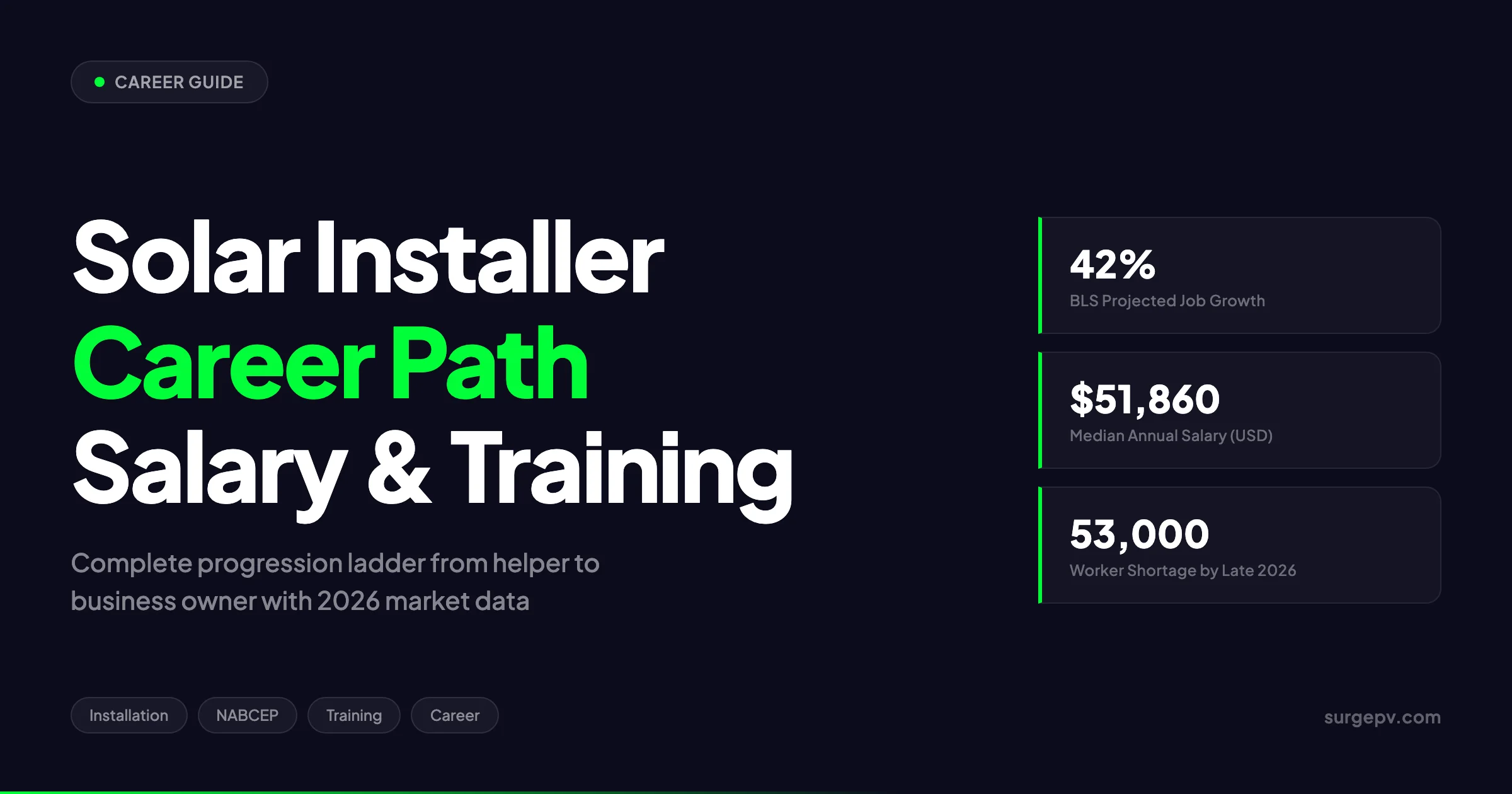
The BLS projects 42% employment growth between 2024 and 2034, a rate that dwarfs the 4% average across all occupations. This guide covers every stage of the solar installer career path in 2026. Most crews arrive at the shop or job site between 6:30 and 7:30 AM.
Solar photovoltaic installer is the fastest-growing occupation tracked by the U.S. Bureau of Labor Statistics. The BLS projects 42% employment growth between 2024 and 2034, a rate that dwarfs the 4% average across all occupations. Yet the industry faces a paradox: employers need an estimated 53,000 additional workers by late 2026 to meet installation targets, while 86% of solar companies report difficulty filling open positions. For anyone considering this trade, the math is simple. Demand exceeds supply, barriers to entry are low, and the career ladder runs from $39,000 entry-level wages to six-figure management roles.
The BLS projects 42% employment growth between 2024 and 2034, a rate that dwarfs the 4% average across all occupations. This guide covers every stage of the solar installer career path in 2026. Most crews arrive at the shop or job site between 6:30 and 7:30 AM.
This guide covers every stage of the solar installer career path in 2026. You will learn what the job actually involves, how much you can earn at each level, which certifications matter, how training pathways compare, what state licensing looks like, and how to move from helper to business owner. The article also covers non-roof career paths, technology trends reshaping the role, and the practical choice between employment and independent contracting.
TL;DR — Solar Installer Career Path 2026
Solar installers earn a median $51,860 per year in the United States with a 42% projected job growth through 2034. Entry requires a high school diploma and OSHA 10 certification. The NABCEP PV Associate credential opens doors. Lead installers earn $58,000 to $72,000. Project managers and business owners can earn $75,000 to $100,000+. The strongest opportunities in 2026 are in utility-scale, commercial, and battery storage sectors.
For more on this topic, see Adding Battery Storage Services.
What this guide covers:
- What solar installers do on a daily basis
- Job market conditions and demand by state in 2026
- The complete career progression ladder with salaries at each stage
- Step-by-step guide to becoming a solar installer
- Certifications that affect pay and employability
- Specialization tracks with salary premiums
- State-by-state licensing requirements
- How solar installation compares to other trades
- Non-installation career paths within the solar industry
- How technology is changing the installer role
- Freelance versus employee career routes
What Does a Solar Installer Actually Do?
A solar installer assembles, sets up, and maintains solar panel systems on rooftops, ground mounts, and commercial buildings. The work splits into two broad categories: mechanical installation and electrical interconnection. On a typical residential job, the installer mounts racking systems to the roof structure, attaches panels to the racking, runs conduit from the array to the inverter location, wires DC strings or microinverters, installs the inverter and any battery storage units, and connects the system to the main electrical panel. On commercial or utility-scale projects, the scale changes but the core tasks remain the same.
A Day in the Life
The day starts early. Most crews arrive at the shop or job site between 6:30 and 7:30 AM. The lead installer holds a brief safety meeting, reviews the job packet including roof diagrams and electrical schematics, and assigns tasks. Helpers unload equipment from the truck while installers inspect the roof structure and mark layout lines. By mid-morning, the crew is mounting rails, attaching clamps, and lifting panels into place. Lunch is typically 30 minutes on site. The afternoon involves wiring, inverter installation, and system testing. A standard residential installation of 20 to 30 panels takes one to two days for a three-person crew.
Physical Demands and Environment
Solar installation is outdoor physical labor. Installers spend 80% of their time on rooftops or elevated platforms. The job requires lifting 50 pounds repeatedly, climbing ladders, working in direct sun, and maintaining balance on sloped surfaces. Work occurs in all weather except heavy rain, snow, or high winds. In hot climates, summer work starts before dawn to avoid midday heat. In northern states, winter schedules shrink and crews pivot to maintenance, battery retrofits, or indoor electrical work.
Seasonality
The work is seasonal in most markets. Peak installation season runs from March through October in temperate climates. November through February sees reduced volume, though battery storage retrofits and maintenance work partially offset the slowdown. Installers in year-round markets such as Arizona, Florida, Southern California, and Texas experience steadier schedules. Many installers use the slow season to complete training courses, pursue certifications, or take vacation.
Pro Tip
Installers who learn battery storage integration and basic electrical troubleshooting gain year-round employability. Battery retrofits and service calls fill the winter gap in seasonal markets.
Solar Installer Job Market in 2026
The solar installer job market in 2026 presents a split picture. Long-term fundamentals are exceptional. Short-term conditions vary by sector and geography.
The Growth Numbers
The Bureau of Labor Statistics projects 42% employment growth for solar photovoltaic installers from 2024 to 2034. This translates to approximately 4,100 job openings per year over the decade. The Solar Energy Industries Association estimates the broader U.S. solar workforce now exceeds 280,000 people. To meet deployment targets of 60 to 70 gigawatts annually, the industry needs roughly 355,000 workers by late 2026.
The gap is real. A PV Magazine analysis published in April 2026 identified a workforce shortfall of 53,000 positions threatening deployment targets. The shortage is most acute for mid-level technical roles, crew supervisors, and utility-scale project developers. Also see: Us Residential Solar Market Trends 2026.
Residential Sector Challenges
The U.S. residential rooftop market contracted in 2026. The federal residential solar investment tax credit expired on December 31, 2025, removing a 30% subsidy that had driven consumer adoption for over a decade. Major installers including Freedom Forever pulled out of multiple states. Purelight Power filed for bankruptcy. Analysts project residential installations could fall by approximately 20% to their lowest levels since 2020.
This contraction primarily affects entry-level residential installers. Companies focused on rooftop solar have reduced hiring, consolidated operations, or shifted toward commercial and battery storage services. Installers who built their careers exclusively on residential rooftops in 2023 to 2025 face the toughest adjustment.
Utility-Scale and Commercial Resilience
While residential struggles, utility-scale and commercial solar continue to expand. The Inflation Reduction Act’s production tax credits and investment tax credits for commercial and utility projects remain in effect through at least 2032. Developers are racing to meet construction deadlines tied to federal incentives. The Bureau of Labor Statistics confirms that utility-scale solar remains a primary driver of installer demand.
Battery storage integration is the fastest-growing sub-sector. Solar-plus-storage projects require installers with electrical skills beyond basic panel mounting. Installers who can wire battery inverters, configure energy management systems, and troubleshoot DC-to-AC conversion issues are in the highest demand.
Demand by State
Not all markets are equal. The following table shows the top states for solar installer demand in 2026 based on installed capacity growth, policy support, and employer hiring activity.
| State | 2026 Demand Drivers | Median Salary | Licensing Requirement |
|---|---|---|---|
| California | NEM 3.0 transition, storage mandate, commercial growth | $56,000+ | C-10 electrical contractor license required for electrical work |
| Texas | ERCOT grid stress, commercial/utility boom, no state income tax | $48,000 | No state solar license; local permits required |
| Florida | Net metering debates, hurricane resilience, battery growth | $44,000 | Electrical contractor license required |
| Arizona | Year-round sun, utility-scale projects, retirement community demand | $49,000 | ROC specialty license for solar |
| New York | NY-Sun program, community solar, storage incentives | $54,000 | Electrical license or supervised apprentice |
| Massachusetts | SMART program, SREC market, cold-climate storage | $55,000 | Electrical license required for interconnection |
| North Carolina | Utility-scale pipeline, Duke Energy programs | $45,000 | Electrical license required for electrical work |
| Nevada | NV Energy programs, desert utility-scale projects | $47,000 | C-2 electrical license for electrical work |
| Colorado | Xcel Energy programs, municipal solar mandates | $50,000 | Electrical license for interconnection |
| Illinois | Adjustable Block Program, community solar growth | $49,000 | Electrical license or supervised work |
California leads in absolute numbers but also in competition for jobs. Texas and Florida offer strong growth with lower costs of living. Arizona and Nevada benefit from year-round installation seasons that provide steadier employment.
International Context
The installer shortage is global. Germany needs an estimated 60,000 additional trained solar workers by 2026 to meet its 215 gigawatt by 2030 target. Current training capacity covers approximately 60% of that need. South Africa created over 18,000 direct solar jobs in 2025 and projects to double that by 2027. India, under its PM Surya Ghar Muft Bijli Yojana scheme, is training tens of thousands of rooftop solar installers. Also see: Germany solar subsidies. Also see: Best Solar Design Software India. For Africa-specific compliance details, see Africa solar compliance.
For installers willing to relocate, international opportunities are abundant. European markets particularly value installers with NABCEP or equivalent credentials and English language skills. See our dedicated guide on solar installer jobs in Germany for detailed information on that market. Also see: European Solar Incentives. For Europe-specific compliance details, see Europe solar compliance.
Solar Installer Career Path: The Complete Progression Ladder
The solar installer career path follows a clear ladder. Each rung brings new responsibilities, higher pay, and additional training requirements. The timeline from helper to business owner typically spans 10 to 15 years, though exceptional performers move faster. The IREC Solar Career Map provides an interactive visualization of the full range of solar career pathways for reference.
Stage 1: Helper / Assistant (0 to 1 Year)
Salary: $35,000 to $45,000 per year Hourly: $17 to $22 Responsibilities: Carry materials, pass tools, assist with panel lifting, keep the work site clean, learn basic safety protocols, and observe experienced installers. Requirements: High school diploma or GED, physical fitness, willingness to work at heights. Typical Day: Arrives on site, unloads panels and racking from the truck, hands tools to installers, helps lift panels onto the roof, cleans up debris, and loads the truck at day’s end.
This is the entry point. Most helpers have zero solar experience. Employers value punctuality, coachability, and a strong work ethic over technical knowledge. The best helpers ask questions, take notes, and volunteer for tasks beyond their assigned role. Within three to six months, a motivated helper begins assisting with basic mounting tasks.
Stage 2: Installer (1 to 3 Years)
Salary: $45,000 to $58,000 per year Hourly: $22 to $28 Responsibilities: Mount racking systems, attach solar panels, run conduit, make basic electrical connections under supervision, read system designs, and follow NEC compliance protocols. Requirements: OSHA 10 certification, 6 to 12 months of field experience, basic tool proficiency. Typical Day: Leads the mounting phase of installation, measures and cuts rails, installs flashing and sealant, secures panels to racking, and runs conduit from the array to the inverter location.
At this stage, the installer works independently on mechanical tasks but still receives oversight on electrical work. Most installers at this level pursue the NABCEP PV Associate credential to demonstrate foundational knowledge. The role demands attention to detail. A single improperly torqued bolt or unsealed roof penetration can cause leaks or system failures.
Stage 3: Lead Installer / Crew Chief (3 to 5 Years)
Salary: $52,000 to $68,000 per year Hourly: $25 to $33 Responsibilities: Direct a crew of 2 to 4 installers, assign daily tasks, ensure code compliance, troubleshoot installation issues, interface with the project manager, and train junior staff. Requirements: NABCEP PV Installation Professional certification or equivalent experience, 3+ years of documented installation work, demonstrated leadership ability. Typical Day: Reviews the job packet before the crew arrives, assigns roles for the day, performs quality checks on mounting and wiring, resolves technical problems on site, and submits daily progress reports.
The lead installer is the on-site decision maker. This person needs technical depth across mounting systems, electrical codes, and safety protocols. Lead installers also serve as the primary training resource for new hires. Companies prize lead installers who can maintain both production speed and quality standards.
Stage 4: Site Supervisor / Foreman (5 to 8 Years)
Salary: $60,000 to $78,000 per year Hourly: $29 to $38 Responsibilities: Oversee multiple crews across concurrent projects, manage site safety programs, coordinate with general contractors and inspectors, handle permit-related site visits, and resolve escalated technical issues. Requirements: OSHA 30 certification, extensive installation experience, electrical licensing in many states, proven team management skills. Typical Day: Rotates between 2 to 4 active job sites, conducts safety audits, meets with inspectors, reviews crew performance metrics, and coordinates material deliveries with the operations team.
Site supervisors spend less time on the roof and more time managing people and logistics. The role requires strong communication skills, conflict resolution ability, and deep technical knowledge to handle unexpected site conditions. Many supervisors hold electrical licenses, which allows them to sign off on interconnection work without a separate electrician visit.
Stage 5: Project Manager (8+ Years)
Salary: $70,000 to $95,000 per year Hourly: Salaried position Responsibilities: Manage project timelines, budgets, and client relationships, coordinate between sales, design, installation, and utility interconnection teams, handle change orders, and ensure projects close on time and within budget. Requirements: Bachelor’s degree preferred but not required with sufficient experience, project management certification (PMP or CAPM) beneficial, deep industry knowledge across all project phases. Typical Day: Reviews project schedules in the morning, responds to client inquiries, visits active job sites for quality audits, meets with utility representatives on interconnection timelines, and prepares project status reports for leadership.
Project managers bridge the gap between field operations and business operations. The best project managers started as installers and understand the realities of roof work, weather delays, and material shortages. This background earns respect from field crews and enables realistic project planning.
Stage 6: Operations Manager / Business Owner (10+ Years)
Salary: $85,000 to $150,000+ per year Hourly: Salaried position or business profit Responsibilities: Run an installation division or an entire company, set hiring and training standards, manage profit and loss, develop vendor relationships, and set strategic direction. Requirements: Business acumen, financial management skills, extensive industry network, and typically 10+ years of progressive experience. Typical Day: Reviews financial reports, meets with department heads, negotiates vendor contracts, reviews proposals for major projects, and handles regulatory or legal matters.
Many successful solar business owners started as installers. The path from helper to owner is well-documented in the industry. Owners who understand installation firsthand make better decisions about pricing, scheduling, and crew management than owners who enter from unrelated fields.
Alternative Advancement Tracks
Not every installer wants to manage people. Several technical specialization paths offer strong pay without management responsibility:
- System Designer / CAD Technician: Uses solar design software to create permit-ready system plans. Salary range: $55,000 to $85,000.
- Commissioning Technician: Tests and certifies completed systems, troubleshoots performance issues, and handles warranty claims. Salary range: $60,000 to $90,000.
- O&M Specialist: Performs maintenance, cleaning, and repairs on existing systems. Salary range: $50,000 to $75,000.
- Technical Sales / Sales Engineer: Combines installation knowledge with sales skills to consult on complex projects. Commission-based total earnings: $70,000 to $150,000+.
- Trainer / Educator: Teaches new installers at training centers or community colleges. Salary range: $55,000 to $80,000.
Solar Installer Salary Guide by Experience Level
Solar installer salaries vary widely based on experience, location, certifications, and sector. The following data combines Bureau of Labor Statistics figures, Salary.com benchmarks, and industry reporting for 2025 to 2026.
National Salary Benchmarks
| Experience Level | Annual Salary | Hourly Wage | Typical Responsibilities |
|---|---|---|---|
| Entry (0-1 year) | $35,000 - $45,000 | $17 - $22 | Helper tasks, material handling, basic mounting assistance |
| Junior (1-2 years) | $42,000 - $52,000 | $20 - $25 | Independent mounting, conduit runs, supervised electrical work |
| Mid-Level (2-4 years) | $48,000 - $62,000 | $23 - $30 | Full installation tasks, quality checks, minor troubleshooting |
| Senior (4-6 years) | $55,000 - $72,000 | $26 - $35 | Lead installation, crew direction, code compliance oversight |
| Supervisor (6-10 years) | $65,000 - $85,000 | $31 - $41 | Multi-crew oversight, safety management, inspector coordination |
| Management (10+ years) | $80,000 - $120,000+ | Salaried | P&L responsibility, strategic planning, vendor management |
Salary by State
Location is the single biggest factor affecting solar installer pay after experience level. High-cost states with strong solar markets pay premiums. States with lower costs of living and weaker demand pay less, though purchasing power may be equivalent.
| State | Entry-Level | Median | Senior / Lead | Top 10% |
|---|---|---|---|---|
| California | $38,000 | $56,000 | $72,000 | $95,000+ |
| Massachusetts | $40,000 | $55,000 | $70,000 | $92,000+ |
| Hawaii | $42,000 | $60,000+ | $78,000 | $105,000+ |
| New York | $38,000 | $54,000 | $68,000 | $88,000+ |
| Colorado | $37,000 | $50,000 | $64,000 | $82,000+ |
| Arizona | $36,000 | $49,000 | $62,000 | $80,000+ |
| Texas | $35,000 | $48,000 | $60,000 | $78,000+ |
| Florida | $32,000 | $44,000 | $56,000 | $72,000+ |
| North Carolina | $34,000 | $45,000 | $58,000 | $75,000+ |
| National Median | $36,000 | $51,860 | $65,000 | $80,150+ |
Overtime and Seasonal Earnings
Overtime is common in solar installation. During peak season, installers frequently work 50 to 60 hours per week. At time-and-a-half rates, a $25-per-hour installer earns $37.50 for overtime hours. A worker putting in 10 overtime hours weekly for 20 weeks adds approximately $7,500 to annual earnings. Some companies offer project completion bonuses ranging from $100 to $500 per job depending on size and complexity.
How Certifications Affect Pay
Certifications create measurable salary premiums. The NABCEP PV Installation Professional credential can increase starting offers by $3,000 to $5,000 annually. Electrical licensing creates the largest premium, with licensed electricians in solar roles earning 25% to 40% more than unlicensed counterparts. Battery storage certifications from major manufacturers add another $2,000 to $4,000 to base salary.
Benefits
Full-time solar installers typically receive health insurance, paid time off, and retirement contributions. Larger companies may offer tool allowances, vehicle stipends, and tuition reimbursement for certification courses. Unionized installers in some markets receive additional pension and health benefits through IBEW or similar organizations.
How to Become a Solar Installer in 2026
Becoming a solar installer requires less time and money than most skilled trades. The fastest path from zero experience to paid work takes 1 to 3 months. The path from helper to certified professional takes 1 to 2 years.
Minimum Requirements
The baseline requirements are minimal:
- High school diploma or GED
- Valid driver’s license
- Ability to lift 50 pounds repeatedly
- Comfort working at heights on ladders and roofs
- Basic math skills for measurements and calculations
- Clean background check (required by many employers for site access)
Physical fitness matters. Installers who struggle with lifting, climbing, or heat exposure face shorter careers. The job is demanding, and employers prefer candidates who demonstrate stamina and coordination.
Step 1: Obtain OSHA 10 Construction Certification
OSHA 10 is the baseline safety credential for construction work. The 10-hour course covers fall protection, electrical safety, hazard communication, and personal protective equipment. Most employers require OSHA 10 before allowing workers on active job sites.
The course costs $50 to $100 and takes one to two days to complete online or in person. OSHA 10 certificates do not expire officially, though many employers require refresher training every 3 to 5 years. For supervisory roles, OSHA 30 (a 30-hour advanced course) becomes necessary.
Step 2: Complete a Solar Training Program
Several training pathways exist. The right choice depends on your budget, timeline, and learning style.
| Training Pathway | Duration | Cost | Best For |
|---|---|---|---|
| On-the-job training | 1-6 months | Free (paid while learning) | Those who need income immediately |
| Vocational / bootcamp | 3-6 months | $2,000 - $8,000 | Fast credentialing with structured learning |
| Community college certificate | 6-12 months | $3,000 - $15,000 | Comprehensive education with college credit |
| Apprenticeship (IBEW, etc.) | 2-4 years | Free (paid throughout) | Highest long-term earning potential |
| Self-study + exam prep | 2-6 months | $500 - $2,000 | Motivated self-learners with some background |
On-the-job training is the most common entry route. Many solar companies hire helpers with no experience and train them on active installations. This path earns money from day one but provides less structured education. Quality varies significantly by employer.
Vocational programs at technical schools offer focused curricula in solar installation, electrical basics, and NEC code requirements. Programs typically run 3 to 6 months full-time or 6 to 12 months part-time. Look for programs with hands-on lab components and job placement assistance.
Community college certificates in renewable energy technology provide the most comprehensive education. These programs include solar fundamentals, electrical theory, CAD drafting, and sometimes business courses. An Associate degree adds broader employability if you later want to move into design or management.
Apprenticeships through the International Brotherhood of Electrical Workers (IBEW) or similar unions offer the highest long-term earning ceiling. These 2-to-4-year programs combine paid work with classroom instruction and culminate in journeyman electrician licensing. Apprentices earn while they learn, though starting wages are lower than fully trained installers.
Notable training organizations include Solar Energy International (SEI), the Midwest Renewable Energy Association, and regional community colleges with renewable energy programs. The Department of Energy’s Solar Ready Vets program provides free training for military veterans transitioning to civilian careers.
Step 3: Earn the NABCEP PV Associate Credential
The NABCEP PV Associate is the entry-level industry credential. It demonstrates foundational knowledge of solar photovoltaic systems, electrical basics, and safety protocols. The exam requires no field experience, making it accessible to new entrants.
Preparation takes 40 to 60 hours of study. Exam fees run approximately $150 to $200. The credential is valid for 6 years and can be renewed through continuing education. Many employers list NABCEP PV Associate as a preferred or required qualification in job postings.
Earning this credential before applying for jobs significantly improves application success rates. It signals to employers that you understand the fundamentals and are serious about the career.
Step 4: Gain Documented Field Experience
Field experience is the most valuable asset in solar installation. Employers care more about what you have installed than what courses you have completed. Document every project: system size, panel type, inverter configuration, battery integration, and your specific role.
During the first year, focus on building a broad skill set. Work on different roof types (shingle, tile, metal, flat). Learn multiple racking systems. Assist with electrical work even if you are not yet qualified to perform it independently. Ask questions and take notes.
After 12 to 18 months of consistent work, most installers can handle residential installations with minimal supervision. This is the point at which you become a net positive contributor rather than a training investment for your employer.
Step 5: Pursue the NABCEP PV Installation Professional Certification
The NABCEP PV Installation Professional is the gold standard credential for experienced installers. Requirements include:
- 58 hours of advanced training in photovoltaic installation
- Documented installation experience (specific hour requirements vary by pathway)
- Passing a comprehensive examination covering system design, installation, commissioning, and troubleshooting
This certification is not required for most residential work but is increasingly necessary for lead roles, commercial projects, and utility-scale installations. Some incentive programs and jurisdictions require NABCEP-certified installers for project eligibility. The credential costs approximately $500 to $1,200 including training and exam fees, with renewal every 3 years.
Step 6: Specialize for Higher Pay
After achieving baseline competency, specialization drives the largest salary increases. The highest-paying specializations in 2026 are battery storage integration, commercial and utility-scale installation, and commissioning. Each requires additional training but adds $5,000 to $20,000 to annual earnings.
Pro Tip
The fastest route from helper to lead installer is to work for a company that does both residential and commercial projects. Commercial work teaches larger-scale techniques, stricter code compliance, and more complex electrical work that accelerates skill development beyond what residential-only experience provides.
Certifications That Matter in 2026
Certifications serve two purposes in solar installation. They prove competence to employers and customers, and they unlock higher-paying roles and project types. The following certifications carry the most weight in 2026.
Safety Certifications
OSHA 10-Hour Construction: Required by most employers for site access. Covers fall protection, electrical hazards, and personal protective equipment. Cost: $50 to $100. Duration: 1 to 2 days.
OSHA 30-Hour Construction: Required for supervisory roles and some commercial job sites. Covers advanced safety management, hazard analysis, and incident investigation. Cost: $150 to $300. Duration: 4 days.
Fall Protection Training: Specialized training for rooftop work. Many employers provide this in-house. Covers harness use, anchor points, and rescue procedures. Cost: Often employer-paid. Duration: 4 to 8 hours.
Industry Professional Certifications
NABCEP PV Associate: Entry-level credential proving foundational knowledge. No experience required. Cost: $150 to $200. Valid for 6 years.
NABCEP PV Installation Professional: Advanced credential for experienced installers. Requires training hours and documented experience. Cost: $500 to $1,200 including prep. Valid for 3 years with continuing education.
NABCEP PV System Inspector: For quality assurance and inspection roles. Requires installation experience and additional training. Cost: $400 to $800.
Electrical Licensing
Electrical licensing requirements vary by state but generally follow this progression:
Apprentice Electrician: Registration allowing supervised electrical work. Requirements vary by state. Often requires enrollment in an apprenticeship program.
Journeyman Electrician: Independent electrical work license. Typically requires 4 years of apprenticeship (8,000 hours of documented work) plus passing a state examination. This license unlocks the highest installer pay tiers.
Master Electrician: Advanced license for business ownership and supervisory electrical work. Typically requires 2+ years as a journeyman plus an additional examination.
In states requiring electrical licenses for solar interconnection, the journeyman license is the practical ceiling for installer earnings. Unlicensed installers can still perform mechanical mounting work but cannot legally connect systems to the electrical panel.
Manufacturer-Specific Certifications
Major equipment manufacturers offer product-specific certifications that improve employability:
Tesla Powerwall Certification: Training on Tesla battery storage installation, commissioning, and troubleshooting. Required by Tesla-authorized installers. Cost: Often free through Tesla’s partner program.
Enphase Installer Certification: Training on Enphase microinverter systems and monitoring platform. Cost: Free online training.
SolarEdge Installer Certification: Training on SolarEdge power optimizers and inverters. Cost: Free online training.
Generac PWRcell Certification: Training on Generac battery storage systems. Cost: Free through authorized channels.
These certifications are quick to obtain and signal to employers that you can work with specific product lines. An installer certified on three or more battery platforms becomes highly desirable as solar-plus-storage becomes standard.
Certification ROI Summary
| Certification | Cost | Time Investment | Salary Impact | Priority |
|---|---|---|---|---|
| OSHA 10 | $50-$100 | 1-2 days | Required for employment | Essential |
| NABCEP PV Associate | $150-$200 | 40-60 hours study | +$2,000-$3,000 starting offers | High |
| NABCEP PV Installation Professional | $500-$1,200 | 58 hours + experience | +$5,000-$8,000 for lead roles | High |
| Journeyman Electrician License | $2,000-$5,000 | 4 years apprenticeship | +25-40% base salary | Very High |
| Battery Storage Certification | $0-$500 | 4-16 hours | +$2,000-$4,000 | Medium-High |
| OSHA 30 | $150-$300 | 4 days | Required for supervisor roles | Medium |
Specialization Tracks That Pay More
Generalist solar installers face a salary ceiling. Specialization breaks through that ceiling. The following tracks offer the highest salary premiums in 2026.
Solar Plus Battery Storage Installer
Battery storage is the fastest-growing segment of the solar market. Installers who understand battery inverters, energy management systems, and DC-coupled versus AC-coupled configurations earn premiums of $3,000 to $8,000 above generalist installers.
Skills required: Understanding of battery chemistry (LFP vs NMC), inverter integration, backup panel wiring, load management, and commissioning procedures. Familiarity with NEC Article 706 (Energy Storage Systems) is essential.
Typical salary: $55,000 to $78,000 for experienced battery storage installers.
Commercial and Utility-Scale Installer
Commercial solar projects involve larger arrays, more complex electrical systems, and stricter engineering requirements. Commercial installers work on flat roofs, carports, ground mounts, and utility-scale fields rather than residential rooftops. See Commercial Solar Carport Design Guide for detailed guidance.
Skills required: Reading engineering drawings, working with structural engineers, understanding medium-voltage electrical systems, and familiarity with large-scale racking and tracking systems.
Typical salary: $58,000 to $85,000 for lead commercial installers and foremen.
System Designer / CAD Technician
Installers with design aptitude can transition into system design roles using solar design suite. These roles involve creating permit-ready plans, performing shade analysis, and sizing systems for optimal performance.
Skills required: Proficiency in CAD software, understanding of solar irradiance and shading analysis, NEC code knowledge, and familiarity with local permitting requirements. Solar PV design software like SurgePV automates much of the layout and calculation work, but human judgment remains essential. For a direct comparison, see Arka 360 vs SurgePV.
Typical salary: $55,000 to $85,000 depending on experience and location.
Commissioning and Diagnostics Technician
Commissioning technicians verify that installed systems operate correctly before handover to the customer. They perform electrical tests, verify monitoring connectivity, and troubleshoot performance issues.
Skills required: Electrical testing equipment proficiency, understanding of inverter firmware and settings, monitoring platform setup, and systematic troubleshooting methodology.
Typical salary: $60,000 to $90,000 for experienced commissioning specialists.
Technical Sales / Sales Engineer
Technical sales roles combine installation knowledge with sales skills. Sales engineers consult with customers on system design, explain technical options, and support the sales team with technical credibility.
Skills required: Deep product knowledge, customer communication, solar proposal software proficiency, and understanding of financing options. Many sales engineers create their own proposals using solar proposal platform.
Typical salary: $70,000 to $150,000+ including commissions.
Operations and Maintenance Technician
O&M technicians maintain existing solar systems through periodic inspections, cleaning, and repairs. This work provides year-round employment in seasonal markets and serves as a stable career path for installers who prefer not to work on new construction.
Skills required: Electrical troubleshooting, panel cleaning techniques, inverter maintenance, monitoring system interpretation, and warranty claim documentation.
Typical salary: $50,000 to $75,000 with potential for independent O&M business ownership.
State-by-State Licensing and Requirements
Solar installer licensing is a patchwork of state and local regulations. No federal licensing requirement exists. Understanding your state’s rules is essential before starting work or planning a move.
States Requiring Electrical Licensing for Solar Work
Several states require a licensed electrician to perform or supervise the electrical portion of solar installations:
| State | Requirement | Notes |
|---|---|---|
| California | C-10 electrical contractor license for interconnection | Unlicensed installers may do mechanical work under licensed contractor |
| Florida | Certified electrical contractor for interconnection | Solar contractor license (CV license) also exists for full installation |
| Massachusetts | Licensed electrician for interconnection | Apprentices may work under supervision |
| New Jersey | Licensed electrician for electrical work | Solar installation may require home improvement contractor registration |
| Connecticut | Licensed electrician for interconnection | Journeyman or master license required |
| Hawaii | C-13 electrical contractor for solar | Specialized solar contractor classification exists |
| Oregon | Licensed electrician for electrical work | Limited renewable energy technician license available |
| Washington | 01 electrician or 02 residential specialty for interconnection | Electrical trainees may work under supervision |
States with Solar-Specific Licensing
Some states have created dedicated solar installer licenses:
| State | License Type | Requirements |
|---|---|---|
| Arizona | ROC Specialty Residential Solar | Exam + experience or training |
| Nevada | C-2 electrical with solar endorsement | Electrical exam + solar-specific module |
| Louisiana | Solar Energy Contractor | Exam + financial requirements |
| New Mexico | Journeyman or MM-98 solar license | MM-98 requires 4,000 hours solar-specific experience |
| Utah | S220 Solar Photovoltaic license | Exam + experience |
States with No Special Solar Licensing
Many states have no solar-specific licensing requirements. In these states, solar installation falls under general contractor or electrical contractor categories:
- Texas
- North Carolina
- Georgia
- Tennessee
- Indiana
- Missouri
- Kansas
- Oklahoma
- Idaho
- Montana
- Wyoming
- South Dakota
- Nebraska
- Iowa
- Wisconsin
- Michigan
- Ohio
- Pennsylvania
- Virginia
- South Carolina
In these states, the primary regulatory hurdles are local building permits and electrical inspections. Installers should check municipal requirements, which vary significantly even within the same state.
Interstate Mobility Considerations
Licensed electricians and certified installers do not automatically transfer credentials across state lines. Most states require licensure by endorsement, which involves proving equivalent training and experience, and sometimes passing a state-specific examination. The NABCEP PV Installation Professional credential is recognized nationally and can ease interstate job searches, but it does not substitute for state electrical licensing where required.
Installers planning to relocate should research the target state’s requirements 6 to 12 months in advance. Some states offer reciprocity agreements with neighboring states. For example, several northeastern states have reciprocity for electrical licenses.
Solar Installer vs Other Trades: A Side-by-Side Comparison
Solar installation competes with other skilled trades for the same pool of workers. Understanding how it compares helps career decision-makers evaluate their options.
| Factor | Solar Installer | Electrician | HVAC Technician | Plumber | Roofer |
|---|---|---|---|---|---|
| Median Salary | $51,860 | $61,590 | $57,460 | $61,550 | $48,890 |
| Entry Barrier | Low (HS diploma + OSHA 10) | Medium (4-year apprenticeship) | Medium (2-year program) | Medium (4-5 year apprenticeship) | Low (HS diploma) |
| Training Time | 1-12 months | 4-5 years | 6 months - 2 years | 4-5 years | 1-6 months |
| Job Growth (10-year) | 42% | 6% | 9% | 2% | -2% |
| Physical Demand | High (heights, lifting) | Medium (varied work) | Medium (varied work) | High (crawling, lifting) | High (heights, heat) |
| Licensing Required | Varies by state | Yes, in all states | Varies by state | Yes, in most states | Varies by state |
| Seasonality | Moderate to high | Low | Moderate | Low | Moderate |
| Advancement Ceiling | Business owner ($150K+) | Master electrician / business owner ($120K+) | Business owner ($120K+) | Business owner ($130K+) | Business owner ($100K+) |
| Union Availability | Limited | Strong (IBEW) | Moderate | Strong (UA) | Limited |
Why Solar Wins on Growth
The 42% projected job growth for solar installers far exceeds every trade on this list. Solar benefits from declining equipment costs, federal and state policy support, corporate sustainability commitments, and grid modernization. No other trade faces comparable demand expansion.
Where Solar Lags
Solar installation currently pays less than electrician and plumber careers at the median. Electricians and plumbers have stronger union representation in most markets, providing better benefits and job security. Solar also has higher seasonality in northern climates and greater exposure to policy changes such as the expiration of the federal residential tax credit.
The Strategic Path
Many successful solar professionals start as electricians and add solar specialization. The electrician license provides a stable foundation, while solar expertise captures the growth upside. An electrician with solar credentials earns more than a general electrician and has more job security than a solar-only installer.
Working Conditions and What to Expect
Solar installation is not a desk job. Understanding the working conditions helps set realistic expectations and identify whether the career matches your temperament and physical capabilities.
Schedule and Hours
Most installation crews work Monday through Friday, 7:00 AM to 3:30 PM or 8:00 AM to 4:30 PM. Overtime is common during peak season, with Saturday work offered on major projects. Start times may shift earlier in summer to avoid afternoon heat. Commercial and utility-scale projects sometimes run multiple shifts.
The schedule is predictable compared to emergency trades like plumbing or HVAC repair, which require on-call availability. Solar installers rarely work nights unless performing specific maintenance windows coordinated with utilities.
Physical Demands
The job requires sustained physical exertion. A typical day involves climbing ladders 20 to 40 times, lifting 40-pound solar panels repeatedly, kneeling on roof surfaces, and working in awkward positions. Core strength, grip endurance, and balance are essential. Installers with prior construction, roofing, or landscaping experience adapt quickly.
Heat exposure is the primary occupational hazard. Roof temperatures in summer can exceed 140 degrees Fahrenheit. Employers must provide water, rest breaks, and shade per OSHA guidelines. Installers in hot climates learn to pace themselves and recognize heat exhaustion symptoms.
Safety Protocols
Safety is non-negotiable. Every job site requires fall protection equipment including harnesses, lanyards, and anchor points. Electrical lockout/tagout procedures prevent accidental energization. Tool safety inspections occur daily. Incident rates in solar installation are lower than in general construction but higher than in office-based occupations.
Tools and Equipment
Installers carry a personal tool set including drills, impact drivers, wrenches, levels, tape measures, and electrical testers. Employers typically provide ladders, scaffolding, and specialized racking tools. Many companies provide tool allowances or replace worn tools at no cost to the installer.
Team Dynamics
Solar installation is team work. A residential crew typically has 2 to 4 members. Commercial crews may have 6 to 12 members with specialized roles. Communication is constant. Miscommunication about electrical isolation or roof load points can cause injuries or property damage. Installers who work well in teams advance faster than those who prefer solo work.
Non-Roof Career Paths in Solar
Not every solar professional spends their career on a roof. The industry offers multiple paths for installers who want to transition away from physical labor while staying in the field.
System Design and Engineering
Designers create the plans that installers execute. They use solar design platform to model system layouts, calculate energy production, and generate permit documentation. The transition from installer to designer is natural because field experience provides practical knowledge that pure desk-based designers lack.
Path: 2 to 4 years of installation experience plus self-study of design software and solar irradiance modeling. Some designers hold engineering degrees, though many successful designers come from installation backgrounds.
Salary: $55,000 to $95,000 depending on location and employer type.
See our guide on how to become a solar designer for a detailed roadmap.
Sales and Business Development
Technical sales roles are ideal for installers with strong communication skills and customer rapport. Sales engineers explain system options, address technical objections, and support proposal development. They often earn more than installers through commission structures.
Path: 3 to 5 years of installation experience plus sales training. Understanding of financing options, local incentives, and solar proposal tool is essential.
Salary: $70,000 to $150,000+ with commissions.
Project Management
Project managers coordinate the entire installation process from contract signing to utility interconnection. They schedule crews, order materials, coordinate inspections, and manage customer expectations. Former installers make excellent project managers because they understand realistic timelines and can anticipate field problems.
Path: 5 to 8 years of installation experience, possibly supplemented by project management certification (PMP or CAPM).
Salary: $70,000 to $110,000.
Operations and Maintenance
O&M technicians service existing systems rather than installing new ones. The work involves periodic inspections, performance monitoring, cleaning, and repairs. O&M provides year-round work in seasonal markets and suits installers who prefer stable schedules over the pace of new construction.
Path: 2 to 4 years of installation experience. Electrical troubleshooting skills are critical.
Salary: $50,000 to $80,000.
Training and Education
Experienced installers can teach the next generation at vocational schools, community colleges, or manufacturer training centers. This path suits installers who enjoy mentoring and have strong communication skills.
Path: 5+ years of diverse installation experience. Teaching certification may be required for formal educational institutions.
Salary: $55,000 to $85,000.
How Technology Is Changing the Installer Role in 2026
The solar installer job is evolving. Technology is not replacing installers, but it is changing what successful installers need to know.
Digital Site Assessment
Drone surveys and satellite imagery now provide preliminary site assessments before crews arrive. Installers increasingly review digital site data including roof measurements, shade analysis, and structural load calculations. Understanding how to interpret this data improves installation accuracy and reduces callbacks.
Solar shadow analysis software produces detailed shade reports that installers use to confirm optimal panel placement. See our guide on how to read a solar shade report for details on interpreting these assessments.
Design Software on the Job Site
Installers no longer work from paper blueprints alone. Many crews access digital designs on tablets during installation. Solar design tools allows real-time adjustments when field conditions differ from plans. Installers who can navigate these tools add value beyond physical labor.
Battery Storage Complexity
Battery storage adds electrical complexity to every installation. Installers must understand energy management systems, backup panel wiring, and grid interaction protocols. The days of simple DC-to-AC conversion are ending. Modern installers need electrical knowledge that approaches electrician-level competency.
Smart Home and EV Integration
Solar systems increasingly connect to heat pumps, EV chargers, and smart home energy management systems. Installers who understand whole-home electrification command higher wages. A customer asking about load shifting, time-of-use optimization, or vehicle-to-home integration expects their installer to provide informed answers.
Monitoring and Diagnostics
Remote monitoring systems alert installers to performance issues before customers notice them. Modern installers need to interpret monitoring data, diagnose issues remotely when possible, and dispatch service crews efficiently. This data-driven approach to maintenance is replacing scheduled inspections.
Pro Tip
Installers who learn one digital design platform and one monitoring platform thoroughly become indispensable. Technical fluency with solar software separates senior installers from replaceable labor.
AI and Automation
Artificial intelligence is entering solar installation through automated design tools, drone inspection, and predictive maintenance algorithms. However, rooftop installation itself remains physically demanding work that robots cannot perform cost-effectively in residential settings. Commercial and utility-scale installations may see partial automation in racking and panel placement, but human installers remain essential for quality control, troubleshooting, and customer interaction.
Design Solar Systems Like a Senior Installer
SurgePV gives installers professional-grade design, shading analysis, and proposal tools that replace manual calculations and speed up every project.
Book a DemoNo commitment required · 20 minutes · Live project walkthrough
Freelance vs Employee: Which Route to Choose?
Experienced installers face a choice between continued employment and independent contracting. Each path has distinct advantages and risks.
Employee Route
Advantages: Stable income, health insurance, paid time off, retirement contributions, employer-provided tools and vehicle, workers compensation coverage, unemployment insurance, and predictable schedules.
Disadvantages: Fixed hourly rate regardless of productivity, limited schedule flexibility, company policies and politics, and earnings capped at the company’s pay scale.
Best for: Installers who value stability, those with families depending on consistent income, and those who prefer to focus on technical work rather than business administration.
Independent Contractor Route
Advantages: Higher hourly rates (typically 20% to 40% above employee wages), schedule flexibility, ability to choose projects and clients, tax deductions for business expenses, and unlimited earnings potential.
Disadvantages: Income inconsistency, responsibility for self-employment taxes, need for liability and health insurance, equipment and vehicle expenses, no paid time off or benefits, and administrative burden of invoicing and bookkeeping.
Best for: Experienced installers with established client relationships, those in high-demand markets with steady project flow, and entrepreneurs who eventually want to build a crew or company.
When to Make the Switch
Most successful contractors work as employees for 3 to 5 years before going independent. This period builds technical skills, industry relationships, and financial reserves. Switching too early leaves you without the network and reputation needed to maintain consistent work.
Before going independent, secure:
- 6 months of living expenses in savings
- General liability insurance ($1 million minimum)
- Workers compensation insurance if hiring helpers
- A reliable vehicle capable of transporting materials
- A complete professional tool set
- At least 3 potential clients or project sources
- Registration with your state’s contractor licensing board
Hybrid Approaches
Some installers combine employment with side contracting. They work a regular job for stability and take weekend or seasonal contract work for extra income. This approach works in markets with abundant project flow but can create conflicts with employment agreements. Check your employment contract for non-compete or exclusivity clauses before taking side work.
Conclusion
The solar installer career path offers exceptional growth, accessible entry, and clear advancement. The Bureau of Labor Statistics projects 42% job growth through 2034. The median salary of $51,860 exceeds many trades requiring longer training. The path from helper to business owner is well-established and documented across thousands of real careers.
Success in 2026 requires strategic positioning. The residential rooftop market faces headwinds after the federal tax credit expiration. The strongest opportunities lie in utility-scale solar, commercial installations, and battery storage integration. Installers who add electrical licensing, battery certifications, and digital tool fluency to their skill set command premium wages and job security.
Three actions to take this week:
-
Enroll in OSHA 10 training if you have not already. This is the baseline credential that unlocks job site access. The $50 to $100 investment pays for itself on the first paycheck.
-
Research your state’s licensing requirements using the state-by-state guide above. If your state requires electrical licensing, start planning the apprenticeship or examination path now.
-
Identify one specialization that interests you. Battery storage, commercial installation, and system design offer the strongest salary premiums in 2026. Begin the training or certification path for that specialization within 30 days.
The solar industry needs capable installers. The workforce gap of 53,000 positions means qualified workers have an edge in job markets nationwide. Start with the basics, build experience systematically, and specialize for the roles that pay the most. The career path is clear. The demand is real. The timing is now.
Frequently Asked Questions
How much does a solar installer make in 2026?
The U.S. Bureau of Labor Statistics reports a median annual salary of $51,860 for solar photovoltaic installers as of May 2024. Entry-level installers earn approximately $39,000 to $45,000 per year, while experienced lead installers and crew chiefs earn $58,000 to $72,000. Supervisors and project managers in commercial or utility-scale solar can earn $75,000 to $100,000 or more. Location, certifications, and specialization in battery storage or commercial systems significantly affect pay.
How long does it take to become a solar installer?
Most people can begin working as a solar installer helper within 1 to 3 months. To become a fully independent installer, expect 6 to 12 months of combined training and on-the-job experience. Earning the NABCEP PV Installation Professional credential requires at least 58 hours of training and documented field experience, which typically takes 1 to 2 years to accumulate. The fastest path is through a vocational program followed by immediate employment.
What certifications do solar installers need?
No single certification is legally required nationwide, but employers strongly prefer candidates with OSHA 10 construction safety certification and the NABCEP PV Associate credential. For lead roles and commercial projects, the NABCEP PV Installation Professional certification is the industry gold standard. State-specific electrical licensing is required in many jurisdictions for electrical interconnection work. Battery storage certifications from manufacturers such as Tesla and Enphase are increasingly valuable.
Is solar installation a good career in 2026?
Yes, solar installation ranks among the fastest-growing occupations in the United States with a 42% projected job growth from 2024 to 2034 according to the Bureau of Labor Statistics. However, the market in 2026 is split: utility-scale and commercial solar sectors are expanding rapidly, while the residential rooftop market faces a short-term contraction after the federal residential tax credit expired at the end of 2025. Installers who specialize in commercial systems, battery storage, or utility-scale projects have the strongest prospects.
What is the career progression for a solar installer?
The typical progression runs from Helper or Assistant (0 to 1 year), to Installer (1 to 3 years), to Lead Installer or Crew Chief (3 to 5 years), to Site Supervisor or Foreman (5 to 8 years), to Project Manager (8+ years), and finally to Operations Manager or Business Owner (10+ years). Each step brings increased responsibility, higher pay, and new skill requirements. Alternative paths include system design, technical sales, commissioning, and operations and maintenance roles.
Do you need an electrician license to install solar panels?
Requirements vary by state. Some states, including California and Florida, require a licensed electrician to perform the electrical interconnection work. Other states allow unlicensed installers to perform the full installation under a licensed contractor’s supervision. In all cases, the person performing electrical work must comply with the National Electrical Code and local building codes. Aspiring installers should check their state’s specific licensing requirements through the local contractor licensing board.
Can solar installers work as independent contractors?
Yes, many experienced solar installers work as independent contractors or 1099 workers, especially in states with high seasonal demand such as California, Arizona, and Texas. Independent contractors typically earn 20% to 40% more per hour than employees but must cover their own insurance, tools, vehicle expenses, and tax obligations. Most contractors start as employees to build experience and client relationships before going independent.
What skills do employers look for in solar installers?
Employers value physical fitness, comfort working at heights, basic electrical knowledge, and the ability to read technical drawings. The most in-demand technical skills include battery storage integration, commercial system installation, and familiarity with digital design tools. Soft skills such as punctuality, clear communication with crew members, and attention to safety protocols are equally important. In 2026, installers who understand whole-home energy systems including EV chargers and heat pumps command a salary premium.
Where this fits
This article is part of SurgePV's Solar Installation hub, which works through the topic from first principles to the decisions a project team actually has to make.

