

Marcus Chen spent eleven years wiring commercial buildings in Phoenix. He pulled cable through conduit, terminated panels, and passed every inspection on the first try. In 2024, a general contractor asked if his crew could “also handle the solar part” of a mixed-use development. Marcus said yes, then spent the next three weekends reading NEC Article 690 and watching YouTube videos on string inverter wiring. The job went fine. The panels produced power. But Marcus knew he had gotten lucky. He did not understand DC arc fault detection. He had never commissioned a monitoring system. When the utility inspector asked about rapid shutdown compliance, Marcus pointed at the inverter and hoped.
That night, he enrolled in a NABCEP prep course. Six months later, he held a PV Installation Professional certification and a 22% raise. Today Marcus leads a six-person solar crew for the same electrical contractor. His story is common. The solar industry needs 53,000 additional workers by late 2026, according to the Solar Energy Industries Association (SEIA) workforce reports. Electricians, roofers, and HVAC technicians already own most of the skills required. What they lack is specific knowledge of photovoltaic systems, code requirements, and safety protocols that differ from their home trades.
This guide shows exactly what transfers and what does not. It covers the fastest path for each trade, the certifications that matter, salary comparisons, and the mistakes that waste time and money. If you are starting from scratch rather than switching from a trade, see our guide on how to become a solar installer for a broader entry-level path. For France-specific information, see Agricultural Solar Case Study. For France-specific information, see Floating Solar Farms France.
Quick Answer
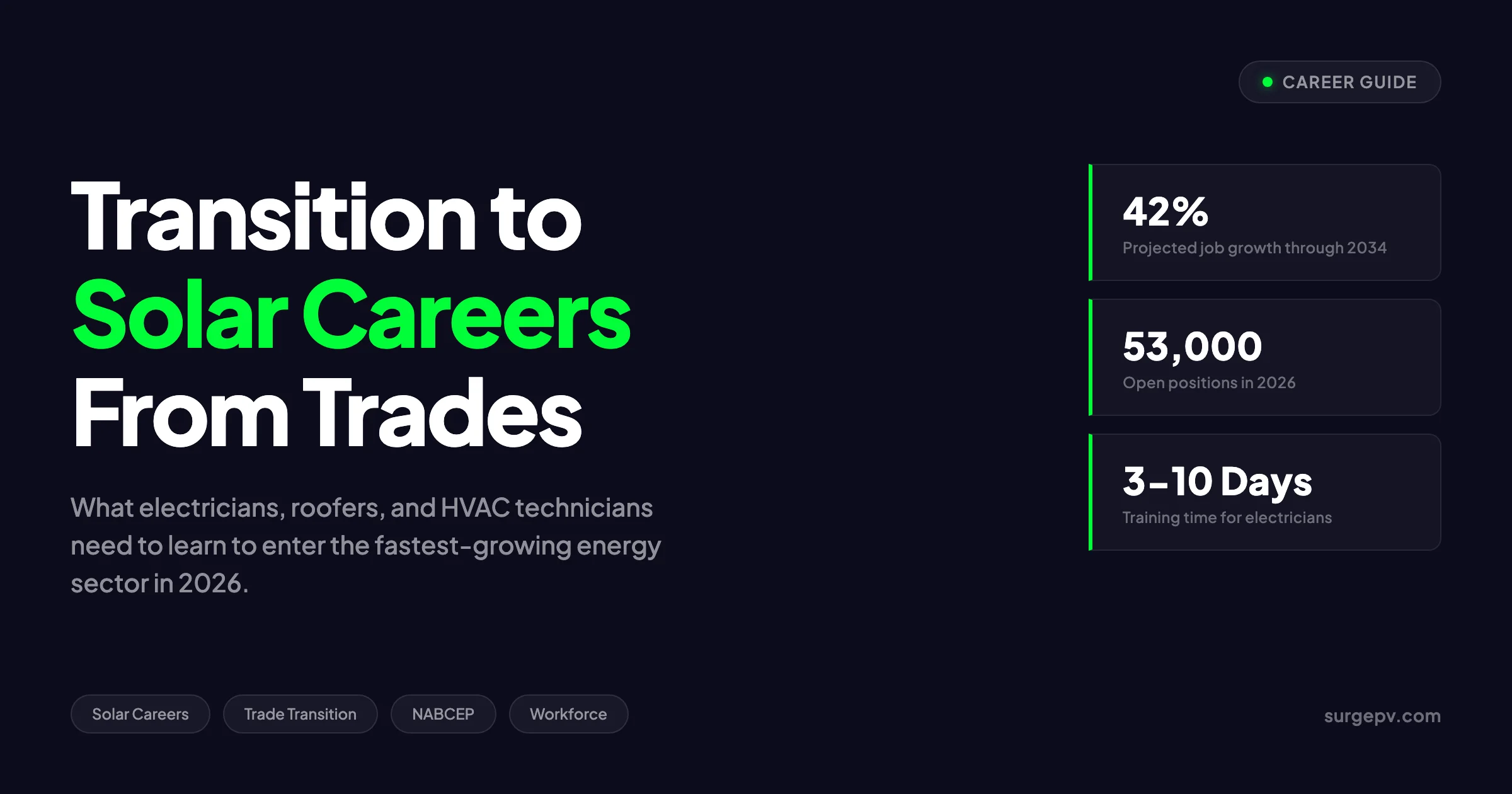
Electricians need 3 to 10 days of solar-specific training. Roofers need 2 to 6 months to add electrical and PV knowledge. HVAC technicians need 3 to 6 months to bridge into solar PV or solar thermal work. All three trades face a 42% growth solar market with a 53,000-worker shortage in 2026.
Key takeaways:
- Electricians have the fastest transition path because AC/DC fundamentals, grounding, and code compliance transfer directly.
- Roofers bring structural assessment and weatherproofing skills that pure solar installers often lack.
- HVAC technicians understand building systems and controls, making them ideal for solar-plus-storage and whole-home energy integration.
- Multi-skilled workers earn the highest wages—an electrician with solar credentials earns 25% to 40% more than a general electrician.
- The biggest mistake is adding solar casually without proper training in DC safety and NEC Article 690.
In this guide:
- Why trades workers are switching to solar in 2026
- What electricians already know—and what they must learn
- What roofers bring to solar—and where they need help
- What HVAC technicians transfer—and how they bridge the gap
- Skills transfer analysis by trade
- Training and certification requirements
- Timeline to transition for each trade
- Salary comparison: trade vs solar
- Common transition mistakes
- Real success stories
- Frequently asked questions
Why Trades Workers Are Switching to Solar in 2026
The numbers tell a clear story. The U.S. solar workforce stands at approximately 280,000 workers. The industry needs roughly 355,000 by late 2026 to support annual installation targets of 60 to 70 gigawatts. That leaves a gap of 53,000 positions. According to the 2025 U.S. Energy and Employment Report, 86% of solar employers report difficulty filling open positions. The shortage is most acute for installation crews, electrical technicians, and project supervisors.
At the same time, the Bureau of Labor Statistics (BLS) projects 42% employment growth for solar photovoltaic installers from 2024 to 2034. That rate is 14 times the average across all occupations. Clean energy jobs grew three times faster than the rest of the U.S. workforce in 2024, according to Department of Energy (DOE) solar workforce data. For trades workers in mature industries, solar represents the strongest growth opportunity available.
The policy landscape adds urgency. Projects must ensure 15% of total labor hours are performed by qualified apprentices to secure full Section 45Y and 48E tax credits. Yet only 43% of the U.S. workforce currently has access to the necessary skills training. Developers are building internal training pipelines and recruiting aggressively from related trades.
For electricians, roofers, and HVAC technicians, the switch is not a leap into the unknown. It is a lateral move into a faster-growing sector using skills they already possess. Many workers who complete this transition go on to follow a structured solar installer career path that leads to lead installer or supervisory roles within two years.
Pro Tip
Trade workers who transition in 2026 enter a seller’s market. Employers are offering signing bonuses, paid training, and accelerated promotion tracks to attract electricians, roofers, and HVAC technicians with solar interest.
Electrician to Solar: What Transfers and What to Learn
Electricians have the clearest and fastest path into solar. Their entire skill set sits at the foundation of photovoltaic installation. The transition is not a career change. It is a specialization.
What Electricians Already Know
An electrician entering solar already understands circuit design, load calculations, grounding systems, and protective device sizing. They know how to read electrical schematics, pull conduit, and terminate conductors. They have worked with the National Electrical Code for years. They understand lockout/tagout procedures, arc flash hazards, and ohmmeter testing. These skills cover roughly 70% of what a solar installer does on the electrical side.
Specifically, electricians transfer these competencies directly:
- AC panel interconnection and breaker sizing
- Conduit fill calculations and routing
- Grounding electrode systems and equipment grounding
- GFCI and AFCI protection requirements
- Voltage drop calculations
- Working safely with energized circuits
- Inspection preparation and code compliance documentation
What Electricians Must Learn
Solar adds three domains that most electricians have not encountered: DC circuit behavior at scale, photovoltaic-specific code requirements, and system commissioning.
DC safety and string design. Residential solar strings operate at 300 to 600 volts DC. Commercial systems reach 1,000 to 1,500 volts DC. Electricians accustomed to 120/240V AC residential work must learn DC arc fault behavior, which differs fundamentally from AC arcs. DC arcs sustain themselves without zero-crossing. They require specialized detection and interruption equipment. NEC Article 690.11 mandates arc fault circuit protection for PV systems. Most electricians have never specified or installed these devices.
NEC Article 690. The article dedicated to solar PV systems contains 25 subsections covering everything from PV source circuit labeling to rapid shutdown requirements. Article 690.12 requires rapid shutdown of PV systems on buildings to reduce shock hazard for firefighters. Electricians must learn which rapid shutdown architectures—module-level, string-level, or array-level—apply to which system types. This is not intuitive. It requires study.
Inverter configuration and commissioning. Solar inverters—string inverters, microinverters, and power optimizers—require configuration for grid parameters, grounding schemes, and monitoring integration. Commissioning involves verifying proper operation, setting up production monitoring, and generating as-built documentation. Electricians who have only installed loads rarely perform this type of equipment startup.
Module-level power electronics. Microinverters and power optimizers add complexity. Each panel becomes its own electrical node. Troubleshooting requires understanding panel-level diagnostics, not just string-level voltage readings. Electricians must learn to interpret monitoring platforms and isolate underperforming modules.
Training Path for Electricians
The fastest path is a 3-to-5-day solar PV installation course. In the UK, this is the City & Guilds 2922 or EAL Level 3 Award. In the United States, NABCEP certification programs offer equivalent intensive courses. A licensed electrician with current code knowledge can absorb the PV-specific material quickly. For UK-specific information, see Battery Solar System Design UK. For United Kingdom-specific compliance details, see United Kingdom comparisons/mcs-vs-non-mcs.
Recommended sequence:
- NABCEP PV Associate credential — 40 to 60 hours of study, $150 to $200 exam fee. Proves foundational PV knowledge to employers.
- Manufacturer-specific training — Enphase, SolarEdge, or SMA installer certification. Free or low-cost. Teaches the specific equipment the employer uses.
- NABCEP PV Installation Professional — 58 hours of advanced training plus documented installation experience. The gold standard for lead roles. Cost: $500 to $1,200.
- Battery storage certification — Tesla Powerwall, Enphase IQ Battery, or Generac PWRcell training. Most 2026 installations include batteries. This adds 1 to 2 days. For more on this topic, see Adding Battery Storage Services.
Total time from licensed electrician to certified solar installer: 1 week to 3 months depending on certification depth.
Salary Impact
A general electrician in the United States earns a median $62,350 per year according to BLS May 2024 data. An electrician who adds solar specialization and NABCEP certification can earn $65,000 to $85,000. Those who move into solar project management or start their own solar electrical contracting business can exceed $100,000. The solar premium is real and growing. For United States-specific compliance details, see United States arizona/phoenix.
| Role | Median Annual Salary | Source |
|---|---|---|
| General electrician | $62,350 | BLS May 2024 |
| Electrician with solar certification | $65,000–$85,000 | Industry surveys 2025–2026 |
| Solar project manager (electrical background) | $75,000–$100,000+ | Industry surveys 2025–2026 |
| Solar electrical contractor (self-employed) | $100,000–$150,000+ | Industry surveys 2025–2026 |
Roofing to Solar: What Transfers and What to Learn
Roofers enter solar from the opposite direction of electricians. Their strength is mechanical, not electrical. They understand the building envelope. This matters more than most people realize.
What Roofers Already Know
A roofer assessing a roof for solar already knows what the solar design software user needs to know. They can identify structural issues, estimate remaining roof life, and spot drainage problems. They understand how different roofing materials—asphalt shingle, tile, metal, membrane—respond to penetration and loading. They own fall protection equipment and know how to use it. They have weatherproofed thousands of penetrations. Also see: Us Residential Solar Market Trends 2026.
Specific transferable skills:
- Structural load assessment and rafter spacing evaluation
- Roof pitch measurement and orientation determination
- Flashing installation and waterproofing at penetrations
- Working at heights with harnesses, anchors, and ladders
- Racking and mounting system installation (similar to vent flashing and equipment curbs)
- Weatherproofing and sealant selection for different materials
- Array layout coordination with roof features (vents, chimneys, skylights)
Poorly sealed roof penetrations are a leading cause of solar system callbacks and warranty claims. A roofer who adds solar skills brings something that many pure solar installers lack: the instinct to make a penetration watertight before moving to the next panel.
What Roofers Must Learn
The gap for roofers is electrical. Most roofers have never terminated a conductor, sized a breaker, or read an electrical schematic. The learning curve is steeper than for electricians, but the starting point is higher on the mechanical side.
Basic electrical theory. Roofers must understand voltage, current, resistance, and power. They need to know why DC wiring requires different handling than AC. They must learn to identify conductor sizes, understand conduit types, and recognize proper grounding methods. This is not optional. Even if a licensed electrician handles the final interconnection, the roofer who mounts the panels must understand how the wiring integrates with the racking. Read Solar Racking Design Guide for a complete walkthrough.
NEC Article 690 compliance. Roofers performing solar installation must understand code requirements for PV array grounding, conduit routing on roofs, and rapid shutdown device placement. They need to know where they can and cannot run conductors. They must understand labeling requirements for PV source circuits.
System design basics. Roofers should learn to read solar design drawings, understand string layout, and identify shading issues. They need to know why panel placement affects system performance. A roofer who can flag a design flaw before installation begins saves the project time and money.
Electrical interconnection. In most states, roofers cannot legally connect a solar system to the electrical panel without an electrician’s license. However, understanding the interconnection process helps roofers coordinate with electricians, plan conduit routes, and avoid conflicts between mechanical and electrical work.
Training Path for Roofers
Roofers need more training than electricians but less than someone starting from scratch. Many roofers also find value in solar apprenticeship programs that combine paid work with structured classroom instruction.
Recommended sequence:
- OSHA 10 construction safety — If not already held. Most roofers have this. Cost: $50 to $100.
- Basic electrical course — 40 to 80 hours covering DC/AC theory, wiring methods, and code basics. Community colleges and vocational schools offer these. Cost: $300 to $800.
- NABCEP PV Associate — 40 to 60 hours of PV-specific study. Cost: $150 to $200.
- Hands-on solar installation training — 1 to 2 weeks of practical panel mounting, racking installation, and wiring practice. SEI, MREA, and regional providers offer these. Cost: $800 to $2,000.
- NABCEP PV Installation Professional — For roofers who want to lead crews or perform full installations in permissive states. Requires documented experience. Cost: $500 to $1,200.
Total time from roofer to solar installer: 2 to 6 months of part-time study and training.
Business Model Options
Roofers have a unique advantage: they are already on the roof. Many successful solar roofers start by offering solar as an add-on service to existing roofing customers. A customer replacing a roof is the perfect candidate for solar. The roof is clear, the structure is exposed, and the timing is right.
Three common business models:
- Solar roofing subcontractor — Partner with solar companies to handle mounting while they handle electrical. Lowest risk, lowest margin.
- Integrated solar roofing contractor — Add electrical licensing or partner with a licensed electrician. Offer full solar installation alongside roofing services. Medium risk, higher margin.
- Solar-first contractor with roofing legacy — Pivot the business toward solar while maintaining roofing for existing customers. Highest risk, highest upside.
Salary Impact
Roofers earn a median $50,970 per year according to BLS 2024 data. A roofer who adds solar skills and partners with an electrician can earn $55,000 to $70,000. A roofing contractor who offers integrated solar services can earn $80,000 to $120,000 or more, depending on market and volume.
| Role | Median Annual Salary | Source |
|---|---|---|
| Roofer | $50,970 | BLS 2024 |
| Roofer with solar skills | $55,000–$70,000 | Industry surveys 2025–2026 |
| Solar roofing contractor | $80,000–$120,000+ | Industry surveys 2025–2026 |
HVAC to Solar: What Transfers and What to Learn
HVAC technicians occupy an interesting middle ground. They understand electrical systems, building controls, and thermal management. They work with refrigerants, ductwork, and air handlers. Their path to solar is less direct than an electrician’s but more electrical than a roofer’s. HVAC professionals who want to understand how their existing skills map to solar should read our NABCEP certification guide, which breaks down exactly which credentials matter for each trade background.
What HVAC Technicians Already Know
HVAC technicians bring a systems-thinking mindset. They understand how components interact in a building-wide system. They read schematics, troubleshoot electrical faults, and work with control systems. They have EPA certification for refrigerant handling, which demonstrates technical competence. Many HVAC techs hold electrical licenses or work under them.
Specific transferable skills:
- Electrical troubleshooting and multimeter use
- Reading technical schematics and wiring diagrams
- Working in attics, crawl spaces, and on rooftops
- Building automation and control system integration
- System charging, pressure testing, and commissioning
- Customer communication and service call management
- Understanding of thermal loads and building envelope performance
What HVAC Technicians Must Learn
The HVAC-to-solar gap is narrower than most people assume. The core challenge is shifting from closed-loop thermal systems to open-loop electrical generation systems.
Photovoltaic system fundamentals. HVAC techs must learn how solar panels generate DC electricity, how inverters convert DC to AC, and how the system synchronizes with grid frequency. They need to understand IV curves, maximum power point tracking, and how shading affects string performance. This is new territory for most HVAC professionals.
NEC Article 690 and 705. Article 690 covers PV systems. Article 705 covers interconnected electric power production sources. HVAC techs must understand both. They need to know grounding requirements for PV arrays, disconnect locations, and labeling standards. Most have never worked with DC circuits at solar voltages.
Solar thermal specialization. HVAC technicians have the most direct path into solar thermal systems—solar water heating and space heating. These systems use collectors, storage tanks, and circulation pumps. The plumbing and control logic is familiar to HVAC professionals. Solar thermal is a smaller market than PV but offers strong margins and less competition.
Integrated home energy systems. The fastest-growing opportunity for HVAC technicians is not pure solar. It is whole-home energy integration: solar PV plus heat pumps plus battery storage plus EV charging. HVAC techs who understand both thermal and electrical systems are uniquely positioned for this work. They can size heat loads, specify equipment, and integrate everything into a single control platform.
Training Path for HVAC Technicians
HVAC technicians should leverage their electrical background while filling PV-specific gaps.
Recommended sequence:
- NABCEP PV Associate — 40 to 60 hours. Cost: $150 to $200. Establishes baseline PV knowledge.
- Solar thermal training — If pursuing that path. 20 to 40 hours. SRCC or NABCEP solar thermal credentials available. Cost: $300 to $600.
- Battery storage certification — Tesla, Enphase, or Generac. 1 to 2 days. Most solar systems in 2026 include batteries. Cost: Often free through manufacturer programs.
- NABCEP PV Installation Professional — For lead roles. Requires documented experience. Cost: $500 to $1,200.
- Heat pump + solar integration course — Emerging specialty. Some manufacturers and utilities offer these. Cost: $200 to $500.
Total time from HVAC technician to solar-capable installer: 3 to 6 months of part-time study.
Salary Impact
HVAC technicians earn a median $59,810 per year according to BLS May 2024 data. An HVAC technician with solar PV skills can earn $60,000 to $75,000. Those who specialize in integrated home energy systems—solar plus heat pumps plus storage—can earn $70,000 to $90,000. The premium is strongest for technicians who can design, install, and commission complete energy systems.
| Role | Median Annual Salary | Source |
|---|---|---|
| HVAC technician | $59,810 | BLS May 2024 |
| HVAC technician with solar skills | $60,000–$75,000 | Industry surveys 2025–2026 |
| Integrated home energy technician | $70,000–$90,000 | Industry surveys 2025–2026 |
Skills Gap Analysis by Trade
The following table summarizes what each trade brings and what each must add.
| Skill Domain | Electrician | Roofer | HVAC Technician |
|---|---|---|---|
| AC electrical work | Expert | None | Intermediate |
| DC electrical work | Intermediate | None | Basic |
| Structural assessment | Basic | Expert | Basic |
| Weatherproofing/penetrations | Basic | Expert | Basic |
| Working at heights | Variable | Expert | Intermediate |
| System troubleshooting | Expert | None | Expert |
| Building controls/automation | None | None | Expert |
| Code compliance (NEC) | Expert | None | Intermediate |
| PV-specific knowledge | None | None | None |
| Inverter configuration | None | None | None |
| Array layout optimization | None | Expert | None |
| Thermal system design | None | None | Expert |
| Training time to solar readiness | 1 week–3 months | 2–6 months | 3–6 months |
The electrician starts closest to the finish line. The roofer starts with the most unique and valuable non-electrical skills. The HVAC technician starts with the broadest systems knowledge. Each has a viable path. Each requires different investments. For a deeper look at how each trade builds a long-term career in this field, see our solar installer career path breakdown.
What Most People Get Wrong
Most trade workers assume solar is entirely new. It is not. The IREC Solar Career Map identifies “Roofer with Solar Expertise” and “HVAC Technician with Solar Expertise” as defined, recognized career pathways. The industry expects and values these transitions. Employers are not looking for solar-only purists. They need workers who combine trade depth with solar breadth.
Training and Certification You Actually Need
Certification requirements vary by state, employer, and project type. Here is what matters in 2026.
Safety Certifications
OSHA 10-Hour Construction. Required by most employers for job site access. Covers fall protection, electrical hazards, and PPE. Cost: $50 to $100. Time: 1 to 2 days.
OSHA 30-Hour Construction. Required for supervisory roles. Cost: $150 to $300. Time: 4 days.
Fall Protection Training. Specialized rooftop safety. Many employers provide in-house. Time: 4 to 8 hours.
Industry Certifications
NABCEP PV Associate. Entry-level credential. No experience required. Cost: $150 to $200. Valid for 6 years. This is the minimum credential that signals serious intent to employers.
NABCEP PV Installation Professional. Advanced credential. Requires 58 hours of training and documented installation experience. Cost: $500 to $1,200. Valid for 3 years. The gold standard for lead installers and commercial projects.
NABCEP PV System Inspector. For quality assurance roles. Requires installation experience. Cost: $400 to $800.
Electrical Licensing
State requirements vary. In California, Florida, Massachusetts, and Hawaii, a licensed electrician must perform or supervise electrical interconnection work. In Texas, North Carolina, and Georgia, no state-level solar license exists. Local permits and inspections apply. Electricians who want to perform this work should also understand how PV shade analysis and site assessment affect system design and permitting.
Electricians should verify their current license covers solar work. Roofers and HVAC technicians should research whether their state allows supervised work or requires full electrical licensing.
Manufacturer Certifications
- Tesla Powerwall Certification — Required for Tesla-authorized battery installations. Often free through partner programs.
- Enphase Installer Certification — Free online training for microinverter systems.
- SolarEdge Installer Certification — Free online training for power optimizer systems.
- Generac PWRcell Certification — Free through authorized channels.
These certifications take 4 to 16 hours each and improve employability significantly.
Timeline to Transition: Trade by Trade
| Phase | Electrician | Roofer | HVAC Technician |
|---|---|---|---|
| Week 1–2 | Solar PV course (3–5 days) | OSHA 10 + basic electrical course | NABCEP PV Associate prep |
| Week 3–4 | NABCEP PV Associate exam | NABCEP PV Associate prep | NABCEP PV Associate exam |
| Month 2 | On-the-job solar work | Hands-on solar training | Battery storage certification |
| Month 3 | Manufacturer certifications | Start solar roofing work | On-the-job solar work |
| Month 4–6 | NABCEP PVIP prep (if desired) | Build experience, partner with electrician | Build experience, pursue specialization |
| Month 6–12 | Lead installer roles | NABCEP PVIP (if desired) | NABCEP PVIP (if desired) |
| Year 1–2 | Project management or business ownership | Integrated contractor model | Integrated home energy specialist |
Electricians can be productive solar workers within two weeks. Roofers and HVAC technicians need two to six months to reach the same level of independence. All three trades can reach lead installer or supervisory roles within one to two years.
Salary Comparison: Your Trade vs Solar in 2026
The following table compares median wages across trades and solar roles using the most recent available data.
| Occupation | Median Annual Salary | 10-Year Growth | Training Required |
|---|---|---|---|
| Electrician | $62,350 | 9% | 4–5 year apprenticeship |
| HVAC technician | $59,810 | 8% | 6 months–2 years |
| Roofer | $50,970 | 6% | 1–6 months on-the-job |
| Solar PV installer | $51,860 | 42% | 1–12 months |
| Electrician + solar | $65,000–$85,000 | 42%+ | Apprenticeship + solar course |
| Roofer + solar | $55,000–$70,000 | 42%+ | Roofing + 2–6 months solar |
| HVAC + solar | $60,000–$75,000 | 42%+ | HVAC + 3–6 months solar |
Source: BLS Occupational Employment and Wage Statistics, May 2024; industry surveys 2025–2026.
The pure solar installer median of $51,860 is below electricians and HVAC technicians. This is why the smartest transition strategy is not to abandon your trade. It is to add solar to it. A multi-skilled worker commands a premium because they can handle more of the project. An electrician who also understands array layout and commissioning is worth more than an electrician who waits for a solar specialist to finish the “solar part.” Professionals who want to model the financial return of adding solar skills can use a generation and financial tool to compare salary and project revenue scenarios.
Pro Tip
The highest earners in solar are not solar-only installers. They are electricians, roofers, and HVAC technicians who added solar as a specialization. A licensed electrician with NABCEP certification and battery storage training is one of the most employable people in the construction industry in 2026. For electricians and HVAC technicians considering union pathways, IBEW union training programs offer structured solar-electrical apprenticeships with strong wage progression.
Common Transition Mistakes
After reviewing hundreds of trade-to-solar transitions, these are the errors that cost time and money. Workers who want to avoid these pitfalls should also read our guide on how to become a solar installer, which covers the foundational knowledge every new solar worker needs regardless of trade background.
Mistake 1: Skipping the electrical code training. Roofers and HVAC technicians sometimes assume they can learn solar “on the job” without formal NEC study. This creates liability. Article 690 contains requirements that differ from general electrical work. Untrained installers create fire hazards, failed inspections, and voided warranties.
Mistake 2: Treating solar as a side hustle. Trade workers who add solar casually—taking a job here and there without proper training—produce inconsistent work. They miss opportunities for premium projects. They also risk their reputation. Solar customers talk to each other. One bad installation can damage a roofing or HVAC business that took decades to build.
Mistake 3: Ignoring state licensing requirements. In states requiring electrical licensing for solar interconnection, an unlicensed roofer or HVAC tech who connects a system to the panel commits a violation. The penalty varies by state but can include fines, project shutdowns, and license revocation. Always verify requirements before bidding work.
Mistake 4: Undervaluing the roofer’s contribution. Solar companies sometimes hire electricians and teach them to mount panels. This is backwards. A roofer understands weatherproofing in a way that most electricians never will. The best solar crews pair a roofer’s mechanical expertise with an electrician’s electrical expertise.
Mistake 5: Neglecting battery storage training. In 2026, most new solar installations include batteries. Installers who understand only PV miss the fastest-growing segment. Battery storage adds complexity—energy management systems, backup panel wiring, load management—but also adds the largest salary premium.
Mistake 6: Failing to document experience. The NABCEP PV Installation Professional certification requires documented installation experience. Trade workers who transition informally often fail to record project details, system sizes, and their specific roles. Without documentation, they cannot advance to the highest credential.
Success Stories: Trades Workers Who Made the Switch
From Electrician to Solar Business Owner
David Park worked as a journeyman electrician in Colorado for eight years. In 2022, he noticed that every new commercial project included a solar scope. His electrical contractor employer did not have solar capability, so they subcontracted that work at a markup. David proposed that the company send him for solar training and bring the work in-house. The owner agreed. David’s story mirrors what many for solar installers experience when they expand their service offerings.
David completed a 5-day solar PV course and earned his NABCEP PV Associate credential within a month. He performed his first solar interconnection under his journeyman license six weeks later. Within a year, he had completed 40 installations and earned his NABCEP PV Installation Professional certification.
In 2024, David left to start his own solar electrical contracting business. He now employs four electricians and two installers. His company completed 120 installations in 2025. Revenue exceeded $1.2 million. David’s key insight: “The electrical license was the hard part. Solar was just another application of what I already knew.”
From Roofer to Solar Roofing Contractor
Lisa Torres ran a small roofing company in Florida with six employees. In 2023, a customer asked if she could install solar shingles during a re-roofing project. Lisa had never touched solar. She called three solar companies for quotes to subcontract the work. All three quoted prices that made the combined project uncompetitive. Workers in similar situations often research solar panel options and mounting systems before deciding whether to bring the work in-house.
Lisa enrolled in a 2-week solar installation course at a local community college. She added a NABCEP PV Associate credential. She partnered with a licensed electrician on a per-project basis. Her first solar roofing project—a 12-kilowatt system on a tile roof—took four days. The customer referred two neighbors.
By 2025, solar accounted for 40% of Lisa’s revenue. Her roofing crew of six became a solar roofing crew of ten. She still partners with electricians for interconnection work. Her advantage is simple: she is already on the roof. The customer does not need a separate solar company. The roof and the panels are one project.
From HVAC Technician to Integrated Energy Specialist
James Okonkwo serviced commercial HVAC systems in Texas for twelve years. He understood chillers, boilers, and building automation. In 2024, a client asked him to integrate a new PV system with their existing HVAC controls. James had no solar experience, but he understood the building’s energy flows better than any solar installer the client had interviewed.
James completed NABCEP PV Associate training and a Tesla Powerwall certification. He learned to read solar production data and map it against HVAC load profiles. Within six months, he was designing integrated systems that optimized solar production for thermal load timing.
Today James works as an integrated energy specialist for a commercial contractor. He designs and commissions systems that combine solar PV, battery storage, heat pumps, and smart building controls. His salary increased from $58,000 to $82,000. His next goal is to start a consulting practice focused on net-zero building retrofits.
Design Solar Systems With Trade-Grade Precision
SurgePV gives electricians, roofers, and HVAC professionals professional-grade solar design, shading analysis, and proposal tools that speed up every project and reduce callbacks.
Book a DemoNo commitment required · 20 minutes · Live project walkthrough
For a direct comparison, see Arka 360 vs SurgePV.
The Tradeoff Nobody Talks About
Here is an honest assessment that most transition guides omit. Solar installation pays less at the median than electrical and HVAC work. The BLS median for solar installers is $51,860. Electricians earn $62,350. HVAC technicians earn $59,810. Roofers earn $50,970—roughly equivalent to solar.
So why switch? Because the growth trajectory is different. Solar’s 42% projected growth creates opportunities for rapid advancement that do not exist in mature trades. An electrician in a saturated market might wait five years for a promotion. A solar installer in a growing market might advance in two. The tradeoff is lower starting pay for faster career velocity.
The solution is not to abandon your trade. It is to combine it. A roofer who adds solar does not become a $51,860 solar installer. They become a $65,000 solar roofing specialist. An electrician who adds solar does not take a pay cut. They add a growth channel to an already solid income. The tradeoff only hurts workers who switch completely and start at the bottom.
Frequently Asked Questions
How long does it take an electrician to transition to solar?
A licensed electrician can transition to solar installation in 3 to 10 days of additional training. The core electrical skills—circuit design, grounding, protective devices, and AC integration—transfer directly. Most electricians add a NABCEP PV Associate credential within 1 to 3 months and a PV Installation Professional certification within 1 to 2 years if they want lead roles.
Can a roofer install solar panels without an electrical license?
Roofers can perform the mechanical mounting portion of solar installation in most states, including attaching racking systems and securing panels. However, the electrical interconnection work—wiring panels to inverters and connecting to the main panel—requires a licensed electrician or supervision by one in states such as California, Florida, and Massachusetts. Many successful solar roofers partner with electricians or pursue electrical licensing themselves.
What do HVAC technicians need to learn to work in solar?
HVAC technicians already understand electrical wiring, system diagnostics, and building controls. To transition to solar, they need training in photovoltaic system design, DC string wiring, inverter configuration, and NEC Article 690 compliance. The fastest path is through a 40 to 60 hour NABCEP PV Associate course followed by on-the-job training. HVAC techs with solar skills command premium wages in the growing solar-plus-storage market.
Is solar installation better paid than electrical, roofing, or HVAC work?
At the median, solar installers earn $51,860 per year according to BLS May 2024 data. This is below electricians ($62,350) and HVAC technicians ($59,810) but above roofers ($50,970). However, solar offers 42% projected job growth through 2034—far exceeding all three trades. Multi-skilled workers who combine solar with their original trade earn the highest wages, often $65,000 to $85,000 or more.
What certification do I need to switch from a trade to solar?
No single certification is required nationwide. Most employers prefer OSHA 10 construction safety certification and the NABCEP PV Associate credential. Electricians may only need manufacturer-specific training. Roofers and HVAC technicians should pursue the NABCEP PV Associate first, then the PV Installation Professional certification for lead roles. State electrical licensing requirements vary.
What is the biggest mistake trade workers make when switching to solar?
The biggest mistake is treating solar as a side service rather than a core skill. Trade workers who add solar casually—without proper training in NEC Article 690, DC safety, or system commissioning—create liability risks and miss premium opportunities. The second biggest mistake is ignoring the electrical licensing requirements in their state, which limits the work they can legally perform.
Can I start my own solar business after working in electrical, roofing, or HVAC?
Yes. Electricians have the clearest path because electrical contractor licensing is often the main barrier to solar business ownership. Roofers can start solar roofing companies but need licensed electricians for interconnection work in most states. HVAC contractors can add solar thermal and solar-plus-heat-pump services. Each path requires business licensing, insurance, and often NABCEP certification for credibility.
How does the 2026 solar workforce shortage affect trade workers switching careers?
The U.S. solar industry faces a workforce gap of 53,000 positions in 2026, with 86% of employers reporting hiring difficulty. This creates strong demand for workers with transferable trade skills. Electricians, roofers, and HVAC technicians who add solar credentials can negotiate higher starting wages and faster promotions than workers entering solar without trade backgrounds.
Conclusion
The solar industry does not need workers to start from zero. It needs electricians who understand Article 690, roofers who can weatherproof a penetration, and HVAC technicians who can integrate solar with building systems. The 53,000-worker shortage in 2026 is not a problem for the training industry to solve. It is an opportunity for trades workers to capture.
The path is clear for each trade. Electricians need a week of focused training. Roofers need two to six months to bridge the electrical gap. HVAC technicians need three to six months to add PV fundamentals. All three can reach lead installer or supervisory roles within one to two years. All three earn more by combining their original trade with solar than by switching entirely.
The misconception that solar is a separate industry persists. It is not. Solar is a specialization within construction, just like commercial wiring or refrigeration. The workers who thrive are those who bring depth from their home trade and add breadth in photovoltaics. For workers coming from a sales background rather than a trade, the solar sales career path offers a different but equally viable entry point into the industry.
Three actions to take this week:
-
Assess your transferable skills against the skills gap table in this guide. Identify which domain—electrical, mechanical, or systems—you already own. That is your starting advantage.
-
Enroll in one credentialing course. Electricians should register for a NABCEP PV Associate prep course or manufacturer certification. Roofers and HVAC technicians should start with the NABCEP PV Associate. The $150 to $200 investment signals intent and builds foundational knowledge.
-
Research your state’s licensing requirements for solar interconnection work. If your state requires electrical licensing, map the path to compliance now. Do not bid work you cannot legally complete.
The workforce gap is real. The demand is immediate. Your trade skills are more valuable in solar than you think. Start this week. Solar design software automates design and compliance. Solar proposal software generates professional quotes in minutes.
Where this fits
This article is part of SurgePV's Solar Business & Operations hub, which works through the topic from first principles to the decisions a project team actually has to make.

