

Most people who try to become solar installers make the same mistake. They search online for training programs, sign up for the first course they find, and spend $2,000 on a certificate that no employer recognizes. Three months later, they are still unemployed and out of pocket.
The problem is not a lack of training options. The problem is that solar installer requirements are fragmented across 50 states, multiple certification bodies, and a maze of local regulations. A certificate that opens doors in California means nothing in Texas. A license that lets you work in Florida does not transfer to New York. And the credential that one employer demands, another ignores entirely.
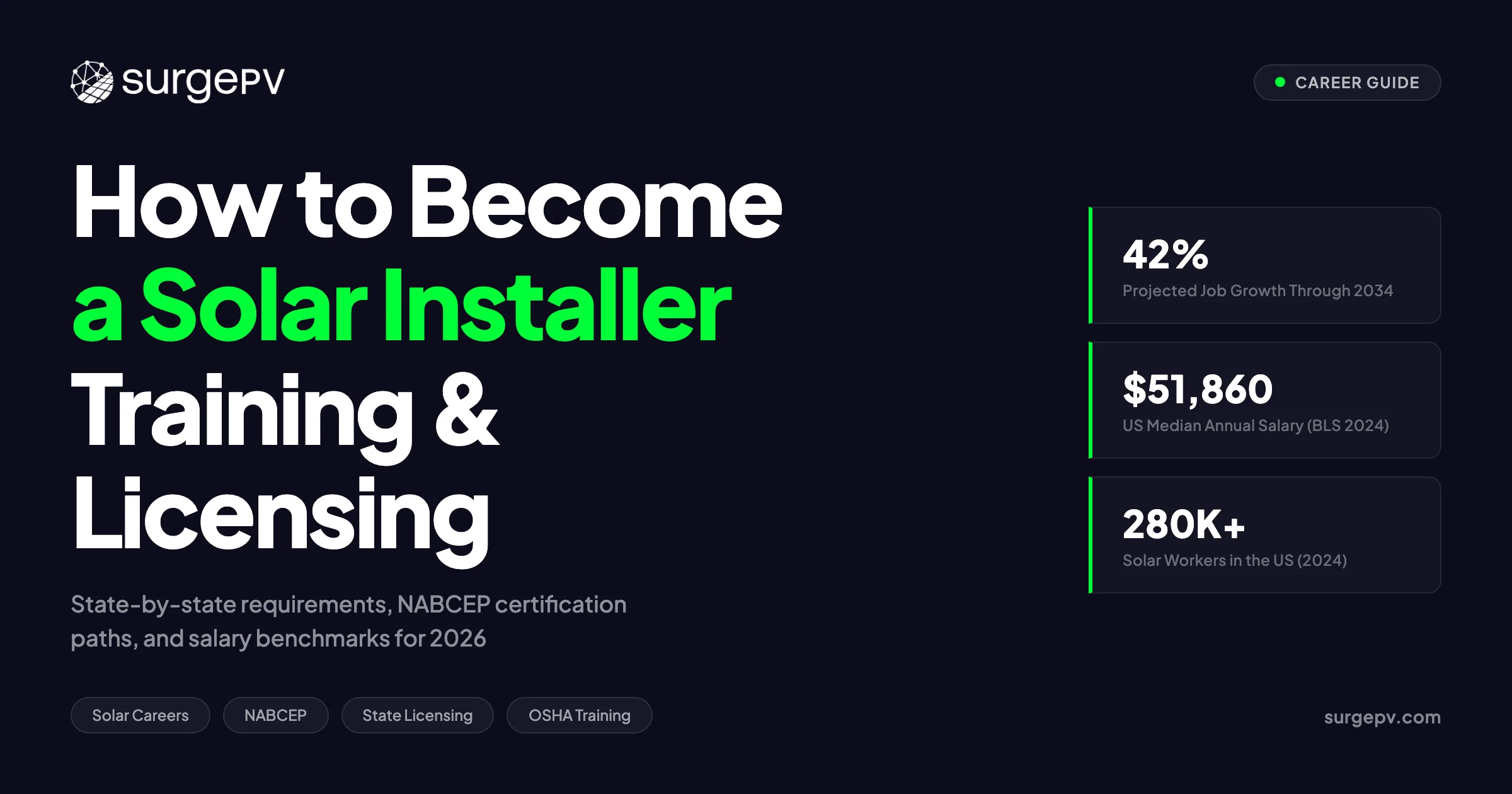
This guide cuts through the noise. It maps every state licensing requirement, explains which certifications actually matter, details the training pathways that lead to jobs, and shows what you will earn at each stage. All salary data comes from the U.S. Bureau of Labor Statistics (2024). All licensing information reflects 2026 state board rules. The solar industry is the fastest-growing occupation in the United States, with 42% projected growth through 2034 according to the Department of Energy.
Quick Answer
Becoming a solar installer requires a high school diploma, OSHA 10 construction safety training, and either a state electrical contractor license or employment under a licensed contractor. Nine states issue dedicated solar licenses. NABCEP certification is voluntary but adds $11,000/year in salary. Most installers start as helpers and reach full professional status in 1–2 years.
Key takeaways:
- Solar installer is the fastest-growing US occupation at 42% projected growth through 2034 (BLS 2024)
- Nine states have dedicated solar contractor licenses; most require electrical licensing
- NABCEP PV Installation Professional is the industry gold standard certification
- Median salary is $51,860 nationally, ranging from $32,000 in Tennessee to $82,160 in Rhode Island
- OSHA 10 construction safety training is mandatory for NABCEP and most employers
- 53,000 additional workers are needed by late 2026 to meet installation targets (IREC Solar Jobs Census 2024)
- The fastest path starts with a helper role and stacks credentials while earning Also see: Us Residential Solar Market Trends 2026.
In this guide:
- What solar installers do and who hires them
- Education and training requirements by pathway
- State licensing comparison table with every state’s rules
- NABCEP certification: types, requirements, and costs
- Apprenticeship programs and IREC-accredited training
- Salary by state with experience-based progression
- Tools and equipment every installer needs
- Safety training: OSHA, fall protection, and electrical safety
- Common mistakes new installers make
- Career advancement paths beyond installation
- Frequently Asked Questions
What Does a Solar Installer Do?
A solar installer mounts photovoltaic panels on rooftops, carports, or ground-mounted structures and connects them to a building’s electrical system. The job splits into three phases: pre-installation site assessment, physical installation, and system commissioning. For a deeper look at the career trajectory, see our guide on the solar installer career path. See Commercial Solar Carport Design Guide for detailed guidance.
Site assessment involves measuring roof dimensions, evaluating structural integrity, identifying shading obstacles, and documenting electrical panel capacity. Installers use measuring tapes, laser distance meters, and shading analysis tools. Shadow analysis software can help identify shading issues before arriving on site. A proper assessment takes 1–2 hours for a residential system and prevents costly errors later.
Physical installation is the core of the job. Installers carry panels to the roof (never up ladders — mechanical lifts or team carries only), attach mounting rails to roof trusses, secure panels to the rails, and run DC wiring from the array to the inverter. They also install conduit, grounding equipment, and monitoring hardware. This work happens outdoors in all weather conditions and requires comfort working at heights.
Commissioning includes testing system voltage, verifying grounding continuity, programming the inverter, and walking the homeowner through system operation. The installer ensures the system meets local code and passes utility inspection.
Most installers work for solar contractors, electrical contractors, or EPC firms. Some work directly for utilities on utility-scale projects. The workday typically runs 7–10 hours, with early starts to avoid afternoon heat on rooftops. If you are hiring for your own team, our guide on hiring solar installers covers recruitment strategies and compensation benchmarks.
Pro Tip
Employers value installers who can read electrical single-line diagrams and understand basic DC circuit theory. If you have no electrical background, take a free online course on Ohm’s Law and series/parallel circuits before applying. It takes 2–3 hours and immediately separates you from other entry-level candidates.
Education Requirements: What You Actually Need
The minimum formal education for a solar installer is a high school diploma or GED. No college degree is required. What matters more is a specific combination of safety training, technical knowledge, and documented hands-on experience.
High school diploma or GED: This is the baseline requirement for virtually all entry-level solar installer positions. Relevant high school coursework — basic algebra, physics, and shop class — provides a foundation but is not mandatory.
Post-secondary training (optional but recommended): Community colleges and vocational schools offer PV technology programs lasting 6 to 18 months. These programs cover solar fundamentals, electrical theory, system design, and the National Electrical Code (NEC). IREC-accredited programs carry the most weight with employers because they meet NABCEP credentialing requirements.
Notable IREC-accredited programs include Kankakee Community College (Illinois), Midwest Renewable Energy Association (Wisconsin), and Solar Energy International (online). Costs range from $1,500 for online certificates to $8,000 for full associate degree programs. For a detailed breakdown of credentialing options, see our NABCEP certification guide.
On-the-job training: Most employers provide 3–6 months of structured on-the-job training for new hires. This training covers company-specific installation methods, safety protocols, and equipment handling. The quality of this training varies enormously between employers. Companies with formal apprenticeship programs provide the most structured learning.
The tradeoff: Community college programs cost money and time upfront but accelerate credentialing. Starting as a helper earns money immediately but extends the path to full certification. The right choice depends on your financial situation and local job market. In markets with severe labor shortages like Texas and Florida, employers hire helpers with minimal credentials and train them on the job. In saturated markets like California, employers can be selective and prefer candidates with existing certifications. SurgePV’s solar design software helps contractors streamline project workflows and reduce the training burden on new hires. For a direct comparison, see Arka 360 vs SurgePV.
State Licensing: The Complete 2026 Comparison Table
No federal solar installer license exists in the United States. Every state sets its own rules. This creates a patchwork where the same installer faces completely different requirements crossing from Nevada into Utah.
The table below shows the licensing landscape for all 50 states plus Washington D.C. as of 2026. Requirements change — always verify with your state contractor licensing board before acting. For state-specific compliance requirements, see our solar compliance guides.
States with Dedicated Solar Contractor Licenses
| State | License Type | Experience Required | Bond | Initial Fee | Notes |
|---|---|---|---|---|---|
| California | C-46 Solar Contractor (CSLB) | 4 years | $25,000 | $200 | C-10 Electrical also accepted; most rigorous solar license in the US |
| Arizona | CR-11 / CC-11 Solar Contractor | 4 years | $9,000 | $200 | ROC-registered; separate residential and commercial classifications |
| Connecticut | PV-1 Solar Photovoltaic Contractor / PV-2 Journeyperson | 2 years | None | $150 | Two-tier system; PV-2 works under PV-1 supervision |
| Florida | Certified or Registered Solar Contractor | 4 years | Varies | $200+ | Hurricane zone mandates strict wind-load requirements |
| Hawaii | C-60 Solar Power Systems Contractor | 4 years | None | $200 | C-13 Electrical also accepted; high demand due to electricity costs |
| Nevada | C-2g Photovoltaic (subclass of C-2 Electrical) | 4 years | $10,000 | $600 | Must hold C-2 Electrical or C-2g subclass specifically |
| New Mexico | GS-3 Solar Installation Contractor | 4 years | None | $150 | Dedicated solar license available alongside electrical pathways |
| Tennessee | BC-A (Solar Energy) Limited Specialty | 3 years | None | $250 | Limited specialty; CE Electrical Contractor also accepted |
| Utah | S202 Solar Photovoltaic Contractor | 4 years | None | $240 | E200 Electrical Contractor also accepted |
States Requiring Electrical Contractor or Master Electrician License
| State | Required License | Experience | Notes |
|---|---|---|---|
| Alabama | Electrical Contractor | 4+ years | No dedicated solar license |
| Alaska | Electrical Administrator | 7–8 years | High experience requirement |
| Colorado | DORA Electrical Contractor | 4+ years | Master electrician must supervise |
| Delaware | Master Electrician | 7+ years | High experience barrier |
| D.C. | Master Electrician | 7+ years | District-specific requirements |
| Idaho | Electrical Contractor | 4+ years | No state solar license |
| Iowa | Master Electrician | 4+ years | No dedicated solar pathway |
| Kentucky | Master Electrician | 6+ years | Electrical licensing required |
| Louisiana | Electrical Contractor | 4+ years | No solar-specific license |
| Maine | Master Electrician | 4+ years | Limited solar-specific guidance |
| Maryland | Master Electrician | 7+ years | One of the highest barriers |
| Massachusetts | Master Electrician (Class A) | 4+ years | Strong state incentive programs |
| Michigan | Electrical Contractor | 4+ years | No dedicated solar license |
| Minnesota | Master Electrician | 4+ years | Electrical pathway only |
| Mississippi | Electrical Contractor | 4+ years | NASCLA reciprocity accepted |
| Montana | Electrical Contractor | 4+ years | No solar-specific license |
| Nebraska | Electrical Contractor | 4+ years | Limited solar market |
| New Hampshire | Master Electrician | 4+ years | OSHA 10 required by state law |
| New Jersey | Electrical Contractor | 5+ years | Active SREC market |
| North Carolina | Electrical Contractor | 4+ years | Growing utility-scale market |
| North Dakota | Electrical Contractor | 4+ years | Limited solar market |
| Ohio | Electrical Contractor | 4+ years | Low licensing fee ($25) |
| Oklahoma | Electrical Contractor | 4+ years | Emerging solar market |
| Oregon | CCB Contractor + BCD LRT | 2+ years | LRT = Limited Renewable Energy Technician |
| South Carolina | Electrical Contractor | 4+ years | Growing residential market |
| South Dakota | Electrical Contractor | 4+ years | Limited solar market |
| Vermont | Electrical Contractor | 4+ years | Strong renewable policies |
| Virginia | Electrical Contractor | 4+ years | Growing market |
| Washington | Electrical Contractor (06 General) + Specialty | 4+ years | Specialty endorsement for solar |
| West Virginia | Electrical Contractor | 4+ years | Limited solar market |
| Wisconsin | Electrical Contractor | 4+ years | MREA training hub |
| Wyoming | Electrical Contractor | 4+ years | Limited solar market |
States with Local or Municipal Licensing Only
| State | Situation | What You Need |
|---|---|---|
| Georgia | No state solar or electrical license | Local electrical contractor license by municipality |
| Illinois | No state solar license | Local electrician + ICC Distributed Generation Installer |
| Indiana | No state license | Local electrical contractor required |
| Kansas | No state license | Local electrical contractor required |
| Missouri | No state license | Local electrical contractor; OSHA 10 required by state law |
| New York | No state solar license | Local Master Electrician + NYSERDA Eligible Installer for incentives |
| Pennsylvania | No state solar license | PA HIC Registration + local electrician required |
| Texas | No state solar license | TECL (Texas Electrical Contractor License) or local equivalent |
What Most People Get Wrong About State Licensing
The most common mistake is assuming a solar installation certificate from a training program equals a license to work. It does not. Certificates prove training. Licenses grant legal authority to perform work. In most states, you need both.
Another misconception is that NABCEP certification replaces state licensing. It does not. NABCEP is a voluntary industry credential. State licenses are legal requirements. You can hold every NABCEP certification and still be unable to legally install solar in California without a C-46 or C-10 license.
The third error is ignoring local requirements. Even in states with clear state-level licensing, individual cities and counties add their own layers. Los Angeles County has additional fire department requirements for rooftop solar. Miami-Dade County mandates specific wind-load certifications. Always check with your local Authority Having Jurisdiction (AHJ) before starting work. For a deeper understanding of electrical standards, see our glossary entry on the National Electrical Code (NEC).
NABCEP Certification: The Complete Path
NABCEP (North American Board of Certified Energy Practitioners) operates the most widely recognized certification program for solar professionals in North America. While voluntary in most states, NABCEP certification is increasingly treated as a practical requirement by utilities, manufacturers, and state incentive programs. For a complete breakdown of credential types and exam requirements, read our NABCEP certification guide for 2026.
NABCEP Certification Types
| Certification | Focus | Best For |
|---|---|---|
| PV Associate | Entry-level fundamentals | New professionals, career changers |
| PV Installation Specialist (PVIS) | Hands-on installation execution | Field technicians, crew leads |
| PV Installation Professional (PVIP) | Design, installation, commissioning, maintenance | Lead installers, project managers |
| PV Design Specialist (PVDS) | Mechanical and electrical design | System designers, engineers |
| PV Technical Sales (PVTS) | Sales and site assessment | Sales professionals |
| PV System Inspector (PVSI) | Code compliance inspection | Inspectors, AHJs |
| PV Commissioning & Maintenance (PVCMS) | O&M procedures | Service technicians |
| Energy Storage Installation Professional (ESIP) | Battery storage systems | Storage installers |
PVIP Requirements (Gold Standard)
The PV Installation Professional credential is the most sought-after NABCEP certification. Requirements include:
- OSHA 10-Hour Construction Industry training (mandatory prerequisite)
- 58 hours of approved advanced PV training from an accredited provider
- Passing the PVIP written examination ($450 exam fee)
- Documented installation experience in decision-making roles
The experience requirement varies by education level. Candidates with a bachelor’s degree in a related field need less field experience than those with only a high school diploma. The exact hour requirements are detailed in the NABCEP Certification Handbook.
New Board Eligible Pathway (2025+)
NABCEP introduced a “Board Eligible” pathway that changes the sequence. Candidates can now:
- Complete the 58 training hours
- Pass the PVIP exam
- Receive temporary “Board Eligible” status
- Have 3 years to accumulate required field experience
- Convert to full certification once experience is verified
This pathway is ideal for career changers and recent training program graduates who have the knowledge but lack sufficient field hours.
Recertification
NABCEP certifications require renewal every 3 years. Renewal requires 18 continuing education credits or 30 CEU hours. The recertification fee is approximately $200–$300. Active PVIP holders receive credit for up to 18 non-accredited training hours toward renewal.
Why NABCEP Certification Matters Commercially
NABCEP certification is not just a resume line. It directly affects which projects you can work on:
- Utility interconnection: Many utilities in California, New York, Massachusetts, and Texas require NABCEP certification for commercial project approval
- Manufacturer programs: SunPower, Enphase, and SolarEdge require NABCEP certification for authorized dealer status
- State incentives: California SGIP and SREC programs give preference to NABCEP-certified installers
- Customer trust: The NABCEP Installer Locator is a major consumer search tool
- Salary premium: NABCEP-certified installers earn approximately $11,000 more per year than uncertified peers
Only about ten NABCEP-accredited companies exist in the United States, concentrated in California, Florida, Massachusetts, North Carolina, and Texas. Accreditation is separate from individual certification and applies to companies, not individuals.
Apprenticeship Programs and Training Pathways
In January 2025, the U.S. Department of Labor approved national guidelines for Registered Apprenticeship programs in the solar industry. Developed by IREC, SEIA, and MREA, these guidelines create a template that any employer, school, or union can use to build a compliant program.
Registered Apprenticeship Structure
Solar apprenticeships follow the Construction Craft Laborer occupation classification. The model combines paid on-the-job training with classroom instruction. Apprentices earn wages while learning and receive a nationally recognized credential upon completion.
The Inflation Reduction Act (IRA) makes apprenticeships increasingly important for the industry. Solar projects over 1 MW must meet apprenticeship labor hour requirements to qualify for full tax credits:
- 2024–2025: Minimum 12.5% of construction labor hours from registered apprentices
- 2026 and beyond: Minimum 15% of construction labor hours from registered apprentices
This policy creates direct demand for apprenticeship programs and apprentices.
IREC-Accredited Training Providers
| Provider | Program | Format | Location |
|---|---|---|---|
| Kankakee Community College | AAS Electrical Engineering / Renewable Energy or 1-year Solar-PV certificate | In-person | Illinois |
| Midwest Renewable Energy Association (MREA) | IREC-accredited solar courses | Online or in-person | Wisconsin-based, various |
| Solar Energy International (SEI) | PVOL101: Solar Electric Design and Installation | Online | Online |
| San Juan College | PV Installer certificate program | In-person | New Mexico |
| Lansing Community College | Renewable Energy certificate | In-person | Michigan |
Costs range from $800 for single online courses to $8,000 for full associate degree programs. Many employers reimburse tuition for employees who commit to staying with the company for a specified period.
Apprenticeships in Clean Energy (ACE) Network
IREC operates the ACE Network, which provides free technical assistance to employers starting apprenticeship programs. As of late 2024, the ACE Network helped register 31 new apprenticeship programs and place over 1,100 apprentices, with 78% from underrepresented populations.
IREC also launched a free “Apprenticeship Ready” course in 2026. It includes four modules, a playbook workbook, and a digital badge upon completion. The course takes 4–6 hours and is available at no cost. For more on apprenticeship pathways, see our guide to solar apprenticeship programs in the US.
The Installer Story: From Warehouse Worker to Lead Technician
Marcus started in a warehouse in Phoenix at $16 an hour. He had no electrical background and no construction experience. A friend told him solar installers were hiring helpers at $18 an hour with overtime.
He applied to three companies. Two never responded. The third hired him as a helper after a 15-minute phone interview. His first day involved carrying panels from a truck to a rooftop edge — no ladder climbing yet. By month three, he was attaching mounting rails. By month six, he was running conduit.
Marcus paid $300 for an OSHA 10 online course during his second month. His employer reimbursed him. At month nine, he enrolled in a NABCEP PV Associate prep course ($450) and passed the exam on his first attempt. His pay increased from $18 to $22 an hour.
At 18 months, Marcus had logged enough field hours to sit for the NABCEP PVIS exam. He passed and became a crew lead at $28 an hour. Two years after leaving the warehouse, he was earning $58,240 a year with benefits and supervising a three-person crew.
His total investment: $750 in training (mostly reimbursed). His total time from warehouse to lead: 24 months. This is a typical trajectory in markets with strong demand like Arizona, Texas, and Florida. For a broader view of earnings across regions, see our solar installer salary by country breakdown.
Solar Installer Salary by State: 2026 Data
Solar installer salaries vary by a factor of nearly 3 between the highest and lowest-paying states. The variation reflects union density, cost of living, state incentive programs, and local solar market maturity.
National Benchmarks (BLS May 2024 Data)
| Metric | Value |
|---|---|
| Median annual wage | $51,860 |
| Median hourly wage | $24.93 |
| Lowest 10% | $39,070 |
| Lowest 25% | $46,040 |
| Highest 25% | $63,020 |
| Highest 10% | $80,150+ |
Top-Paying States
| State | Median Annual Wage | Hourly Rate | Key Drivers |
|---|---|---|---|
| Rhode Island | $82,160 | $39.50 | High union density, strong residential mandates |
| New Jersey | $69,510 | $33.42 | Active SREC market, state incentives |
| Nevada | $69,410 | $33.37 | Strong utility-scale solar market |
| Hawaii | $67,430 | $32.42 | High electricity costs drive solar adoption |
| California | $66,440 | $31.94 | Largest solar market, high cost of living |
| Massachusetts | $60,800 | $29.23 | Strong state incentives, SMART program |
| Oregon | $58,180 | $27.97 | Growing solar market, union presence |
| Washington | $56,920 | $27.37 | Strong renewable energy policies |
| Arizona | $51,840 | $24.92 | Major solar hub, high volume |
| Colorado | $50,500 | $24.28 | Growing residential and C&I market |
Experience-Based Progression
| Level | Years | Annual Salary | Hourly Rate |
|---|---|---|---|
| Helper / Laborer | 0–1 | $30,000–$35,000 | $14–$17 |
| Entry-level Installer | 0–2 | $35,000–$42,000 | $16.89 |
| Early Career | 2–4 | $39,000–$48,000 | $18.82 |
| Mid-Career | 4–8 | $48,000–$58,000 | $22.79 |
| Senior Installer | 8+ | $61,000–$80,000 | $29.48 |
| Crew Lead / Supervisor | 5+ | $65,000–$100,000 | $31–$48 |
| Top 10% | 10+ | $72,000–$130,000 | $34.65+ |
Salary Factors That Matter
NABCEP Certification: Adds approximately $11,000 per year. About 70% of NABCEP holders report a salary increase after certification.
Commercial vs. Residential: Commercial and utility-scale installers earn $15,000–$20,000 more than residential-only installers. The work is more complex and the projects are larger.
Union vs. Non-Union: Unionized installers in states like Rhode Island, Hawaii, and California earn significantly more than non-union peers. Union density explains much of the Rhode Island premium.
Geographic Location: Coastal states and states with strong renewable energy policies generally pay more. However, the cost of living in high-paying states often offsets the salary advantage.
Project Scale: Crew leads on utility-scale projects can exceed $100,000. These roles require travel and often involve extended periods away from home.
Key Takeaway
The state-to-state salary gap is dramatic — $82,160 in Rhode Island versus $31,740 in Tennessee. But raw salary is not the whole picture. Tennessee’s cost of living is 35% lower than Rhode Island’s. A $50,000 salary in Tennessee buys more than a $65,000 salary in California. Factor in cost of living before relocating for a higher paycheck.
Tools and Equipment Every Installer Needs
Solar installation requires a specific toolkit. Most employers provide power tools, ladders, and safety equipment. Individual installers should invest in personal hand tools and testing equipment.
Essential Hand Tools
| Tool | Purpose | Personal Investment |
|---|---|---|
| Cordless drill / impact driver | Drilling holes, driving screws | Employer-provided |
| Torque wrench | Tightening bolts to manufacturer spec | $80–$200 |
| Socket wrench set | Bolts and fasteners | $40–$100 |
| Adjustable wrenches | Various nuts and bolts | $20–$50 |
| Screwdrivers (flat and Phillips) | Electrical enclosures, equipment | $15–$30 |
| Wire strippers | Removing cable insulation | $15–$40 |
| Cable cutters | Clean cutting of electrical cables | $25–$60 |
| MC4 crimping tool | Waterproof DC solar connections | $80–$250 |
| Multimeter | Voltage, current, resistance testing | $150–$400 |
| Clamp meter | Current measurement without disconnect | $100–$300 |
| Measuring tape | Roof and panel measurements | $10–$25 |
| Spirit level | Panel alignment | $15–$40 |
| Utility knife | Cutting various materials | $5–$15 |
Safety Equipment (Non-Negotiable)
| Equipment | Purpose |
|---|---|
| Safety harness + fall arrest system | Rooftop fall protection |
| Roof anchors | Secure attachment points |
| Hard hat | Head protection |
| Safety glasses | Eye protection |
| Insulated gloves | Electrical hazard protection |
| Non-slip safety boots | Foot protection, traction |
| Extension ladder | Safe roof access |
Specialized Solar Tools
| Tool | Purpose |
|---|---|
| Panel lifting straps | Safe panel handling without glass damage |
| Panel cart / dolly | Transporting panels on site |
| Step drill bit (up to 2 inches) | Conduit and enclosure entries |
| Hydraulic knockout punch | Custom holes in metal enclosures |
| Heat gun | Heat-shrink tubing |
| Caulk gun | Sealing roof penetrations |
| Solar irradiance meter | Measuring sunlight intensity |
| Thermal camera | Detecting hotspots in panels and connections |
Total Personal Investment
A new installer should budget $500–$1,000 for personal tools. The multimeter is the most important personal investment — a quality Fluke or Klein multimeter costs $200–$400 and lasts years. Most other tools can be acquired gradually as needs arise. For the latest details on UK, see Battery Solar System Design UK. See our guide on Heritage Building Solar Case Study for more. For United Kingdom-specific compliance details, see United Kingdom comparisons/mcs-vs-non-mcs.
Pro Tip
Buy the best multimeter you can afford. Cheap multimeters give inaccurate readings that can lead to dangerous mistakes. A Fluke 117 ($220) or Klein CL800 ($180) are the industry standard. These tools pay for themselves the first time they catch a wiring error before it becomes a fire hazard.
Safety Training: OSHA, Fall Protection, and Electrical Safety
Solar installation is dangerous work. Falls from heights, electrical shock, and heat exposure are the three primary hazards. Proper safety training is not optional — it is a career prerequisite.
OSHA 10-Hour Construction
OSHA 10-Hour Construction Industry training is the minimum safety credential for solar installers. It is mandatory for NABCEP certification and required by law in several states.
States where OSHA 10 is legally required for construction workers:
- Connecticut (every 5 years)
- Massachusetts (every 5 years)
- Missouri (every 5 years)
- Nevada (every 5 years)
- New Hampshire (every 5 years)
- New York (public works, every 5 years)
- Rhode Island (every 5 years)
OSHA 10 covers:
- Fall protection (critical for rooftop work at 6+ feet)
- Electrical safety including lockout/tagout (LOTO)
- Personal protective equipment (PPE)
- Ladder and scaffold safety
- Hazard identification and avoidance
OSHA cards do not expire federally, but many states and employers require cards to be less than 5 years old. The Construction track (29 CFR 1926) is required for solar work, not General Industry (1910).
OSHA 30-Hour Construction
OSHA 30 is designed for supervisors and workers with safety responsibility. It covers the same topics as OSHA 10 in greater depth plus additional material on safety program management. NABCEP recommends OSHA 30 for lead installers and crew chiefs. The 30-hour course takes 4 days and costs $150–$300.
Fall Protection
Falls account for 38% of construction fatalities. Solar installers work on sloped roofs, often near edges, with limited workspace as panels accumulate. Fall protection is not just about harnesses — it is a hierarchy:
- Elimination: Work from the ground when possible (ground-mount systems)
- Guardrails: Install temporary guardrails around roof edges and openings
- Fall restraint: Harness systems that prevent reaching the edge
- Fall arrest: Harness systems that stop a fall after it begins
- Safety nets: Secondary protection below the work area
Never work on a wet roof. Never carry solar panels up a ladder. Never work within 6 feet of a roof edge without fall protection.
Electrical Safety
Solar panels generate DC power whenever light hits them. Even on cloudy days, a PV array produces dangerous voltage. Key electrical safety rules:
- Cover panels with opaque material before working on them
- Use lockout/tagout procedures before touching electrical components
- Test for dead before touching any conductor
- Use insulated tools rated for the voltage you are working with
- Never work alone on energized systems
- Ground all metallic components properly
The National Electrical Code Article 690 governs PV system safety. Every installer should read and understand NEC 690.7 (voltage calculations), 690.8 (circuit sizing), 690.9 (overcurrent protection), and 690.12 (rapid shutdown requirements).
Heat Safety
Solar installers work outdoors in summer heat on dark roofs that amplify temperatures. Heat exhaustion and heat stroke are real risks. Employers should provide:
- Adequate drinking water on every job site
- Rest breaks in shade every 2 hours
- Scheduling that avoids peak heat hours (11 AM – 3 PM)
- Training on heat illness recognition
Common Mistakes New Installers Make
Every experienced installer has a story about mistakes made early in their career. The good news is that most errors are preventable with proper training and attention.
Mistake 1: Skipping the Site Assessment
New installers often rush to the roof without thoroughly assessing the site. They miss brittle roof materials, asbestos-containing materials, inadequate electrical panel capacity, or shading that will degrade system performance. A proper site assessment takes time but prevents callbacks, warranty claims, and safety incidents. For design best practices that prevent these issues, see our guide on solar design principles for installers.
The fix: Use a checklist for every site assessment. Verify roof age, condition, and structural capacity. Identify all shading sources. Confirm electrical panel ampacity and available breaker spaces. Document everything with photos.
Mistake 2: Poor Wire Management
Exposed, tangled, or unsecured wiring is one of the most common installation defects. UV exposure, pest damage, and abrasion from wind movement degrade unprotected cables. Poor wire management also makes maintenance difficult and dangerous.
The fix: Use UV-resistant cable ties and clips. Keep wires elevated and protected. Follow NEC requirements for conduit and cable routing. Implement company-wide wiring standards with inspection checklists.
Mistake 3: Incorrect Torque on Bolts
Solar panels and mounting hardware must withstand decades of wind, snow, and thermal cycling. Under-tightened bolts loosen over time. Over-tightened bolts strip threads or crack components. Both cause system failures.
The fix: Always use a torque wrench and follow manufacturer specifications. Record torque values on installation checklists. Re-torque critical connections during maintenance visits.
Mistake 4: Working on Live Systems
New installers sometimes forget that PV modules generate voltage whenever exposed to light. Working on a “turned off” system without covering panels or verifying zero voltage is a dangerous error.
The fix: Never assume a system is de-energized. Cover all panels with opaque tarps before electrical work. Use a multimeter to verify zero voltage at every connection point. Follow lockout/tagout procedures religiously.
Mistake 5: Neglecting Documentation
Installation documentation — photos, test results, as-built drawings — protects the installer, the employer, and the customer. New installers often skip documentation to save time.
The fix: Take photos at every stage: pre-installation roof condition, mounting hardware placement, wire routing, inverter installation, and final array. Record all test results. Keep copies of permits and inspection approvals. Good documentation resolves disputes before they become legal problems.
Career Advancement: Beyond the Rooftop
Solar installation is an entry point into a broad industry. Many installers advance into specialized roles with higher pay and less physical demands.
Career Progression Ladder
| Role | Years of Experience | Salary Range | Key Requirements |
|---|---|---|---|
| Helper / Assistant | 0–1 | $30,000–$35,000 | High school diploma, physical fitness |
| Installer | 1–3 | $35,000–$48,000 | OSHA 10, basic tool skills |
| Lead Installer | 3–5 | $48,000–$65,000 | NABCEP PVIS, crew management |
| Crew Chief | 5–8 | $58,000–$75,000 | NABCEP PVIP, multiple crew oversight |
| Site Supervisor | 5–8 | $65,000–$85,000 | OSHA 30, project coordination |
| Project Manager | 8+ | $75,000–$100,000 | Commercial experience, client management |
| Operations Manager | 10+ | $85,000–$120,000 | Multi-project oversight, P&L responsibility |
| Business Owner | 10+ | Variable | Licensing, sales, business management |
Alternative Career Paths
System Designer: Uses solar design software to create plansets and performance models. Requires technical aptitude but no rooftop work. Designers earn $55,000–$80,000. SurgePV’s solar software includes design tools that streamline this workflow.
Technical Sales: Combines product knowledge with customer-facing skills. Sales engineers earn $60,000–$100,000 plus commission.
Commissioning Specialist: Tests and verifies system performance after installation. Requires deep technical knowledge. Specialists earn $65,000–$90,000.
Operations and Maintenance: Services existing systems, replaces failed components, and optimizes performance. O&M technicians earn $50,000–$75,000 with regular hours and minimal travel.
Inspector / AHJ: Works for municipalities or inspection firms verifying code compliance. Requires deep NEC knowledge. Inspectors earn $55,000–$80,000.
Trainer / Educator: Teaches new installers at training centers or community colleges. Requires extensive field experience plus teaching ability. Educators earn $50,000–$75,000.
The Technology Shift
The installer role is changing. Solar design software now generates optimized layouts in minutes. Drones conduct site assessments. Digital permitting platforms reduce paperwork. These tools do not replace installers — they make good installers more productive.
Installers who understand technology have an advantage. Learning to use design software, drone mapping tools, and digital workflow platforms increases your value to employers. Shadow analysis software and customer-ready solar proposals are becoming standard skills for lead installers. For installers specifically, SurgePV offers tools tailored to the solar installer workflow.
Design Solar Systems Like a Pro
SurgePV helps installers create accurate designs, professional proposals, and shade reports in minutes — not hours.
Book a DemoNo commitment required · 20 minutes · Live project walkthrough
The Industry Misconception: Solar Installers Are Just Roofers
This misconception hurts everyone. Homeowners assume solar installers are glorified roofers who happen to work with electrical equipment. Policymakers write regulations that treat solar installation as unskilled labor. And some aspiring installers enter the field without understanding the technical depth required.
A solar installer is a hybrid professional. The job combines structural engineering (roof loads, wind forces), electrical work (DC and AC circuits, grounding, code compliance), and construction skills (weatherproofing, sealing, precision fastening). A typical residential PV system involves 200+ individual connections, each of which must withstand 25 years of thermal cycling, moisture, and UV exposure.
The misconception also undervalues the work. Calling solar installers “roofers with panels” justifies lower wages and weaker safety standards. It discourages young people from entering a field that offers genuine technical careers. And it leads to installation quality problems that damage the industry’s reputation.
The reality is that a lead solar installer on a commercial project makes decisions that affect electrical safety, structural integrity, and fire prevention. That is not unskilled labor. That is a technical trade requiring continuous learning and professional development.
2026 Market Outlook: What New Installers Should Know
The solar industry employed 280,119 workers in the United States as of the 2024 IREC Solar Jobs Census. When battery storage is included, the total rises to 464,053. The industry needs approximately 53,000 additional workers by late 2026 to meet installation targets, according to NREL solar workforce projections. Read Adding Battery Storage Services for a complete walkthrough.
However, the market is split. Utility-scale solar jobs surged 73% since 2021. Commercial solar is growing steadily. Residential rooftop jobs declined 31% in 2024 due to high interest rates and policy changes, including the expiration of the federal residential tax credit at the end of 2025.
What this means for new installers:
- Utility-scale and commercial sectors offer the strongest job security and highest wages
- Battery storage integration is a high-demand specialization
- Geographic flexibility helps — willingness to travel for utility-scale projects opens more opportunities
- Residential markets remain viable but more competitive in states with policy headwinds
88% of solar construction employers report hiring difficulty, according to SEIA workforce statistics. 33% of utility employers call hiring “very difficult.” For qualified installers, this means strong negotiating power and job security.
Frequently Asked Questions
Do you need a license to install solar panels?
It depends on your state. Nine states issue dedicated solar contractor licenses: California, Arizona, Connecticut, Florida, Hawaii, Nevada, New Mexico, Tennessee, and Utah. Most other states require an electrical contractor or master electrician license to perform AC interconnection work. Eight states defer to local or municipal licensing only: Georgia, Illinois, Indiana, Kansas, Missouri, New York, Pennsylvania, and Texas. See our guide on 5kW Solar Panel Price in India for more. For India-specific compliance details, see India andhra-pradesh.
How long does it take to become a certified solar installer?
You can start working as a helper within weeks. Full certification as a NABCEP PV Installation Professional requires 58 hours of approved training, OSHA 10 construction safety certification, passing a written exam, and documented field experience. The new Board Eligible pathway lets you pass the exam first and accumulate experience over three years. Most installers reach full professional status in 1 to 2 years.
What is NABCEP certification and is it required?
NABCEP (North American Board of Certified Energy Practitioners) is the industry gold standard for solar installer certification. It is voluntary in most states but practically required by utilities, manufacturers, and state incentive programs. The PV Installation Professional credential is the most recognized. NABCEP-certified installers earn approximately $11,000 more per year than uncertified peers.
How much do solar installers make by state?
Solar installer salaries vary dramatically by state. Rhode Island leads at $82,160 median (BLS 2024), followed by New Jersey at $69,510, Nevada at $69,410, Hawaii at $67,430, and California at $66,440. The national median is $51,860. Entry-level installers start around $39,000, while senior installers earn $65,000 to $80,000. Crew leads on commercial projects can exceed $100,000.
What training do I need before my first solar installation job?
Minimum requirements are a high school diploma and OSHA 10-Hour Construction certification. Most employers also prefer NABCEP PV Associate credential. Hands-on training through an IREC-accredited program, community college PV certificate, or registered apprenticeship provides the practical skills employers want. Physical fitness and comfort working at heights are essential.
Can I install solar panels without being an electrician?
In many states, yes — but with limits. Unlicensed installers can perform mounting, racking, and DC wiring under a licensed contractor’s supervision in most jurisdictions. However, AC interconnection work typically requires a licensed electrician. Some states with dedicated solar licenses, like California’s C-46, allow non-electricians to perform full installations after meeting experience and exam requirements.
What is the fastest way to become a solar installer?
The fastest path is: (1) Complete OSHA 10 online or in-person (1–2 days), (2) Enroll in a NABCEP PV Associate prep course (1–2 weeks), (3) Apply for helper or assistant positions with solar contractors, (4) Log field hours while pursuing advanced NABCEP credentials. Licensed electricians can fast-track by adding NABCEP PVIS or PVIP certification in weeks to months.
What tools does a solar installer need?
Essential tools include a cordless drill/impact driver, torque wrench, MC4 crimping tool, multimeter, wire strippers, cable cutters, measuring tape, spirit level, and safety harness with fall arrest system. Most employers provide power tools and ladders. Personal investment in a quality multimeter ($150–$400) and basic hand tools ($200–$500) signals professionalism to employers.
Is solar installation dangerous work?
Solar installation carries real risks: falls from roofs, electrical shock, and heat exposure. Falls account for 38% of construction fatalities. Proper OSHA training, fall protection equipment, and lockout/tagout procedures reduce risk substantially. No installer should work on a roof without a harness and anchor system. The work is physically demanding and involves exposure to weather.
What states have the best solar installer job opportunities in 2026?
California leads with 78,982 solar jobs, followed by Florida (14,303), Texas (12,820), New York (11,923), and Massachusetts (11,365). Fastest-growing markets include Ohio (+5%), Georgia (+4.5%), Utah (+3.5%), and Texas (+3%). Utility-scale solar jobs have surged 73% since 2021, while residential jobs declined 31% in 2024 due to policy changes.
Conclusion: Three Actions to Take This Week
Becoming a solar installer is not complicated, but it requires deliberate steps. The industry needs workers. The pay is solid. The career path runs from helper to business owner. Here are three specific actions to take this week:
1. Verify your state’s licensing requirements. Visit your state contractor licensing board website and confirm whether you need an electrical license, a dedicated solar license, or local licensing. This single step prevents months of wasted effort on the wrong training path.
2. Enroll in OSHA 10-Hour Construction training. This is the minimum credential for every solar installer and a prerequisite for NABCEP certification. The course costs $60–$100, takes 1–2 days, and can be completed online. Do this before applying for jobs — it immediately separates you from unprepared candidates.
3. Apply for helper positions with three local solar contractors. Do not wait until you have every credential. Helpers are hired based on attitude, reliability, and physical fitness. Training happens on the job. The sooner you start logging field hours, the faster you reach full certification and higher pay.
The solar industry will install millions of systems over the next decade. Each one needs skilled installers. The path from interested observer to certified professional is measured in months, not years. Start this week. If you are an employer looking to grow your team, read our guide on hiring solar installers for recruitment strategies and compensation benchmarks.
Where this fits
This article is part of SurgePV's Solar Business & Operations hub, which works through the topic from first principles to the decisions a project team actually has to make.

