

Mike Torres failed the PVIP exam twice. He had six years on roofs, hundreds of installations, and a reputation as the fastest conduit bender on his crew. The first attempt, he walked in cold. The second, he skimmed a prep book for two weeks. On the third try, after a structured 12-week study plan, he passed with a 78. “The exam does not test whether you can install,” he told me. “It tests whether you can explain why you installed it that way.” That distinction cost him $1,050 in re-exam fees and six months of delayed eligibility for a lead installer role that paid $18,000 more per year.
His story is common. The NABCEP PV Installation Professional exam is not a skills test. It is a knowledge test that rewards systematic preparation. This guide gives you that system. Every fee, every requirement, every study resource, and every salary data point you need to make the certification decision with full information.
Quick Answer
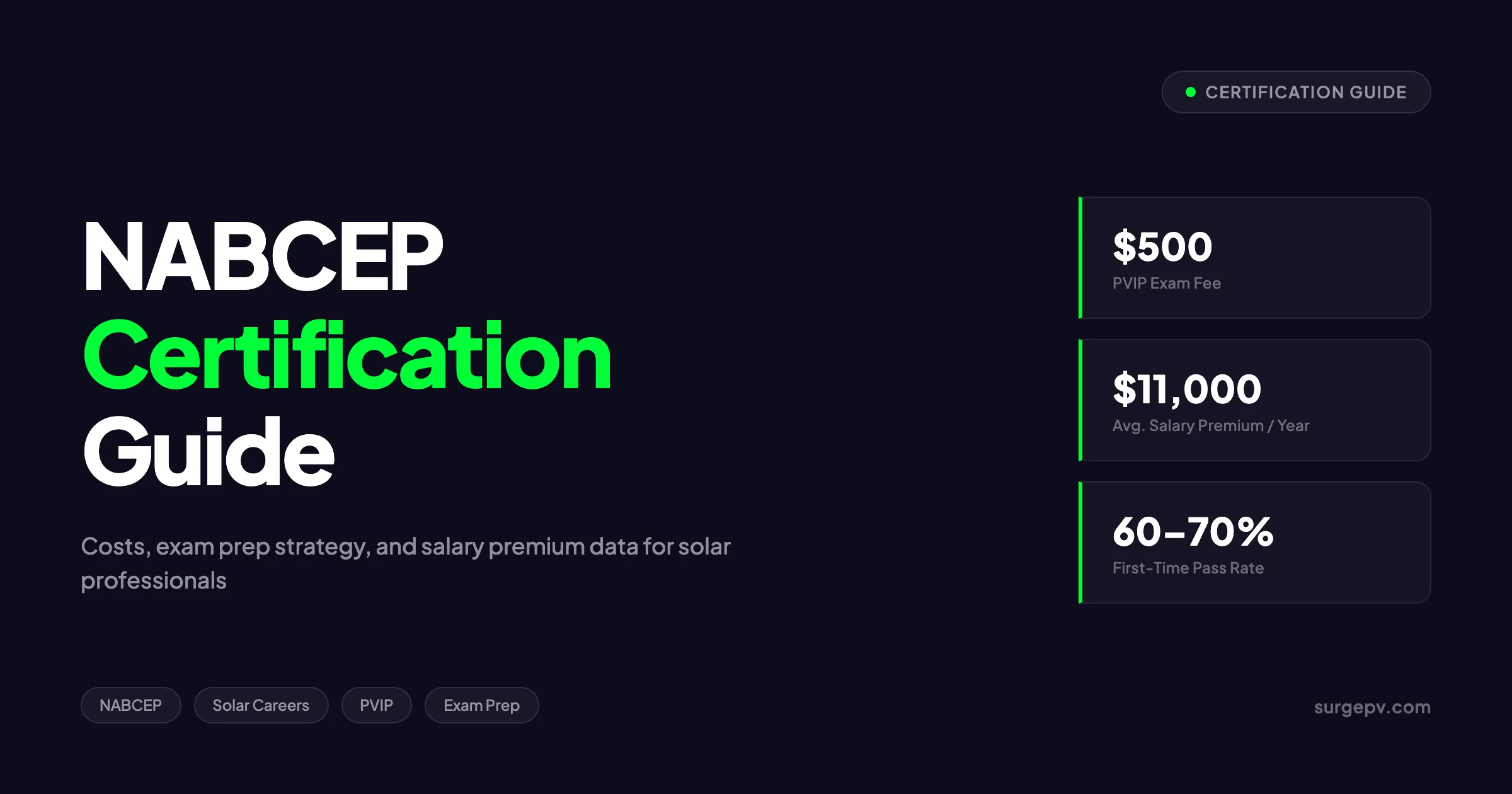
NABCEP certification costs $500 for PVIP or $150 for PVA. Certified professionals earn $11,000 more per year on average. The PVIP exam has 70 questions, a 4-hour time limit, and a 70 scaled passing score. Most candidates need 100–150 study hours and a structured prep course to pass on the first attempt.
Key takeaways:
- NABCEP PVIP certification costs $500 and requires 58 hours of training plus documented installation experience
- Certified professionals earn an average $11,000 annual premium over non-certified installers
- The PVIP exam passes 60–70% of first-time candidates; structured prep significantly improves odds
- A new Board Eligible pathway lets you take the exam before completing all experience requirements
- Recertification is required every 3 years with 30 continuing education hours
- 60% of EPC firms consider NABCEP certification essential or very important for hiring
In this guide:
- What NABCEP certification is and why it matters in 2026
- Every certification type explained: PVIP, PVA, PVDS, PVTS, and more
- Complete 2026 fee breakdown by certification level
- Exam format, scheduling, and what to expect on test day
- Step-by-step exam prep strategy with resource recommendations
- Salary premium data with real numbers and sources
- Employer demand and which jobs require certification
- Recertification requirements and continuing education rules
- Common prep mistakes and how to avoid them
- 2026 policy updates and the new Board Eligible pathway
What Is NABCEP Certification?
NABCEP stands for the North American Board of Certified Energy Practitioners. Founded in 2002, it is the most widely recognized professional certification body for solar energy practitioners in North America. NABCEP credentials are accredited under ISO/IEC 17024:2012, the international standard for personnel certification programs. The organization’s mission, mission statement, and full credential catalog are available on NABCEP’s official website.
The organization offers two credential levels. Associate credentials — PV Associate (PVA), Solar Heating Associate (SHA), and Operations & Maintenance Associate Technician (OMAT) — are entry-level credentials that demonstrate foundational knowledge. Board certifications — PV Installation Professional (PVIP), PV Design Specialist (PVDS), PV Technical Sales Professional (PVTS), and others — are advanced credentials that require documented experience, training, and passing a rigorous exam.
NABCEP certification is voluntary. No state or federal law requires it. But the credential has become the de facto industry standard for professional competency. Many utility incentive programs, manufacturer dealer agreements, and commercial procurement specifications either require or strongly prefer NABCEP-certified personnel. The NABCEP certification glossary entry covers the basics; this guide goes deeper on costs, preparation, and outcomes.
The opinion that matters: After eight years of hiring and training solar crews, I can tell you that NABCEP certification is the single clearest signal of professional seriousness. It does not guarantee quality workmanship — nothing does — but it guarantees that the holder has invested significant time and money into understanding the standards that govern safe, code-compliant installations. In an industry where anyone with a ladder and a drill can call themselves an installer, that signal has real economic value.
Pro Tip
NABCEP certification signals professional credibility in a way that no other solar credential matches. For companies using solar design software to produce professional proposals, having NABCEP-certified staff adds a layer of trust that directly influences close rates.
NABCEP Certification Types: Complete Comparison
NABCEP offers nine distinct credentials across three categories. Choosing the right one depends on your current role and career direction.
Board Certifications (Advanced)
PV Installation Professional (PVIP) — The gold standard. Covers PV design, installation, operations, commissioning, and maintenance. This is the credential most employers ask for by name. It requires the most training hours and experience documentation. If you are on a roof, in a truck, or managing crews, this is your target.
PV Design Specialist (PVDS) — Focused on mechanical and electrical design components of PV systems. Ideal for professionals who configure systems, ensure code compliance, and perform performance modeling but do not perform physical installation. If you spend your day in solar design software, PVDS validates that expertise.
PV Technical Sales Professional (PVTS) — Covers qualifying prospects, site analysis, performance analysis, and financial incentives. This credential bridges technical knowledge with customer relations. Sales teams use it to prove they understand system capabilities, not just closing techniques.
PV Installer Specialist (PVIS) — Focused on installing DC and AC PV system conductors, raceways, monitoring hardware, and developing safety plans. Narrower than PVIP but deeper on the physical installation side.
PV Commissioning & Maintenance Specialist (PVCMS) — Covers operations, maintenance, commissioning, verification protocols, and preventive maintenance procedures. Growing in importance as the installed base of solar systems ages.
PV System Inspector (PVSI) — For professionals who inspect residential and commercial PV systems for authorities having jurisdiction, utilities, and incentive programs. Covers applicable codes, ordinances, and safety assessment.
Energy Storage Installation Professional (ESIP) — Covers energy storage design, installation, operations, commissioning, and maintenance. The fastest-growing certification track as battery storage deployment accelerates. For more on this topic, see Adding Battery Storage Services.
Solar Heating Installer (SHI) — For solar water heating system installation.
Solar Heating System Inspector (SHSI) — For inspecting solar heating systems.
Associate Credentials (Entry-Level)
PV Associate (PVA) — Foundational PV knowledge credential. Best for career starters, students, and those transitioning into solar. Costs $150 total and requires minimal experience.
Solar Heating Associate (SHA) — Entry-level solar thermal credential.
Operations & Maintenance Associate Technician (OMAT) — Entry-level O&M credential.
Certification Comparison Table
| Certification | Level | Focus Area | Exam Fee | Experience Required | Best For |
|---|---|---|---|---|---|
| PVIP | Board | Full installation lifecycle | $500 | 58 hrs training + 6 project credits | Installers, project managers, crew leads |
| PVDS | Board | System design | $500 | 40+ hrs training + design portfolio | Designers, engineers, drafters |
| PVTS | Board | Technical sales | $500 | 40+ hrs training + sales experience | Sales consultants, account managers |
| PVIS | Board | Hands-on installation | $500 | 40+ hrs training + installation exp | Installers who want depth over breadth |
| PVCMS | Board | O&M and commissioning | $500 | 40+ hrs training + O&M experience | O&M technicians, service teams |
| PVSI | Board | System inspection | $150 | 40+ hrs training + inspection exp | Code officials, third-party inspectors |
| ESIP | Board | Energy storage | $500 | 40+ hrs training + storage exp | Battery storage specialists |
| PVA | Associate | Foundational PV | $150 | Course completion or 6 months work | Career starters, students |
NABCEP Certification Costs & Fees: Full 2026 Breakdown
Understanding the full cost of NABCEP certification requires looking beyond the exam fee. Here is every line item.
Board Certification Fees
| Fee Type | Cost |
|---|---|
| Application fee | $125 |
| Exam fee | $375 |
| Total initial cost | $500 |
| Re-exam fee | $275 |
| Recertification (every 3 years) | $390 |
| Late recertification penalty | $50 |
| Printed certificate (optional) | $25 |
Associate Credential Fees
| Fee Type | Cost |
|---|---|
| Application fee | $25 |
| Exam fee | $125 |
| Total initial cost | $150 |
| Re-exam fee | $125 |
| Renewal (every 3 years) | $150 |
| Late renewal penalty | $50 |
| Printed certificate (optional) | $25 |
Additional Costs to Budget
Training courses: $500–$3,000 depending on provider, format, and certification level. HeatSpring, Solar Energy International (SEI), and Everblue are NABCEP-registered providers. Some employers cover this as professional development.
Study materials: $100–$300 for textbooks, practice exams, and code references. Sean White’s Solar PV Engineering and Installation runs approximately $35 on Amazon. A current NEC codebook is essential.
International testing fee: $75 additional for exams taken outside the United States and Canada. For Canada-specific compliance details, see Canada comparisons/solar-designing.
Time cost: 100–150 study hours for PVIP. At a conservative $25/hour opportunity cost, that is $2,500–$3,750 in time investment.
Total Real Cost of PVIP Certification
| Cost Category | Low Estimate | High Estimate |
|---|---|---|
| NABCEP fees (application + exam) | $500 | $500 |
| Training course | $500 | $3,000 |
| Study materials | $100 | $300 |
| Time investment (valued) | $2,500 | $3,750 |
| Total | $3,600 | $7,550 |
The $11,000 average annual salary premium means most certified professionals recover their investment within the first year. That is a strong return even at the high estimate.
Hidden Costs Most Guides Do Not Mention
Beyond the obvious fees, budget for these often-overlooked expenses:
Travel to testing centers: If you live outside a major metro area, the nearest CBT center may be 100+ miles away. Gas, hotel, and meals can add $200–$400 per attempt.
OSHA 10 training: Required for PVIP eligibility. Costs $50–$100 online or $150–$200 in person. Some employers cover this; many do not.
Codebook updates: NEC cycles change every three years. If you certified under the 2017 NEC and are now testing under the 2023 cycle, you need the updated codebook. Budget $120 every code cycle.
Time off work: The exam takes half a day. Add travel time and you may need a full day off. For hourly workers, that is lost wages.
Retake risk: With a 60–70% first-time pass rate, 30–40% of candidates pay the $275 re-exam fee. Budget for this possibility. The candidates who pass on the first try are almost always those who completed a full prep course and took at least three practice exams under timed conditions.
NABCEP Exam Format & Scheduling
NABCEP offers two exam delivery formats. Both use the same question pool and scoring.
Computer-Based Testing (CBT)
CBT takes place at Meazure Learning testing facilities. Over 500 locations exist in the United States and nearly 1,000 globally across 97 countries. After NABCEP approves your application, you receive a Notice-to-Schedule (NTS) email. You then select your location, date, and time through Meazure Learning’s online system. You have six months from receiving the NTS to schedule. For Global-specific compliance details, see Global net-metering-by-country.
Live Remote Proctoring (LRP)
LRP lets you take the exam from any location on your personal computer. A live proctor monitors via webcam. All board certifications and associate credentials are available via LRP. The same six-month scheduling window applies.
LRP technical requirements:
- Windows 10 or newer
- 1 GB RAM minimum
- 2 Mbps upload and download (wired connection preferred)
- Webcam with 640×480 resolution minimum
- Working speakers and microphone
- Internet Explorer, Firefox, Chrome, or Safari
LRP exams are not available on smartphones or tablets.
Exam Structure
The PVIP exam contains 70 questions with a 4-hour time limit. A scaled score of 70 is required to pass. The exam covers:
- NEC Article 690 (Solar Photovoltaic Systems)
- NEC Article 705 (Interconnected Electric Power Production Sources)
- NEC Article 706 (Energy Storage Systems)
- System sizing and component selection
- Installation best practices
- Commissioning procedures
- Safety protocols
- Site assessment and design fundamentals
Scheduling Rules
Submit scheduling requests at least two business days before your desired exam date. Rescheduling is possible but incurs a fee paid directly to Meazure Learning. All scheduling changes go through their online system.
ID requirements are strict. You must present a valid government-issued photo ID that matches your application name exactly. Accepted forms: driver’s license, photo ID card, passport, or military ID. Expired IDs are rejected. If you show up without valid ID, you forfeit the full exam fee.
PVIP Exam Prep Strategy: A Systematic Approach
The PVIP exam rewards preparation, not just experience. Here is a proven study framework.
Phase 1: Foundation (Weeks 1–4)
Start with the NABCEP Job Task Analysis (JTA). This document maps exactly what the exam covers and how questions are weighted. Download it free from nabcep.org. Read it twice. The JTA is your syllabus.
Next, enroll in a NABCEP-registered training course. For PVIP, you need 58 hours of advanced PV training. HeatSpring’s bundle covers this across three courses: 18–24 hours on fundamentals, 40 hours on advanced design and installation, and 7–10 hours on exam-specific prep. SEI and Everblue offer comparable programs. Self-paced formats let you study on your own schedule. For more on this topic, see Advanced Solar PV Design Software.
During this phase, read Sean White’s Solar PV Engineering and Installation. It is the most widely recommended textbook for PVIP prep. Budget $35 for the paperback.
Phase 2: Code Deep Dive (Weeks 5–8)
Roughly 40–50% of the PVIP exam covers NEC requirements. This phase focuses exclusively on code.
Priority NEC articles:
- Article 690 — Solar Photovoltaic Systems (highest weight)
- Article 705 — Interconnected Electric Power Production Sources
- Article 706 — Energy Storage Systems
- Article 710 — Stand-Alone Systems
- Article 712 — DC Microgrids
- Article 625 — EV Power Transfer Systems
Buy a current NEC codebook. Do not rely on online summaries. The exam tests specific code language and exceptions. Work through each article with a highlighter. Pay special attention to rapid shutdown requirements, grounding systems, and overcurrent protection sizing.
Phase 3: Practice & Timing (Weeks 9–12)
Take practice exams under timed conditions. The PVIP exam gives you about 3.4 minutes per question. Practice exams build the pacing instinct you need.
HeatSpring’s prep bundle includes question-by-question practice exam review with 71 assignments. Take the full practice exam at least three times. Track your scores by topic area. If you are scoring below 75% on NEC questions, return to Phase 2 before scheduling the real exam.
Key topics that trip up experienced installers:
- Voltage temperature calculations (though NABCEP has not included these on PVA exams since 2019, they still appear on PVIP)
- Rapid shutdown device placement and wiring methods
- DC conductor ampacity and derating
- Inverter sizing and clipping analysis
- Grounding electrode system requirements
Phase 4: Final Review (Week 13)
Review your weakest topic areas from practice exam analytics. Re-read the corresponding JTA sections. Do not cram new material. Focus on solidifying what you know.
Schedule your exam for a morning slot if you are a morning person, afternoon if not. The four-hour exam is mentally taxing. Arrive (or log in) 30 minutes early. Bring water and a snack for the break.
What to Expect on Exam Day
For CBT candidates: arrive 30 minutes early with two forms of ID. Lockers are provided for personal items. You cannot bring phones, watches, notes, or calculators into the testing room. The testing center supplies a basic calculator and scratch paper.
For LRP candidates: test your equipment the day before. Run a speed test. Check your webcam. Close all other applications. Have a backup internet connection ready — mobile hotspot if your primary connection fails. The proctor will ask you to show your workspace and ID via webcam before starting.
The exam interface shows one question at a time. You can flag questions for review and navigate back and forth. Use this feature. Answer every question — there is no penalty for guessing. Budget your time: 70 questions in 240 minutes means roughly 3.4 minutes per question. If a calculation question is taking more than 5 minutes, flag it and move on. You want 15–20 minutes at the end to review flagged items.
Pro Tip
The most common reason experienced installers fail is overconfidence in field knowledge. The exam tests code book knowledge, not muscle memory. A crew chief with ten years of experience who has never read Article 690 cover to cover will likely fail. A two-year installer who has studied the NEC systematically will likely pass.
Study Resources: What Works and What Does Not
Highly Recommended
NABCEP Job Task Analysis — Free. Essential. Your exam blueprint.
HeatSpring NABCEP PVIP Certification Prep — $1,295–$1,595. NABCEP-registered provider. 58 hours of training. Includes practice exams. Materials accessible for 12 months. Sean White instructs.
Solar Energy International (SEI) — $995–$1,495. NABCEP-registered. Online and in-person options. Strong reputation for hands-on training.
Sean White’s Solar PV Engineering and Installation — ~$35. The standard textbook for PVIP prep.
Current NEC Codebook — ~$120. Non-negotiable. The exam references specific code language.
Worth Considering
Everblue Training — $500–$1,200. NABCEP-registered. Good for candidates who want structured classroom time.
NABCEP CE Conference — Held annually. The 2026 conference ran March 16–19 in Milwaukee. Offers continuing education credits and networking. Not a prep course but valuable for recertification hours. Read more about Battery Solar System Design UK. See our guide on Heritage Building Solar Case Study for more.
Not Recommended
Unregistered online prep courses — Any course not listed on NABCEP’s registered provider directory may not count toward your training hour requirements. Verify before enrolling.
Outdated practice exams — NEC code cycles change. Practice exams based on the 2017 NEC will mislead you if you are testing under the 2023 cycle.
NABCEP Salary Premium: The Real Numbers
Does NABCEP certification actually pay off? The data says yes.
Official NABCEP Research
NABCEP’s own research shows that board-certified professionals earn an average of $11,000 more per year than non-certified installers. This represents a 26% average salary increase. The research also found that 60% of EPC firms consider NABCEP board certifications “essential” or “very important” when making hiring decisions. Solar employment data from the U.S. Bureau of Labor Statistics confirms strong demand for certified practitioners, with the occupation projected to grow 42% through 2034.
PayScale Data
PayScale reports NABCEP Solar PV Installer Certification holders earning an average base salary of $85,000 per year based on 63 individual salary reports. The range spans $36,000 to $156,000 depending on location, experience, and additional credentials.
HeatSpring Survey
A HeatSpring survey of NABCEP exam-takers found:
- 70% of employed professionals who passed the exam received a higher salary
- 35% of job seekers found employment after passing
- 75% of respondents on Indeed reported that NABCEP certification helped them get a job
Salary Comparison
| Credential Status | Typical Annual Salary |
|---|---|
| Non-certified solar installer | $30,000–$40,000 |
| NABCEP PVA holder | $40,000–$55,000 |
| NABCEP PVIP holder | $70,000–$85,000 |
| PVIP + electrical license | $85,000–$115,000 |
| PVIP + commercial experience | $90,000–$130,000 |
What Drives the Premium
Location matters most. California, Massachusetts, New York, and Colorado pay NABCEP-certified professionals 20–40% above the national average. Rural markets in the Southeast and Midwest pay closer to the baseline.
Additional credentials multiply the effect. A licensed electrician who adds NABCEP PVIP certification can command $85,000–$115,000. Add commercial or utility-scale experience and the range extends to six figures.
Specialization pays. Energy storage certification (ESIP) is the fastest-growing premium skill. Battery storage installers with NABCEP credentials are in acute shortage.
The opinion most hiring managers will not say out loud: NABCEP certification is becoming a proxy for professionalism in an industry that still employs too many untrained helpers. When a project goes wrong — a grounding fault, a failed inspection, a warranty claim dispute — the first question lawyers and insurers ask is whether the installer held recognized credentials. Certification is not just about salary. It is about liability protection.
What the Data Actually Means
The $11,000 figure is an average, not a guarantee. A residential installer in rural Mississippi who earns NABCEP certification will not automatically jump $11,000. But the credential opens doors to higher-paying markets, roles, and employers that were previously inaccessible. The certification is a multiplier, not a fixed bonus.
Employer Demand: Who Requires NABCEP?
NABCEP certification is not legally required. But the practical reality is that it functions as a requirement for an increasing share of the solar job market.
EPC Firms
Sixty percent of EPC firms consider NABCEP board certification essential or very important for hiring. Large commercial and utility-scale contractors rarely hire lead installers without it. The certification signals that a candidate understands code, safety, and quality standards without requiring extensive on-the-job verification. Industry-wide hiring data from SEIA’s National Solar Jobs Census shows that certified installers are disproportionately represented in lead roles.
Utility Rebate Programs
Many state and utility incentive programs require NABCEP-certified personnel on installation crews. California’s SGIP (Self-Generation Incentive Program) for battery storage, NY-Sun in New York, and Massachusetts SMART program all specify NABCEP certification for contractor eligibility. These programs are overseen by state energy authorities and DOE’s Solar Energy Technologies Office, which provides technical guidance for workforce qualification standards.
Manufacturer Dealer Programs
SunPower, Enphase, SolarEdge, and other major manufacturers require or prefer NABCEP certification for their certified installer networks. These programs often come with lead generation benefits, preferential pricing, and warranty support that uncertified installers cannot access.
Government and Commercial Procurement
Federal agencies, schools, and commercial entities increasingly specify NABCEP certification in RFPs and procurement documents. A contractor without certified staff is simply non-responsive for these bids. The IRENA 2026 Renewable Energy and Jobs report estimates the global solar workforce at 5.5 million, with North America representing one of the fastest-growing certification markets.
What Most Candidates Get Wrong About Employer Demand
Many installers assume NABCEP only matters for lead roles. That is outdated. In 2026, mid-sized solar companies are using NABCEP certification as a filter at the application stage. An uncertified candidate with five years of experience may lose out to a certified candidate with two years. The certification has become a sorting mechanism, not just a promotion requirement.
Small Business Owners: Why Certification Affects Bids
If you run a solar installation company, NABCEP certification on your team directly affects which projects you can bid. Utility-scale EPCs, commercial property managers, and government procurement officers increasingly require certified personnel in their RFPs. A two-person shop with one PVIP-certified owner can bid on projects that a five-person crew without certification cannot touch. The certification functions as a business development tool, not just a personal credential.
For solar installers building a company, the math is straightforward. The $500 exam fee plus $1,500 training investment for one employee opens access to project categories that can generate tens of thousands in additional annual revenue. Also see: Us Residential Solar Market Trends 2026.
NABCEP Renewal & Recertification Requirements
NABCEP certification is not a one-time achievement. Maintaining it requires ongoing investment.
Board Certification Recertification
| Requirement | Details |
|---|---|
| Renewal period | Every 3 years |
| Continuing education | 30 hours total |
| Ethics/safety minimum | 3 hours within the 30 |
| Recertification fee | $390 |
| Late fee | $50 |
Associate Credential Renewal
| Requirement | Details |
|---|---|
| Renewal period | Every 3 years |
| Continuing education | 18 hours total |
| Renewal fee | $150 |
| Late fee | $50 |
Earning Continuing Education Hours
NABCEP accepts continuing education from multiple sources:
- NABCEP-registered training providers
- Manufacturer training programs (Enphase, SolarEdge, Tesla, etc.)
- Industry conferences (NABCEP CE Conference, Solar Power International, etc.)
- Online courses from approved providers
- Some solar software vendor training programs
The key is that the provider must be NABCEP-registered or the course must be pre-approved. Random YouTube videos and informal workshops do not count.
How Continuing Education Fits Into Your Career
Treat CE hours as professional development, not a checkbox. The best installers use the three-year recertification cycle to deepen skills in emerging areas. In 2024–2026, that means battery storage integration, EV charger coupling, and smart inverter programming. Manufacturer training on inverters from Enphase, SolarEdge, or Tesla often qualifies for CE credit while making you more valuable to employers.
Alternative: Retake the Exam
You can recertify by retaking and passing the certification exam instead of accumulating continuing education hours. This costs the same $500 application and exam fee. Most professionals find continuing education less expensive and less stressful.
Common NABCEP Prep Mistakes
After training hundreds of installers, I have seen the same errors repeat. Here is what to avoid.
Mistake 1: Underestimating the NEC Portion
The National Electrical Code is not a suggestion on this exam. It is roughly half the content. Installers who know how to wire a system but cannot cite the specific Article 690 section for rapid shutdown will fail. Read the codebook. Highlight it. Tab it.
Mistake 2: Skipping the JTA
The Job Task Analysis is not marketing material. It is the exam blueprint, published by NABCEP itself, that tells you exactly which topics carry which weight. Candidates who study without referencing the JTA waste hours on low-weight topics while neglecting high-weight ones.
Mistake 3: Relying on Field Experience Alone
Field experience helps, but it is not sufficient. The exam tests standardized knowledge, not individual company practices. Your crew may wire grounding one way. The exam tests the NEC-mandated way. If they differ, the exam answer is the NEC way.
Mistake 4: Poor Time Management on Exam Day
Seventy questions in four hours sounds generous. It is not. Complex calculation questions can consume 8–10 minutes each. If you hit a hard question, mark it and move on. Come back if time permits. Running out of time with ten unanswered questions is a common failure mode.
Mistake 5: Using Outdated Materials
NEC code cycles change. Training materials from 2019 reference outdated requirements. Always verify that your prep course and practice exams align with the current code cycle.
Mistake 6: Not Documenting Experience as You Go
NABCEP requires detailed documentation of your installation experience. Project dates, system sizes, your specific role, and supervisor contact information. Installers who wait until application time to reconstruct two years of work history often find gaps that delay eligibility. Start a log now.
2026 NABCEP Updates & Changes
The certification landscape shifted in 2025–2026. Here is what changed and what stayed the same.
New Board Eligible Pathway
The biggest change is the Board Eligible status program for PVIP. This pathway flips the traditional order:
- Complete 58 hours of training plus OSHA 10
- Pass the PVIP exam
- Receive “Board Eligible” status
- Complete experience requirements within 3 years
- Submit conversion application
- Receive full board certification
Benefits: You can demonstrate knowledge to employers immediately. You have one year (or four attempts) to pass the exam after coursework. No additional fees convert Board Eligible to Board Certified.
Tradeoff: Board Eligible is not the same as Board Certified. Some employers and programs may not accept it until you complete the conversion. Check with your target employers before choosing this path.
2026 NABCEP CE Conference
The annual continuing education conference ran March 16–19, 2026, in Milwaukee, Wisconsin. It offered: For the latest details on UK, see MCS-Certified Heat Pump + Solar.
- Complete PVA training course
- 100+ exhibitors
- FAA Part 107 drone training
- Walt Ratterman and Les Nelson Awards
- Networking events
The conference is the single most efficient way to earn multiple continuing education hours in one event.
Exam Format Stability
No changes to the exam structure in 2026. PVIP remains 70 questions, 4 hours, scaled 70 passing score. CBT and LRP formats remain unchanged.
Fee Stability
NABCEP fees held steady in 2026. No increases to application, exam, or recertification fees.
The Tradeoff: Certification vs. Experience
Here is a tension every solar professional faces. You need experience to get certified. You need certification to get the best jobs that build experience. The new Board Eligible pathway partially solves this by letting you take the exam first. But it does not eliminate the tradeoff.
My advice: do not wait until you feel “ready.” Start with the PVA if you are new. It is $150, requires minimal experience, and signals intent to employers. If you have two years of field work, start the PVIP training course while you continue working. The 58 hours of training will make you a better installer even if you delay the exam. The certification is a credential. The knowledge is the real asset.
Design Better Systems with SurgePV
NABCEP-certified professionals use SurgePV to produce code-compliant designs, accurate shade analysis, and bankable proposals. The platform handles the calculations so you can focus on installation quality.
Book a DemoNo commitment required · 20 minutes · Live project walkthrough
For a direct comparison, see Arka 360 vs SurgePV.
A Misconception About NABCEP
Many installers believe NABCEP certification replaces an electrical license. It does not. NABCEP is a professional credential. An electrical license is a legal requirement to perform electrical work, and requirements vary by state. California and Florida require a licensed electrician for interconnection work. Other states allow installation under a licensed contractor’s supervision.
You can hold NABCEP PVIP certification and still be legally unable to perform electrical work without a state license. The certifications are complementary, not substitutive. The smartest career move is to pursue both.
Narrative: From Roofer to Certified Professional
Jake started as a roofer in Phoenix in 2019. A solar company hired him as a helper at $16 per hour. By 2022 he was leading a three-person crew at $24 per hour. He heard about NABCEP from a foreman who had just passed the PVIP exam.
Jake enrolled in HeatSpring’s prep course in January 2025. He studied 10 hours per week while working full time. He failed his first attempt in June — scored a 68, two points below passing. The re-exam cost $275. He doubled down on NEC Article 690, retook practice exams until he was scoring 80+, and passed in September with a 76.
Within two months, his company promoted him to project supervisor at $72,000 per year, up from $52,000. A competitor offered $85,000 six months later. Jake stayed — his company had paid for his training — but the offer validated his market value. His total investment: $500 exam fee + $275 re-exam + $1,295 course fee = $2,070. First-year return: $20,000. That is a 968% return on investment.
His advice to new candidates: “Treat the exam like a job interview for a $20,000 raise. Prepare accordingly.”
Conclusion: Three Action Items
NABCEP certification is a significant investment of time and money. It is also one of the highest-return credentials in the solar industry. Here is what to do next:
-
Download the Job Task Analysis for your target certification today. Read it cover to cover. It is free and it tells you exactly what to study.
-
Start an experience log if you have not already. Document every system you work on: date, address, system size, your role, and a supervisor who can verify. NABCEP will ask for this.
-
Enroll in a NABCEP-registered training course within 30 days. Do not let preparation drift. The best time to start was six months ago. The second best time is now.
The solar industry needs certified professionals. Employers are paying premiums. The solar installer career path has never been clearer. And for designers, the path to becoming a solar designer runs directly through credentials like NABCEP PVDS. Whether you are on the roof, at the design desk, or in front of customers, certification is the credential that opens the next door.
For UK-based professionals, the equivalent credential is MCS certification. For installers looking to deepen their technical foundation, the NABCEP certification glossary entry and PV system definitions provide useful background. And if you are building a career in solar sales, the SurgePV solar proposal software and Clara AI tools can help you close more deals with the credibility your certification brings. Solar design software automates design and compliance.
Where this fits
This article is part of SurgePV's Solar Business & Operations hub, which works through the topic from first principles to the decisions a project team actually has to make.


