

Quick Answer
The US solar industry added 33,000 jobs in 2024 and now employs over 280,000 workers. The Inflation Reduction Act's prevailing wage and apprenticeship requirements mean every large solar project must put registered apprentices on the roof. The result: a nationwide scramble to recruit, train, and certify solar apprentices in every state. None required OJT hours. 8,000 hours (typically 4–5 years).
The US solar industry added 33,000 jobs in 2024 and now employs over 280,000 workers. That growth is accelerating. The Inflation Reduction Act’s prevailing wage and apprenticeship requirements mean every large solar project must put registered apprentices on the roof. The result: a nationwide scramble to recruit, train, and certify solar apprentices in every state.
The US solar industry added 33,000 jobs in 2024 and now employs over 280,000 workers. The Inflation Reduction Act’s prevailing wage and apprenticeship requirements mean every large solar project must put registered apprentices on the roof. The result: a nationwide scramble to recruit, train, and certify solar apprentices in every state.
This guide is a complete state-by-state directory of solar apprenticeship programs in the US. It covers what a solar apprenticeship actually involves, how much you get paid, how to qualify and apply, and where to find a registered program in your state. Whether you are a high school graduate exploring trades, a career changer, or an employer building a pipeline, this directory gives you the contacts and requirements you need.
TL;DR — Solar Apprenticeship Programs US
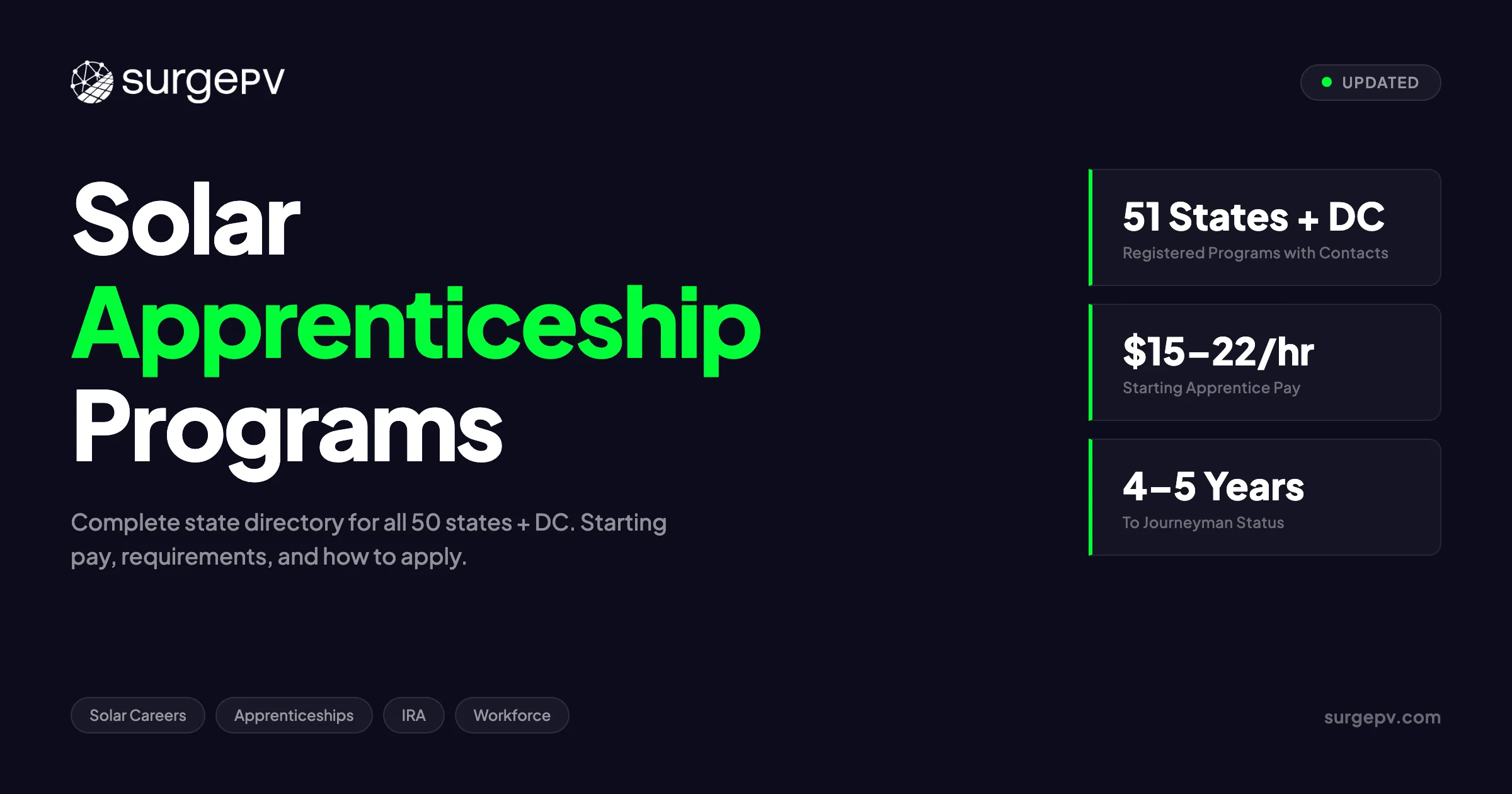
Solar apprentices earn $15–$22/hr starting, reach $25–$35/hr by year four, and $35–$55/hr as a journeyman. Programs run 4–5 years with 8,000 hours of on-the-job training plus classroom instruction. The IRA requires 15% apprentice labor hours on projects over 1 MW, creating unprecedented demand. Every state has at least one registered program, typically through IBEW JATCs, community colleges, or state workforce boards.
For more on this topic, see Design Commercial Solar System 1MW.
In this guide:
- What a solar apprenticeship is: registered vs. unregistered, DOL standards
- Pay scales: earn-while-you-learn model by year and by state
- How to qualify and apply: age, education, testing, and interview process
- State-by-state directory: all 50 states + DC with program names, sponsors, and contact links
- Top national programs: NABCEP, IBEW, GAF Roofing Academy, and military transition programs
- Apprenticeship vs. trade school vs. on-the-job training: which path fits you
- Journeyman salary and career paths after completion
- IRA prevailing wage and apprenticeship rules: what they mean for demand
What Is a Solar Apprenticeship?
A solar apprenticeship is a structured, paid training program that combines on-the-job work experience with classroom instruction to prepare workers for careers in solar photovoltaic installation, electrical work, and system design. Apprentices work full-time under the supervision of experienced journeymen while attending technical classes, typically one or two evenings per week or in concentrated block sessions.
Registered vs. Unregistered Apprenticeships
The distinction matters for your career, your credentials, and your employer.
| Feature | Registered (DOL-Approved) | Unregistered (Informal) |
|---|---|---|
| Oversight | US Department of Labor or state agency | None |
| Curriculum | Standardized, documented, audited | Varies by employer |
| Credential | Nationally recognized completion certificate | None |
| IRA compliance | Counts toward 15% apprentice hour requirement | Does not count |
| Wage progression | Defined scale with scheduled raises | Employer discretion |
| Classroom hours | 576–800 hours required | None required |
| OJT hours | 8,000 hours (typically 4–5 years) | Varies |
| Portability | Credential recognized across states | Tied to specific employer |
Registered apprenticeships are the only path that qualifies for IRA compliance. For anyone serious about a solar career, registered is the only choice worth considering.
The DOL Apprenticeship Model
The US Department of Labor’s Office of Apprenticeship sets the framework that most registered programs follow. The standard solar electrician apprenticeship includes:
- On-the-job training (OJT): 8,000 hours of supervised work over 4–5 years
- Related technical instruction (RTI): 576–800 hours of classroom learning
- Wage progression: Starting at 40–50% of journeyman rate, increasing every 1,000 hours
- Safety training: OSHA 10 or 30, NFPA 70E electrical safety, fall protection
- Credential: Journeyworker certificate upon completion
IRA-Driven Growth in Apprenticeship Demand
The Inflation Reduction Act changed the economics of solar apprenticeship. Projects over 1 MW that claim the full 30% Investment Tax Credit must meet two labor standards:
- Prevailing wage: All workers paid at or above Davis-Bacon Act wage rates
- Apprenticeship: Qualified apprentices perform 15% of total labor hours
Projects that fail these requirements receive only 6% ITC instead of 30%. That 24-point difference on a $10 million project is $2.4 million in lost tax credits. Developers have a powerful incentive to hire registered apprentices, and that incentive has created a structural demand surge that will persist through at least 2032, when the IRA credits begin to phase down.
Key Takeaway — Why Apprenticeships Matter Now
The IRA turned solar apprenticeships from a nice-to-have training option into a project finance requirement. Every utility-scale solar project in the US now needs a pipeline of registered apprentices. That demand is filtering down to residential and commercial installers who want journeyman-trained crews even on smaller projects. The apprenticeship pathway has never been more valuable.
Solar Apprenticeship Pay & Earn-While-You-Learn Model
Solar apprentices get paid from day one. The earn-while-you-learn model is one of the strongest arguments for apprenticeship over trade school, where students typically pay tuition and forego income.
National Pay Scale by Apprenticeship Year
| Year | % of Journeyman Rate | Typical Hourly Range | Annual (2,000 hrs) |
|---|---|---|---|
| Year 1 | 40–50% | $15.00 – $22.00 | $30,000 – $44,000 |
| Year 2 | 55–65% | $20.00 – $28.00 | $40,000 – $56,000 |
| Year 3 | 70–75% | $25.00 – $33.00 | $50,000 – $66,000 |
| Year 4 | 80–85% | $28.00 – $38.00 | $56,000 – $76,000 |
| Year 5 (if applicable) | 90–95% | $32.00 – $42.00 | $64,000 – $84,000 |
| Journeyman | 100% | $35.00 – $55.00 | $70,000 – $110,000 |
Figures are national ranges. California, New York, and Massachusetts run 20–40% above these figures. Rural Southern and Midwestern markets may run 10–15% below.
Pay by State: Journeyman Solar Electrician
| State | Journeyman Hourly | Annual (2,000 hrs) | Notes |
|---|---|---|---|
| California | $45 – $65 | $90,000 – $130,000 | Highest wages; strong union presence |
| New York | $42 – $58 | $84,000 – $116,000 | NYC premium; Local 3 sets market rate |
| Massachusetts | $40 – $55 | $80,000 – $110,000 | Clean energy center subsidies help training |
| Washington | $38 – $52 | $76,000 – $104,000 | Strong IBEW; hydroelectric crossover skills |
| Colorado | $32 – $45 | $64,000 – $90,000 | Growing market; Denver metro leads |
| Texas | $28 – $40 | $56,000 – $80,000 | High volume; lower cost of living |
| Florida | $26 – $38 | $52,000 – $76,000 | Right-to-work; non-union programs common |
| Arizona | $28 – $40 | $56,000 – $80,000 | Strong solar resource; utility-scale demand |
| North Carolina | $26 – $36 | $52,000 – $72,000 | Duke Energy territory; growing C&I |
| Ohio | $28 – $38 | $56,000 – $76,000 | Manufacturing base; supply chain jobs |
Source: Bureau of Labor Statistics Occupational Employment and Wage Statistics (May 2024), IBEW local wage schedules, and state prevailing wage determinations.
Benefits Beyond Base Pay
Most registered apprenticeship programs include:
- Health insurance (typically after 90 days)
- Pension or 401(k) contributions (IBEW programs include multi-employer pension)
- Paid time off (varies by sponsor)
- Tool allowances or provided equipment
- Tuition coverage for related technical instruction
- NABCEP exam fee reimbursement (some programs)
The total compensation package for a journeyman solar electrician in a union market often exceeds $100,000 annually when benefits are included.
Pro Tip — Compare Total Compensation, Not Just Hourly Rate
A $32/hr non-union position with minimal benefits may deliver less total value than a $28/hr union position with full family health coverage, pension contributions, and paid training. When evaluating offers, ask for the total compensation statement including benefits valuation.
How to Qualify and Apply for a Solar Apprenticeship
The application process for solar apprenticeship programs is competitive but straightforward. Understanding the requirements and preparing in advance increases your chances of acceptance.
Basic Eligibility Requirements
| Requirement | Typical Standard | Notes |
|---|---|---|
| Age | 18+ (some programs accept 17 with parental consent) | Hard minimum; no exceptions |
| Education | High school diploma or GED | Transcripts required |
| Driver’s license | Valid state license | Clean driving record preferred |
| Physical fitness | Able to lift 50 lbs, climb ladders, work at heights | Medical clearance may be required |
| Drug test | Pass pre-employment screening | Random testing during program |
| Math test | Pass algebra and geometry aptitude test | Study resources available online |
| Legal status | US citizen or authorized to work | E-Verify at most sponsors |
The Application Process
Step 1: Research programs in your state. Use the directory below to identify 2–3 programs near you. Check their application windows: many JATC programs accept applications only during specific months.
Step 2: Gather documentation. You will need: high school diploma or GED certificate, official transcripts (showing math grades), driver’s license, Social Security card or proof of work authorization, and resume.
Step 3: Apply online or in person. Most IBEW JATCs use an online portal. State and community college programs may use a separate application system.
Step 4: Take the aptitude test. The standard test covers reading comprehension and algebra. A score in the top 50% is typically required to advance. Free study materials are available through the Electric Prep website.
Step 5: Interview. Competitive programs interview candidates who pass the aptitude test. The interview panel typically includes journeymen, training directors, and contractors. They assess communication skills, work ethic, and commitment to the trade.
Step 6: Ranking and selection. Most programs create a ranked list of candidates. When an apprenticeship slot opens, they offer it to the highest-ranked available candidate. This means you may pass all steps but wait months for an opening.
Step 7: Orientation and start. Accepted apprentices attend an orientation covering safety, program rules, and work expectations. First assignments typically start within 2–4 weeks.
How to Strengthen Your Application
- Take math classes: If your high school math is weak, complete a community college algebra course before applying.
- Get OSHA 10 certified: The $50–$100 investment shows commitment and saves the sponsor training time.
- Gain related experience: Construction labor, roofing, electrical helper, or even volunteer Habitat for Humanity work counts.
- Prepare for the interview: Practice explaining why you want to enter solar specifically, not just “the trades.”
- Apply to multiple programs: Do not rely on a single application. Apply to every registered program within commuting distance.
State-by-State Solar Apprenticeship Directory
This directory lists registered or state-recognized solar apprenticeship programs for all 50 states and Washington, DC. Programs are primarily IBEW Joint Apprenticeship and Training Committees (JATCs), community college partnerships, or state workforce development initiatives. Contact information links to the sponsoring organization’s apprenticeship page where available.
| State | Program Name(s) | Sponsoring Organization | Contact / Apply |
|---|---|---|---|
| Alabama | Alabama Electrical JATC (IBEW Locals 136, 443) | Alabama Chapter NECA | aljatc.org |
| Alaska | Alaska Electrical Apprenticeship (IBEW Local 1547) | Alaska JATC | alaskajatc.org |
| Arizona | Arizona Electrical JATC (IBEW Locals 640, 769) | Arizona NECA | azjatc.org |
| Arkansas | Arkansas Electrical JATC (IBEW Locals 1518, 700) | Arkansas NECA | arjatc.org |
| California | IBEW Local 11 JATC (LA), Local 340 JATC (Sacramento), Local 595 JATC (Bay Area), CA Solar & Storage Assn Apprenticeship | Multiple JATCs / CALSEIA | ibew11.org, calsolar.org |
| Colorado | Colorado Electrical JATC (IBEW Locals 68, 111) | Colorado NECA | coloradojatc.org |
| Connecticut | Connecticut Electrical JATC (IBEW Local 90, 457) | Connecticut NECA | ctelectricalapprenticeship.com |
| Delaware | Delaware Electrical JATC (IBEW Local 313) | Delaware NECA | ibew313.org |
| Florida | Florida Electrical JATC (IBEW Locals 177, 349, 728, 824) | Florida NECA | fejatc.org |
| Georgia | Georgia Electrical JATC (IBEW Locals 1579, 1759) | Georgia NECA | georgiajatc.com |
| Hawaii | Hawaii Electrical JATC (IBEW Local 1186) | Hawaii NECA | hawaiijatc.org |
| Idaho | Idaho Electrical JATC (IBEW Local 291) | Idaho NECA | idahojatc.org |
| Illinois | Electrical Joint Apprenticeship (IBEW Local 134 Chicago, Local 364 Rockford) | Chicago & Illinois NECA | ejatc.org |
| Indiana | Indiana Electrical JATC (IBEW Locals 481, 153, 725) | Indiana NECA | iejatc.org |
| Iowa | Iowa Electrical JATC (IBEW Local 405) | Iowa NECA | ibew405.org |
| Kansas | Kansas Electrical JATC (IBEW Local 304, 226) | Kansas NECA | kansasjatc.org |
| Kentucky | Kentucky Electrical JATC (IBEW Locals 369, 862) | Kentucky NECA | kyjatc.com |
| Louisiana | New Orleans Electrical JATC (IBEW Local 130) | Louisiana NECA | noajatc.org |
| Maine | Maine Electrical JATC (IBEW Local 567) | Maine NECA | maineelectricalapprenticeship.com |
| Maryland | Maryland Electrical JATC (IBEW Local 24 Baltimore, Local 26 DC metro) | Maryland NECA | mdjatc.org |
| Massachusetts | IBEW Local 103 JATC (Boston), MassCEC Clean Energy Internship | Boston JATC / MassCEC | bostonjatc.org, masscec.com |
| Michigan | Michigan Electrical JATC (IBEW Locals 58 Detroit, 275 Lansing) | Michigan NECA | miejatc.org |
| Minnesota | Minnesota Electrical JATC (IBEW Local 110, 160, 292) | Minnesota NECA | mnjatc.org |
| Mississippi | Mississippi Electrical JATC (IBEW Local 480) | Mississippi NECA | mselectric.com |
| Missouri | Missouri Electrical JATC (IBEW Local 1 St. Louis, Local 53 Kansas City) | Missouri NECA | mojatc.org |
| Montana | Montana Electrical JATC (IBEW Local 233) | Montana NECA | montanajatc.org |
| Nebraska | Nebraska Electrical JATC (IBEW Local 265) | Nebraska NECA | nejatc.org |
| Nevada | Nevada Electrical JATC (IBEW Local 357 Las Vegas, Local 401 Reno) | Nevada NECA | nevadataj.org |
| New Hampshire | New Hampshire Electrical JATC (IBEW Local 490) | New Hampshire NECA | nhejatc.org |
| New Jersey | New Jersey Electrical JATC (IBEW Local 102, 269, 400) | New Jersey NECA | njejatc.org |
| New Mexico | New Mexico Electrical JATC (IBEW Local 611 Albuquerque) | New Mexico NECA | nmejatc.org |
| New York | IBEW Local 3 JATC (NYC), Local 43 JATC (Syracuse), NY-SUN Workforce | NYC JATC / NYSERDA | nycjatc.org, nyserda.ny.gov |
| North Carolina | Carolinas Electrical JATC (IBEW Locals 379, 553) | Carolinas NECA | cejatc.org |
| North Dakota | North Dakota Electrical JATC (IBEW Local 714) | North Dakota NECA | ndjatc.org |
| Ohio | Ohio Electrical JATC (IBEW Local 8 Cleveland, Local 82 Toledo) | Ohio NECA | ohiojatc.org |
| Oklahoma | Oklahoma Electrical JATC (IBEW Local 584 Tulsa, Local 1141 OKC) | Oklahoma NECA | okcjatc.org |
| Oregon | Oregon Electrical JATC (IBEW Local 48 Portland, Local 280 Salem) | Oregon NECA | oregonjatc.org |
| Pennsylvania | Pennsylvania Electrical JATC (IBEW Local 98 Philadelphia, Local 5 Pittsburgh) | Pennsylvania NECA | pejatc.org |
| Rhode Island | Rhode Island Electrical JATC (IBEW Local 99) | Rhode Island NECA | riejatc.org |
| South Carolina | South Carolina Electrical JATC (IBEW Local 775) | South Carolina NECA | scejatc.org |
| South Dakota | South Dakota Electrical JATC (IBEW Local 761) | South Dakota NECA | sdjatc.org |
| Tennessee | Tennessee Electrical JATC (IBEW Local 429 Nashville, Local 760 Memphis) | Tennessee NECA | tnejatc.org |
| Texas | Texas Electrical JATC (IBEW Local 20 Dallas, Local 520 Austin, Local 666 Houston) | Texas NECA | tejatc.org |
| Utah | Utah Electrical JATC (IBEW Local 354 Salt Lake City) | Utah NECA | utahjatc.org |
| Vermont | Vermont Electrical JATC (IBEW Local 300) | Vermont NECA | vtejatc.org |
| Virginia | Virginia Electrical JATC (IBEW Local 26 Richmond, Local 50 Norfolk) | Virginia NECA | vejatc.org |
| Washington | Washington Electrical JATC (IBEW Local 46 Seattle, Local 191 Spokane) | Washington NECA | washingtonjatc.org |
| West Virginia | West Virginia Electrical JATC (IBEW Local 317) | West Virginia NECA | wvjatc.org |
| Wisconsin | Wisconsin Electrical JATC (IBEW Local 159 Milwaukee, Local 158 Madison) | Wisconsin NECA | wejatc.org |
| Wyoming | Wyoming Electrical JATC (IBEW Local 322) | Wyoming NECA | wyojatc.org |
| Washington DC | Washington DC Electrical JATC (IBEW Local 26) | DC NECA | dcjatc.org |
Note: Many JATC websites serve multiple locals under a state or regional umbrella. If a specific URL does not resolve, contact the IBEW local union hall directly. The IBEW national directory lists all locals with phone numbers. For states without a dedicated solar apprenticeship, the electrical apprenticeship includes photovoltaic modules as part of the standard curriculum under DOL guidelines.
Prominent Programs Worth Highlighting
California: The largest solar market in the US has the most apprenticeship slots. IBEW Local 11 (Los Angeles) runs one of the largest JATC programs nationwide, with dedicated solar PV training facilities. The California Solar & Storage Association (CALSSA) also sponsors a statewide apprenticeship recognized by the California Division of Apprenticeship Standards.
New York: IBEW Local 3 (New York City) operates a rigorous 5-year program with strong solar emphasis. NYSERDA’s NY-SUN workforce development initiative provides additional funding for training organizations statewide, creating pathways outside the traditional JATC model.
Massachusetts: IBEW Local 103 (Boston) partners with the Massachusetts Clean Energy Center (MassCEC) to offer one of the most comprehensive clean energy apprenticeship tracks in the country. Massachusetts also requires solar contractors on state-funded projects to use registered apprentices, creating guaranteed demand.
Texas: Despite being a right-to-work state with lower union density, Texas has extensive apprenticeship capacity through IBEW Locals 20 (Dallas), 520 (Austin), and 666 (Houston). The sheer volume of utility-scale solar construction in Texas — over 10 GW under development — creates demand that outstrips supply of trained workers.
Florida: IBEW Locals 177 (Jacksonville), 349 (Daytona), 728 (Pensacola), and 824 (Orlando) serve a state with strong residential solar growth. Florida’s net metering battles have not slowed installation volume, and the apprenticeship pipeline is expanding to meet demand.
Key Takeaway — Finding Your Program
If you cannot find a dedicated solar apprenticeship in your state, apply to the electrical apprenticeship at your nearest IBEW JATC. The DOL’s electrical apprenticeship standards now include photovoltaic system installation, troubleshooting, and maintenance as core competencies. Every electrical apprentice in the US receives solar training as part of the standard curriculum.
Train Your Solar Crew on Professional Design Software
SurgePV’s solar design software helps apprenticeship programs teach real-world system design, shading analysis, and proposal generation. Give your apprentices hands-on experience with the tools they will use in the field.
Book a DemoNo commitment required · 20 minutes · Live project walkthrough
Read Solar Shading Analysis Guide for a complete walkthrough.
Top National Solar Apprenticeship Programs
Beyond the state-by-state JATC network, several national programs offer specialized solar apprenticeship pathways, military transitions, and accelerated tracks.
NABCEP Workforce Development Partnerships
The North American Board of Certified Energy Practitioners (NABCEP) does not run apprenticeships directly but partners with training providers nationwide to integrate NABCEP certification into apprenticeship curricula. For United States-specific compliance details, see United States arizona/phoenix. For United States-specific compliance details, see United States california/los-angeles.
Key NABCEP certifications for apprentices:
| Certification | Prerequisites | Exam Focus |
|---|---|---|
| PV Installation Professional (PVIP) | 58 hours advanced training + 10 installations | System design, installation, code compliance |
| PV Design Specialist (PVDS) | 28 hours design training | NEC compliance, string sizing, performance modeling |
| PV Technical Sales (PVTS) | 24 hours sales training | Site assessment, financial analysis, proposal development |
| PV Commissioning & Maintenance (PVCMS) | 40 hours O&M training | Troubleshooting, performance testing, warranty claims |
Many JATC programs now structure their curriculum so apprentices can sit for the NABCEP PVIP exam in their fourth or fifth year. The credential is not required for journeyman status but is increasingly expected by employers on commercial and utility-scale projects.
GAF Roofing Academy — Solar Track
GAF, the largest roofing manufacturer in North America, operates the GAF Roofing Academy with a dedicated solar installation track. This program is shorter than a full electrical apprenticeship and targets workers who want to specialize in residential rooftop solar attachment and waterproofing.
| Feature | Details |
|---|---|
| Duration | 6 months full-time |
| Focus | Roof-mounted PV, flashing, waterproofing, structural attachment |
| Credential | GAF Solar Installer Certification |
| IRA compliance | No — does not qualify as registered apprenticeship |
| Best for | Career changers, roofing workers adding solar skills |
| Cost | Free (GAF-funded) |
The GAF program is a valuable entry point but does not replace a registered electrical apprenticeship for workers who want full journeyman status or IRA-compliant credentials.
Solar Energy Industries Association (SEIA) Workforce Partnerships
SEIA operates a workforce development initiative that connects training providers with employers. Their SEIA Solar Career Map outlines progression paths from entry-level installer to project manager, with recommended training at each stage.
SEIA also advocates for federal funding for solar apprenticeship programs through the Department of Energy’s Solar Energy Technologies Office (SETO). SETO-funded programs at community colleges in Arizona, Colorado, and New York offer low-cost or free solar training that can feed into registered apprenticeships.
Military Transition Programs
Veterans represent one of the strongest talent pipelines for solar apprenticeships. Several programs bridge military service directly into registered apprenticeships:
- Helmets to Hardhats: Connects transitioning service members with registered building trades apprenticeships, including IBEW electrical apprenticeships that include solar training.
- Solar Ready Vets: A DOE program operated at military bases nationwide that provides 4–6 weeks of solar-specific training, followed by placement with employers who sponsor registered apprenticeships.
- IBEW Veterans Committee: Many IBEW locals have dedicated veteran liaisons who fast-track military applicants with relevant experience (electrician’s mate, construction battalion, etc.).
Military veterans with electrical or construction experience often enter apprenticeships at year two instead of year one, shortening the path to journeyman status.
Community College Solar Programs
Dozens of community colleges nationwide offer solar technician certificates and associate degrees that articulate into registered apprenticeships. Notable programs include:
| College | Program | Location |
|---|---|---|
| San Juan College | Solar Energy Technician Certificate | Farmington, NM |
| Lansing Community College | Renewable Energy Certificate | Lansing, MI |
| Hudson Valley Community College | Solar PV Installation Certificate | Troy, NY |
| Red Rocks Community College | Solar Energy Technology AAS | Lakewood, CO |
| Midlands Technical College | Solar Technician Certificate | Columbia, SC |
These programs typically run 1–2 years and provide the related technical instruction (RTI) component of an apprenticeship. Graduates can then seek employer sponsors for the on-the-job training portion.
Solar Apprenticeship vs. Trade School vs. On-the-Job Training
Prospective solar workers face three main pathways. Each has trade-offs.
| Factor | Registered Apprenticeship | Trade School / Certificate | On-the-Job Training |
|---|---|---|---|
| Duration | 4–5 years | 6 months – 2 years | Varies |
| Cost to student | Free (employer-paid) | $5,000 – $25,000 | Free |
| Income during training | Full salary, increasing | None (full-time student) | Entry wage |
| Credential value | Highest (journeyman card) | Medium (certificate) | Low (experience only) |
| IRA compliance | Yes | No | No |
| Classroom depth | Extensive (576–800 hrs) | Moderate (varies) | Minimal |
| Job placement | Built into program | Career services | Self-directed |
| Long-term earnings | Highest | Medium | Lowest |
When Apprenticeship Is the Right Choice
Choose a registered apprenticeship if you want:
- The highest long-term earning potential
- A nationally recognized, portable credential
- Zero student debt
- Guaranteed job placement
- Eligibility for IRA-compliant project work
- Union benefits and pension (in union programs)
When Trade School Makes Sense
Trade school or certificate programs work better if you:
- Need to enter the workforce in under 12 months
- Cannot commit to a 4–5 year program
- Want to test the field before committing to an apprenticeship
- Already have an employer willing to train you on the job
- Need flexible scheduling (night classes, online components)
When On-the-Job Training Is Enough
Some workers start as solar installers with no formal training and learn entirely from experienced crew leads. This path works for:
- Entry-level residential installers in non-union markets
- Workers with strong construction backgrounds
- Seasonal or temporary workers not seeking long-term careers
The limitation is clear: without a registered apprenticeship, you cannot advance to journeyman status, and your employer cannot count your hours toward IRA compliance. For long-term career growth, informal OJT is a starting point, not a destination.
Pro Tip — Combine Paths Strategically
Many successful solar workers start with a 6-month community college certificate to get foundational knowledge, then apply to registered apprenticeships at a higher starting level. Some JATCs give credit for prior training, letting you skip the first 6–12 months of classroom instruction. This hybrid approach gets you earning faster while still capturing the long-term benefits of journeyman status.
After the Apprenticeship: Journeyman Salary & Career Paths
Completing a solar apprenticeship opens multiple career tracks beyond installation. The journeyman credential is a foundation, not a ceiling.
Journeyman Solar Electrician Salary by Market
| Market Tier | Hourly Range | Annual (2,000 hrs) | Total Comp (with benefits) |
|---|---|---|---|
| Tier 1 (CA, NY, MA, WA) | $45 – $65 | $90,000 – $130,000 | $110,000 – $160,000 |
| Tier 2 (CO, OR, IL, MN) | $35 – $50 | $70,000 – $100,000 | $85,000 – $125,000 |
| Tier 3 (TX, FL, AZ, NC) | $28 – $42 | $56,000 – $84,000 | $68,000 – $105,000 |
| Tier 4 (Rural Midwest/South) | $24 – $35 | $48,000 – $70,000 | $58,000 – $85,000 |
Total compensation includes health insurance, pension/401(k), and other benefits. Union markets typically show the largest gap between base and total compensation.
Career Progression Paths
Path 1: Lead Installer / Foreman
- Timeline: 2–3 years post-journeyman
- Responsibilities: Crew leadership, quality control, safety oversight
- Salary: $45 – $65/hr (overtime common)
Path 2: Project Manager
- Timeline: 3–5 years post-journeyman
- Responsibilities: Scheduling, client communication, permitting, subcontractor coordination
- Salary: $80,000 – $130,000/year
Path 3: Solar Designer / Engineer
- Timeline: 3–5 years post-journeyman, plus software training
- Responsibilities: System design, performance modeling, code compliance review
- Salary: $75,000 – $120,000/year
- Tools: Solar design software for PV layout, string sizing, and performance simulation
Path 4: Inspector / Code Official
- Timeline: 5+ years post-journeyman
- Responsibilities: AHJ plan review, field inspections, code enforcement
- Salary: $65,000 – $95,000/year
Path 5: Training Director / JATC Instructor
- Timeline: 8+ years in the trade
- Responsibilities: Curriculum development, apprentice instruction, program administration
- Salary: $70,000 – $100,000/year
Path 6: Business Owner
- Timeline: 5–10 years post-journeyman
- Responsibilities: Company ownership, sales, operations, hiring
- Income: Highly variable; $100,000 – $500,000+ for successful contractors
Continuing Education
Journeyman status is not the end of learning. Most states require continuing education for license renewal. NABCEP certifications require 18 hours of continuing education every 3 years. Advanced credentials like the Certified Energy Manager (CEM) or Professional Engineer (PE) license open additional career tracks.
For journeymen moving into design roles, proficiency with solar software platform becomes essential. Tools that model shading, generate financial proposals, and produce permit-ready plans are standard in the industry. SurgePV’s solar proposal tools is one example of the platforms that bridge field experience with professional design work. For a direct comparison, see Arka 360 vs SurgePV.
How the IRA Prevailing Wage & Apprenticeship Rules Affect Demand
The Inflation Reduction Act’s labor provisions are the single largest driver of apprenticeship demand in solar industry history. Understanding how they work explains why apprenticeships have shifted from a workforce development nicety to a project finance necessity.
The Mechanics: ITC and PTC Labor Requirements
The IRA extended and enhanced the Investment Tax Credit (ITC) and Production Tax Credit (PTC) for solar projects. The base credit is 6% for ITC and $5.50/MWh for PTC. Projects can claim the full 30% ITC or $27.50/MWh PTC if they meet two conditions:
- Prevailing wage: All laborers and mechanics on the project must be paid at least the prevailing wage for the geographic area, as determined by the Department of Labor under the Davis-Bacon Act.
- Apprenticeship: Qualified apprentices must perform at least 15% of total labor hours on the project.
Project Size Thresholds
| Project Size | ITC/PTC Labor Requirements | Apprenticeship Hours Required |
|---|---|---|
| Under 1 MW | Exempt — full credit without labor standards | None |
| 1 MW and over | Must meet prevailing wage + apprenticeship | 15% of total labor hours |
| Adjusted for inflation annually | Same thresholds apply | Same percentage |
The 1 MW threshold captures most utility-scale solar projects and many large commercial installations. A 5 MW ground-mount project with 50,000 total labor hours must have 7,500 hours performed by qualified apprentices.
Penalty for Non-Compliance
Projects that fail the labor requirements receive only the base credit:
- ITC: 6% instead of 30% (an 80% reduction)
- PTC: $5.50/MWh instead of $27.50/MWh (an 80% reduction)
On a typical 100 MW utility-scale solar project costing $100 million, the difference between 30% and 6% ITC is $24 million in lost tax credits. No developer will leave that money on the table.
The Apprenticeship Supply Crunch
The IRA created demand for apprenticeships faster than the training pipeline can supply them. In 2024, the solar industry needed an estimated 45,000 registered apprentices to meet IRA requirements on projects under construction. The total pool of registered solar apprentices nationwide was approximately 18,000.
This gap is driving three trends:
- Wage inflation for apprentices: Starting wages in high-demand markets (Texas, California, Arizona) have risen 15–25% since 2022 as contractors compete for apprentice labor.
- Expansion of program capacity: JATCs are adding classes, hiring instructors, and building new training facilities. Several states have approved accelerated apprenticeship models that maintain quality while increasing throughput.
- New program creation: Non-union employers, community colleges, and industry associations are creating new registered apprenticeships to capture the demand. The DOL has streamlined approval for new programs in clean energy trades.
Good-Faith Effort Exception
The IRA includes a “good-faith effort” exception for projects that cannot find sufficient apprentices. To qualify, developers must:
- Request apprentices from a registered program
- Receive a denial or non-response within 5 business days
- Document the request and response
This exception is temporary and intended only for the transition period while program capacity expands. The IRS has signaled that good-faith claims will be scrutinized more closely after 2026.
Key Takeaway — The Apprenticeship Advantage
The IRA has created a structural, decade-long demand for registered solar apprentices. Workers who enter apprenticeship programs now will benefit from rising wages, guaranteed project demand, and career advancement opportunities as the industry scales. For employers, building an apprenticeship pipeline is no longer optional — it is a competitive requirement for winning utility-scale work.
Conclusion
Solar apprenticeship programs are the backbone of the US clean energy workforce transition. With 280,000+ solar workers already employed and tens of thousands of new positions opening annually, the apprenticeship pathway offers a rare combination: paid training, zero debt, national credentials, and strong long-term earnings. Also see: Us Residential Solar Market Trends 2026.
The IRA’s prevailing wage and apprenticeship requirements have transformed what was already a good career path into an essential one. Every utility-scale solar project in America now needs registered apprentices. That demand is flowing through to residential and commercial installers who want trained, credentialed crews.
The state directory above gives you a starting point in every state. The national programs — NABCEP, GAF, SEIA, military transition — offer specialized pathways. And the comparison of apprenticeship vs. trade school vs. on-the-job training should clarify which route fits your situation. Read more about Agricultural Solar Case Study. Read more about Floating Solar Farms France.
Three actions to take now:
- Apply to 2–3 programs in your area. Do not wait for the “perfect” program. Get on the ranked list at multiple JATCs and take the first opening that fits.
- Get OSHA 10 certified before applying. The small investment signals commitment and removes a training burden from your sponsor.
- Study for the aptitude test. The algebra and reading comprehension test is the most common barrier to entry. Free prep materials are available at electricprep.com.
For solar companies scaling their teams, cloud solar design software and solar proposal software help journeyman-trained crews work more efficiently — turning apprenticeship investment into productive output faster.
Tools & Further Reading
Continue exploring related SurgePV resources:
Frequently Asked Questions
How much do solar apprentices get paid in the US?
Solar apprentices in the US typically earn $15 to $22 per hour in year one, depending on location and program. By year four, most apprentices reach $25 to $35 per hour. After completing a 4-5 year program and passing the journeyman exam, solar electricians earn $35 to $55 per hour, with total compensation exceeding $80,000 to $120,000 annually in high-demand markets like California, New York, and Massachusetts.
How long is a solar apprenticeship program?
Most registered solar apprenticeship programs in the US run 4 to 5 years and require 8,000 hours of on-the-job training plus 576 to 800 hours of classroom instruction. Some shorter programs exist: the GAF Roofing Academy solar track is 6 months, and certain state-recognized pre-apprenticeships run 12 to 18 months. However, the DOL-registered programs that qualify for IRA prevailing wage requirements are uniformly 4-5 years.
What are the requirements to join a solar apprenticeship?
Standard requirements for solar apprenticeship programs include: age 18 or older, high school diploma or GED, valid driver’s license, passing a drug test, and passing a basic math aptitude test (algebra and geometry). Some programs require a physical fitness assessment. Prior construction or electrical experience helps but is not required. The IBEW JATC programs also require an interview and may use a ranking system based on test scores and work history.
Does the IRA require solar apprentices on every project?
The Inflation Reduction Act (IRA) requires that projects claiming the full Investment Tax Credit (ITC) or Production Tax Credit (PTC) must pay prevailing wages and employ qualified apprentices for 15% of total labor hours on projects over 1 MW. Projects under 1 MW are exempt. For the full 30% ITC or $27.50/MWh PTC, developers must meet both the prevailing wage and apprenticeship requirements. Failure to comply reduces the credit by 80%. This rule has created massive demand for registered solar apprentices nationwide.
What is the difference between a registered and unregistered solar apprenticeship?
A registered apprenticeship is approved by the US Department of Labor (DOL) or a state apprenticeship agency, follows a structured curriculum, issues a nationally recognized credential, and qualifies for IRA prevailing wage requirements. An unregistered apprenticeship is an informal on-the-job training arrangement without standardized curriculum, external oversight, or portable credentials. Only registered apprentices count toward IRA compliance, making registered programs the clear choice for anyone entering the solar workforce.
Can I get NABCEP certified through an apprenticeship?
Yes. Many registered solar apprenticeship programs integrate NABCEP (North American Board of Certified Energy Practitioners) certification preparation into their curriculum. The NABCEP PV Installation Professional certification requires documented installation experience, which apprenticeships provide. Some IBEW JATC programs have formal partnerships with NABCEP, allowing apprentices to sit for the exam during or immediately after program completion. NABCEP certification is not mandatory for journeyman status but significantly increases employability and earning potential.
Which states have the best solar apprenticeship programs?
California leads with the most programs and highest wages, including IBEW Local 11 (Los Angeles), Local 340 (Sacramento), and the California Solar & Storage Association apprenticeship. New York has strong programs through IBEW Locals 3 (NYC) and 43 (Syracuse), plus NY-SUN workforce development. Massachusetts offers top-tier programs through IBEW Local 103 (Boston) and the Massachusetts Clean Energy Center. Texas and Florida also have extensive programs due to high installation volume, though wages are lower than the Northeast or West Coast.
Where this fits
This article is part of SurgePV's Solar Incentives & Policy hub, which works through the topic from first principles to the decisions a project team actually has to make.
