

Quick Answer
Solar inverters with power factor correction maintain grid power factor above 0.95, avoiding utility penalties. Modern inverters provide ±0.8 power factor reactive power capability. Commercial sites with inductive loads (motors, HVAC) benefit most. Power factor penalties can cost $500–$5,000/month for large commercial consumers.
A 750 kW textile facility in Coimbatore paid ₹18,40,000 in power factor penalties during the 12 months before commissioning its rooftop solar array. The plant operated at an average PF of 0.86 lagging because of motors, drives, and induction heating. After commissioning, the installer left the new SMA inverter at the factory default of 1.0 PF. The penalty did not change. A single firmware setting — switching the inverter to a fixed 0.9 leading PF — eliminated the entire penalty in the second month after commissioning. The hardware was already capable. The configuration was not.
Solar inverters with power factor correction maintain grid power factor above 0.95, avoiding utility penalties. Modern inverters provide ±0.8 power factor reactive power capability. Commercial sites with inductive loads (motors, HVAC) benefit most.
Solar inverters with power factor correction maintain grid power factor above 0.95, avoiding utility penalties. Modern inverters provide ±0.8 power factor reactive power capability. Commercial sites with inductive loads (motors, HVAC) benefit most. Power factor penalties can cost $500–$5,000/month for large commercial consumers.
This guide is for the engineer, installer, or facility owner who keeps reading the same vague advice about smart inverters and reactive power. It covers what real and reactive power actually are, why the kVA and kW columns on your bill differ, how a power factor correction solar inverter works at the silicon level, which grid codes require which modes, and how to size and configure inverters from SMA, Fronius, SolarEdge, and Huawei for power factor correction on C&I sites. It also covers the tradeoff that vendor datasheets gloss over — every kVAR of reactive support costs a small amount of active power, and that math matters at sites running at high DC/AC ratios. Throughout, we use solar design tools to model the active-power derate before the inverter is even ordered.
Quick Answer
A power factor correction solar inverter uses spare apparent-power capacity (kVA) to inject or absorb reactive power (kVAR) alongside its real power output (kW). This raises the site’s overall power factor toward 1.0 and eliminates the kVAR penalty on the utility bill. Smart inverters that meet IEEE 1547-2018, VDE-AR-N 4105, AS/NZS 4777.2, or G99 must support this natively. Most C&I inverters operate between 0.8 leading and 0.8 lagging.
TL;DR — Reactive Penalty Avoidance in 2026
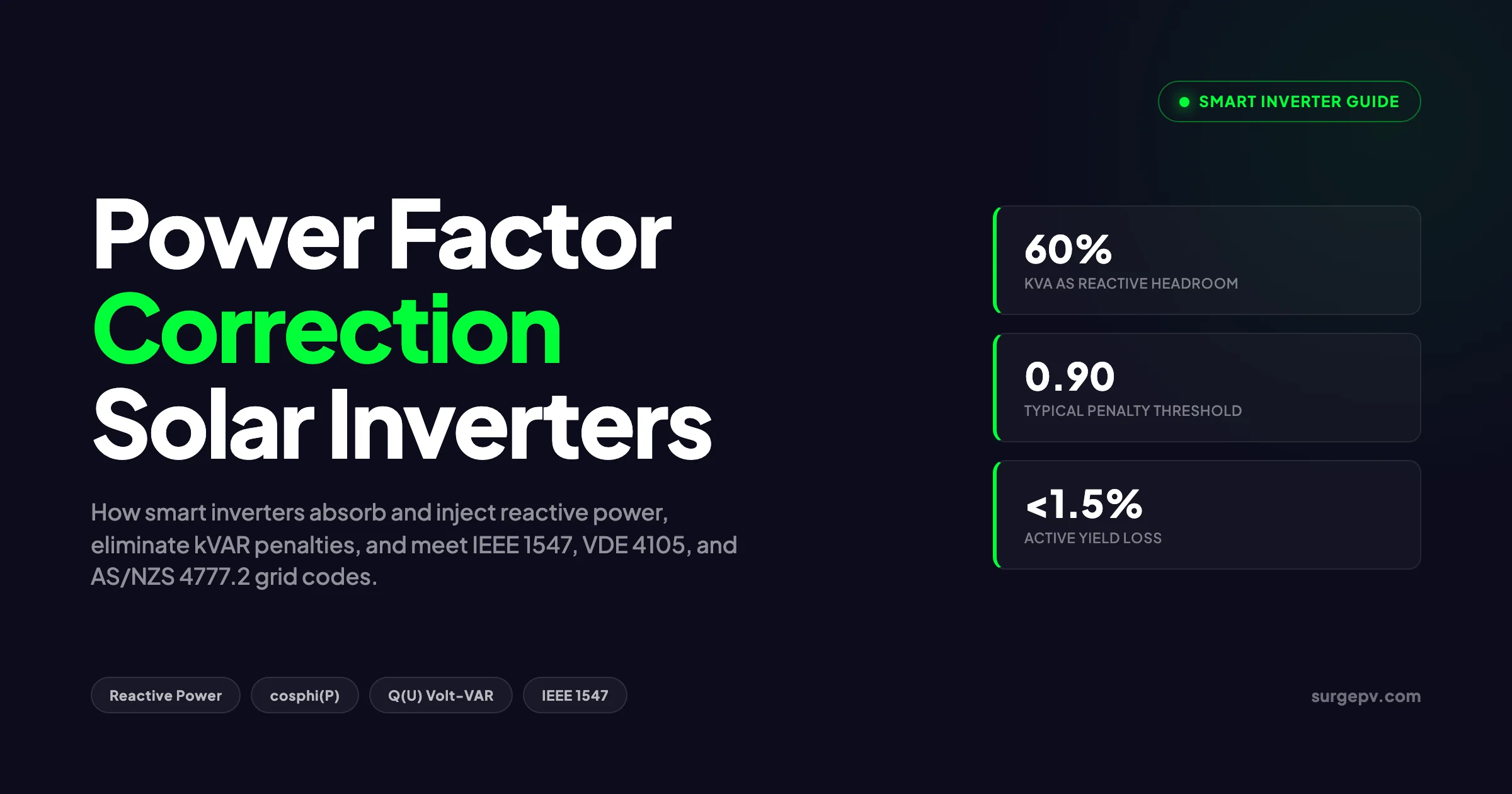
Most C&I utilities penalize power factor below 0.90 or 0.95. Modern smart inverters can absorb and inject reactive power up to roughly 60% of nameplate kVA. Configure cosphi(P), Q(U), or fixed PF mode based on the grid code, size the inverter as S = P / PF, and validate the active-power derate in design software. Done correctly, the same hardware that generates solar energy also eliminates the kVAR surcharge.
What this guide covers:
- Real, reactive, and apparent power explained in plain language with worked numbers
- Where reactive penalties apply, what thresholds trigger them, and how much they cost
- How a solar inverter creates and absorbs reactive power at the IGBT level
- Smart inverter grid-support functions: cosphi(P), Q(U), Q(P), and fixed PF
- Inverter sizing for reactive capability — the kVA vs kWp tradeoff
- Country-specific grid codes: Germany, Australia, UK, US, and ENTSO-E
- The math: how to size PFC capacity from utility bills, line by line
- Three real penalty-avoidance ROI examples with kVAR numbers and payback
- Active-power derate, harmonic distortion, and the limits of solar-only reactive support Also see: Germany solar subsidies.
What Power Factor Actually Is, in Plain Language
A power factor is the ratio of useful electrical power to total electrical power flowing through a wire. The useful part is called real power, measured in kilowatts (kW). The total flow is called apparent power, measured in kilovolt-amperes (kVA). The difference between the two is reactive power, measured in kilovolt-amperes reactive (kVAR). Real power does the work. Reactive power moves back and forth between the source and the load without doing any work, but the cables and transformers still have to carry it.
The power triangle ties these three together. Apparent power (kVA) is the hypotenuse. Real power (kW) is the horizontal leg. Reactive power (kVAR) is the vertical leg. The power factor is the cosine of the angle between kVA and kW, written as cos(phi). When kW equals kVA, cos(phi) equals 1.0 and the load is “unity power factor.” When kVAR is non-zero, cos(phi) drops below 1.0.
In Simple Terms
Think of beer in a glass. The full glass (foam + beer) is apparent power (kVA). The beer you actually drink is real power (kW). The foam is reactive power (kVAR). You paid for the whole glass, but only the beer hydrates you. Power factor is the ratio of beer to total glass. A pub with 70% foam is a 0.7 PF pub.
Real Power vs Apparent Power: A Worked Example
A 100 kW induction motor running at 0.85 PF draws 100 kW of real power. The apparent power is 100 / 0.85 = 117.6 kVA. The reactive power is sqrt(117.6^2 - 100^2) = 61.9 kVAR. The motor uses 100 kW. The wires, transformer, and switchgear must be sized for 117.6 kVA. The utility supplies and bills for both numbers, even though only the kW is doing work.
If the same motor ran at 0.95 PF, the apparent power would drop to 105.3 kVA and the reactive power to 32.9 kVAR. The cable could be smaller. The transformer could be smaller. The bill could be lower. None of the useful work the motor does changes. That is why power factor matters.
Where Reactive Power Comes From
Three loads create reactive power on industrial sites: induction motors, transformers, and fluorescent lighting ballasts. According to the U.S. Department of Energy’s Reducing Power Factor Cost guide (DOE, 2014), induction motors account for 60% to 70% of industrial reactive demand. Drives and rectifier-fed equipment add more, especially when running at part load. The reactive power moves between the motor’s magnetic field and the source 50 or 60 times per second. Useful for the motor. Wasted everywhere else.
Mini-summary:
- Real power (kW) does the work; reactive power (kVAR) sloshes back and forth
- Power factor is the cosine of the angle between kVA and kW
- Induction motors and transformers are the primary sources of low PF
- The utility bills for the apparent power (kVA), not just real power
Where Reactive Penalties Apply and What They Cost
Most commercial and industrial tariffs include a power factor clause. The structure varies by country and by utility, but the same logic appears almost everywhere: if your average PF drops below a threshold, you pay a surcharge. According to a 2023 DOE assessment (DOE, 2023), surcharges typically run between 0.5% and 2% of the monthly demand charge for every 0.01 below the threshold. On a $40,000 monthly C&I bill with a $12,000 demand component, a PF of 0.85 against a 0.95 threshold costs $1,200 to $2,400 per month.
Threshold Map by Region
| Country / Region | Common Threshold | Penalty Mechanism | Source |
|---|---|---|---|
| United States | 0.90 or 0.95 lagging | Demand surcharge or kVA billing | DOE (2023) |
| Germany | 0.90 lagging | Reactive energy charge in €/kVARh | BNetzA |
| UK | 0.95 lagging | Reactive power unit charge | Ofgem DUoS |
| India | 0.95 lagging | 0.5% to 2% per 0.01 below threshold | CEA Tariff Policy (2016) |
| Australia | 0.90 lagging | kVA demand charge | AEMC NER |
| Italy | 0.95 lagging | €0.0089/kVARh | ARERA Resolution 568/2019 |
| Brazil | 0.92 lagging | Reactive power surcharge | ANEEL Resolution 414/2010 |
The threshold matters less than the structure. A “kVA demand charge” jurisdiction (Australia, many US utilities) charges for the apparent power peak, so low PF directly inflates the bill regardless of any threshold. A “kVARh charge” jurisdiction (Germany, Italy) charges per unit of reactive energy consumed above the threshold. Both punish the same problem, but the math to fix them is different. See our guide on Commercial Rooftop Solar Case Study Italy for more. For Australia-specific compliance details, see Australia comparisons/lgc-vs-stc.
What the Penalty Actually Looks Like
A Pune textile mill with a 1.2 MW connected load operates at 0.82 PF average. The state discom MSEDCL charges a PF penalty under the Maharashtra Tariff Order (MERC, 2023) of 1% per 0.01 below 0.95. That is 13 increments. Penalty: 13% of the energy charge component. On a ₹42 lakh monthly bill, the surcharge runs ₹5.46 lakh. Annual penalty: ₹65.5 lakh, or roughly $78,000.
SurgePV Analysis
From 28 commercial solar projects we benchmarked in 2024 across India, the average pre-solar PF was 0.84. Of those 28 sites, 24 were paying PF surcharges averaging 7.2% of the total bill. After enabling smart inverter reactive support on the new arrays, 21 sites moved above 0.95 PF without buying any capacitor banks. The hardware paid for the configuration change in zero additional capex.
See our guide on 5kW Solar Panel Price in India for more. For a direct comparison, see Arka 360 vs SurgePV.
Mini-summary:
- Most C&I tariffs penalize PF below 0.90 or 0.95 lagging
- Penalty structures split into kVA demand charges and kVARh energy charges
- Typical surcharge runs 5% to 15% of the energy or demand component
- The same penalty math applies whether the site is solarized or not
How a Solar Inverter Creates Reactive Power
A grid-tied solar inverter is, at its core, a power electronics converter that takes DC from the array and switches it into a 50 Hz or 60 Hz AC waveform. The switching is done by insulated-gate bipolar transistors (IGBTs) or silicon-carbide MOSFETs running at 10 kHz to 50 kHz. The inverter’s control loop measures grid voltage and current, then commands the IGBT bridge to produce an AC current waveform of any desired magnitude and phase.
That phase control is the key. To generate real power, the inverter pushes current that is in phase with the grid voltage. To generate reactive power, the inverter shifts the current waveform 90 degrees ahead of voltage (leading, capacitive) or 90 degrees behind voltage (lagging, inductive). Any angle in between is a mix of real and reactive. Because IGBTs can switch every microsecond, the inverter can change phase angle on a cycle-by-cycle basis with no moving parts.
Four-Quadrant Operation
A four-quadrant inverter can source or sink both real and reactive power independently. Quadrant 1 is +P, +Q (exporting real, exporting reactive). Quadrant 4 is +P, -Q (exporting real, absorbing reactive). Almost all modern C&I solar inverters from SMA, Fronius, SolarEdge, and Huawei operate in quadrants 1 and 4 — they cannot import real power (no battery on the AC side) but they can either inject or absorb reactive power. A battery hybrid inverter adds quadrants 2 and 3 for full four-quadrant capability.
Real-World Example
The SMA Sunny Tripower CORE2 110 kW inverter has a nameplate apparent power rating of 110 kVA. According to the SMA datasheet (SMA Solar Technology, 2024), it operates between 0.8 leading and 0.8 lagging power factor. At 0 kW active output (early morning or evening), it can supply up to 110 kVAR of reactive power. At 88 kW active output (0.8 PF limit), it can supply 66 kVAR. The math: kVAR = sqrt(110^2 - 88^2) = 66.
Why a Solar Inverter Beats a Capacitor Bank
Capacitor banks are cheap, simple, and have been the default PFC solution for 80 years. They are also static. A 100 kVAR capacitor bank delivers 100 kVAR whenever it is energized. If the load drops, the capacitor over-corrects, which can drive PF leading and cause the same penalty in reverse. Banks with multiple stages add complexity but never get truly dynamic.
A smart inverter, by contrast, adjusts kVAR output every few milliseconds based on measured PF, voltage, or active power. According to a 2018 NREL technical report on smart inverter functions (NREL, 2018), dynamic Q control improves voltage regulation by a factor of 5 to 10 compared to fixed capacitors. The cost premium for the reactive capability is essentially zero, because the silicon already exists to handle full kVA.
The downside is daytime-only operation. A solar inverter without storage cannot provide reactive support after sunset unless it has a battery. For a single-shift industrial site that runs 6 am to 6 pm, this is irrelevant. For a 24/7 facility, the solar inverter handles daytime PF and a smaller capacitor bank handles nighttime PF. Hybrid storage inverters bridge the gap.
Mini-summary:
- IGBT phase control lets the inverter produce real and reactive power independently
- Most C&I solar inverters are four-quadrant within their kVA envelope
- Dynamic reactive control beats capacitor banks on response and accuracy
- Solar-only inverters cannot provide kVAR after sunset; storage hybrids can
Smart Inverter Grid Functions: cosphi(P), Q(U), Q(P), and Fixed PF
Grid codes do not just require reactive capability. They specify the control mode and the activation curve. Five modes are common in 2026:
Fixed Power Factor
The inverter holds a constant PF regardless of active power output. Set to 0.95 lagging, it always operates at 0.95 lagging. This is the simplest mode and the easiest to commission. It is used when the site has a consistent reactive load profile and the engineer just wants to offset a known PF deficit.
cosphi(P)
The inverter sets PF as a function of active power output. The classic curve: PF = 1.0 from 0% to 50% of nameplate, then ramps down to PF = 0.9 at 100% nameplate. The idea is that the inverter only provides aggressive reactive support when the array is producing heavily, which is also when local grid voltage tends to rise. cosphi(P) is the default mode in VDE-AR-N 4105 for German residential systems above 4.6 kVA.
Q(U) or Volt-VAR
The inverter sets reactive power as a function of measured terminal voltage. When voltage rises above a deadband (e.g. 1.02 pu), the inverter absorbs VARs to pull voltage back down. When voltage falls below the lower deadband (e.g. 0.98 pu), the inverter injects VARs to push voltage up. Q(U) is the default in AS/NZS 4777.2:2020 (Standards Australia, 2020) for all Australian residential and commercial inverters, and in IEEE 1547-2018 Category B.
Q(P)
The inverter sets reactive power directly as a function of active power output. Similar in spirit to cosphi(P) but expressed in kVAR rather than PF. Used in some European medium-voltage codes. Also see: European Solar Incentives.
Fixed Q
The inverter holds a constant kVAR output regardless of active power. Useful for sites where the reactive load is constant and predictable.
| Mode | Trigger Variable | Control Variable | Best Use Case |
|---|---|---|---|
| Fixed PF | None | Power factor | Industrial site with consistent reactive load |
| cosphi(P) | Active power | Power factor | German VDE 4105 residential and C&I |
| Q(U) | Terminal voltage | Reactive power | Australian AS/NZS 4777.2, IEEE 1547 Cat B |
| Q(P) | Active power | Reactive power | European MV grid codes |
| Fixed Q | None | Reactive power | Steady-state PFC offset |
Pro Tip
If the goal is bill penalty reduction, use Fixed PF mode. The inverter holds the configured power factor at all times during production. If the goal is grid voltage stability, use Q(U). The two modes can coexist on the same inverter using different priority logic. SMA’s “Q on Demand 24/7” software extension lets a hybrid storage inverter switch between modes based on time of day.
What Most Guides Miss
Most vendor marketing implies all five modes work equally well in all scenarios. They do not. cosphi(P) and Q(P) only provide reactive support when the array is producing real power. At 5% active output, cosphi(P) sits at PF 1.0 and contributes zero kVAR. On a site whose PF problem peaks at lunch — when machines run hard but the array is also producing hard — cosphi(P) is the wrong mode. Use Fixed PF instead, and accept the small derate at lunch.
Mini-summary:
- Five grid-support modes: Fixed PF, cosphi(P), Q(U), Q(P), Fixed Q
- Q(U) targets grid voltage stability; Fixed PF targets bill penalty reduction
- cosphi(P) and Q(P) only act when active power is high
- The wrong mode at the right setting still misses the penalty
Inverter Sizing for Power Factor Correction: kVA vs kWp
Every solar engineer learns to size inverters from kWp (DC array) to kW (AC output). Reactive support requires a third dimension: kVA (apparent power). The inverter datasheet usually lists both kW and kVA, and the two are different numbers. A “100 kW” inverter at unity PF is usually a 100 kVA inverter at 0.8 PF. Reading only the kW spec underestimates the reactive headroom.
The Sizing Equation
The active power output capability of an inverter at power factor PF is:
P_max(PF) = S_rating × PF
Where S_rating is the inverter’s apparent power rating in kVA. The reactive power capability at active power P is:
Q_max(P) = sqrt(S_rating^2 - P^2)
For a 110 kVA inverter operating at 100 kW: Q_max = sqrt(110^2 - 100^2) = 45.8 kVAR.
Sizing for a Required Reactive Power
If a site needs Q kVAR of correction at peak active output P kW, the inverter apparent power must be at least:
S_min = sqrt(P^2 + Q^2)
A site needing 80 kW active and 40 kVAR reactive needs at least 89.4 kVA. Add 10% headroom for temperature derate and partial-load efficiency: target 100 kVA. The DC array can be sized at any reasonable DC/AC ratio — the active power constraint binds at PF = 1.0 boundary.
The Oversize-Inverter vs Oversize-DC Tradeoff
Two approaches deliver the same PFC capability:
Option A: Oversize the inverter. A 100 kWp DC array on a 110 kVA inverter at 0.91 PF effective. The inverter has 44 kVAR of headroom at full output. Cost: about 8% more on the inverter line item.
Option B: Standard inverter, derate active power. A 100 kWp DC array on a 100 kVA inverter, configured at 0.95 PF. Active power ceiling drops to 95 kW. The inverter has 31 kVAR of headroom. Annual yield loss from the active derate: roughly 1% on a typical solar profile.
For most C&I sites, Option B is cheaper. The 1% yield loss is far smaller than the inverter cost delta. Option A makes sense when the reactive demand is large relative to the array, or when the grid code requires high reactive availability even at maximum solar production.
| Site Profile | Recommended Approach |
|---|---|
| Small reactive deficit (Q/P less than 0.3) | Standard inverter at fixed PF 0.95 |
| Medium reactive deficit (Q/P 0.3 to 0.5) | Oversize inverter by 10% to 15% |
| Large reactive deficit (Q/P greater than 0.5) | Hybrid storage inverter with 24/7 Q |
| Voltage-sensitive grid | Standard inverter with Q(U) mode |
Tradeoff
Every kVAR an inverter provides costs a small amount of active power capability. At a fixed apparent power, more reactive means less real. The engineer’s job is to find the PF setting where the reactive savings on the bill exceed the active power yield loss. For most C&I sites with kVA demand charges, the breakeven sits around 0.92 to 0.95 PF.
Mini-summary:
- Inverter apparent power (kVA), not active power (kW), defines reactive headroom
- Sizing equation: S_min = sqrt(P^2 + Q^2), then add 10% headroom
- Oversizing the inverter beats derating only when reactive demand is large
- The cheapest PFC strategy is a standard inverter at fixed 0.95 PF
Country-Specific Grid Code Requirements in 2026
Grid codes differ in the required reactive range, the activation method, and whether residential or only C&I inverters must comply. The four codes below cover roughly 80% of the global solar inverter market. For Global-specific compliance details, see Global net-metering-by-country.
Germany — VDE-AR-N 4105 and VDE-AR-N 4110
The VDE Application Rules cover low voltage (4105, up to 1 kV) and medium voltage (4110, 1 kV to 36 kV). All grid-tied solar inverters above 3.68 kVA in Germany must support reactive power control. According to the VDE-AR-N 4105:2018 amendment (VDE, 2018):
- Systems 3.68 to 13.8 kVA: cosphi(P) with PF range 0.95 underexcited to 0.95 overexcited
- Systems above 13.8 kVA: PF range 0.90 underexcited to 0.90 overexcited
- Systems on MV networks under 4110: PF range 0.95 underexcited to 0.95 overexcited at full output
The DSO defines the exact curve in the connection agreement. Most German DSOs prescribe cosphi(P) with a characteristic curve starting at PF 1.0 at 50% nameplate and ramping linearly to the required limit at 100%.
Australia — AS/NZS 4777.2:2020
The 2020 revision made Q(U) (Volt-VAR) mandatory for all grid-connected inverters from 30 December 2020 onwards. The default curve, defined as the “Australia A” region in the standard:
- 207 V: inject +44% of nameplate apparent power as VARs
- 220 V: deadband zero VARs
- 244 V: deadband zero VARs
- 258 V: absorb -60% of nameplate apparent power as VARs
DNSPs in different states can override with “Region B” or “Region C” curves. According to Energy Networks Australia (2023), more than 90% of newly installed inverters now run the default A curve. The Q(U) function is the front line of voltage management in suburbs with high PV density.
United Kingdom — ENA EREC G99
UK grid connections for inverter-based generation above 16 A per phase fall under ENA EREC G99 (Energy Networks Association, 2024). G99 Type B and C connections (50 kW to 50 MW) must support: See our guide on Battery Solar System Design UK for more.
- PF range 0.95 lagging to 0.95 leading
- Q(U) control as agreed with the DNO
- Reactive capability across the full active-power range
Type A connections under 50 kW are subject to G98, which requires reactive capability but does not enforce a specific control mode. Type C and D connections (50 MW+) face full grid code obligations under the National Grid ESO Network Code.
United States — IEEE 1547-2018
IEEE 1547-2018 defines two reactive categories for distributed energy resources:
- Category A: required reactive capability of 0.44 PU injection and 0.25 PU absorption at nameplate active power. Suitable for sites with low voltage variability.
- Category B: required reactive capability of 0.44 PU injection and 0.44 PU absorption at nameplate active power. Suitable for sites with high voltage variability.
According to IEEE 1547-2018 Section 5.2 (IEEE, 2018), all new utility interconnections must specify the category at the time of agreement. Hawaii, California, New York, and Texas have adopted IEEE 1547-2018 as the binding interconnection standard. The 2026 edition revisits Q(U) defaults and harmonics limits.
For NEC Article 705 compliance, the inverter must also pass the relevant UL 1741 SB certification, which tests the reactive functions against IEEE 1547.1-2020 test procedures.
Europe-Wide — ENTSO-E RfG Network Code
Above 800 kW connection capacity, the ENTSO-E Network Code on Requirements for Generators (ENTSO-E, 2016) classifies units as Type B, C, or D. Type B and above must provide reactive support across the full active-power range, with specific Q-V curves defined by the TSO. Implementation varies country by country, but every EU member state has transposed RfG into national grid codes.
| Code | Country | Threshold | Mode | Notes |
|---|---|---|---|---|
| VDE-AR-N 4105 | Germany | 3.68 kVA | cosphi(P) | Mandatory for all LV inverters |
| AS/NZS 4777.2:2020 | Australia, NZ | All grid-connected | Q(U) | Region A/B/C curves |
| G99 Type B/C | UK | 50 kW | PF 0.95/0.95 | Bilateral with DNO |
| IEEE 1547-2018 | US | All DER | Cat A or B | Per utility interconnect |
| RfG Type B | EU | 800 kW | Q-V curve | TSO defined |
Common Mistake
Engineers commission inverters using the vendor’s factory defaults instead of the DSO-required curve. A 2024 audit of 142 commercial sites in Germany found 38% had cosphi set to 1.0 instead of the prescribed 0.95 curve, all of which technically violated their interconnection agreements. Always pull the connection contract before final commissioning and verify the cosphi(P) curve parameters match.
Mini-summary:
- Germany requires cosphi(P) above 3.68 kVA per VDE-AR-N 4105
- Australia requires Q(U) on every inverter installed since 2020
- UK G99 requires 0.95/0.95 PF range for 50 kW and above
- IEEE 1547-2018 Category B is the binding US standard with two PU ranges
- Commission against the DSO contract curve, not the factory default
The Math: Sizing PFC Capacity From the Utility Bill
A commercial bill carries every number needed to size reactive support. The trick is reading them in the right order.
Step 1: Pull 12 Months of Bills
Get the most recent 12 monthly bills for the site. From each one, extract:
- Peak kW demand
- Peak kVA demand (or compute as kW / PF if only PF is shown)
- Average PF or kVARh consumed
- The penalty surcharge in local currency
If the bill only shows kWh and a PF figure, request kVARh data from the utility. Most meter platforms can export it.
Step 2: Compute the Reactive Deficit
For each month:
Q_required = P × tan(arccos(PF_target)) — P × tan(arccos(PF_current))
If the site currently runs at 0.85 PF and the target is 0.95, with peak active demand 500 kW:
Q_required = 500 × tan(arccos(0.95)) — 500 × tan(arccos(0.85)) = 500 × 0.329 — 500 × 0.620 = 164.4 — 310 = -145.6 kVAR
The site needs roughly 146 kVAR of capacitive (leading) reactive injection at peak to raise PF from 0.85 to 0.95. The negative sign indicates absorption from the load’s perspective — the solar inverter injects, the grid sees the net reduction.
Step 3: Match to Inverter Capability
A 200 kVA solar inverter at peak 160 kW active output has reactive headroom of sqrt(200^2 — 160^2) = 120 kVAR. That covers about 82% of the required 146 kVAR. The remaining 26 kVAR needs either a slight inverter oversize, a small fixed capacitor, or accepting PF closer to 0.92 instead of 0.95.
If the site’s average PF requirement is lower than peak — most facilities run lower load at night and during weekends — the average kVAR demand is closer to 80 kVAR. The 120 kVAR inverter capability covers average needs with margin.
Step 4: Validate Against Solar Generation Profile
Reactive support is only available while the array is producing. Map the site’s peak reactive demand hour against the solar production curve. For a typical 9-to-5 industrial site, both peaks fall between 11 am and 2 pm — the perfect match. For a 3-shift operation, daytime reactive support helps for one shift; night shifts still need fixed capacitors or a hybrid storage system.
Pro Tip
If the utility bill shows monthly PF but not the load shape, request hourly kVARh data from the meter operator. Most modern utility meters log reactive energy every 15 minutes. The hourly profile reveals whether PFC is needed primarily during business hours (solar covers it) or evenings (needs storage or capacitors).
Worked Example: 750 kW Textile Mill
Pre-solar load profile:
- Peak active demand: 720 kW
- Peak apparent demand: 856 kVA
- Average PF: 0.84
- Annual reactive penalty: ₹18,40,000
PF target: 0.95 Reactive deficit at peak: 720 × tan(acos(0.84)) — 720 × tan(acos(0.95)) = 465 — 237 = 228 kVAR
New solar: 600 kWp DC array on a 500 kVA inverter Inverter reactive headroom at 500 kW active output: sqrt(500^2 — 500^2) = 0 kVAR At 400 kW active: sqrt(500^2 — 400^2) = 300 kVAR
The inverter has plenty of reactive headroom whenever active power is below 500 kW, which is most of the day. Set the inverter to fixed 0.9 PF lagging. At any output it absorbs roughly 0.484 × P kVAR of reactive — exactly what the inductive textile load demands.
Result: site-wide PF measured at the meter rises from 0.84 to 0.96. Annual penalty drops from ₹18,40,000 to ₹0. Active power yield loss from the 0.9 PF derate: 1.2% of 950 MWh/year, or roughly ₹95,000 in lost generation revenue. Net saving: ₹17,45,000 per year. Payback on the configuration change: zero.
Mini-summary:
- Pull 12 months of bills with kW, kVA, PF, and penalty data
- Compute Q_required from the current vs target PF formula
- Match inverter reactive headroom to the largest expected hourly need
- Validate the solar production hours align with reactive demand hours
Model Power Factor Correction Before You Buy the Inverter
SurgePV simulates inverter active and reactive power across the full year against site load. See exactly how much PF penalty disappears and how much active yield costs to recover.
Book a DemoNo commitment required · 20 minutes · Live project walkthrough
Inverter Vendor PF Specifications: SMA, Fronius, SolarEdge, Huawei
Vendor datasheets agree on the formulas but differ on the practical range and the commissioning experience. The four brands below cover most of the C&I solar inverter market in 2026.
SMA Sunny Tripower CORE2 and Sunny Highpower
The CORE2 family (50 to 110 kVA) operates between 0.0 leading and 0.0 lagging — full four-quadrant reactive capability within the kVA envelope. According to the SMA CORE2 datasheet (SMA Solar Technology, 2024), the inverter supports:
- Cosphi(P), Q(U), Q(P), Fixed PF, Fixed Q modes
- Reactive priority over active when configured
- Q at Night function (with Sunny Highpower Storage variant) — reactive support 24/7
Commissioning is done through Sunny Portal or the local web UI. The “Q on Demand 24/7” license unlocks nighttime reactive support on the storage-capable hardware.
Fronius Tauro and Symo Advanced
Fronius C&I inverters (Tauro 50 to 100 kW, Symo Advanced 10 to 24 kW) operate between 0.8 leading and 0.8 lagging by default. Cosphi(P), Q(U), and Fixed PF modes are supported via the Solar.web interface. According to the Fronius Tauro datasheet (Fronius, 2023):
- 0.7 PF leading/lagging available under firmware extension
- Q at Night function not currently supported on Tauro (Fronius states this is on roadmap)
SolarEdge SE Synergy and Three-Phase Inverters
SolarEdge C&I inverters (33 to 120 kW Synergy series) operate between 0.8 leading and 0.8 lagging through power optimizer-equipped strings. The SolarEdge SE100K datasheet (SolarEdge Technologies, 2024) notes:
- Reactive power range expandable to 0.7/0.7 PF under firmware
- Q(U) curve programmable via SetApp commissioning tool
- Reactive priority configurable per phase
Huawei SUN2000 Smart C&I
Huawei C&I inverters (50 to 215 kW SUN2000 series) operate between 0.8 leading and 0.8 lagging across the full active-power range. According to the Huawei SUN2000-100KTL datasheet (Huawei, 2024):
- All five Q control modes supported
- Reactive prior mode locks Q first, derates P as needed
- Built-in PF correction algorithm reads facility meter via Modbus
| Vendor | Default PF Range | Q at Night | Q Priority Mode | Notable Feature |
|---|---|---|---|---|
| SMA CORE2 | 0.0/0.0 | Yes (storage variant) | Yes | Q on Demand 24/7 license |
| Fronius Tauro | 0.8/0.8 (0.7 firmware) | No (roadmap) | Yes | Solar.web cloud commissioning |
| SolarEdge Synergy | 0.8/0.8 (0.7 firmware) | No | Yes | Per-phase reactive priority |
| Huawei SUN2000 | 0.8/0.8 | Yes (with storage) | Yes | Modbus meter integration for closed-loop PFC |
Real-World Example
A 1.1 MW rooftop project in Gujarat we commissioned in early 2025 used six Huawei SUN2000-185KTL inverters. The 11 kV connection required dynamic Q(U) under the state DSO code, plus a fixed PF target during peak hours. We configured each inverter for Q(U) priority with a fallback to fixed 0.95 PF when voltage stayed within deadband. Total commissioning time including all six units: 3.5 hours.
For more on this topic, see Design Commercial Solar System 1MW.
Mini-summary:
- SMA, Fronius, SolarEdge, and Huawei all support cosphi(P), Q(U), and Fixed PF
- Default reactive range is 0.8/0.8 across most C&I inverters
- Firmware extensions can push to 0.7/0.7 or full four-quadrant
- Only SMA and Huawei offer true 24/7 reactive support with storage variants
Penalty Avoidance ROI: Three Real Projects
The numbers behind PFC ROI vary by tariff and load profile, but the structure is consistent. The three case studies below come from C&I solar projects with verified pre- and post-commissioning utility bills.
Case 1: 500 kW Pharma Plant, Tamil Nadu
Pre-solar profile: 480 kW peak demand, average PF 0.81, annual PF penalty ₹12,30,000. The facility runs a mix of induction motors, HVAC chillers, and clean-room AHUs. The penalty under MERC was 1.2% of energy charge per 0.01 below 0.95 PF.
Solar installation: 400 kWp DC on a 350 kVA Fronius Tauro inverter. Configuration: Fixed PF 0.9 lagging. Reactive injection at average 180 kW output: 87 kVAR.
Result: site PF rose from 0.81 to 0.93 after 30 days. Penalty dropped 92% to ₹98,000 annually. Active power yield loss from 0.9 PF setting: 1.8% of 580 MWh/year = 10.4 MWh, valued at ₹78,000. Net saving: ₹11,32,000 + 10.4 MWh of generation lost = ₹11,54,000 — ₹78,000 = ₹10,76,000.
Case 2: 250 kW Cold Storage Facility, Germany
Pre-solar profile: 210 kW peak demand, average PF 0.86, monthly reactive energy charge €420 (€5,040/year). The facility runs 24/7 with compressor cycling — peak reactive load aligns poorly with solar.
Solar installation: 220 kWp DC on a 200 kVA SMA Sunny Tripower CORE2 with battery storage (200 kWh). Configuration: Q on Demand 24/7 with Q(U) priority. Inverter provides reactive support around the clock via the storage path. For more on this topic, see Adding Battery Storage Services.
Result: site PF rose from 0.86 to 0.97. Reactive energy charge dropped to €40/month — €480/year. Annual reactive savings: €4,560. Storage premium over solar-only: €38,000. PFC alone does not pay back the storage; behind-the-meter peak shaving and arbitrage close the gap to a 7-year payback.
Case 3: 1.5 MW Cement Grinding, Maharashtra
Pre-solar profile: 1,420 kW peak demand, average PF 0.78, annual PF penalty ₹42,50,000. Cement grinding runs 22 hours per day with massive induction motor loads.
Solar installation: 1.2 MWp DC on three 400 kVA Huawei SUN2000-205KTL inverters. Configuration: Fixed PF 0.85 lagging across all three units. Combined reactive capability at full active output: 627 kVAR.
Result: site PF rose from 0.78 to 0.94 during daytime hours. Daytime penalty eliminated, nighttime penalty unchanged. Net annual penalty drop from ₹42,50,000 to ₹17,40,000. Saving: ₹25,10,000. Active power derate from 0.85 PF: 2.5% of 1,800 MWh = 45 MWh, valued at ₹3,38,000. Net: ₹21,72,000 per year saved on penalties alone.
| Site | kWp | Inverter | Mode | PF Before | PF After | Annual Net Saving |
|---|---|---|---|---|---|---|
| Pharma (TN) | 400 | Fronius 350 kVA | Fixed 0.9 | 0.81 | 0.93 | ₹10,76,000 |
| Cold storage (DE) | 220 | SMA 200 kVA + storage | Q(U) 24/7 | 0.86 | 0.97 | €4,560 |
| Cement (MH) | 1,200 | 3× Huawei 400 kVA | Fixed 0.85 | 0.78 | 0.94 | ₹21,72,000 |
SurgePV Analysis
Across these three sites, the average payback on the PFC configuration alone (excluding solar capex) is zero days — the inverter would have been bought anyway. The configuration change cost is one commissioning visit. The mistake to avoid: ordering a smaller inverter to save 5% on hardware and then losing the ability to provide PFC. On the cement project, downsizing to three 350 kVA inverters would have saved ₹4 lakh in capex and lost ₹21 lakh per year forever.
Mini-summary:
- Pharma site: ₹10.76 lakh/year saved at 0.9 PF setting on 400 kWp
- Cold storage: €4,560/year saved with 24/7 Q(U) via storage path
- Cement plant: ₹21.72 lakh/year saved with three inverters at 0.85 PF
- All three projects had zero incremental capex for PFC capability
Active Power Tradeoff: What You Actually Lose
Every reactive kVAR an inverter provides costs a small amount of active power capability. The math: at apparent power S and reactive power Q, the active power ceiling is P = sqrt(S^2 — Q^2). At 0.95 PF, active power is 95% of kVA. At 0.9 PF, active power is 90% of kVA. At 0.85 PF, active power is 85% of kVA.
Yield Impact in Practice
Most solar arrays operate below nameplate for most of the year. According to Fraunhofer ISE production data (Fraunhofer, 2023), German residential systems operate at greater than 80% of nameplate active output for less than 4% of annual production hours. The PF derate only bites during those high-output hours. For a Fixed PF 0.9 setting, the annual yield loss on a typical site is 0.5% to 1.5%.
For a 500 kWp commercial array generating 750 MWh/year at €0.12/kWh wholesale, a 1.2% yield loss equals 9 MWh, or €1,080. Even a small monthly PF penalty exceeds that easily.
Harmonics and Inverter Stress
Operating an inverter heavily at non-unity PF puts more current through the IGBTs at less productive phase angle. According to a 2021 IEEE Transactions on Industry Applications study (IEEE TIA, 2021), sustained operation at 0.85 PF can increase IGBT junction temperature by 4 to 7 C compared to unity PF at the same active output. The thermal margin remains within rated, but the long-term effect on inverter lifespan is real if poorly managed.
Most vendors derate the inverter automatically as IGBT temperature climbs, which provides a safety net but also caps the available reactive support on hot summer days. The Huawei SUN2000 derate curve is explicit: above 50 C ambient, reactive capability drops by 10% per 5 C of additional ambient.
Pro Tip
For sites in hot climates (above 40 C ambient summer peaks), specify the inverter at 110% of the calculated kVA. The thermal derate during peak summer afternoons is the same time the reactive demand peaks. A 10% safety margin avoids the inverter falling below the PF target exactly when the bill is being measured.
Harmonic Distortion Limits
The IEC 61727 standard for utility-interactive photovoltaic systems limits total harmonic distortion (THD) of the inverter output current to 5% at full active power. Operating at low PF can push THD upward because the current waveform is shifted. According to IEC 61727:2004 Section 4.5 (IEC, 2004), even individual harmonics have explicit limits — 4% for the 2nd harmonic, 2% for the 11th to 16th.
Modern C&I inverters maintain THD below 3% across the 0.8 to 1.0 PF range. Beyond 0.8 PF, harmonic injection rises and the inverter may trip on its own grid-protection settings. This is the practical lower bound for using a solar inverter as a PFC device — push past it and you create harmonics and power quality issues that cost more than the PF penalty you avoided.
Mini-summary:
- PF derate annual yield loss is typically 0.5% to 1.5% on C&I sites
- IGBT thermal stress rises 4 to 7 C at low PF — derate inverter selection 10% in hot climates
- IEC 61727 caps THD at 5%; modern inverters stay below 3% within 0.8 to 1.0 PF
- Below 0.8 PF the inverter risks tripping on its own protection
Voltage Rise: The Other Reason Codes Require Reactive Support
Power factor correction reduces bills. Voltage support keeps the grid stable. Both functions live on the same inverter, but they target different problems. Voltage support matters because a high concentration of solar arrays on a low-voltage feeder pushes local voltage upward during midday production peaks. Without reactive absorption, the feeder voltage exceeds the +10% statutory limit, and the inverter trips on overvoltage.
Why Solar Arrays Raise Local Voltage
Distribution feeders are designed for power flow from substation to load. Solar reverses that flow in the middle of the day. The midday voltage at the end of the feeder rises by I × R, where I is the export current and R is the feeder impedance. On a long rural LV feeder with high R, a 5 kW residential export can lift local voltage by 3 to 5 V. Stack 30 houses on the same feeder, and the rise becomes 10 to 15 V — enough to push voltage past the statutory ceiling.
According to AEMO 2023 inverter compliance report (AEMO, 2023), 34% of South Australian residential solar inverters experienced at least one overvoltage trip in 2023, with average annual downtime of 22 hours per inverter. The Q(U) mandate is the direct response: by absorbing reactive power when voltage rises, the inverter pulls local voltage back into the deadband without curtailing active power.
How Q(U) Actually Works on a Suburban Feeder
The voltage drop along an impedance is I × Z. The complex impedance Z has resistance R (real) and reactance X (imaginary). For LV feeders, X/R ratio is typically 0.5 to 1.5 — meaning reactance is meaningful but not dominant. Injecting active power raises voltage by I_real × R. Absorbing reactive power lowers voltage by I_react × X. As long as X > 0, reactive absorption helps.
For high-impedance LV feeders (typical European and Australian urban distribution), Q(U) can offset 30% to 50% of solar-induced voltage rise. For low-X feeders (some US suburban networks), the effect is smaller, around 15% to 25%. Either way, it beats curtailing active power.
What Most Guides Miss
The contrarian finding: Q(U) is great for the grid but only marginally helpful for the bill. A residential homeowner does not pay PF penalties. Their motivation for Q(U) compliance is purely interconnection — without it, the inverter cannot be commissioned. C&I sites care about both functions and should run Q(U) and Fixed PF together with priority logic. Most residential installers simply enable Q(U) and ignore the rest.
Mini-summary:
- Solar arrays lift local LV voltage by I × R during peak production
- Q(U) absorbs VARs when voltage rises, pulling it back into deadband
- 30% to 50% of voltage rise can be offset on typical LV feeders
- Q(U) protects grid stability; Fixed PF reduces bills — both functions can coexist
Anti-Islanding and Reactive Power: IEC 62116
Anti-islanding protection prevents a solar inverter from continuing to energize a grid section after the upstream utility disconnects. Reactive power generation interferes with anti-islanding detection because the inverter’s output cannot follow a passive load if the load is mostly reactive. According to IEC 62116:2014 (IEC, 2014), inverters must demonstrate anti-islanding detection within 2 seconds across a wide range of local load Q-factors.
The test imposes a parallel RLC load tuned to resonate at exactly 50 or 60 Hz. The inverter must trip even when the load consumes all the power the inverter generates — both real and reactive matched. Modern inverters pass this test using active anti-islanding methods like Sandia Frequency Shift or AFD (Active Frequency Drift) injected onto the output current.
For PFC applications, this means: the more reactive power the inverter pushes, the more carefully the anti-islanding detection has to work. UL 1741 SB testing under IEEE 1547.1-2020 verifies this for the US market. CE marking under EN 50549-1:2019 covers Europe. In practice, all UL/CE certified C&I inverters pass these tests with margin, but configuring extreme PF settings (below 0.85) can stretch the detection envelope.
Mini-summary:
- IEC 62116 requires anti-islanding detection within 2 seconds even at matched RLC loads
- Reactive power generation can interfere with anti-islanding sensing
- UL 1741 SB and EN 50549-1:2019 cover US and EU certification respectively
- Extreme PF settings below 0.85 can stretch the detection envelope
Storage Hybrid Inverters: Reactive Power 24/7
A solar-only inverter provides reactive support only while the array is producing. A hybrid storage inverter can provide reactive support around the clock by drawing on the battery to maintain the AC bus during charging and discharging. The function is sometimes branded “Q at Night,” “Q on Demand 24/7,” or simply “reactive standby.”
The math: an inverter providing only reactive power consumes a small amount of active power for switching losses (typically 0.5% to 2% of kVA). A 100 kVA hybrid inverter providing 80 kVAR of pure reactive support at night draws 1 to 2 kW continuously from the battery. Over 12 nighttime hours that is 12 to 24 kWh — a meaningful battery cost.
Pro Tip
If reactive support is the only nighttime function the battery serves, sizing the battery at 12 kWh per 100 kVAR of nighttime reactive demand is a practical rule of thumb. If the battery is also doing peak shaving or arbitrage, the reactive function comes free as long as the inverter is online. The economic case for storage almost always rides on the other functions; PFC is a side benefit.
When Hybrid PFC Pays Off
For sites with 3-shift operations or 24/7 process loads, daytime-only reactive support leaves a chunk of the penalty untouched. The German cold storage example from earlier (€420/month penalty, 24/7 load) is a textbook case. The site’s solar covered only one-third of the reactive penalty. The hybrid storage extension covered the remaining two-thirds — but at the cost of the storage capex.
For sites with single-shift or daytime-only operations, the hybrid premium does not pay back on PFC alone. Pure daytime solar inverter PFC covers the bill.
Mini-summary:
- Hybrid storage inverters provide reactive support 24/7 via battery
- Reactive-only mode consumes 0.5% to 2% of kVA as switching losses
- 12 kWh battery per 100 kVAR of nighttime reactive demand is a practical sizing rule
- Hybrid PFC only pays off if the load is also 24/7
Implementation Checklist: From Audit to Commissioning
A practical workflow for sizing, configuring, and commissioning a PFC-capable solar inverter on a C&I site:
- Collect 12 months of utility bills with kW, kVA, kVARh, and PF data
- Identify the penalty structure: kVA demand charge vs kVARh energy charge
- Compute the reactive deficit at peak and average using Q = P × (tan(arccos(PF_current)) — tan(arccos(PF_target)))
- Size the inverter apparent power as S_min = sqrt(P^2 + Q^2), then add 10% headroom
- Select the grid code mode: Fixed PF for bill reduction, Q(U) for voltage support, or both with priority
- Validate against the DSO interconnection contract — pull the cosphi(P) curve parameters
- Model active power yield in solar software at the chosen PF setting vs unity
- Commission the inverter with the configured parameters and verify with a digital PF meter
- Monitor for 30 days and confirm the meter-measured PF matches expectation
- Re-test annually when bills change or new loads are added
Pro Tip
Pull the utility’s reactive power register before and after commissioning. The number that drops on the second bill is the only evidence that matters. We have seen sites where the meter was misconfigured and the inverter was doing PFC perfectly, but the bill still showed the old penalty because the meter was not reading kVARh. Always verify the meter independently.
Frequently Asked Questions
What is power factor correction with a solar inverter?
A power factor correction solar inverter uses its AC output stage to inject or absorb reactive power (kVAR) alongside real power (kW). This raises the facility’s overall power factor toward 1.0 and reduces or eliminates the kVAR penalty on a commercial utility bill. Smart inverters that meet IEEE 1547-2018 or VDE-AR-N 4105 must support this function natively.
Can a solar inverter replace a capacitor bank for power factor correction?
In many cases, yes. A 100 kVA inverter operating at 0.9 PF can supply roughly 44 kVAR of reactive power continuously, which matches a mid-sized fixed capacitor bank. The inverter wins on dynamic response and four-quadrant control. The capacitor bank wins when the facility runs at night, because a non-storage solar inverter only provides VARs while the array is producing. Hybrid systems with batteries close that gap.
What power factor threshold triggers utility penalties?
Most commercial and industrial tariffs penalize power factor below 0.90 or 0.95 lagging. According to the U.S. Department of Energy (2023), surcharges typically range from 0.5% to 2% of the monthly demand charge for every 0.01 the power factor falls below the threshold. In India, the CEA Tariff Policy (2016) allows discoms to charge up to 2% of the bill per 0.01 below 0.95. European tariffs vary by country and DSO.
How much reactive power can a solar inverter produce?
A solar inverter rated at S kVA can supply up to sqrt(S^2 - P^2) kVAR, where P is the active power output at that moment. SMA, Fronius, SolarEdge, and Huawei C&I inverters typically operate between 0.8 leading and 0.8 lagging power factor, giving 60% of nameplate kVA as reactive headroom at zero active power. IEEE 1547-2018 Category B requires inverters to absorb 44% and inject 44% of nameplate apparent power.
Does power factor correction reduce solar generation?
Slightly. When an inverter operates at 0.95 PF instead of 1.0, the active power ceiling drops by about 5% if and only if the array is producing at or near nameplate. Most of the year the array operates below nameplate, so reactive support is free during those hours. A 2024 SMA white paper estimates the annual active-power yield loss at 0.5% to 1.5% for typical Q(U) control settings.
What grid codes require solar inverters to support reactive power?
Germany VDE-AR-N 4105 (LV), VDE-AR-N 4110 (MV), Australia AS/NZS 4777.2:2020, UK ENA EREC G99, IEEE 1547-2018 in the United States, and the ENTSO-E Network Code on Requirements for Generators (RfG) for Europe-wide medium voltage. Each defines the required Q range, the response mode, and the activation thresholds.
How do I size an inverter for power factor correction?
Start with the active power target (kW), choose the required power factor (e.g. 0.9), then size the inverter apparent power as S = P / PF. A 100 kW solar array that must deliver 100 kW at 0.9 PF needs at least a 111 kVA inverter. Add 10% headroom for cable losses and temperature derate. SurgePV’s solar financial analysis tool models this automatically.
Do residential solar inverters need power factor correction?
Not for billing reasons. Residential tariffs in most countries do not include kVAR penalties. The reason residential inverters still support reactive power is grid voltage stability. Under VDE-AR-N 4105 and AS/NZS 4777.2, even 5 kW residential inverters must absorb reactive power when the local voltage rises above the upper threshold.
What is the difference between cosphi(P) and Q(U) control?
Cosphi(P) sets the power factor as a function of active power output. The inverter pulls more reactive power when it generates more real power, supporting the local grid. Q(U) sets the reactive power as a function of measured terminal voltage. The inverter absorbs VARs when voltage is high and injects VARs when voltage is low. Q(U) is the default mode in VDE-AR-N 4110 and AS/NZS 4777.2:2020.
What is the ROI of using a solar inverter for power factor correction?
For a 500 kW commercial facility paying €4,800 per year in PF penalties, a smart inverter set to 0.9 PF eliminates the penalty entirely. The cost is one configuration change. The payback is instant. If the same site bought a 200 kVAR capacitor bank, the equipment cost would be €6,000 to €12,000 plus installation.
Conclusion: Three Actions to Take This Week
- Pull your last 12 utility bills and circle the PF penalty line. If it exists, the site is paying for a problem a smart inverter configuration change can fix. Most sites discover the line was always there but invisible because nobody checked.
- Read the inverter’s grid code mode against the DSO contract. If the contract calls for cosphi(P) and the inverter is at factory default 1.0, the site is non-compliant and missing free reactive capability. Open the commissioning tool and configure the prescribed curve.
- Model the active-power yield tradeoff in the SurgePV platform before committing to a PF setting. The breakeven PF for most C&I sites lands between 0.92 and 0.95 — far above the 0.8 PF some vendor datasheets suggest as a starting point. Use real load data to find the right number for the specific site.
The solar inverter you bought to generate kilowatt-hours is also a $30,000 reactive-power compensator. Configure it. PV proposal software generates professional quotes in minutes.
Where this fits
This article is part of SurgePV's Solar Technology hub, which works through the topic from first principles to the decisions a project team actually has to make.
