

A solar installer in Charlotte, NC tracked every lead source in 2024. The top three lead sources by cost-per-acquired-customer:
- Customer referral programs: $185 per acquired customer
- Yard sign + neighborhood door hangers: $310 per acquired customer
- Google Local Service Ads: $890 per acquired customer
Facebook ads, Google PPC, and lead aggregator buys ranked 4th through 7th — each between $1,200 and $2,800 per acquired customer. The cheapest, most reliable channel was a corrugated plastic sign that cost $4.50 to produce.
Quick Answer: Solar Yard Signs & Vehicle Wraps
Solar yard signs cost $4-$12 each and generate 4-12 leads per sign per year in suburban markets. Vehicle wraps cost $3,000-$6,500 and create 30,000-80,000 impressions per van per month. Combined, these tactics deliver $40-$120 in lead value per dollar spent — dramatically better than digital advertising for local solar installers.
In this guide:
- Why physical marketing still beats digital for local solar
- Yard sign design that generates leads (not just brand awareness)
- Vehicle wrap design and full-cost analysis
- Placement strategy: which yards, which routes
- Legal considerations: state Solar Rights laws and HOA limits
- Tracking systems that prove ROI
- Neighborhood saturation playbook
- What most installers get wrong about physical marketing
- Eight common questions
Why Physical Marketing Still Beats Digital for Local Solar
Solar is fundamentally a neighborhood-by-neighborhood industry. A homeowner in Mesa, AZ rarely needs a solar installer in Tucson. The customer base is hyper-local. The decision is influenced heavily by visible social proof — seeing solar panels on neighbors’ roofs.
Yard signs and vehicle wraps deliver three things that digital advertising cannot match:
-
Geographic precision. A sign in a specific yard or a van on a specific route reaches exactly the audience that could be your customer. No wasted impressions.
-
Social proof in real space. A yard sign next to actual solar panels signals “your neighbor did this.” Digital ads can show a stock photo. Physical signs show real homeowners.
-
Decay-proof exposure. A digital ad shows once and disappears. A yard sign sits for 30-90 days. A vehicle wrap delivers impressions for 5-7 years. The compounding exposure delivers ROI that digital cannot match.
The trade-off: physical marketing scales linearly with effort. You need someone planting signs and tracking placements. There is no algorithmic boost. This is why most solar installers underweight physical marketing — it requires real operational discipline. For more on this topic, see Solar Racking Design Guide.
The Real Math Behind Yard Signs
A residential solar installer in suburban Phoenix typically installs 8-15 systems per month. With a standard yard sign program, each install generates:
- 1 yard sign in the customer’s yard for 30 days minimum
- 100 door hangers in the surrounding houses
- 4 referral asks to the customer over 90 days
The yard sign alone generates 4-12 leads over its lifetime. Lead cost (sign + placement labor) totals roughly $35. Lead-to-close rate of 12-25% means $5-$15 per acquired customer for the sign component.
Compare that to a $50 cost-per-click Google PPC ad with a 1.5% conversion rate to lead and 15% lead-to-customer rate. Same outcome (1 acquired customer) costs $2,200 from PPC.
The math is not subtle. The reason installers don’t lean harder into yard signs: it requires the install crew to actually plant signs, not just hand customers a card.
Yard Sign Design That Generates Leads
A poorly designed yard sign sits in a yard. A well-designed sign generates 4-12 leads. The design differences matter.
What Works on Solar Yard Signs
1. Specific homeowner names “Thank You Mike & Sarah Johnson” outperforms “Another Happy Customer” by 4-7x in lead generation. See Solar Lead Generation Strategies for detailed guidance.
2. System size and benefit “9.6 kW installed July 2025” plus “Designed to save $2,400/year” creates specificity that anonymous claims cannot match.
3. QR code that captures source A unique QR code per neighborhood (not per sign — too many) routes to a landing page that captures “yard sign / Maple Heights” as the source. This proves ROI and refines targeting.
4. Local phone number Toll-free numbers feel impersonal. Local area codes signal local business. Track conversions by setting up CallRail or similar with distinct numbers per neighborhood.
5. Visible from car Sign needs to be legible from 40 feet at 25 mph. Max 12 words on the front. Large fonts. High contrast.
6. Brand consistency Same colors and logo as your van, website, and uniforms. Repetition across mediums increases recognition.
What Doesn’t Work
- Generic “Solar Installed Here” with only a logo
- Phone number printed too small
- Cluttered designs with 5+ pieces of information
- Stock images that look like other installer signs
- Signs that don’t survive weather (cheap printing)
- Single-language signs in bilingual markets
Sign Specifications
| Element | Specification |
|---|---|
| Size | 18“ x 24“ (minimum) or 24“ x 36“ |
| Material | 4mm corrugated plastic (Coroplast) |
| Wire stakes | H-stake, galvanized, 30“ length |
| Printing | Full-color, both sides, UV-resistant ink |
| Cost per sign | $4-12 in quantity (50+ orders) |
| Lead time | 7-10 business days from order to delivery |
For full-color, double-sided, 24“x36” Coroplast signs ordered in quantities of 100+, expect $6-$8 per sign delivered.
Vehicle Wrap Design and Cost Analysis
A wrapped solar install van generates 30,000-80,000 impressions per month. Over a 5-7 year wrap lifespan, that’s 2-7 million impressions per van.
Full vs Partial Wraps
Full wrap (entire vehicle):
- Cost: $4,500-$6,500 per vehicle
- Coverage: All visible surfaces except glass
- Lifespan: 5-7 years
- Impression generation: Maximum
Partial wrap (rear + sides):
- Cost: $1,800-$3,500
- Coverage: Rear panel, side panels, partial hood
- Lifespan: 5-7 years
- Impression generation: 60-75% of full wrap
Lettering only (vinyl decals):
- Cost: $400-$1,000
- Coverage: Door panels, rear window
- Lifespan: 4-6 years
- Impression generation: 25-40% of full wrap
For most solar installers, partial wraps deliver the best ROI. Full wraps are warranted for fleet vans dedicated to install work; lettering is sufficient for office vehicles or owner cars.
Wrap Design Best Practices
- Logo and phone number must be 6“+ tall on rear panel — readable from 30 feet
- Use brand colors at minimum 70% saturation — faded designs disappear in traffic
- Include website URL on side panels — not phone number (drivers can’t dial while driving)
- Include service tagline — “Residential Solar Installation, Mesa to Scottsdale” beats generic taglines
- Show one product image — panels on roof, not stock graphics
- Match design across vehicles — fleet consistency builds recognition
What to Avoid on Wraps
- Photos with humans (look dated within 2 years)
- Multiple phone numbers (confuses readers)
- Tiny text (un-readable from 20 feet)
- Cluttered designs (the eye can scan 3-5 elements per glance, not 10)
- Outdated incentive callouts (“30% Federal Tax Credit” — expired Dec 2025 for residential)
Wrap Vendor Selection
Quality varies dramatically across wrap installers. Cheap wraps peel within 18 months. Quality wraps last 7+ years.
Vetting questions for wrap installers:
- What 3M or Avery film grade do you use? (Look for 3M IJ180Cv3 or Avery MPI 1105)
- What lamination grade? (3M 8519 or 8520 for outdoor durability)
- Warranty period? (5+ years industry standard)
- Can you show 3 wraps installed 3+ years ago? (Reference checks matter)
- In-house design or external? (Better to use in-house unless you have your own designer)
Placement Strategy: Which Yards, Which Routes
Yard signs in random yards are worth less than yard signs in strategic yards. The same applies to vehicle routes.
Yard Sign Placement Strategy
1. Customer yards (the obvious play): Every install gets a sign for 30-60 days. Negotiate at contract signing.
2. Permission marketing in non-customer yards: Some homeowners will host signs for $25-$50/month in cash or as a referral incentive. Target homeowners with:
- High-visibility corner lots
- Houses on busy roads (30+ mph traffic)
- Yards near schools or community centers
- Homeowners who are vocal community members
3. Strategic placement on customer properties: The sign goes on the front lawn, perpendicular to the road, 8-12 feet from the curb. Visible from both directions of travel. Not behind parked cars or hedges.
4. Multi-property campaigns: When you install for one customer in a neighborhood, ask if their neighbor will host a sign too. Some will, especially if you offer a small thank-you.
Vehicle Route Strategy
Vehicle wraps generate impressions during normal business operations. But where the van parks matters.
During install (8-10 hours):
- Park visible from street, not behind house
- Leave logo facing busiest street
- Don’t park in driveway behind garage door
During lunch breaks (1 hour daily):
- Park at restaurants on busy streets
- High-traffic shopping centers
- Avoid back parking lots
Drive-time routes (60-120 minutes daily):
- Use surface streets with traffic lights (more impression time per mile)
- Avoid limited-access highways during off-peak
- Use neighborhood streets where customers live
The same van that drives a $0.05/impression highway corridor and a $0.30/impression neighborhood street generates 6x more value on the neighborhood route.
Legal Considerations
Solar yard signs and vehicle wraps face fewer restrictions than most outdoor advertising, but there are real limits.
State Solar Rights Laws
22 states have Solar Rights laws limiting HOA and local restrictions on solar systems. Most of these laws also protect signage related to solar installation.
Key states with strong Solar Rights protections:
- California (Civil Code Section 714) — protects solar systems and reasonable signage
- Arizona (A.R.S. Section 33-1816) — limits HOA restrictions
- Texas (Texas Property Code 202.010) — protects solar installations
- Florida (Florida Statutes 163.04) — limits HOA solar restrictions
- Massachusetts (Chapter 8 of the Acts of 1985) — protects solar access
Specific signage protections vary. Generally:
- During active installation: signs almost always allowed
- 7-30 days post-installation: usually allowed
- Permanent signage: subject to local ordinances and HOA rules
Consult state-specific legal counsel before launching multi-state programs.
Local Sign Ordinances
Many cities limit:
- Sign size (often 6 sq ft maximum for residential signs)
- Sign duration (90-day limits in some markets)
- Multiple signs per yard (often 1-2 maximum)
- Distance from property line (5-15 feet typical setback)
Phoenix permits residential signs up to 6 sq ft without a sign permit. Same-day removal of unpermitted signs is common in some metros.
HOA Restrictions
HOAs that pre-date state Solar Rights laws may have restrictions in CC&Rs. Newer HOAs often comply with state law. When customers express HOA concerns:
- Provide the customer a copy of relevant state Solar Rights statute
- Sign agreement allows customer to remove sign if HOA enforces
- Replace removed signs at no charge if installer caused HOA issue
Some HOAs have begun specifically including solar signage in restrictions. Check CC&Rs before assuming permission.
Tracking Systems That Prove ROI
Marketing without tracking is wasted spending. Yard signs and vehicle wraps need tracking systems to prove ROI.
Lead Source Tracking
Every CRM lead needs a “source” field with specific values:
- yard-sign-[neighborhood]
- vehicle-wrap-[vehicle-id]
- door-hanger-[neighborhood]
- customer-referral-[customer-id]
Build dashboards that show:
- Leads per source per month
- Cost per lead by source
- Close rate by source
- Revenue per dollar spent by source
QR Code Implementation
Modern yard signs include QR codes that route to source-specific landing pages.
Example URLs:
- yourdomain.com/maple-heights → “Your neighbor Mike installed solar in Maple Heights”
- yourdomain.com/sunset-ridge → “Your neighbor Sarah installed solar in Sunset Ridge”
Each landing page tracks visits and form submissions. The data tells you which neighborhoods generate strongest lead flow per sign.
Call Tracking
Use CallRail, CallTrackingMetrics, or similar services to set up dedicated phone numbers per medium:
- 480-555-0001 → yard signs
- 480-555-0002 → vehicle wraps
- 480-555-0003 → digital ads
- 480-555-0004 → website organic
Calls route to your main line but tag the source. Quarterly reports show actual call volumes per source.
Attribution Period
A solar lead generated by a yard sign on Day 1 may not close until Day 90+. Attribution windows matter.
Standard attribution settings:
- 30-day first-touch attribution: full credit to first lead source
- 90-day window: most appropriate for solar
- 180-day window: for high-consideration commercial
Set CRM attribution to 90 days minimum.
Neighborhood Saturation Playbook
Single yard signs work. Coordinated neighborhood saturation campaigns multiply results.
The 100-House Plan
When you complete an install in a neighborhood, run a 30-day saturation campaign in the surrounding 100 homes:
Day 0 (install day):
- Customer yard sign goes up
- Yard sign on adjacent corner lot (if you can secure permission)
- Photo of the install posted to GBP and local Facebook neighborhood groups
Day 7:
- Door hangers on 50 closest homes
- Personal letter from project manager to immediate neighbors (8 closest)
Day 14:
- Direct mail to remaining 100 homes (cheaper than door hangers via EDDM)
- Facebook ad targeting that specific zip code
Day 21:
- Customer testimonial video shared in neighborhood Facebook groups
- Follow-up door hanger on top-prospect homes (those who showed interest)
Day 30:
- Send customer a $100 referral bonus check (psychologically signals continued relationship)
- Update yard sign with current month/year if customer agrees to extend
This 30-day campaign typically generates 4-8 qualified leads from a single original install. Cost per lead: $35-$75.
What Makes Saturation Work
The mechanism is social proof + recency + multiple touches. Studies of customer purchase decisions show 6-8 marketing touches required before conversion. A single sign or single ad is rarely enough. Coordinated multi-medium touches in the same neighborhood, over a defined 30-day window, get to conversion threshold.
Pro Tip
Track your “neighborhood clustering rate” — what percentage of your installs occur within 0.5 miles of a prior install. Mature installers running good saturation campaigns achieve 25-45% clustering rates. Below 15% suggests your post-install marketing is underutilized.
What Most Solar Installers Get Wrong About Physical Marketing
Mistake 1: Treating Yard Signs as Optional
The crew sees the sign as the last task at the end of a long install day. It gets forgotten or planted poorly. Make sign installation a checklist item with photo verification.
Mistake 2: Generic Signs
The same sign for every customer is cheaper to produce but underperforms. Use the customer’s name. Use the install date. Use system specifics.
Mistake 3: Removing Signs Too Soon
Some installers leave signs for 7-14 days. Solar adoption decisions happen over months, not days. Push for 60-90 day sign duration when customers agree.
Mistake 4: Wraps Without Tracking
A wrapped van is invisible to the marketing system if you can’t tie inbound calls to the wrap. Use distinct phone numbers or QR codes.
Mistake 5: Outdated Wrap Designs
A 2018 wrap advertising “30% Federal Tax Credit” still on a 2025 van confuses customers and signals an unprofessional business. Refresh wrap design every 3-5 years.
Mistake 6: Ignoring Vehicle Wrap Maintenance
Wraps with paint damage, fading, or peeling damage brand more than they help. Wash wrapped vehicles weekly. Repair damage within 30 days.
What Most Guides Miss
Digital marketing experts dismiss yard signs as “old school.” Local solar installers running aggressive yard sign programs consistently generate the cheapest leads in their portfolio. The “old school” channel beats most digital channels by 5-10x on cost per acquired customer for residential solar in suburban markets.
Real-World Example: A Yard Sign Saturation Win
A solar installer in Tampa, FL was running paid ads at $1,800 customer acquisition cost (CAC) in 2024. The owner committed to a 12-month yard sign + saturation campaign and tracked results separately from digital.
Implementation:
- Every install: customer yard sign + 100-house door hanger campaign
- All 22 install vans: full wraps with QR codes
- 6 strategic “rented” signs in high-visibility yards at $40/month each
Year 1 results:
- 487 total leads from physical marketing
- 89 acquired customers from physical marketing
- Total physical marketing spend: $52,000 (signs, wraps, hangers, sign rental)
- Cost per acquired customer: $584
- Compared to digital: $1,800 CAC
- Cost savings: ~$108,000 across 89 customers
The owner reallocated $80,000 from digital to physical for 2025. Total customer volume grew 18% on the same total marketing budget.
Make Every Sign and Wrap Earn Its Cost
SurgePV’s solar design software tracks installs by neighborhood, so you can target your saturation campaigns where they’ll work best. Pair physical marketing with smart project intelligence.
Book a DemoNo commitment required · 20 minutes · Live project walkthrough
For a direct comparison, see Arka 360 vs SurgePV.
Frequently Asked Questions
Do solar yard signs actually generate leads?
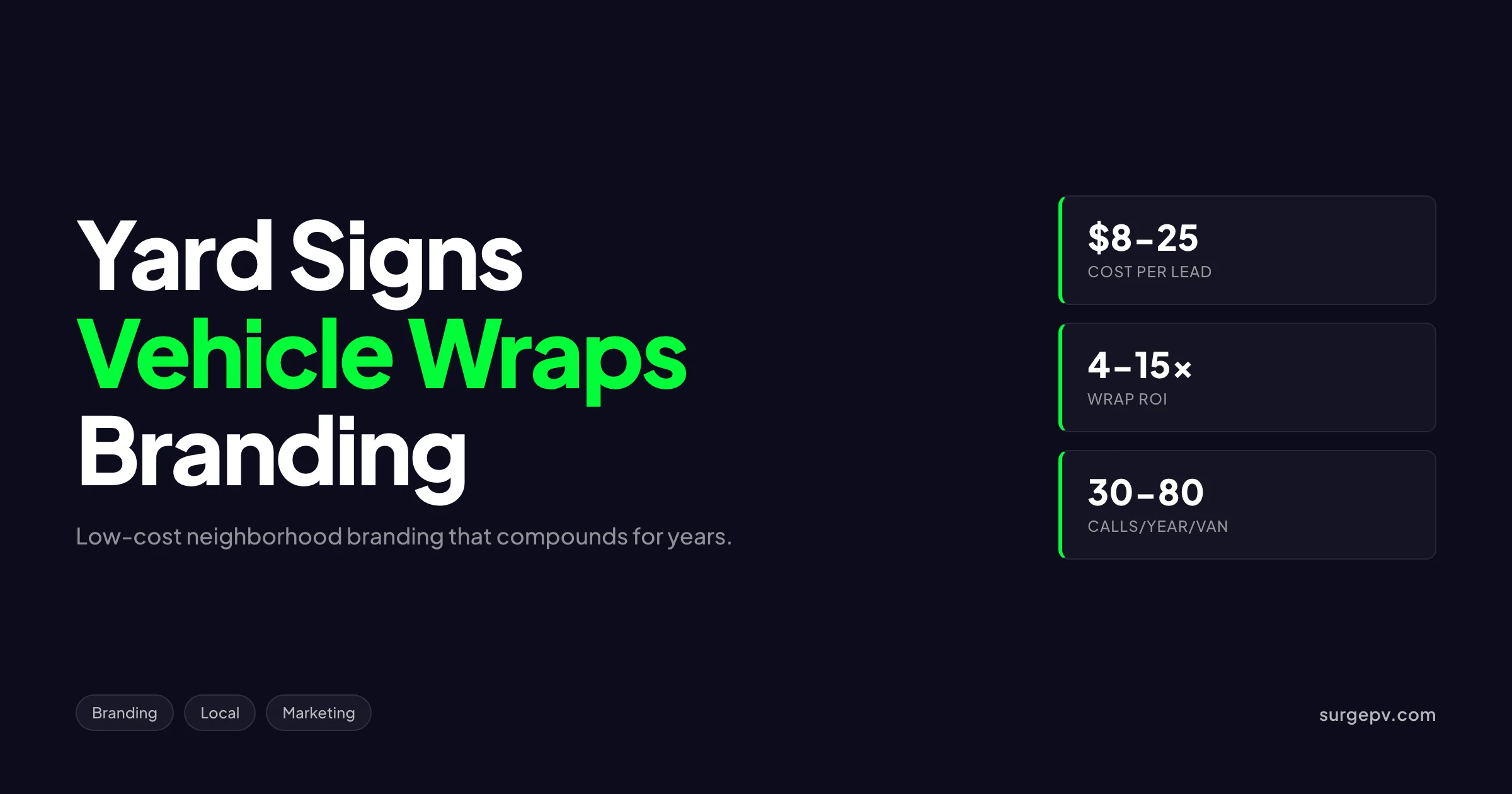
Yes. Well-placed solar yard signs generate 4 to 12 leads per sign per year in suburban neighborhoods. Lead cost ranges from $8 to $25 per lead compared to $120 to $400 for paid digital ads. The signs work best when paired with neighborhood saturation campaigns.
How much does a solar vehicle wrap cost in 2026?
Full vehicle wraps for solar install vans cost $3,000 to $6,500 in 2026 according to The Wrap Institute’s 2025 industry survey. Partial wraps run $800 to $2,500. Wraps last 5 to 7 years. Cost per impression is roughly $0.10 to $0.30 per 1,000 views — dramatically cheaper than billboards.
Are solar yard signs legal in HOAs?
It depends on the HOA and state. 22 states have Solar Rights laws that limit HOA restrictions on solar-related signage. California, Texas, Arizona, and Florida specifically protect solar installer signage during and shortly after installation. Many HOAs still attempt restrictions; check state law before designing yard sign programs.
How long can a solar installer leave a yard sign in a customer’s lawn?
Most installers leave signs for 4 to 8 weeks post-install. Some customers consent to permanent signs in exchange for service credits or referral bonuses. State Solar Rights laws typically protect signage during construction and for 7-30 days after, though specific provisions vary.
What is the ROI on vehicle wrap advertising for solar installers?
Vehicle wraps generate $4 to $15 in revenue per dollar spent over 5 to 7 years for solar installers. A $4,500 wrap on a van averaging 40 hours per week of road time creates 30,000 to 80,000 impressions per month. Even a 0.01% conversion rate yields 30-80 calls per year from wrap impressions alone.
Should solar installers use yard signs or door hangers for neighborhood marketing?
Both have a role. Yard signs reach drive-by traffic and signal social proof. Door hangers reach door-knockers directly. Most successful neighborhood saturation campaigns use yard signs for 30-day social proof, then door-hanger 100 surrounding homes during week 2-3 of the install.
How do you track which yard sign generated a lead?
Use unique QR codes per neighborhood or per installer crew. Each QR code routes to a landing page that captures the source. Some installers use distinct phone numbers per neighborhood (CallRail or similar tracking). Modern solar installers tag every lead with a source field including ‘yard sign’ as a value.
What is the biggest mistake with solar yard signs?
The biggest mistake is generic signs with only a logo and phone number. High-performing signs include the homeowner’s first name (‘Thank You, Mike & Sarah!’), the install date, a QR code, and the system size or savings. Specific details turn passive signs into active social proof.
Three Steps to Start This Week
-
Audit your last 10 installs. How many got yard signs? How long did the signs stay? Build a checklist that makes yard sign placement a non-optional install task with photo verification.
-
Design one strong yard sign with customer name, system size, QR code, and local phone number. Order 100 signs at $6-8 each. Total investment: $600-$800. Expected return over 12 months: 400-1,200 leads.
-
Get one van wrapped this quarter. Test design, vendor quality, and lead tracking with one vehicle before scaling to the full fleet. The first van wrap is the learning vehicle (literally). Use solar design platform project data to inform your messaging — real installations beat generic claims.
Related SurgePV Resources
Continue learning with these related guides for solar installers and EPCs:
- Neighborhood Solar Marketing
- Solar Community Events Marketing
- Solar Customer Testimonial Strategy
- Solar Review Management
- Local SEO for Solar Installers
For more solar business and marketing content, explore the full SurgePV blog or browse the SurgePV glossary for definitions of solar industry terms.
Solar Software Tools to Support This Work
Effective solar installer operations depend on integrated software. SurgePV’s solar design platform helps installers handle the upstream work that feeds every decision in this guide:
- Solar design software for system layouts, panel placement, and BOM generation
- Shadow analysis for site-specific irradiance and obstruction modeling
- Generation and financial tool for production forecasts and project ROI
- Solar proposal generation for branded, customer-facing proposals
- Clara AI for automated design assistance and Q&A
Browse the full SurgePV platform to see how installers worldwide use the tools to design smarter, sell faster, and streamline every solar project.
Where this fits
This article is part of SurgePV's Solar Sales & Proposals hub, which works through the topic from first principles to the decisions a project team actually has to make.


