

Quick Answer
Solar community events include open houses at installed sites, educational workshops at libraries, and partnerships with environmental groups. These events generate high-quality leads at $100–$200 cost-per-lead (half of digital channels). Success factors: free energy audits, live monitoring demos, and local installer presence.
A solar installer in Lehi, Utah hosted a single backyard demo in May 2025. They invited their recently installed customer’s 25 closest neighbors. 18 attended. The event lasted 90 minutes — homeowner walked attendees through her decision process, the installer showed system performance data, and a local utility rep explained net metering. Total cost: $620 (food, materials, gift card to host customer).
Solar community events include open houses at installed sites, educational workshops at libraries, and partnerships with environmental groups. These events generate high-quality leads at $100–$200 cost-per-lead (half of digital channels). Success factors: free energy audits, live monitoring demos, and local installer presence.
Solar community events include open houses at installed sites, educational workshops at libraries, and partnerships with environmental groups. These events generate high-quality leads at $100–$200 cost-per-lead (half of digital channels). Success factors: free energy audits, live monitoring demos, and local installer presence.
Outcome over 6 months: 11 acquired customers from the 18 attendees. $284,000 in installed revenue. Cost per acquired customer: $56. Compared to their digital advertising average of $1,400 per acquired customer.
Quick Answer: Solar Community Events Marketing
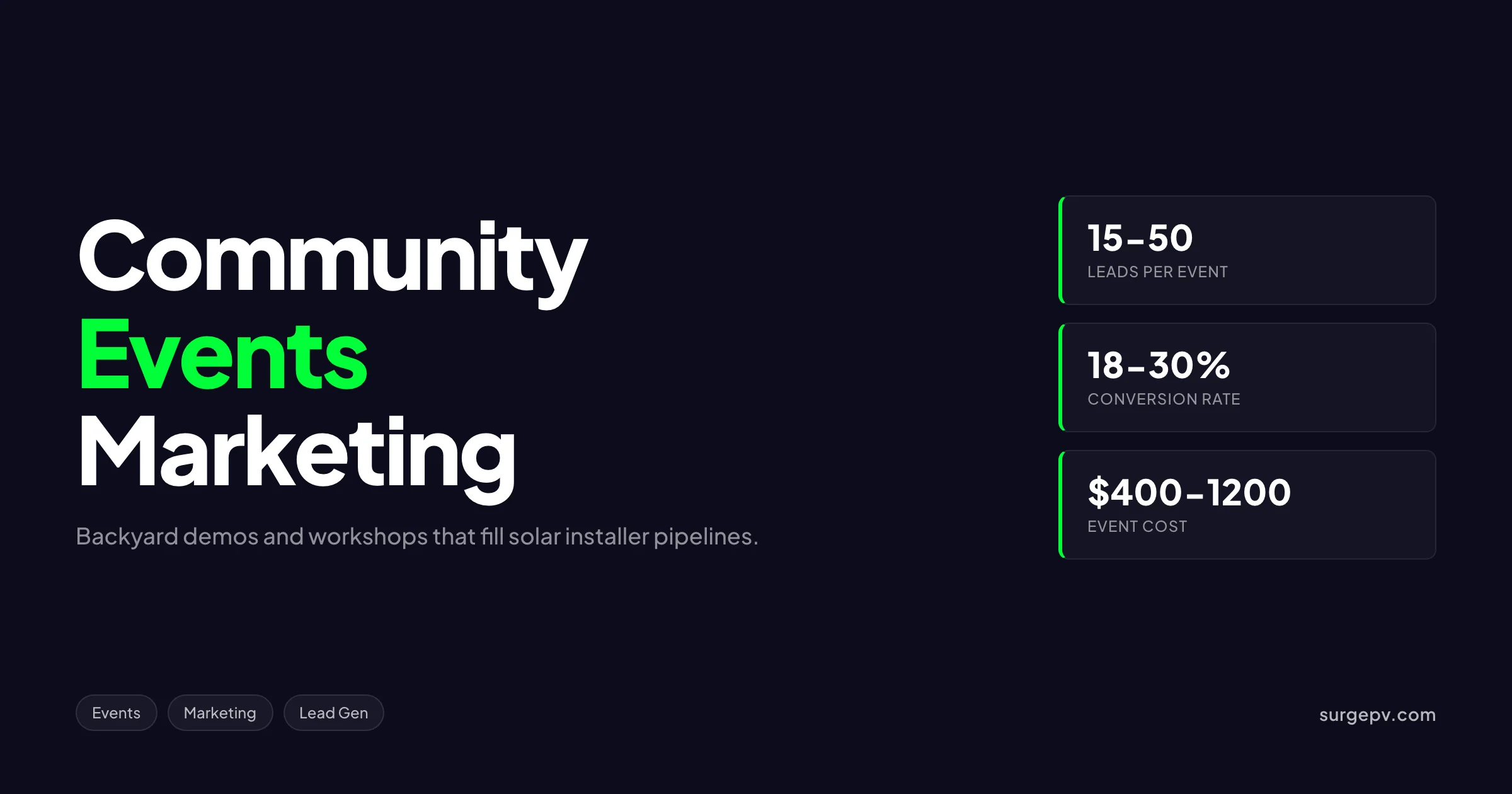
Solar community events generate 12-25x the lead value of digital advertising for residential installers. Best formats: customer backyard demos (15-25 attendees, $400-$1,200 cost), workshop nights (40-80 attendees, $1,500-$5,000), partner-hosted Q&A. Lead-to-customer conversion typically runs 18-30%. Education-first approach outperforms sales-first by 3-5x.
In this guide:
- Why community events outperform digital for residential solar
- 6 event formats with cost and ROI data
- Pre-event planning timeline (8 weeks out to day-of)
- Promotion strategy that fills seats
- During-event flow that maximizes conversions
- Post-event follow-up system
- Common mistakes that kill event ROI
- Eight common questions
Why Community Events Outperform Digital for Residential Solar
Solar is a high-consideration purchase. The average residential solar buyer takes 90-180 days from first inquiry to contract signing. The decision involves multiple stakeholders (often a spouse or partner). It requires technical understanding (kWh, panel efficiency, net metering). It requires trust in the installer.
Digital advertising delivers single-impression touchpoints. A 30-second video. A Facebook ad seen for 3 seconds. A landing page visit. These touchpoints work for low-consideration products. They underperform for high-consideration products like solar.
Community events deliver 60-120 minutes of focused attention from highly qualified prospects in a high-trust environment. The math is structural:
| Channel | Touchpoint Duration | Qualifying Filter | Trust Level |
|---|---|---|---|
| Facebook ad | 3-15 seconds | Demographic only | Low |
| Google PPC | 30-90 seconds | Search intent | Low-medium |
| Webinar | 30-60 minutes | Email opt-in | Medium |
| Sales call | 30-45 minutes | Lead form completion | Medium |
| Community event | 60-120 minutes | Showed up in person | High |
A single 60-minute community event with 20 attendees delivers 1,200 minutes of focused engagement with prospects who self-selected enough to show up. That is more than 1,000 Facebook ad impressions could deliver, and at a fraction of the cost.
The Trust Compounding Effect
Community events also build trust faster than other channels because they include:
- Social proof. Other attendees are physically present, asking questions. The room confirms solar adoption.
- Specific examples. Real customer with real system answers real questions.
- Local expertise. Installer demonstrates knowledge of local utilities, codes, incentives.
- Direct interaction. Attendees ask questions; installer answers. Builds personal trust.
This trust compounding is why event attendees convert at 18-30% vs 3-8% for other lead sources.
6 Event Formats with Cost and ROI Data
Not all events deliver equal ROI. The format must match the audience and business model.
Format 1: Customer Backyard Demo
A recently installed customer hosts a 60-90 minute gathering for 15-25 neighbors. Installer leads tour of system. Q&A with installer and customer.
Cost: $400-$1,200 (food, gift to host, materials) Attendees: 15-25 Leads generated: 8-15 Conversion rate: 25-35% ROI: 20-40x
Best for: Residential installers with strong customer relationships and active project flow.
Logistics: Host customer agrees to event (often in exchange for $200-$500 referral credit). 30-day notice. Invitations to 50-100 surrounding homes. Catered light food. Print materials about installer.
Format 2: Educational Workshop Night
Installer hosts 60-90 minute educational session at community space (library, community center, restaurant). 40-80 attendees. Format: presentation + Q&A + 1:1 follow-up.
Cost: $1,500-$5,000 Attendees: 40-80 Leads generated: 25-50 Conversion rate: 18-25% ROI: 8-15x
Best for: Mid-market installers building brand awareness. Educational format reduces sales resistance.
Logistics: Venue rental ($300-$1,500). Promotion ($500-$1,500). Materials and refreshments ($200-$1,000). Speaker prep and AV ($500-$1,000).
Format 3: Partner-Hosted Q&A
Joint event with utility, sustainability nonprofit, or municipality. Installer is one of multiple presenters. Format: panel discussion + Q&A.
Cost: $500-$2,000 (partner shares cost) Attendees: 60-200 Leads generated: 30-80 Conversion rate: 12-18% ROI: 5-10x
Best for: Installers building partnerships with utilities or municipal sustainability programs.
Logistics: Partner organization handles venue and promotion. Installer provides materials and staff. Co-branded promotion.
Format 4: Neighborhood Open House
After a high-visibility install (especially commercial or unique residential), host an open house at the site. 90-120 minutes. 30-60 attendees.
Cost: $800-$2,500 Attendees: 30-60 Leads generated: 15-30 Conversion rate: 20-30% ROI: 12-22x
Best for: Commercial installers featuring portfolio. Residential installers with unique installations (large systems, special applications).
Logistics: Customer/site owner permission required. Promotional outreach to surrounding businesses or homes. Refreshments and materials. Tour planning.
Format 5: Solar + Storage Demo
Focused demo on battery storage technology. 90 minutes. 20-40 attendees in target households. Format: technical demo + use case discussion. Read Adding Battery Storage Services for a complete walkthrough.
Cost: $1,000-$3,000 Attendees: 20-40 Leads generated: 15-30 Conversion rate: 25-40% (high-intent audience) ROI: 15-30x
Best for: Installers expanding into storage. Target audience: existing customers and storage-curious prospects.
Logistics: Battery on display (often loaned by manufacturer). Live demo of charge/discharge cycle. Power outage simulation for backup use case.
Format 6: Multi-Installer Expo
Large event with multiple installers, manufacturers, and adjacent service providers. 200+ attendees. Format: booths, panel discussions, education tracks.
Cost: $5,000-$20,000 (per participating installer) Attendees: 200-500 Leads generated: 80-200 Conversion rate: 5-12% (broader, less qualified audience) ROI: 4-8x
Best for: Mid-large installers building market presence. Co-marketing opportunity with peers.
Logistics: Multi-organization coordination. Larger venue. More complex logistics.
Pre-Event Planning Timeline
A successful solar community event requires 6-8 weeks of preparation. Compressed timelines kill attendance.
8 Weeks Out
- Choose date (Tuesday/Thursday evening 6-8 PM or Saturday 2-4 PM)
- Choose venue or confirm host customer
- Confirm budget
- Identify target audience (geography, demographics)
- Begin partner outreach (utility rep, municipal speaker, manufacturer)
6 Weeks Out
- Finalize event format and agenda
- Design promotional materials (digital + print)
- Set up event registration page or Facebook event
- Begin staff scheduling
- Order any equipment (chairs, AV, demo equipment)
4 Weeks Out
- Launch promotional campaign (paid social, email, door hangers)
- Confirm partner participation
- Send first attendee email sequence
- Order food/refreshments
2 Weeks Out
- Second promotion wave
- Confirm all partner logistics
- Send reminder emails to registered attendees
- Prepare presentation materials
- Brief booth staff
1 Week Out
- Confirm venue logistics
- Final promotional push
- Send detailed event info to registered attendees
- Prepare lead capture process
- Confirm staff assignments
Day of Event
- Setup 90 minutes before start
- AV check 60 minutes before
- Staff briefing 30 minutes before
- Doors open 15 minutes before
- Execute agenda
- Manual lead capture for all attendees
- Photo/video for post-event marketing
Day +1
- All attendee data into CRM
- Personalized thank-you email to all attendees
- Hot leads handed to sales reps
- Post-event social media content
Promotion Strategy That Fills Seats
The single biggest predictor of event success: number of people who pre-register. Walk-ins are nice but unreliable. Pre-registered attendees show up 70-85% of the time.
Multi-Channel Promotion Stack
Channel 1: Door hangers (highest ROI for local events)
- 200-500 hangers in target neighborhoods
- Cost: $200-$600
- Conversion rate to registration: 2-4%
- Best for: Residential, hyper-local events
Channel 2: Facebook event + paid boost
- Create Facebook event 4-6 weeks out
- Boost to local audience: $100-$300 total
- Cost per registration: $4-$15
- Best for: 40+ demographic, suburban markets
Channel 3: Nextdoor neighborhood post
- Free organic post in target neighborhoods
- Higher engagement than Facebook for local events
- Conversion: 1-3% of viewers
- Best for: Suburban, established neighborhoods
Channel 4: Email to existing list
- Customer/prospect database invitation
- Open rate: 25-40%
- Conversion: 2-5% of opens
- Best for: Customer events, second event in same neighborhood
Channel 5: Partner promotion
- Utility newsletter, nonprofit newsletter, municipal email
- Reach: 1,000-50,000 per partner
- Conversion: 0.1-0.5%
- Best for: Educational workshops with broad appeal
Channel 6: SMS to customer list
- Direct text invitation
- Open rate: 95%+
- Conversion: 3-8%
- Best for: Customer-hosted events, referral source
Email Sequence for Registered Attendees
5-email sequence drives 70-85% attendance:
Email 1 (immediately upon registration): Confirmation with event details, agenda, parking info, what to expect.
Email 2 (10 days before): Build excitement. Share what attendees will learn. Include speaker bio if applicable.
Email 3 (3 days before): Reminder with logistics. Address, time, parking.
Email 4 (day before): Final reminder. “Looking forward to seeing you tomorrow.”
Email 5 (3 hours before): “We start at 6 PM. Address: [link to map].”
Each email lifts attendance by 5-15%.
During-Event Flow That Maximizes Conversions
The agenda determines ROI. Event flows that prioritize education over sales convert dramatically better than event flows that prioritize sales over education.
Recommended 75-Minute Workshop Flow
0:00-0:10 — Welcome and arrival
- Greet attendees by name as they enter
- Distribute materials
- Light refreshments available
- Casual conversation
0:10-0:15 — Opening
- Brief installer introduction (90 seconds max)
- Format and agenda preview
- Encouragement to ask questions throughout
0:15-0:40 — Educational content
- How solar works (high level, not too technical)
- Local incentives and savings math
- Common questions and concerns addressed
- Visual aids (slides, system diagrams)
- NO sales pitch
0:40-0:55 — Customer story or live demo
- Real customer shares experience
- Or: Live demo of system (if at customer home)
- Specific numbers (cost, savings, payback)
0:55-1:10 — Q&A
- Open audience questions
- Installer answers thoughtfully
- Time for everyone who wants to ask
1:10-1:15 — Closing
- Clear next-step offer (free site assessment, follow-up call)
- Thank attendees
- Refreshments continue for natural networking
1:15+ — Networking and 1:1
- Installer staff available for individual conversations
- Schedule follow-up appointments
- Capture warm leads
The 80/20 Rule
80% education + 20% offer beats 50/50 or 30/70 every time.
Attendees who feel educated trust the installer. Attendees who feel sold to leave skeptical. The “soft sell” with clear value first delivers conversion rates 3-5x higher than aggressive selling.
Post-Event Follow-Up System
Most event ROI is determined in week 2-4 post-event. Without disciplined follow-up, 60-80% of event value evaporates.
30-60-90 Day Follow-Up Cadence
Day 1-3 (immediate):
- Personal thank-you email to every attendee
- Photo gallery from event sent to attendees
- Top 10 hot leads called by sales rep
Day 7:
- Educational content email (deeper dive on a topic from event)
- Specific call-to-action (book site assessment)
Day 14:
- Social proof email (recent install case study from attendee’s neighborhood)
- Direct call-to-action
Day 30:
- Status check email (“Still considering solar?”)
- Offer free consultation
Day 60:
- Industry update email (incentive changes, new technology)
- Soft re-engagement
Day 90:
- “We’re still here when you’re ready” email
- Move to long-term nurture sequence
Tracking and Attribution
Every attendee gets tagged in CRM with:
- Event name and date
- Engagement level (asked questions, requested follow-up, etc.)
- Initial qualification status
- Source channel (how they heard about event)
Track conversions to closed deal for 12 months. Most event conversions happen at month 2-4, not month 1.
Pro Tip
Send a survey 7 days after every event. Ask: “What was most useful?” and “What would have made this better?” The responses guide future events and re-engage attendees. Survey response rates of 30-50% are normal for engaged event attendees.
Common Mistakes That Kill Event ROI
Mistake 1: Sales Pitch Disguised as Education
Attendees can detect when an “educational” event is actually a sales pitch. Trust collapses. Conversion plummets. Lead with genuine education.
Mistake 2: Inadequate Promotion
Events with 1-week promotion windows attract 5-15 attendees instead of 40-80. Quality promotion takes 4-6 weeks of layered marketing.
Mistake 3: No Pre-Registration
Walk-in only events under-attend. Pre-registration with email sequence drives 3-5x higher attendance.
Mistake 4: Generic Content
Events that don’t include local specifics (utility names, local incentives, neighborhood examples) feel generic. Hyper-local content drives engagement.
Mistake 5: Insufficient Follow-Up
Events with 1-2 follow-up touches convert at 20-30% of their potential. Events with 5-7 disciplined touches over 90 days hit full potential.
Mistake 6: Mismatched Format and Audience
Workshop format for an audience expecting a demo. Demo format for an audience expecting in-depth education. Match the format to attendee expectations.
What Most Guides Miss
Generic event marketing advice emphasizes promotion volume. For solar community events specifically, the host customer or partner organization matters more than promotion budget. A backyard demo at a respected neighbor’s house outdraws a workshop at a community center, even with 10x less promotion.
Real-World Example: Backyard Demo Program at Scale
A solar installer in Madison, WI built a backyard demo program that became their primary lead source over 18 months.
The system:
- Every 5th install offered host opportunity ($300 referral credit)
- 1-2 demos per month, year-round
- Standard 75-minute agenda
- Consistent promotion: 200 door hangers + Facebook event + utility newsletter
Results over 18 months:
- 22 events hosted
- 412 total attendees
- 286 leads generated
- 89 acquired customers
- $1.9M revenue attributed to events
- Total event cost: $14,500
- Cost per acquired customer: $163
- ROI: 131x
The installer’s overall blended CAC dropped from $1,200 to $640 as event-driven customer share grew to 38% of total acquisitions.
Make Your Events More Engaging
Live system performance data through solar PV design software turns a generic demo into a memorable experience. Show attendees actual production curves, financial models, and ROI calculations during your events.
Book a DemoNo commitment required · 20 minutes · Live project walkthrough
Frequently Asked Questions
What are solar community events?
Solar community events are installer-hosted gatherings designed to educate prospective customers, build trust, and generate leads. Common formats include backyard demos, workshop nights, neighborhood open houses, and partner-hosted Q&A sessions with local utility representatives or municipal sustainability officers. For more on this topic, see Solar Lead Generation Strategies.
How much does a solar community event cost to host?
A small backyard demo (15-25 attendees) costs $400-$1,200. A formal workshop (40-80 attendees) runs $1,500-$5,000. A multi-installer expo with partner participation costs $5,000-$20,000. Cost per lead ranges from $25 to $120, dramatically lower than digital advertising for solar.
How many leads does a solar community event generate?
Backyard demos with 15-25 attendees generate 8-15 qualified leads. Workshop nights with 40-80 attendees generate 25-50 leads. Expos with 200+ attendees can generate 80-200 leads. Lead-to-customer conversion rates from events typically run 18-30% — higher than most other channels.
What is the best format for solar community events?
Customer backyard demos consistently deliver the highest ROI. They combine social proof (real customer system), low cost, and high engagement. Workshop formats work for installers wanting to educate broader audiences. Avoid ‘sales pitch’ formats — they reduce attendance and trust.
How do you promote a solar community event?
Multi-channel: door hangers to 200+ surrounding homes, Facebook event with paid boost ($50-$150), neighborhood Nextdoor post, Google Business Profile post, customer text invites, partner newsletter mention. Pre-event email sequence drives 60-70% of registrations.
When are the best times to host solar community events?
Late spring (April-May) and early fall (September-October) deliver highest attendance. Weekday evenings (Tuesday-Thursday, 6-8 PM) work for educational formats. Saturday afternoons (1-4 PM) work for outdoor demos. Avoid Fridays, Sundays, and holiday weeks.
Do solar community events require liability insurance?
Yes. Events at customer homes or rental venues require general liability coverage extending to event activities. Typical solar installer policies cover hosted events; verify with your insurance broker. Vendor venues often require certificate of insurance naming venue as additional insured.
What is the biggest mistake solar installers make with community events?
Treating the event as a sales pitch rather than an educational experience. Attendees who feel sold to leave without taking action. Events that educate first and ask second consistently outperform pure-sales formats. The 80/20 rule applies: 80% education, 20% offer.
Three Steps to Plan Your First Community Event
-
Pick a recent customer who would host a backyard demo. Offer $300-$500 referral credit. Schedule for 6 weeks out on a Tuesday or Thursday evening.
-
Build the promotion stack. 200 door hangers in surrounding homes ($200), Facebook event with $100 boost, Nextdoor neighborhood post (free). Total: $300.
-
Design the 75-minute agenda with 80% education and 20% offer. Use real customer story, real local data, real Q&A. Showcase solar design software to walk through actual production projections during the event for maximum credibility.
Related SurgePV Resources
Continue learning with these related guides for solar installers and EPCs:
- Neighborhood Solar Marketing
- Solar Customer Testimonial Strategy
- Solar Review Management
- Solar Yard Signs and Vehicle Wraps
- Solar Trade Shows 2026
For more solar business and marketing content, explore the full SurgePV blog or browse the SurgePV glossary for definitions of solar industry terms. For a direct comparison, see Arka 360 vs SurgePV.
Solar Software Tools to Support This Work
Effective solar installer operations depend on integrated software. SurgePV’s solar design platform helps installers handle the upstream work that feeds every decision in this guide:
- Solar design software for system layouts, panel placement, and BOM generation
- Shadow analysis for site-specific irradiance and obstruction modeling
- Generation and financial tool for production forecasts and project ROI
- Customer-ready solar proposals for branded, customer-facing proposals
- Clara AI for automated design assistance and Q&A
Browse the full SurgePV platform to see how installers worldwide use the tools to design smarter, sell faster, and streamline every solar project.
Where this fits
This article is part of SurgePV's Solar Sales & Proposals hub, which works through the topic from first principles to the decisions a project team actually has to make.


