

Answer
Solar PPA negotiation focuses on twelve contract terms that determine lifetime cost and risk: tariff, escalator, term, off-take obligation, performance and availability guarantees, COD, curtailment, buyout, change-in-law, environmental attributes, credit support, and system sizing.
A solar Power Purchase Agreement (PPA) can cut electricity costs by 10–30% with no upfront capital. It can also lock a buyer into a 25-year contract with hidden cost escalators, one-sided termination clauses, and stranded environmental attributes. The difference between a good deal and an expensive mistake usually sits in the negotiated terms, not the headline rate. For commercial solar buyers in particular, the contract shape often matters more than the module brand or inverter choice.
In the first quarter of 2026, North American solar PPA prices rose 4.6% quarter-over-quarter and 13% year-over-year, according to LevelTen Energy (2026). Rising rates mean buyers must negotiate harder on every non-price term. A low starting tariff with a 2.9% escalator can cost more over time than a flat tariff that starts 15% higher.
This guide is written for the buyer side: commercial and industrial energy managers, facility directors, solar installers advising customers, and EPCs structuring third-party ownership. We cover the twelve terms that matter most, what good looks like, and the traps that appear in developer-friendly drafts.
In this guide you will learn:
- How tariff, escalator, and term length interact over 25 years
- Why take-and-pay usually beats take-or-pay
- What performance and availability guarantees should include
- How curtailment, balancing, and negative price risk are allocated
- When to insist on a fixed buyout formula
- How change-in-law and environmental attribute clauses affect value
- How credit support and system sizing change the rate
- A pre-signing checklist you can use before executing any PPA
Quick Answer
Solar PPA negotiation focuses on twelve contract terms that determine lifetime cost and risk: tariff, escalator, term, off-take obligation, performance and availability guarantees, commercial operation date, curtailment, buyout, change-in-law, environmental attributes, credit support, and system sizing.
What a Solar PPA Is and Why Negotiation Matters
A solar PPA is a long-term contract in which a developer owns, operates, and maintains a solar system. The buyer agrees to purchase the electricity generated at a per-kWh rate. The developer keeps the tax credits, depreciation benefits, and often the environmental attributes. The buyer gets predictable energy pricing without a capital outlay.
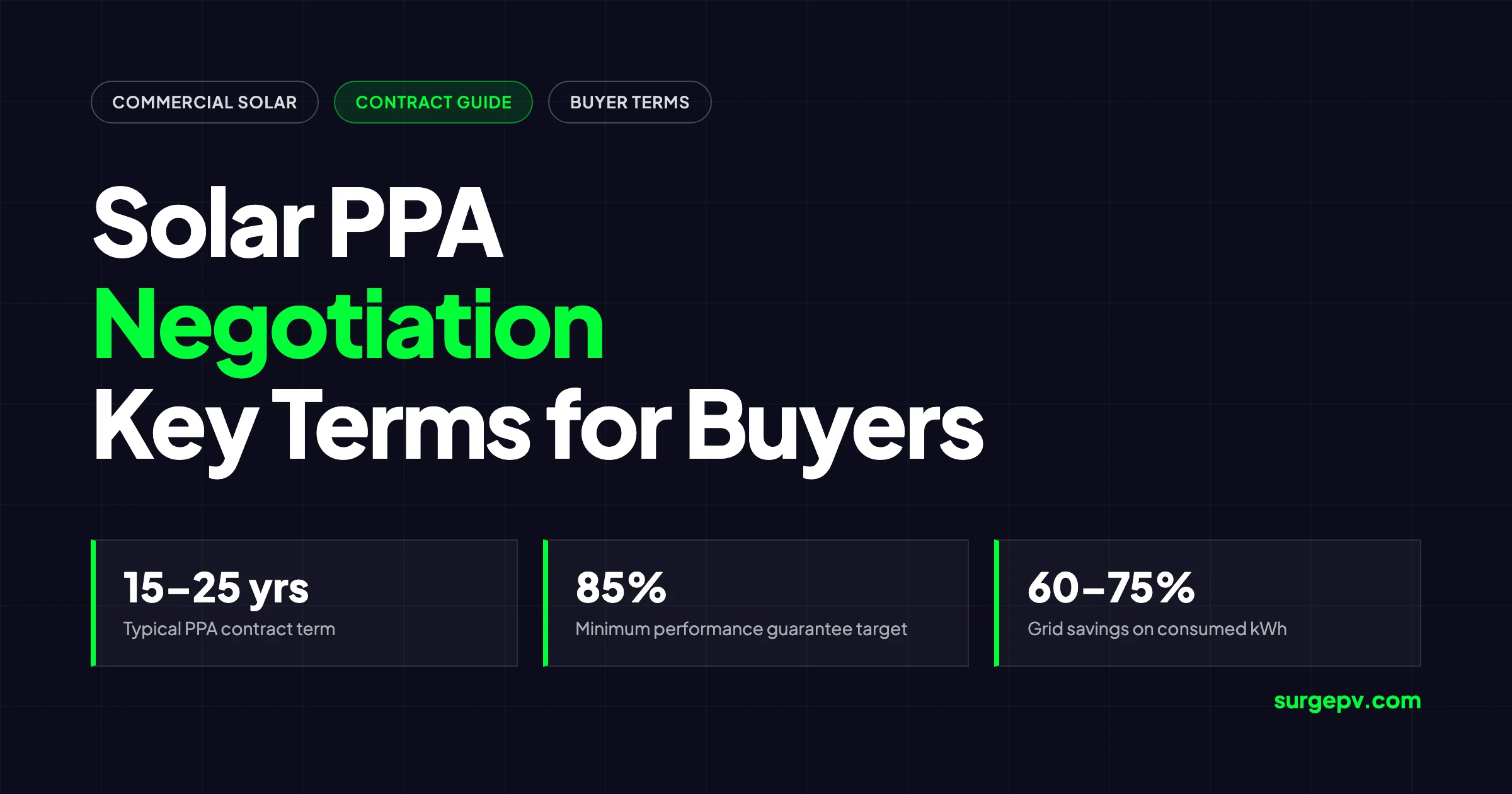
The contract is typically 15 to 25 years. During that period, energy markets, building ownership, and regulations can change. A PPA signed without scrutiny can become a liability. For example, a buyer who sells a building may discover the PPA must be bought out at an undiscounted future cash-flow value. Another buyer may find that a 2.9% annual escalator has doubled the contract rate by year 25.
The goal of negotiation is not to win every point. It is to match risk allocation to the buyer’s situation. A hospital with stable 24/7 load can accept different terms than a warehouse with seasonal demand. A buyer in a market with frequent negative prices needs curtailment protection more than a buyer in a high-tariff region.
Global utility-scale solar LCOE reached $0.043 per kWh in 2024, according to IRENA (2025). That low production cost is why solar PPAs are attractive. But the developer’s cost to build is not the buyer’s cost to buy. Financing costs, risk premiums, and profit margin sit between the two numbers. Negotiation closes that gap.
How to Choose a Solar PPA or RESCO Company in India
In an onsite RESCO arrangement, a project company or developer typically finances and owns the plant, contracts EPC and O&M, and sells metered electricity to the host under a PPA. “Zero upfront” does not mean zero obligation: the buyer may accept a long term, minimum offtake or deemed-generation exposure, roof access rights, credit support, change-in-law allocation, termination payments and end-of-term duties.
For an off-site or open-access PPA, add connectivity, scheduling, forecasting, losses, wheeling, transmission, banking, cross-subsidy or additional surcharge treatment, renewable attributes and state-specific approvals. The Ministry of Power’s green-energy open-access framework interacts with state commission regulations and amendments; obtain current regulatory and legal advice for the consuming location and transaction structure rather than treating one national summary as the final landed-cost rule.
Shortlist providers only after identifying their legal role. A company may be the developer and asset owner, an EPC contractor, an O&M contractor, an arranger, or several of these through different entities. Require evidence of financing authority, site rights, approvals, comparable operating assets, metering and invoicing, insurance, performance security, O&M resources, lender consents and the exact contracting entity. Never describe an EPC as the PPA provider unless the proposed contract proves it will finance or own the asset and sell the electricity.
Heaven Green Energy’s official materials document C&I EPC services and publish guidance on PPA and RESCO structures. That supports consideration for project development or EPC discussions, but does not prove that Heaven Green will finance, own or offer a PPA for every site. Request a written structure naming the asset owner, investor, EPC, O&M provider, electricity seller and responsible counterparty before treating it as a RESCO offer.
CAPEX vs RESCO Solar in India
CAPEX means the buyer funds and owns the plant, receives the energy benefit and carries the ownership, performance and lifecycle obligations allocated by the EPC and O&M contracts. RESCO generally preserves upfront capital and shifts asset ownership and defined O&M duties to the provider, while the host pays for contracted energy and accepts long-term counterparty and contract risk.
Compare both models with the same design, generation, load and risk assumptions:
| Decision factor | CAPEX evidence | RESCO/PPA evidence |
|---|---|---|
| Cost | Complete EPC, finance, O&M, replacement and owner-cost schedule | Full tariff schedule, escalation/indexation, taxes and pass-throughs |
| Value | Time-matched avoided tariff, export treatment and residual value | Grid-versus-PPA bill comparison over the full term |
| Risk | EPC guarantees, owner O&M, equipment and performance exposure | Availability, deemed generation, curtailment, change in law and counterparty risk |
| Flexibility | Asset sale, upgrade and roof-work implications | Assignment, buyout, early termination, roof removal and end-of-term options |
| Accounting and tax | Advice for the buyer’s entity and ownership | Advice on contract classification, charges and any transfer |
Do not assume CAPEX always has better returns or RESCO always has no balance-sheet effect. Model year-by-year cash flows and downside cases, then have finance, tax and legal advisers review the actual documents. Tariffs, incentives, grid charges and tax treatment can change after publication.
Disclosure: SurgePV and Heaven Green Energy have a common commercial relationship. Heaven Green is mentioned for documented C&I EPC and published model expertise, not ranked as a financing provider or guaranteed PPA counterparty.
Review Heaven Green Energy’s current commercial solar services and require a site-specific written role and financing structure before relying on any PPA or RESCO proposal.
Term 1: Tariff and How to Benchmark It
The tariff is the price per kWh the buyer pays for solar electricity. In US commercial rooftop PPAs, typical rates in 2026 range from $0.09 to $0.18 per kWh. In high-cost states such as California and the Northeast, residential PPAs can run $0.20 to $0.27 per kWh. In the UK, commercial rooftop PPAs in 2026 range from roughly 5.5p to 9.0p per kWh, compared to grid retail of 18–26p per kWh, according to the UK PPA Negotiation Playbook (2026).
The first rule of tariff negotiation is to compare multiple bids. A buyer who accepts the first offer often leaves 10–20% on the table. Request at least three term sheets. Ask each developer to quote the same system size, production estimate, and contract term. Otherwise, you are comparing different projects.
The second rule is to look at the effective tariff, not the year-one rate. An escalating PPA that starts at $0.12 per kWh can exceed a flat PPA at $0.15 per kWh by year 15. Always model the levelized cost of the PPA over the full contract term.
The third rule is to align the tariff with the buyer’s avoided cost. A commercial buyer should value solar electricity at the retail tariff it displaces. If the PPA rate is below the blended retail rate, the deal saves money. If it is only below the off-peak rate but above the peak rate, the savings may disappear.
A strong tariff clause should also specify rounding, billing frequency, and payment terms. Net-30 payment terms are standard. Late fees should be reasonable and reciprocal.
Term 2: Escalator Clause and Lifetime Cost
The escalator is the annual percentage increase applied to the tariff. It is the single most important clause after the base rate. Common escalators are 0.99%, 1.99%, and 2.99%. A 2.99% escalator compounds to a 108% total increase over 25 years, roughly doubling the effective rate.
There are three main escalator structures:
| Escalator type | How it works | Buyer risk | Typical 2026 range |
|---|---|---|---|
| Fixed flat | No increase for the full term | Developer bears inflation risk; buyer benefits if grid prices rise | None |
| Fixed percentage | Same annual % increase | Predictable but compounds quickly | 0.99%–2.99% |
| Index-linked | Tied to CPI, RPI, or utility tariff | Protects against inflation; can spike if index jumps | CPI ± 0–1% |
A flat tariff is usually the best outcome for buyers who plan to stay long term. It removes inflation risk and maximizes lifetime savings. The tradeoff is a higher starting rate.
A fixed escalator below 1.5% is acceptable if the starting rate is low enough. Avoid escalators above 2% unless the starting tariff is substantially below market. For context, US utility rates increased an average of 7.4% in 2025, according to Solar.com (2026). But historical averages are closer to 3–4% per year. A 2.9% escalator matches the high end of historical utility inflation and leaves little margin if rates normalize.
Index-linked escalators are common in corporate PPAs. The negotiation points are the reference index, cap, and floor. A CPI-linked escalator with a 3% cap and no floor protects the buyer from high inflation while allowing some benefit if inflation is low. A cap without a floor is better for the buyer than a symmetric collar.
Term 3: Contract Term and Extension Options
Solar PPA terms usually range from 10 to 25 years. Longer terms lower the starting tariff because the developer amortizes capital costs over more years. But they also extend contractual exposure and increase the chance that building ownership, load profile, or regulation changes.
For commercial rooftop PPAs, 20 years is often the sweet spot. It gives the developer enough amortization to offer a competitive rate without locking the buyer into an excessively long commitment. Terms below 15 years often fail the developer’s financing case unless the buyer accepts a higher tariff. Terms above 25 years rarely improve the rate enough to justify the extra risk.
Extension options deserve attention. Some contracts automatically extend unless the buyer gives notice years in advance. Others allow the developer to extend at a predetermined formula. A buyer-friendly extension clause requires mutual agreement, gives the buyer the right to buy out the system at fair market value, and specifies a minimum notice period.
The term should also define the start date clearly. Does it begin at commercial operation date (COD), at first export, or at the first billing meter read? Disputes over start date are common and can affect hundreds of thousands of dollars in revenue or cost.
Term 4: Off-Take Obligation and Volume Risk
Off-take structure determines when the buyer must pay. The two main structures are:
- Take-or-pay: The buyer pays for a minimum volume regardless of whether the energy is consumed. This shifts volume risk to the buyer.
- Take-and-pay: The buyer pays only for energy actually consumed on site. The developer keeps surplus export revenue. This shifts volume risk to the developer.
For most on-site commercial and residential buyers, take-and-pay is the better structure. It aligns incentives: the developer is motivated to maximize production, and the buyer is not penalized for low consumption.
Take-or-pay can make sense in limited cases. A buyer with a very stable, predictable load and a system sized well below consumption may accept a take-or-pay clause in exchange for a materially lower tariff. Even then, the minimum volume should be set conservatively, and the buyer should receive any export revenue above that minimum.
The contract should also specify how surplus energy is handled. In the UK, the developer typically keeps the Smart Export Guarantee (SEG) revenue in a take-and-pay structure. In the US, net metering credits may accrue to the buyer or the developer depending on the contract. Clarify ownership of export revenue and any associated accounting.
Term 5: Performance and Availability Guarantages
A PPA rate is only as good as the energy it buys. Performance guarantees protect the buyer against underproduction. Availability guarantees protect against downtime.
A typical performance guarantee is 80–85% of the PVsyst P50 annual production estimate. An 85% guarantee at P50 is achievable on well-specified systems. Below 80% suggests the developer expects underperformance or is padding risk.
Compensation for underperformance should be proportional. If the system produces 90% of the guaranteed amount, the buyer receives a credit equal to 10% of the expected energy at the PPA rate or the retail rate. Compensation at the retail rate is better for the buyer because it reflects the true cost of replacing lost solar energy with grid power.
Availability guarantees are separate from performance guarantees. Availability measures uptime, not total energy. A system can be available 98% of the time but still underperform due to soiling, shading, or degradation. Typical availability guarantees are 96–98%. Compensation should be at the buyer’s retail rate for kWh shortfall.
The contract should define what counts as unavailable. Scheduled maintenance windows, grid outages, and force majeure events are usually excluded. The developer should provide real-time monitoring access so the buyer can verify availability claims.
Term 6: Commercial Operation Date and Delay Risk
The Commercial Operation Date (COD) is the date the system is fully installed, interconnected, and ready to generate. It triggers the start of the PPA term and the buyer’s payment obligation.
COD delay is a major risk in new-build projects. Interconnection queues in some US markets now stretch three to five years. A delayed COD means the buyer waits longer for savings while the developer incurs carrying costs. Those carrying costs often flow back to the buyer through higher rates or delay liquidated damages.
A buyer-friendly PPA should include:
- A firm target COD with a defined grace period
- Liquidated damages paid by the developer for delays beyond the grace period
- A termination right for the buyer if COD is delayed by more than a specified period, such as 12–18 months
- A cap on the buyer’s obligation to accept delay-related cost pass-throughs
For operational assets, COD is already achieved. The buyer’s focus shifts to verifying actual production history and ensuring the system is free of defects before the PPA begins.
Term 7: Curtailment, Balancing, and Negative Prices
Curtailment is a forced reduction in production ordered by the grid operator or caused by market conditions. In markets with high solar penetration, curtailment is rising. In Spain, some nodes see curtailment above 5% annually, according to PV-Maps (2026).
There are three types of curtailment risk:
- Technical curtailment: Grid operator orders reduced output due to congestion.
- Commercial curtailment: Developer reduces output because market prices are negative or very low.
- Buyer-driven curtailment: Buyer’s consumption drops below available solar generation.
The contract should allocate each type clearly. For technical curtailment, the developer should bear the risk up to a threshold, often 3–5% of estimated annual production. Above that, losses can be shared. For commercial curtailment, the buyer should not pay for energy not delivered. Buyer-driven curtailment is usually the buyer’s responsibility in a take-or-pay structure, but not in a take-and-pay structure.
Negative price risk has become more important as renewable penetration rises. Between 2023 and 2024, negative price hours in European energy markets rose by 49%, according to Pexapark (2025). Some PPAs force the asset to stop producing during prolonged negative prices. Others allocate the negative price cost to the developer or share it. Buyers should understand who bears this risk and how it affects the tariff.
Term 8: Early Termination, Buyout, and Site Exit
A 25-year PPA is longer than many companies own a building. The contract must specify what happens if the buyer sells, vacates, or wants to end the agreement early.
The three main exit structures are:
| Exit option | How it works | When it fits |
|---|---|---|
| Pass-through | New occupier inherits the PPA | Building sale to an investor or long-term tenant |
| Buyout | Buyer pays a fixed or formula-based amount to terminate | Buyer wants to own the system or exit cleanly |
| System removal | Developer removes the system at a known cost | Building changes use or needs roof replacement |
A fixed buyout formula is far better than a formula “to be negotiated at the time.” The formula should decline over time as the system depreciates. A common approach is the net book value of the system plus a small premium. The buyer should model the buyout cost in years 5, 10, 15, and 20 before signing.
Site exit clauses should also address roof replacement. If the roof needs work during the PPA term, who pays to remove and reinstall the system? A roof condition survey before signing prevents disputes. If the roof is near end of life, the buyer should replace it before installation or negotiate removal coverage into the contract.
Term 9: Change-in-Law and Regulatory Risk
Solar PPAs span decades. Regulations on net metering, feed-in tariffs, carbon pricing, and building codes can change. The change-in-law clause allocates that risk.
A buyer-friendly change-in-law clause does three things:
- Defines a “material adverse change” clearly
- Requires renegotiation or tariff adjustment if such a change occurs
- Allows termination with a defined buyout if the parties cannot agree
Without this clause, a developer may try to pass new costs to the buyer through broad “force majeure” or “regulatory change” language. Conversely, a buyer should not use change-in-law to escape a deal just because market prices have moved.
In the United States, the Investment Tax Credit (ITC) timeline is a live example. The ITC for commercial solar is currently 30% if construction begins before July 4, 2026, or the system is placed in service by December 31, 2027. Changes to this timeline can materially affect developer economics and, indirectly, PPA pricing. The contract should specify whether tax credit changes affect the tariff.
Term 10: Environmental Attributes and Renewable Energy Credits
Solar systems generate environmental attributes: Renewable Energy Certificates (RECs) in the US, Guarantees of Origin (GoOs) in Europe, and Renewable Energy Guarantees of Origin (REGOs) in the UK. These attributes have value. Who owns them matters.
In many rooftop PPAs, the developer keeps the RECs or REGOs by default. The buyer gets the electricity but cannot claim the carbon reduction. For buyers with net-zero targets, this is a problem. A buyer who wants to report Scope 2 zero-carbon electricity must own or retire the attributes.
The three typical structures are:
- Developer keeps attributes: lowest tariff
- Buyer gets attributes: slightly higher tariff
- Split: buyer gets attributes; developer keeps any premium from voluntary carbon markets
Buyers with corporate sustainability commitments should negotiate attribute ownership explicitly. The contract should require the developer to transfer, retire, or register the attributes on the buyer’s behalf. Vague language such as “buyer may claim environmental benefits” is not enough.
Term 11: Credit Support and Counterparty Risk
A PPA is only valuable if both parties can perform. The developer needs confidence the buyer will pay. The buyer needs confidence the developer will build, operate, and maintain the system.
For buyers, credit support requirements can include:
- Parent guarantee
- Letter of credit
- Security deposit
- Advanced payment
Strong-credit buyers, such as investment-grade corporates or public sector entities, can often negotiate lower rates because they reduce developer financing risk. Smaller buyers may face higher rates or collateral requirements.
The buyer should also assess developer credit. Ask for:
- Audited financial statements
- Track record of completed projects
- Operations and maintenance capabilities
- Insurance certificates
- Performance bond or completion guarantee for new-build projects
A low tariff from a weak counterparty is not a good deal. If the developer fails before COD, the buyer may be left with a half-built system and no clear path forward.
Term 12: System Sizing and Self-Consumption
Developers often want to install the largest possible system because capital cost per watt falls with scale. But a larger system is not always better for the buyer. Oversizing increases export volume, which benefits the developer more than the buyer in a take-and-pay structure.
The optimal system size maximizes on-site self-consumption. For many commercial buyers, the sweet spot is 75–90% self-consumption. Above that, incremental generation is exported at a low rate while the buyer pays for a system that primarily benefits the developer.
The PPA should require production modeling at multiple system sizes. The model should use site-specific load data, not average profiles. Hourly modeling is better than annual modeling because it captures peak shaving and export timing. Buyers can verify developer assumptions with solar design software that links 3D layout and shading to hourly yield.
For buyers considering storage, the PPA should address whether battery capacity is included, who owns it, and how charging and discharging are dispatched. Storage can increase self-consumption and shift solar energy to higher-value hours, but it adds complexity.
What Most Buyers Get Wrong About Solar PPA Negotiation
The biggest mistake is negotiating only the tariff. A low starting rate with a high escalator, weak guarantees, and one-sided termination terms can cost more than a higher flat rate with balanced terms.
The second mistake is accepting the developer’s standard contract without legal review. Standard contracts are written to protect the developer. Even a few hours of specialist legal review can identify material risks.
The third mistake is ignoring exit scenarios. A buyer who signs a 25-year PPA without thinking about building sale, roof replacement, or load changes may face expensive surprises. The contract should answer these questions before signature.
The fourth mistake is failing to model total cost. Buyers often compare year-one savings. They should compare lifetime cost, including escalators, buyout options, and the cost of replacing lost solar energy with grid power.
A Pre-Signing Checklist for Solar PPA Buyers
Before signing any solar PPA, confirm the following:
- Tariff benchmarked against at least three developers
- Escalator capped at 1.5% or linked to a transparent index with a cap
- Contract term between 15 and 25 years, with a clear start date
- Take-and-pay structure unless take-or-pay offers a major rate reduction
- Performance guarantee of at least 85% of PVsyst P50
- Availability guarantee of 97% or higher
- Firm COD with liquidated damages and buyer termination right for delay
- Curtailment risk allocated to developer up to a defined threshold
- Fixed buyout formula declining over time
- Site exit and roof replacement mechanics specified
- Change-in-law clause allowing renegotiation on material adverse change
- Environmental attributes owned by buyer if needed for net-zero reporting
- Developer credit and insurance verified
- System sized for 75–90% on-site self-consumption
- Production modeled with hourly site-specific load data
How SurgePV Helps Buyers and Installers Model PPA Economics
PPA negotiation is easier when the buyer understands the numbers. SurgePV’s generation and financial tool builds year-by-year cash flows for fixed, escalating, and hybrid PPA structures. It shows NPV, IRR, LCOE, and payback from the same system design.
For installers advising buyers, solar proposal software turns the analysis into a branded, itemised quote. For detailed engineering or permit design support, particularly on commercial rooftops, Heaven Designs provides solar design and engineering consultancy. Indian EPCs that also need CRM, WhatsApp follow-up, and proposal automation can use QuickEstimate to manage the sales workflow.
For a deeper dive into pricing structures, read our guide to solar PPA pricing models. For project finance fundamentals, see our solar NPV calculation guide.
Conclusion
Solar PPA negotiation is not about winning every clause. It is about aligning the contract with the buyer’s load, risk tolerance, and time horizon. The buyers who get the best outcomes follow three habits.
- Compare total lifetime cost rather than only the year-one tariff.
- Negotiate escalators, guarantees, and exit terms as hard as the headline rate.
- Review the contract with a lawyer or advisor who understands solar before signing.
A well-negotiated PPA can deliver decades of low-cost, low-risk solar electricity. A poorly negotiated one can become a long-term liability. The twelve terms in this guide are the place to start.
Frequently Asked Questions
What is a solar PPA negotiation?
Solar PPA negotiation is the process of agreeing the commercial and legal terms of a long-term contract to buy solar electricity. Buyers negotiate the tariff, escalator, contract length, off-take obligation, performance guarantees, curtailment rights, termination options, and change-in-law protections before signing.
What are the most important terms in a solar PPA?
The most important terms are the tariff, annual escalator, contract term, off-take structure, performance and availability guarantees, commercial operation date, curtailment allocation, early buyout or termination rights, change-in-law clause, and ownership of environmental attributes such as RECs or REGOs.
How do you negotiate a lower solar PPA rate?
Request competing bids from at least three developers, size the system for high on-site self-consumption, accept a longer term only if the rate justifies it, cap the escalator below 2%, and offer reasonable credit support. A buyer with strong consumption data and a good balance sheet can often reduce the rate by 5–15%.
What is a good escalator clause in a solar PPA?
A good escalator clause keeps the annual increase at or below 1.5% for fixed-escalator deals, or ties the rate to an inflation index with a cap and no floor. A 2.9% escalator can double the effective rate over 25 years, so lower is almost always better for the buyer.
Should a solar PPA be take-or-pay or take-and-pay?
Most buyers should prefer take-and-pay, where they pay only for energy actually consumed on site. Take-or-pay forces the buyer to pay for a minimum volume even if consumption falls or the plant underperforms, which shifts volume risk to the buyer.
What is a reasonable performance guarantee in a solar PPA?
A reasonable performance guarantee is 85% of the PVsyst P50 annual energy estimate, with proportional compensation for shortfalls. Availability guarantees of 97% or higher are common, with compensation at the buyer’s retail grid rate rather than the lower PPA rate.
Who pays for curtailment in a solar PPA?
Curtailment risk should be shared or borne by the developer for grid-ordered curtailment up to a threshold, often 3–5% of estimated annual production. Above that threshold, the parties may split losses. Buyers should avoid clauses that make them pay for curtailment caused by grid constraints outside their control.
What happens if I sell the building before the PPA ends?
The contract should specify an exit path before signing. The cleanest option is pass-through to the new occupier. Alternatives include a defined buyout formula, system removal at a known cost, or transfer to a new site. Avoid open-ended buyout clauses calculated at the developer’s discretion.
Can a solar PPA be terminated early?
Most solar PPAs allow early termination through a negotiated buyout, default, or change-in-law event. The buyout formula should be fixed in the contract, typically declining as the system depreciates. Early termination without cause can be expensive, so review the formula carefully.
Do I own the carbon credits or RECs from a rooftop PPA?
Ownership of environmental attributes is negotiable. Developers often keep RECs or REGOs unless the buyer specifically requests them, sometimes in exchange for a slightly higher tariff. Buyers with net-zero targets should insist on attribute ownership and document the transfer in the contract.
Where this fits
This article is part of SurgePV's Solar Business & Operations hub, which works through the topic from first principles to the decisions a project team actually has to make.

