

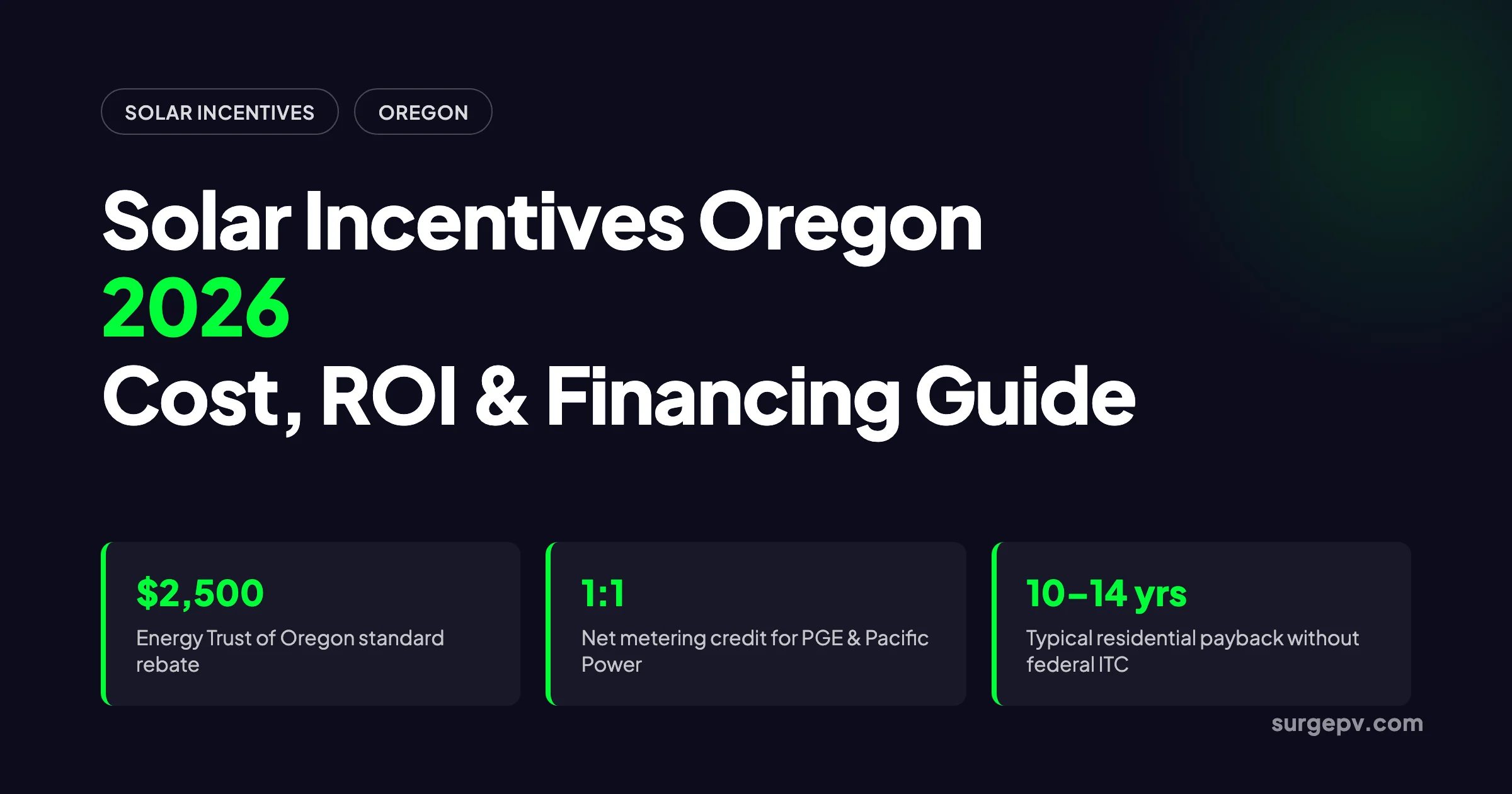
Oregon homeowners paid an average residential electricity rate of about 15–20 cents per kWh in early 2026, according to Power Northwest rate analysis (2026). PGE customers in the Portland area saw rates reach roughly 20 cents per kWh after an April 2026 increase. That makes solar attractive even though the federal Residential Clean Energy Credit expired for homeowner-owned systems at the end of 2025. Oregon still offers one of the stronger state-level incentive stacks on the West Coast, but the value depends almost entirely on which utility serves the home.
This guide covers every active Oregon solar incentive in 2026. It explains Energy Trust of Oregon rebates, Solar Within Reach, the Oregon Department of Energy Solar + Storage Rebate Program status, net metering rules by utility, the property tax exemption, and local rebates in Eugene, Salem, Ashland, and Central Lincoln. It also shows how to stack incentives, model ROI, and avoid the most common installer mistakes. For national context, see our posts on solar incentives in the USA 2026 and state solar incentives in the US. For installers, SurgePV’s solar design software and generation and financial tool let you model each incentive stream, utility rate, and financing scenario in one place.
Quick Answer
In 2026, Oregon solar incentives include a flat $2,500 Energy Trust of Oregon rebate for PGE and Pacific Power customers, enhanced Solar Within Reach incentives up to $5,500 for income-qualified households, battery rebates up to $5,000, a property tax exemption under ORS 307.175, and 1:1 net metering. The federal residential tax credit expired for homeowner-owned systems after December 31, 2025.
In this guide:
- How Oregon solar incentives changed in 2026.
- Energy Trust of Oregon standard and Solar Within Reach rebates.
- Oregon Department of Energy Solar + Storage Rebate Program status.
- Net metering rules by utility territory.
- Property tax, sales tax, and other state rules.
- Local utility rebates outside PGE and Pacific Power territory.
- Cost, ROI, and payback scenarios.
- Financing options and common mistakes.
- How to stack incentives and apply.
Oregon Solar Incentives at a Glance — 2026
Oregon’s 2026 incentive stack is built around cash rebates rather than tax credits. The state has no sales tax, so there is no sales tax exemption to claim. The biggest variable is utility territory.
| Incentive | Type | 2026 Status | Typical Value |
|---|---|---|---|
| Federal residential ITC (Section 25D) | Tax credit | Expired | $0 for new homeowner-owned systems |
| Federal Section 48E | Commercial tax credit | Active, deadlines apply | 30% for eligible commercial, lease, or PPA systems |
| Energy Trust standard solar rebate | Utility rebate | Active | $2,500 flat for PGE/Pacific Power |
| Energy Trust Solar Within Reach | Income-qualified rebate | Active | Up to $5,500 PGE / $5,250 Pacific Power |
| Energy Trust standard battery rebate | Utility rebate | Active | $400/kWh up to $5,000 PGE; $320/kWh up to $4,000 Pacific Power |
| Solar Within Reach battery rebate | Income-qualified rebate | Active | $520/kWh up to $6,500 PGE; $440/kWh up to $5,500 Pacific Power |
| Oregon property tax exemption | Tax exemption | Active, sunset planned | 100% of added value exempt under ORS 307.175 |
| Net metering | Bill credit | Active, utility-specific | 1:1 retail for PGE/Pacific Power; avoided-cost for EWEB |
| ODOE Solar + Storage Rebate | State rebate | Fully reserved / closed to new apps | Wait for future funding rounds |
| EWEB solar rebate | Local utility rebate | Active, budget-limited | $0.40/AC W up to $2,500 |
| Salem Electric solar rebate | Local utility rebate | Active, fund-limited | $300/kW up to $1,500 |
| Ashland solar rebate | Municipal rebate | Active | $600 per installation |
| Central Lincoln battery rebate | Utility rebate | Active | Up to $2,000 for solar-paired batteries |
The biggest misconception is that Oregon offers a state income tax credit. It does not. The real money is in Energy Trust rebates, battery adders, property tax savings, and net metering value.
How Oregon Solar Incentives Changed in 2026
Oregon entered 2026 with the same federal policy shock as every other state. Three shifts drive every proposal now.
The Federal Residential Credit Ended
The Residential Clean Energy Credit under Internal Revenue Code Section 25D allowed homeowners to claim 30% of qualified solar costs. It expired on December 31, 2025. Homeowner-owned solar and battery systems placed in service on or after January 1, 2026, no longer qualify.
Commercial and third-party-owned residential systems still have a path. Section 48E, the Clean Electricity Investment Tax Credit, offers a 30% base credit for projects that begin construction by July 4, 2026, or are placed in service by December 31, 2027. That is why solar leases and power purchase agreements can still advertise lower monthly payments in 2026.
Energy Trust Rebates Became the Headline Incentive
With the federal credit gone, the Energy Trust of Oregon rebate is now the first line item most Oregon homeowners see on a proposal. The standard rebate is a flat $2,500 for PGE and Pacific Power customers. Income-qualified households can receive much larger Solar Within Reach incentives.
Energy Trust confirmed its 2026 residential rates in January 2026, according to Energy Trust Insider (2026). Rates may decline gradually as budgets are consumed, so installers should check the current Incentive Status Report before every quote.
Net Metering Is Under Pressure
Oregon’s 1:1 net metering policy still makes solar work in 2026, but it is not guaranteed forever. PGE has discussed possible future reductions, though no rule change was finalized by mid-2026. Homeowners who lock in a net metering agreement now keep their credit terms for the life of the system.
Energy Trust of Oregon Standard Rebates
The Energy Trust of Oregon is an independent nonprofit funded by a public-purpose charge on PGE and Pacific Power ratepayers. It administers cash incentives that reduce the upfront cost of solar and battery systems.
Standard Solar Rebate: $2,500 Flat
For 2026, the standard residential solar rebate is $2,500 per home for both PGE and Pacific Power customers. The system must be installed by an approved Energy Trust trade ally and meet minimum performance requirements. The installer applies for the rebate and passes it through as an upfront discount on the contract.
A typical 7 kW residential system costing $21,000 before incentives drops to $18,500 after the standard rebate. That single line item can shorten the payback period by roughly one to two years compared with a project that receives no rebate.
Standard Battery Storage Rebates
The Energy Trust also offers rebates for paired battery storage:
- PGE customers: $400 per kWh, up to $5,000.
- Pacific Power customers: $320 per kWh, up to $4,000.
A 13.5 kWh battery receives the full $5,000 rebate for PGE customers or $4,000 for Pacific Power customers. The battery must be paired with a solar system that meets Energy Trust standards.
Who Qualifies for Standard Rebates
Standard rebates are available to owner-occupied homes served by PGE or Pacific Power. Third-party-owned systems such as leases and PPAs are not eligible. The home must have good solar access, typically a Total Solar Resource Fraction above 75%. The installer confirms eligibility during the site assessment.
Solar Within Reach for Income-Qualified Households
Solar Within Reach is the Energy Trust’s enhanced rebate pathway for low- and moderate-income households. The incentives are large enough to change project economics dramatically.
Solar Incentives
- PGE customers: $0.90 per watt, up to $5,500.
- Pacific Power customers: $0.85 per watt, up to $5,250.
A 6 kW system on PGE qualifies for $5,400, just under the cap. A 7 kW system hits the $5,500 maximum.
Battery Incentives
- PGE customers: $520 per kWh, up to $6,500.
- Pacific Power customers: $440 per kWh, up to $5,500.
Combined solar and battery incentives can reach $11,750 for PGE customers and $10,250 for Pacific Power customers, according to EcoFlow Oregon solar rebate guide (2026).
Income Limits
Eligibility is based on gross household income and household size. A four-person household can qualify with annual gross income at or below roughly $128,564, according to Power Northwest Oregon incentives guide (2026). Applicants must complete an income verification process before the installer reserves funds.
Solar Within Reach cannot be combined with the standard Energy Trust rebate. The customer receives the higher-value offer, not both.
Oregon Department of Energy Solar + Storage Rebate Program
The Oregon Department of Energy (ODOE) Solar + Storage Rebate Program previously offered up to $5,000 for solar and $2,500 for paired battery storage. It had income-qualified tiers that paid $1.80 per watt for low- and moderate-income customers.
As of early 2026, the program is fully reserved and not accepting new applications. The legislature allocated additional funding in prior sessions, but all current funds are committed. Homeowners should check ODOE Solar + Storage Rebate Program for any future reopening.
Installers should not list ODOE rebates as a guaranteed line item in 2026 proposals unless the customer already holds a confirmed reservation.
Net Metering in Oregon by Utility Territory
Net metering is the single most valuable solar incentive for many Oregonians in 2026. The rules vary by utility.
PGE and Pacific Power: 1:1 Retail Credits
For residential systems up to 25 kW, PGE and Pacific Power credit exports at the full retail rate. Credits roll over month to month and reset annually in March. Any leftover credits after the true-up are transferred to the utility’s low-income bill assistance program.
This 1:1 structure makes solar-only systems financially attractive even without the federal tax credit. A homeowner can size the system to offset annual usage and bank summer credits for winter months.
EWEB: Avoided-Cost Net Metering
The Eugene Water & Electric Board moved to an avoided-cost methodology in 2026. Excess generation is credited at $0.0399 per kWh, according to EWEB solar generation rates (2026). That is well below the retail rate, so EWEB customers should size systems for self-consumption rather than export.
EWEB also offers a $0.40 per AC watt solar rebate up to $2,500, but the 2026 budget is only $125,000 and is first-come, first-served.
Salem Electric, Ashland, and Other Municipal Utilities
Salem Electric offers a $300 per kW solar rebate up to $1,500 for systems 25 kW or smaller. The City of Ashland offers a $600 flat rebate for residential solar. These customers are not eligible for Energy Trust incentives, so the local rebate becomes the primary cash incentive.
Central Lincoln Electric Utility offers a battery storage rebate up to $2,000 for solar-paired systems. Customers must complete a pre-installation technical review and sign a net metering agreement.
Idaho Power Net Billing
Idaho Power customers in Oregon have transitioned to net billing. New exports receive credits below the retail rate. Customers with legacy net metering status before June 1, 2024, keep favorable terms through December 1, 2045.
| Utility | Net Metering Regime | Solar Rebate | Battery Rebate |
|---|---|---|---|
| PGE | 1:1 retail credit | $2,500 standard; up to $5,500 SWR | Up to $5,000 standard; up to $6,500 SWR |
| Pacific Power | 1:1 retail credit | $2,500 standard; up to $5,250 SWR | Up to $4,000 standard; up to $5,500 SWR |
| EWEB | Avoided cost ($0.0399/kWh) | $0.40/AC W up to $2,500 | Check EWEB programs |
| Salem Electric | Net metering | $300/kW up to $1,500 | Check utility programs |
| Ashland | Net metering | $600 flat | None known |
| Central Lincoln | Net metering | None known | Up to $2,000 |
| Idaho Power | Net billing | None known | None known |
Sources: Energy Trust Insider (2026); EWEB solar generation rates (2026); National Solar Oregon incentives (2026).
Property Tax, Sales Tax, and Other Oregon Solar Rules
Oregon treats solar favorably for property taxes and has no sales tax. These two rules reduce both lifetime and upfront costs.
Property Tax Exemption
Under ORS 307.175, the added value of a qualifying solar energy system is exempt from property taxes. The system must be net metered or primarily designed to offset on-site electricity use. The exemption applies to third-party-owned systems as well as customer-owned systems.
Homeowners should file the exemption application with their county assessor. The exemption is not automatic in every county. According to Palmetto Oregon solar guide (2026), the exemption is currently scheduled to phase out for systems installed after July 1, 2029. Systems installed before that date and approved for the exemption keep it for the life of the system.
For a typical home where solar adds $20,000 to $30,000 in value, the exemption can save several thousand dollars in property taxes over 25 years.
No State Sales Tax
Oregon does not have a statewide sales tax. Solar equipment and installation labor are not taxed at the state level. This is a built-in cost advantage compared with states where solar is subject to sales tax unless a specific exemption exists.
No State Solar Tax Credit
Oregon has never offered a statewide income tax credit for residential solar. Homeowners sometimes confuse the expired federal Section 25D credit with a state credit. Installers should make this distinction clear in proposals.
Cost, ROI, and Payback Scenarios by Utility Territory
The financial case for solar in Oregon depends heavily on utility territory, system size, and incentive eligibility.
Typical System Costs
As of mid-2026, Oregon residential solar costs average roughly $3.00 to $3.37 per watt before incentives, according to SolarReviews Oregon cost data (2026). A typical 7 kW system costs $21,000 to $23,600 before incentives.
Oregon receives about 4 to 5 peak sun hours per day on average. A 7 kW system produces roughly 9,000 to 10,000 kWh per year. Production is higher in central and eastern Oregon and lower in the cloudy Willamette Valley winter.
Scenario 1: PGE Territory, Standard Rebate, 7 kW System
| Line Item | Value |
|---|---|
| Gross system cost | $21,000 |
| Energy Trust standard rebate | -$2,500 |
| Net upfront cost | $18,500 |
| Annual savings at $0.20/kWh | $1,800–$2,000 |
| Simple payback | 9–11 years |
This assumes the system offsets most annual consumption under 1:1 net metering.
Scenario 2: PGE Territory, Solar Within Reach, 7 kW System
| Line Item | Value |
|---|---|
| Gross system cost | $21,000 |
| Solar Within Reach rebate | -$5,500 |
| Net upfront cost | $15,500 |
| Annual savings at $0.20/kWh | $1,800–$2,000 |
| Simple payback | 8–9 years |
The income-qualified rebate shortens payback by roughly two years.
Scenario 3: EWEB Territory, 7 kW System
| Line Item | Value |
|---|---|
| Gross system cost | $21,000 |
| EWEB solar rebate | -$2,500 |
| Net upfront cost | $18,500 |
| Annual savings with avoided-cost exports | $1,200–$1,500 |
| Simple payback | 12–15 years |
EWEB’s lower export credit makes solar-only payback longer. The system should be sized for self-consumption. A battery can improve economics by shifting solar to evening hours.
These scenarios are illustrative. Actual results depend on roof orientation, shading, equipment, financing, and future utility rate changes. SurgePV’s generation and financial tool can model specific projects with current Oregon rates and incentives.
Financing Options for Oregon Solar in 2026
Without the federal residential tax credit, financing choice matters more. The best option depends on tax liability, credit score, and ownership preference.
Cash Purchase
Cash delivers the highest lifetime savings because there is no interest. The customer captures the full Energy Trust rebate and any local utility rebates. Payback is typically 9 to 14 years in Oregon, and the system produces free electricity for decades after that.
Solar Loan
Solar loans allow ownership without a large upfront payment. The customer still captures rebates. However, loan interest reduces net savings. A 20-year loan at 7–9% interest can add 30–50% to the total cost compared with cash.
In 2026, the federal tax credit cannot be used to reduce loan principal for new homeowner-owned systems. Customers should compare loan payments to expected utility savings carefully.
Lease and Power Purchase Agreement
Leases and PPAs require no upfront payment and provide immediate monthly savings. The system owner, usually a financing company, claims any available federal Section 48E credit. The homeowner receives a lower electricity rate, typically 10–20% below utility rates.
The downside is that the homeowner does not own the system or capture Energy Trust rebates directly. Lease and PPA customers are generally not eligible for Energy Trust standard rebates. SREC value, if any, is built into the lease rate.
Solar Within Reach and Low-Income Pathways
For income-qualified households, Solar Within Reach is usually the best option. The rebates are large enough that the project often pays back in 7 to 9 years even with a loan. Nonprofits and low-income service providers may also qualify for separate Energy Trust equity programs.
Common Mistakes and Misconceptions
Oregon solar proposals fail or get disputed when installers oversimplify the incentive stack. Here are the most common errors.
Assuming the Federal Tax Credit Still Exists
The biggest change in 2026 is the end of the Section 25D residential credit. A proposal that assumes a 30% federal credit will understate the net cost by roughly $6,000 to $7,000 on a typical system.
Quoting Energy Trust Rebates for Non-Eligible Utilities
Energy Trust incentives are available only to PGE and Pacific Power customers. Salem Electric, EWEB, Ashland, and most municipal utility customers do not qualify. Installers must confirm the utility before listing the rebate.
Ignoring EWEB’s Avoided-Cost Export Rate
EWEB customers who size a system for 100% annual offset based on retail rates will be disappointed. Exports are credited at $0.0399/kWh. The right approach is to size for self-consumption and add storage if budget allows.
Missing Local Rebate Deadlines
EWEB’s $125,000 annual solar budget is first-come, first-served. Salem Electric and Ashland rebates are also fund-limited. Delaying an application can mean losing the rebate.
Forgetting the Property Tax Exemption Deadline
The property tax exemption is not automatic. Homeowners must file with the county assessor, usually by December 31 of the installation year. Missing the filing can cost thousands of dollars in property taxes over the life of the system.
Model Oregon Incentives Accurately in Every Proposal
Energy Trust rebates, utility-specific net metering, and local incentive budgets change the math on every Oregon project. SurgePV’s financial modeling applies the right rates and rebates so your customer sees real net cost and payback.
Explore Financial ModelingNo commitment required · 20 minutes · Live project walkthrough
How to Stack Oregon Incentives and Apply
Stacking Oregon incentives correctly is more important than finding more incentives. The order of operations matters because some programs cannot be combined.
Step 1: Confirm the Utility Territory
Check the electric bill to confirm whether the home is served by PGE, Pacific Power, EWEB, Salem Electric, Ashland, Central Lincoln, Idaho Power, or another utility. This determines which rebates and net metering rules apply.
Step 2: Screen for Income-Qualified Programs
Ask early about household income relative to Energy Trust Solar Within Reach limits. If the household qualifies, start the income verification process before signing the contract. Solar Within Reach incentives are larger than standard rebates.
Step 3: Choose the Ownership Structure
A cash purchase or loan lets the homeowner claim Energy Trust rebates directly. A lease or PPA may allow the financier to claim Section 48E, but the homeowner usually cannot claim Energy Trust standard rebates. For a full comparison, see our solar financing options guide.
Step 4: Apply for Local Utility Rebates
EWEB, Salem Electric, Ashland, and Central Lincoln require direct applications or pre-approval. Submit paperwork before installation where required. Missing a pre-installation review can void eligibility.
Step 5: File the Property Tax Exemption
File the exemption application with the county assessor, usually by December 31 of the installation year. Keep a copy of the interconnection agreement and final invoice as supporting documentation.
Step 6: Document Everything
Keep itemized invoices, interconnection agreements, proof of placed-in-service date, Energy Trust approval letters, and county assessor filings. Incentives are increasingly audited. Missing paperwork can delay or cancel a rebate.
Conclusion
Oregon solar incentives in 2026 are still strong, but they require careful stacking. The federal residential tax credit is gone for homeowner-owned systems. The value now comes from Energy Trust of Oregon rebates, Solar Within Reach, battery adders, the property tax exemption, and utility-specific net metering.
- Confirm the utility territory and net metering rules before quoting any savings.
- Screen every customer for Solar Within Reach eligibility before assuming the standard rebate.
- File property tax exemption paperwork with the county assessor on time.
For installers, accurate Oregon proposals require precise modeling of Energy Trust rebates, local utility programs, and net metering value. SurgePV’s solar design software helps you design systems that match each utility’s rules, while the solar yield and financial analysis lets you build proposals that show real payback and ROI for both residential and commercial projects. For a broader view, see our state solar incentives US guide.
Frequently Asked Questions
What solar incentives are available in Oregon in 2026?
Oregon solar incentives in 2026 include the Energy Trust of Oregon flat $2,500 rebate for PGE and Pacific Power customers, Solar Within Reach up to $5,500 for income-qualified households, battery rebates up to $5,000, a property tax exemption under ORS 307.175, and 1:1 net metering for most investor-owned utility customers. The federal residential tax credit expired after December 31, 2025.
Does Oregon have a state solar tax credit in 2026?
No. Oregon does not offer a statewide income tax credit for residential solar. The strongest state-level support comes from the Energy Trust of Oregon cash rebates and the property tax exemption. Oregon also has no statewide sales tax, so solar equipment is not subject to sales tax.
How much is the Energy Trust of Oregon solar rebate in 2026?
The standard Energy Trust of Oregon rebate is $2,500 per home for PGE and Pacific Power customers who install a qualifying system through an approved trade ally. Income-qualified households can receive Solar Within Reach incentives of $0.90/W up to $5,500 for PGE and $0.85/W up to $5,250 for Pacific Power.
Is the federal solar tax credit still available in Oregon in 2026?
The 30% federal Residential Clean Energy Credit under Internal Revenue Code Section 25D expired for homeowner-owned systems placed in service after December 31, 2025. Commercial, lease, and power purchase agreement systems may still qualify under Section 48E if construction begins by July 4, 2026, or the system is placed in service by December 31, 2027.
How does net metering work in Oregon in 2026?
Oregon allows 1:1 net metering for residential systems up to 25 kW and commercial systems up to 2 MW. PGE and Pacific Power credit exports at the full retail rate. Credits roll over monthly and reset each March; leftover credits go to low-income bill assistance. EWEB credits exports at $0.0399/kWh under an avoided-cost methodology.
Does Oregon have a property tax exemption for solar panels?
Yes. Under ORS 307.175, the added value of a qualifying solar energy system is exempt from property taxes if the system is net metered or primarily offsets on-site use. Homeowners should file with their county assessor. The exemption is currently scheduled to phase out for systems installed after July 1, 2029.
What is Solar Within Reach in Oregon?
Solar Within Reach is an Energy Trust of Oregon program for income-qualified PGE and Pacific Power customers. It pays higher per-watt solar incentives and larger battery rebates than the standard offer. A four-person household can qualify with gross annual income at or below roughly $128,564.
Are battery storage incentives available in Oregon in 2026?
Yes. The Energy Trust of Oregon offers standard battery rebates of $400/kWh up to $5,000 for PGE and $320/kWh up to $4,000 for Pacific Power. Solar Within Reach battery rebates are $520/kWh up to $6,500 for PGE and $440/kWh up to $5,500 for Pacific Power. Central Lincoln Electric offers a separate battery rebate up to $2,000.
What is the typical solar payback period in Oregon in 2026?
A well-designed residential solar system in Oregon typically pays back in 10 to 14 years in 2026 without the federal residential tax credit. Payback is shorter in PGE territory due to higher rates and much shorter for households that qualify for Solar Within Reach. Exact payback depends on utility territory, system size, financing, and export compensation.
How do I apply for Oregon solar incentives?
Homeowners do not apply directly for Energy Trust rebates. An approved trade ally installer reserves the incentive and deducts it from the contract price. Property tax exemption forms are filed with the county assessor. Local utility rebates such as EWEB require a first-come, first-served application through the utility.
Where this fits
This article is part of SurgePV's Solar Incentives & Policy hub, which works through the topic from first principles to the decisions a project team actually has to make.
