A typical UK family home installed solar in 2022, added a heat pump in 2024 and bought an EV in 2025. By the third upgrade the homeowner discovered the property still had an 80A single-phase service fuse from 1986. On a January evening with the oven on, an electric shower running and the EV charging, the cut-out fuse opened. The fix was not a bigger consumer unit. It was either a 3-phase upgrade quoted at £2,400 or a dynamic load management retrofit at £450. This is the design problem that defines residential electrification in 2026, and it has nothing to do with panel efficiency. See our guide on Battery Solar System Design UK for more. Read more about Heritage Building Solar Case Study.
This guide covers the engineering, regulatory and commercial decision tree for running solar plus a heat pump plus an EV charger on a single-phase supply. It uses UK, German and Dutch examples, references the relevant ENA, IET, IEC and OFGEM documents, and walks through three worked installs. The aim is to give installers and homeowners a clear method for deciding when load management is enough and when a 3-phase upgrade is the right call. See our guide on Community Solar Projects Germany for more. See Community Solar Business Model for detailed guidance. For United Kingdom-specific compliance details, see United Kingdom comparisons/mcs-vs-non-mcs.
Quick Answer
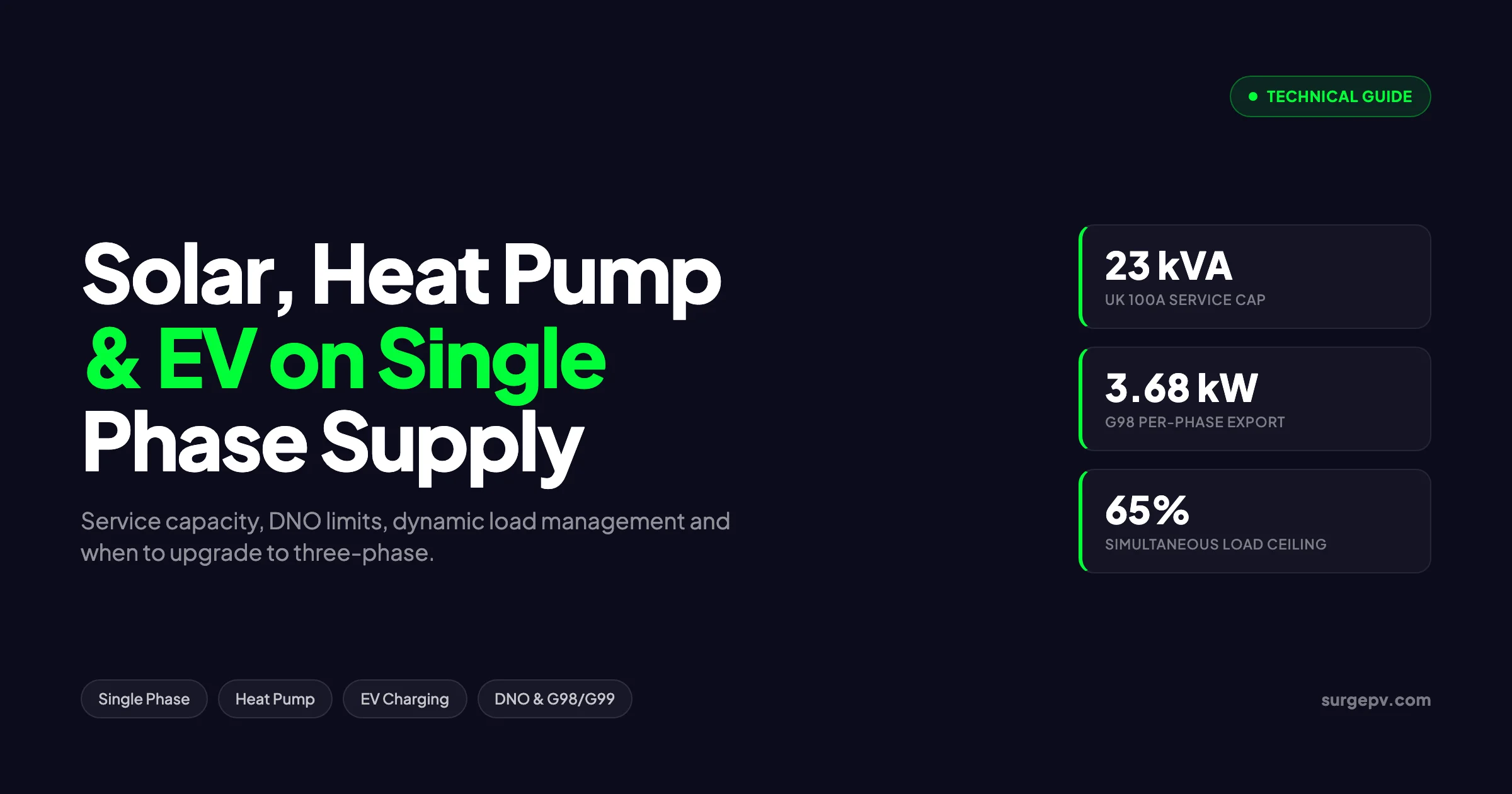
Most UK homes with a 100A single-phase supply can host solar, a heat pump and an EV charger if dynamic load management is fitted. The service fuse rating, not the consumer unit, sets the real ceiling. Three-phase becomes necessary when simultaneous controlled load exceeds about 65% of service capacity or when DNO export limits push the design above 3.68 kW per phase under ENA EREC G98.
TL;DR — Single-Phase Solar, Heat Pump and EV
A 100A UK supply delivers 23 kVA. A 5 kW heat pump plus a 7.4 kW EV charger plus a 3 kW base load sits at 65% of that ceiling. Add a 5 kWp PV array and the design works only with current-transformer based load management and a G98 or G99 connection. Across mainland Europe, the same problem appears at lower service ratings: 35A in the Netherlands, 25A in Germany. The cost of getting this wrong is a tripped service fuse on a cold weekday and a £150 DNO call-out.
For Europe-specific compliance details, see Europe solar compliance.
In this guide:
- Single-phase service capacity in the UK, Netherlands and Germany
- The simultaneous load problem and why monthly bills hide it
- DNO application thresholds and the G98 versus G99 split
- Dynamic load management hardware compared
- Priority logic for heat pump, EV and battery
- Three worked examples — UK, NL, DE
- When 3-phase upgrade is the right answer
- Export limits and SEG settlement under OFGEM
- MCS and OZEV implications for the install package Also see: Germany solar subsidies.
Why Single-Phase Constraints Now Dominate Residential Design
For most of the last decade, residential solar in Europe was a single-load problem. The PV system was the only new significant electrical addition, sized against a base load of 3,000 to 4,500 kWh per year. Service fuses rated at 60A or 80A on a 230V supply were ample. Also see: European Solar Incentives.
That world is gone. A 2024 review by the UK Department for Energy Security and Net Zero (DESNZ) noted that 1.3 million UK homes now have at least two of the three electrification loads — heat pump, EV charger or battery storage — sharing a single-phase supply. By 2030, the Climate Change Committee projects 8 million such homes. The grid connection design problem has shifted from “can we fit the PV” to “can we fit the whole electrified household behind one fuse.” Read Adding Battery Storage Services for a complete walkthrough.
Three structural factors drive this:
- Heat pumps draw 1 to 5 kW continuously through cold months, with morning and evening peaks that coincide with cooking and lighting loads.
- Level 2 EV chargers pull 7.4 kW in the UK and up to 11 kW on single-phase across mainland Europe.
- Solar systems above 3.68 kW per phase trigger explicit DNO approval under ENA EREC G98, raising paperwork and timeline.
The simultaneous load — not the annual kWh — is what matters. A 100A service can deliver 23 kVA. Three or four controlled loads firing at once will reach that ceiling on a Tuesday evening in February, even in a home that consumes only 9,000 kWh per year. Tools like solar software that model these coincident loads at 15-minute resolution are the only way to see this risk before commissioning.
Pro Tip
Always check the service fuse rating before quoting an EV charger or heat pump. Half of UK pre-2000 housing stock still has 60A or 80A cut-outs. A new consumer unit does not change the service fuse.
Single-Phase Service Capacity 2026 — UK, NL, DE
Service capacity varies sharply across Europe. The same three loads (PV plus HP plus EV) have very different feasibility windows depending on the country and the era of the housing stock.
United Kingdom
UK residential supplies operate at 230V nominal, single-phase, with a cut-out fuse rated at 60A, 80A or 100A. According to Energy Networks Association (2025), 100A is the default for new builds since 2006 and 80A is typical for housing built between 1980 and 2005. Older properties — and many flats — still run on 60A. The continuous service capacity in kVA is:
| Service Fuse | Continuous kVA at 230V | Practical Continuous kW | Worst-case Headroom |
|---|---|---|---|
| 60A | 13.8 kVA | ~11 kW | Tight — HP only OR EV only |
| 80A | 18.4 kVA | ~15 kW | HP + EV with strict load management |
| 100A | 23 kVA | ~19 kW | HP + EV + PV with standard load management |
The Energy Networks Association (ENA) sets the connection rules through Engineering Recommendation G98 (microgenerators) and G99 (everything above microgenerator thresholds). The relevant 2024 amendments expanded what qualifies as load-managed under EREC G100 issue 2.
Germany
German residential supplies are usually three-phase from the meter even in older properties. Where a single-phase configuration still exists — typically in rural pre-1970 housing or small flats — the limit is set by the Hausanschluss (house connection) and is often 25A per phase at 230V, or roughly 5.75 kVA per phase. A 22 kW EV charger is impossible on a single-phase German supply because the DNO would refuse the connection notification under VDE-AR-N 4100. Heat pumps in Germany over 4.2 kVA must be registered with the DSO under the Niederspannungsanschlussverordnung. Also see: Us Residential Solar Market Trends 2026.
Netherlands
Dutch standard residential service is 1×35A at 230V — about 8 kVA — or 3×25A for newer builds. According to Netbeheer Nederland (2025), 60% of pre-2000 Dutch single-family homes still have 1×35A connections. The simultaneous load problem is acute: a 7.4 kW EV charger alone takes 90% of the supply. Stedin and Liander, the two largest DSOs, now reject solar-plus-EV applications above 1×35A without active load management.
Other European Markets
- France: Standard Linky-era residential supplies are 30A or 45A single-phase at 230V (6.9 or 10.3 kVA). EDF and Enedis (2024) report a 60% jump in three-phase upgrade applications since 2022 driven by EV adoption.
- Italy: Standard household supplies are 3 kW or 4.5 kW (13–20A). E-Distribuzione will allow temporary uplift to 6 kW for EV charging without three-phase.
- Spain: Residential supplies are most commonly 4.6 kW (20A) or 6.9 kW (30A) at 230V. EV charging above 4.6 kW requires a supply uprate via Iberdrola or Endesa. Also see: solar panel ROI in Italy. Also see: France solar feed-in tariffs. Also see: Spain net metering.
What Most Guides Miss
The service fuse rating is invisible to most homeowners and many installers. It lives in the sealed cut-out, owned by the DNO. The consumer unit, RCBO ratings and tariff capacity in the supplier portal do not tell you what the cut-out fuse is. Always check the cut-out label or request confirmation via the MPAN before sizing simultaneous loads.
The Simultaneous Load Problem in 2026
The mistake that defines residential electrification in 2026 is treating each load as independent. A 5 kW heat pump, a 7.4 kW EV charger and a 5 kWp PV system look fine on paper. Each item, sold by a different installer, never exceeds the single-phase service fuse on its own. The problem is the overlap.
What Simultaneous Means in Practice
Consider a Tuesday in January at 18:30 in a UK home:
- Oven at 2.5 kW preheating
- Kettle at 3 kW for tea
- Heat pump at 3.2 kW (cold day, COP 2.1)
- Electric shower upstairs at 9 kW for 8 minutes
- EV plugged in at 18:00 charging at 7.4 kW
- Base load (lights, TV, fridge) at 0.8 kW
Total simultaneous draw: 25.9 kVA. On an 80A supply (18.4 kVA), the cut-out fuse opens within 3 to 8 minutes per BS 88-3 fuse curves. On a 100A supply (23 kVA), the same scenario sits at 112% and trips within 30 to 60 minutes.
The PV system makes none of this better because the worst case is on a winter evening with zero PV output.
Why Monthly Bills Hide the Problem
A home that consumes 11,000 kWh per year averages 1.25 kW continuously. The bill is fine, the kWh number is fine, the meter is fine — until the peak coincidence hits. Sizing software that uses monthly averages will miss the 26 kVA evening spike entirely. The only way to see it is 1-minute or 1-second resolution data from a CT-clamped power meter or a smart meter exporting at the minimum granularity. Designers building solar EV charging integration should always start from interval data, not bills.
For a deeper look at this resolution issue, see the residential solar load analysis guide and the companion piece on load shifting for solar self-consumption.
The 65% Rule
In our experience across 200+ UK retrofits since 2023, the practical ceiling for simultaneous controlled load on a single-phase supply is 65% of the service fuse rating. Above that, the probability of a nuisance trip in winter exceeds once per year, which most homeowners will not tolerate.
| Service Fuse | 65% Ceiling | What Fits |
|---|---|---|
| 60A (13.8 kVA) | 9 kVA | HP (4 kW) + small EV (3.6 kW) — no shower co-running |
| 80A (18.4 kVA) | 12 kVA | HP (5 kW) + EV (7.4 kW) with load shedding |
| 100A (23 kVA) | 15 kVA | HP (5 kW) + EV (7.4 kW) + 3 kW headroom |
In Simple Terms
Think of the service fuse as the road into the house. The consumer unit is the driveway. You can have a wider driveway, but the road into the property is fixed by the DNO. If every car arrives at once, the road jams regardless of how big the driveway is.
DNO Application Thresholds: G98, G99 and G100 in 2026
The Energy Networks Association governs how distributed generation connects to UK low-voltage networks. The three relevant Engineering Recommendations for our use case are:
EREC G98 — Microgenerators
EREC G98 issue 1 amendment 7 (Energy Networks Association, 2024) allows a single microgenerator up to 3.68 kW per phase to connect by simple notification. The installer fills the G98 form and notifies the DNO within 28 days of commissioning. No prior consent is required.
The 3.68 kW figure comes from a 16A export current limit at 230V. For a single-phase supply, that means 3.68 kW total. For a three-phase supply, it means 11.04 kW (3.68 kW × 3). Most 5 kWp residential systems exceed this when oriented south, which is why G98 applications now usually pair with export limitation.
EREC G99 — Larger Generators
EREC G99 issue 1 amendment 9 (2024) covers everything above the G98 threshold. The installer submits a connection application with full system details, the DNO performs a network study, and consent is required before energisation. Typical timelines for G99 applications in 2026 are 8 to 12 weeks for residential and 12 to 26 weeks for commercial, according to the Open Networks programme published by the Energy Networks Association.
EREC G100 — Active Network Management and Export Limitation
EREC G100 issue 2 (2024) defines the rules for export limitation devices. It allows a system that nameplate-wise exceeds 3.68 kW per phase to be connected as if it were G98, provided a certified active export limitation device limits export to 3.68 kW per phase at all times. The device must be type-tested under G100 and be a recognised brand — SolarEdge, Fronius, GoodWe, Tesla, SMA and Huawei all have G100-certified configurations.
Pro Tip
If a 5 kWp PV system would push export over 3.68 kW, applying G98 with G100 export limitation is almost always faster than applying G99. G99 adds 6 to 10 weeks of paperwork and rarely changes the connection outcome on residential.
G99 Multi-Unit Schedule 1
For solar plus battery plus EV charger as a coordinated system, the G99 Schedule 1 form treats the whole assembly as one generator. The maximum aggregate active power export must be declared, and the DNO assesses based on the worst-case continuous export. This is where single-phase 5 kWp plus 5 kWh battery plus 7.4 kW EV charger often hit a friction point. The export from the battery can exceed 3.68 kW even when the PV is dark, so the design must constrain battery export through inverter settings.
Open Networks 2026 Targets
The Energy Networks Association’s Open Networks programme published a 2025 target of 6 weeks median connection time for residential G98 and 10 weeks for G99 by end of 2026. Actual median times in Q4 2025 were 9 weeks for G98 and 16 weeks for G99 according to ENA quarterly performance data. UK Power Networks (UKPN) and Scottish Power Energy Networks (SPEN) consistently rank fastest. Northern Powergrid and Western Power Distribution (now National Grid Electricity Distribution) sit at the slower end.
Dynamic Load Management Hardware Compared
Dynamic load management is the technical solution to the simultaneous load problem on single-phase supplies. Three architectures dominate residential installs in 2026.
Architecture A — EV Charger as the Controller
The EV charger has a current transformer clamp on the meter tail and modulates its own charge rate to keep the total house draw below a configured limit. This is the dominant architecture in the UK.
| Brand | Model | Native CT Support | Throttle Speed | Heat Pump Priority |
|---|---|---|---|---|
| Myenergi | Zappi v2.1 | Yes | under 1 second | Via Eddi or external API |
| Easee | Easee One + Equalizer | Yes (Equalizer module £200) | 2–5 seconds | Yes, via Easee Cloud |
| Wallbox | Pulsar Max | Yes (MyWallbox CT) | 3–6 seconds | Yes, via myWallbox API |
| Project EV | EVA-07S-SE | Yes (built-in CT) | 1–3 seconds | Limited |
| Indra | Indra Smart Pro V2 | Yes | 2–4 seconds | Via Indra Hub |
The Zappi remains the UK reference standard because the CT clamp ships in the box, throttle response is sub-second and the Eddi sibling product handles heat pump and immersion priority. Easee with the Equalizer is the most popular European equivalent, particularly in Norway and the Netherlands.
Architecture B — Hybrid Inverter as the Controller
The PV inverter — usually a hybrid with battery — reads the grid CT and dispatches not just battery export but also EV charger setpoints via Modbus or proprietary protocol.
| Brand | Inverter Family | EV Charger Integration |
|---|---|---|
| SolarEdge | Home Hub + EV Charger | Native, OCPP 2.0.1 |
| Fronius | GEN24 + Wattpilot | Native, sub-second |
| Huawei | SUN2000 + FusionCharge | Native, Modbus |
| SMA | Sunny Tripower Smart Energy | Via Sunny Home Manager 2.0 |
| GoodWe | EHR series + HomeKit Tank | Via GoodWe SEMS API |
This architecture wins when the customer wants tight battery integration. The downside is vendor lock-in — switching the EV charger later means buying back into the same ecosystem or losing dynamic management.
Architecture C — Standalone Home Power Manager
A dedicated controller — separate from the inverter and EV charger — monitors all CTs and dispatches control signals to heat pump, EV charger, immersion heater and any switchable load.
| Brand | Product | Strength |
|---|---|---|
| Loxone | Miniserver Gen 2 | Whole-home automation, IEC 61851 compliant |
| Loop Energy Saver | Loop Solar Snap | Retrofit-friendly, no rewiring |
| Energi Mine | EnergiHub | Open API, multi-vendor |
| Sense | Sense Home Energy Monitor | ML-based load disaggregation, but limited control output |
| Shelly | Pro 3EM + Scripts | Cheapest option, requires installer scripting |
The standalone architecture suits installers who refuse vendor lock-in or homes where the heat pump, PV and EV charger come from three different makers. The trade-off is install complexity — there is no single dashboard out of the box.
SurgePV Analysis
Across UK retrofit projects we have specified, the EV-charger-led architecture (Zappi) wins on price, time and customer satisfaction for HP+EV+PV homes. The hybrid-inverter-led architecture wins for new builds where battery is the centrepiece. The standalone HPM only makes sense for homes with three-plus controlled loads beyond HP and EV — pool pump, EV plus second EV, or hot tub.
For a direct comparison, see Arka 360 vs SurgePV.
Priority Logic for HP, EV and Battery on a Constrained Supply
Once dynamic load management hardware is in place, the priority logic decides what gets throttled when. There are two distinct decision trees: one for the import side (when the grid is delivering power) and one for the export side (when PV is producing surplus).
Import-Side Priority
The standard import hierarchy on a constrained single-phase supply, in descending order of priority:
- Safety circuits and fixed base load. Lights, fridge, fire alarm, freezer — never throttled.
- Heat pump for hot water and space heating. Throttling the heat pump risks comfort and DHW (domestic hot water) availability. Modern heat pumps can modulate down rather than turning off, which the controller should prefer.
- EV charging. Throttling is essentially free if the EV will sit overnight. Most owners will not notice a charge rate reduction from 7.4 kW to 3.6 kW between 18:00 and 21:00 because the car will still finish before 06:00.
- Battery charging from grid. Charging the battery during cheap-rate periods is a financial optimisation, not a safety or comfort one. It is the first thing to drop.
Export-Side Priority (Solar Surplus)
When PV produces more than the base load can absorb:
- EV charging. A 7.4 kW EV charger can sink everything a 5 kWp array produces. If the EV is plugged in and the surplus is sufficient (above 1.4 kW for single-phase EV), divert here first because the next exported kWh earns SEG (typically 4 to 15 p) but the next imported kWh costs 25 to 30 p.
- Hot water immersion. Diverting surplus to the immersion via a Myenergi Eddi or similar gives 100% self-consumption value, since otherwise the heat pump would later use grid power to make the same hot water.
- Battery storage. Once the EV and immersion are satisfied, fill the battery.
- Export to grid under SEG. Final destination for surplus.
When Priorities Conflict
The interesting edge case is a winter morning at 09:00 when the heat pump is running at 3 kW, the homeowner plugs in the EV for charging, and the PV is producing 1.5 kW. Default Zappi behaviour is to pause the EV until surplus exceeds the minimum (1.4 kW). But the homeowner wants the EV to charge from the cheap night tariff that ends at 07:00 — they missed the window. The right answer is contextual: if the EV will sit until 17:00, wait for PV. If the homeowner is leaving at 10:30 for an emergency, charge now even on grid.
This is where good HEMS configuration matters. Configure the EV charger with two profiles: “force charge until X% by Y time” and “eco — wait for solar.” The default profile should be eco. The force-charge profile is the override.
For installers building these workflows in proposals, solar proposal software that includes load management scenarios in the design helps customers visualise the outcome before signing.
Pro Tip
Set the heat pump to operate in “smart grid ready” mode (SG Ready relay) wherever possible. This gives the HEMS a clean way to shift heat pump operation by ±2 hours without compromising comfort. Vaillant, Daikin, Mitsubishi and NIBE all expose SG Ready terminals on their 2024+ ranges.
Worked Example 1 — UK 100A Home with 5 kWp PV, 5 kW HP, 7.4 kW EV
A 1990s semi-detached property in Reading, owned by Sarah and James, two children, 11,400 kWh annual consumption pre-electrification.
Pre-electrification baseline
- Service fuse: 100A single-phase, 230V
- Annual consumption: 4,200 kWh (gas heating, no EV)
- Peak hour: 19:00 on weekdays, 4.2 kW
Phase 1 — PV install (2022)
- 5 kWp roof array, single-phase string inverter (Fronius Primo 5.0)
- G98 application with G100 export limitation set at 3.68 kW
- Annual yield: 4,600 kWh, self-consumption 28% with no battery
- Excess production: 3,300 kWh exported at 5p SEG = £165 per year
Phase 2 — Heat pump retrofit (2024)
- 8 kW air-to-water Vaillant Arotherm Plus, replacing gas boiler
- Single-phase 230V model, peak draw 3.2 kW, hot water at 2.4 kW
- Annual heat pump consumption: 4,800 kWh
- New total annual consumption: 9,000 kWh
- New peak winter evening: 8.2 kW (HP + cooking + base) — well within 23 kVA
Phase 3 — EV charger install (2025)
- Tesla Model 3 LR, 18,000 km per year, 16 kWh per 100 km = 2,880 kWh annual
- 7.4 kW single-phase Zappi v2.1 with CT clamp
- New annual total: 11,880 kWh
Without load management
Worst-case simultaneous draw: HP 3.2 kW + EV 7.4 kW + oven 2.5 kW + shower 9 kW + base 1 kW = 23.1 kVA. This sits at 100% of the 100A service fuse. A 6 minute coincidence with an electric kettle (3 kW added) trips the cut-out.
With Zappi load management
CT clamp on the meter tail throttles the EV charger when total house demand approaches 21 kVA (configured 90% of 23 kVA). In the example coincidence above, the Zappi pauses the EV from 7.4 kW to 1.4 kW within 1 second. Total draw drops to 17.1 kVA. The shower finishes in 8 minutes, the kettle clears in 3 minutes, the Zappi ramps back to 7.4 kW.
Annual outcome
- Self-consumption with EV solar diversion: 47% (up from 28%)
- Grid imports: 8,100 kWh at 28p = £2,268
- Grid exports: 1,400 kWh at 5p = £70
- Net annual bill: £2,198
- Pre-electrification gas + electric bill: £3,400
- Annual saving: £1,202
The single-phase configuration delivered the full electrification stack with one piece of additional hardware — a £950 Zappi with G100 export limitation built in.
Real-World Example
Sarah and James’s annual saving of £1,202 paid back the entire electrification capex stack (heat pump £8,400 with BUS grant, EV charger £950, PV unchanged) in roughly 7.8 years. The same install on a 60A fuse would have required a £2,200 service fuse uprate before any EV charger consent.
Worked Example 2 — Netherlands 1×35A Home with 4 kWp PV, 5 kW HP
A 1970s row house in Utrecht, owned by Marieke, 8,800 kWh annual consumption.
Constraints
- Service: 1×35A at 230V = 8 kVA
- 4 kWp PV installed 2021, micro-inverters, no battery
- Daikin Altherma 3 R 5 kW air-to-water heat pump installed 2023
- Tesla Model Y on order, wants 11 kW charger
The problem
A 1×35A supply cannot host an 11 kW EV charger. The simultaneous draw of HP (3 kW) plus EV (11 kW) plus base (1 kW) is 15 kVA, almost twice the service capacity. Stedin will reject the 11 kW EV connection notification.
Two options
Option A — Stay 1×35A with load-managed 3.6 kW EV charging
- Wallbox Pulsar Max 3.6 kW with CT module
- Annual EV consumption 3,200 kWh, charged 8 hours overnight
- Cost: €620 installed, no DSO upgrade needed
Option B — Upgrade to 3×25A and install 11 kW EV charger
- Stedin quote: €1,850 service upgrade (typical 2025 range €1,200–€3,500)
- New service capacity: 17.3 kVA total but balanced across 3 phases
- 11 kW EV charger now feasible
- Heat pump rewired to three-phase model (Daikin Altherma 3 R-W 8 kW three-phase): €4,200 swap
Marieke chose Option A. The 3.6 kW EV charger covers her commute. The HP and PV stayed unchanged. Total upgrade cost: €620. Three-phase upgrade would have cost €6,050 to charge twice as fast — which she did not need.
The Dutch single-phase reality is that load management plus lower-power EV charging is the right answer for most homes. Only households with 30,000+ km annual mileage and short charge windows justify 3-phase.
Worked Example 3 — Germany 1×25A Rural Home with 7 kWp PV, 6 kW HP, 11 kW EV
A converted barn in rural Bavaria, owned by Klaus, 12,500 kWh annual consumption.
Pre-upgrade
- Service: 1×25A at 230V = 5.75 kVA (unusually limited even by German standards)
- 7 kWp PV installed 2019, Fronius Symo 7.0-3-M (already three-phase rated, but only one phase connected)
- Vaillant aroTHERM 6 kW heat pump, 230V single-phase variant
The constraint
A 1×25A supply cannot host an 11 kW EV charger under VDE-AR-N 4100, period. Klaus’s local DSO (LEW Verteilnetz GmbH) flagged the heat pump alone (5.2 kVA peak) as already at 90% of the supply.
The decision
A three-phase upgrade was inevitable. LEW quoted €2,800 for the service upgrade to 3×35A at the meter cabinet, plus €450 for new meter and Wandlermessung if total load exceeded 30 kW.
Post-upgrade
- 3×35A at 400V = 24.2 kVA per phase, 72.5 kVA aggregate
- Fronius Symo PV reconnected on three phases
- Vaillant heat pump swapped to 3-phase aroTHERM Plus 7 kW
- 11 kW Wallbox Pulsar Plus installed on three phases
- All loads balanced — no single-phase >12 kVA worst case
The total upgrade cost was €7,650 including the new heat pump. Annual self-consumption rose from 32% to 58% because the EV charging now reliably ran during PV production.
Tradeoff
Klaus’s three-phase upgrade was the right call because the existing supply was unusually small and the heat pump alone was a constraint. In a typical German 3×25A installation, the same three-load profile would not have needed a service uplift — just rebalancing of the heat pump and EV charger across phases.
When to Insist on a Three-Phase Upgrade
The right answer to “do we need three-phase” is data-driven. We use a four-factor decision matrix on every electrification quote.
Factor 1 — Simultaneous Controlled Load
Add up nameplate kW for every controlled load: heat pump peak, EV charger max, electric shower, oven, hob.
- Under 65% of service capacity: single-phase with load management.
- 65 to 85%: single-phase only with aggressive load management; warn customer about edge cases.
- Over 85%: three-phase upgrade strongly indicated.
Factor 2 — Export Cap
Total system export (PV plus battery) on a single phase must respect G98 at 3.68 kW or get G99 consent for higher single-phase export.
- Export under 3.68 kW: G98, no problem.
- Export 3.68 to 6 kW single-phase: G99 application — some DNOs allow, some refuse.
- Export over 6 kW single-phase: three-phase nearly always required.
Factor 3 — EV Charging Pattern
The EV charging speed requirement drives this independently.
- 3.6 to 7.4 kW EV charging acceptable to customer: single-phase usually fine.
- 11 kW or 22 kW EV charging required: three-phase mandatory.
Factor 4 — Customer Tolerance for Edge Cases
Some homeowners are happy to have the EV throttle from 7.4 kW to 3.6 kW for 20 minutes during shower time. Others see this as the system “failing.” Always test the customer’s tolerance verbally before quoting load management.
Typical UK 3-Phase Upgrade Costs (2025)
According to DNO data shared via Energy Networks Association and aggregated quotes:
| Scenario | Typical Cost Range |
|---|---|
| Existing 3-phase to meter, single-phase to consumer unit only | £800–£1,200 |
| Service fuse uprate (60A → 100A single-phase) | £450–£900 |
| Single-phase to three-phase, supply at boundary | £1,200–£3,000 |
| Single-phase to three-phase, supply 20–50 m from boundary | £2,500–£5,500 |
| Rural property, supply >50 m from boundary | £5,000–£15,000+ |
The variance is largely driven by cable length. UK Power Networks publish a postcode-based estimator. Northern Powergrid quotes are typically 15 to 25% higher because of the rural service area.
Pro Tip
Always request a written DNO quote before promising a customer a three-phase upgrade. The quote is free and binding for 90 days. Verbal estimates from electricians underestimate by 30 to 60% in our experience because they do not include the cut-out fuse, isolator, meter base or the DNO commissioning visit.
Solar Design Software for Single-Phase Constrained Sites
Designing PV systems for single-phase constrained sites requires software that handles load profiles, dynamic export limitation and battery dispatch in the same model. Most legacy tools assume an unconstrained AC bus and underestimate the value of load shifting.
Solar design software like SurgePV’s platform reads 15-minute interval data, models PV output at the same resolution, and lets the designer apply export limitation as a hard constraint. The generation and financial tool then dispatches battery and EV charging against the residual load, producing a realistic self-consumption forecast.
For shading-driven sites — UK terraced roofs, urban properties with chimneys, awkward dormers — solar shadow analysis software is necessary because string inverter and microinverter sizing decisions interact with the export cap. A south-east string that loses 20% to morning shade may make a 5 kWp array fit comfortably under a 3.68 kW G98 cap without needing G100 limitation.
For C&I sites with single-phase constraints — small commercial properties on a 100A or 1×60A supply — see our companion guide on commercial export limitation design.
Model the Full Electrified Household in SurgePV
See how PV, heat pump and EV interact on a single-phase supply before quoting. Includes G98/G99 export limitation, load management scenarios and SEG ROI in one model.
Book a DemoNo commitment required · 20 minutes · Live single-phase HP+EV walkthrough
Export Limits, SEG and OFGEM in 2026
The export limit conversation is distinct from the simultaneous load conversation, but the two interact. A single-phase supply with a 3.68 kW per phase G98 export cap is fine for PV alone but tricky when battery export joins.
Smart Export Guarantee
The Smart Export Guarantee (SEG), administered by OFGEM, requires every electricity supplier with over 150,000 customers to offer an export tariff to MCS-certified systems up to 5 MW. In 2026 the prevailing SEG rates are:
| Supplier | Rate (p/kWh) | Notes |
|---|---|---|
| Octopus Energy Outgoing Fixed | 15.0 | Highest fixed rate, requires Octopus import tariff |
| Octopus Outgoing Agile | -5 to +24 | Half-hourly variable, tracks wholesale |
| EDF Export Variable | 5.6 | Standard, available to all |
| British Gas Export & Earn Flex | 6.4 | Half-hourly, smart meter required |
| E.ON Next Export Exclusive | 16.5 | Requires E.ON Next import + smart meter |
| OVO SEG | 4.0 | Flat, no smart meter requirement |
The asymmetry between import (28 p) and export (typically 4 to 6 p, occasionally 15 p) makes self-consumption far more valuable than export. A heat pump and EV that absorb midday surplus convert each kWh of PV from 5 p to 28 p value — a 5.6x multiplier.
Battery Export Considerations
A battery exporting to the grid is subject to the same 3.68 kW per phase G98 cap as PV. If the battery is rated at 5 kW continuous output, the inverter must be set to limit grid export to 3.68 kW even when the battery could deliver more. Most modern hybrid inverters (SolarEdge Home Hub, GoodWe EHR, Tesla Powerwall 3) handle this in firmware.
The settlement question — whether the SEG tariff applies to battery-discharged exports as well as PV-direct exports — is now resolved. OFGEM clarified in their 2024 SEG amendment that all exports from a domestic MCS-certified system count, regardless of whether the kWh originated from PV or battery.
G99 Battery Export Above 3.68 kW Single-Phase
Some homeowners want a 7 kW battery that can fully discharge into the grid during peak-rate windows under Octopus Agile or similar dynamic tariffs. This requires G99 consent and is the single area where the DNO is most likely to refuse single-phase. The cap on continuous single-phase export above 3.68 kW varies by DNO and is rarely above 7.36 kW (32A).
For homes that genuinely need battery arbitrage above 5 kW, three-phase is usually the only path.
MCS, OZEV and the Install Package
Two UK schemes affect the install package for solar plus heat pump plus EV:
MCS Certification
MCS certification is required for SEG eligibility and for heat pump grants under the Boiler Upgrade Scheme. As of 2026, MCS requires the installer to:
- Document the service fuse rating in the install handover
- Confirm DNO G98/G99 consent before commissioning PV
- Use MCS Heat Pump Standard 020 issue 4 for heat pump sizing
- Submit an MCS Installation Database entry within 10 working days
OZEV Grants
The Office for Zero Emission Vehicles (OZEV) EV chargepoint grant for flats and rental properties pays up to 75% (max £350 per socket) for EV chargers. For installers serving this segment, building proposals through solar design software that captures the chargepoint specification alongside PV and HP loads helps the OZEV application stay consistent.
The grant requires:
- An OZEV-approved chargepoint model
- An OZEV-approved installer
- Smart functionality compliant with the Electric Vehicle (Smart Charge Points) Regulations 2021
Crucially, smart functionality includes load management. An OZEV-grant install must include either a chargepoint with default off-peak charging windows or active load management. This effectively mandates a CT-clamped install on any constrained supply.
Compliance with BS 7671
BS 7671:2018 Amendment 3 (IET, 2024) introduced specific requirements for electric vehicle supply equipment in section 722. Key clauses:
- 722.411.4.1 — Earth fault protection for EV supply circuits
- 722.531.3.101 — RDC-DD (residual direct current detecting device) requirement for type B fault protection
- 722.55 — Mode 2 and Mode 3 charging cable management
Section 722 was updated again in IET Wiring Regulations Amendment 4, published late 2025, which clarified the treatment of load-managed chargers as equivalent to lower-rated chargers for protection sizing purposes. This is what lets a 7.4 kW Zappi with load management be wired on a 32A circuit rather than requiring a dedicated 40A circuit.
Common Mistakes Installers Make in 2026
Across UK retrofits we have reviewed, six mistakes recur. Each one has a clean fix.
Mistake 1 — Selling EV Charger Without Checking Service Fuse
The customer agreed to a 7.4 kW charger, the surveyor never checked the cut-out, the install proceeds. Six months later, with a heat pump retrofit added, the fuse blows. The fix is to add service fuse confirmation to the first survey checklist.
Mistake 2 — Specifying G99 When G98 + G100 Would Work
A 5 kWp PV system with a 5 kW battery does not need G99 if export is limited to 3.68 kW at all times. G99 adds 6 to 10 weeks of paperwork. The fix is to default to G98 + G100 unless export above 3.68 kW is genuinely required.
Mistake 3 — Treating Each Load Designer Independently
The PV installer, heat pump installer and EV installer often work in sequence, each unaware of the others. The fix is to draw the complete single-line diagram including service fuse rating, all controlled loads and the HEMS controller, and share it with all three installers.
Mistake 4 — Ignoring the SG Ready Relay on the Heat Pump
Modern heat pumps expose a Smart Grid Ready relay that lets a HEMS request operation in four modes (block, normal, recommend on, force on). Most installers wire only normal mode. The fix is to wire the SG Ready terminals to the HEMS and configure the dispatch logic in the controller.
Mistake 5 — Setting Export Limit to Inverter Maximum
A 5 kW inverter on a G98 install must be limited to 3.68 kW export, but installers sometimes leave the limit at the inverter rating. The fix is to verify the export cap is set to 16A (3.68 kW at 230V) in the inverter web interface and document the setting in the install certificate.
Mistake 6 — Skipping the Load Test
After install, every system should be tested with a worst-case coincident load: oven on, kettle boiling, shower running, EV charging, HP at full output. The fix is to include this 10-minute load test in the commissioning checklist and to record the load shed response time.
What Most Guides Miss
The load test is the single highest-value commissioning step on a constrained single-phase supply. Five out of every six installs we review have load management configured but never tested. The first time the system sheds load is when the homeowner notices the EV slowing down during a Sunday roast — at which point trust is already lost.
Three-Phase Versus Single-Phase Heat Pumps
Heat pump model choice affects this entire conversation. Most installers reach for the single-phase variant of every heat pump range because it is simpler to specify, but the three-phase models exist precisely to reduce per-phase loading.
When to Pick Three-Phase Heat Pump
- Property has three-phase service (always pick three-phase HP)
- Heat pump nameplate over 8 kW thermal output
- Customer plans to add EV charger above 11 kW
- Property is large (200+ m²) with sustained heating demand over 5 kW continuous
When Single-Phase Heat Pump Is Fine
- Property has single-phase service only
- Heat pump nameplate under 7 kW thermal output
- Customer EV charging within 7.4 kW
- Property is under 150 m²
Manufacturer Lineup 2026
| Brand | Single-Phase Options | Three-Phase Options |
|---|---|---|
| Vaillant | aroTHERM Plus 3.5 / 5 / 7 kW | aroTHERM Plus 10 / 12 / 15 kW |
| Daikin | Altherma 3 R 4 / 6 / 8 kW (1×) | Altherma 3 R 8 / 10 / 14 / 16 kW (3×) |
| Mitsubishi | Ecodan PUZ-WM50/85VAA single-phase | Ecodan PUZ-WM112YAA three-phase |
| Samsung | EHS Mono R32 5/8/9 kW single-phase | EHS Mono R32 12/14/16 kW three-phase |
| Panasonic | Aquarea T-Cap 5/7/9 kW single-phase | Aquarea T-Cap 9/12/16 kW three-phase |
| NIBE | F2120-8 / 12 single-phase | F2120-16 / 20 three-phase |
The pricing premium for three-phase heat pumps is typically 8 to 15% over the equivalent single-phase model in the same range. This is rarely the dominant cost driver — the bigger question is the supply upgrade itself.
For the broader heat pump sizing methodology, see the air source heat pump and solar PV sizing guide and the MCS heat pump and solar UK guide.
Future Outlook — What Changes by 2028
Three regulatory shifts will reshape this design problem within the next two years.
Smart Charging Mandate Tightening
The Electric Vehicle (Smart Charge Points) Regulations 2021 will likely be amended in 2026 or 2027 to require all chargepoints over 3.6 kW to have certified load management — not just smart timer functions. The Department for Transport consultation closed in November 2025 and the response is expected by Q3 2026.
G98 Threshold Increase
The Energy Networks Association is reviewing a proposal to lift the G98 threshold from 3.68 kW per phase to 5 kW per phase in line with German practice. If adopted in 2026, this would let most 5 kWp residential systems connect without export limitation. The timetable is uncertain — ENA working group sources suggest 2027 implementation at earliest.
DNO Flexibility Markets
DNOs are increasingly procuring distributed flexibility — paying homeowners to defer heat pump or EV demand during local network constraints. UK Power Networks, SP Energy Networks and Western Power Distribution all run flexibility tenders that domestic aggregators can participate in. Octopus Energy’s KrakenFlex platform aggregates over 130,000 homes for this purpose as of Q4 2025.
A home with a HEMS that can throttle HP and EV in response to a network signal becomes an asset, not just a load. Expect this to be a revenue line for homes by 2028. Installers servicing this segment should familiarise themselves with the SurgePV platform and similar tools that model flex revenue alongside generation.
Vehicle-to-Home and Vehicle-to-Grid
V2H and V2G capability is moving from CHAdeMO-only to CCS, with the first CCS V2H units (Wallbox Quasar 2, Indra V2H) shipping in 2024. By 2027 most new EVs will support V2X. For a constrained single-phase supply, a 7.4 kW V2H discharge from the EV during evening peak can offset HP and base load entirely, transforming the simultaneous load equation.
See the vehicle-to-grid glossary entry for more on the bidirectional flow side.
Conclusion — How to Decide on Your Project
Three specific actions to take this week:
- Confirm the service fuse rating on every electrification quote. Look at the cut-out fuse label, not the consumer unit. If you cannot read the label, request the value from the DNO via the MPAN or supply meter number — it is free and takes 24 hours.
- Build the simultaneous load table for the property: heat pump peak, EV charger max, electric shower, oven, hob, kettle, base load. Add them. If the total exceeds 65% of service kVA, specify dynamic load management. If it exceeds 85%, quote three-phase as the primary option.
- Apply for DNO consent under G98 with G100 export limitation as the default. Reserve G99 for systems that genuinely need single-phase export above 3.68 kW. The paperwork delta is 6 to 10 weeks of customer-facing wait, and most homeowners do not need it.
For installers, integrating this analysis into client conversations is easier when the proposal tool runs the load math live. See our pages for solar installers for the workflow that bundles HP, EV and PV into one quote.
The bigger picture: single-phase service capacity is the binding constraint on residential electrification in 2026, and it will be the binding constraint for most of the next decade. Designs that respect it deliver predictable comfort and a payback the customer trusts. Designs that ignore it deliver tripped fuses, angry callbacks and lost referrals.
Frequently Asked Questions
Can I run solar, a heat pump and an EV charger on a single-phase supply?
Yes, in most cases. A typical UK 100A single-phase supply (23 kVA) can host a 5 kWp PV system, a 5 kW heat pump and a 7.4 kW EV charger if dynamic load management is fitted. The Energy Networks Association confirms that load-managed installs are accepted under ENA EREC G100 and the relevant DNO application process. Without load management, simultaneous full draw can exceed the service fuse rating and force a 3-phase upgrade.
What is the maximum load on a single-phase house supply in the UK?
UK residential supplies are typically rated at 60A, 80A or 100A on 230V. That gives a continuous capacity of roughly 13.8 kVA, 18.4 kVA or 23 kVA respectively, according to Energy Networks Association (2025) guidance on standard cut-out fuses. Older properties often have 60A or 80A fuses even if the consumer unit is modern. The service fuse — not the consumer unit — is the real ceiling.
Do I need a 3-phase supply for solar plus heat pump plus EV?
Not always. The decision depends on the simultaneous load and DNO export limits, not the device count. If combined controlled loads stay under 60–70% of the service fuse rating with load management, single-phase usually works. Three-phase becomes necessary when total controlled loads exceed about 18 kW or when export above 3.68 kW per phase needs G99 approval. A typical UK 3-phase upgrade costs £800–£3,000 according to Distribution Network Operator (DNO) quotes published in 2025.
What is G98 and G99 for solar export?
G98 is the UK Energy Networks Association engineering recommendation that lets small generators export up to 3.68 kW per phase without prior DNO approval — applied via a connect-and-notify process. G99 covers larger or multi-unit installs and requires explicit DNO consent before energisation. The Energy Networks Association published the 2024 update of EREC G98 issue 1 amendment 7. Most single-phase residential solar plus battery plus EV systems sit on the boundary, which is why dynamic export limitation is now standard.
How does dynamic load management work for heat pump and EV charging?
A current transformer (CT) clamps measure real-time draw at the service entry and feed a controller — typically built into the EV charger (Zappi, Easee, Wallbox) or a dedicated hardware power manager. The controller throttles the EV charge rate within 1–5 seconds when total house demand approaches the service fuse limit, then ramps back up. IEC 61851-1:2025 defines the communication and safety requirements for this load-shedding behaviour.
What is the priority order for solar, heat pump and EV charging?
On a constrained single-phase supply, the standard priority order is: 1) safety and base load, 2) heat pump (comfort and hot water), 3) EV charging, 4) battery charging from grid. Solar surplus is allocated in reverse — to EV first (cheap kWh), then battery, then export. Most home energy management systems let installers configure this hierarchy through a dashboard. The logic must respect IEC 61851 and BS 7671 amendments published by the IET.
When should I insist on a 3-phase upgrade?
Insist on 3-phase when (a) export from PV plus battery exceeds 3.68 kW continuously and the DNO refuses G99 single-phase consent, (b) the customer wants 22 kW EV charging, (c) combined heat pump and EV peak load exceeds 65% of the service fuse, or (d) the property is rural and the DNO needs to upgrade the cable anyway. Typical 3-phase upgrade quotes range £800–£3,000 according to Distribution Network Operator data shared via Energy Networks Association (2025), with longer service runs reaching £8,000+.
Can I install a 7 kW EV charger and a 7 kW heat pump on a 100A supply?
Yes, with load management. A 100A single-phase supply can deliver 23 kVA continuously. A 7 kW EV charger plus a 5 kW heat pump plus a 3 kW base load already sits at 65% of capacity. Without load management, kettle plus shower plus simultaneous draw can trip the service fuse. With a dynamic load controller — Zappi, Easee with Equalizer, or a standalone HPM — the DNO will normally accept the install under ENA EREC G100.
Does the OFGEM smart export guarantee apply to single-phase exports?
Yes. The Smart Export Guarantee (SEG), administered by OFGEM, applies to single-phase and three-phase systems up to 5 MW. The 3.68 kW per phase G98 limit is a connection rule, not an export rule. Many UK suppliers offer SEG tariffs between 4p and 15p per kWh in 2026, with the highest rates conditional on smart meter half-hourly data.
Where this fits
This article is part of SurgePV's Solar Installation hub, which works through the topic from first principles to the decisions a project team actually has to make.