Quick Answer
Predictive maintenance for solar uses AI analytics on inverter data, drone thermal imagery, and IoT weather sensors to predict failures before they occur. Benefits include 10–20% reduction in O&M costs, 5–15% improvement in availability, and extended equipment life. Leading platforms include Power Factors and QOS Energy.
Solar installations lose an estimated $50 billion globally to unplanned industrial downtime each year. For PV systems specifically, most of that loss is preventable — but only if you catch the fault before the inverter trips, the string drops, or the thermal event takes hold. Predictive maintenance uses real-time sensor data and machine learning to flag developing faults up to 7 days before failure, giving O&M teams time to act on their schedule rather than scrambling after an alert. This guide covers how predictive maintenance works for solar, which data sources power the models, how to build a program from scratch, and what the economics look like across residential, commercial, and utility-scale deployments.
Predictive maintenance for solar uses AI analytics on inverter data, drone thermal imagery, and IoT weather sensors to predict failures before they occur. Benefits include 10–20% reduction in O&M costs, 5–15% improvement in availability, and extended equipment life. Leading platforms include Power Factors and QOS Energy.
Predictive maintenance for solar uses AI analytics on inverter data, drone thermal imagery, and IoT weather sensors to predict failures before they occur. Benefits include 10–20% reduction in O&M costs, 5–15% improvement in availability, and extended equipment life. Leading platforms include Power Factors and QOS Energy.
TL;DR — Predictive Maintenance for Solar
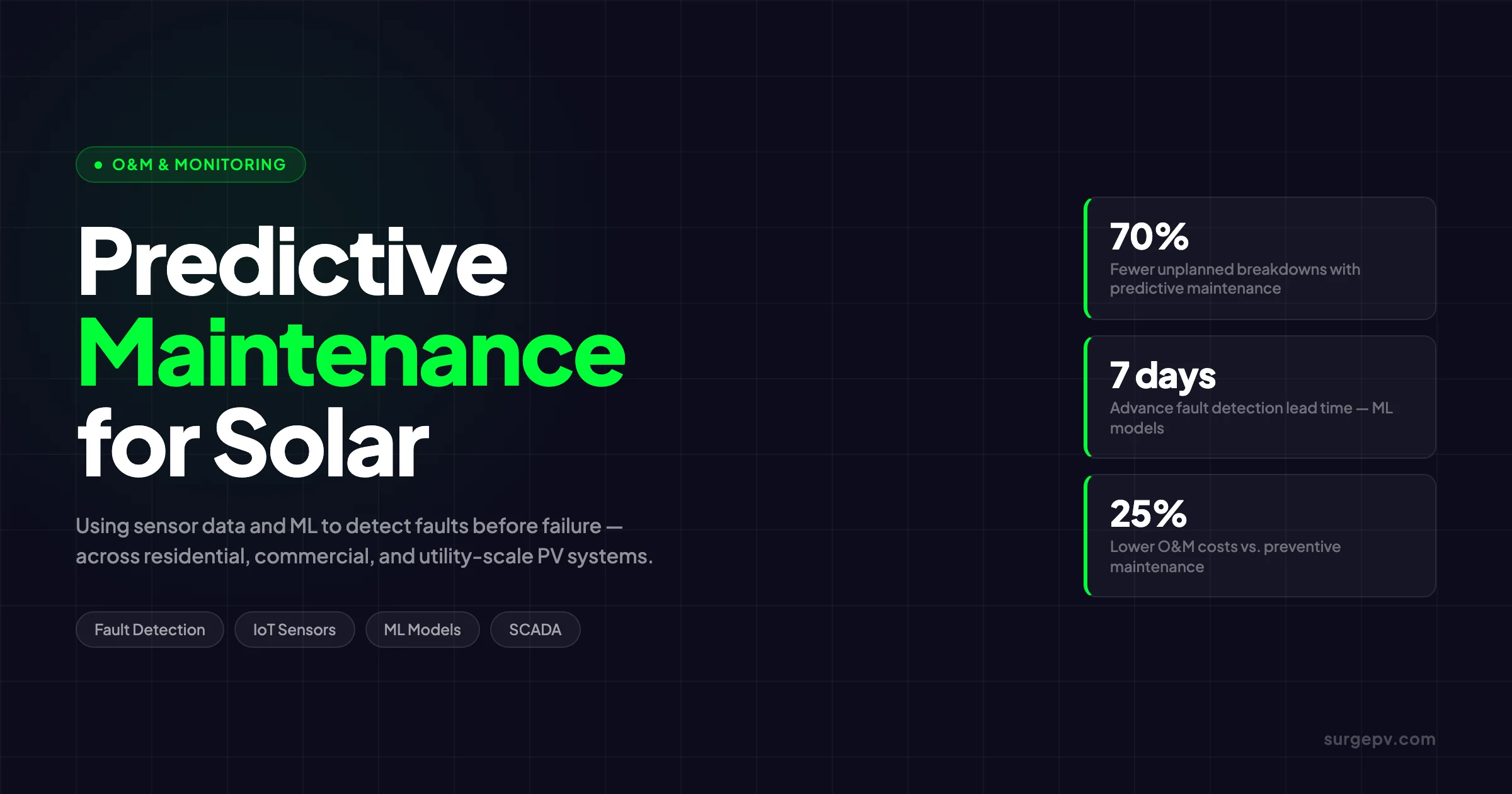
Predictive maintenance cuts solar breakdowns by up to 70%, lowers O&M costs by 25%, and can detect faults up to 7 days before failure. It works by feeding IoT sensor data into ML models that identify anomalies before they cause downtime. The approach scales from residential installer fleets to 100 MW utility plants — the data requirement differs, but the logic is the same.
What Is Predictive Maintenance for Solar?
Maintenance for solar PV systems has traditionally fallen into two buckets: reactive (fix it when it breaks) and preventive (service on a fixed calendar). Both cost more than they need to.
Reactive maintenance means you only learn about a problem after generation has dropped — potentially for days or weeks before anyone investigates. Preventive maintenance runs on schedule regardless of actual system condition, sending crews to inspect equipment that doesn’t need it while missing faults developing between visits.
Predictive maintenance is condition-based. It monitors equipment in real time, tracks performance against expected baselines, and triggers a work order only when sensor data or ML models indicate a fault is developing. The goal is to intervene at the earliest effective moment — before failure, but not so early the intervention is premature.
The distinction matters financially. A single unplanned inverter failure at a 5 MW commercial site can mean 3 to 7 days of lost generation depending on parts availability and crew scheduling. At €80/MWh, that’s €60,000 to €140,000 in lost revenue from a single event. A predictive alert 5 days out turns that into a scheduled half-day visit with parts pre-ordered.
Key Takeaway
Predictive maintenance is not about more monitoring — it’s about smarter use of data already available. Most solar systems collect enough sensor data to support basic predictive models. The gap is usually in the analytics layer, not the hardware.
Reactive vs. Preventive vs. Predictive: A Direct Comparison
| Approach | Trigger | Cost Driver | Typical Downtime Impact |
|---|---|---|---|
| Reactive (run-to-failure) | System stops working | Emergency labor + expedited parts | High — failures are full and unplanned |
| Preventive (scheduled) | Calendar interval | Fixed labor cost regardless of need | Medium — catches some, over-services others |
| Predictive (condition-based) | Data signal from equipment | Targeted labor only when needed | Low — faults caught before full failure |
According to research compiled in the PMC review of predictive maintenance advances for solar plants, organizations shifting from preventive to predictive maintenance see a 70% reduction in equipment breakdowns and a 25% decrease in maintenance costs. For a 10 MW portfolio, that typically translates to $80,000 to $150,000 in annual savings.
The cost structure also changes. Preventive maintenance carries fixed, predictable costs that often feel manageable — until a major fault slips through. Predictive maintenance has variable costs that spike briefly for investigations but deliver far lower total spend over a 10-to-25-year system life.
Why Solar Systems Fail: The Fault Taxonomy
Before you can predict a failure, you need to understand what fails and why. PV faults cluster into four main categories.
Module-Level Failures
Module-level faults are the most common in terms of frequency, though individual events rarely cause catastrophic generation loss on their own.
Soiling and contamination is the single most frequent performance issue globally. Dust, bird droppings, pollen, and industrial deposits on panel surfaces reduce irradiance absorption. In high-soiling climates — desert, arid, and agricultural zones — soiling losses range from 2% to 25% of annual generation without intervention. The damage is gradual and follows measurable accumulation curves that ML models can track against weather data. For Global-specific compliance details, see Global net-metering-by-country. For Global-specific compliance details, see Global solar-permitting-speed-by-country.
Bypass diode failure short-circuits a cell string within a module when cells overheat. Once a diode fails, the affected cell string produces no current. Thermal imaging reveals this as a distinctive hot-spot pattern. Bypass diode failures accelerate if the root cause — shading or micro-cracks — goes unaddressed.
Micro-cracks develop from mechanical stress during installation, transport, or thermal cycling. They reduce the active cell area contributing to current. IV curve tracing detects micro-cracks as a fill factor reduction. They often go undetected for months because early-stage cracks cause small, gradual losses with no single detectable event.
Delamination and encapsulant degradation affects older modules exposed to UV and moisture over years. Delamination increases reflectivity and allows moisture ingress, accelerating corrosion of cell contacts. Electroluminescence (EL) imaging during annual surveys detects early delamination patterns before they appear in production data.
Inverter Failures
Inverters account for the largest share of unplanned downtime in solar PV systems. They are the most maintenance-intensive component in the balance of system (BOS), particularly in string and central inverter configurations.
Common inverter failure modes:
- Capacitor degradation — electrolytic capacitors wear over time and are sensitive to temperature cycling; degrading capacitors show up as increasing ripple in DC voltage waveforms
- IGBT module failure — insulated gate bipolar transistors handle DC-to-AC conversion and fail from overload and thermal stress; efficiency data shows a measurable decline before complete failure
- Ground fault development — gradual insulation breakdown creates ground faults that trip protection systems; insulation resistance monitoring detects this trend early
- Cooling system failure — fan failure or blocked airflow accelerates all of the above failure modes; temperature logs show the signature Read DC Bus Voltage Optimization for a complete walkthrough.
Inverter failures develop over days to weeks, leaving a measurable data trail in efficiency metrics, harmonic distortion levels, and thermal signatures. This makes inverters the primary target for predictive algorithms. Getting inverter prediction right alone captures 60 to 70% of the total financial value of a predictive program.
String and DC System Issues
String-level problems arise from mismatch — one panel underperforming drags down the entire string’s current. Causes include:
- Partial shading from nearby objects or localized soiling
- Module degradation mismatch within a string
- Loose or corroded MC4 connectors and terminals
- Wiring polarity errors from installation
String-level faults are detectable through current comparison between parallel strings at the same irradiance level — a statistical anomaly detection task any monitoring platform can handle once you have string-level sensors installed. See our guide on Agricultural Solar Case Study for more. Read more about Floating Solar Farms France.
Grid and AC Side Faults
AC-side failures include transformer issues, protection relay malfunctions, and grid disturbances that cause protective trips. SCADA-level monitoring is required to detect and log these events with the time resolution needed for root cause analysis.
Data Sources That Power Predictive Models
The quality of predictive maintenance is constrained by the quality and completeness of data available to the models. Here is what a well-instrumented solar site collects.
Sensor Data
Voltage and current sensors at the string or module level provide the primary performance signal. Deviations from expected IV curve shape indicate faults at the cell or module level. String-level monitoring is the minimum effective granularity. Module-level monitoring — via MLPE (microinverters or DC optimizers) — provides far more precise fault localization but at higher hardware cost.
Temperature sensors measure ambient air temperature and module back-sheet temperature. The difference between these values, compared to irradiance, reveals thermal anomalies. A module running 15°C hotter than its neighbors under the same irradiance conditions warrants investigation.
Irradiance sensors — pyranometers or calibrated reference cells — measure actual solar resource hitting the array plane. This is the denominator in every performance calculation. Inaccurate irradiance data corrupts all anomaly detection downstream.
Meteorological stations at larger sites add wind speed (for soiling accumulation models), humidity (for dew and corrosion risk), and rain events (for soiling reset analysis).
SCADA and Data Loggers
SCADA systems for grid-connected solar PV centralize data from inverters, meters, weather stations, and protection relays. They provide time-stamped logs at 1 to 15-minute intervals — the raw material for trend analysis and anomaly detection.
Data loggers at inverter level capture AC/DC voltage, current, frequency, power factor, and error codes. Inverter manufacturers now expose this data via APIs, making cloud-based aggregation feasible without site-level servers for systems above 100 kW.
Thermal Imaging and Drone Surveys
Thermal drone inspection identifies hot spots, bypass diode failures, soiling patterns, and delamination across large arrays in a single flight. A 10 MW site can be surveyed in 3 to 4 hours with a drone versus weeks of manual panel-by-panel inspection on the ground.
AI-powered image analysis software classifies thermal anomalies automatically, tagging fault types and severity without manual review. This converts drone data into actionable work orders within hours of the flight. The thermal drone inspection glossary entry covers diagnostic interpretation.
IV Curve Tracers
IV curve tracers apply a variable load to a string and measure the current-voltage response across the full operating range. The resulting curve shape reveals shading, soiling, bypass diode status, series resistance increase, and fill factor degradation with a precision that production data alone cannot match.
IV tracing is typically done quarterly or annually, or when production data suggests a string-level anomaly. See the IV curve tracing entry for diagnostic interpretation guidelines.
Weather and Forecast Integration
Integrating weather forecast APIs enables predictive models to separate weather-driven production drops from fault-driven ones. A 20% production shortfall during a cloud-cover event is expected. The same shortfall on a clear day triggers an alert. Without weather integration, this distinction requires manual review — which scales poorly across large portfolios.
How Predictive Algorithms Work
Performance Ratio Deviation Detection
The simplest and most widely deployed predictive method is Performance Ratio (PR) deviation monitoring. The performance ratio formula compares actual energy output to theoretical maximum output given measured irradiance.
A well-performing system holds a PR of 75 to 85% depending on climate and design. When PR drops outside the expected range, the monitoring system flags it for investigation. The challenge is separating legitimate PR drops — seasonal temperature effects, soiling events — from fault-driven drops. This requires weather normalization, typically using temperature coefficients and irradiance data together.
PR deviation monitoring is rule-based and interpretable. It doesn’t require training data or ML expertise to deploy, making it the right first layer in any predictive program. Build on it once you have 6 months of clean operational data.
Machine Learning Fault Classification
ML models move beyond threshold rules to detect patterns that rules miss — subtle multivariate correlations visible only across large historical datasets.
Random Forest classifiers are the most common model for fault classification in solar PV. They train on labeled datasets (historical fault logs matched with sensor readings at fault time) and classify incoming sensor data as normal or one of several fault types. Studies using Random Forest on SCADA data consistently report classification accuracy above 95% for well-labeled training sets.
CatBoost and gradient boosting ensembles perform similarly to Random Forest on tabular sensor data. They are particularly robust on imbalanced datasets, where faults are rare relative to normal operation — which describes every real-world solar monitoring dataset.
Convolutional Neural Networks (CNNs) process time-series sensor data as 2D arrays and classify thermal images from drone surveys. They detect spatial and temporal patterns too complex for rule-based methods. A CNN trained on thermal images can classify bypass diode failures, soiling patterns, and delamination with accuracy comparable to an experienced thermographer.
LSTM autoencoders learn normal production sequences and flag deviations from the learned baseline. They are effective for detecting slow-developing faults — gradual inverter efficiency decline, progressive soiling build-up — that don’t cross any single threshold but are visible as drift from expected behavior.
Research published in Springer Nature Energy Informatics reviewing AI-based PV predictive maintenance confirms these architectures achieve fault detection sensitivity up to 96.9% with predictive alerts issued 7 days before failure across multiple independent deployments.
Digital Twins
A digital twin is a virtual model of a physical solar system, calibrated with real sensor data, that simulates expected behavior under any conditions. Comparing real-time output to digital twin predictions produces a residual error signal. When that residual grows beyond statistical bounds, the system flags a fault.
Digital twins are the highest-fidelity approach but require significant setup: accurate shading models, module-level electrical models, and weather integration. The digital twin modeling entry covers the technical architecture.
The solar design suite used during project development builds the foundational system model — accurate panel placement, shading analysis, and electrical design — that forms the basis of a digital twin for O&M use. A design built on accurate models doesn’t require recalibration when you deploy the O&M layer.
Setting Up a Predictive Maintenance Program
Step 1: Instrument the Site
Deploy sensors at the minimum required granularity for your risk tolerance and system scale:
| System Scale | Minimum Instrumentation | Recommended |
|---|---|---|
| Residential (5–20 kW) | Smart inverter diagnostics + module-level MLPE | + Cloud fleet analytics platform |
| Commercial (50 kW–1 MW) | String-level monitoring + irradiance + temperature | + SCADA integration + IV curve tracing |
| Utility (1 MW+) | Full SCADA + string monitoring + pyranometer + met station | + Thermal drones + digital twin |
For residential installer fleets, the economics favor a cloud-aggregation approach: pull data from MLPE inverter APIs, normalize for weather, and flag outliers across your entire portfolio in a single dashboard. Per-system hardware investment is zero.
Step 2: Establish Baselines
Predictive models need a baseline of normal operation before they can flag anomalies. For a new system, collect 3 to 6 months of clean operational data before activating ML-based alerts. For an existing system with historical SCADA logs, this can be done retrospectively.
The baseline must capture:
- Seasonal PR variation with temperature normalization
- Local soiling accumulation rate and rain-reset pattern
- Expected inverter operating ranges at various load levels
- String current distribution across the range of irradiance values
Baseline quality determines model quality. A system whose design was built on accurate shading and weather data — rather than rough estimates — requires far less recalibration when the O&M layer goes live.
Step 3: Deploy Anomaly Detection
Start with rule-based PR deviation alerts. Set string-level thresholds at ±5% of expected PR and plant-level at ±10%. These will generate false positives in extreme weather until you add weather normalization. Refine thresholds for your climate before adding ML layers.
Once you have 6+ months of labeled data including fault events, train classification models. Even simple Random Forest models on string voltage, current, temperature, and irradiance achieve fault classification accuracy above 90% on well-labeled datasets from real sites.
Step 4: Connect to Work Order Management
An alert that doesn’t create a work order is wasted. Connect your monitoring platform to your work order system so a fault classification automatically generates a maintenance ticket containing:
- Fault type and severity score
- Affected asset — string, inverter, or section
- Recommended action and required parts
- Estimated revenue impact per day if unaddressed
The generation and financial tool quantifies the financial impact of a performance deviation — converting a sensor alert into a dollar figure that drives priority scheduling rather than competing with other tickets on gut feel.
Step 5: Close the Feedback Loop
Predictive models improve with outcome data. When a technician visits and confirms — or doesn’t confirm — a fault, that result should feed back into the model as a labeled training example. Over 12 to 24 months, a consistent feedback loop reduces false positive rates and improves fault-type accuracy. Without it, models drift.
Pro Tip
Start inverter-focused before expanding to string-level monitoring. Inverters cause the most expensive unplanned downtime and produce the richest data stream. Getting high accuracy on inverter fault prediction alone typically captures 60 to 70% of the total financial savings potential of a predictive maintenance program — and proves the business case before you invest in full string-level hardware.
Design Systems That Are Built for O&M
The foundation of effective predictive maintenance starts at design. SurgePV’s solar software builds accurate system models that become your O&M baseline from day one.
Book a DemoNo commitment required · 20 minutes · Live project walkthrough
For a direct comparison, see Arka 360 vs SurgePV.
Real-World Performance: What the Data Shows
The performance evidence for predictive maintenance in solar comes from real deployments, not just simulations.
A 75 MW installation documented in the PMC review of solar predictive maintenance advances deployed 12,000 distributed sensors integrated with an AI/ML analytics infrastructure. Results after one year of operation:
- 94.3% accuracy in anomaly detection
- 98.2% precision in fault localization
- 47% reduction in unplanned downtime
- $425,000 in annual savings
Research published in Solar RRL’s trend-based maintenance analysis demonstrated that ML-based predictive models achieve 96.9% sensitivity in fault detection with 92.9% sensitivity for predictive alerts issued up to 7 days before failure across multiple test sites.
The MDPI Sustainability study on distributed IoT-based predictive maintenance applied edge-computing architectures to process sensor data locally, reducing cloud bandwidth requirements by 80% while maintaining real-time fault detection — a design pattern that makes large-scale deployment cost-effective.
Key Takeaway
The gap between best-in-class and average predictive maintenance performance is almost entirely a data quality issue. The algorithms are proven. The binding constraint is instrumentation completeness and consistent fault labeling for model training. Good data with a simple model outperforms poor data with a sophisticated one every time.
Predictive Maintenance Across System Types
Residential Solar (5–25 kW)
Residential systems don’t justify dedicated IoT hardware per installation, but they benefit from fleet-scale predictive analytics.
Solar installers managing hundreds of residential systems deploy cloud-based monitoring platforms that aggregate module-level data from MLPE inverters across their entire portfolio. Anomaly detection at fleet scale identifies underperforming homes and routes service tickets before the homeowner notices a problem.
The practical approach: use the inverter manufacturer’s API to pull daily performance data, compare against weather-normalized production baselines, and flag outliers automatically. Most commercial monitoring platforms have this built in. No data scientist required.
The exception to watch: systems using string inverters without MLPE have significantly less fault localization precision. For these systems, the monitoring platform can detect that a system is underperforming but often cannot tell you which panel or string is the cause without a site visit.
Commercial Solar (50 kW–2 MW)
Commercial sites justify string-level monitoring hardware and annual IV curve tracing campaigns. The ROI case is direct.
A 200 kW system losing 15% to an undetected inverter fault over 60 days, at a feed-in tariff of €0.12/kWh, loses approximately €5,200. A monitoring platform that catches this fault within 3 days costs €1,500 to €3,000 per year. The payback arithmetic is clear.
SCADA integration is standard at commercial scale. The key addition beyond basic monitoring is weather normalization. Without it, commercial systems in high-irradiance-variability climates generate too many false alarms to maintain technician trust in the alert system. Trust is a harder problem to fix than accuracy.
Utility-Scale Solar (2 MW+)
Utility-scale plants have the clearest business case and the most sophisticated implementations. At this scale, the standard stack includes:
- Full SCADA with 15-minute or 1-minute data logging
- Pyranometers and meteorological stations on-site
- Thermal drone surveys at 1 to 2 times per year
- Digital twin modeling for highest-accuracy performance baselines
- Dedicated asset management teams managing the ML model lifecycle
The MDPI distributed IoT study mentioned above provides the clearest utility-scale framework: edge computing processes sensor data locally before sending anomaly summaries to a central platform. This architecture handles 12,000 sensors per site without bandwidth constraints while delivering real-time detection.
Key O&M Metrics to Track Alongside Predictive Alerts
Predictive alerts flag specific faults. KPIs tell you whether your O&M program is working at the portfolio level. These two layers work together — KPIs identify systemic underperformance that individual alerts miss.
Performance Ratio (PR)
PR is the primary O&M health metric. Track it monthly at a minimum, comparing to:
- The PR baseline established during commissioning
- PR of comparable systems in similar climates
- PR targets specified in the O&M contract or performance guarantee
A PR declining 1 to 2 percentage points per year without a clear cause (aging alone accounts for 0.3 to 0.7%/year) indicates a systemic issue — soiling, wiring degradation, or recurring inverter clipping — that no single fault alert will surface. Read Solar Inverter Clipping for a complete walkthrough.
Availability
System availability measures the percentage of time generation equipment is operational and ready to produce. Industry-standard targets for utility-scale solar are 99% or higher annual availability. Commercial systems typically run at 97 to 99%.
Track availability separately from PR. A system can have high availability (inverter is running) but low PR (multiple string faults degrading output). Both metrics are needed.
Mean Time Between Failures (MTBF) and Mean Time to Repair (MTTR)
MTBF and MTTR measure the reliability of specific components — inverters most commonly — and the efficiency of your maintenance response. As your predictive maintenance program matures, MTBF should increase (fewer unplanned failures) and MTTR should decrease (faster resolution when failures do occur, because you have parts staged and root cause identified before arrival).
Tracking MTBF and MTTR by asset type and site tells you where to focus reliability improvement efforts and which equipment lines are costing the most in O&M labor over time.
Truck Roll Rate
Every site visit that finds nothing wrong represents wasted cost. Truck roll rate — dispatched visits divided by confirmed faults found — is a direct measure of predictive model precision. A high truck roll rate (many visits, few confirmed faults) indicates over-sensitive alert thresholds or a model with high false positive rates. As your models improve over 12 to 24 months of feedback training, truck roll rate should fall.
Specific Yield (kWh/kWp)
Specific yield normalizes annual generation to system size, making sites comparable regardless of capacity. Year-over-year specific yield tracks the combined effect of equipment aging, soiling management, and fault correction. A system losing more than 0.8% of specific yield per year after the first 3 years — beyond normal module degradation — warrants a root cause investigation.
Key Takeaway
Predictive alerts address individual faults in real time. KPIs address systemic performance trends across quarters and years. Run both in parallel. A system that never triggers a fault alert but shows 2% annual PR decline has a problem — it’s just a slow one that individual alerts won’t catch.
Common Failure Modes and Their Data Signatures
| Fault Type | Primary Data Signal | Typical Lead Time | Detection Method |
|---|---|---|---|
| Inverter capacitor degradation | DC-to-AC efficiency decline; output ripple increase | 7–14 days | Trend analysis on conversion efficiency |
| Bypass diode failure | Hot spot in thermal image; string current drop | Hours to days | Thermal drone + IV curve |
| Soiling accumulation | Progressive PR decline vs. rain reset events | Days to weeks | PR trend normalized against rain data |
| Micro-crack | Fill factor reduction in IV curve; gradual current drop | Weeks to months | IV curve tracing; string current monitoring |
| MC4 connector failure | String voltage drop; intermittent fault codes | Hours to days | String voltage + temperature sensor |
| Ground fault development | Insulation resistance decline in SCADA logs | Days to weeks | Ground fault monitoring; insulation resistance |
| Delamination | EL imaging; spectral reflectance change | Months | Annual EL inspection |
The fault detection glossary entry covers detection methodologies in detail. For SCADA architecture, see SCADA for solar systems. For string-level monitoring specifics, see string monitoring.
Cost vs. ROI: Building the Business Case
Implementation Cost Tiers
| Scale | Hardware Cost | Platform and Analytics | Annual O&M |
|---|---|---|---|
| Residential fleet (100+ homes) | MLPE inverters already installed | $50–$150 per home per year | Minimal |
| Commercial (200–500 kW) | $5,000–$20,000 for string monitoring | $3,000–$8,000 per year | $1,000–$3,000 per year |
| Utility (5–50 MW) | $50,000–$300,000 for full sensor deployment | $15,000–$50,000 per year | $10,000–$30,000 per year |
Revenue Protection Value
Calculate the value of prevented downtime with this framework:
Annual savings = (Baseline unplanned downtime hours × System kW × $/kWh) × 0.70 reduction factor
For a 500 kW commercial system:
- Baseline: 150 unplanned downtime hours per year (industry average without predictive maintenance)
- Tariff: €0.12/kWh
- Baseline generation loss: 150 × 500 × 0.12 = €9,000/year
- 70% recovery: €6,300/year recaptured
- Add 25% reduction on a €20,000/year O&M contract: €5,000/year in labor savings
Total first-year benefit: roughly €11,300 against a platform cost of €4,000 to €6,000. Payback under 6 months.
The PV generation and financial modeling within solar software models these scenarios with your actual system parameters, local tariff rates, and O&M cost structure. Running the numbers before a monitoring investment decision takes less than 20 minutes.
Pro Tip
When building the ROI case for a client, start with the single-event inverter failure scenario. Calculate the revenue loss from one 5-day outage at your client’s specific capacity and tariff rate. That number alone often exceeds the annual monitoring platform cost — making the business case obvious before you discuss the full savings picture.
The Role of Accurate System Design in O&M
Predictive maintenance is only as reliable as the performance baseline it measures against. If the design model is wrong — incorrect shading assumptions, mismatched equipment specs, errors in DC/AC ratios — the system generates false alarms against an inaccurate expected baseline from day one.
This is why the design phase and the O&M phase are directly connected. A cloud solar design software platform that produces accurate shading models, correct string configurations, and precise yield estimates gives the O&M team a reliable expected production curve to compare against from commissioning forward.
The shadow analysis tool generates horizon profiles and hour-by-hour irradiance calculations that translate directly into the expected performance baseline used for anomaly detection. Systems designed with accurate shading data hold consistent PR baselines over time. Systems designed on rough estimates need constant manual recalibration of alert thresholds — which consumes analyst time and degrades team trust in the system.
Further Reading
See the guide to calculating solar performance ratio for the measurement framework behind O&M anomaly detection, and how shading affects solar panels for the shading loss science that underpins baseline accuracy.
Cybersecurity: The Risk Most O&M Teams Ignore
Predictive maintenance systems connect physical equipment to cloud platforms via IoT interfaces. This creates attack surface that most O&M teams have not fully considered.
The PMC review of predictive maintenance and cybersecurity for solar plants identifies the primary attack vectors: unauthorized SCADA access, manipulation of sensor data to mask fault events, and ransomware targeting monitoring platforms.
Minimum cybersecurity controls for a connected O&M system:
- Segment the OT (operational technology) network from corporate IT networks
- Use encrypted communication protocols (TLS 1.3) for all sensor-to-cloud data transmission
- Implement role-based access control on monitoring platforms with MFA
- Run firmware updates on inverters and data loggers on a defined schedule
- Audit third-party integrations (weather APIs, CMMS software) at least annually
European grid codes and some asset insurance policies now require documented cybersecurity measures for grid-connected solar assets. This is not optional for operators seeking bankable O&M contracts. Also see: European Solar Incentives.
Building an O&M Team That Uses Predictive Data
The technology is only part of the problem. An alert system that technicians don’t trust — or don’t know how to act on — delivers no value regardless of model accuracy.
Training requirements: Technicians using predictive maintenance outputs need to understand what the model is telling them and what it isn’t. An anomaly score is not a work order — it’s a signal to investigate. Training on how to read IV curves, interpret thermal images, and triage alert severity is a prerequisite for effective deployment.
False positive management: Every predictive maintenance system generates false positives, especially early in deployment. If technicians respond to every alert and consistently find nothing wrong, they stop responding. The goal is not zero false positives — it’s a false positive rate low enough to sustain operational trust. Start with conservative thresholds and tighten only after the model stabilizes over 6+ months.
Escalation protocols: Define what happens at each alert severity level before you go live. A string current anomaly might warrant a remote log review. An 8% inverter efficiency drop sustained over 3 days warrants a site visit within 48 hours. A ground fault alarm warrants same-day response. Undocumented escalation paths are the most common reason good monitoring programs deliver poor outcomes.
Vendor lock-in risk: Many O&M monitoring platforms own the ML models and the processed data. Before signing a multi-year contract, confirm that raw sensor data is exportable in open formats, and that you retain ownership of your training data and model outputs. This matters when you switch platforms or internalize analytics.
Integrating Predictive Maintenance with Solar Proposal Software
The predictive maintenance data you generate over years of operation is one of the strongest sales assets available to a solar installer. Documented performance histories showing 99%+ system availability, fault detection before customer-visible events, and energy yield within 3% of proposal projections build the kind of track record that closes commercial contracts.
Solar proposal platform that pulls from real system performance data — rather than generic benchmarks — produces proposals that stand up to technical scrutiny. When a commercial buyer asks “how did your last 10 systems perform versus your original estimates?”, having the monitoring data to answer precisely is a competitive differentiator.
Conclusion
- Deploy string-level monitoring and performance ratio deviation alerts as the immediate first step. This alone catches 60% of the financial value of predictive maintenance without any machine learning.
- Connect monitoring data to financial modeling so every fault alert carries a revenue impact figure, not just a technical description. Dollar-denominated alerts get acted on; abstract anomaly scores do not.
- Design accurately from the start. The performance baseline is only as reliable as the system model behind it — use solar design platform and accurate shading analysis tools to create the O&M reference baseline before the system goes live.
Frequently Asked Questions
What is predictive maintenance for solar?
Predictive maintenance uses real-time sensor data, machine learning algorithms, and historical performance records to identify developing faults before they cause system downtime. Unlike reactive or time-based maintenance, it schedules intervention only when equipment shows signs of failure — reducing unnecessary site visits and preventing unplanned outages.
How far in advance can predictive maintenance detect solar faults?
Well-configured ML models detect incipient faults between a few hours and 7 days before failure, with sensitivity rates up to 96.9%. Lead time depends on fault type — inverter degradation patterns are visible days out, while sudden bypass diode failures give shorter windows of minutes to hours.
What sensors are needed for solar predictive maintenance?
A basic setup requires module-level current and voltage sensors, ambient and module temperature sensors, an irradiance sensor (pyranometer or reference cell), and a data logger feeding a SCADA or cloud monitoring platform. Advanced setups add string-level IV curve tracers, thermal imaging drones, and weather-forecast API integration.
What is the ROI of predictive maintenance for solar?
Studies show predictive maintenance reduces unplanned downtime by up to 70%, cuts maintenance costs by 25%, and increases system availability by 25%. One 75 MW installation achieved $425,000 in annual savings after deploying 12,000 distributed sensors with AI-based anomaly detection.
How does predictive maintenance differ from preventive maintenance?
Preventive maintenance runs on a fixed schedule — panels cleaned every 90 days, inverters inspected annually — regardless of actual system condition. Predictive maintenance triggers work orders from real data: a performance ratio drop, an abnormal IV curve, or a temperature anomaly. It replaces calendar-based visits with condition-based ones.
Can predictive maintenance work for residential solar?
Yes, though the economics differ. Residential setups benefit from cloud-based monitoring platforms that aggregate data across installer fleets, allowing companies to manage hundreds of homes remotely. Module-level monitoring via MLPE inverters and smart inverter diagnostics bring predictive capability to smaller systems without dedicated IoT hardware.
What algorithms are used in solar predictive maintenance?
The most proven models are Random Forest, CatBoost, and gradient boosting ensembles for fault classification. CNNs handle time-series sensor data and thermal image analysis. LSTM autoencoders detect anomalies in production sequences. Performance Ratio deviation detection is the right rule-based baseline before introducing ML layers.
What is the most common failure in solar PV systems?
Inverters account for the highest share of unplanned downtime. They are the most maintenance-intensive component in any string or central inverter configuration. At the module level, soiling is the most frequent performance issue, followed by bypass diode failures and micro-cracks from mechanical or thermal stress.
Where this fits
This article is part of SurgePV's Solar Installation hub, which works through the topic from first principles to the decisions a project team actually has to make.