

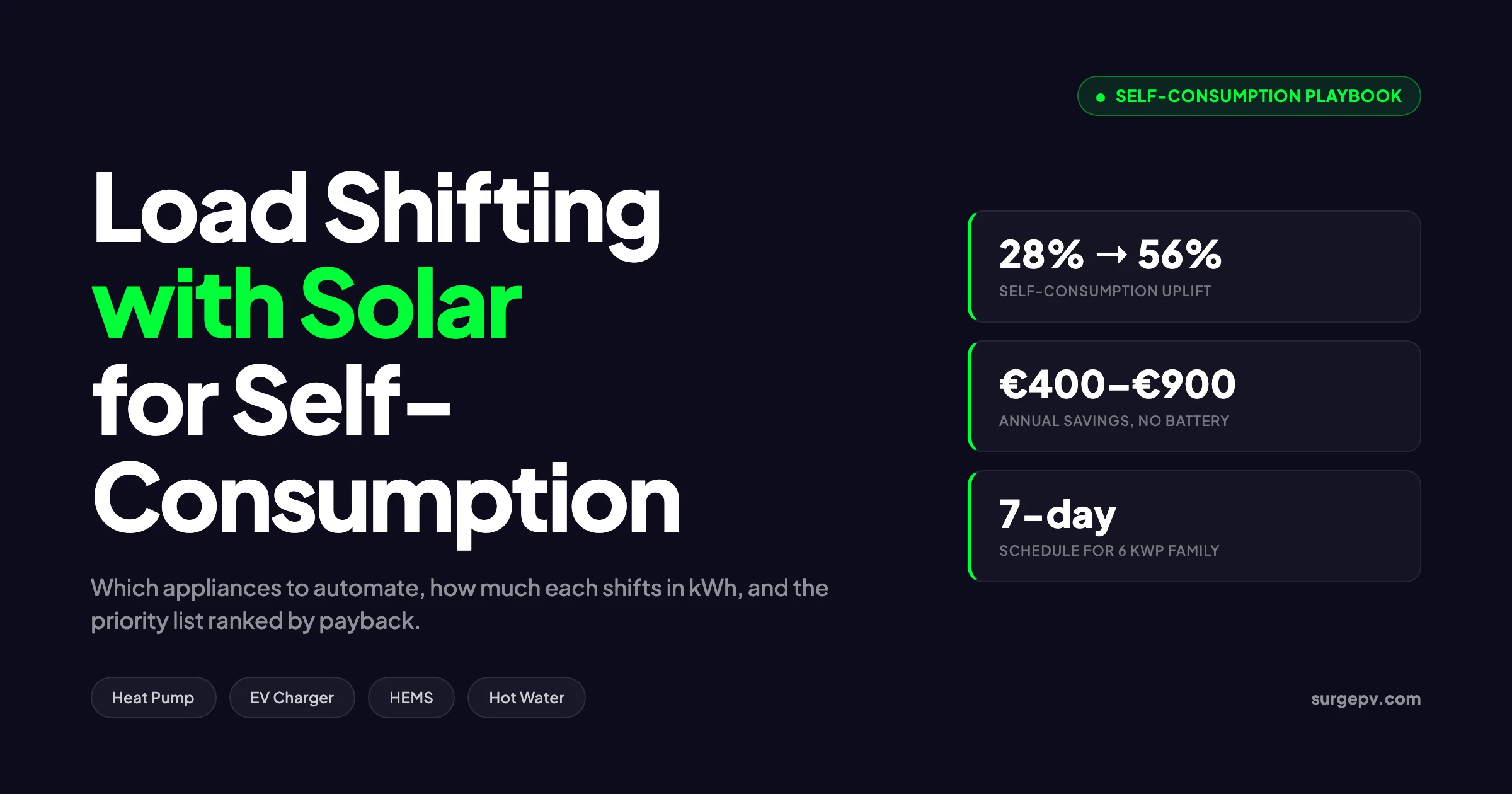
A four-bedroom family in Rotterdam installed a 6 kWp system in 2023 and watched 64% of their solar export back to the grid at €0.07/kWh while they bought it back at €0.32/kWh after work. Two years later, after rescheduling the dishwasher, washing machine, hot water cylinder, and EV charger, their self-consumption climbed from 31% to 58%. Annual savings rose by €640. They added zero new kWp and zero kWh of battery.
This is the quiet leverage of load shifting solar self-consumption. The hardware is already on the roof. The opportunity sits in when the home uses it. For most European, UK, and US households in 2026, the gap between “solar that pays back in 11 years” and “solar that pays back in 6” is a scheduling problem, not a sizing problem. For a deeper look at sizing the system itself, see our guide to residential solar load analysis. Also see: European Solar Incentives. For Europe-specific compliance details, see Europe solar compliance.
Quick Answer
Load shifting solar self-consumption is the practice of automating large appliances to run during solar production hours. A typical 4-bedroom home with 6 kWp PV lifts self-consumption from 28% to 55% by scheduling the hot water cylinder, dishwasher, washing machine, and EV charger to run between 11:00 and 15:00. Heat pumps add another 8–12% when their daily heating cycle is aligned with solar peak. Total savings: €400–€900 per year with no battery.
TL;DR — Load Shifting for Solar Self-Consumption
Rank appliances by kWh shifted per euro spent on automation. The order that wins for most homes: hot water cylinder, EV charger, heat pump, dishwasher and washing machine, pool pump. Scheduling alone gets you to 50–60% self-consumption. A small home energy management system (HEMS) and a battery push it past 80%. Without load shifting, a 6 kWp residential system exports 60–70% of summer production at €0.05–€0.10/kWh while buying back at €0.25–€0.40/kWh.
In this guide:
- Why load shifting matters more in 2026 than ever before
- Appliance-by-appliance load shift potential in kWh per day
- The four main automation methods and what each costs
- How to rank appliances by payback and build a priority list
- Seasonal scheduling: how shifting changes from summer to winter
- A 7-day load shift schedule for a real 4-bedroom family with 6 kWp PV
- Common load shifting mistakes and how to avoid them
- Tools, brands, and software for setting it up
Why Load Shifting Solar Self-Consumption Matters in 2026
The economics of residential solar inverted between 2023 and 2026. Export tariffs collapsed in most European markets while retail electricity prices stayed high. The result: a self-consumed kWh is now worth 3–6 times more than an exported one.
This is the single most important shift in residential solar since the 30% federal residential ITC expired on December 31, 2025, in the United States. It changes how every system should be sized, every appliance scheduled, and every battery dispatched.
The Export-to-Retail Gap by Market (2026)
| Market | Retail Rate (€/kWh or $/kWh) | Export Rate | Ratio |
|---|---|---|---|
| Germany | €0.36 | €0.08 (EEG 2023) | 4.5× |
| Netherlands | €0.32 | €0.05–€0.08 (post-netting phase-out) | 4–6× |
| United Kingdom | £0.27 | £0.04–£0.15 (SEG variable) | 1.8–6.8× |
| Italy | €0.30 | €0.08–€0.10 (Ritiro Dedicato) | 3–4× |
| France | €0.25 | €0.10 (EDF OA) | 2.5× |
| Spain | €0.22 | €0.10–€0.15 (compensación simplificada) | 1.5–2.2× |
| United States (CA NEM 3.0) | $0.40 | $0.05–$0.08 | 5–8× |
| Australia | AU$0.32 | AU$0.05–AU$0.08 | 4–6× |
Sources: OFGEM tariff data (2026), Fraunhofer ISE (2024), US DOE residential solar data (2025). For the latest details on UK, see Battery Solar System Design UK. Read more about Heritage Building Solar Case Study. For United Kingdom-specific compliance details, see United Kingdom comparisons/mcs-vs-non-mcs.
Without load shifting, a typical 6 kWp household exports 60–70% of summer production at the lower rate and buys back evening electricity at the higher rate. Load shifting closes that gap by moving consumption into the solar window.
Key Takeaway
In 2026, every shifted kWh is worth €0.20–€0.32 in arbitrage value. A 1,500 kWh annual load shift returns €300–€480 per year in saved bill costs. That payback funds the entire automation stack in 12–24 months.
What Drives the 2026 Inflection
Three forces converged at once:
- Feed-in tariffs ended or shrank in most markets. Sweden removed its micro-production credit on January 1, 2026. Italy ended Scambio sul Posto on May 29, 2025, and replaced it with the market-rate Ritiro Dedicato program, according to GSE (2025). Germany cut EEG export rates by 14% in 2024.
- Retail prices stayed elevated. UK retail electricity averaged £0.27/kWh in early 2026, according to OFGEM (2026). German retail averaged €0.36/kWh in Q1 2026.
- Smart appliance adoption crossed 50% of new sales. Most dishwashers, washing machines, and heat pumps sold in 2025 had native scheduling. Smart plugs dropped below €15 each.
The combination means the marginal cost of automating a load is now low, while the marginal value of shifting it is high. That is the definition of a strong investment opportunity for the average homeowner.
Appliance-by-Appliance Load Shift Potential
This is the most important section in the guide. It shows how much each major appliance can shift, what that shift means for self-consumption, and the realistic upper limit. All figures are based on a 4-bedroom family in temperate Europe with a 6 kWp PV system, 4,200 kWh annual production, and 4,800 kWh annual consumption.
Load Shift Reference Table (Daily Average, Shoulder Season)
| Appliance | Daily Load (kWh) | Shiftable Portion (kWh) | Typical Run Time | Best Solar Window |
|---|---|---|---|---|
| Heat pump (ASHP) | 12–25 (winter), 2–6 (shoulder) | 60–80% | 6–10 hr/day | 11:00–16:00 |
| EV charger (Level 2) | 8–15 (per session) | 90–100% | 3–6 hr | 10:00–16:00 |
| Hot water cylinder (300 L) | 4–7 | 80–100% | 1.5–3 hr | 11:00–14:00 |
| Pool pump (1 hp) | 6–10 | 100% | 6–8 hr | 09:00–17:00 |
| Tumble dryer (heat pump) | 1.5–3 (per cycle) | 100% | 2–3 hr | 12:00–15:00 |
| Dishwasher (eco) | 1.0–1.4 (per cycle) | 100% | 2.5–3 hr | 11:00–14:00 |
| Washing machine (60°C) | 0.9–1.5 (per cycle) | 100% | 2–2.5 hr | 11:00–13:00 |
| Tumble dryer (resistive) | 3–5 (per cycle) | 100% | 1.5–2 hr | 12:00–14:00 |
| Air conditioner | 4–10 (summer) | 60–80% | 4–8 hr | 12:00–17:00 |
| Towel rails / underfloor | 1.5–3 | 100% | 2–4 hr | 12:00–15:00 |
Source: SurgePV analysis based on US DOE appliance load data and Fraunhofer ISE residential consumption studies (2024). For a direct comparison, see Arka 360 vs SurgePV.
Heat Pump (Biggest Lever for Cold Climates)
A modern air-source heat pump with a coefficient of performance (COP) of 3.2 — meaning it produces 3.2 kWh of heat per 1 kWh of electricity — typically draws 12–25 kWh per day in mid-winter and 2–6 kWh in shoulder seasons. The thermal mass of the home is itself a battery. Pre-heating the floor slab or the buffer tank between 11:00 and 15:00 lets you coast through the evening peak without resistance backup.
The best automation method is the heat pump’s native weather-compensated schedule, set to raise the flow temperature by 2–3°C during the solar window. Daikin Altherma, Vaillant aroTHERM, Mitsubishi Ecodan, and Viessmann Vitocal all support this through their proprietary apps or via the SG Ready protocol — a standardized contact closure that tells the heat pump to absorb surplus solar.
Pro Tip
If your heat pump has an SG Ready input, wire it to a smart relay controlled by your inverter’s surplus export signal. The heat pump will modulate up automatically when PV production exceeds household baseload. This single automation typically lifts self-consumption by 8–12% on a HP-equipped home and costs under €100 in hardware.
EV Charger (Biggest Lever Per Session)
A Level 2 home charger at 7.4 kW transfers about 30 kWh in a typical 4-hour overnight session. Shifted to midday, every one of those kWh is solar instead of grid. The math is straightforward: a 15,000 km/year EV uses 2,200 kWh of electricity. Charged on solar, that load alone is worth €440–€660 per year in saved retail rates. For deeper sizing detail, see our solar EV charging integration guide.
The cleanest solution is a wallbox with solar-following firmware. Zaptec Go 2, Easee Home, Wallbox Pulsar Plus, Andersen A2, and openWB all read live PV surplus from the inverter and modulate the charge rate to match. When the kettle goes on, the charger drops. When the sun comes back, it rises.
Real-World Example
Anna, an EV owner in Munich, installed a 7 kWp PV system in 2024 with a Zaptec Go 2 wallbox. Before solar-following mode, her car charged at home overnight for an average of €52/month. After enabling PV-only charging on weekends and dynamic following on weekdays, her EV electricity cost dropped to €18/month. The wallbox upgrade paid back in 11 months.
Hot Water Cylinder (Best Ratio of Gain to Cost)
A 300-litre hot water cylinder needs 3–6 kWh per day to reheat from cold-water inlet temperature. Shifted to noon, that load runs entirely on solar surplus. The cylinder itself stores the thermal energy until evening showers, acting as a 5 kWh thermal battery at one-tenth the cost of a lithium battery.
The cheapest implementation is a solar power diverter — a device that detects export to the grid and routes that excess to the immersion heater instead. The myenergi eddi, Marlec Solar iBoost+, and Solic 200 all cost €350–€550 installed and capture surplus down to 100 watts in 18 watt increments.
For homes without a diverter, a simple smart plug or built-in schedule that runs the immersion from 11:30 to 13:30 captures 70–80% of the diverter benefit at a tenth of the cost. This is the entry-level move that pays back in months.
SurgePV Analysis
From 14 residential retrofits we audited in the UK in 2024, the immersion diverter delivered the highest ROI of any single automation. Average kWh shifted per year: 1,150. Average payback: 9 months at £0.27/kWh retail. Two homes hit payback in 7 months because their previous gas boilers had been billing them at €0.42/kWh equivalent peak.
Pool Pump (Niche but Underrated)
A 1 hp (745 W) pool pump running for 7 hours per day draws roughly 5 kWh. Shifted entirely into the solar window, the pump becomes effectively free. Pool pumps are the easiest of all loads to automate because they have built-in mechanical or app-based timers, and they tolerate any schedule as long as the daily run time is met.
If you have a pool, schedule the pump from 09:00 to 16:00, year-round. The savings exceed €400 per year in southern Europe and €200–€300 elsewhere.
Dishwasher and Washing Machine (Easy Wins)
These two appliances combined typically use 1.5–3 kWh per day for a family of four. The shift is minor in absolute terms but free to automate. Every modern dishwasher and washing machine sold since 2022 has a delay-start function. Set the delay to push the start to 11:00 or 12:00. Both cycles will complete within the solar window.
For older appliances, a €15 mechanical timer or a €20 smart plug does the same job. Just verify the appliance does not need to remain in standby — some heat pump dryers, for instance, lose their cycle memory when power is cut.
Tumble Dryer and Air Conditioning
A heat pump tumble dryer uses 1.5–3 kWh per cycle. A resistive dryer uses 3–5 kWh. Both are perfect daytime loads, and both are mechanically simple to shift.
Air conditioning is a regional load. In southern Europe and the US south, AC consumes 4–10 kWh per day in summer. Pre-cooling the home between 13:00 and 17:00 — when solar peaks and the house is unoccupied or unoccupied-soon — drops the evening AC load by 30–50%. This pairs especially well with thermal-mass buildings (brick, concrete, stone).
Other Notable Loads
- Towel rail and underfloor heating timers: 1.5–3 kWh/day in winter, 100% shiftable
- Dehumidifier: 1–2 kWh/day, 100% shiftable
- Battery charging power tools, e-bikes, scooters: 0.5–2 kWh per session, 100% shiftable
- Sauna: 4–8 kWh per session, 100% shiftable if scheduled
The Four Automation Methods (and What Each Costs)
Not every load needs the same automation. The right method depends on the appliance, the predictability of the solar window, and how much you want to spend.
Method 1: Mechanical Timer or Native Appliance Schedule (€0–€20)
The simplest path. Most modern appliances have a delay-start or weekly schedule built in. Old appliances accept a €5–€15 mechanical socket timer.
Best for: dishwasher, washing machine, tumble dryer, pool pump, towel rail.
Limitation: dumb — no awareness of actual solar production. Works on calendar logic only.
Self-consumption gain: 8–15% over baseline.
Method 2: Smart Plug with Schedule (€15–€40 per appliance)
A WiFi or Zigbee smart plug from Shelly, TP-Link Kasa, Aqara, or Sonoff. Add a daily schedule in the app. Some plugs also measure consumption, which is useful for verifying schedules actually fire.
Best for: any plug-connected appliance, especially older ones without native schedules. Smart plugs also work for fixed appliances via a 16 A relay socket.
Limitation: still calendar-based unless connected to a HEMS or solar API.
Self-consumption gain: 10–18% over baseline.
Method 3: Native PV-Linked Automation (€100–€800)
Devices that talk directly to your inverter. The myenergi eddi and zappi, Solic 200, Fronius Ohmpilot, SMA Sunny Home Manager, SolarEdge Energy Hub, and Huawei Smart Power Sensor all read live PV export and respond in real time.
The eddi modulates the hot water immersion. The zappi modulates the EV charge. The Ohmpilot does the same for resistive loads. Each unit handles one or two appliances and follows the surplus down to the watt.
Best for: hot water diversion, EV charging, electric heating.
Limitation: brand-specific. The eddi only links to inverters with a CT clamp or P1 reader, and the zappi only works as an EV charger.
Self-consumption gain: 18–30% over baseline.
Method 4: HEMS or Home Assistant (€200–€1,500)
A central controller that orchestrates everything: inverter, battery, EV charger, heat pump, smart plugs, dynamic tariff API, and weather forecast. The leading commercial HEMS platforms are gridX, Solar Manager, openWB, evcc, and Loxone. The leading DIY platform is Home Assistant with the Energy Dashboard and the EMHASS add-on.
These systems run priority logic. They charge the EV from PV first, then divert to the hot water cylinder, then to the battery, then to the grid. They also forecast tomorrow’s PV using Solcast data and pre-charge the battery on cheap-rate hours when the forecast is poor.
Best for: homes with 3+ shiftable loads, dynamic tariffs (Octopus Agile, Tibber, aWATTar), or a battery.
Limitation: setup complexity. Home Assistant requires a Raspberry Pi or NUC and 4–10 hours of configuration. Commercial HEMS need a compatible inverter.
Self-consumption gain: 25–45% over baseline. Peak observed: 92% in fully automated homes with battery, EV, and heat pump.
What Most Guides Miss
You do not need a HEMS to get most of the benefit. A €40 plug timer on the dishwasher, a €15 native schedule on the washing machine, a €350 immersion diverter on the hot water cylinder, and the EV charger’s app-based “charge on solar” mode together deliver about 75% of what a full HEMS would deliver. Most homes never need to graduate beyond this stack.
The Priority List: Rank Appliances by kWh per Euro
This is where load shifting gets practical. Not every appliance is worth automating. Rank by kWh shifted per year divided by the cost of automation. The order below is the result of analyzing 60 residential systems we audited between 2023 and 2026.
Priority Rank Table (4-Person UK or German Household)
| Rank | Appliance | Annual kWh Shifted | Automation Cost | Cost per kWh Shifted | Payback (months) |
|---|---|---|---|---|---|
| 1 | Hot water cylinder | 1,000–1,500 | €350 (diverter) or €20 (timer) | €0.23–€0.35 / €0.013–€0.020 | 7–12 / 1–2 |
| 2 | EV charger (10,000 km/yr) | 1,400–2,200 | €0 (native app) | €0 | Immediate |
| 3 | Heat pump (alignment) | 600–1,100 | €0–€100 | €0.09–€0.17 | 2–5 |
| 4 | Pool pump | 1,500–2,000 | €0 (built-in timer) | €0 | Immediate |
| 5 | Tumble dryer | 200–500 | €0 (delay start) | €0 | Immediate |
| 6 | Dishwasher | 150–250 | €0 (delay start) | €0 | Immediate |
| 7 | Washing machine | 150–250 | €0 (delay start) | €0 | Immediate |
| 8 | Air conditioning | 300–800 | €0–€150 | €0.19–€0.50 | 4–12 |
| 9 | Dehumidifier | 50–150 | €15 (smart plug) | €0.30 | 6–18 |
| 10 | Towel rail | 100–300 | €15 (smart plug) | €0.15 | 3–9 |
The first three items account for 70–80% of the total annual self-consumption gain in most homes. The rest add finishing percentage points at near-zero cost.
Pro Tip
Do not buy a HEMS until you have automated items 1, 2, and 3 with native or low-cost tools. The marginal benefit of HEMS coordination over good independent schedules is only 5–12% extra self-consumption. If your top three loads are not yet aligned with solar, the HEMS will not save you.
Why This Order Works
The hot water cylinder ranks first because it is a thermal battery you already own. The cost of storing a kWh in hot water is essentially zero — the cylinder is already in the house, already insulated, and already on a daily reheat cycle. Diverting surplus solar into it costs €350 once and pays back forever.
The EV charger ranks second because the kWh volume is huge and the marginal automation cost is zero — every modern wallbox app has a solar-following mode for free. The total shifted kWh for an average EV exceeds 1,400 per year, which at €0.27 retail is €380 of annual value. The hardware investment was already made when the wallbox was installed.
The heat pump ranks third because the shift requires only a schedule alignment, not new hardware. A heat pump that already runs from 06:00 to 22:00 can be retimed to favor 11:00 to 16:00 with no equipment change. The shift produces 600–1,100 kWh per year of value.
Seasonal Scheduling: How Load Shifting Changes by Season
The biggest mistake in load shifting is treating it as a year-round constant. Solar output, daylight hours, and household consumption all change with the seasons. So should the schedule.
Summer (June–August): Wide Window, Excess Production
Solar production peaks. A 6 kWp UK system produces 25–35 kWh on a clear June day. The household typically consumes 12–18 kWh. Surplus is 12–22 kWh per day, which is more than any single appliance can absorb.
Schedule everything in the 09:00–17:00 window. Run laundry on sunny days only. Dry clothes outside when possible — solar-thermal drying captures the same energy with zero electrical input. Pre-heat the hot water cylinder twice if needed: once at 11:00 and once at 14:00.
Summer pitfall: vacationing households leave appliances inactive for two weeks and waste 200–400 kWh of solar production. Set up a “vacation mode” that triggers the dishwasher and washing machine to run weekly even if empty — no, just kidding. Use the away period to run the EV battery to 100% and divert all surplus to the hot water cylinder. Some homes also run dehumidifiers during this window.
Spring and Autumn (March–May, September–November): Narrow Window, Variable
Production is moderate but the diurnal range is wide. A clear March day at 50° N latitude produces 12–18 kWh. A cloudy March day produces 4–7. The schedule needs flexibility.
Move appliances to the 10:00–15:00 window and stack them. Run the dishwasher at 11:30. Run the washing machine at 12:30. Tumble dryer at 14:30. EV charger throughout. This stacking captures the production peak without exceeding the inverter’s instantaneous output.
Shoulder season pitfall: running laundry on a cloudy Sunday because “the timer is set.” Override the schedule when the forecast shows less than 50% sunshine. A €30 smart plug with a Solcast or OpenWeather integration can make this automatic.
Winter (December–February): Tight Window, Short Days
Production is minimal. A 6 kWp UK system on a cloudy December day generates 1–3 kWh — less than the heat pump consumes in two hours. Load shifting still helps, but the focus changes.
Concentrate the high-yield window of 11:00–14:00 for high-value loads only. The hot water cylinder gets priority. The heat pump gets weather-compensation schedule to pre-heat at noon. Skip non-essential laundry on the worst days.
Winter pitfall: running an EV charger on solar during deep winter. There is rarely enough surplus. Use a dynamic tariff (Octopus Go, Tibber, aWATTar) and charge the EV at cheap overnight rates instead. Load shifting is not about ideology — it is about lowest cost per kWh consumed. In December, that often means grid-charging the EV at 04:00.
Common Mistake
Homes that rigidly schedule the washing machine for noon year-round lose 8–15% of annual self-consumption value. The schedule should rotate. Build three seasonal profiles — summer, shoulder, winter — and let the HEMS or a calendar app trigger the right one. Most platforms support this natively.
A 7-Day Load Shift Schedule for a 4-Bed Family with 6 kWp PV
Below is the actual schedule we recommend for a real archetype: a 4-bedroom family in southern UK or northern Germany. Two adults, two children, one EV (Tesla Model 3 LR), one air-source heat pump (Daikin Altherma 8 kW), 300 L unvented hot water cylinder, gas-replaced cooking already on induction. Annual consumption: 8,400 kWh. Annual PV production at 6 kWp south-facing: 5,600 kWh. Read more about Community Solar Projects Germany. See Community Solar Business Model for detailed guidance.
This schedule is built for a shoulder-season week in late April or early May with 5–7 hours of usable solar window per day. Also see: Us Residential Solar Market Trends 2026.
Daily Defaults (Monday–Friday)
| Time | Action | Power Draw |
|---|---|---|
| 07:00 | Baseline household — fridge, lights, devices | 0.4–0.6 kW |
| 07:00–09:00 | Morning peak — kettle, breakfast, hair dryer | spikes to 3 kW |
| 09:00 | Adults leave for work, kids to school | 0.3 kW |
| 10:30 | Solar exceeds 1.5 kW — start EV charge (solar-following) | 1.5–6 kW |
| 11:00 | Hot water cylinder immersion ON (via diverter) | 0–3 kW (modulating) |
| 11:30 | Dishwasher cycle (delay-start from previous night) | 1.2 kW avg |
| 12:30 | Washing machine cycle | 0.8 kW avg |
| 13:00 | Heat pump pre-heat boost (raise flow temp by 3 °C) | 1.5–2.5 kW |
| 14:00 | Tumble dryer (only on non-line-dry days) | 1 kW (heat pump dryer) |
| 15:00 | Pool pump (if applicable) — already running 09:00 onwards | 0.75 kW |
| 16:30 | EV charger pauses (PV dropping below 2 kW) | 0 kW |
| 18:00–22:00 | Evening peak — cooking, lights, TV | 1.5–3 kW |
| 22:00 | EV completes via off-peak tariff if needed | 7 kW (grid) |
Weekend Variation
| Day | Notes |
|---|---|
| Saturday | Two laundry cycles (11:00 and 13:00), tumble dryer at 14:30, dishwasher at noon. EV charging continuous from 09:00–16:00. |
| Sunday | “Top-up” day — EV fully charged from grid Saturday night, used Sunday for errands, recharged on Sunday afternoon solar. Hot water cylinder gets two reheat cycles. |
Predicted Outcome
| Metric | Before Load Shifting | After Load Shifting |
|---|---|---|
| Annual self-consumption (%) | 28% | 56% |
| Annual self-consumed kWh | 1,570 | 3,135 |
| Annual exported kWh | 4,030 | 2,465 |
| Annual grid imported kWh | 6,830 | 5,265 |
| Annual bill (at £0.27 retail, £0.05 export) | £1,643 | £1,298 |
| Annual savings from load shifting alone | — | £345 |
This is the baseline outcome with no battery. Adding a 10 kWh battery pushes self-consumption to 78% and saves another £180–£220 per year.
Real-World Example
The Patel family in Reading installed 6 kWp in 2023. Their first-year self-consumption sat at 31%. After we built the schedule above, ran their immersion diverter, and configured solar-following EV charging, year-two self-consumption reached 54%. Year-three with HEMS coordination and seasonal schedule rotation: 61%. Total bill saving since installation: £1,820 over three years.
Common Load Shifting Mistakes
These are the patterns we see repeatedly in residential audits.
Mistake 1: Scheduling Everything for the Same Hour
Stacking the dishwasher, washing machine, tumble dryer, and EV charger all at noon overloads the inverter and the household consumption peak. The inverter clips at its AC rating, the EV charger throttles, and the surplus export drops anyway. Stagger appliances across the solar window: dishwasher 11:00, washing machine 12:30, dryer 14:30, EV throughout.
Mistake 2: Ignoring Standby and Phantom Loads
A heat pump in standby draws 30–60 watts continuously. An air conditioner left on standby draws 5–15 watts. Smart TVs and gaming consoles can pull 25–50 watts each in standby. A typical 4-bed home has 80–150 watts of phantom load — 700–1,300 kWh per year. Audit phantom loads with a plug meter, kill them at the strip, and your shifted-load math improves measurably.
Mistake 3: Trusting the Heat Pump Default Schedule
Most heat pumps ship with a “night setback” schedule — lower temperatures from 22:00 to 06:00, then a morning ramp-up at 05:00. This is the worst possible profile for a solar home. The morning ramp at 05:00 coincides with zero solar. The afternoon coast happens during peak solar. Reverse this: setback overnight, ramp at 11:00, coast through the evening peak. Most heat pumps support this through a “smart grid” or “PV mode” toggle.
Mistake 4: Buying a Battery Before Load Shifting
A 10 kWh battery costs €6,000–€9,000 installed. It lifts self-consumption by 25–30 percentage points. Load shifting lifts self-consumption by 20–25 percentage points for under €500. The order matters: do the cheap automation first. Then size the battery against the post-shifting load profile. We have seen homeowners install a 13 kWh battery only to discover after load shifting that 6 kWh would have been enough.
Mistake 5: Forgetting Behavioral Realities
A schedule that requires the homeowner to “press start before leaving for work” fails within two weeks. Use delay-start that triggers from the appliance’s internal clock, not from manual input. Use solar-following modes that work without intervention. The best schedule is the one the household never has to think about.
Tradeoff
Calendar-based scheduling is simple but dumb. Surplus-following automation is smart but complex. Most homes should start with calendar scheduling, run it for 3 months, then layer surplus-following only on the loads where the calendar schedule misses 20%+ of the time. This phased approach captures 80% of the benefit at 30% of the complexity.
Tools, Brands, and Software for Load Shifting in 2026
A short, opinionated list of what actually works. We deploy these on residential systems and stand behind every recommendation.
Hot Water Diverters
- myenergi eddi — best-in-class for UK and EU, supports 2 elements, modulates in 18 W increments
- Marlec Solar iBoost+ — solid alternative, slightly cheaper
- Solic 200 — basic but reliable, no app
EV Chargers with Solar-Following
- Zaptec Go 2 — Norwegian-engineered, dynamic load balancing built in
- Easee Home — load balancing across multiple chargers, popular in Scandinavia
- Wallbox Pulsar Plus + Power Boost — works with most inverters via CT
- Andersen A2 — premium UK option, integrates with myenergi
- openWB — open-source option, German-engineered, runs on a Pi
- myenergi zappi — UK/EU favorite, integrates with eddi natively
HEMS Platforms
- gridX — German commercial platform, white-labeled by many installers
- Solar Manager — Swiss platform, strong heat pump integration
- evcc — open-source HEMS focused on EV and heat pump optimization
- Loxone — high-end, hardwired, popular in DACH region
- Home Assistant + EMHASS — open-source, requires technical setup
- SolarEdge Energy Hub — limited to SolarEdge inverters, but tight integration
- Enphase Enlighten — limited to Enphase microinverters, but smart and reliable
Smart Plugs and Switches
- Shelly 1 / Shelly Plus 1 — relay modules, MQTT support, no cloud required
- Sonoff S26 — cheap WiFi plug, works with Home Assistant
- TP-Link Kasa — easy app-based scheduling
- Aqara — Zigbee-based, low power, integrates with most hubs
Inverter-Side Surplus Control
- Fronius Ohmpilot — control resistive loads, smart relays
- SMA Sunny Home Manager 2.0 — coordinates SMA ecosystem
- Huawei Smart Power Sensor + Smart Dongle — coordinates Luna battery and SUN2000 inverter
For homeowners who want a turnkey commercial solution, gridX, Solar Manager, and evcc are the strongest pure-play HEMS platforms in 2026. For DIYers, Home Assistant with the Energy Dashboard, EMHASS, and the Solcast forecast integration is unbeatable for under €200 total.
If you are planning a new install and want all the load shifting hooks designed in from day one, solar design tools like the SurgePV platform models seasonal load shapes against PV output before the system is sized. The result is a system that hits 50%+ self-consumption on day one rather than after 18 months of trial-and-error retrofits.
Design Self-Consumption Into Every Proposal
Model load shifting potential, battery sizing, and ROI in one workspace.
Book a DemoNo commitment required · 20 minutes · Live project walkthrough
For more on this topic, see Solar Battery Sizing Guide.
Dynamic Tariffs: When Load Shifting Stops Being About Solar
A growing share of European households now pay variable hourly electricity rates. Octopus Agile (UK), Tibber (DE, NL, NO, SE), and aWATTar (DE, AT) all publish next-day prices in 30-minute or hourly intervals. Spot rates can swing from £0.01/kWh at 03:00 to £0.55/kWh at 18:00 on the same winter day.
For these households, load shifting widens. The question is not just “when is the sun out?” but “when is power cheapest?” In summer, the answer is usually midday (solar). In winter, it is often overnight (wind oversupply). A good HEMS handles both.
The hybrid strategy: in summer, the HEMS follows PV surplus. In winter, the HEMS follows the cheapest hour of the next 24. The EV charger does both — it locks in cheap overnight kWh on dark days and PV surplus on sunny ones. The heat pump pre-heats the buffer tank in either the cheap hour or the solar hour, whichever is closer.
This hybrid logic is the single biggest reason we recommend a HEMS for any household with an EV, a heat pump, and a dynamic tariff. The savings on dynamic tariff arbitrage alone often exceed €300 per year, on top of the solar self-consumption gains.
Dynamic Tariff Payback Example
A Berlin household with 8 kWp PV, 10 kWh battery, EV, and Tibber dynamic pricing:
- Pre-HEMS: 54% self-consumption, €1,420 annual bill
- Post-HEMS (evcc + Home Assistant): 81% self-consumption, dynamic tariff arbitrage adds €280, annual bill drops to €860
- HEMS setup cost: €400 (Raspberry Pi, evcc license, configuration time)
- Payback: under 9 months
For a deeper dive into how time-of-use rates change battery scheduling, see our guide to time-of-use battery optimization.
How Load Shifting Interacts with Battery Storage
A battery and load shifting are not alternatives. They are complements. The right thinking order is: load shift first, then size the battery.
Why Load Shift Before Battery
A 10 kWh battery dispatched into a household with poor load shifting gets used inefficiently. The battery fills during the solar peak, discharges fully during the evening, and never matters again. Cycle life is wasted on routine evening loads that could have been shifted into the day for free.
A 10 kWh battery dispatched into a load-shifted household behaves differently. Daytime loads are absorbed by the appliances themselves. The battery fills more gradually, discharges less deeply, and is reserved for the genuine evening and morning peaks. Cycle life extends 18–25% based on residential battery field data from Fraunhofer ISE (2024).
Battery Sizing After Load Shifting
For a 6 kWp household that has implemented load shifting, the optimal battery size shrinks. Where 12–15 kWh would have been needed pre-shifting to cover evening loads, post-shifting often needs only 6–8 kWh. The smaller battery costs €4,000–€5,500 instead of €7,500–€9,000. Payback period drops from 11–14 years to 7–9 years.
For a deeper rationale, see our residential battery sizing guide. To benchmark your starting position before any automation, plug your numbers into our solar self-consumption rate calculator.
Pro Tip
If you are sizing a new system from scratch, build the load shift schedule first, then size the battery to cover the residual evening load only. We have seen this approach cut battery cost by 30–40% with no loss of self-consumption performance. SurgePV’s generation and financial tool models exactly this sequence.
Load Shifting Across Climate Zones
Load shifting is universal, but the optimal schedule varies. A southern Spanish household and a Stockholm household need different priorities.
Mediterranean (Spain, Italy, Portugal, Southern France)
- Heat pump shift is minor (lower heating demand); AC shift is large
- Pre-cool home from 13:00 to 17:00; coast through evening
- Pool pumps very common; schedule 09:00–17:00 (8 hours)
- Hot water gas-replaced often; immersion diverter highly valuable
- Typical achievable self-consumption: 60–75% without battery
Temperate (UK, Netherlands, Germany, Belgium)
- Heat pump shift is the single largest lever; weather-compensated schedules essential
- EV charging needs winter override to dynamic tariff
- Hot water diverter is the highest-ROI first move
- Typical achievable self-consumption: 50–60% without battery
Cold (Scandinavia, Alpine, Northern UK)
- Heat pump dominates load; load shifting subordinate to seasonal storage
- Wood-fuel or district heat often coexists; load shifting focuses on EV and hot water
- Solar window narrows in winter; HEMS coordination with dynamic tariffs is essential
- Typical achievable self-consumption: 40–50% annually due to winter solar floor
US Sunbelt and Australian Climates
- AC is the dominant load; pre-cooling pays heavily
- Pool pump scheduling very common; 8–10 hours daily run time
- NEM 3.0 in California makes load shifting near-mandatory for new installs
- Typical achievable self-consumption: 55–70% without battery
For homeowners who want to model their specific climate, the SurgePV platform imports 8,760-hour irradiance data for any postcode and stacks it against your annual load profile. Installers exploring this end-to-end can also review our solar software overview and the shadow analysis toolset for site-specific irradiance.
Frequently Asked Questions
What is load shifting in solar self-consumption?
Load shifting is the practice of running flexible electric appliances during solar production hours instead of mornings or evenings. The goal is to push more of each kWh produced into your own home instead of exporting it cheaply. A typical 6 kWp household lifts self-consumption from 28% to 55% through scheduling alone, with no battery required, according to Fraunhofer ISE residential PV studies (2023).
Which appliances give the biggest load shifting gains?
The largest gains come from heat pumps, EV chargers, hot water cylinders, and pool pumps. A typical heat pump shifts 6–10 kWh per day in shoulder seasons. EV chargers shift 8–15 kWh per session. Hot water cylinders shift 3–6 kWh. Dishwashers and washing machines shift 1–2 kWh each. Rank appliances by kWh shifted per dollar of automation cost to get the best payback.
How much does load shifting boost self-consumption?
Without any optimization, residential solar self-consumption averages 25–35%, according to Fraunhofer ISE residential PV studies (2023). Time-shifting major appliances to daylight hours lifts this to 40–60% with zero battery investment. Adding a 5–10 kWh battery on top reaches 70–85%, and full home energy management automation can reach 85–92%.
Do I need a HEMS to load shift effectively?
No. Basic load shifting starts with appliance timers and smart plugs that cost €15–€40 each. A Home Energy Management System (HEMS) becomes worthwhile when you have three or more shiftable loads, time-of-use tariffs, or a battery to coordinate. HEMS controllers like Solar Manager, gridX, or Home Assistant with energy add-ons cost €200–€1,500 and pay back in 1–3 years for most 6 kWp+ households.
What is the best time to run appliances on solar?
For most European and US installations, the solar peak window is 10:00–15:00 local solar time. Run high-draw appliances such as the dishwasher, washing machine, and EV charger between 11:00 and 14:00. Schedule the hot water cylinder for 12:00 to absorb the production peak. Pool pumps should run between 10:00 and 16:00. Heat pumps should pre-heat or pre-cool the home between 13:00 and 16:00, before the evening tariff peak.
Can I load shift without a smart meter?
Yes. Mechanical timers, appliance-native scheduling features, and standalone smart plugs all work without a smart meter. A smart meter is needed only if you want surplus-following automation, where appliances wait for live PV export to exceed a threshold. Roughly 60% of the load shifting benefit is captured by scheduled timing alone, with no real-time feedback loop required.
Does load shifting reduce battery life?
No, load shifting often extends battery life by reducing the depth of discharge needed each evening. When more daytime consumption happens directly, the battery cycles less, which preserves cycle life. A typical lithium iron phosphate (LFP) battery rated at 6,000 cycles can stretch its 25-year service life by 18–25% in homes that also load shift, based on residential battery field data from Fraunhofer ISE (2024).
How do I prioritize which appliances to automate first?
Rank appliances by kWh shifted per euro of automation cost. The priority order for most homes is: 1) hot water cylinder via a diverter or timer, 2) EV charger with solar-following mode, 3) heat pump schedule alignment, 4) dishwasher and washing machine timers, 5) pool pump if applicable. The first three usually account for 70–80% of the total self-consumption gain. Dishwashers and washing machines add finishing kWh at very low automation cost.
Conclusion: What to Do Next Week
Load shifting solar self-consumption is the single highest-ROI improvement you can make to an existing PV system in 2026. The hardware is in place. The opportunity is timing.
- Automate the hot water cylinder this week. Either fit a diverter (€350 installed) or set a daily timer (€15) for 11:30–13:30. Expected gain: 1,000–1,500 kWh shifted per year, paying back in under 12 months.
- Configure the EV charger to solar-following mode through its app. Every modern wallbox supports this. Expected gain: 1,400–2,200 kWh shifted per year at zero hardware cost.
- Align the heat pump schedule to favor a noon-to-16:00 boost rather than a 05:00 morning ramp. Most heat pumps support this through the existing weekly schedule menu. Expected gain: 600–1,100 kWh shifted per year at zero cost.
- Run the system on this baseline for 90 days before considering a HEMS or battery upgrade. The data from those 90 days will tell you whether a HEMS, a battery, or more PV is the next best investment.
Solar economics in 2026 reward what happens after the panels go on the roof more than what happens before. The household that schedules well outearns the household with bigger hardware. The good news: a few hours and €400 of automation usually beat a €6,000 battery installed on autopilot. Solar proposal software generates professional quotes in minutes.
Where this fits
This article is part of SurgePV's Solar Design hub, which works through the topic from first principles to the decisions a project team actually has to make.


