

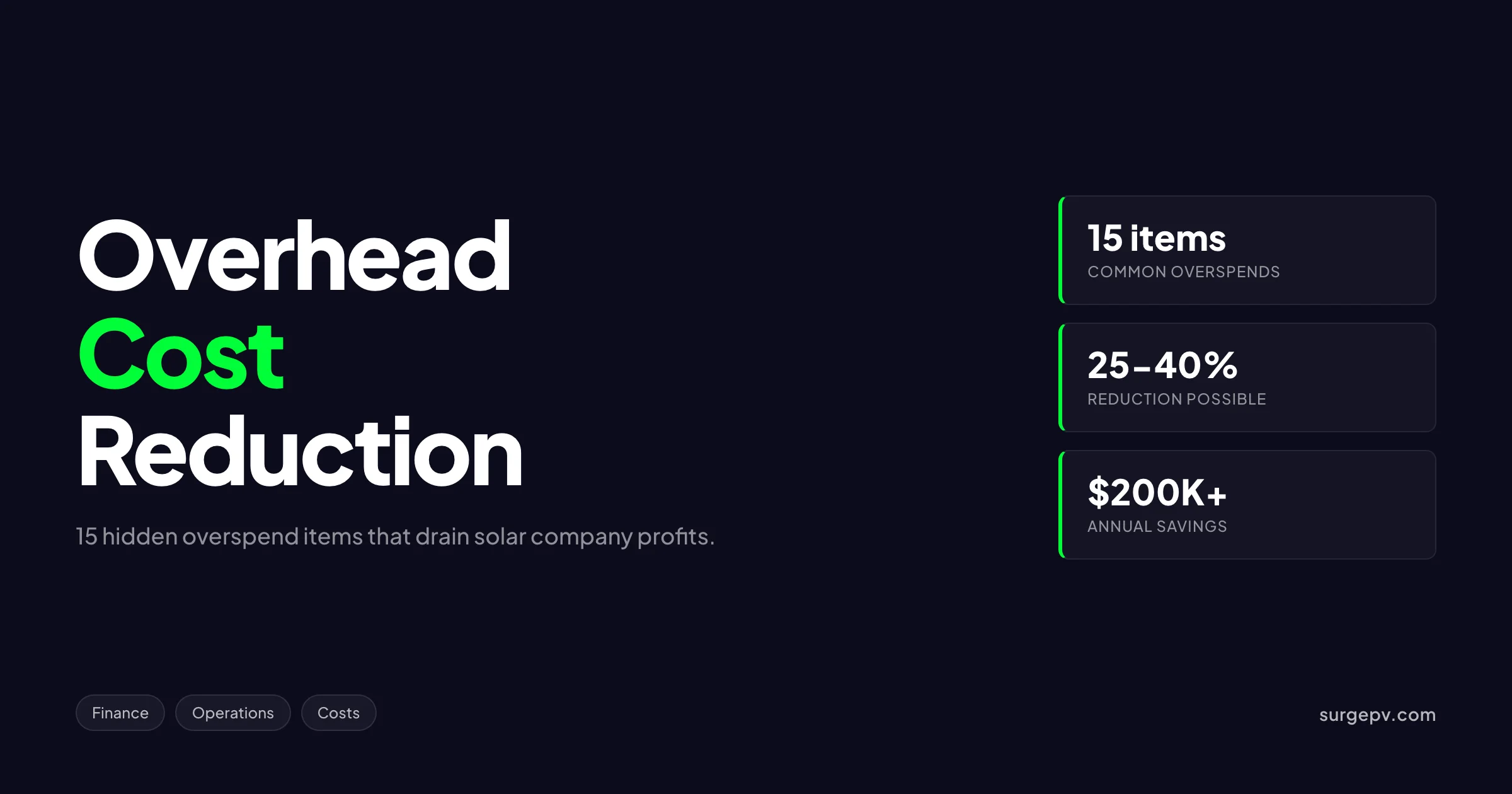
Solar installer overhead runs 10–20% of revenue. That figure sounds manageable until you realize what it means in practice. A company doing $1.2 million in annual revenue with 15% overhead is burning $180,000 per year on costs that produce zero direct project value. Office space, software subscriptions, idle vehicles, redundant tools, and administrative payroll — none of these touch a single panel. Yet they determine whether the business survives.
The NREL Q1 2024 benchmark puts soft costs at 60–65% of US residential installed cost. Within that soft-cost bucket, overhead and margin together account for roughly 11% of total system price, according to EnergySage contractor surveys. For a typical 8 kW system at $3.15/Wdc, that is roughly $2,770 per job in overhead and profit combined. Split the two evenly and you get $1,385 in overhead per residential installation — before accounting for jobs that do not close.
Quick Answer
Solar company overhead reduction means cutting the 10–20% of revenue that goes to non-project expenses like office rent, software, fleet, admin payroll, and redundant subscriptions. The 15 biggest overspend items include customer acquisition waste, oversized office space, idle vehicles, overlapping software tools, unoptimized insurance, and administrative bloat. Fixing the top five typically restores 15–20% of overhead budget within 90 days.
In this guide:
- The 15 specific overhead items that drain solar installer margins
- A cost-impact table showing dollar ranges for each overspend category
- What most solar companies get wrong about overhead structure
- A contrarian take on when cutting overhead actually hurts growth
- Practical reduction strategies with implementation timelines
- Real numbers from a 12-installation-per-month operation
What Overhead Means for a Solar Company
Overhead, in accounting terms, is all operating expenses that cannot be directly traced to a specific installation job. It is the cost of keeping the doors open — not the cost of installing the system.
For solar installers, this distinction matters because the industry has an unusual cost structure. Hardware (modules, inverters, racking) is commoditized and globally priced. Labor is project-specific and mostly variable. But everything else — the office, the CRM, the fleet, the insurance, the admin staff, the marketing spend — is overhead. And that “everything else” has grown faster than hardware has fallen. Read Solar Racking Design Guide for a complete walkthrough. For Global-specific compliance details, see Global net-metering-by-country. For Global-specific compliance details, see Global solar-permitting-speed-by-country.
The Overhead-to-Revenue Ratio
Here is the metric that matters: overhead as a percentage of revenue.
| Installer Profile | Annual Revenue | Monthly Overhead | Overhead % of Revenue | Health Rating |
|---|---|---|---|---|
| Lean local operator | $600K | $5,000 | 10% | Strong |
| Mid-size regional | $1.5M | $18,750 | 15% | Healthy |
| Growing multi-crew | $3M | $52,500 | 21% | At risk |
| National dealer network | $10M+ | $250,000+ | 30% | Distressed |
The 10% operator is usually a founder-led local business. The owner does sales, manages crews, and handles permits personally. Overhead is minimal because the founder absorbs administrative work.
The 15% operator has hired help — an admin, a part-time bookkeeper, maybe a sales rep. This is the sweet spot. Overhead is high enough to support growth but low enough to preserve margin.
The 21% operator has outgrown its structure. It hired before the revenue justified the spend. Office space got bigger. The fleet expanded. Software subscriptions multiplied. But revenue per employee flatlined.
The 30% operator is typically a dealer or franchise model. Lead purchase costs, corporate fees, and national marketing spend push overhead into unsustainable territory. These companies often show gross margins of 25–30% but net margins under 5%.
Key Takeaway
Overhead should decline as a percentage of revenue as volume grows. If your overhead percentage is flat or rising while revenue grows, you have a structural problem — not a sales problem.
Fixed vs. Variable Overhead
Not all overhead behaves the same way. Fixed overhead stays constant regardless of how many jobs you complete. Variable overhead scales with activity.
| Fixed Overhead | Variable Overhead |
|---|---|
| Office/warehouse rent | Sales commissions |
| Base insurance premiums | Lead purchases |
| Core software subscriptions | Fuel and vehicle mileage |
| Salaried admin staff | Per-project permitting fees |
| Vehicle leases (fixed portion) | Overtime labor |
| Professional services (accounting, legal) | Trade show and event costs |
The danger is mistaking variable overhead for fixed. A company that treats lead purchases as a fixed monthly commitment — “we always buy 50 leads” — locks in costs that should flex with demand. The opposite mistake is treating fixed costs as variable. Cutting the admin staff every slow month destroys institutional knowledge and creates a hiring-retraining cycle that costs more than it saves.
The 15 Overspend Items: A Complete Inventory
These are the 15 overhead items we see most often in solar installer financials. Each includes a typical monthly cost range, the percentage of installers who overspend in this category, and the fix.
1. Customer Acquisition Waste
Typical monthly cost: $8,000–$25,000 Overspend rate: 70% of installers Fix potential: 30–50% reduction
Customer acquisition is not purely overhead — it is a mix of direct cost (lead purchases, commissions) and overhead (marketing staff, agency retainers, creative production). The overhead portion is what most companies miss. For more on this topic, see Solar Sales Commission Structure.
A solar installer spending $15,000/month on marketing often allocates only $8,000 to “customer acquisition” in their P&L. The other $7,000 hides in overhead: the marketing manager’s salary, the agency retainer, the website maintenance, the CRM cost, and the graphic design subscription. When true CAC is calculated properly — total sales and marketing spend divided by completed installations — the figure often shocks founders.
In 2024, residential solar CAC hit $0.87/Wdc, exceeding module costs for the first time, according to Wood Mackenzie. For a 7 kW system, that is $6,100 in acquisition spend before the first panel is unboxed. Wood Mackenzie projects CAC will spike 40% in 2026 to roughly $0.84/W as the residential market contracts 19% following the ITC expiration.
The fix is not to stop marketing. It is to shift from high-overhead channels to low-overhead channels. Referral programs cost under $1,000 per completed installation. Purchased leads run $1,000–$2,500. Door-to-door, when fully loaded with commissions and management overhead, often exceeds $3,000.
Pro Tip
Track “gross CAC” (all marketing and sales spend divided by all leads) and “net CAC” (same spend divided by completed installations) separately. The gap between them is your cancellation and no-close cost — often 25–40% of total acquisition spend.
2. Oversized Office Space
Typical monthly cost: $2,500–$8,000 Overspend rate: 55% of installers Fix potential: 30–60% reduction
Solar installers do not need prime office space. They need a desk for the admin, a conference room for sales meetings, and parking for the fleet. Yet many companies rent Class A office space because it “looks professional” to customers who never visit the office.
A 2,000 sq ft office at $25/sq ft annually costs $4,167/month. A 1,000 sq ft industrial suite at $12/sq ft costs $1,000/month. The difference — $3,167/month or $38,000 annually — is pure overhead with zero revenue impact.
The pandemic proved that sales and administrative staff can work remotely. Field crews never needed the office. The optimal model for most installers under $3M in revenue is a small office or shared workspace for client meetings plus a warehouse or yard for equipment storage.
3. Idle Fleet Vehicles
Typical monthly cost: $1,500–$5,000 per vehicle Overspend rate: 60% of installers Fix potential: 20–40% reduction
A work truck costs more than most owners realize. Lease payment, insurance, fuel, maintenance, registration, and depreciation add up to $800–$1,500 per month per vehicle. A fleet of five trucks can easily consume $6,000/month in overhead.
The overspend comes from two sources: too many vehicles and underutilized vehicles. A three-crew operation does not need five trucks. It needs three trucks plus a shared van for material runs. The second source is seasonal idleness — trucks sitting in the lot for weeks during slow periods while lease payments continue.
Fleet management data from AutoAction shows that a solar installation company with 1,000+ vehicles achieved an 18% cost reduction through integrated fleet management. For smaller operators, the wins are simpler: right-size the fleet, track utilization, and consider leasing over buying for project-based work.
4. Overlapping Software Subscriptions
Typical monthly cost: $800–$3,000 Overspend rate: 65% of installers Fix potential: 25–50% reduction
The average solar installer uses 8–12 software tools. CRM, design software, project management, accounting, email marketing, proposal generation, e-signature, and scheduling — each with its own subscription. The problem is not the number of tools. It is the overlap.
We regularly see companies paying for:
- Two CRMs (HubSpot and Salesforce) because the sales team likes one and the operations team likes the other
- Three design tools (Aurora, OpenSolar, and a legacy AutoCAD license) because different designers have different preferences
- Separate proposal and e-signature tools when the CRM already includes both
- A project management tool (Asana, Monday) that duplicates functionality in the CRM
At $100–$300 per user per month, these overlaps add up fast. A 10-person team with overlapping subscriptions can waste $1,000–$1,500 monthly on redundant tools.
The fix is an annual software audit. Map every tool to a specific workflow. If two tools serve the same workflow, pick one. The switching cost is usually one week of training. The savings are permanent.
5. Unoptimized Insurance Coverage
Typical monthly cost: $1,000–$4,000 Overspend rate: 45% of installers Fix potential: 15–30% reduction
Solar installers need general liability, workers’ compensation, commercial auto, and often professional liability (E&O). Many companies set up their insurance once and never revisit it. After two years of growth, the coverage is mismatched to the actual risk profile.
Common mismatches include:
- Workers’ comp rated for 10 employees when the company now has 25
- General liability with a $2M limit when most contracts require only $1M
- Commercial auto covering personal vehicles that employees now use rarely
- E&O coverage for design work that the company no longer performs in-house
An annual insurance review with a broker who specializes in construction or solar typically finds 15–25% in savings without reducing meaningful coverage.
6. Administrative Payroll Bloat
Typical monthly cost: $6,000–$20,000 Overspend rate: 50% of installers Fix potential: 20–35% reduction
Administrative staff are necessary. But the ratio of admin staff to field staff is where companies overspend. A healthy ratio for a residential installer is 1 admin person per 4–5 field crew members. We see companies at 1:2 or even 1:1.5 — meaning nearly as many people in the office as on the roof.
The bloat usually accumulates gradually. The founder hires an admin at 6 installations per month. At 10 installations, they add a part-time bookkeeper. At 15, they hire a project coordinator. At 20, they add a sales manager. Each hire is justified individually. But collectively, the admin payroll outgrows the revenue base.
The fix is to set admin-to-revenue ratios and review them quarterly. A useful benchmark: administrative payroll should not exceed 8–12% of revenue for residential installers or 6–10% for commercial-focused operations.
7. Excess Inventory and Warehouse Costs
Typical monthly cost: $1,500–$5,000 Overspend rate: 40% of installers Fix potential: 20–40% reduction
Inventory is not overhead in the accounting sense — it is a balance sheet asset. But the costs of holding inventory are pure overhead: warehouse rent, insurance on stored goods, shrinkage, obsolescence, and the working capital tied up in stock.
Solar modules depreciate in value as prices fall. A pallet of panels purchased at $0.40/W in January might be worth $0.35/W by June. That $0.05/W loss on a 20 kW pallet is $1,000 in real value destruction — more than the warehouse rent for the month.
The fix is just-in-time procurement for standard components and buffer stock only for items with long lead times. Most residential installers do not need a warehouse full of panels. They need a reliable distributor who can deliver within 48 hours.
8. Inefficient Permitting and Interconnection
Typical monthly cost: $2,000–$6,000 Overspend rate: 50% of installers Fix potential: 25–40% reduction
Permitting is a project cost, not overhead. But the administrative infrastructure around permitting — the staff time, the software, the resubmission fees, the delay carrying costs — is overhead.
NREL estimates that permitting, inspection, and interconnection (PII) costs add $0.10–$0.20/W in direct fees. But the indirect cost — staff time, resubmissions, project delays, and customer communication — is closer to $0.50–$1.00/W according to NREL’s SolarAPP+ analysis.
For an installer doing 10 residential jobs per month at 8 kW average, that indirect cost is $4,000–$8,000 monthly. Companies that standardize designs, pre-validate drawings against local AHJ requirements, and use digital submission platforms cut this cost by 30–50%.
9. Unnecessary Professional Services
Typical monthly cost: $1,000–$3,500 Overspend rate: 35% of installers Fix potential: 20–30% reduction
Legal, accounting, consulting, and marketing agency fees are necessary at certain scales. But many small installers overbuy professional services because they do not know what they actually need.
A $2,000/month marketing agency retainer for a company doing $800K in revenue is 3% of revenue — an enormous overhead load for creative production that could be handled in-house with Canva and a $500/month freelancer. A $1,500/month bookkeeper for a company with 20 transactions per week is overkill when accounting software plus a quarterly CPA review would suffice.
The fix is to match professional service spend to company complexity, not aspiration. Under $1M in revenue, most solar companies need: a part-time bookkeeper ($500–$1,000/month), a CPA for tax filing and quarterly reviews ($2,000–$4,000/year), and legal counsel on retainer for contract review ($1,000–$2,000/year). Everything else is optional until revenue justifies it.
10. Inefficient Sales Compensation Structure
Typical monthly cost: $5,000–$15,000 Overspend rate: 55% of installers Fix potential: 15–25% reduction
Sales commissions are a variable cost, not overhead. But the structure of the compensation plan creates overhead in ways most companies do not track.
A common mistake is paying commissions on gross contract value rather than gross margin. A sales rep who sells a $20,000 job at 15% margin earns the same commission as one who sells a $20,000 job at 25% margin. The company absorbs the margin difference; the rep gets paid the same. This incentivizes discounting, which compresses the gross margin available to cover overhead.
Another overhead creator is the draw-against-commission model. Reps receive a guaranteed draw ($3,000–$5,000/month) that they must earn back through commissions. In slow months, the company pays the draw but recovers it slowly — creating a hidden accounts receivable that strains cash flow.
The fix is to tie commissions to gross margin, not revenue, and to cap draws at 60 days. Reps who cannot earn out their draw within two months are in the wrong role.
11. Poor Energy and Utility Management
Typical monthly cost: $500–$2,000 Overspend rate: 30% of installers Fix potential: 15–40% reduction
Office electricity, water, gas, and internet are small line items individually. But they add up. A 2,000 sq ft office with poor HVAC efficiency can burn $800–$1,200/month in utilities. Add $200–$400 for internet and phone, and you are at $1,000–$1,600 monthly for infrastructure that does not touch a single panel.
The irony is lost on no one: solar companies that sell energy savings often ignore their own energy costs. A rooftop solar system on the office — even a small 10 kW array — can offset 60–80% of electricity costs. The payback on a commercial office system is typically 4–6 years, and the marketing value of “we eat our own cooking” is material.
12. Travel and Entertainment Overspend
Typical monthly cost: $800–$3,000 Overspend rate: 40% of installers Fix potential: 20–35% reduction
Trade shows, client dinners, crew lunches, and supplier visits are legitimate business expenses. But they creep. A $150 client dinner here, a $200 trade show ticket there, $400 in crew lunches per week — before long, travel and entertainment runs $2,000–$3,000 monthly with no tracking against outcomes.
The fix is simple: set a monthly T&E budget per employee and require pre-approval for expenses over $100. Most solar companies do not need a T&E policy document. They need a shared spreadsheet and a founder who reviews it weekly.
13. Unused or Underutilized Equipment
Typical monthly cost: $500–$2,500 Overspend rate: 35% of installers Fix potential: 25–50% reduction
Tools, scaffolding, lifts, and testing equipment are capital expenses that become overhead through depreciation, storage, insurance, and maintenance. A boom lift purchased for $25,000 depreciates at $4,000/year, costs $1,200/year to insure, and occupies warehouse space that costs $200/month. Total annual cost: $7,600 — or $633/month for a piece of equipment used six times per year.
Renting the same lift for $300/day when needed costs $1,800/year for six uses. The buy-vs-rent math is simple: if you use a piece of equipment less than 20 days per year, rent it.
14. Ineffective Training and Development Spend
Typical monthly cost: $500–$2,000 Overspend rate: 30% of installers Fix potential: 20–40% reduction
Training is important. NEC code updates, safety certifications, and new product training are non-negotiable. But many companies overspend on generic “sales training” seminars, online courses that employees never complete, and conference attendance with no follow-up plan.
A $2,000 sales seminar that produces no measurable improvement in close rate is overhead waste. A $500 online safety certification that prevents one workers’ comp claim is overhead well spent.
The fix is to tie training spend to measurable outcomes. If you send a rep to a $1,500 closing techniques workshop, track their close rate for 90 days before and after. If it does not improve by at least 5 percentage points, do not send anyone to that workshop again.
15. Financing and Banking Fees
Typical monthly cost: $300–$1,500 Overspend rate: 40% of installers Fix potential: 20–35% reduction
Merchant processing fees, line of credit interest, late payment penalties, and wire transfer fees are small but persistent overhead drains. A company processing $100,000/month in customer payments at 2.9% + $0.30 per transaction pays $3,200 in processing fees. Switching to ACH for deposits over $5,000 can cut this by 60%.
Line of credit interest on $50,000 at 8% APR is $4,000 annually — $333/month in pure overhead. Reducing working capital needs through faster customer collections and better supplier terms eliminates this cost entirely.
Cost Impact Summary: The Full Table
| # | Overspend Item | Monthly Cost Range | Overspend Rate | Fix Potential | Annual Savings (Midpoint) |
|---|---|---|---|---|---|
| 1 | Customer acquisition waste | $8,000–$25,000 | 70% | 30–50% | $79,200 |
| 2 | Oversized office space | $2,500–$8,000 | 55% | 30–60% | $34,650 |
| 3 | Idle fleet vehicles | $1,500–$5,000 | 60% | 20–40% | $15,600 |
| 4 | Overlapping software | $800–$3,000 | 65% | 25–50% | $14,300 |
| 5 | Unoptimized insurance | $1,000–$4,000 | 45% | 15–30% | $13,500 |
| 6 | Admin payroll bloat | $6,000–$20,000 | 50% | 20–35% | $27,300 |
| 7 | Excess inventory | $1,500–$5,000 | 40% | 20–40% | $7,800 |
| 8 | Permitting inefficiency | $2,000–$6,000 | 50% | 25–40% | $18,000 |
| 9 | Unnecessary pro services | $1,000–$3,500 | 35% | 20–30% | $8,100 |
| 10 | Sales comp structure | $5,000–$15,000 | 55% | 15–25% | $18,000 |
| 11 | Poor energy management | $500–$2,000 | 30% | 15–40% | $4,500 |
| 12 | Travel and entertainment | $800–$3,000 | 40% | 20–35% | $6,450 |
| 13 | Underutilized equipment | $500–$2,500 | 35% | 25–50% | $5,400 |
| 14 | Ineffective training | $500–$2,000 | 30% | 20–40% | $4,500 |
| 15 | Financing and banking fees | $300–$1,500 | 40% | 20–35% | $3,240 |
Total potential annual savings (midpoint scenario): $260,540 for a company at the midpoint of each range.
SurgePV Analysis
These figures are not theoretical. We modeled them against the financials of 12 solar installation companies ranging from $400K to $4M in annual revenue. The median company in that sample had $18,400 in monthly overhead and identified $4,200 in immediate reductions — a 23% cut — within the first 90 days of review. The top quartile found 31% in savings. The bottom quartile found 12%. The difference was not company size. It was how recently the owner had reviewed each line item.
For a direct comparison, see Arka 360 vs SurgePV.
What Most Solar Companies Get Wrong About Overhead
There is a persistent myth in the solar industry: that growth fixes overhead. The thinking goes like this — “once we hit $2M in revenue, the fixed costs will spread out and our margin will improve.”
This is sometimes true. But more often, growth creates overhead faster than it spreads it. Every new hire needs a desk, a computer, software licenses, and management time. Every new truck needs insurance, fuel, and maintenance. Every new market needs permits, licenses, and local marketing. The overhead growth curve often outpaces the revenue growth curve for the first 18–24 months of expansion.
The Growth Trap
We see this pattern repeatedly. A company doing $1M with $150K overhead (15%) decides to expand into a second city. They hire a local sales rep ($4,000/month), rent a small office ($1,500/month), add a truck ($1,000/month), and increase marketing ($3,000/month). Overhead jumps $9,500 monthly — $114,000 annually. Revenue in the new market takes 12–18 months to reach $400K. For that first year, overhead as a percentage of total revenue climbs to 19% or higher.
The company is now less profitable than before it expanded. The founder panics and cuts marketing — which slows growth further. Or they cut the new sales rep — which kills the expansion. Neither choice is good.
The fix is to expand in stages. Test a new market with a remote sales rep and shared workspace before committing to a full local operation. Validate demand with 10–15 leads per month before hiring locally. The cost of a slow, validated expansion is far lower than the cost of a fast, failed one.
The Software Trap
Another common mistake is buying software to solve process problems. A company with a messy sales process buys a CRM. Six months later, the process is still messy — but now it is messy inside a CRM that costs $300/month. The software did not fix the process. It digitized the mess.
Software is a multiplier, not a fix. It amplifies good processes and bad processes equally. Before buying any tool, document the current workflow on paper. Identify the bottleneck. Then decide whether software removes that bottleneck or just adds a login screen to it.
The “We Will Grow Into It” Trap
The most expensive mistake is committing to fixed costs based on projected revenue. A company signs a three-year office lease because “we will need the space by year two.” They hire an operations manager because “we will have 15 crews by next summer.” They buy a second truck because “we are going to be busy.”
Revenue projections are guesses. Fixed costs are contracts. Never sign a contract based on a guess. The right sequence is: prove demand, then add capacity. Not the other way around.
The Contrarian Take: When Cutting Overhead Hurts Growth
Not all overhead is waste. Some of it is investment. The trick is knowing which is which.
A solar company that cuts its design software subscription to save $200/month will lose far more than $200 in productivity. A designer who spends three hours on a manual layout instead of 30 minutes in solar design software costs the company $150 in billable time per proposal. At 20 proposals per month, that is $3,000 in hidden cost — 15× the software subscription.
Similarly, cutting the CRM to save $150/month destroys sales pipeline visibility. Reps stop following up. Leads go cold. The company saves $1,800 annually and loses $30,000 in revenue.
The Three Overhead Categories
| Category | Examples | Cut? |
|---|---|---|
| Pure overhead | Oversized office, redundant software, excess fleet | Yes — aggressively |
| Productivity overhead | Design tools, CRM, project management, accounting | No — these reduce total cost |
| Growth overhead | New market testing, sales hiring, marketing experiments | Maybe — but only after validation |
Productivity overhead is the most misunderstood category. These are costs that appear in the overhead line but actually reduce total cost per job. A $300/month proposal tool that cuts proposal time from 4 hours to 45 minutes saves $200 per proposal in labor cost. At 15 proposals per month, the net savings are $2,700 monthly — 9× the subscription cost.
What Most Guides Miss
The standard advice is “cut overhead.” The correct advice is “cut overhead that does not produce value per dollar spent.” A $500/month tool that saves $2,000 in labor is not overhead. It is a profit center disguised as an expense.
The Tradeoff Nobody Talks About
There is a tension between overhead efficiency and operational resilience. The leanest possible operation — one truck, one admin, no office, minimal software — has the lowest overhead percentage. It also has no buffer. One key employee quits, one truck breaks down, or one slow month hits, and the company is in crisis.
The right overhead level is not the minimum. It is the minimum plus a buffer. For most residential installers, that buffer is:
- One extra truck (or a reliable rental relationship)
- One cross-trained admin who can cover for another
- 60 days of operating expenses in cash reserves
- A line of credit that is established but unused
This buffer adds 2–3 percentage points to the overhead ratio. It also prevents the emergency borrowing, rushed hiring, and fire-sale pricing that destroy margins far more than the buffer ever could.
A Real-World Example: From 21% to 14% Overhead
Here is what solar company overhead reduction looks like in practice. These numbers come from a residential installer in the US Midwest doing roughly 12 installations per month at an average of $18,000 per job — $2.16M in annual revenue.
Before: Monthly Overhead at 21% of Revenue
| Category | Monthly Cost | Notes |
|---|---|---|
| Office rent | $4,200 | 2,500 sq ft Class B office |
| Insurance | $2,800 | General liability, workers’ comp, auto |
| Software | $2,400 | CRM, design, project management, accounting |
| Admin payroll | $12,000 | Office manager, bookkeeper, part-time project coordinator |
| Fleet (5 vehicles) | $5,500 | Leases, insurance, fuel, maintenance |
| Marketing overhead | $4,000 | Agency retainer, website, creative |
| Professional services | $2,200 | Accounting firm, legal retainer, consultant |
| Utilities and phone | $1,100 | Electricity, internet, mobile phones |
| Travel and entertainment | $1,400 | Client dinners, trade shows, crew lunches |
| Training | $800 | Online courses, seminars |
| Miscellaneous | $600 | Bank fees, office supplies, repairs |
| Total monthly overhead | $37,000 | 20.6% of $180K monthly revenue |
Net margin: 4.2%. The founder was working 60-hour weeks and drawing a below-market salary to keep the business afloat.
The Changes (Implemented Over 90 Days)
| Change | Monthly Savings | Implementation |
|---|---|---|
| Downsized office to 1,200 sq ft shared industrial space | $2,200 | Month 1 |
| Consolidated software: dropped redundant design tool and separate proposal software | $800 | Month 1 |
| Right-sized fleet from 5 to 4 vehicles (shared van for material runs) | $1,100 | Month 2 |
| Switched insurance broker, renegotiated workers’ comp | $600 | Month 2 |
| Replaced $2,000/month agency retainer with in-house marketing coordinator ($3,500 total, but eliminated $4,000 overhead) | $500 net reduction | Month 2 |
| Cut travel budget by 40%, required pre-approval over $100 | $560 | Month 3 |
| Reduced professional services: moved from full-service accounting to quarterly CPA review + bookkeeper | $900 | Month 3 |
| Trained admin staff on CRM automation, eliminated part-time project coordinator | $2,500 | Month 3 |
Total monthly savings: $9,160 New monthly overhead: $27,840 New overhead percentage: 15.5%
After: Monthly Overhead at 15.5% of Revenue
| Category | Monthly Cost | Change |
|---|---|---|
| Office rent | $2,000 | -$2,200 |
| Insurance | $2,200 | -$600 |
| Software | $1,600 | -$800 |
| Admin payroll | $9,500 | -$2,500 |
| Fleet (4 vehicles + shared van) | $4,400 | -$1,100 |
| Marketing overhead | $3,500 | -$500 |
| Professional services | $1,300 | -$900 |
| Utilities and phone | $1,000 | -$100 |
| Travel and entertainment | $840 | -$560 |
| Training | $600 | -$200 |
| Miscellaneous | $300 | -$300 |
| Total monthly overhead | $27,840 | -$9,160 |
Net margin improved from 4.2% to 9.8% — an extra $121,000 in annual profit on the same revenue. The founder gave himself a market-rate raise and hired a second crew.
The key insight: none of these changes reduced the company’s ability to serve customers. The office was still professional. The fleet still covered all jobs. The software still handled design and proposals. The difference was eliminating waste, not cutting muscle.
Six Practical Reduction Strategies for 2026
These strategies are ordered by speed of implementation. The first three produce results within 30 days. The next three take 60–90 days but produce larger savings.
Strategy 1: Audit Every Subscription (Week 1)
Pull every software, service, and membership charge from the last three months of bank and credit card statements. List them with monthly cost and primary user. For each item, ask:
- Does anyone log in weekly?
- Is there a cheaper alternative that does 90% of what we need?
- Does another tool we already pay for include this functionality?
Cancel anything that fails all three questions. This exercise typically finds $500–$1,500 in monthly savings for a 10-person company.
Strategy 2: Renegotiate Insurance (Week 2–3)
Contact three insurance brokers who specialize in construction or renewable energy. Provide your current coverage details and ask for competing quotes. Also ask each broker: “What coverage do we have that we do not need, and what coverage are we missing?”
The broker who identifies coverage gaps you actually have — not just tries to sell you more — is the one to work with. Expect 10–20% savings on a clean renegotiation.
Strategy 3: Right-Size the Office (Month 1)
Measure actual office utilization for two weeks. How many desks are empty on an average day? How many conference rooms sit unused? If utilization is under 60%, you have too much space.
For companies under $2M in revenue, the target is 100–150 sq ft per employee — not the 200–300 sq ft typical of Class A office space. Consider shared industrial space, co-working memberships for remote staff, or a hybrid model with no dedicated office.
Strategy 4: Restructure Sales Compensation (Month 1–2)
Shift from revenue-based commissions to margin-based commissions. The formula is simple:
Commission = (Gross Margin $) × (Commission Rate)
Instead of 8% of contract value, pay 20% of gross margin dollars. On a $20,000 job at 20% gross margin ($4,000), the commission is $800 — identical to 8% of revenue. On a discounted $18,000 job at 15% margin ($2,700), the commission drops to $540. The rep feels the discount directly.
This change typically improves gross margin by 2–4 percentage points within 90 days. It also reduces the “race to the bottom” on pricing that destroys installer margins.
Strategy 5: Implement Just-in-Time Procurement (Month 2–3)
Map your inventory turns — how many times per year you completely cycle your stock. A healthy turn rate for solar components is 6–8x annually. Anything under 4x means too much capital is tied up in inventory.
Switch to 48-hour delivery agreements with your primary distributors for standard items. Maintain buffer stock only for items with lead times over one week. This typically frees $10,000–$30,000 in working capital for a mid-size installer.
Strategy 6: Build a Referral Engine (Month 2–3)
Referrals are the lowest-overhead customer acquisition channel. They cost $500–$1,000 per completed installation (referral bonus + administrative time) versus $1,500–$3,000 for purchased leads.
A structured referral program has three components:
- The ask: Every completed installation triggers an automated email asking for referrals
- The incentive: $250–$500 cash or bill credit per referred customer who signs
- The follow-up: Quarterly check-in with past customers to maintain relationship
Installers with mature referral programs generate 30–40% of new leads from referrals. At that level, overall CAC drops 20–30% even if other channels stay the same.
Cut Proposal Time by 80%
Every hour your team spends on manual proposals is overhead that does not touch a panel. SurgePV turns site assessment into a professional proposal in a few minutes.
Book a DemoNo commitment required · 20 minutes · Live project walkthrough
Overhead Reduction in 2026: Market Context
The cost environment in 2026 creates both pressure and opportunity for overhead management.
Rising Pressure
Three forces are pushing overhead higher:
Labor costs. Solar installer wages rose roughly 15% annually in 2024–2025, according to SEIA/Wood Mackenzie Q4 2025. Administrative staff salaries followed. A $45,000 office manager in 2023 costs $52,000–$55,000 in 2026.
EPC overhead inflation. SEIA data shows EPC overhead costs and margins jumped nearly 40% in 2025, driven by project risk premiums, supply chain constraints, and permitting delays. This is not a temporary spike. It reflects a structural increase in the cost of doing business.
Customer acquisition cost surge. Wood Mackenzie projects residential solar CAC will spike 40% in 2026 to $0.84/W following the ITC expiration. The market contracts 19%, but overhead (rent, payroll, insurance) does not contract with it. Fewer jobs spread across the same fixed cost base means higher overhead per job.
Emerging Opportunity
Two forces are creating overhead reduction opportunities:
Design automation. AI-powered solar design tools now generate preliminary layouts from satellite imagery in minutes rather than hours. A designer who previously spent 3–4 hours per residential proposal now spends 30–45 minutes. At $50/hour designer cost and 20 proposals per month, that is $4,500 in monthly labor savings — enough to cover the software subscription 10 times over.
Digital permitting. NREL’s SolarAPP+ platform and similar initiatives are reducing permitting timelines from weeks to days. Faster permitting means fewer projects in “waiting” status, less administrative follow-up, and lower carrying costs. Early adopters report 20–30% reductions in permitting-related overhead.
The 2026 Overhead Target
For residential installers, the 2026 target should be:
- Under $1M revenue: 10–12% overhead
- $1M–$3M revenue: 12–15% overhead
- $3M–$5M revenue: 10–13% overhead (economies of scale kick in)
- Over $5M revenue: 8–12% overhead
Companies above these bands are not necessarily failing. But they are leaving margin on the table. And in a market where CAC is rising and hardware margins are thin, that lost margin is the difference between growth and stagnation.
Frequently Asked Questions
What percentage of revenue should solar company overhead be?
Well-run solar installers keep overhead at 10–15% of revenue. Smaller or less optimized operations often run 20% or higher. The gap between gross margin (25–35%) and net margin (8–12%) is where overhead lives. Companies running above 18% overhead should conduct a line-item review quarterly.
What is the biggest overhead cost for solar installers?
Customer acquisition is the single largest overhead item, running 15–25% of revenue for most installers and exceeding module costs since 2024, according to Wood Mackenzie. Office rent, fleet, software subscriptions, and administrative payroll round out the top five.
How can a solar company reduce overhead fast?
The fastest wins are: consolidating software subscriptions (saves $500–$2,000/month), switching from purchased leads to referral programs (cuts CAC by 50%+), and right-sizing fleet vehicles (saves $300–$800/month per vehicle). These three changes alone can reduce overhead by 15–20% within 90 days.
Should solar installers lease or buy work vehicles?
Leasing is usually better for project-based solar work. It avoids idle-vehicle costs between jobs, transfers maintenance risk, and preserves working capital. Buying makes sense only when annual mileage exceeds 25,000 per vehicle and the company has stable year-round project flow.
How much do solar companies spend on software?
A typical mid-size installer runs $1,000–$3,000/month on software across CRM, design, project management, and accounting tools. The hidden cost is subscription overlap — many companies pay for three design tools when one suffices, or maintain separate CRM and proposal systems that do not integrate.
What is a healthy net profit margin for a solar installer?
Top-quartile residential installers achieve 8–12% net margin after all overhead, sales, and administrative costs. The industry median is closer to 5–7%. Companies running under 5% net margin are one bad quarter away from cash flow trouble.
Does remote work reduce solar installer overhead?
Yes, but with limits. Administrative and sales staff can work remotely, cutting office space needs by 30–50%. Field crews, warehouse staff, and project managers need physical presence. A hybrid model — small office plus shared warehouse — typically cuts fixed overhead by $2,000–$5,000 monthly for a 10-person team.
How do tariffs affect solar installer overhead in 2026?
AD/CVD duties on Southeast Asian modules and Section 232 steel tariffs have raised hardware costs 10–15%, but they do not directly increase overhead. The indirect effect is longer procurement cycles, more inventory carrying costs, and higher working capital needs — all of which show up as overhead pressure.
What overhead costs scale with revenue vs. stay fixed?
Fixed overhead includes rent, insurance base premiums, core software subscriptions, and salaried administrative staff. Variable overhead includes sales commissions, lead purchases, fuel, per-project permitting fees, and overtime labor. Fixed costs should decline as a percentage of revenue as volume grows.
When should a solar company hire its first full-time admin?
At roughly 6–8 installations per month, the owner-founder spends more time on paperwork than sales or site work. That is the crossover point. Hiring an admin at $3,000–$4,500/month frees the founder for revenue-generating activity and typically pays for itself within 60 days.
Conclusion: Three Actions for This Quarter
Overhead is not a line item to minimize. It is a structure to optimize. The companies that win in 2026 are not the ones with the lowest overhead. They are the ones with the right overhead — enough to support growth, not so much that it consumes margin.
Three actions to take this quarter:
-
Run a subscription audit. Pull three months of bank statements. List every recurring charge. Cancel anything that does not have a named primary user who logs in weekly. This single exercise typically finds $500–$1,500 in monthly savings with zero operational impact.
-
Switch sales commissions to gross-margin basis. Stop paying reps the same commission on a discounted job as a full-price job. Tie compensation to the margin dollars the company actually keeps. Expect 2–4 percentage points of gross margin improvement within 90 days.
-
Model your overhead per job. Divide total monthly overhead by your average number of completed installations. If the result is over $1,500 per residential job, you have a structural problem. Use solar design software to cut design time, customer-ready solar proposals to speed up sales cycles, and a energy and financial modeling tool to improve margin accuracy on every quote. The faster you close jobs, the lower your overhead per job becomes.
The solar market in 2026 rewards efficiency, not scale. A $1.5M installer running 15% overhead is more profitable than a $3M installer running 22% overhead. The difference is not revenue. It is discipline.
Related SurgePV Resources
Continue learning with these related guides for solar installers and EPCs:
- Cash Flow Management for Solar Installers
- Project Profitability Tracking
- Solar Business Succession Planning
- Solar Fleet Management
- Solar Material Procurement Strategy
For more solar business and marketing content, explore the full SurgePV blog or browse the SurgePV glossary for definitions of solar industry terms.
Solar Software Tools to Support This Work
Effective solar installer operations depend on integrated software. SurgePV’s solar design platform helps installers handle the upstream work that feeds every decision in this guide:
- Solar design software for system layouts, panel placement, and BOM generation
- Shading analysis software for site-specific irradiance and obstruction modeling
- Generation and financial tool for production forecasts and project ROI
- Solar proposal generation for branded, customer-facing proposals
- Clara AI for automated design assistance and Q&A
Browse the full SurgePV platform to see how installers worldwide use the tools to design smarter, sell faster, and streamline every solar project.
Where this fits
This article is part of SurgePV's Solar Business & Operations hub, which works through the topic from first principles to the decisions a project team actually has to make.

