

Quick Answer
Key solar trade shows in 2026 include Intersolar Europe (Munich, June), RE+ (Anaheim, September), and Solar Power International (multiple US cities). Booth costs: $10,000–$50,000. Lead targets: 100–300 qualified leads per show. Best practices: pre-show outreach, live demos, and same-day follow-up.
A residential solar installer from Phoenix spent $48,000 attending RE+ 2024 in Anaheim. Booth fee: $14,500. Travel, lodging, staffing, swag, and shipping: $33,500. Total leads generated: 187. Total acquired customers over 12 months: 4. Total revenue: $98,000. Net ROI: 2.04x — not a disaster, but well below the 5x+ benchmark for solar trade shows.
Key solar trade shows in 2026 include Intersolar Europe (Munich, June), RE+ (Anaheim, September), and Solar Power International (multiple US cities). Booth costs: $10,000–$50,000. Lead targets: 100–300 qualified leads per show. Best practices: pre-show outreach, live demos, and same-day follow-up. Also see: European Solar Incentives.
A commercial solar developer from Denver attended Intersolar Europe 2024 with a $62,000 budget. They generated 23 qualified leads but landed two large commercial projects worth $4.2M combined. Net ROI: 67x.
Same industry. Same year. Two very different outcomes. The difference: matching the event to the business model and going in with a clear pre-show plan.
Quick Answer: Solar Trade Shows 2026
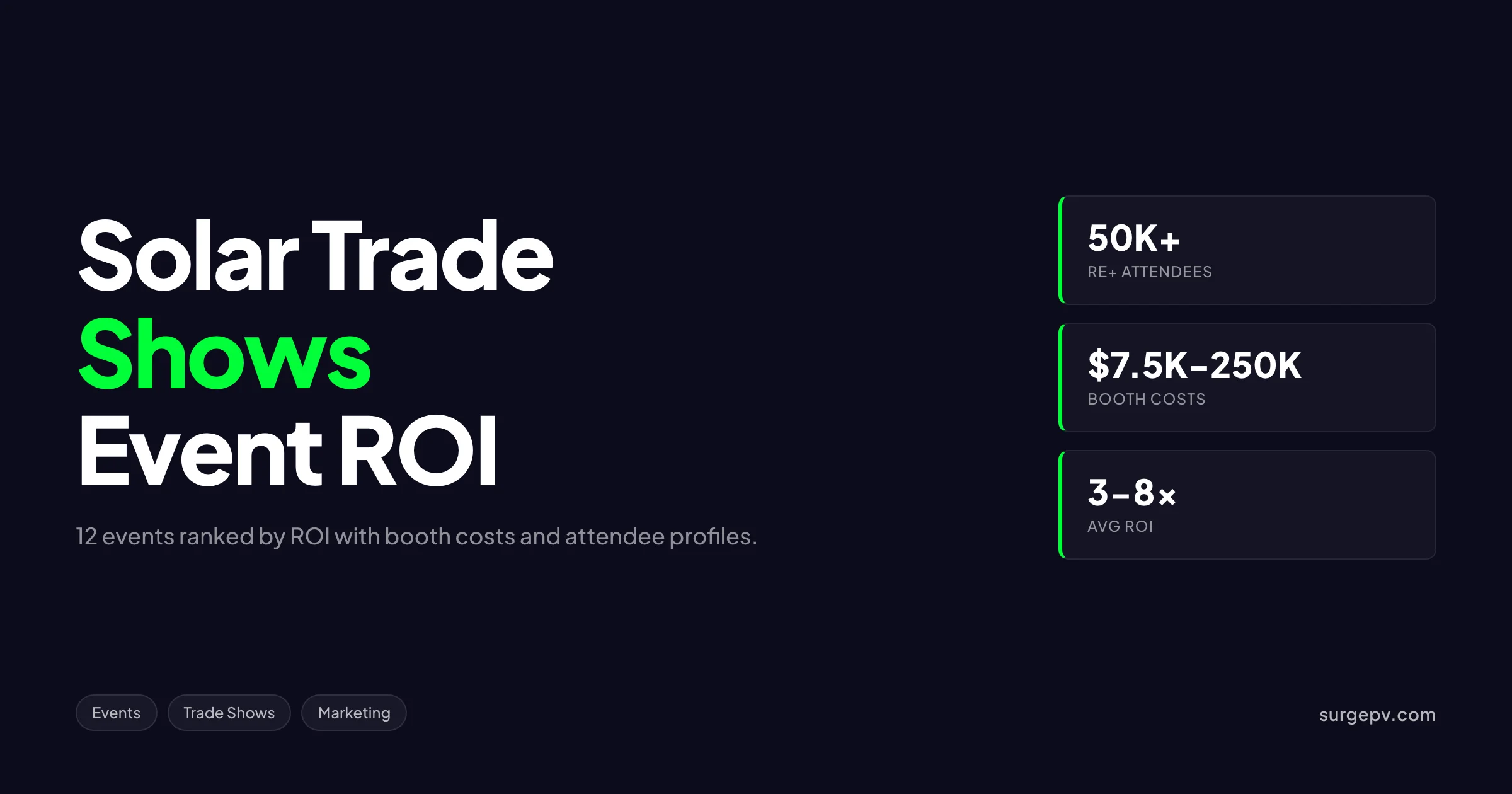
RE+ 2026 (September, Las Vegas) is the largest U.S. solar trade show with 50,000+ attendees. Intersolar Europe (June, Munich) is the global benchmark. Mid-tier regional shows often deliver better ROI for residential installers. Total event cost typically runs 3-4x booth fee when staffing and travel are included. Well-planned shows return 3-8x; poorly planned shows lose money.
For Global-specific compliance details, see Global net-metering-by-country. For Global-specific compliance details, see Global solar-permitting-speed-by-country.
In this guide:
- The 12 solar trade shows worth considering in 2026
- True cost analysis (booth + staffing + travel + opportunity cost)
- Which shows match which business models
- Booth design and staffing for solar exhibitors
- Pre-show, on-site, and post-show ROI maximization
- Common mistakes that waste solar trade show budget
- What replaces trade shows for cost-conscious installers
- Eight common questions
The 12 Solar Trade Shows Worth Considering in 2026
Not all solar trade shows deliver value. The 12 below are the events with track records of strong ROI for specific business models.
Tier 1: Global Industry Events
1. RE+ 2026 (Las Vegas, September 9-11)
- Attendees: 50,000+
- Exhibitors: 1,200+
- Booth cost: $7,500-$250,000+
- Best for: Mid-large installers, EPCs, OEM relationships, technology evaluation
- ROI signal: Strong for $2M+ procurement budgets
2. Intersolar Europe 2026 (Munich, June 17-19)
- Attendees: 90,000+
- Exhibitors: 2,400+
- Booth cost: €4,000-€100,000+
- Best for: European installers, manufacturers, international expansion
- ROI signal: Strong for European and EMEA-focused businesses
3. SNEC PV+ Power Expo (Shanghai, June 2026)
- Attendees: 200,000+
- Exhibitors: 2,500+
- Booth cost: $5,000-$150,000+
- Best for: Manufacturer relationships, China sourcing
- ROI signal: Strong for installers with China supply chain or technology evaluation needs
Tier 2: North American Regional Events
4. Solar Power Northeast (Boston, March 2026)
- Attendees: 8,000
- Exhibitors: 200+
- Booth cost: $3,000-$15,000
- Best for: Northeast installers, residential focus
5. Solar Power International (formerly SPI, now part of RE+)
- Integrated into RE+ 2026; see above
6. Solar Power Texas (Austin, October 2026)
- Attendees: 6,000
- Exhibitors: 180+
- Booth cost: $2,500-$12,000
- Best for: Texas installers, ERCOT-focused projects
7. Solar Power Mountain West (Denver, April 2026)
- Attendees: 4,500
- Exhibitors: 140+
- Booth cost: $2,500-$10,000
- Best for: Rocky Mountain installers, mid-altitude installation
8. Energy Storage North America (San Diego, November 2026)
- Attendees: 12,000
- Exhibitors: 300+
- Booth cost: $4,000-$25,000
- Best for: Installers expanding into storage and battery sales
Tier 3: Specialized Solar Events
9. Solar & Storage Live USA (Las Vegas, March 2026)
- Attendees: 15,000
- Exhibitors: 400
- Booth cost: $3,500-$25,000
- Best for: Solar+storage installers, residential focus Also see: Us Residential Solar Market Trends 2026.
10. Off-Grid Solar Show (Nairobi, September 2026)
- Attendees: 3,500
- Exhibitors: 150
- Booth cost: $2,000-$8,000
- Best for: International expansion, off-grid systems See Off Grid Solar System Sizing for detailed guidance.
11. Floating Solar Conference (Asia/Global rotating)
- Attendees: 1,500
- Booth cost: $2,500-$12,000
- Best for: Specialized floating PV installers
Tier 4: SEIA Regional Conferences
12. SEIA State Solar Summits (Various states, year-round)
- Attendees: 200-1,200 per event
- Booth cost: $1,000-$5,000
- Best for: State-specific networking, policy updates
- ROI signal: Best for in-state installers; minimal for out-of-state
True Cost Analysis: What a Trade Show Actually Costs
The booth fee is 25-40% of total event cost. The real budget needs to account for everything.
Sample Budget: 10x10 Booth at RE+
Direct booth costs:
- Booth fee (inline 10x10): $11,500
- Carpet and basic furnishings: $1,200
- Electrical service: $400
- Internet/Wi-Fi: $350
- Lead capture rental: $300
- Booth design and graphics: $4,500 (one-time, amortized 3-5 shows)
Subtotal: $18,250 (or $13,750 amortized booth design)
Staffing costs (3 days, 2 people):
- Travel (2x flights): $1,200
- Hotel (4 nights x 2 people): $2,800
- Per diem (4 days x 2 people): $720
- Booth staff time (3 days x 2 people x 8 hours x $50/hr): $2,400
- Pre/post event prep (16 hours x $50/hr): $800
Subtotal: $7,920
Marketing materials:
- Brochures: $800
- Branded swag: $1,500
- Digital materials and signage: $400
Subtotal: $2,700
Pre/post event marketing:
- Pre-show email campaign: $300
- Pre-show outreach time: 20 hours
- Post-show follow-up materials: $400
- Post-show follow-up time: 40 hours
Subtotal: $700 + 60 hours of labor
Hidden costs:
- Lost productivity during travel: 24 work-hours per person
- Customer follow-up delays during show
- Cost of CRM setup for lead processing: minimal
Total cash budget: $30,000-$35,000 for a single 10x10 at major show
This is the real number. Most installers budget the booth fee and forget the rest.
Match the Event to Your Business Model
Residential Installers (Under $10M Revenue)
Best events:
- Regional SEIA summits in your state
- Solar Power [Region] events
- Solar & Storage Live USA
- Home shows in target cities (not always considered “solar trade shows” but high ROI)
Why: Audience is local. Decision makers are homeowners or installer-buyers. Booth cost is manageable. Lead-to-customer conversion is faster.
Avoid: RE+ as a primary attendance strategy. The cost-to-lead ratio rarely works for residential installers.
Mid-Market Installers ($10M-$50M Revenue)
Best events:
- RE+ (every 1-2 years)
- Solar Power [Region] events relevant to your service area
- Energy Storage North America (if storage is growth focus)
- Specialty events (e.g., Solar & Storage Live for hybrid installers)
Why: Audience includes both prospects and partners. Equipment vendor relationships matter at this scale. The investment is justified by the volume of relationships.
EPCs and Developers ($50M+ Revenue)
Best events:
- RE+ (annual mandatory)
- Intersolar Europe (if expanding internationally)
- Energy Storage North America
- SNEC PV (if China sourcing)
Why: Vendor relationships drive cost. Technology evaluation matters. Cross-border deals require international event presence.
Manufacturer-Adjacent Companies
Best events:
- RE+ (must-attend)
- SNEC PV (must-attend if Chinese supplier)
- Intersolar (must-attend if European market)
- Regional shows where customers attend
Why: Customer presence at these events is required for brand visibility and dealer recruitment.
Booth Design and Staffing
The 3-Second Rule
Attendees walk past hundreds of booths. You have 3 seconds to capture attention. The booth needs to communicate, in order:
- What you do (1 second)
- Why someone should care (1 second)
- What action to take (1 second)
Most booths fail at #2 and #3.
Strong Booth Design
Header signage:
- Company name (large, visible from 30 feet)
- One-line value proposition
- Booth number
Bad: “Acme Solar Solutions” with a logo Better: “Acme Solar — 1.2 GW installed across 14 states” Best: “Acme Solar — Mountain West’s #1 commercial installer, 800+ projects completed”
Body content:
- One large product/service display (panel or inverter on display, not just photos)
- Customer logos or project photos
- Single call to action (“Get a free site assessment” not “Schedule a meeting/call us/email us”)
Lead capture:
- iPad-based lead form, not paper
- Single field for fast capture (email + company)
- QR code that loads pre-filled form
Engagement triggers:
- Live demo (not just brochure)
- Game or interactive element
- Branded giveaway with utility (battery pack, USB drive with content)
Staffing Strategy
Bad staffing model: 2 sales reps standing in front of the booth, talking to each other when foot traffic is slow.
Good staffing model: 2-3 people, varied roles:
- One “greeter” who engages walkers and qualifies fast
- One “demo specialist” who shows product or technology
- One “closer” who handles qualified prospects
Coverage:
- Both booth opens and closes
- No lunch breaks where booth is empty (rotate)
- Always 1+ person actively engaging
Active vs Passive Booth Engagement
Passive booths: Staff stand at booth. Wait for foot traffic. Hand out brochures.
Active booths: Staff step OUT of booth. Ask qualifying questions to walkers (“Are you involved in solar installation in [state]?”). Engage rather than wait.
Active booths typically generate 3-5x more leads than passive booths.
Pre-Show, On-Site, Post-Show ROI Maximization
The booth is 20% of trade show ROI. The other 80% is what happens before and after.
Pre-Show Activities (60% of total ROI)
6 weeks before:
- Identify target attendee list (use show registration database when possible)
- Build email outreach to 100-300 priority attendees
- Schedule 8-15 booth meetings during show hours
- Promote your attendance on LinkedIn, Twitter, industry newsletters
4 weeks before:
- Send custom invitations to top-priority targets
- Set up event app presence (most major shows have apps with messaging)
- Reach out to media contacts attending the show
- Confirm booth logistics, shipping, staffing
2 weeks before:
- Final email push to less-committed targets
- Confirm scheduled meetings
- Train booth staff on lead qualification
- Set up post-show automation in CRM
1 week before:
- Final pre-show email push
- Brief booth staff on talking points and demo
- Confirm all booth materials shipped
On-Site Activities (20% of total ROI)
- Daily team huddle (8 AM) before show floor opens
- Lead capture during conversations, not as data collection at end
- Photo and video content for social media throughout show
- Networking at evening receptions (often where deals close)
- End-of-day debrief: what’s working, who’s hot, what to change
Post-Show Activities (20% of total ROI)
Day 1-3 post-show:
- All leads imported to CRM with proper tagging
- Personal email to every meaningful conversation (not bulk message)
- LinkedIn connection requests to all qualified leads
- Hot leads handed to sales team for immediate follow-up
Week 1-2 post-show:
- Phone follow-up to top 20% of leads
- Customized proposals or content sent to qualified prospects
- Survey to all leads for feedback
Month 1-3 post-show:
- Drip email campaign to nurture cold/warm leads
- Quarterly check-ins with high-potential contacts
- Track every closed deal back to the show for ROI calculation
Pro Tip
Most “trade show waste” happens in week 1 post-show. Leads sit in spreadsheets while sales reps wait for them. Get every lead into CRM within 48 hours with a clear next-action assigned, or you waste 60-80% of show value.
Common Mistakes That Waste Solar Trade Show Budget
Mistake 1: Wrong Show Selection
Residential installer at RE+ vs same installer at home shows. The same $30,000 budget generates 5-15 acquired customers at the home show and 1-3 at RE+. Audience matters more than booth quality.
Mistake 2: Brochure Booth
Booths that hand out printed brochures and expect them to drive action. Brochures end up in hotel trash cans. Digital materials, video, and live demos work; paper does not.
Mistake 3: No Pre-Show Outreach
Showing up to RE+ and “seeing what happens” wastes 60% of potential ROI. Pre-show outreach books 8-15 meetings that drive most of the deal flow.
Mistake 4: Generic Lead Capture
Capturing every business card creates noise. Quality lead capture asks 3-5 qualifying questions in 2 minutes. Filter at the booth, not in post-show triage.
Mistake 5: Same Show Every Year
Diminishing returns kick in after 2-3 consecutive years at the same show. Same audience, same competitors, same conversations. Rotate shows or change strategy.
Mistake 6: No Post-Show Follow-Through
Sales teams that show up to events but don’t run structured follow-up turn $30,000 trade shows into $30,000 networking trips. Set up post-show automation BEFORE the show.
What Most Guides Miss
Solar trade shows reward consistency over single big bets. An installer who attends 3 regional shows per year for 4 years builds brand recognition that beats a one-time RE+ splash. Trade show ROI compounds over multi-year presence in the right rooms.
What Replaces Trade Shows for Cost-Conscious Installers
Not every installer needs trade shows. Alternative tactics that deliver similar value at lower cost:
1. Hosting your own installer education events Half-day workshops for prospective commercial customers cost $5,000-$15,000. Generate 20-50 highly qualified leads. ROI often exceeds trade show booths.
2. Sponsored webinars with industry associations $2,500-$10,000 sponsorship of SEIA, NABCEP, or trade publication webinars. Reaches 200-2,000 attendees. Lead generation comparable to mid-tier trade show.
3. Speaking engagements at adjacent industry events Roofing conferences, electrical contractor events, real estate broker conferences. Free or low-cost speaking slots. Reaches solar-adjacent decision makers.
4. Local community events City sustainability fairs, school district green programs, Earth Day events. Booth costs $200-$2,000. Direct homeowner contact.
5. Strategic partnerships with home shows Booth at major home shows in service area. Costs comparable to regional solar shows but with consumer audience.
Real-World Example: Trade Show Strategy Pivot
A mid-market solar installer in Atlanta attended RE+ for four consecutive years (2021-2024) with average annual spend of $45,000. ROI tracking showed:
- 2021: 3.2x ROI
- 2022: 2.8x ROI
- 2023: 1.9x ROI
- 2024: 1.4x ROI Read Solar Racking Design Guide for a complete walkthrough.
Diminishing returns from same audience.
The CMO pivoted for 2025:
- Skipped RE+ ($45,000 saved)
- Attended 3 regional events: Solar Power Northeast, Energy Storage North America, Solar Power Texas
- Hosted 4 commercial customer education events
- Total 2025 spend: $48,000
2025 results:
- 12 acquired commercial customers
- $1.8M revenue attributed to events
- 37.5x ROI vs 2024’s 1.4x
The shift from one large general show to multiple targeted regional events with owned education content tripled total event spend efficiency.
Bring Real Project Data to Your Booth
Live demos of solar design software at trade shows generate 4-6x more booth engagement than printed brochures. Showcase real project workflows that potential customers can experience.
Book a DemoNo commitment required · 20 minutes · Live project walkthrough
Frequently Asked Questions
What is the biggest solar trade show in 2026?
RE+ 2026 in Las Vegas (September 9-11) is the largest solar trade show globally, drawing 50,000+ attendees and 1,200+ exhibitors. Intersolar Europe in Munich (June 17-19) and SNEC PV in Shanghai are the largest international shows for solar manufacturers and developers.
How much does a solar trade show booth cost in 2026?
RE+ 2026 booth costs range from $7,500 for a 10x10 inline space to $250,000+ for a 50x50 island. Mid-tier shows like Solar Power Mountain West run $3,000-$15,000 per booth. Regional shows often cost $1,500-$5,000. Booth fees represent 30-40% of total event cost when staffing and travel are included.
Is RE+ worth attending as a solar installer?
RE+ is primarily B2B (manufacturer-to-developer). Solar installers benefit from product education, supplier relationships, and dealer agreement negotiations. ROI is high if you have a $2M+ procurement budget. Below that, regional installer-focused shows often deliver better ROI.
Which solar trade shows are best for residential installers?
For residential-focused installers: Solar & Storage Live USA, Smart Energy Week, and regional installer summits hosted by SEIA chapters. RE+ has installer-focused programming but skews toward commercial and utility scale. Look for events with installer-buyer matchmaking programs.
What is the average ROI of a solar trade show?
Industry benchmarks suggest a 3:1 to 8:1 ROI for well-planned trade shows according to Trade Show Executive’s 2025 ROI Report. Solar-specific events often outperform general expos due to qualified attendance. Poor preparation typically delivers 0.5:1 to 2:1 ROI — a net loss.
How many leads does a solar trade show booth generate?
A standard 10x10 booth at a mid-tier solar show typically generates 80-250 qualified leads over 3 days. Larger booths with active engagement (giveaways, demos, presentations) generate 300-800 leads. Lead quality varies; expect 30-50% to be true prospects vs information gatherers.
What are the must-attend solar events in 2026?
RE+ (September, Las Vegas), Intersolar Europe (June, Munich), SPI/Energy Storage Conference (September, San Antonio), SNEC PV (June, Shanghai), and Solar Power Northeast (March, Boston). Add regional SEIA events relevant to your service area.
How do you maximize ROI at solar trade shows?
Pre-show outreach to attendees on the show’s app, booth design optimized for foot traffic flow, qualified-lead capture process (not business card collection), live demos rather than printed brochures, and post-show 30-60-90 day follow-up cadence. Pre-show outreach alone often determines 60% of ROI.
Three Steps to Take This Quarter
-
Audit your 2024-2025 trade show ROI. Calculate total cash spent vs total attributed revenue. Categorize each event as keeper, kill, or pivot.
-
Pick 2-3 events for 2026 based on the ROI analysis. Avoid the “we’ve always gone to that show” trap. Match event audience to your business model.
-
Build a 60-day pre-show plan template. Outreach lists, meeting scheduling, content prep, booth design checklist. Reuse the template for every event. Pair with PV design software demos for live booth engagement that out-converts brochures by 4-6x.
Related SurgePV Resources
Continue learning with these related guides for solar installers and EPCs:
- Solar Community Events Marketing
- Co-Marketing With Solar Manufacturers
- Partnership Marketing for Solar
- Content Marketing for Solar Companies
- Video Marketing for Solar Installers
For more solar business and marketing content, explore the full SurgePV blog or browse the SurgePV glossary for definitions of solar industry terms. For a direct comparison, see Arka 360 vs SurgePV.
Solar Software Tools to Support This Work
Effective solar installer operations depend on integrated software. SurgePV’s solar design platform helps installers handle the upstream work that feeds every decision in this guide:
- Solar design software for system layouts, panel placement, and BOM generation
- Irradiance and shading analysis for site-specific irradiance and obstruction modeling
- Solar financial analysis tool for production forecasts and project ROI
- Solar proposal platform for branded, customer-facing proposals
- Clara AI for automated design assistance and Q&A
Browse the full SurgePV platform to see how installers worldwide use the tools to design smarter, sell faster, and streamline every solar project.
Where this fits
This article is part of SurgePV's Solar Sales & Proposals hub, which works through the topic from first principles to the decisions a project team actually has to make.


