

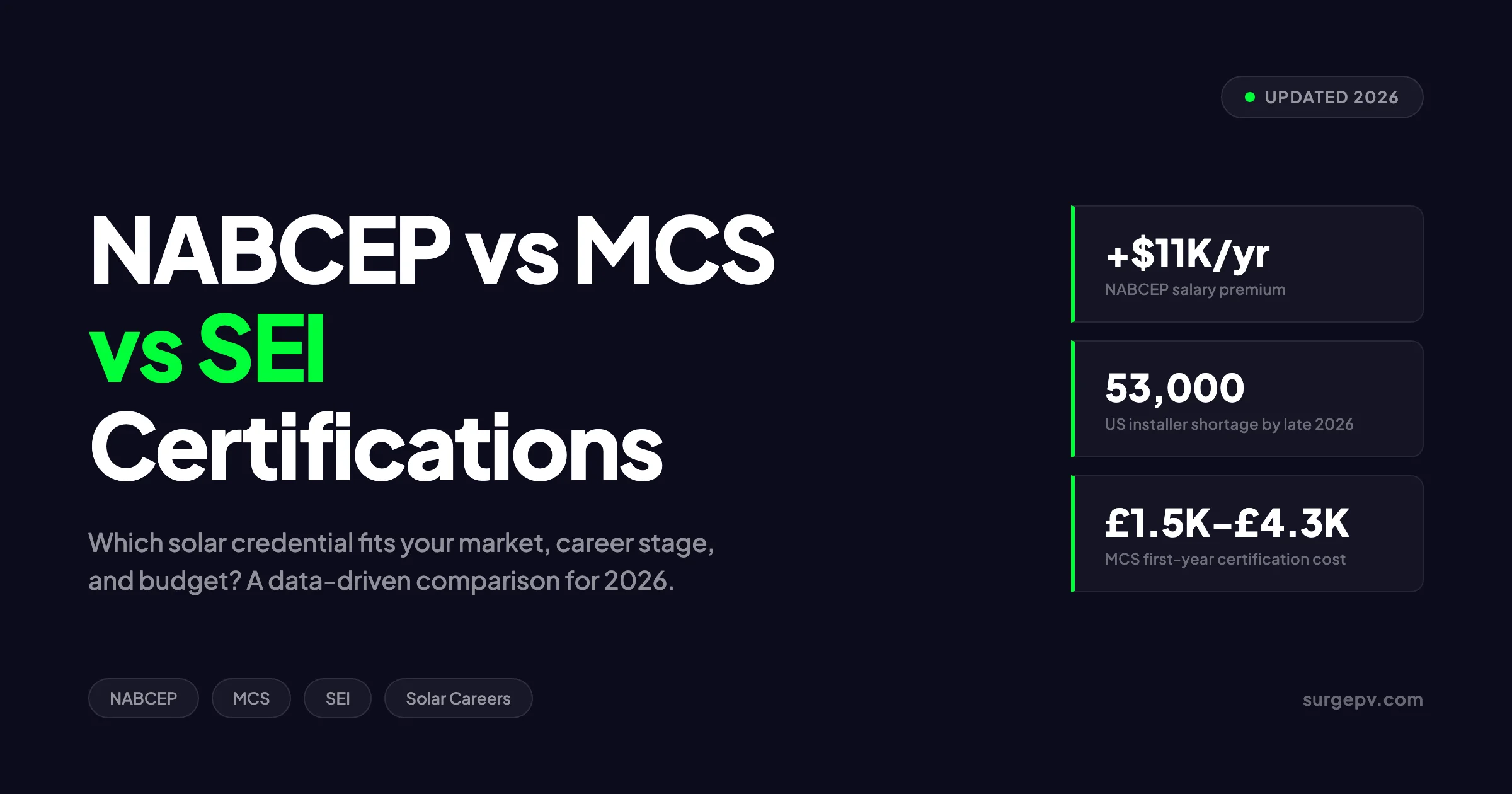
Here is a question most solar training guides never ask: what if the certification you are working toward does not actually open the doors you think it does?
Every month, installers spend thousands of dollars and hundreds of hours on credentials that look impressive on paper but fail to deliver the jobs, the pay raises, or the market access they expected. The reason is simple. NABCEP, MCS, and SEI are not three versions of the same thing. They are three entirely different tools built for three different markets, three different career stages, and three different regulatory frameworks. Also see: Us Residential Solar Market Trends 2026.
NABCEP is a professional board certification for the US market. MCS is a company accreditation scheme for the UK. SEI is a training provider that prepares people for certifications like NABCEP. Confuse them, and you waste money. Understand them, and you pick the credential that actually moves your career forward. For UK-specific information, see Battery Solar System Design UK. For United Kingdom-specific compliance details, see United Kingdom comparisons/mcs-vs-non-mcs.
This guide compares all three side by side. You will learn what each credential actually proves, what it costs, how long it takes, which market it unlocks, and how to avoid the mistakes that derail most certification journeys.
Quick Answer: NABCEP vs MCS vs SEI
NABCEP is the US gold-standard professional certification for solar installers. It is voluntary but required by most utilities and commercial clients. Cost: ~$1,000–$2,500. Time: 2–4 years. Best for: US-based installers seeking career advancement.
MCS is the UK’s company-level quality scheme for renewable installations. Without it, your customers cannot access export payments. Cost: £1,500–£4,255 first year. Time: 6–12 weeks (plus prior electrical qualifications). Best for: UK solar companies and electricians.
SEI is a training organization, not a certifying body. Its courses satisfy NABCEP’s training requirements. Cost: $995–$6,425. Time: 6 weeks per course. Best for: Anyone building foundational solar knowledge before pursuing professional certification.
Key Takeaways
- NABCEP certifies individual professionals in the US. MCS certifies installation companies in the UK. SEI trains people for both.
- NABCEP adds roughly $11,000 per year to installer salaries. MCS adds market access, not individual pay.
- NABCEP takes 2–4 years including field experience. MCS takes 6–12 weeks if you already have electrical qualifications.
- SEI’s Solar Professionals Certificate costs $5,425–$6,425 but does not replace NABCEP or MCS.
- These credentials are not transferable across borders. US NABCEP does not qualify you for UK work, and UK MCS does not qualify you for US projects.
- The biggest mistake is pursuing certification before gaining hands-on experience. Both NABCEP and MCS require documented field work.
What This Guide Covers
- How the solar certification landscape works in 2026
- A deep dive into NABCEP: requirements, costs, and career impact
- A deep dive into MCS: the UK scheme, costs, and business implications
- A deep dive into SEI: training paths, costs, and how it fits into the bigger picture
- Side-by-side comparison table across all three credentials
- US market preference: when NABCEP matters most
- UK and EU market preference: when MCS is non-negotiable
- Cost comparison with real numbers
- Time to certification for each path
- Decision framework: which credential fits your situation
- Common mistakes and what most people get wrong
- Frequently asked questions
The Solar Certification Landscape in 2026
The global solar industry employed over 280,000 workers in the United States and approximately 825,000 across Europe in 2025, according to IRENA. Both markets are growing, and both face severe shortages. The US needs an estimated 53,000 additional workers by late 2026 to meet deployment targets, according to SEIA. The UK government aims for 60 GW of installed solar capacity by 2030, which requires roughly 43,000 new job roles. Also see: European Solar Incentives.
Yet the training and credential systems in these markets could not be more different.
In the United States, solar installer credentials are decentralized. No federal license exists. Each state sets its own electrical contractor requirements. NABCEP sits on top of this patchwork as a voluntary but widely expected professional certification. It is ANSI-accredited, ISO/IEC 17024 compliant, and recognized by utilities, manufacturers, and government incentive programs.
In the United Kingdom, the system is more standardized. The 18th Edition BS 7671 wiring regulations provide a national electrical baseline. MCS adds a company-level quality layer on top. Without MCS, a UK installer can still legally wire a solar system. But the customer cannot register for the Smart Export Guarantee, which pays them for excess electricity sent to the grid. That makes MCS practically mandatory for the residential market.
SEI operates outside both frameworks. Founded in 1991 in Colorado, SEI (Solar Energy International) is the oldest and largest solar training organization in North America. It offers online and in-person courses that satisfy NABCEP’s education requirements. SEI also runs its own Solar Professionals Certificate Program, which is a training credential — not a professional certification.
The confusion starts here. Many newcomers see “SEI certificate” and assume it carries the same weight as “NABCEP certified.” It does not. SEI proves you completed rigorous training. NABCEP proves you passed a board exam and verified years of field experience. MCS proves your company meets UK quality standards. All three have value. None are interchangeable. Learn more in our NABCEP certification guide.
Pro Tip: Check Your Market Before You Spend
If you plan to work in the US, NABCEP is the credential that opens commercial contracts and utility interconnection agreements. If you plan to work in the UK, MCS is the gatekeeper to the residential market. If you are still deciding where to work, start with SEI training — it builds portable knowledge that helps in any market. For a full breakdown of the US credential, see our NABCEP certification guide.
NABCEP: The US Professional Standard
The North American Board of Certified Energy Practitioners was founded in 2002. It is an independent, non-profit organization that sets professional standards for renewable energy practitioners. NABCEP is not a government body. It does not issue licenses. What it does is certify that an individual has met rigorous education, experience, and examination standards.
What NABCEP Certifies
NABCEP offers multiple certification tracks. The most relevant for solar installers are:
PV Installation Professional (PVIP) — The flagship credential. It certifies that you can design, install, and commission grid-direct PV systems. This is the certification most employers and utilities ask for.
PV Design Specialist (PVDS) — For professionals who focus on solar design rather than physical installation.
PV Technical Sales (PVTS) — For sales professionals who need technical depth to specify systems correctly.
PV Commissioning and Maintenance Specialist (PVCMS) — For O&M-focused professionals.
Energy Storage Installation Professional (ESIP) — The newest major credential, covering battery storage systems. See Adding Battery Storage Services for detailed guidance. Read Solar Storage System Design Guide for a complete walkthrough.
PV System Inspector (PVSI) — For code officials and inspectors.
PV Associate (PVA) — An entry-level credential that does not require field experience. It is a knowledge-based exam that demonstrates foundational understanding.
Requirements for PVIP
The PV Installation Professional credential is NABCEP’s most demanding certification. To sit for the exam, you need:
- 58 hours of advanced PV training completed within the past 5 years
- OSHA 10 for Construction safety certification
- 6 project credits from documented installations
- A completed application with employer verification
Project credits are earned based on system size and your role. A lead installer on a system over 100 kW earns more credits than a helper on a residential array. Most candidates need 2–4 years of field work to accumulate enough credits.
The Board Eligible Pathway
NABCEP now offers a Board Eligible pathway that reorders the traditional sequence. Instead of completing all experience first, you can take the exam after finishing your training. You pay the same $500 fee. If you pass, you hold Board Eligible status for 3 years while you complete your project credits. Once verified, you convert to full Board Certified status at no extra cost.
This pathway is useful for people who want to prove their knowledge early in their career. But it is not a shortcut. You still need the same field experience. The only difference is timing.
NABCEP Costs
| Cost Item | Amount |
|---|---|
| Application fee | $125 |
| Exam fee | $375 |
| Total to sit for exam | $500 |
| Re-exam fee (if needed) | $275 |
| Recertification (every 3 years) | $390 |
| Training courses | $300–$1,800 |
| Typical total first-time cost | $1,000–$2,500 |
The $500 exam fee is only the beginning. Most candidates spend $300–$1,800 on preparatory training. Some employers cover these costs as professional development. Independent contractors typically pay out of pocket.
NABCEP Recertification
NABCEP certifications expire after 3 years. To renew, you need:
- 30 CEU hours of continuing education
- An industry involvement letter from your employer
- The $390 renewal fee
The 30 CEU hours break down as follows: 6 hours of NEC code training, 12 hours in your specific job task area, and 12 hours of renewable energy education (including 2 hours of building or fire codes). These requirements increased in 2025 to reflect changes in the industry.
Career Impact
NABCEP certification has a measurable effect on earnings. According to a HeatSpring survey of 58 certified professionals, 70% reported a higher salary after earning the credential. The average pay increase is approximately $11,000 per year, or a 15% premium over uncertified peers.
Beyond salary, NABCEP opens access to:
- Utility interconnection agreements that require certified installers
- Manufacturer dealer programs from SunPower, Enphase, and SolarEdge
- Commercial and utility-scale EPC contracts
- State incentive programs like SGIP and SREC markets
- The NABCEP Installer Locator, a consumer marketing tool
For US-based installers, NABCEP has shifted from “nice to have” to “expected” in most professional contexts. If you are mapping out your career, our solar installer career path guide breaks down each stage.
MCS: The UK Quality Gatekeeper
The Microgeneration Certification Scheme launched in 2007–2008 as an industry-led, government-supported quality assurance program. Unlike NABCEP, which certifies individuals, MCS certifies installation companies. The business entity — not the individual electrician — holds the certification.
What MCS Covers
MCS applies to small-scale renewable energy systems up to 50 kW. For solar installers, it covers:
- Solar PV installations
- Solar thermal systems
- Battery storage (growing segment)
- Heat pumps and biomass
MCS operates across three interconnected standards:
MCS 001 — Product certification. Panels, inverters, and batteries must appear on the MCS Product Directory.
MCS 012 / MIS 3002 — Technical installation standards covering design, wiring, commissioning, and handover.
MCS 003 — Consumer code of conduct governing sales practices, customer communication, and complaints handling.
Who Needs MCS
MCS certification is held by the company, but at least one Named Technical Person (NTP) must hold recognized PV qualifications. Required qualifications include:
- City & Guilds 2922 (or 2399) in Solar Photovoltaic Systems
- BPEC Solar PV qualification
- EAL Level 3 in Installing and Testing Solar PV Systems
- 18th Edition BS 7671 wiring regulations (mandatory prerequisite)
- NVQ Level 3 electrical qualification plus AM2 assessment
The company also needs:
- Public liability insurance (minimum £2 million)
- Competent Person Scheme registration for Part P electrical work
- A documented quality management system
- Consumer Code membership
MCS Costs
| Cost Item | Amount |
|---|---|
| Application / initial assessment | £500–£1,500 |
| Initial audit | £800–£2,000 |
| MCS annual registration | £55–£350 |
| Consumer Code membership | £100–£300 |
| Competent Person Scheme (if new) | £200–£600 |
| Documentation preparation | £0–£2,000 |
| Total first-year cost | £1,500–£4,255 |
Annual ongoing costs include surveillance audits (£300–£1,500), MCS fees, Consumer Code renewal, and approximately £30 per installation certificate. At 30 installations per year, total annual compliance runs £1,350–£2,550.
Timeline
The MCS certification process takes 6–12 weeks from application to certificate issuance. The main variable is the certification body’s backlog and how quickly you supply documentation. Incomplete applications are the most common cause of delays.
However, the full pathway for someone starting from scratch is much longer. A beginner needs 3.5–4.5 years to complete an electrical apprenticeship, pass the 18th Edition exam, and gain the NVQ Level 3 before they can even apply for MCS. Qualified electricians can add the PV-specific qualification in 3–5 days.
Why MCS Matters
Without MCS certification, your customers cannot access the Smart Export Guarantee. SEG pays homeowners 13p–25p per kWh for excess electricity exported to the grid. Over a system’s lifetime, that is worth thousands of pounds. Most UK homeowners specifically filter for MCS-certified installers when comparing quotes.
MCS also unlocks:
- Government-funded schemes like ECO4 and the Home Upgrade Grant
- Higher quote acceptance rates from comparison platforms
- Local authority and social housing contracts
- Insurance coverage (some policies require MCS for solar-specific cover)
In practice, MCS is the price of admission to the UK residential solar market.
Pro Tip: Work for an MCS Company First
If you are new to the UK solar industry, the fastest path is to join an existing MCS-certified company as an employee or subcontractor. You can also explore solar apprenticeship programs to build documented field hours. You gain field experience, learn the quality management system, and understand the certification requirements before investing in your own company accreditation.
SEI: The Training Foundation
Solar Energy International was founded in 1991 in Carbondale, Colorado. It is the oldest and largest solar training organization in North America. SEI is not a certifying body. It does not issue professional certifications. What it does is provide the education that prepares people for certifications like NABCEP.
What SEI Offers
SEI runs two main types of programs:
Individual Courses — Online and in-person classes covering solar design, installation, battery storage, and business skills. The flagship entry course is PVOL101 (online, 6 weeks, $995) or PV101 (in-person, 5 days, $1,145).
Solar Professionals Certificate Program (SPCP) — A structured curriculum requiring a minimum of 120 contact hours across multiple courses. Students choose a certificate path such as PV Installation, Solar Business and Technical Sales, or Renewable Energy Applications.
SEI Costs
| Program | Cost | Duration |
|---|---|---|
| PVOL101 (online) | $995 | 6 weeks |
| PV101 (in-person) | $1,145 | 5 days |
| Solar Professionals Certificate | $5,425–$6,425 | 4–12 months |
| NABCEP CE 18-hour package | $499 | Self-paced |
| NABCEP CE 30-hour package | $899 | Self-paced |
SEI offers payment plans ($500 down + $500/month) and scholarships. Greentech Renewables contractors receive $50 off per course.
How SEI Fits In
SEI courses satisfy NABCEP’s training hour requirements. For example, PVOL101 provides 40–60 contact hours that count toward the 58-hour requirement for PVIP. SEI also sells continuing education packages that fulfill NABCEP’s 30-hour recertification requirement.
The critical distinction: SEI proves you learned the material. NABCEP proves you can apply it in the field. SEI is a stepping stone, not a destination.
Who Should Start with SEI
SEI is the right starting point for:
- Career changers with no solar background
- Students deciding whether solar is the right field
- Professionals who need flexible online learning
- Installers preparing for NABCEP exams
- International students who want portable knowledge before choosing a market
SEI also offers a free introductory course (RE100: Introduction to Renewable Energy) for absolute beginners. If you are weighing training options, our NABCEP certification guide explains how SEI hours map to NABCEP requirements.
Side-by-Side Comparison
| Factor | NABCEP | MCS | SEI |
|---|---|---|---|
| What it is | Professional board certification | Company quality scheme | Training provider |
| Region | North America (primarily US) | United Kingdom | Global (based in US) |
| Certifies | Individual professionals | Installation companies | Training completion |
| Legal status | Voluntary | Voluntary (but market-required) | Voluntary |
| Prerequisites | 58 hrs training + 6 project credits + OSHA 10 | Electrical qualifications + company structure | None |
| Direct exam fee | $500 | N/A (via certification body) | N/A |
| Total typical cost | $1,000–$2,500 | £1,500–£4,255 first year | $995–$6,425 |
| Time to complete | 2–4 years | 6–12 weeks (plus prior quals) | 6 weeks per course |
| Salary impact | +$11,000/year (+15%) | Company-level pricing power | None direct |
| Renewal | Every 3 years, 30 CEU hrs | Annual surveillance audit | No renewal required |
| Renewal cost | $390 + training | £455–£2,550/year | N/A |
| Market access | Utility interconnection, commercial contracts, manufacturer programs | SEG payments, government schemes, residential market | Knowledge only |
| Transferable | No — US only | No — UK only | Yes — knowledge is portable |
US Market: When NABCEP Is Essential
The US solar market is decentralized. No federal solar license exists. Each of the 50 states sets its own electrical contractor requirements. Some states have dedicated solar contractor licenses. Others require only a general electrical license. A few have minimal requirements. For anyone entering the trade, solar apprenticeship programs are the most reliable path to the hours you need.
For installers evaluating tools, solar software like SurgePV streamlines the design and documentation that NABCEP-certified professionals handle daily. For a direct comparison, see Arka 360 vs SurgePV.
NABCEP sits above this patchwork. It is voluntary at the federal level. But in practice, it has become a market requirement for several reasons. Many employers now treat it as the baseline for any installer working with solar design software at scale.
Utilities Require It
Many US utilities require NABCEP certification for interconnection agreements. If you want to connect a solar system to the grid, the utility may insist that a NABCEP-certified professional performed or supervised the installation. This is especially common in California, New York, Massachusetts, and Texas.
Incentive Programs Require It
State and federal incentive programs increasingly list NABCEP certification as a prerequisite. The Self-Generation Incentive Program (SGIP) in California, SREC markets in the Northeast, and various state rebate programs all favor or require NABCEP-certified installers.
Manufacturers Require It
Premium solar manufacturers like SunPower, Enphase, and SolarEdge require NABCEP certification for their dealer and installer networks. If you want to sell and install these brands, you need the credential.
Commercial Contracts Require It
EPC contracts for commercial and utility-scale projects increasingly specify NABCEP certification for lead installers and project managers. At the 200 kW+ scale, most RFPs include NABCEP as a scoring criterion.
The Salary Premium
NABCEP-certified installers earn approximately $11,000 more per year than their uncertified peers, according to HeatSpring (2025). That is a 15% premium. For a credential that costs $1,000–$2,500 and takes 2–4 years to earn, the payback period is roughly 2–3 months after certification.
What the Data Says
According to SEIA (2025), the US solar industry employed 280,119 workers. The median installer salary was $51,860 per year. NABCEP certification pushes that figure into the $60,000–$80,000 range for experienced installers. At the commercial and utility scale, NABCEP-certified project managers and lead installers can earn $90,000–$130,000.
UK and EU Market: When MCS Is Non-Negotiable
The UK solar market is more centralized than the US. The 18th Edition BS 7671 provides a single national electrical standard. MCS adds a quality layer on top.
Why MCS Is Practically Mandatory
The Smart Export Guarantee is the key driver. SEG pays homeowners for excess electricity they export to the grid. Rates range from 13p to 25p per kWh depending on the supplier. Over a 25-year system lifetime, that adds up to thousands of pounds.
Homeowners cannot register for SEG unless their system was installed by an MCS-certified company. That makes MCS a de facto requirement for the residential market. An uncertified installer might win a few jobs from uninformed customers. But most homeowners filter for MCS on comparison sites. Most mortgage lenders require MCS for solar-specific valuations. Most insurers prefer it. Read more about Agricultural Solar Case Study. For France-specific information, see Floating Solar Farms France.
The UK Solar Workforce Context
The UK government aims for 60 GW of solar capacity by 2030. That target requires approximately 43,000 new job roles, according to SolarPower Europe. The Solar Careers UK program, launched in July 2025, aims to build a talent pool of 2,000 candidates in year one, expanding to 4,000–6,000 before further ramping. For Europe-specific compliance details, see Europe solar compliance.
The six most in-demand solar roles in the UK are:
- Small-scale solar PV designer and installer
- Small-scale solar PV project manager
- Commercial and industrial solar PV installer
- Commercial and industrial solar PV design engineer
- Commercial and industrial solar PV project manager
- Utility-scale site technician
All of these roles benefit from MCS certification or work within MCS-accredited companies.
MCS and the European Context
MCS is UK-specific. It does not apply to EU markets post-Brexit. However, the underlying principle — a quality assurance scheme linked to subsidy eligibility — exists across Europe. Germany has its own certification requirements. France has QualiPV. Spain has specific installer registries. For UK installers looking to work in Europe, MCS provides a quality foundation but does not replace local credentials. For a deeper look at UK credentials, read our MCS certification solar UK guide. Also see: Germany solar subsidies. Also see: France solar feed-in tariffs. Also see: Spain net metering.
Cost Comparison: Real Numbers
Let us look at what each credential actually costs, including hidden expenses that training providers rarely mention.
NABCEP Total Cost of Ownership (3 Years)
| Item | Cost |
|---|---|
| Application + exam | $500 |
| Training courses | $800–$1,500 |
| Study materials | $100–$300 |
| OSHA 10 (prerequisite) | $50–$100 |
| Travel to exam center (if applicable) | $0–$500 |
| Recertification at year 3 | $390 |
| CEU training for renewal | $300–$600 |
| 3-year total | $2,140–$3,890 |
MCS Total Cost of Ownership (3 Years)
| Item | Cost |
|---|---|
| Initial certification | £1,500–£4,255 |
| Year 1 ongoing | £455–£1,655 |
| Year 2 ongoing | £455–£1,655 |
| Year 3 ongoing | £455–£1,655 |
| 3-year total | £2,865–£9,220 |
Note: MCS costs vary significantly based on company size, installation volume, and certification body. A one-person operation at low volume might spend £2,865 over three years. A multi-crew company at high volume might spend £9,220.
SEI Total Cost of Ownership
| Item | Cost |
|---|---|
| PVOL101 entry course | $995 |
| Additional courses for certificate | $4,430–$5,430 |
| Total | $5,425–$6,425 |
SEI certificates do not expire, so there is no renewal cost. However, solar technology changes rapidly. A course completed in 2024 may not cover 2026 code changes or battery storage integration.
Time to Certification: What to Actually Expect
Training providers often quote optimistic timelines. Here is what the real world looks like.
NABCEP Real Timeline
| Phase | Typical Duration |
|---|---|
| Entry-level solar job | Month 0 |
| OSHA 10 training | 1–2 days |
| 58 hours of approved training | 2–6 months (part-time) |
| Accumulate 6 project credits | 18–36 months |
| Application review | 4–6 weeks |
| Exam prep and scheduling | 2–4 weeks |
| Total from first job to certification | 2–4 years |
The Board Eligible pathway lets you take the exam after training, but you still need 3 years to complete the experience requirement. There is no genuine shortcut.
MCS Real Timeline
| Phase | Typical Duration |
|---|---|
| Electrical apprenticeship (if needed) | 3.5–4.5 years |
| 18th Edition qualification | 3–5 days |
| PV-specific qualification (C&G 2922) | 3–5 days |
| Prepare documentation | 2–4 weeks |
| Application and audit | 6–12 weeks |
| Total for qualified electrician | 2–4 months |
| Total from scratch | 3.5–5 years |
SEI Real Timeline
| Phase | Typical Duration |
|---|---|
| PVOL101 online | 6 weeks |
| Additional courses (if certificate path) | 4–10 months |
| Total for full certificate | 4–12 months |
Which Credential Should You Choose? A Decision Framework
The right credential depends on four factors: your location, your experience level, your career goals, and your budget. If you are just starting out, our guide on how to become a solar installer covers the first steps before certification enters the picture.
If You Are in the United States
New to solar (0–1 year experience): Start with SEI’s PVOL101 or the NABCEP PV Associate exam. Build foundational knowledge before investing in advanced credentials.
Working installer (1–3 years): Pursue NABCEP PVIP through the Board Eligible pathway. Take the exam now. Accumulate project credits over the next 3 years.
Lead installer or crew chief (3+ years): If you do not have NABCEP PVIP, get it. It is becoming a market requirement. Consider adding ESIP if you work with battery storage.
Business owner: Ensure your lead installers are NABCEP-certified. This unlocks commercial contracts, utility interconnection, and manufacturer dealer programs.
If You Are in the United Kingdom
Qualified electrician without PV experience: Complete City & Guilds 2922 (3–5 days, ~£689–£1,200). Then apply for MCS certification through a certification body like NAPIT or NICEIC.
New to the electrical trade: Start with an electrical apprenticeship. MCS is not your first step. You need the electrical foundation first.
Solar company owner: If you are not MCS-certified, get certified immediately. You are leaving the residential market on the table.
Installer working for MCS company: Focus on gaining experience and qualifications. Your employer holds the MCS certificate. Your job is to become the Named Technical Person they rely on.
If You Are International or Undecided
Start with SEI training. It builds portable knowledge that applies in any market. Then choose NABCEP for North America, MCS for the UK, or local equivalents for other markets. Do not try to make one credential work everywhere. It will not.
Design Solar Systems with Confidence
Whether you are NABCEP-certified, MCS-accredited, or still training, the right software makes every installation faster and more accurate.
Explore Solar Design SoftwareBuilt for certified professionals · NEC and BS 7671 compliant · Free trial
Common Mistakes and What Most People Get Wrong
Mistake 1: Treating Certifications as Interchangeable
NABCEP, MCS, and SEI are not three brands of the same product. They serve different markets, different legal frameworks, and different career stages. A NABCEP certificate will not get you MCS work in the UK. An MCS certificate will not get you NABCEP work in the US. SEI training helps with both but replaces neither.
Mistake 2: Pursuing Certification Before Experience
Both NABCEP and MCS require documented field experience. You cannot sit for NABCEP PVIP without project credits. You cannot get MCS without electrical qualifications and installation competence. Training providers sometimes market their courses to beginners who are years away from meeting the experience requirements. Buy the training when you need it, not when it is on sale.
Mistake 3: Ignoring the Total Cost of Ownership
The exam fee is only part of the cost. NABCEP requires $390 renewal every 3 years plus 30 CEU hours. MCS requires annual audits and per-installation fees. SEI courses are expensive upfront but have no renewal. Calculate the 3-year cost, not just the initial fee.
Mistake 4: Skipping the Electrical Foundation
In both the US and UK, solar installation is electrical work. NABCEP requires OSHA 10 and assumes electrical competency. MCS requires full electrical qualifications. Trying to become a solar installer without understanding basic electrical theory is like trying to become a surgeon without studying anatomy. Start with the fundamentals.
Mistake 5: Thinking One Credential Is Enough Forever
The solar industry changes fast. NEC 2023 introduced significant updates to Article 690 (solar PV systems). The UK’s MIS 3002 was revised in 2025. Battery storage integration is now standard on most residential systems. A credential earned in 2020 does not prove competence in 2026. Continuing education is not optional. It is maintenance.
What Most Get Wrong About SEI
The most common misconception is that SEI certification equals NABCEP certification. It does not. SEI is a training provider. NABCEP is a professional board. SEI courses prepare you for NABCEP. They do not replace it. When a job posting asks for “NABCEP certification,” an SEI certificate does not qualify.
What Most Get Wrong About MCS
Many UK electricians assume MCS is a personal qualification like NABCEP. It is not. MCS is held by the company. An individual electrician can be highly skilled and fully qualified, but if their employer loses MCS accreditation, they cannot issue MCS certificates for installations. Job security in the UK solar trade is tied to your employer’s certification status as much as your own skills.
The Tradeoff Nobody Talks About
Here is the uncomfortable truth: certifications open doors, but they do not guarantee work. The US solar industry needs 53,000 more workers by late 2026. The UK needs 43,000 new roles by 2030. Yet 86% of US solar employers report difficulty filling positions. The bottleneck is not a lack of certified workers. It is a lack of workers, period.
Certification makes you more competitive among the workers who exist. It does not create demand where none exists. In a tight labor market, an uncertified installer with 2 years of experience will get hired before a freshly certified installer with no field work. Experience plus certification beats certification alone every time.
A Story from the Field
I met a contractor in Texas at a trade show in 2024. He had spent $4,200 on SEI courses, passed the NABCEP PVIP exam on his first attempt, and printed business cards with “NABCEP Certified” in bold letters. He had zero installation experience. He thought the credential would bring customers.
Six months later, he was back installing roofs for a general contractor. No solar company would hire him as a lead installer without field credits. No homeowner would hire an independent contractor with no portfolio. His $4,200 bought knowledge, not customers.
The lesson: certification validates what you already do. It does not replace the doing. He should have spent his first year on a crew, his second year studying for the exam, and his third year launching his business with both the credential and the portfolio to back it up.
Frequently Asked Questions
Which solar certification pays the most in 2026?
NABCEP-certified installers in the United States report the highest salary premiums. The credential adds approximately $11,000 per year (a 15% raise) according to industry surveys. In the UK, MCS certification does not directly raise an individual installer’s salary because it is held by the company, not the person. However, MCS-accredited firms can charge 5–15% more per job. SEI certificates are training credentials, not professional certifications, so they do not carry a direct salary premium — though they are a prerequisite for earning NABCEP.
Can I use NABCEP certification to work in the UK, or MCS to work in the US?
No. NABCEP and MCS are not transferable across markets. NABCEP is built around the US National Electrical Code (NEC), while MCS follows the UK’s BS 7671 wiring regulations. An installer with NABCEP would still need UK electrical qualifications, MCS company certification, and familiarity with UK standards to work legally and commercially in Britain. The same applies in reverse. For international work, you need market-specific credentials in each country.
How long does each certification take from start to finish?
NABCEP PVIP takes 2–4 years for most candidates: 58 hours of training, 6 project credits of field experience, plus exam prep and scheduling. The new Board Eligible pathway lets you take the exam earlier, but you still need 3 years to convert to full certification. MCS certification for a UK company takes 6–12 weeks from application to approval, but the installer needs prior electrical qualifications that take 3.5–4.5 years to earn. SEI’s Solar Professionals Certificate takes 4–6 months of part-time online study, or 2–3 weeks of intensive in-person labs.
Is SEI a certification or just a training provider?
SEI is a training provider, not a certifying body. SEI issues certificates of completion for its courses, which satisfy NABCEP’s training hour requirements. The actual professional certification comes from NABCEP after you pass their exam and verify your experience. Think of SEI as the school and NABCEP as the licensing board. SEI is one of the most respected solar training organizations in the world, but its certificates alone do not qualify you to sign off on installations or bid on commercial contracts.
What is the total cost for each credential?
NABCEP PVIP costs $500 in direct fees ($125 application + $375 exam) plus $300–$1,800 in training, for a typical total of $1,000–$2,500. MCS certification costs £1,500–£4,255 in the first year including assessment, audit, insurance, and documentation, then £455–£2,550 annually. SEI’s Solar Professionals Certificate costs approximately $5,425–$6,425 for the full program, or $995 per individual online course. NABCEP recertification costs $390 every 3 years plus 30 CEU hours.
Do I need a certification to install solar panels?
In the US, you need a state electrical contractor license to perform the electrical work, but NABCEP itself is voluntary. In the UK, you need electrical qualifications (NVQ Level 3, 18th Edition) to do the wiring, but MCS is voluntary — though without it your customers cannot access Smart Export Guarantee payments. In practice, both NABCEP and MCS have become market requirements because utilities, incentive programs, and customers demand them. You can technically install without them, but your addressable market shrinks dramatically.
What is the NABCEP Board Eligible pathway?
The Board Eligible pathway, introduced in recent years, lets candidates take the NABCEP PVIP exam before completing all field experience requirements. You pay the same $500 fee, pass the exam, and then have 3 years to accumulate the required 6 project credits. Once verified, you convert to full Board Certified status at no extra cost. This is ideal for people who have completed training and want to prove their knowledge while gaining experience. It does not replace the experience requirement — it just reorders the steps.
Which certification should I get first if I am new to solar?
Start with SEI’s PVOL101 or an equivalent introductory course to build foundational knowledge. Next, earn the NABCEP PV Associate credential ($150 total) as a stepping stone. Then gain 1–2 years of field experience while working toward NABCEP PVIP or, in the UK, pursue electrical qualifications followed by MCS certification. Do not attempt NABCEP PVIP or MCS without hands-on experience — both require documented installation work that you cannot fake.
How do I maintain these certifications once I have them?
NABCEP requires 30 CEU hours every 3 years, an industry involvement letter, and a $390 renewal fee. The 30 hours must include 6 hours of NEC code training, 12 hours in your specific job task area, and 12 hours of renewable energy education. MCS requires annual surveillance audits, ongoing compliance with MIS 3002 standards, consumer code membership, and per-installation certificate fees. SEI certificates do not expire, but the knowledge they represent becomes outdated quickly in a fast-moving industry.
What is the biggest mistake people make when choosing a solar certification?
The biggest mistake is treating certifications as interchangeable or as a substitute for experience. NABCEP, MCS, and SEI serve completely different purposes in different markets. Another common error is pursuing NABCEP PVIP before gaining field experience — the exam is designed for working professionals, not students. In the UK, some electricians try to skip MCS because of the cost, then discover they cannot access the residential market. The right approach is to match the credential to your market, your experience level, and your career goals — not to chase the most impressive-sounding title.
Conclusion: Three Credentials, Three Paths, One Principle
NABCEP, MCS, and SEI are not competitors. They are complementary tools for different stages of a solar career.
SEI gives you knowledge. It is where you start when you know nothing and need to learn fast. If you are completely new to the trade, read our guide on how to become a solar installer first.
NABCEP gives you professional standing in the US. It is what you earn after years of field work when you want to bid on commercial contracts and command a higher salary. For definitions of key terms, see our NABCEP certification glossary entry.
MCS gives your company market access in the UK. It is what you need when you want to serve residential customers who depend on export payments.
The principle that unites all three is this: credentials validate competence. They do not create it. Start with training. Build experience. Then certify what you have already proven you can do.
If you are deciding today, here are three actions to take:
-
Identify your market. If you work in the US, prioritize NABCEP. If you work in the UK, prioritize MCS. If you are unsure, start with SEI training and decide later.
-
Audit your experience. If you have fewer than 12 months of field work, focus on gaining experience before pursuing advanced credentials. Certification without experience is an expensive piece of paper.
-
Calculate the full cost. Include training, exam fees, travel, renewal, and continuing education. A $500 exam becomes a $3,000 commitment over three years. Budget for the full journey, not just the first step.
The solar industry needs skilled, certified professionals. The path is clear. The demand is real. Pick the credential that fits your market, do the work, and let the certification confirm what your experience already proves. Solar proposal platform generates professional quotes in minutes.
Where this fits
This article is part of SurgePV's Solar Business & Operations hub, which works through the topic from first principles to the decisions a project team actually has to make.


