

Quick Answer
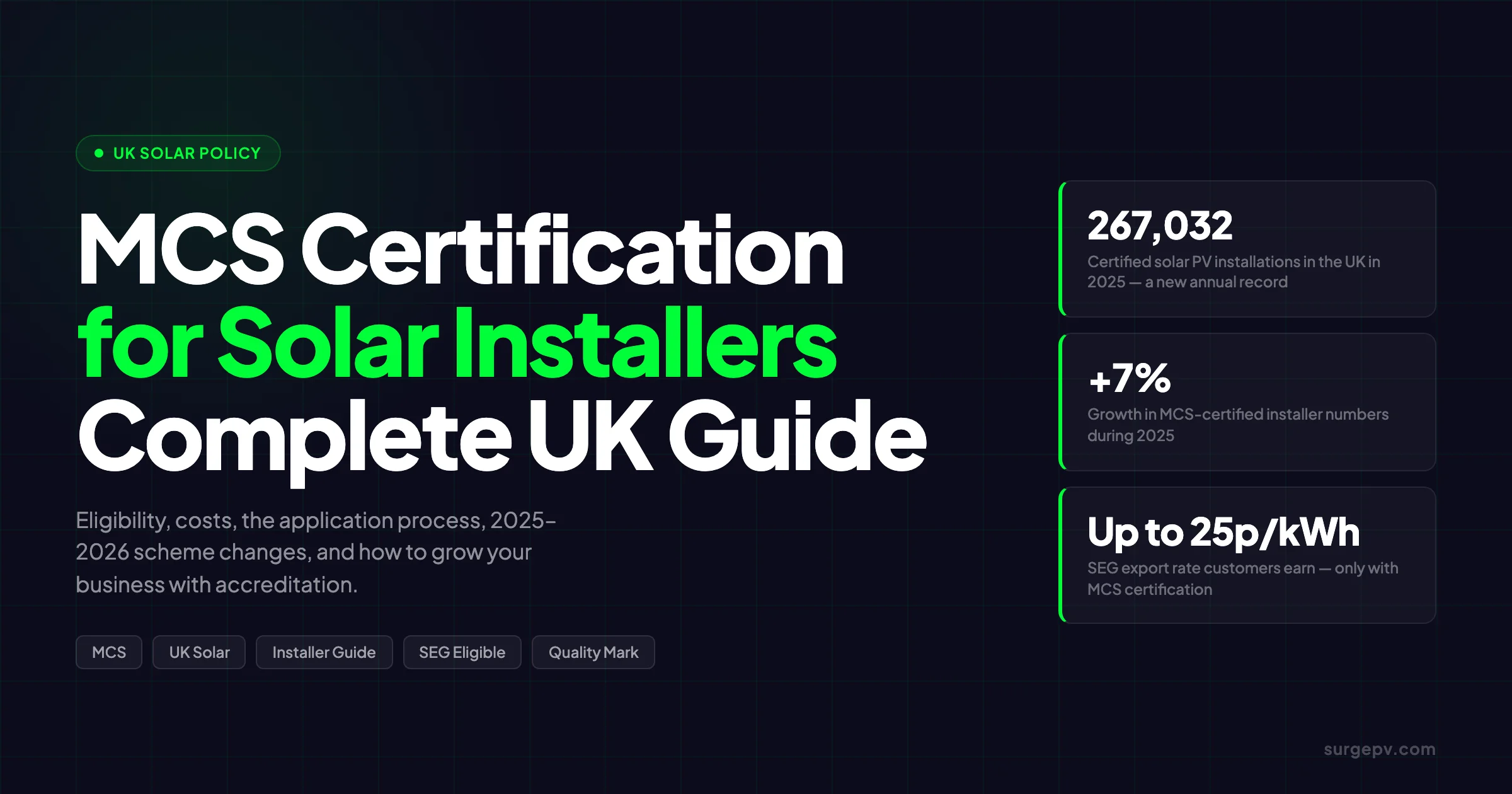
The UK solar market installed 267,032 certified solar PV systems in 2025 — a 31% increase above the previous annual record set in 2011. MCS was established in 2007 and became central to the UK solar market when the Feed-in Tariff launched in 2010. The number of MCS-certified solar installers grew by 7% over the course of 2025.
The UK solar market installed 267,032 certified solar PV systems in 2025 — a 31% increase above the previous annual record set in 2011. Behind every one of those installations is an MCS-certified installer. For solar companies operating in the UK, MCS certification is not a box-ticking exercise — it is the licence to compete in a market that is growing faster than at any point in the country’s solar history. Read more about Battery Solar System Design UK. For UK-specific information, see Heritage Building Solar Case Study. For United Kingdom-specific compliance details, see United Kingdom comparisons/mcs-vs-non-mcs.
The UK solar market installed 267,032 certified solar PV systems in 2025 — a 31% increase above the previous annual record set in 2011. MCS was established in 2007 and became central to the UK solar market when the Feed-in Tariff launched in 2010. The number of MCS-certified solar installers grew by 7% over the course of 2025. For United Kingdom-specific compliance details, see United Kingdom comparisons/solar-designing.
This guide covers what MCS certification means for your business, what it takes to get certified, what the process looks like end to end, what 2025-2026 scheme changes you need to act on, and how running disciplined installation processes from day one makes the whole thing significantly easier.
TL;DR — MCS Certification for Solar Installers
MCS (Microgeneration Certification Scheme) is the UK’s quality standard for solar installers. Without it, your customers cannot access Smart Export Guarantee payments and most homeowners will not shortlist you. Initial certification costs £500–£1,500, takes 6–12 weeks, and requires qualified staff, documented procedures, and a successful site assessment. The 2025-2026 scheme redevelopment introduces updated standards — if you are already certified, check your certification body is guiding you through the transition.
What MCS Certification Actually Is
MCS is the Microgeneration Certification Scheme — an independent, government-backed quality assurance programme for small-scale renewable energy in the UK. It covers solar PV, wind, heat pumps, battery storage, and biomass. For solar installers, it operates across three interconnected standards: For more on this topic, see Adding Battery Storage Services.
- MCS 001 — Product certification: every panel, inverter, and battery used in a certified installation must appear on the MCS Product Directory
- MCS 012 — The technical installation standard: how systems must be designed, wired, commissioned, and handed over
- MCS 003 — Consumer code: minimum requirements for contracts, cooling-off periods, energy assessments, and complaint handling
Certification is held by the installation company as a legal entity, not by individual electricians or roofers. Your named operatives must hold relevant qualifications, but the certificate belongs to the business. This matters when staff changes happen — any operative departure that affects your certification must be notified to your certification body before they leave.
MCS was established in 2007 and became central to the UK solar market when the Feed-in Tariff launched in 2010. When the Feed-in Tariff closed to new applicants in March 2019, MCS remained mandatory for Smart Export Guarantee access. Today, with SEG rates ranging from 13p to 25p per kWh, MCS-certified systems earn customers £150 to £300 per year in export payments — money they cannot access without your accreditation.
For an in-depth look at the regulatory framework around MCS — including the standards text, competent person scheme interaction, and commissioning documentation requirements — see the UK MCS Certification Guide in our compliance centre.
The Market Opportunity Behind MCS Certification
The numbers from 2025 make a clear case. The number of MCS-certified solar installers grew by 7% over the course of 2025. Total MCS-certified renewable installations reached 369,000 — the highest annual total in the scheme’s history. Solar PV alone accounted for 267,032 of those, compared to the previous record of around 203,000 in 2011.
In Q4 2025 alone, 58,708 solar PV installations were completed by 5,636 certified contractors.
| Metric | 2025 Figure |
|---|---|
| Total MCS-certified renewables installed | 369,000 |
| Solar PV installations | 267,032 |
| Year-on-year growth vs. 2011 record | +31% |
| Certified contractors active in Q4 2025 | 5,636 |
| Growth in certified installer numbers | +7% |
| Solar PV installations in Q4 2025 alone | 58,708 |
The UK government’s net-zero targets require roughly 40 GW of solar capacity by 2030, compared to around 17 GW installed today. The installation volume required to bridge that gap means demand for qualified MCS-certified installers will remain strong for years. Companies that build their MCS accreditation now, before the pipeline fully accelerates, will be positioned ahead of those scrambling to certify during a supply crunch.
SEG Earnings: The Customer Benefit You Can Quote
A typical 4 kWp residential system without battery storage exports approximately 1,500–2,000 kWh per year. At the current average SEG rate of 13p per kWh, that is £195–£260 annually. With premium tariffs from Octopus or Good Energy reaching 25p/kWh, annual earnings can reach £375–£500. MCS certification is what makes these payments accessible to your customers.
Why Customers Demand MCS-Certified Installers
The business logic for getting certified runs deeper than just SEG access.
Lead generation platforms filter on MCS status. Most comparison sites and lead generation tools in the UK solar market — including Which? Trusted Traders, Checkatrade, and Trustmark — require or prominently feature MCS certification. Appearing in those filtered results is worth several thousand pounds in lead cost savings annually. Also see: Us Residential Solar Market Trends 2026. See our guide on Agricultural Solar Case Study for more.
Government schemes require it. ECO4 (Energy Company Obligation), the Home Upgrade Grant, and the Social Housing Decarbonisation Fund all require MCS-certified installations. These publicly funded schemes represent a significant revenue stream unavailable to uncertified companies.
The MCS Guarantee builds customer confidence. MCS-certified installations come with a five-year workmanship guarantee backed by the scheme. For a homeowner spending £7,000 to £9,500 on a 4 kWp system, this guarantee is a credible safety net if the installer ceases trading. It is distinct from product warranties and is administered under MCS 003.
Property valuations reference MCS status. Surveyors and mortgage assessors increasingly look for MCS certification when valuing homes with solar. A system that cannot be verified against MCS standards may be flagged as a liability rather than an asset.
The alternative — operating without MCS — limits you to commercial buyers who may accept uncertified work and a shrinking pool of residential customers who either do not know about SEG or are willing to forgo it. That market segment will only get smaller as public awareness of export payments grows.
Eligibility Requirements: What Your Company Needs Before Applying
MCS certification is held at company level, but the eligibility assessment looks at the qualifications, insurance, and operational processes behind the business. Before you approach a certification body, you need these in place.
Qualified Personnel
At least one named lead installer on the certificate must hold a recognised PV qualification. Accepted qualifications are:
| Qualification | Body |
|---|---|
| City & Guilds 2399 (Solar PV for Electricians) | City & Guilds |
| BPEC Solar PV Installation | BPEC |
| EAL Level 3 Award in Installing and Testing Solar PV Systems | EAL |
If your installations include significant roof work, named operatives carrying out structural or roofing elements may also need relevant roofing qualifications. The certification body will specify this based on your scope of work during the application review.
The Nominated Technical Person (NTP) on your certificate carries responsibility for technical quality across your installations. This role must be filled by someone with both the qualification and demonstrable hands-on installation experience.
Electrical Competency and Part P
Solar PV electrical work is notifiable under Part P of the Building Regulations in England. Your company must either hold registration with a competent person scheme (NAPIT, NICEIC, or similar) or notify building control separately for each installation. Nearly all MCS-certified solar installers use the competent person route — it is simpler, faster, and cheaper per installation than individual building control notifications.
If your company is not yet registered with a competent person scheme, apply for that alongside your MCS application. Many certification bodies offer bundled MCS and Part P registration.
Insurance
You must carry adequate public liability insurance before the application is accepted. The standard minimum is £2 million, but some certification bodies, commercial clients, and local authority contracts require £5 million. Product liability insurance is also expected. Professional indemnity cover is advisable if you provide written energy yield assessments or financial projections to customers.
Have your insurance schedule ready to upload when you apply — it is one of the first documents reviewed.
Quality Management Documentation
You do not need ISO 9001 or a formally certified quality management system. What assessors expect is documented procedures for design, installation, commissioning, and complaint handling that your staff can demonstrate following in practice.
At minimum, this means written procedures covering:
- Site survey and shading assessment
- System design (string sizing, inverter selection, structural check)
- Installation methods and DC wiring
- Commissioning tests (insulation resistance, OC voltage, SC current)
- Handover documentation to the customer
- Customer complaints process
These do not need to be a large document. Clarity and consistency with what assessors actually observe during the site visit matters more than volume.
Pro Tip
Run a gap analysis against MCS 012 before applying. Download the standard from mcscertified.com and work through each section against your current practices. Mark what you already do and where you need to write a new procedure. Installers who do this first typically move through the assessment with fewer non-conformances.
Certification Bodies: Choosing the Right One
MCS does not certify installers directly. It approves a set of certification bodies who conduct assessments and issue certificates on MCS’s behalf. In 2026, the main options for solar PV are:
| Certification Body | Key Characteristics |
|---|---|
| NAPIT | Large scheme covering electrical and renewable installations. Bundled MCS + Part P available. Online portal widely regarded as straightforward. |
| NICEIC | Long-established electrical scheme. Strong technical resources and helpline. Widely recognised by domestic customers. |
| RECC | Renewable Energy Consumer Code. Consumer protection focus. Includes MCS 003 compliance support. Good option for companies prioritising consumer code compliance. |
| Stroma | Covers energy assessment and renewable installation. Smaller market share but competitive fees for some company sizes. |
| Kiwa | Strong in commercial and European contexts. Worth considering for companies targeting larger commercial projects. |
When comparing certification bodies, focus on four things:
- Total annual cost — including application, initial assessment, annual surveillance, and consumer code membership
- What is bundled — some bodies include Part P registration, training resources, and consumer code compliance in one fee; others charge for each component separately
- Assessment turnaround — ask how long the current wait is from application submission to first site visit
- Portal quality — you will use the body’s portal to issue MCS certificates for every installation; a slow or difficult portal adds cost per job
Request a fee schedule from at least two certification bodies before committing. The cheapest initial fee is rarely the cheapest option over three years.
The MCS Certification Process: Step by Step
The process from decision to certificate typically runs 6 to 12 weeks. Delays almost always trace back to one of two causes: incomplete documentation submitted at the start, or difficulty scheduling the site assessment around live installations.
Step 1: Pre-Application Preparation (2–4 weeks)
Gather every required document before opening the application:
- Company registration certificate (Companies House number or sole trader evidence)
- All named operative qualification certificates (originals or certified copies)
- Public liability and product liability insurance schedule (current)
- Competent person scheme registration confirmation (or building control notification evidence)
- Written procedures for design, installation, commissioning, and complaints
- At least one documented example installation (survey, design, commissioning record)
The last item — a documented example installation — is often the bottleneck. If your existing records are informal, create a clean set for one recent project that follows your new written procedures before applying. Assessors refer to this during the desktop review.
Step 2: Select a Certification Body and Submit the Application
Choose your certification body, complete their application form, and pay the initial assessment fee. The certification body assigns an assessor and begins the documentation review.
If anything is missing or unclear, the process pauses until you respond. Treat the assessor’s document queries as preparation for the site visit — they are flagging what they will look for in person.
Step 3: Desktop Audit
The assessor reviews your submitted documentation against MCS 001, MCS 012, and MCS 003. They are checking whether your documented procedures match what the standards require — not whether your work is perfect, but whether you have a system that could produce consistently compliant work.
Common issues found at desktop stage:
- Commissioning procedures that omit specific tests required by MCS 012
- Complaint handling that lacks the required timescales (MCS 003 specifies resolution periods)
- Shading assessment methodology not referenced in design procedures
- Handover documentation checklist incomplete
Address any observations promptly. Most can be resolved with written additions to your procedures rather than significant operational changes.
Step 4: On-Site Assessment
An assessor visits an active or recently completed installation to observe your work against the standards. They will typically:
- Review the system design documentation against the installed configuration
- Check DC wiring methods, cable routing, and UV protection
- Inspect isolator placement, ratings, and labelling
- Review inverter installation, clearances, and commissioning records
- Check handover documentation provided to the customer
- Interview the lead installer on technical questions
What Assessors Commonly Flag
The most frequently cited non-conformances in MCS 012 site assessments are: DC isolator labelling missing the required voltage and current information; commissioning records that do not include all required test parameters; handover packs without as-installed drawings; and shading/yield assessment documentation absent from the project file. Have these specifically reviewed before the assessor arrives.
If non-conformances are identified, you receive a report with corrective actions. Minor ones can often be resolved with documentation evidence submitted remotely. Major ones may require a follow-up site visit. Most first-time applicants experience at least one minor non-conformance — it does not prevent certification, it just adds a step.
Step 5: Certification Decision and Listing
Once non-conformances are closed, the certification body issues your MCS certificate and lists your company on the MCS Installer Register. You receive login credentials for the MCS database portal, which is where you register every installation and generate MCS certificates for customers.
The MCS Installer Register is publicly searchable. Customers, lead generation platforms, and government scheme administrators use it to verify your status. Keep your company details current — an outdated address or lapsed insurance on your listing undermines customer confidence even if your certificate is technically valid.
Step 6: Issue Your First Certificates
For every MCS-compliant installation you complete, you register the job in the MCS database and generate an MCS installation certificate. The certificate number is what your customer uses to register for Smart Export Guarantee payments with their energy supplier.
The per-certificate cost is £30. At 50 installations per year, that is £1,500 annually — a line item worth building into your pricing.
Cost Breakdown: What MCS Certification Costs in 2026
There are two distinct cost categories: getting certified, and staying certified.
Initial Certification Costs
| Cost Item | Typical Range |
|---|---|
| Application and initial assessment fee | £500–£1,500 |
| Consumer code membership (MCS 003) | ~£100 |
| MCS annual company fee | ~£55 |
| Competent person scheme registration (if new) | £200–£600 |
| Documentation preparation (internal time or consultant) | £0–£2,000 |
| Total first-year cost | £855–£4,255 |
The wide range reflects company size and whether you use a consultant to help prepare documentation. For a small sole-trader operation with documentation already in reasonable shape, the lower end is achievable. For a company with multiple operatives and no existing written procedures, budget for the higher end.
Ongoing Annual Costs
| Cost Item | Typical Range |
|---|---|
| Annual surveillance audit | £300–£500 |
| MCS annual company fee | ~£55 |
| Consumer code membership renewal | ~£100 |
| Per-installation certificate fees (£30 per install) | Varies |
| Total annual overhead (ex. installation fees) | £455–£655 |
At 30 installations per year, the per-certificate cost adds £900, bringing the total annual compliance cost to roughly £1,350–£1,550. Against the revenue a certified installer generates — average system price of £7,500 at 30 installs equals £225,000 — the compliance cost is under 1% of revenue.
The ROI of Getting Certified
The case for certification is not just cost avoidance. It is revenue access.
MCS-certified installers can charge a premium. Market data from lead generation platforms consistently shows that MCS-certified quotes command 5–15% higher acceptance rates than uncertified quotes for equivalent systems. Over 30 installations, that conversion rate difference is worth more than the entire annual compliance cost.
Access to government-funded schemes (ECO4, Home Upgrade Grant) creates an additional revenue channel that is entirely closed to uncertified companies. ECO4 funding in particular has supported thousands of installs for low-income households — a segment that is politically protected and likely to persist across governments.
Design MCS-Compliant Systems from Day One
SurgePV generates the shading assessments, yield calculations, and system documentation that MCS 012 requires — in the format assessors expect to see.
Book a DemoNo commitment required · 20 minutes · Live project walkthrough
For a direct comparison, see Arka 360 vs SurgePV.
2025-2026 Scheme Changes: What Installers Must Act On
The MCS scheme underwent significant revision in 2025, with changes rolling through into 2026. If you are already certified, several of these require active compliance steps — not just awareness.
MIS 3002:2025 — Updated Solar PV Installation Standard
The solar PV installation standard (MIS 3002, formerly referenced as MCS 012 in some contexts) was updated in 2025. The revision tightens documentation requirements and aligns the standard more explicitly with current BS 7671 wiring regulations. Review your procedures against the updated version available on the MCS website.
If your certification body has not contacted you about transitioning your quality management documentation to MIS 3002:2025, chase them. The phased rollout means some installers are migrating throughout 2026 — but waiting until a surveillance audit to discover a gap is avoidable.
MCS 032 — New Customer Commitment Standard
MCS 032 is a new standard introduced as part of the 2025 scheme overhaul, adding to the existing MCS 003 consumer code framework. It introduces updated requirements for customer commitment documentation — specifically how pre-sale agreements and customer expectations around system performance are documented and communicated.
The practical implication: review and update your customer-facing documentation templates. Any gap between your existing contracts and MCS 032 requirements will be flagged at your next surveillance audit.
Flat-Roof Mounting — August 2025 Deadline
From August 2025, only mounting systems approved under MCS 012 are permitted for flat-roof installations. The previous clause (5.5.5) that allowed a workaround for non-approved mounting systems was removed. If you carry out flat-roof commercial or residential work, confirm that every mounting kit in your current stock appears on the MCS Product Directory. For more on this topic, see Solar Racking Design Guide.
Installations started before the August 2025 deadline using the previous clause may still be valid — the key date is when the installation certificate was issued, not when the job started.
Product Phase-Out — November 2025 Deadline
Delisted mounting kits (mounting systems removed from the MCS Product Directory) could only be used if installations were complete and certificates issued before 10 November 2025. Any stock of delisted mounting kits in your warehouse after that date cannot be used in MCS-certified installations. Audit your current stock against the MCS Product Directory.
MCS 020a — Revised Planning Guidance (England)
Effective 29 May 2025, MCS 020a was updated to reflect the current Permitted Development Rights for solar in England. This affects permitted size limits, height constraints, and placement restrictions on residential and some commercial buildings. Review your survey and design procedures to confirm they reference the current MCS 020a guidance rather than earlier versions.
Scotland and Wales have separate planning frameworks — if you work across borders, check the applicable guidance for each jurisdiction separately.
Scheme Redevelopment Rollout — Throughout 2026
MCS is rolling out a redeveloped installer scheme framework throughout 2026, with certification bodies supporting installers through the transition in a phased approach. The redeveloped scheme includes updated assessment criteria and documentation requirements. Your certification body should be your primary point of contact for timing — ask them explicitly when your company is expected to migrate and what changes you need to make to your quality management system.
Key Actions for Existing MCS-Certified Installers
1. Confirm your procedures reference MIS 3002:2025, not an earlier version. 2. Update customer documentation to meet MCS 032 requirements. 3. Audit flat-roof mounting kit stock against the MCS Product Directory. 4. Check MCS 020a (England) reflects current permitted development rules in your survey process. 5. Ask your certification body for a transition timeline for the 2026 scheme redevelopment.
Maintaining MCS Certification: What Annual Compliance Requires
Getting certified is the harder half of the process. Maintaining it is largely a matter of discipline.
Annual Surveillance Audits
Your certification body conducts an annual surveillance visit — typically at a live or recently completed installation. The assessor checks whether your documented procedures are being followed in practice and whether any standard changes have been incorporated into your quality management system.
The most common reason for non-conformances at surveillance audits is procedure drift — where staff have developed informal shortcuts that diverge from written procedures. The fix is straightforward: include internal review of your procedures as a quarterly management task, not something revisited only when the assessor is due.
Staff and Qualification Changes
Any change to named personnel on your certificate must be notified to your certification body promptly:
- If a qualified lead installer leaves, you must either name a replacement or risk certificate suspension
- If you add a new technology (battery storage under MIS 3012, for example), you need the qualification to match
- New staff carrying out installation work must be named on your certificate or supervised by a named operative
Staying ahead of staff changes — particularly in a market where trained solar installers are in high demand — is one of the operational challenges for growing installation companies.
Product Directory Compliance
Every panel, inverter, and battery used in an MCS-certified installation must appear on the MCS Product Directory at the time of installation. Product listings can and do lapse if manufacturers fail to renew their MCS product certification. Build a check against the directory into your purchasing process — before ordering a batch of components, verify they are currently listed.
This is particularly relevant when switching suppliers or trying new products. An installation using an unlisted product invalidates the MCS certificate for that job, which directly affects your customer’s SEG eligibility.
Installing Without a Certificate
Issuing certificates for jobs that do not meet MCS 012 requirements is a serious breach. Common scenarios that create risk:
- Skipping commissioning tests under time pressure and filling in test results retrospectively
- Using a product substituted on-site without checking directory status
- Completing handover documentation after the customer has signed off, rather than at commissioning
Certification bodies have the power to investigate complaints, conduct unannounced audits, and suspend or withdraw certificates for repeated or deliberate non-compliance. Given that each MCS certificate you issue carries your company’s name, the reputational and commercial cost of suspension is significant.
Subcontracting vs. Your Own Certification
For installers who are not yet MCS-certified, two routes exist to participate in the certified market:
Option 1: Work as a subcontractor under an MCS-certified company
Many growing installation businesses start by subcontracting under an existing MCS-certified company. The certified company issues the installation certificates under their accreditation, and you carry out the physical work under their supervision. This is legal and common. It does not require you to hold your own MCS certificate.
Advantages: instant market access, no certification cost or process, and the opportunity to learn installation quality standards in a real working environment. Limitations: you cannot issue certificates independently, you depend on the certified company’s margin structure, and you have no direct customer relationship for warranty and maintenance work.
Option 2: Get your own MCS certification
Independent certification gives you full commercial control. You own the customer relationship, you can price your work without a certified company taking a cut, and you can access government schemes directly. The cost and process are the barriers — but as the cost breakdown above shows, the break-even point is reached within a handful of installations.
For a business planning to do more than 10 to 15 installations per year, the economics of independent certification are compelling. Below that volume, subcontracting may be more cost-effective until the business grows.
Pro Tip
If you are currently subcontracting and planning to get your own MCS certification, use that period to build your documentation. Record every installation you complete with the full design, commissioning, and handover documentation that MCS 012 requires. By the time you apply, you will have a file of compliant installation records ready to show an assessor.
How Good Solar Design Software Supports MCS Compliance
MCS 012 requires documented shading analysis, accurate yield estimates, and formal commissioning and handover records for every installation. These are not optional extras — they are assessed during both the initial certification and annual surveillance visits.
Using solar PV design software that generates MCS-compatible documentation from the start removes the manual burden of producing these records and reduces the risk of documentation gaps that create non-conformances.
Specifically, software that handles solar shadow analysis can produce the shading assessment documentation that assessors check against MCS 012’s design requirements. A generation and financial tool that outputs customer-facing yield projections in a standard format covers the handover documentation requirement for system performance expectations.
For the proposals side — which MCS 003 governs separately — solar proposal generation that generates written quotations with the content MCS requires (system size, components, estimated yield, price, cooling-off period information) eliminates the most common MCS 003 non-conformances before they arise.
The point is not that software makes compliance automatic. It is that consistent, documented processes — the thing assessors are looking for — are easier to sustain when the documentation is built into your standard workflow rather than created separately for each job.
For UK-specific solar design tools and how they interact with MCS and G98/G99 compliance workflows, see our UK solar design software guide and the UK solar compliance overview.
Common Mistakes That Delay or Block MCS Certification
Based on the certification body processes and common non-conformance patterns, these are the issues most likely to slow your application or create problems at assessment:
1. Applying before documentation is ready The single most common delay. Certification bodies pause applications when required documents are missing. Submitting before you have everything assembled typically costs two to four weeks compared to having everything ready at submission.
2. Procedures that exist but are not followed Assessors conduct site visits because documentation compliance and operational compliance are not the same thing. A procedure that says “commissioning records must include insulation resistance test results” but is never actually completed that way will generate a non-conformance. Procedures must reflect actual practice, not ideal practice.
3. Using products not on the MCS Product Directory Panels or inverters substituted on-site without directory verification create invalidated certificates. Build the directory check into your purchasing order process, not as an afterthought before you start wiring.
4. Handover documentation given to customers informally MCS 012 requires a specific set of documents to be handed over at commissioning. Many installers provide these verbally or informally. Print them out, get a signature, and keep a copy in the project file.
5. Not addressing MIS 3002:2025 and MCS 032 in existing procedures For currently certified installers, the 2025 standard changes require procedure updates before the next surveillance audit. Finding a gap at audit is a non-conformance that could have been closed in an afternoon of document revision.
6. Letting qualified personnel leave without a replacement plan If your only named qualified operative leaves, your certificate is at risk of suspension until a replacement is named. Plan for succession on your certificate — either train additional staff to hold PV qualifications or maintain a pool of qualified operatives.
Frequently Asked Questions
What is MCS certification for solar installers in the UK?
MCS (Microgeneration Certification Scheme) is the UK’s government-backed quality assurance scheme for small-scale renewable energy. For solar installers, MCS certification means your company has been assessed and approved against defined standards for design, installation, commissioning, and customer service. It is held by the installation company, not individual operatives.
Is MCS certification mandatory for solar installers in the UK?
MCS certification is not legally mandatory to perform a solar installation. However, without it your customers cannot access Smart Export Guarantee (SEG) payments, and most residential buyers specifically filter for MCS-certified installers. In practice, operating without MCS locks you out of the majority of the UK residential solar market.
How much does MCS certification cost in the UK?
Initial MCS certification typically costs £500 to £1,500 in assessment and application fees, depending on the certification body and company size. Annual renewal and surveillance costs are generally £300 to £500 per year. Additional costs include MCS annual company fees (£55), consumer code membership (£100), and £30 per installation certificate issued.
How long does MCS certification take?
The process typically takes 6 to 12 weeks from application submission to receiving your certificate. The main variable is the certification body’s assessment backlog and how quickly you can supply supporting documentation. Incomplete applications are the most common cause of delays.
What qualifications do I need for MCS certification?
At least one named operative on the certificate must hold a recognised PV qualification: City & Guilds 2399, BPEC Solar PV, or EAL Level 3 in Installing and Testing Solar PV Systems. Your company also needs public liability insurance (minimum £2 million), documented quality management procedures, and registration with a competent person scheme for Part P electrical work.
Can I install solar panels without MCS certification in the UK?
You can legally install solar without MCS certification, but your customers will be ineligible for Smart Export Guarantee payments and most homeowners will not hire an uncertified installer. Grid-connected systems still require G98 or G99 notification to the DNO regardless of MCS status. Most non-MCS work is limited to commercial projects where some buyers accept uncertified installations.
What are the main 2025-2026 changes to the MCS scheme?
Several significant changes took effect in 2025-2026: MIS 3002:2025 updated the solar PV installation standard, MCS 020a was revised to reflect current Permitted Development Rights in England (effective May 2025), flat-roof mounting now requires MCS 012-approved systems only (August 2025), and a redeveloped Scheme framework is rolling out throughout 2026 via certification bodies.
What is the difference between MCS 001, MCS 012, and MCS 003?
MCS 001 covers product certification — panels, inverters, and batteries used in installations must appear on the MCS Product Directory. MCS 012 is the technical installation standard for solar PV, covering design, wiring, commissioning, and handover. MCS 003 is the consumer code of conduct governing sales practices, customer communication, and complaints handling. All three apply to certified solar installers.
Conclusion
MCS certification is the foundation of a viable UK solar installation business. The market installed a record 267,032 solar PV systems in 2025, certified installer numbers grew 7% in the same year, and the pipeline to 2030 requires far more. The cost of certification — under £1,500 to get started and under £700 per year to maintain — is not the barrier it once was.
Three things to act on now:
- If you are not yet certified: Start the gap analysis against MCS 012 and MCS 003 today. Identify what documentation you need to write and which qualification your team holds. Set a certification target date 12 weeks out.
- If you are currently certified: Review your procedures against MIS 3002:2025 and MCS 032. Audit your mounting kit stock against the current MCS Product Directory. Ask your certification body for your 2026 scheme redevelopment timeline.
- If you are subcontracting: Track every installation with full MCS-compatible documentation. You are building the evidence base for your own certification — do it systematically from the start.
The installers who grow the fastest in this market are not the ones who treat MCS as paperwork. They are the ones who treat it as a quality system that makes every installation consistent, every customer confident, and every audit straightforward.
Where this fits
This article is part of SurgePV's Solar Incentives & Policy hub, which works through the topic from first principles to the decisions a project team actually has to make.

