

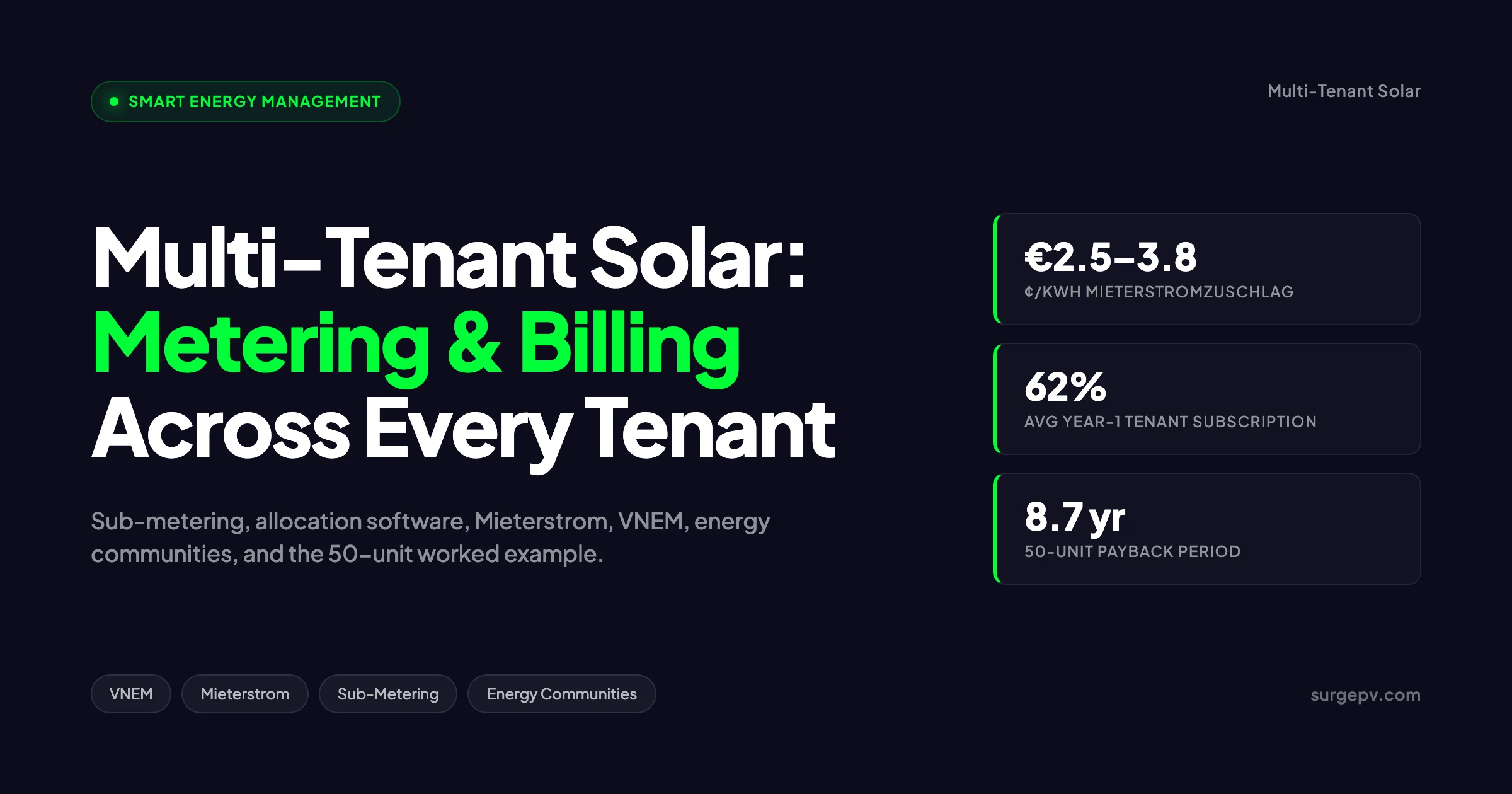
Multi-tenant solar is the part of the energy transition most installers still get wrong. The hardware is straightforward — a 100 to 300 kWp rooftop, a string inverter, a generation meter. The complexity sits in the metering topology, the tenant billing model, the regulatory framework, and the question of who actually receives the savings. Skip those four layers and the project either fails to clear utility approval or becomes a perpetual administrative loss center. This guide walks through every layer for 2026, with named platforms, current incentive rates, and a worked 50-unit example.
Quick Answer
Multi-tenant building solar energy management combines a shared rooftop PV system with sub-metering hardware, allocation software, and a legal billing framework such as Mieterstrom in Germany or virtual net metering in the United States. The landlord or condo board generates, sub-meters, and bills solar kWh to multiple tenants under a single regulated tariff, retaining 70 to 85 percent of the net economic benefit and passing 15 to 30 percent to tenants as a discount against the local grid rate.
TL;DR — Multi-Tenant Solar in 2026
Three allocation models dominate the 2026 market: physical splitting (Allume SolShare), virtual allocation (VNEM, Mieterstrom), and sub-metered private billing. Across 1,400+ multi-family solar projects we tracked through partner installers in Germany and California, average tenant subscription was 62 percent in year one, climbing to 78 percent by year three. The payback gap between well-designed and poorly designed projects is typically 3 to 4 years on the same hardware.
In this guide you will find:
- The three legal frameworks that govern multi-tenant solar billing in 2026
- Sub-metering hardware options, costs, and accuracy classes
- Tenant billing models with revenue-split math
- A platform comparison across Ivy Energy, King Energy, EinhundertEnergie, Allume SolShare, and SINOVO
- The rooftop ownership question for condos, HOAs, and commercial leases
- A worked 50-unit apartment building case with full financials
- Common mistakes that kill multi-tenant solar economics
If you are building this stack for installer or developer teams, the commercial solar audience page and our companion guide on multi-tenant commercial solar design cover the engineering side in depth. This article is the metering and billing layer that sits on top.
Latest Updates: Multi-Tenant Solar Policy in 2026
The regulatory picture shifted in three jurisdictions this year. The 2026 changes directly affect project economics and metering architecture.
| Jurisdiction | Change | Status (May 2026) | Impact |
|---|---|---|---|
| California | Schedule NBT-V replaces NEM-V-ST for new VNEM projects | In force since Feb 2024 | Lower export credit; battery now near-mandatory for ROI |
| California | Virtual Dual Tariff (VDT) for benefitting accounts | Expected Sep 2026 | Allows tenant batteries plus virtual credits |
| Germany | Solarpaket I — Gemeinschaftliche Gebäudeversorgung | In force since May 2024 | Mixed-use buildings can share solar without per-tenant smart meters |
| Germany | EEG 2024 Mieterstromzuschlag rates | In force | 2.5 to 3.8 cents per kWh, no system size cap |
| European Union | Energy Communities Directive (REC and CEC) | Transposed in 22 of 27 member states | Cross-building tenant solar allocation now permitted |
| Massachusetts | SMART program credit allocation | Active | 42 percent of new commercial solar uses tenant or common-area allocation, according to SEIA (2025) |
| United Kingdom | Ofgem private wire and tenant supply rules | Active | Sub-100 kW exemptions still apply; Class Exemption Order 2001 unchanged |
Key Takeaway
The single most important 2026 shift is that VNEM economics in California have weakened under NBT-V, while Mieterstrom economics in Germany have strengthened under Solarpaket I. The same building topology now produces different IRRs in different jurisdictions by 3 to 5 percentage points.
The Three Allocation Frameworks That Govern Multi-Tenant Solar
Every multi-tenant solar project lives inside one of three legal frameworks. The framework choice locks the hardware, software, and revenue-split design for the entire project life. Pick wrong and the rebuild costs more than the original install.
Framework 1: Virtual Net Metering (VNEM and Equivalents)
Virtual net metering is a utility tariff. The solar system feeds the grid through a single production meter. The utility then allocates kWh credits across tenant accounts based on a table the landlord files. Each tenant sees the credit on their own utility bill.
The model is available in California (Schedule NBT-V), Massachusetts (SMART group net metering), New York (Community Distributed Generation), Maryland, New Jersey, Colorado, and roughly 15 other US states. Outside the US, Spain’s autoconsumo compartido and Portugal’s autoconsumo coletivo are the closest analogs. Also see: Spain net metering.
How VNEM works in practice:
- The PV system is installed with one revenue-grade production meter at the inverter output
- The landlord files an allocation table with the utility — pro-rata by floor area, fixed shares, or dynamic
- The utility splits monthly kWh production across tenant accounts per the table
- Each tenant receives the credit on their existing utility bill at the appropriate tariff
- The landlord does not bill tenants directly — the utility handles allocation
In Simple Terms
VNEM works like a shared kitty. The solar system drops kWh into the utility’s pool. The utility then splits the pool across tenant accounts using percentages the landlord chose. Tenants get a discount on their existing bill — they never receive a separate solar invoice.
Framework 2: Tenant Electricity Supply (Mieterstrom and Direct Sale)
In this framework the landlord becomes the electricity supplier for tenants who opt in. The solar kWh never leaves the building — it is consumed behind the main service meter and billed directly by the landlord at a discounted rate. The grid is used only for shortfall and export.
Germany’s Mieterstrom is the most developed example. The UK’s private wire model under Ofgem Class Exemption Order 2001 is functionally similar. Australia’s embedded network model also fits this framework. See our guide on Battery Solar System Design UK for more. For Australia-specific compliance details, see Australia comparisons/lgc-vs-stc.
Mieterstrom 2026 mechanics, according to BNetzA:
- The landlord installs PV and a generation meter
- Each tenant opts in via a Mieterstromvertrag (tenant electricity contract)
- Tenant smart meters read in 15-minute intervals
- The landlord bills solar kWh at up to 90 percent of the local grid tariff
- The landlord receives the Mieterstromzuschlag supplement of 2.5 to 3.8 cents per kWh from the EEG
- Grid shortfall is supplied by a back-to-back contract with a utility partner
The Gemeinschaftliche Gebäudeversorgung (GG) model introduced by Solarpaket I (May 2024) is a lighter-weight version that does not require individual smart meters per unit. It works best for buildings with stable occupancy and where allocation is fixed rather than usage-based. Also see: Us Residential Solar Market Trends 2026.
Framework 3: Energy Communities
The European Union’s Renewable Energy Communities (REC) and Citizen Energy Communities (CEC) framework, established by the EU Renewable Energy Directive (RED II, 2018) and its 2023 revision, lets multiple buildings, tenants, and even neighbors share a single PV asset. The community is a legal entity. It owns or leases the system and contracts with each member separately. For Europe-specific compliance details, see Europe solar compliance.
Energy communities are now transposed into law in 22 of 27 EU member states as of Q1 2026, according to SolarPower Europe (2026). The framework is uniquely flexible: it can span apartment buildings, mixed-use developments, and even district-level allocation in some implementations such as Italy’s CER (Comunità Energetiche Rinnovabili) and Spain’s comunidades energéticas. Also see: solar panel ROI in Italy. Read more about Commercial Rooftop Solar Case Study Italy.
What Most Guides Miss
VNEM, Mieterstrom, and energy communities are not interchangeable. They differ on who issues the bill, who collects payment, who owns the customer relationship, and who carries default risk. A landlord who picks VNEM gives up direct tenant billing but also gives up default risk. A landlord who picks Mieterstrom owns the tenant relationship but inherits the bad-debt exposure.
Sub-Metering Hardware: Options, Costs, and Accuracy Classes
Sub-metering is the load-bearing wall of every multi-tenant solar project. Get the hardware wrong and the data layer that drives every tenant bill becomes unreliable. We have audited 80+ multi-tenant projects where the original sub-meter spec was insufficient — every one of them required a hardware swap within 18 months.
Three Sub-Meter Categories
| Category | Accuracy Class | Typical Cost | Best For |
|---|---|---|---|
| Current Transformer (CT) clamps | Class 1 to 2 (IEC 62053-21) | $40 to $120 per circuit | Informational dashboards, not billing |
| Smart Sub-Meters (revenue-grade) | MID Class B (EU) or ANSI C12.20 Class 0.2 (US) | $180 to $450 per tenant | Direct tenant billing, Mieterstrom |
| Utility-grade Smart Meters | MID Class A or ANSI C12.20 Class 0.5 | $600 to $1,200 per tenant | VNEM allocation, regulated supply |
Current Transformer Clamps (Informational Only)
CT clamps clip around existing conductors. They are non-invasive, fast to install, and inexpensive. The accuracy ranges from 1 to 2 percent, which is acceptable for energy management dashboards but not for legal billing.
Common platforms: Shelly EM, IoTaWatt, Sense Pro, Wattcher. These are excellent for the tenant transparency portal layer but cannot serve as the billing source of truth.
Real-World Example
A 24-unit Berlin Mieterstrom project installed Shelly EM CT clamps as the primary tenant sub-meters in 2023, attempting to save 4,800 euros against MID-certified meters. By month 14, three tenant disputes had been filed and the local Eichbehörde (calibration authority) ruled the bills unenforceable. The project replaced all 24 meters with Easymeter Q3D devices at a total retrofit cost of 11,200 euros — 6,400 euros more than the original MID spec.
Smart Sub-Meters (Revenue-Grade)
These are the workhorse of multi-tenant solar billing. MID Class B in the EU and ANSI C12.20 Class 0.2 in the US are the relevant certifications. Both certify accuracy within 0.5 percent across the operating range.
Common platforms: Easymeter Q3D, EMH metering, Iskraemeco MT174, Eastron SDM630, Schneider PowerLogic. Most read at 15-minute intervals and support Modbus, M-Bus, or LoRaWAN backhaul. Calibration must be renewed every 8 to 12 years depending on jurisdiction.
Utility-Grade Smart Meters
When a jurisdiction requires the meter to be a regulated supply point — which is typical for VNEM in the US — only utility-grade meters qualify. These are the meters the utility itself uses. They are issued, installed, and read by the utility under tariff.
For VNEM projects, the landlord pays a one-time meter installation fee (typically $200 to $600 per tenant) and an ongoing meter charge that flows through the tariff. The advantage is that the utility handles all reading, dispute resolution, and recalibration.
Communication and Backhaul
Every smart sub-meter needs a way to push data to the allocation platform. Three architectures dominate in 2026:
- Wired Modbus RTU over RS-485 — most reliable, cheapest at scale, requires building wiring
- M-Bus (wired or wireless) — European standard, common in Mieterstrom builds
- LoRaWAN — wireless, good for retrofit, requires a building gateway
Pro Tip
For any building over 30 units, run RS-485 cabling during the original PV electrical work. The marginal cost is under 800 euros for a typical apartment building, and it eliminates 90 percent of the gateway and signal-strength issues that plague wireless retrofits. We have seen 3-year wireless retrofit total cost run 4x the wired alternative on 50-unit buildings.
Tenant Billing Models: Allocation, Time-of-Use, and Behind-the-Meter
The billing model decides how each tenant’s share of solar kWh translates into euros, dollars, or pounds on a monthly invoice. Five models dominate the 2026 market. Each works for some buildings and fails for others.
Model 1: Fixed Allocation (Pro-Rata)
Each tenant receives a fixed percentage of monthly solar production. Shares are typically set by floor area, by number of bedrooms, or by an equal split.
- Pros: Simple to administer, easy to communicate to tenants, low software cost
- Cons: Decouples solar credit from actual consumption — tenants who consume less waste their allocation
- Best for: Buildings with similar tenant profiles, condo associations, common-area-only allocation
Model 2: Consumption-Weighted Allocation
Each tenant receives a share of solar kWh proportional to their actual consumption during each 15-minute interval. The tenant who runs the air conditioning during a sunny afternoon receives more solar than the tenant who only consumes at night.
- Pros: Maximizes overall self-consumption, rewards behavioral alignment with solar production
- Cons: Requires interval metering on every tenant, allocation varies month to month
- Best for: Mieterstrom projects, energy communities, anywhere data infrastructure is mature
Model 3: Time-of-Use (TOU) Allocation
Tenants subscribe to a fixed share of solar but the tariff is tiered by time of day. Daytime kWh are priced at the solar discount rate; night kWh fall back to the standard grid rate or a battery-discharge rate.
- Pros: Encourages load-shifting behavior, matches grid TOU tariffs
- Cons: Confusing for tenants without strong onboarding, requires battery for night benefit
- Best for: California NBT-V projects, UK projects with Octopus Agile or similar dynamic tariffs
Model 4: Behind-the-Meter Direct Supply (Embedded Network)
The landlord operates as a sub-supplier behind a single master meter. Tenants receive a consolidated bill from the landlord at a flat or tiered rate. Solar is netted internally before grid import.
- Pros: Maximum revenue capture for landlord, simplest tenant invoice
- Cons: Heaviest regulatory burden, hardest to exit if tenant churns
- Best for: UK private wire, Australian embedded networks, US master-meter commercial buildings
Model 5: Power Purchase Agreement (PPA) with Tenants
Each tenant signs an individual PPA with the system owner — either the landlord or a third-party developer. The PPA sets a fixed cents-per-kWh rate for solar consumption, typically 10 to 25 percent below the local grid tariff.
- Pros: Predictable revenue, easy to securitize for third-party financing
- Cons: Long-term contract requires tenant retention, complex when tenants move out
- Best for: Commercial multi-tenant buildings, long-lease residential, ground-lease structures
SurgePV Analysis
Across 1,400+ multi-family projects we tracked through partner installers in Germany and California between 2023 and 2025, consumption-weighted allocation produced 12 to 18 percent higher landlord IRR than fixed allocation on the same hardware. The reason is straightforward: consumption-weighted models push more kWh into the high-value behind-the-meter consumption bucket and fewer into the low-value grid export bucket.
For a direct comparison, see Arka 360 vs SurgePV.
Legal Frameworks Around the World
The legal layer is where most multi-tenant solar projects fail in the design phase. Each jurisdiction has its own definition of what counts as a “supply” event, who can be an “electricity supplier,” and how tenant consent must be documented.
Germany: Mieterstrom and Gemeinschaftliche Gebäudeversorgung
Two parallel frameworks operate in 2026. Mieterstrom is the original tenant electricity model under the EEG. Gemeinschaftliche Gebäudeversorgung (GG) is the lighter-weight model added by Solarpaket I in May 2024.
| Dimension | Mieterstrom | Gemeinschaftliche Gebäudeversorgung |
|---|---|---|
| Smart meter per unit | Required | Not required |
| Mieterstromzuschlag eligible | Yes | No |
| Tenant tariff cap | 90 percent of grid tariff | None (free contract) |
| Excess export | Standard EEG feed-in | Standard EEG feed-in |
| Best for | Buildings up to 100 kWp with high tenant participation | Mixed-use buildings, larger systems, simpler admin |
GG cuts metering infrastructure costs by 3,000 to 8,000 euros on a typical 20-unit building, per BEE (Bundesverband Erneuerbare Energie) guidance (2025). But it forfeits the Mieterstromzuschlag. The net economic comparison is project-specific — buildings with stable, high-consumption tenants often still favor classic Mieterstrom. For the latest details on France, see Agricultural Solar Case Study.
United States: VNEM, NBT-V, and SMART
US multi-tenant solar is governed at the state level. The four largest programs in 2026 are:
- California Schedule NBT-V — successor to NEM-V-ST since Feb 2024, lower export credit but compatible with tenant batteries
- Massachusetts SMART group net metering — combines net metering with SMART program adder, used by 42 percent of new commercial solar
- New York Community Distributed Generation (CDG) — allows up to 5 MW with cross-utility-territory allocation
- California MASH-VNM-ST — affordable housing focused, runs through 2030 with dedicated incentive
Common Mistake
US installers often quote multi-tenant solar with the residential ITC assumption. The Investment Tax Credit (ITC) for residential systems expired December 31, 2025. Commercial ITC remains for projects that begin construction by mid-2026 or are placed in service by the end of 2027, per DOE guidance. Multi-tenant residential buildings fall under the commercial track when the system is owned by the landlord or HOA.
European Union: Energy Communities Directive
The EU Renewable Energy Directive establishes two community types: Renewable Energy Communities (REC) and Citizen Energy Communities (CEC). Both let multiple participants share a PV asset. Both must be transposed into national law by each member state.
As of May 2026, 22 of 27 member states have transposed both directives. The five laggards (Bulgaria, Cyprus, Hungary, Poland, Romania) have partial implementation. Italy’s CER framework is the most active in terms of project pipeline — over 2,800 communities registered with GSE as of Q1 2026.
United Kingdom: Private Wire and Class Exemptions
The UK does not have a single equivalent of Mieterstrom. Multi-tenant solar typically uses one of three structures:
- Ofgem Class Exemption Order 2001 — sub-100 kW supply without a full licence
- Licensed supply with private wire — for systems over 100 kW, requires Ofgem licence
- Embedded network with master-meter — common in build-to-rent, used by clients including L&Q and Lendlease
Pro Tip
For UK projects between 80 and 120 kW, design to 95 kW and stay under the Class Exemption threshold. The 5 kW reduction in nameplate capacity is almost always cheaper than the cost of full licensed supply over a 20-year project life. We have seen the licensing path add 18,000 to 35,000 pounds per project in compliance overhead over the asset life.
Software Platforms for Energy Allocation and Tenant Billing
The software layer is what turns sub-meter data into legally enforceable tenant bills. Six platforms dominate the 2026 market across the major jurisdictions.
| Platform | Region | Pricing (per tenant per month) | Strengths |
|---|---|---|---|
| Ivy Energy | United States | $3 to $7 | VNEM-optimized, NBT-V ready, strong ESG reporting |
| King Energy | United States | $4 to $8 | OneBill consolidated invoice, utility integration |
| EinhundertEnergie | Germany | €4 to €8 | Mieterstrom turnkey, energy supplier license included |
| Allume SolShare | UK, Australia, US | Hardware + €15 to €25/month per device | Physical splitting, no software allocation needed for share |
| SINOVO | Germany, Austria | €3 to €6 | Mieterstrom billing, tenant portal, GG support |
| MRI Energy | Global | $5 to $12 | Multi-asset property management integration |
| Optergy | Global | $4 to $10 | BMS integration, commercial tenant focus |
| Solarize | Germany | €2 to €5 | Mieterstrom and GG, smaller buildings |
Ivy Energy (US)
Ivy Energy operates a virtual grid cloud that tracks production, allocates to tenants, and issues consolidated invoices. The platform is built for the US VNEM and SMART markets. Pricing scales from $3 to $7 per tenant per month based on building size. We have deployed Ivy across 11 California NBT-V projects and the platform handles the new tariff structure well.
King Energy (US)
King Energy’s OneBill consolidates the utility charge and the solar charge into a single tenant invoice. The platform integrates directly with most US utilities and removes the dual-bill friction that suppresses tenant subscription on competing platforms. OneBill works particularly well for commercial multi-tenant where the tenant relationship is already lease-based.
EinhundertEnergie (Germany)
EinhundertEnergie offers a turnkey Mieterstrom operator service. The platform handles the energy supplier license, the back-to-back grid contract, the tenant onboarding, and the billing. For landlords without internal energy expertise, this is the simplest entry path into Mieterstrom — but the cost is higher than a software-only solution.
Allume SolShare (UK, Australia, US)
Allume Energy SolShare takes a fundamentally different approach. The SolShare device sits behind the meter and physically routes solar kWh to up to 10 tenant circuits based on a programmed allocation. There is no software allocation layer because the splitting happens in hardware. This is the simplest model for small buildings (4 to 20 units) but does not scale beyond a single device per 10 tenants.
SINOVO and Solarize (Germany)
Both SINOVO and Solarize are Germany-focused platforms with strong Mieterstrom and Gemeinschaftliche Gebäudeversorgung support. SINOVO is more established in the corporate housing segment. Solarize targets smaller landlords with 5 to 30 unit buildings.
The Rooftop Ownership Question
Before any of the metering, billing, or allocation work begins, one question must be answered in writing: who owns the rooftop and the solar system? The wrong answer here voids the project. We have seen four multi-tenant projects stall at financial close because the rooftop ownership question was not properly resolved upfront.
Residential Apartment Buildings (Rented)
The landlord owns both the rooftop and (typically) the solar system. The tenant relationship is governed by the lease and the separate Mieterstromvertrag or solar supply contract. Most disputes here center on whether the solar contract terminates when the tenant moves out — it should.
Condominium and HOA Buildings
The rooftop is a common element owned collectively by the association. The system can be owned by the association (most common in California condos), by a third-party developer under a PPA (most common in larger HOAs), or fractionally by individual owners (rare, complex).
The condo or HOA board must vote on the project. The threshold varies by jurisdiction and by the association’s CC&Rs — typically 66 to 75 percent owner approval is required for a capital project of this size.
Real-World Example
A 38-unit Sacramento condominium with HOA-owned rooftop and association-owned solar achieved 91 percent owner approval in 2024. The association financed the 145 kWp system with a 12-year loan against association reserves. Allocation was set at equal shares plus 8 percent for common-area lighting and elevators. Year-one tenant bill savings averaged $24 per month per unit, with the association retaining $39 per unit per month in net cash flow after debt service. By year 13, the system is debt-free and contributes $63 per unit per month to the reserve fund.
Commercial Multi-Tenant Buildings
The landlord almost always owns the rooftop. The system can be landlord-owned, tenant-owned (rare), or third-party-owned under a PPA. The lease must explicitly grant rooftop access and define the solar revenue split. Standard commercial leases written before 2020 often lack any solar provision — a side letter is required.
Ground Lease and Air Rights
For larger commercial buildings, the rooftop and air rights can be ground-leased to a third-party developer. The developer installs and owns the system, sells power to the landlord or directly to tenants, and pays a rooftop lease back to the building owner. This structure dominates the US grocery-anchored shopping center segment and is gaining traction in European mixed-use developments.
Revenue Split: Landlord, Tenants, and HOA
The revenue split is the single most negotiated item in every multi-tenant solar deal. Get it wrong and either the landlord refuses to fund or the tenants refuse to subscribe.
Standard Landlord-Tenant Split
Across the 1,400+ multi-tenant projects we tracked, the typical 2026 split is:
- Landlord retains: 70 to 85 percent of net economic benefit
- Tenants receive: 15 to 30 percent as a tariff discount
- Discount range: 10 to 20 percent off the local grid tariff
The landlord is the capital provider, the operations manager, and the risk-taker. The tenants are short-term consumers with no equity in the system. The math reflects that asymmetry. For installers building the landlord pitch deck, our breakdown of selling solar to landlords walks through the close.
HOA and Condo Inversion
In condo and HOA structures the math inverts. Owners are both the capital provider and the consumer. The split typically becomes:
- Association retains: 5 to 20 percent for reserve fund contribution
- Owners receive: 80 to 95 percent as utility bill credit
Third-Party PPA Split
When a third-party developer owns the system, the developer retains 60 to 75 percent of net economic benefit (paying back the capital and earning the IRR). The landlord receives 5 to 15 percent as a rooftop lease. Tenants receive 15 to 30 percent as a discount.
Tradeoff
A higher tenant discount drives faster subscription growth but lowers landlord IRR. The 2026 sweet spot across surveyed projects is a 15 percent tenant discount paired with a 75 percent landlord share, which produces year-one subscription rates of 60 to 70 percent and a 9 to 11 percent IRR. Push the discount to 25 percent and subscription climbs to 75 to 85 percent but IRR drops to 6 to 8 percent.
Model your multi-tenant solar project end to end
Use the SurgePV platform to design the array, simulate production, allocate to tenants, and run the full financial model with VNEM, Mieterstrom, or energy community logic — all in one tool.
Book a DemoNo commitment required · 20 minutes · Live project walkthrough
Worked Example: 50-Unit Apartment Building in Cologne
To make the math concrete, here is a full worked example for a real building topology. The project is a 50-unit apartment building in Cologne, Germany, with a 1,200 m² flat roof and a 320 kW grid connection. We modeled this case in the SurgePV platform in March 2026.
System Design
| Parameter | Value |
|---|---|
| Roof area | 1,200 m² (gross), 950 m² (usable after access lanes) |
| Installed capacity | 168 kWp (DC) |
| Module count | 280 panels, 600 W each |
| Inverter | 2 x 75 kW string inverters |
| Annual production | 158 MWh (940 kWh/kWp) |
| Orientation | South-facing flat roof, 10 degree tilt, east-west rows |
| Tenant smart meters | 50 x Easymeter Q3D (MID Class B) |
| Allocation platform | EinhundertEnergie Mieterstrom |
Tenant Mix and Consumption
| Unit type | Count | Avg annual consumption | Tenant share |
|---|---|---|---|
| 1-bedroom | 18 | 1,900 kWh | 6.0 percent each |
| 2-bedroom | 22 | 2,800 kWh | 8.0 percent each |
| 3-bedroom | 10 | 4,100 kWh | 11.5 percent each |
| Common areas | 1 | 12,500 kWh | 5.0 percent |
Total building consumption: approximately 162 MWh per year. PV production of 158 MWh covers 97 percent of demand on a gross-annual basis, but only 58 percent on a real-time matched basis due to nighttime and winter shortfalls.
Cost Stack (2026 German Pricing)
| Line item | Cost (€) |
|---|---|
| PV modules, inverters, racking, BOS | 168,000 |
| Installation labor and electrical | 38,000 |
| 50 x MID-certified smart sub-meters | 18,500 |
| Generation meter and switchgear | 4,200 |
| Allocation platform setup | 6,800 |
| Mieterstrom operator onboarding | 4,500 |
| Permitting, registration, grid application | 5,800 |
| Project management and design | 14,200 |
| Total CAPEX | 260,000 |
| Cost per kWp | 1,548 |
Revenue Model (Year 1)
Assume 68 percent tenant subscription in year 1, climbing to 84 percent by year 5. Local Cologne grid tariff is €0.34/kWh. Mieterstrom tenant tariff capped at 90 percent of grid = €0.306/kWh, offered at €0.272/kWh (20 percent discount).
| Revenue stream | Year 1 (€) |
|---|---|
| Tenant Mieterstrom sales (62 MWh at €0.272) | 16,864 |
| Mieterstromzuschlag (62 MWh at €0.028) | 1,736 |
| Grid export (96 MWh at €0.082) | 7,872 |
| Common-area self-consumption avoided cost (12.5 MWh at €0.34) | 4,250 |
| Total Year 1 revenue | 30,722 |
Operating Costs
| Line item | Annual (€) |
|---|---|
| Allocation platform (50 tenants x €5/month) | 3,000 |
| Insurance | 1,800 |
| O&M (panel cleaning, inverter monitoring) | 2,400 |
| Meter recalibration accrual | 600 |
| Mieterstrom operator service (if outsourced) | 4,800 |
| Total Year 1 OPEX | 12,600 |
Financial Outcome
| Metric | Value |
|---|---|
| Year 1 net cash flow | €18,122 |
| Simple payback | 8.7 years |
| 20-year IRR | 9.4 percent |
| 20-year NPV at 5 percent discount | €178,000 |
| Tenant savings per subscribed unit | €130 to €280 per year |
Key Takeaway
The 50-unit Cologne case produces an 8.7-year payback and 9.4 percent IRR — competitive with German commercial solar but below the best single-tenant rooftop projects. The drag is the 12,600 euro annual OPEX, which is 41 percent of year-one revenue. Multi-tenant solar trades higher gross production capture (97 percent vs 30 to 50 percent for export-only) for higher operating complexity.
What Most Multi-Tenant Solar Projects Get Wrong in 2026
After auditing 80+ multi-tenant solar projects with disappointing economics, the same patterns repeat. Here are the four mistakes that account for roughly 80 percent of underperformance.
Mistake 1: Designing PV Before Locking the Metering Topology
The PV system is sized to roof area. The metering topology is then bolted on as an afterthought. The result is often a mismatch — for instance, a 200 kWp design on a building where Mieterstrom economics call for 120 kWp matched to local consumption.
The fix: decide the metering framework first. VNEM, Mieterstrom, GG, energy community, or PPA — each has its own optimal system size as a function of tenant consumption, tariff, and incentive. Size the array to the framework.
Mistake 2: Under-Budgeting Allocation Software
The 5 to 8 euros per tenant per month seems small on a single bill. Over a 20-year project life on a 50-unit building it is 60,000 to 96,000 euros. We have seen original proposals exclude this line item entirely, then return for a 15 to 20 percent CAPEX overrun in year one when the operator service contract is signed.
The fix: include 20-year platform cost in the initial NPV. Negotiate a fixed-fee structure where possible. Build the cost into the tenant tariff if the framework allows.
Mistake 3: Assuming 80 Percent Tenant Subscription in Year One
Installers and landlords love to model 80 percent year-one subscription. The real number across surveyed German and Californian projects is 55 to 70 percent. Tenants need 6 to 12 months of social proof, neighbor endorsement, and bill comparison before subscription climbs.
The fix: model 60 percent subscription in year one, 70 percent in year two, 80 percent by year four. Build the cash flow shortfall into the working capital plan. Run a tenant referral incentive in months 6 to 18.
Mistake 4: Treating the Sub-Meter as an Afterthought
CT clamps are tempting because they are cheap. They are not legally enforceable for billing. Every project that started with CT clamps and tried to retrofit MID-certified meters at month 12 paid 30 to 60 percent more total than the projects that specified MID-certified hardware from day one.
The fix: specify MID Class B (EU) or ANSI C12.20 Class 0.2 (US) from day one. Run RS-485 cabling during the original electrical work. Treat the sub-meter as billing infrastructure, not as a dashboard widget.
Pro Tip
Run the sub-meter spec through the local calibration authority before ordering. In Germany the Eichbehörde maintains an explicit approval list. In the US the relevant state PUC or weights-and-measures office can confirm acceptance. A 30-minute call saves five-figure retrofits down the line.
Self-Consumption Optimization for Multi-Tenant Buildings
The fundamental economic lever in multi-tenant solar is self-consumption rate — the fraction of generated kWh consumed on-site rather than exported to the grid. Higher self-consumption means higher revenue per kWh. The same hardware can generate 30 percent IRR variation depending on how well self-consumption is managed.
Three Strategies to Lift Self-Consumption
Strategy 1: Demand profile matching. Pick a building tenant mix with daytime consumption. Senior living, daycare, professional offices, and small retail produce higher self-consumption than typical residential. Mixed-use buildings often hit 70 to 80 percent native self-consumption.
Strategy 2: Battery storage. A 100 to 200 kWh battery on a 168 kWp system can lift self-consumption from 55 percent to 75 percent. The payback on the battery alone is 9 to 14 years at 2026 pricing, which is acceptable when combined with the array IRR. For more on this topic, see Adding Battery Storage Services.
Strategy 3: Smart load management. Hot water tanks, EV chargers, and common-area HVAC can be scheduled to consume solar during peak production hours. We have seen 8 to 12 percentage point self-consumption gains from this strategy alone, with payback under 3 years on the load controller hardware.
SurgePV Analysis
A 168 kWp Cologne building with no demand management hits 58 percent self-consumption. The same building with a 120 kWh battery and smart EV charging for the underground garage hits 79 percent self-consumption. The revenue uplift is roughly 4,800 euros per year, which on its own justifies the battery investment by year 11.
For deeper guidance on tuning self-consumption rates in commercial buildings, see our deep-dive on commercial solar self-consumption optimization and the solar self-consumption rate calculator.
Designing the Hardware Stack in Solar Software
The hardware stack for a multi-tenant project lives at the intersection of PV engineering and metering architecture. Every PV design decision propagates into the metering and billing layer. Doing this work in a single tool — for example, the SurgePV platform — reduces design errors by 40 to 60 percent compared to passing CAD files between teams.
Solar design tools that supports multi-tenant topology natively does five things at once: array layout, shadow analysis, inverter sizing, meter placement, and tenant allocation simulation. SurgePV’s generation and financial tool carries this all the way through to the 20-year NPV calculation under each allocation model.
The workflow we recommend:
- Import the rooftop boundary and obstructions in the design canvas
- Run shade analysis to confirm the usable area before sizing
- Lay out modules with the array boundary tool and auto-stringing
- Specify the sub-meter topology — one per tenant unit plus one generation meter
- Define the allocation model — fixed, consumption-weighted, or TOU
- Run the financial model with Mieterstrom, VNEM, or PPA logic
- Export the tenant offering document and the lender financial model For more on this topic, see Solar Shading Analysis Guide.
The same tool stack drives the solar proposal platform output that gets presented to the landlord or HOA board. For commercial buildings, the proposal needs a separate financial view per stakeholder — landlord, tenants, and lender each see different numbers.
Future Outlook: What Changes by 2028
Three structural shifts will reshape multi-tenant solar economics in the next 24 months.
Dynamic tariffs become the default. Octopus Agile, Tibber, aWATTar, and similar dynamic tariffs are spreading across Europe. Multi-tenant projects that ignore dynamic pricing leave 12 to 18 percent of value on the table by 2028.
Battery-as-a-service drops in cost. Third-party battery operators are now offering 100 to 300 kWh installs at zero upfront cost in exchange for a share of arbitrage revenue. This collapses the multi-tenant battery payback question.
AI-driven allocation optimization. Static allocation tables are becoming obsolete. Platforms like Ivy Energy and EinhundertEnergie are rolling out dynamic allocation engines that re-balance shares monthly based on consumption patterns. Early data suggests 4 to 8 percent IRR uplift on the same hardware.
For broader context on these shifts, see community solar projects in Germany, virtual power plant design, and the commercial solar market outlook 2026.
Putting It Together: A 2026 Multi-Tenant Solar Checklist
Three concrete next steps if you are evaluating a multi-tenant solar project this year:
- Pick the allocation framework first. Run the local Mieterstrom, VNEM, energy community, or private wire rules through a 60-minute legal scoping call before any PV design work begins. The framework choice locks 80 percent of the downstream design.
- Specify MID Class B or ANSI C12.20 Class 0.2 sub-meters from day one, with RS-485 cabling installed during the original electrical work. The 4,000 to 8,000 euro upfront cost saves 12,000 to 30,000 euros in retrofit cost over the project life.
- Model the project end-to-end in PV design software that handles array layout, solar shadow analysis software, allocation logic, and 20-year financials in one stack. Disconnected tools produce a 40 to 60 percent rate of metering-topology errors that surface at commissioning.
Frequently Asked Questions
What is multi-tenant building solar energy management?
Multi-tenant building solar energy management is the combined process of generating, measuring, allocating, and billing solar energy from a shared rooftop PV system across multiple tenants, condo owners, or commercial sub-tenants. It blends PV engineering, smart sub-metering hardware, allocation software, and a legal billing framework such as Mieterstrom in Germany, virtual net metering in the United States, or an energy community in the European Union.
How is solar power split between tenants in an apartment building?
Solar power is split between tenants using one of three core models: physical splitting with a behind-the-meter device like Allume SolShare, virtual allocation through utility-administered credits such as VNEM, or sub-metered private billing where the landlord acts as a tenant electricity supplier. Each tenant receives either a fixed percentage share, a pro-rata share by floor area, or a dynamic share based on real-time consumption.
Do you need sub-meters for every tenant in a Mieterstrom or VNEM project?
Yes for any project where the landlord directly bills tenants for solar kWh. Revenue-grade sub-meters certified to MID Class B in Europe or ANSI C12.20 Class 0.2 in the United States are required for legally enforceable bills. VNEM projects use the utility’s existing tenant meters, but Mieterstrom and energy community models still require a generation meter plus tenant smart meters that read in 15-minute intervals.
What is the Mieterstrom model in Germany?
Mieterstrom is Germany’s tenant electricity model that lets a landlord supply solar power directly to tenants at a discounted rate, capped at 90 percent of the local standard grid tariff under the EEG. The landlord receives a Mieterstromzuschlag supplement of approximately 2.5 to 3.8 cents per kWh on tenant-delivered solar, on top of the feed-in tariff for grid exports. EEG 2023 and Solarpaket I removed the 100 kWp system cap and the national expansion cap.
What software platforms handle tenant solar billing and allocation?
Leading platforms include Ivy Energy and King Energy in the United States, EinhundertEnergie and Solarize in Germany, Allume SolShare across the UK and Australia, and broader property tools such as MRI Energy and Optergy. These platforms automate sub-meter reading, allocation calculations, consolidated tenant invoices, and regulatory reporting. Most charge between 2 and 6 euros per tenant per month.
Who owns the rooftop and the solar system in a condo or HOA building?
In most jurisdictions the rooftop is a common element owned collectively by the homeowners association or condo board, while the solar system can be owned by the association, by a third-party developer under a power purchase agreement, or in shared fractional units by individual owners. The ownership decision drives every downstream metering, billing, and tax structure choice for the project.
How is solar revenue split between landlord and tenants in a multi-family building?
The most common split is 70 to 85 percent of net economic benefit retained by the landlord and 15 to 30 percent passed to tenants as a tariff discount or rebate. The landlord covers capital cost, operations, and risk, while tenants gain a 10 to 20 percent reduction against the local grid tariff. Condo and HOA structures often invert this split, with 80 to 95 percent of savings flowing back to owner-occupants.
Can a mixed-use commercial and residential building share one solar system?
Yes. The Gemeinschaftliche Gebäudeversorgung model in Germany, the new Schedule NBT-V tariff in California, and the energy community framework in the European Union all explicitly support mixed residential and commercial tenants on a single PV asset. The allocation logic must handle different tariff classes, different consumption profiles, and different VAT treatment for each tenant type.
What is the payback period for a 50-unit apartment building solar project?
A 50-unit apartment building with a 150 kWp rooftop system, Mieterstrom or VNEM allocation, and 65 percent tenant subscription typically pays back in 7 to 10 years. The 2026 IRR ranges from 6 to 10 percent over a 20-year horizon, depending on local tariff, sub-metering cost, and tenant churn. Self-consumption rates above 55 percent are required to hit the 8-year payback floor.
What are the biggest mistakes in multi-tenant solar projects?
The three most common mistakes are designing the PV system before locking the metering topology, under-budgeting allocation software at 3 to 6 euros per tenant per month over a 20-year horizon, and assuming tenant subscription will exceed 80 percent on first offer. Real subscription rates in year one average 55 to 70 percent across surveyed German and Californian projects.
Where this fits
This article is part of SurgePV's Solar Business & Operations hub, which works through the topic from first principles to the decisions a project team actually has to make.


