

Answer
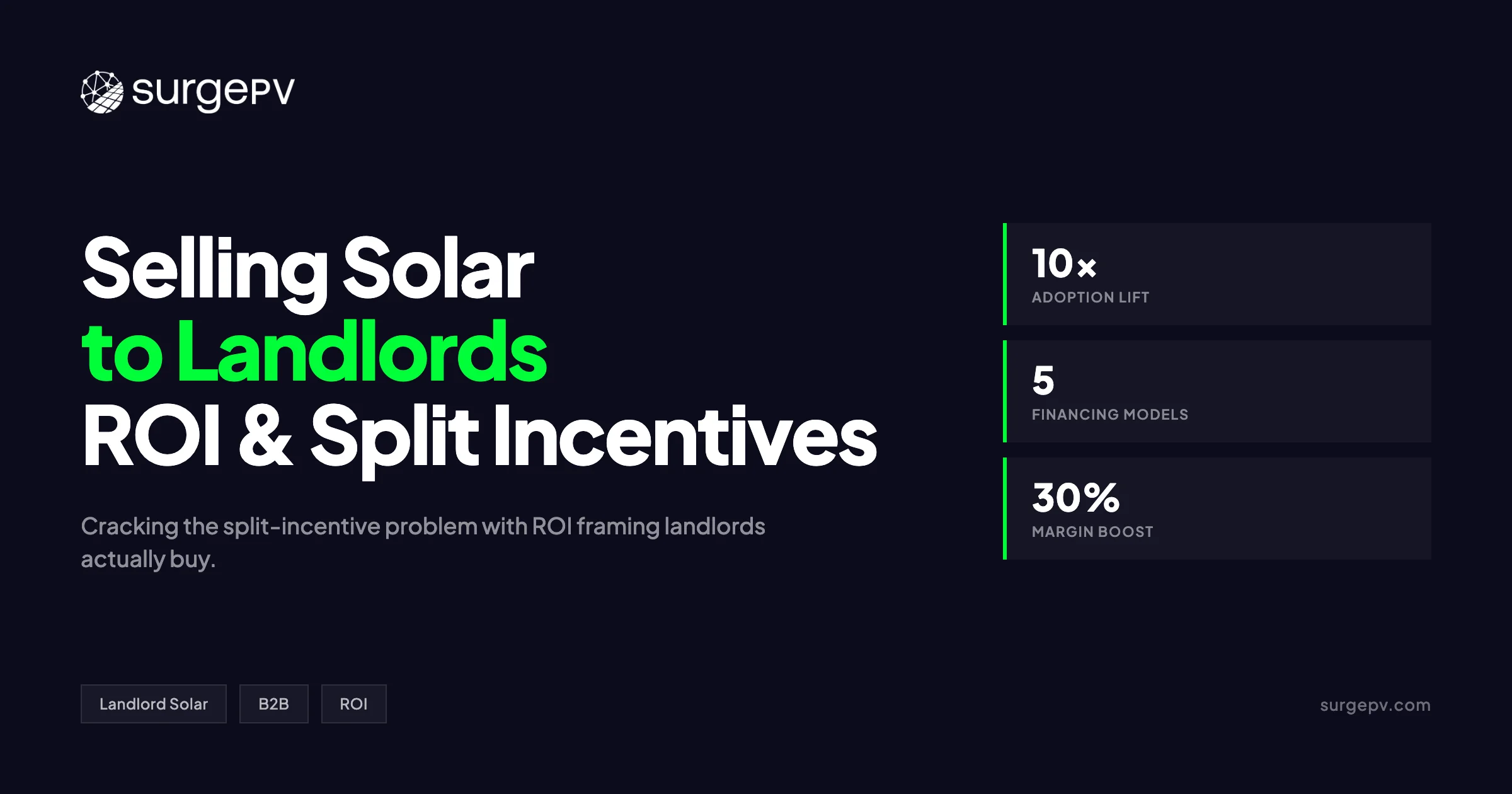
NREL modeling shows that resolving this alignment problem increases solar adoption tenfold in multifamily buildings. Written for solar sales reps, not landlords, this guide delivers discovery questions that qualify the deal in 5 minutes. In the 'Solved' scenario, low-income multifamily renters adopt 12 GW of solar by 2050.
Commercial solar installed 2.3 GWdc in 2025. That growth hides a gap most reps know too well. Landlord deals stall at a higher rate than owner-occupied commercial. Roof condition, price, and incentives are rarely the problem. The barrier is the split incentive.
NREL modeling shows that resolving this alignment problem increases solar adoption tenfold in multifamily buildings. Written for solar sales reps, not landlords, this guide delivers discovery questions that qualify the deal in 5 minutes. In the “Solved” scenario, low-income multifamily renters adopt 12 GW of solar by 2050.
When the landlord pays for the system but the tenant gets the savings, nobody wins. The landlord sees risk with no reward. The tenant sees savings they cannot control. The rep walks away with no contract. NREL modeling shows that resolving this alignment problem increases solar adoption tenfold in multifamily buildings. A rep who brings a resolution model to the first meeting closes before the competition finishes their site visit.
Written for solar sales reps, not landlords, this guide delivers discovery questions that qualify the deal in 5 minutes. You will get five split-incentive resolution models with real math. You will get ROI framing that speaks landlord language. And you will get word-for-word objection scripts. You will also see how to build a landlord-specific proposal in under 10 minutes using solar design software that models NOI, tenant savings, and property value uplift in one view.
TL;DR — Selling Solar to Landlords
NREL data shows solar adoption rises 10x when the split incentive is resolved. This guide gives reps five resolution models, landlord-specific ROI framing around NOI and cap rate, objection scripts for the top four pushbacks, and a proposal structure designed to close in one meeting.
In this guide:
- Why the split incentive is the #1 barrier in landlord deals
- How to qualify a landlord lead before booking a site visit
- Five proven resolution models with real financial math
- ROI framing: NOI, cap rate, and property value uplift
- Word-for-word objection scripts for landlord pushback
- The proposal structure that wins complex deals in one meeting
Selling Solar to Landlords: Why the Split Incentive Is the Real Enemy
The split incentive is a misalignment of costs and benefits. The landlord owns the building and the roof. The tenant pays the utility bill. When solar goes on the roof, the tenant’s bill drops — but the landlord sees no direct financial return. Without a resolution model, the deal dies.
NREL’s Solar Futures Study found a stark result. In a “Never Resolved” split-incentive scenario, solar adoption in renter-occupied buildings stays very low. Price drops do not fix it. In the “Solved” scenario, low-income multifamily renters adopt 12 GW of solar by 2050. That is ten times more than owner-occupied multifamily at 1.2 GW. The roof area available on renter-occupied buildings is more than double that of owner-occupied. The split incentive is the only thing standing between your pipeline and one of the largest untapped segments in commercial solar.
The split incentive also inflates discount rates. E3 and NREL modeling apply a 16% discount rate to multifamily and C&I customers. Standard residential sits at 7%. Higher discount rates mean shorter payback demands and tougher financial hurdles. When you resolve the incentive flow, renters and landlords evaluate solar with the same WACC as owners. The math becomes easy.
Most reps fail because they pitch solar like a product. They lead with panel efficiency, inverter brands, and production estimates. The landlord nods politely and asks for a brochure. Then nothing happens. The rep follows up three times and gives up. The real problem was not price. It was that the rep never showed the landlord how to capture value from the tenant’s savings. Product pitches lose to structure pitches every time in commercial real estate.
For a sales rep, this changes everything. You are not pitching panels. You are pitching a contract mechanism that makes the landlord whole. The system is just the hardware that enables the agreement.
Pro Tip: Lead With the Resolution Model
Reps who open landlord conversations with “Have you considered solar?” lose to reps who open with “There are three ways to structure solar on a rented building so the owner and tenant both benefit. Which lease type are you running?” The second frame signals expertise. The first frame signals a generic pitch.
How to Qualify a Landlord Lead in 5 Minutes
Qualifying a landlord lead means mapping the incentive flow before you touch the roof. You need four answers about lease type, tenant identity, lease term, and roof liability. They take under 5 minutes on a phone call. Without them, you are designing blind and wasting hours on buildings where the split incentive makes direct ownership impossible.
Chase at Point Load Power, interviewed by Aurora Solar, stresses that lease structure comes first. His four questions: What type of lease is in place? Who is the tenant? How long is left on the lease? Who has responsibility for the roof? These four answers tell you whether a split incentive exists, how severe it is, and which resolution model fits. For software options, see 7 Best Aurora Solar Alternatives in.
Here is what each answer reveals:
| Question | Why It Matters | Red Flag |
|---|---|---|
| What type of lease? | NNN, gross, and modified gross leases handle utilities differently | NNN with tenant-paid utilities = full split incentive |
| Who is the tenant? | Credit quality and renewal likelihood affect financing | High turnover retail = short payback demand |
| How long is left? | Solar payback must fit inside remaining lease term | Under 7 years left = direct ownership rarely works |
| Who owns roof liability? | Determines who approves structural work | Tenant with roof responsibility = need tenant consent |
Reps who skip these questions and book a site visit anyway waste 2–3 hours of travel and assessment time. Worse, they design a system for a building where the tenant has 18 months left on a NNN lease. The landlord sees a 10-year payback and no way to recover costs before the tenant leaves. The deal dies in the proposal stage, after your company has already spent $400 in soft costs.
You can discover hold strategy with one question: “Are you planning to hold this asset long-term, or is there a sale horizon?” A flipper wants the solar proposal to show next-year value uplift for the buyer. A holder wants a 20-year cash flow. Send the wrong frame and you look like every other vendor.
SEIA’s Consumer Protection Primer requires that savings estimates include site characteristics, utility escalators, system costs net of incentives, net metering specifics, and inverter replacement costs. For landlord deals, add one more layer: tenant billing assumptions, lease amendment feasibility, and transferability at sale. Build these into your discovery notes so the proposal team does not guess.
Five Split-Incentive Resolution Models That Close Deals
There is no single right answer for landlord solar. The right model depends on lease type, owner strategy, tenant credit, and local regulation. Each structure aligns costs and benefits differently. Here are five field-tested resolution models with real financial math that reps can present in a first meeting.
1. Green Lease (Cost-Sharing Agreement)
A green lease embeds energy cost-sharing into the rental contract. The Institute for Market Transformation and NREL both back this approach. In a typical green lease solar clause, the tenant pays the landlord 80% of modeled savings. The landlord keeps 20% as a management fee and captures the full tax benefit where available.
This model works best when the tenant has strong credit and multiple years left on the lease. It requires a lease amendment, so the rep must coordinate with the property manager or attorney. The advantage is mutual: tenant pays less than the utility rate, landlord earns a new revenue stream, and the building’s EPC or green certification improves.
2. C-PACE + NNN Lease Structure
C-PACE — Commercial Property Assessed Clean Energy — finances up to 100% of project cost through a property tax assessment. Under a NNN lease, the tenant pays property taxes. That means the tenant effectively pays the C-PACE bill. The key is structuring the deal so the tenant’s utility savings exceed their C-PACE payment.
Mile High CRE published a 200 kW case study with real numbers. It used 50% C-PACE financed over 25 years. The owner recoups the full investment plus $13,000 by the end of year one. NOI increases $10,000 per year via utility savings and REC income. The tenant pays $19,000 per year in C-PACE but saves $31,000 in utility costs. Both parties are cash-flow positive. The property value rises an estimated $400,000. IRR hits 11%.
This is the most powerful model for NNN commercial properties with long-term tenants. The rep’s job is to show both parties the parallel cash flows in a single proposal view.
3. Shared Savings / Service Charge Recovery
Under shared savings, the landlord installs the system and sells power to the tenant below the grid rate. For example, €0.20 per kWh versus a €0.35 grid rate. The tenant saves 43% on energy. The landlord recovers the system cost plus margin.
Service charge recovery is the UK equivalent. If the solar improvement directly lowers tenant energy bills, the landlord can recover costs through the service charge. This works in multi-let office and retail schemes where service charges are already itemized. For UK-specific information, see Battery Solar System Design UK. See our guide on Heritage Building Solar Case Study for more. For United Kingdom-specific compliance details, see United Kingdom comparisons/mcs-vs-non-mcs.
Joint venture models split upfront costs 50/50 for tenancies over 10 years. Both parties share savings proportionally. This model suits strong landlord-tenant relationships where both parties plan to stay long-term.
4. Roof Rental / Front-of-Meter Lease
A third party — often a solar developer or specialist like King Energy or Pivot Energy — rents the roof or parking canopy. The third party owns, operates, and maintains the system. The landlord receives stable rent with zero CapEx and zero maintenance risk.
Because the system feeds the grid rather than the building directly, there is no tenant billing complexity. This suits portfolio managers who want hands-off income and property owners who cannot amend leases. The trade-off is lower total return than direct ownership, but the risk profile is minimal.
5. Behind-the-Meter Tenant Billing
Technology platforms now enable landlords to bill tenants for solar energy like a utility. Allume Energy and Wand Solar offer 15-minute interval tracking, utility-rate billing, and automated invoicing. Wand Solar’s model lets landlords keep 90% of revenue. For more on this topic, see Solar Racking Design Guide.
This model requires a technology investment but removes the legal complexity of lease amendments. It works for multifamily buildings with individual unit meters and for commercial properties where submetering is already in place. The rep should verify submetering status during discovery.
Model Selection Cheat Sheet
NNN lease + long-term tenant = C-PACE. Gross lease or landlord-paid utilities = direct ownership. Portfolio manager seeking passive income = roof rental. Strong tenant relationship + lease amendment possible = green lease. Submetered multifamily = behind-the-meter billing.
ROI Framing: NOI, Cap Rate, and Property Value Uplift
Landlords do not think like homeowners. They do not care about payback period. They care about net operating income, capitalization rate, and asset value. A proposal framed around monthly savings will fail. Your financial model must speak their language and show wealth creation, not bill reduction.
A homeowner asks “When do I break even?” A landlord asks “How much does this add to my NOI, and what does that do to my valuation at exit?” If you answer the landlord with a 7-year payback, you have told them something they did not ask for. Worse, you have signalled that you do not understand their business.
NOI Increase
Solar reduces operating costs. In a gross lease, the landlord pays utilities, so savings drop straight to NOI. In a NNN lease with C-PACE, the tenant’s reduced utility spend can support a higher base rent at renewal. Either way, the building produces more net income.
Cap Rate Impact
Commercial property value equals NOI divided by cap rate. A $10,000 annual NOI increase at a 6% cap rate adds roughly $167,000 in property value. At a 5% cap rate, the same NOI adds $200,000. The Mile High CRE case study estimated a $400,000 value increase on a 200 kW system. Show this math explicitly. Landlords understand cap rate instantly.
Tenant Retention Value
Lower utility bills reduce tenant churn. In a tight commercial market, a green lease with embedded energy savings is a retention tool. Reduced turnover saves the landlord 6–12 months of lost rent, fit-out costs, and letting fees. Quantify this if you know the local market vacancy rate and average tenant stay.
Property Sale Premium
Solar panels increase rental property value. A 2021 Australia Institute survey found 55% of landlords willing to install solar if costs were shared with tenants. That willingness translates into buyer demand. A solar-equipped building with documented savings sells faster and at a premium because the buyer inherits a revenue stream, not just a roof. For Australia-specific compliance details, see Australia comparisons/lgc-vs-stc.
Your solar yield and financial analysis should model all four variables — NOI, cap rate impact, tenant retention value, and sale premium — in a single landlord view. When the owner sees $10,000 per year in NOI plus $167,000 in asset appreciation, the system price becomes a line item in a wealth-building story.
Word-for-Word Objection Scripts for Landlord Deals
Landlords raise different objections than homeowners. They think about liability, tenant relations, and asset risk, not monthly payments or break-even dates. Here are the four most common pushbacks you will hear in commercial landlord meetings and exact rebuttals that reframe each concern into a financial opportunity.
Objection 1: “My tenant pays the electric bill. Why would I buy solar?”
“That’s exactly why this matters. Right now your tenant sends their money to the utility. With a green lease amendment or a C-PACE structure, they send part of that money to you instead. They still pay less than the grid rate. You capture a new revenue stream. The building gets greener. And at renewal, you have a tangible reason to justify rent because their total occupancy cost — rent plus energy — stays flat or drops.”
Objection 2: “I don’t want to raise rent to cover solar costs.”
“You don’t have to. Under a shared savings model, the tenant pays less than their current utility bill. Their total cost goes down, not up. You collect the difference as a service charge or a direct solar fee. It’s a rent increase in disguise — but the tenant’s net monthly outlay drops. That’s the pitch: lower bills for them, higher NOI for you.”
Objection 3: “What if the roof needs repairs? I don’t want liability.”
“That’s standard due diligence. Before any design, we run a structural assessment at no cost. The mounting system uses non-penetrating ballast or certified flashing with a 20-year watertight warranty. Our workmanship insurance explicitly covers any leak traceable to the installation. Most landlords find that solar panels actually extend roof life by blocking UV and thermal cycling on the covered sections.” See Rooftop Solar Structural Assessment for detailed guidance.
Objection 4: “What happens when I sell the building?”
“Solar is an asset that transfers with the property — like a new HVAC system or a renovated lobby. Under C-PACE, the financing even transfers automatically because it’s tied to the tax assessment. Under a green lease, the savings clause stays with the tenant. The buyer inherits a building with higher NOI and lower operating costs. That’s why solar increases sale price, not complicates it.”
Pro Tip: Never Answer a Landlord Objection With Residential Logic
Homeowners care about monthly payments and payback. Landlords care about asset value and risk transfer. If you answer a landlord’s roof liability concern with “panels protect your shingles,” you sound like a residential rep. Answer with structural assessments, insurance riders, and warranty terms.
The Landlord Proposal Structure That Wins in One Meeting
Speed beats perfection in commercial solar. The team that delivers a complete landlord proposal in under 4 hours wins the deal before slower competitors finish their first design review. A winning proposal shows lease structure, system design, resolution model, and parallel landlord-tenant financials in one branded document.
Apten.ai speed-to-lead benchmarks show that responding to a commercial inquiry in under 1 minute produces a 391% higher conversion rate than delayed responses. That speed advantage applies to proposals too. A landlord who requests a quote on Monday and receives a generic follow-up on Thursday has already met with two other vendors.
The average solar proposal takes 3–7 days to produce. That timeline assumes a residential workflow: designer models, engineer reviews, rep builds the PDF. Commercial landlord deals cannot survive that queue. By day three, the landlord has met with a competitor who used integrated solar design suite to deliver a draft the same evening.
A winning landlord proposal contains six elements:
- Lease structure summary — NNN, gross, or modified gross; tenant name; years remaining
- System design — kW, module count, layout on their actual roof with shadow analysis
- Resolution model recommendation — green lease, C-PACE, shared savings, roof rental, or behind-the-meter
- Parallel financial table — landlord NOI, tenant savings, property value uplift, and payback side by side
- Scenario comparison — direct ownership versus PPA versus roof lease on one page
- Next step with deadline — “Schedule the lease review call by [date]” For the latest details on France, see Agricultural Solar Case Study.
SurgePV’s PV proposal software connects design, simulation, and financial modeling in one workflow. Clara AI drafts proposal copy and financial summaries from the completed design. A rep can adjust lease terms, rent escalation, and utility pass-through assumptions live in the proposal. No handoff to a design team is required.
Pre-schedule the proposal review call at the time of discovery. “I’ll have your landlord proposal ready Thursday with NOI and tenant savings side by side. Can we review it at 2 PM?” This books the call while you have attention. Sending the proposal 30 minutes before the call — not 3 days before — keeps it fresh.
For solar sales professionals managing teams, proposal analytics show which sections landlords dwell on. If they linger on “property value uplift,” follow up with a comparable sale case study. If they linger on “tenant billing,” send a green lease clause example. Data-driven follow-up converts at 2–3× the rate of generic check-in emails.
Build Landlord Proposals That Close Before Your Competition Responds
SurgePV’s integrated workspace lets you design, model NOI, and generate a branded landlord proposal in under an hour — with parallel tenant savings and cap rate impact views.
Book a DemoNo commitment required · 20 minutes · Live project walkthrough
Conclusion
Landlord solar is not a harder sale. It is a different sale. The rep who treats it like residential with bigger numbers loses. The rep who brings a split-incentive resolution model, speaks NOI and cap rate, and delivers a fast proposal wins.
Three actions to take this week:
-
Add four landlord discovery questions to your qualification script. Lease type, tenant name, years remaining, and roof liability. Disqualify NNN deals with under 5 years left unless the owner will use C-PACE or roof rental.
-
Build a landlord-specific proposal template with parallel financial columns. One column for landlord NOI and asset value. One column for tenant savings. One column for total project IRR. If your solar software cannot model both parties in one view, you are working with a residential tool.
-
Practice one new objection script before your next landlord appointment. Pick the objection you hear most — “my tenant pays the bill,” “I don’t want to raise rent,” or “what happens at sale?” — and rehearse the rebuttal until it sounds conversational. The rep with the best objection handling and the clearest proposal closes more often than the rep with the most aggressive close technique.
Frequently Asked Questions
What is the split incentive problem in solar?
The split incentive problem occurs when the party who pays for solar — the landlord — does not receive the energy savings, because the tenant pays the utility bill. This misalignment kills most multifamily and commercial deals unless the sales rep structures a resolution model such as a green lease, shared savings agreement, or C-PACE financing from the start.
How do landlords benefit from solar panels?
Landlords benefit through increased net operating income, higher property values, improved tenant retention, and compliance with energy regulations. A 200 kW commercial system can add $10,000 per year in NOI and boost property value by up to $400,000, depending on local cap rates and utility savings.
Can a landlord charge a tenant for solar power?
Yes, but the mechanism depends on the lease structure and local law. Green lease clauses, service charge recovery, behind-the-meter billing platforms, and virtual net metering are all legal frameworks that let landlords recover solar costs or sell solar power to tenants without becoming a regulated utility.
What is a green lease for solar?
A green lease is a rental agreement that embeds sustainability commitments and measurable energy cost-sharing terms between landlord and tenant. In solar-specific green leases, tenants typically pay the landlord 80% of modeled energy savings, aligning both parties around the system’s financial performance.
How do you sell solar to a commercial property owner?
Start with lease structure discovery, not system design. Ask who pays the energy bill, how long the lease runs, and whether the owner plans to hold or sell. Then frame the proposal around NOI increase, cap rate impact, and tenant retention value — not simple payback.
Where this fits
This article is part of SurgePV's Solar Sales & Proposals hub, which works through the topic from first principles to the decisions a project team actually has to make.


