

Look closely at a Maxeon 7 panel on a residential roof and something feels off. The surface is uniform black, no thin silver lines crossing the cells, no bright ribbons reflecting in the sun. The cell looks more like a slate tile than a piece of electronics. That is what an interdigitated back contact panel looks like, and it is the visible signature of a 50-year-old design idea that finally went mainstream in 2024.
Interdigitated Back Contact (IBC) solar cells place all electrical contacts on the rear side, eliminating front shading and achieving 24–26% efficiency. SunPower Maxeon leads IBC production. Challenges include complex manufacturing and higher costs ($0.30–$0.50/W premium).
Interdigitated Back Contact (IBC) solar cells place all electrical contacts on the rear side, eliminating front shading and achieving 24–26% efficiency. SunPower Maxeon leads IBC production. Challenges include complex manufacturing and higher costs ($0.30–$0.50/W premium). IBC is ideal for space-constrained applications where maximum efficiency matters.
TL;DR — IBC Solar Cells in 60 Seconds
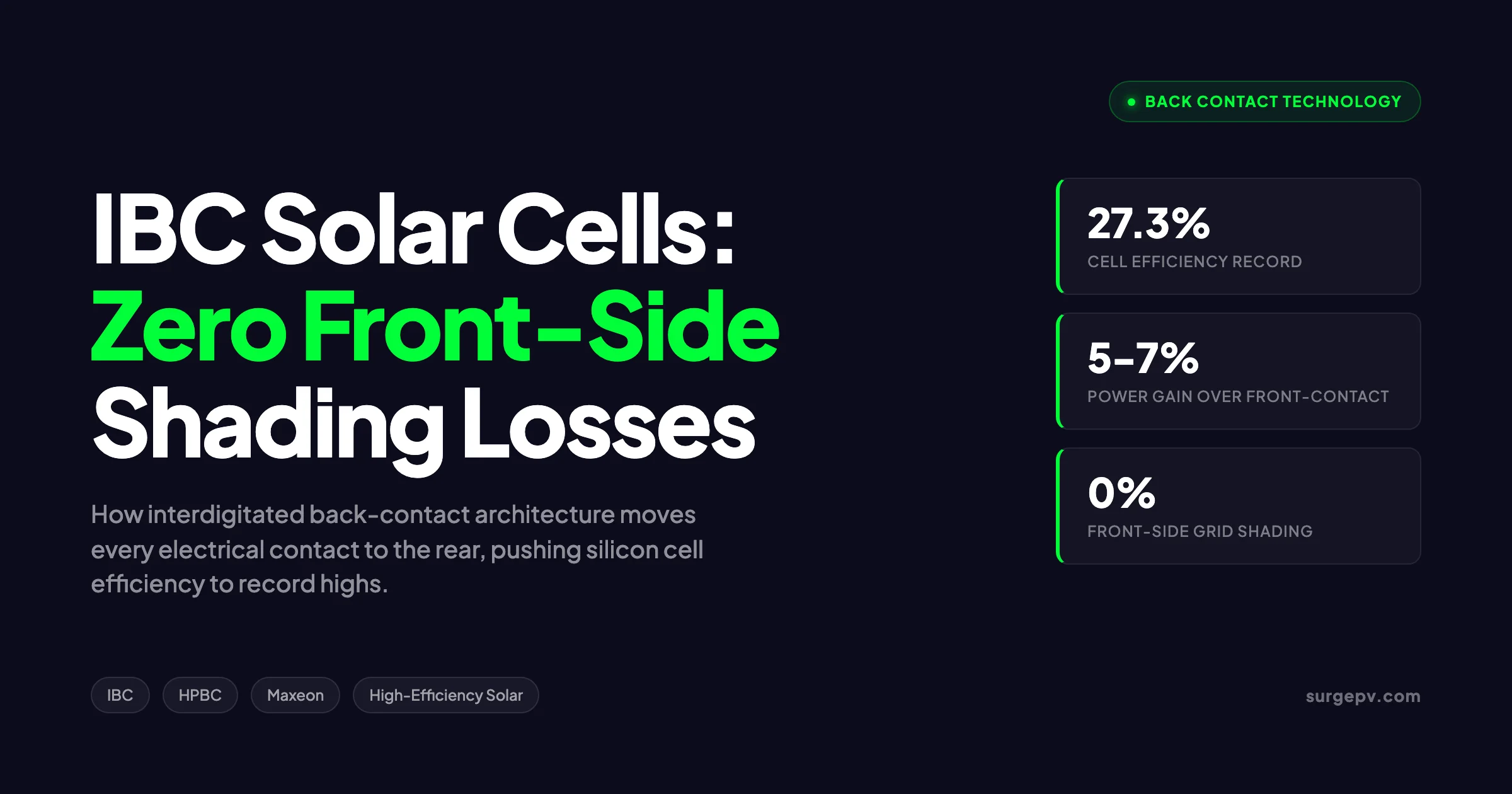
IBC moves every metal contact to the back of the cell. The front absorbs sunlight with nothing blocking it, which gives a 5 to 7 percent relative power gain over front-contact designs. The world record sits at 27.3 percent cell efficiency. Maxeon, LONGi, and Aiko ship commercial panels at 24 to 25.4 percent module efficiency in 2026. The technology costs more per watt than TOPCon but wins on watts per square meter, making it the default choice for roof-limited residential and premium commercial projects.
This guide explains what IBC is, how the architecture changes the physics, the four commercial variants you will see on datasheets in 2026, and the decision framework I use when specifying panels in solar proposal software for clients with limited roof area. For a full architecture-by-architecture comparison inside modern solar software, the back-contact family sits at the top of the silicon stack.
What Is an IBC Solar Cell?
An IBC, or Interdigitated Back Contact, solar cell is a silicon cell where both the positive and negative metal contacts sit on the rear surface, interlocked like the teeth of two combs facing each other. The front face has no grid fingers, no busbars, and no metal of any kind. Light hits an unobstructed semiconductor surface, generates electron-hole pairs, and the charge carriers travel to the back to be collected.
Conventional cells like PERC, TOPCon, and most HJT designs split the contacts. The negative grid sits on the front, the positive contact on the back. That front grid blocks 3 to 5 percent of the incoming light. IBC eliminates that loss by design.
The Comb Pattern Explained
The word “interdigitated” describes the layout. On the rear of an IBC cell, the p-type emitter and the n-type base form alternating stripes, typically 100 to 400 micrometers wide. Each stripe is contacted by its own metal finger. Picture two combs pushed together so the teeth interlock without touching, then imagine that pattern printed across the entire back of a silicon wafer. See our guide on Commercial Rooftop Solar Case Study Italy for more.
This pattern matters because the two polarities must stay electrically isolated within microns of each other. The precision required is what made IBC expensive to manufacture for two decades, and what kept it niche until self-aligned diffusion processes arrived.
Why Front Shading Is the Hidden Tax on Conventional Cells
Every front-contact silicon panel pays an optical tax. The thin silver fingers and busbars that collect current also block the light they exist to capture. On a standard TOPCon cell, this metal coverage typically equals 3 to 5 percent of the cell area, depending on the busbar count and finger width.
The penalty looks small until you compound it over the lifetime of a system. On a 10 kWp rooftop array producing 11,000 kWh per year, a 4 percent shading loss erases about 440 kWh annually, or roughly 11,000 kWh across a 25-year service life. At a German electricity tariff of 0.30 euros per kWh, that single optical loss represents over 3,300 euros in lost generation. See our guide on Community Solar Projects Germany for more.
Multi-busbar (MBB) and shingled-cell designs have reduced the front shading loss from 6 to 7 percent on older 3BB cells down to 2 to 3 percent on modern 12BB or 16BB layouts. Each evolutionary step reduces the loss but does not eliminate it. IBC is the only architecture that takes the loss to zero by design rather than minimizing it incrementally.
Pro Tip
When you compare datasheets between IBC and TOPCon panels at the same wattage, the IBC panel is using a smaller cell area. That smaller footprint is the value, especially on tight residential roofs where every square meter counts.
The Three Wins From Moving Metal to the Back
The architecture delivers three separate gains:
- Optical gain. Removing front metal recovers the 3 to 5 percent of light it used to block. This is the most cited benefit.
- Electrical gain. Wider, lower-resistance rear metallization reduces series resistance losses by 0.5 to 1 percent absolute.
- Recombination gain. Front-surface doping can be tuned for light absorption alone, not for carrier collection. The front emitter layer that conventional cells need can be removed or replaced with a passivation stack.
Total power gain over an equivalent TOPCon cell typically runs 5 to 7 percent relative, with the exact figure depending on the back-contact sub-type.
The 2026 Efficiency Records
The back-contact family currently holds the silicon efficiency crown across every benchmark I track. Here are the numbers worth knowing:
| Metric | Value | Source | Year |
|---|---|---|---|
| Silicon cell world record | 27.3% | LONGi HIBC, Fraunhofer ISFH certified | May 2024 |
| Previous silicon cell record | 27.09% | LONGi HBC | November 2023 |
| HJT-IBC cell (theoretical earlier benchmark) | 26.7% | Kaneka, NREL certified | 2017 |
| POLO-IBC cell | 26.1% | ISFH | 2019 |
| HPBC 2.0 mass-production cell | 26.6%+ | LONGi commercial | 2025 |
| Aiko ABC mass-production module | 25.0% | TaiyangNews verified | April 2026 |
| LONGi Hi-MO X10 module NREL champion | 25.4% | NREL Champion Chart | October 2024 |
| Maxeon 7 NREL panel test | 24.9% | NREL certified | March 2024 |
The two figures to anchor on: 27.3 percent for the lab record, and 25 to 25.4 percent for what you can actually order in 2026.
A Note on the Record History
The crystalline silicon Shockley-Queisser limit sits at around 29.4 percent. IBC at 27.3 percent is within 2.1 percentage points of that fundamental ceiling. For context, conventional PERC peaked at 24.5 percent and TOPCon caps near 26 percent. Back contact is the only mass-produced silicon architecture with meaningful headroom left.
The Four Commercial Variants You Will See in 2026
Not every “back contact” panel uses the same recipe. Four distinct sub-types ship at scale in 2026, and the differences affect price, performance, and warranty.
1. Maxeon Cell (Classic IBC)
Maxeon, the corporate spin-off that absorbed SunPower’s manufacturing, builds the original IBC architecture invented by Dick Swanson in the 1980s. The cell uses a thick copper foundation for the rear metallization and a phosphorus-doped silicon base.
Maxeon’s Generation 7 panel reaches up to 24.0 percent module efficiency at 475 W in 132 half-cell format, with the highest verified single-panel result at 24.9 percent on NREL test equipment. The company pairs the technology with a 40-year warranty, 98 percent year-one retention, and 88.25 percent retention at year 40, the longest binding warranty in the residential market.
2. LONGi HPBC and HPBC 2.0
HPBC stands for Hybrid Passivated Back Contact. LONGi’s twist is to combine a passivated contact layer (similar to TOPCon’s poly-silicon-on-oxide stack) with the IBC layout. The result is back-contact geometry without the photolithography complexity that historically priced IBC out of mass production.
HPBC 2.0, launched October 2024 in the Hi-MO X10 module, achieves 26.6 percent mass-production cell efficiency. The 670 W flagship module hits 24.8 percent in commercial spec and 25.4 percent in NREL champion-cell testing. LONGi’s TaiRay wafer technology contributes to the power gain by reducing wafer defects.
3. LONGi HIBC (Heterojunction Back Contact)
This is LONGi’s premium architecture, combining heterojunction passivation (HJT-style amorphous silicon layers) with back-contact metallization. The Hi-MO S10 (EcoLife Pro), launched at Intersolar Munich 2025, delivers up to 25 percent module efficiency. The underlying cell is the one that set the 27.3 percent world record. HIBC sits above HPBC in LONGi’s hierarchy and targets aesthetics-first residential markets.
4. Aiko ABC (All Back Contact)
Aiko Solar’s ABC technology uses a two-step diffusion process that separates p-type and n-type formation, eliminating the compromise that single-step processes force. The resulting cells reach 27 percent in pilot production and 25 percent at module level in mass production.
The Aiko Gen 3 60-cell module, launched in Australia in March 2026, delivers 545 W at over 25 percent module efficiency in a 1,954 mm by 1,134 mm footprint. The company has begun an 11 GW capacity transition from PERC and TOPCon to ABC, with the Yiwu and Chuzhou plants converting through Q3 and Q4 2026. For Australia-specific compliance details, see Australia comparisons/lgc-vs-stc.
Quick Identifier
If a datasheet lists module efficiency above 24 percent and the front of the cell appears completely uniform with no visible grid lines, you are almost certainly looking at one of these four variants. Cross-check the cell technology field for “IBC,” “BC,” “HPBC,” “HBC,” “HIBC,” or “ABC.”
The History: How IBC Went From Lab Curiosity to 100 GW Mainstream
The IBC concept dates to 1975 work at Stanford under Richard Swanson. The first practical IBC cells were built for terrestrial concentrator photovoltaic systems in the early 1980s, where the high cost was justified by 200-sun to 500-sun concentration ratios. Swanson founded SunPower in 1985 to commercialize the technology for one-sun residential and commercial use.
For two decades, SunPower was effectively the only company shipping IBC panels at meaningful volume. The architecture’s complexity was a moat. Photolithography, double-sided diffusion, copper-foundation rear metallization, and yield management at the cell level kept costs 2x to 3x higher than conventional aluminum-BSF panels. SunPower targeted premium residential and held the efficiency crown for most of the period from 2005 to 2017.
The Chinese pivot started in 2018 when LONGi and Trina began pilot lines. ISC Konstanz licensed an IBC process to SPIC Solar in Xining, achieving 24 percent mass-production efficiency by 2022. LONGi launched HPBC (the first generation) in 2023, reaching 25 percent module efficiency. HPBC 2.0 followed in October 2024 at 24.8 percent commercial and 25.4 percent champion. Aiko’s ABC commercial rollout began in 2024, hitting 25 percent module efficiency by April 2026.
The technology is no longer a single-supplier story. Maxeon ships from Mexico and Malaysia, LONGi from China and now from Vietnam, and Aiko ramps in eastern China. Supply diversification is the change that makes IBC specifiable for serious projects in 2026.
How IBC Cells Are Made
The manufacturing process is where IBC has historically lost to TOPCon. Understanding why the process is harder makes the price premium make sense.
Step 1: Wafer Preparation
Start with an n-type monocrystalline silicon wafer, typically 130 to 150 micrometers thick, with a resistivity of 1 to 5 ohm-centimeters. Texture the front surface with alkaline etching to create the pyramid structure that traps incoming light. So far this is identical to TOPCon.
Step 2: Front Surface Passivation
Deposit a passivation stack on the front, usually an aluminum oxide layer plus a silicon nitride anti-reflection coating. This step does double duty by passivating dangling bonds and minimizing reflection. Note that no doping is required on the front since there is no front contact.
Step 3: Rear Pattern Definition
This is where IBC gets expensive. The rear surface needs alternating p-type and n-type regions in the interdigitated pattern. Three approaches exist:
- Photolithography: The legacy Maxeon approach. High precision, high cost.
- Screen-printed diffusion barriers: Cheaper, lower precision.
- Laser-defined ablation: The modern compromise used by LONGi HPBC.
- Self-aligned diffusion (Aiko’s two-step process): The newest method, which uses BSG and PSG glass layers as natural masks. This is what cracked the cost code for Aiko.
Step 4: Diffusion of Emitter and Base Contacts
Phosphorus diffusion creates the n-type contact regions; boron diffusion creates the p-type regions. The two diffusions need precise alignment, and a single short between the regions destroys the cell. Yield management is the silent constraint on IBC capacity expansion.
Step 5: Rear Passivation and Metallization
Deposit a passivation stack on the rear (silicon nitride or polysilicon, depending on architecture) and pattern openings for the metal. Print or plate the rear metal grid, typically silver paste for screen-printed designs or electroplated copper for premium products.
Step 6: Module Assembly
The bare cell is interconnected using rear ribbons or shingled overlap, encapsulated, and laminated into a panel. Because all contacts are on the back, conventional front ribbons disappear. Aiko uses an “invisible ribbon” interconnection that contributes to the completely uniform front appearance.
Manufacturing Complexity Cost Premium
The extra steps translate to a real cost premium. Industry estimates for 2026 put IBC cell production at 8 to 15 cents per watt above TOPCon, depending on the sub-type. At module level, that becomes a 10 to 20 cent per watt premium at retail. For a 10 kWp residential system, the panel premium typically runs 800 to 1,200 euros.
The premium is shrinking. LONGi has announced HPBC 2.0 cell costs within 5 percent of HJT, and the EU-funded IBC4EU consortium of 17 partners is targeting commodity-level pricing by 2028. My field experience tracks with this. The 2022 IBC premium was punishing; the 2026 premium is tolerable for the right project.
Comparing IBC, HJT, and TOPCon for Your Next Project?
The module choice changes the array layout, wiring losses, and 25-year revenue. Run the comparison inside solar design tools that models real shading and per-cell behavior, not just nameplate numbers.
Book a DemoNo commitment required · 20 minutes · Live project walkthrough
For France-specific information, see Agricultural Solar Case Study.
Where IBC Wins: Five Project Types
After deploying over a gigawatt of capacity across 50 countries, I have a clear sense of when IBC earns its premium and when it does not. Here are the five project types where I specify back-contact panels.
1. Roof-Constrained Residential
A typical urban home roof has 30 to 60 square meters of usable south-facing area. Hitting a target system size with a smaller area is worth real money. Replacing a 22 percent TOPCon array with a 25 percent ABC array buys back 14 percent more capacity on the same roof. For a customer who wants a 10 kW system on an 8 kW roof, IBC is often the only path. Also see: Us Residential Solar Market Trends 2026.
2. Premium Residential Where Aesthetics Drive the Sale
The uniform black appearance is a sales asset. Architects, premium homeowners, and HOA-constrained installations regularly select IBC purely for visual reasons. I have closed deals where the customer chose the panel before reading the datasheet, just because they did not want to see grid lines from the street.
3. Vehicle-Integrated and Building-Integrated Photovoltaics
When the panel is the structure (a car roof, a curtain wall, a sunroof), maximum power per square meter justifies the cost premium. IBC has dominated VIPV and BIPV for two decades and shows no sign of losing this niche.
4. Spaceflight and Specialty Concentrator Designs
Solar racers, satellites, and concentrator PV systems use IBC for the same reason: every square millimeter matters. This is a small market by volume but it is where IBC technology was first validated.
5. Commercial Rooftops With High Local Electricity Prices
In markets where electricity is above 0.25 USD per kWh and the host has limited roof area, the cost premium for IBC clears the IRR hurdle. Hospitality, premium retail, and data center rooftops fit this profile, especially in Western Europe, Australia, and parts of the US Northeast. Also see: European Solar Incentives.
Where IBC Loses: Three Project Types to Avoid
The technology is not a universal answer. I do not specify IBC for:
1. Utility-Scale Ground-Mount
Land is the constraint on utility solar, not roof area, and land is cheap relative to module cost. A 100 MW project saves nothing by squeezing onto fewer acres, but pays a real cash premium for the IBC modules. TOPCon wins on dollars-per-watt and dollars-per-MWh in this segment, and the gap is not closing fast enough to matter through 2027.
2. Large Commercial Roofs With Surplus Area
A 500 kWp warehouse roof with 8,000 square meters of usable surface has no roof-area constraint. The IBC premium adds 5,000 to 10,000 dollars per 100 kWp without buying anything the project needs. TOPCon ships, the customer’s CFO signs, the project pencils.
3. Hot Climates Without HJT-IBC Hybrid
Standard IBC cells have a temperature coefficient near minus 0.34 percent per degree Celsius, similar to TOPCon and worse than HJT. In hot deserts, HJT panels (or HJT-IBC hybrids like LONGi HIBC) outperform pure IBC. If the site is above 35 degrees Celsius average operating temperature, run the math both ways before defaulting to IBC.
IBC vs TOPCon vs HJT: The Cost-Performance Tradeoff
The honest tradeoff matrix for 2026:
| Metric | PERC (legacy) | TOPCon | HJT | IBC |
|---|---|---|---|---|
| Mass production cell efficiency | 22.5% | 25.5% | 25.4% | 26.6%+ |
| Module efficiency (commercial peak) | 21.0% | 22.6% | 22.8% | 25.4% |
| Temperature coefficient (%/°C) | -0.36 | -0.30 | -0.24 | -0.29 to -0.26 |
| First-year degradation | 2.0% | 1.0% | 1.0% | 0.5% |
| Annual degradation after Y1 | 0.55% | 0.40% | 0.25% | 0.25% |
| Cost premium vs PERC (USD/W) | baseline | +0.02 | +0.04 | +0.08 to +0.12 |
| Typical warranty (years) | 25 | 25 | 25-30 | 30-40 |
| Best application | phase-out | utility-scale | hot climate, premium | roof-constrained, premium |
This is the comparison I run before specifying any panel. The full architecture comparison sits in our n-type vs p-type guide, and the head-to-head between competing n-type architectures lives in our TOPCon vs HJT vs perovskite analysis.
A Contrarian View on the IBC Hype Cycle
The industry narrative says IBC is the inevitable endpoint of silicon. Every technology roadmap from Fraunhofer, NREL, and the IEA-PVPS task force ends at an IBC architecture. The marketing from LONGi, Maxeon, and Aiko reinforces the same idea.
I disagree, at least for the next 5 years.
The reason is not technical. The 27.3 percent record proves IBC works. The reason is economic. The marginal cost of an extra patterning step is large enough that TOPCon will continue to win 70 percent of new utility capacity through 2028, even if IBC matches it on cents-per-watt. Capex per gigawatt of IBC capacity is still 25 to 40 percent higher than TOPCon. Tooling depreciation is a 10-year story, and most fabs have not yet recovered the TOPCon conversion they paid for in 2023.
My field call: IBC stabilizes at 15 to 20 percent of the global silicon market by 2028, concentrated in residential, BIPV, and premium commercial. TOPCon keeps the utility crown. HJT takes 10 to 15 percent. The inevitable IBC dominance is a 2030s story, not a 2026 story. For Global-specific compliance details, see Global net-metering-by-country.
What This Means For You
If you sell residential or premium commercial, get certified on at least one IBC product (Maxeon 7, Hi-MO X10, or Aiko Gen 3) within the next 6 months. If you sell utility-scale, do not waste sales effort on the IBC premium until 2028 at the earliest.
IBC and System Design Implications
The architecture changes more than the cell. It changes how the panel behaves in a real array.
Shade Tolerance
IBC panels are not inherently more shade-tolerant than TOPCon at the cell level. The bypass diode and substring layout determine how shade losses propagate, and these are module-design decisions independent of cell architecture. If shade is a concern on your site, run a proper shading analysis before assuming IBC will rescue a partially shaded roof.
Bifacial Performance
Pure IBC modules historically lost bifacial revenue because the dense rear metallization blocks rear-side light. The latest LONGi HIBC and bifacial IBC variants achieve 70 to 75 percent bifaciality versus 80 percent for the best bifacial TOPCon. For ground-mount with reflective surfaces, this gap still favors TOPCon. For rooftop, bifacial gain is mostly cosmetic anyway. See Bifacial Solar Panel Design Guide for detailed guidance.
String Sizing and Inverter Compatibility
A 670 W IBC module pushes string-level voltages higher than older 400 to 450 W panels. The Hi-MO X10 has an open-circuit voltage of 49.3 V per module. On a 1500 V system, the maximum string length is 30 panels. Most modern string inverters handle this without issue, but legacy designs need a recheck.
For low-voltage residential systems on hybrid inverters, the higher Vmp may require recalculating string lengths and considering microinverters for partial-shade scenarios. The generation and financial modeling tool handles this automatically when you input the panel datasheet.
The Manufacturing Capacity Picture in 2026
Annualized IBC capacity at the start of 2026 looks like this:
- LONGi HPBC 2.0: roughly 50 GW of installed capacity, ramping to 80 GW by end of 2026.
- Aiko ABC: roughly 15 GW shipping, with 11 GW more in conversion (5 GW Yiwu, 6 GW Chuzhou).
- Maxeon 7: roughly 1.5 to 2 GW, constrained by the post-SunPower-bankruptcy transition.
- ISC Konstanz / SPIC Solar: roughly 5 GW pilot and early commercial.
- Other Chinese entrants (Jinko BC, Trina BC, JA BC): roughly 10 to 15 GW combined.
Total IBC-family supply approaches 85 to 100 GW for 2026, against global silicon module demand of roughly 700 GW. That puts IBC market share at 12 to 14 percent, on track for my 15 to 20 percent 2028 prediction.
Field Lesson: When the Premium Pays Back
A real project from late 2025. A premium villa in Costa Brava with 42 square meters of usable roof. The owner wanted 12 kWp to cover air conditioning and a heat pump in summer. Standard 440 W TOPCon panels would have required 28 modules (28 × 1.95 m² = 54.6 m²), which the roof could not accommodate.
I specified 22 Maxeon 7 475 W panels at 1.808 m² each, totaling 39.8 m². The system fit. Panel cost premium was 1,840 euros. First-year generation came in at 14,950 kWh against a TOPCon-equivalent estimate of 14,200 kWh, so the IBC array delivered 750 kWh more annually. At the local self-consumption value of 0.28 euros per kWh, the premium pays back in roughly 8.7 years on generation gain alone.
The actual close happened on aesthetics. The architect saw the sample panel and signed the same afternoon.
IBC and Battery System Integration
The higher per-panel power output changes how IBC arrays pair with residential battery systems. Three implications worth flagging.
DC-Coupled Hybrid Inverter Sizing
A 22-panel Hi-MO X10 array at 670 W each generates a 14.74 kWp DC rating. Most residential hybrid inverters cap at 10 kW AC. The DC-to-AC ratio of 1.47 is at the high end of what most inverter datasheets recommend (typically 1.3 to 1.5). Plan the clipping losses into the financial model; my rule of thumb is 1.5 to 2 percent annualized clipping at a DC:AC ratio of 1.5 in southern Europe and 0.5 to 1 percent at the same ratio in northern Europe.
Self-Consumption Optimization
The extra summer peak generation from a high-density IBC array creates more midday export. If feed-in tariffs are low and self-consumption tariffs are high, sizing the battery up by 20 to 30 percent versus a TOPCon-equivalent system improves the economics. The battery storage payback calculator handles this analysis with site-specific tariff inputs. Read Adding Battery Storage Services for a complete walkthrough.
EV Charging Pairing
For homes pairing solar with EV charging, the IBC density advantage matters most. A 14 kWp IBC array can sustain a 11 kW EV charger from solar alone for a 3 to 4 hour window in summer; an equivalent-area TOPCon array at 12 kWp drops that window to 2.5 to 3 hours. The difference is meaningful for households charging during the daytime work-from-home window.
Common Misconceptions About IBC
A few claims I hear repeatedly from sales teams and consumers that need correction.
“IBC panels never degrade.”
False. IBC panels degrade at 0.25 to 0.5 percent per year, depending on sub-type. That is slower than PERC (0.55 percent) and similar to HJT, but it is not zero. The Maxeon 40-year warranty guarantees 88.25 percent retention, not 100 percent. Anyone selling a “no degradation” panel is misreading the datasheet.
“IBC is the only n-type technology that matters.”
False. TOPCon is also n-type and ships at over 600 GW of capacity. HJT is n-type. The base material is shared; the architectural difference is the contact placement. Conflating “IBC” with “n-type” is a category error.
“Back-contact panels work better in shade.”
Partially true at best. The cell architecture does not change shade tolerance. Module-level features like bypass diode count and substring layout determine shade response. If your IBC panel has 6 bypass diodes and your competitor’s TOPCon has 3, the IBC will tolerate partial shade better, but that is a module-design call, not an IBC inherent advantage. Run a proper shading analysis before specifying any high-performance panel on a shaded roof.
“IBC panels are only worth it for off-grid.”
False, and the opposite of the truth. Off-grid systems with surplus solar capacity have no roof-area constraint; you simply add more panels. IBC’s value proposition is highest in grid-tied, urban, roof-limited residential where every square meter matters.
“IBC panels are too fragile for hail-prone regions.”
False with the modern generation. Aiko’s Gen 3 module is certified to 40 mm hail with the 3.2 mm mono-glass variant. Maxeon 7 has equivalent certifications. The copper-foundation rear is structurally robust. Older Maxeon designs from before 2018 had some specific failure modes that have been engineered out.
How to Evaluate an IBC Panel Datasheet
When a manufacturer hands you an IBC spec sheet, check these fields before committing:
- Cell technology designation. Look for “BC,” “IBC,” “HPBC,” “HBC,” “HIBC,” or “ABC.” Vague terms like “advanced cell” without specifics usually indicate TOPCon dressed up.
- Module efficiency. Anything under 23 percent is not really competitive in the IBC class. Top of the line in 2026 is 24.8 to 25.4 percent.
- Power output at NMOT. This is the realistic field condition. Compare against STC to gauge temperature derating.
- Warranty terms. Both product and performance warranty matter. Maxeon offers 40 years, Aiko and LONGi offer 25 to 30 years. The annual degradation rate matters more than the headline year count.
- Bifacial coefficient. Only relevant for ground-mount or large flat-roof commercial. Residential IBC is functionally monofacial.
- First-year light-induced degradation (LID). IBC’s n-type base typically avoids the boron-oxygen LID that plagues P-type. Expect 0.5 percent or less.
- Temperature coefficient. Standard IBC sits at -0.29 to -0.26 percent per degree. HIBC variants can hit -0.24 percent.
- Salt mist and ammonia resistance certifications. Critical for coastal and agricultural installations.
Looking Forward: What 2027 to 2030 Holds
Three trends to watch:
Self-Aligned Mass Production
Aiko’s two-step diffusion approach is the template. Expect every major IBC manufacturer to adopt similar self-aligned processes by 2027, eliminating the photolithography that currently caps capacity expansion. The capex reduction from removing photolithography steps cuts roughly 20 to 25 percent off the per-gigawatt fab investment, which translates to lower module pricing through 2028.
Tandem Cells With IBC Bases
Perovskite-on-IBC tandems are the most credible path to 30 percent module efficiency. The 27.3 percent silicon record plus a 17 to 19 percent perovskite top cell yields a theoretical 32 to 33 percent tandem. Commercial product is still 2 to 3 years out. Read our perovskite solar cells deep dive for the tandem cell roadmap.
Copper Replacing Silver
Silver paste is the largest single bill-of-materials cost in IBC cells. Industry roadmaps target electroplated copper metallization by 2027. The cost reduction would close the IBC-TOPCon price gap by 60 to 70 percent and would shift my 2028 market share call upward. Maxeon already uses copper foundations for its rear metal; the question is whether copper plating becomes economic for the higher-volume Chinese fabs.
Conclusion: The Three Things to Take Away
Three action items for installers and specifiers:
- Get product-certified on at least one IBC product if you sell residential or premium commercial. Maxeon 7, LONGi Hi-MO X10, or Aiko Gen 3 are the three to know. The certification effort pays back the first time a roof-constrained customer asks for “the best panel.”
- Stop assuming IBC is unaffordable. The 2026 premium is 8 to 15 cents per watt, not the 30 to 50 cents it was in 2022. Run the math on roof-area-constrained projects before defaulting to TOPCon.
- Do not over-specify IBC on projects where it wastes money. Utility-scale, large commercial roofs with surplus area, and price-sensitive residential customers are still TOPCon territory. Match the technology to the constraint.
The back-contact era is here. It is not going to displace TOPCon overnight, and it should not. But the technology has finally crossed from niche premium product to credible mainstream choice, and the design tools and proposal software you use should reflect that.
Frequently Asked Questions
What does IBC stand for in solar?
IBC stands for Interdigitated Back Contact. It is a solar cell architecture that moves every electrical contact, including both positive and negative metallization, to the rear surface. The front face has no grid fingers or busbars, so the cell absorbs more sunlight.
How efficient are IBC solar cells in 2026?
The current cell-level record for back-contact silicon is 27.3 percent, set by LONGi heterojunction back contact in May 2024 and certified by Fraunhofer ISFH. In mass production, LONGi HPBC 2.0 cells exceed 26.6 percent and Aiko ABC modules reach 25 percent. Commercial IBC panels sell at 22.8 to 25.4 percent module efficiency.
Why are IBC cells more expensive than TOPCon?
IBC adds 2 to 4 extra patterning steps versus a standard TOPCon line. Each step requires precise alignment of the p-type and n-type regions on the rear, which historically needed photolithography or laser ablation. The added complexity raises capex per gigawatt and silver paste consumption, although LONGi and Aiko have cut both with self-aligned diffusion masks.
Is IBC better than HJT or TOPCon?
IBC delivers the highest cell efficiency and produces the most watts per square meter, but TOPCon costs less per watt and dominates utility-scale projects. HJT sits between the two on cost and runs cooler than both. For roof-constrained homes, IBC wins. For ground-mount farms with cheap land, TOPCon usually wins.
Do IBC panels look different from regular panels?
Yes. Because there are no grid fingers or busbars on the front, IBC panels look completely uniform and matte black from the outside. Many homeowners pick IBC purely for the cleaner aesthetics on visible south-facing roofs.
Who makes IBC solar panels in 2026?
Maxeon (the spin-off from SunPower) makes the Maxeon 7 series. LONGi sells the Hi-MO X10 (HPBC 2.0) and the heterojunction back-contact Hi-MO S10 EcoLife Pro. Aiko Solar sells the ABC Gen 3 line, including a 60-cell residential module at 545 W. ISC Konstanz licenses an IBC process for mass production at SPIC Solar.
Are IBC panels worth the price premium?
For installations where roof space is limited, yes. A 10 percent module-efficiency advantage means roughly 10 percent more power on the same roof, which often pays back the panel premium inside the warranty period. For ground-mount or large commercial roofs with surplus area, the math usually favors TOPCon.
What is HPBC and how is it different from IBC?
HPBC stands for Hybrid Passivated Back Contact. It is LONGi’s commercial implementation of the back-contact concept, which combines passivated contacts with the IBC layout to reach 26.6 percent cell efficiency in mass production. HPBC is a sub-type of IBC. Aiko calls its version ABC (All Back Contact). They share the same core idea: zero front-side metal.
Sources
- LONGi Hi-MO X10 HPBC 2.0 launch announcement
- Aiko 25% mass-production module efficiency milestone
- Maxeon IBC Technology & Manufacturing whitepaper
- PV Magazine: Maxeon claims 24.9% NREL-certified panel
- IBC as final evolution for crystalline silicon (MDPI peer-reviewed)
- Scientific Reports: 26.1% efficient POLO-IBC cell
- PV Magazine: Aiko launches 545 W ABC module March 2026
- LONGi HIBC 25% module launch (Intersolar Munich) Solar proposal software generates professional quotes in minutes.
Where this fits
This article is part of SurgePV's Solar Technology hub, which works through the topic from first principles to the decisions a project team actually has to make.
