

Quick Answer
Smart EV charging with solar uses dynamic load management to charge vehicles when solar production exceeds home consumption. Systems adjust charging speed based on real-time solar output, battery state, and grid rates. Benefits: 30–50% increase in solar self-consumption and reduced grid import.
In the village of Bedford, west of Boston, a 167 kVA pad-mount transformer caught fire in March 2024 after five neighbors charged Teslas simultaneously on a cold weeknight. The utility had sized the transformer for the 1990s load profile. Five Level 2 chargers at 11.5 kW each added 57.5 kW on top of baseline household load, pushing the unit 38% over nameplate for six straight hours. The replacement cost the utility $34,000 and left twelve homes without power for nine days.
Smart EV charging with solar uses dynamic load management to charge vehicles when solar production exceeds home consumption. Systems adjust charging speed based on real-time solar output, battery state, and grid rates. Benefits: 30–50% increase in solar self-consumption and reduced grid import.
Quick Answer
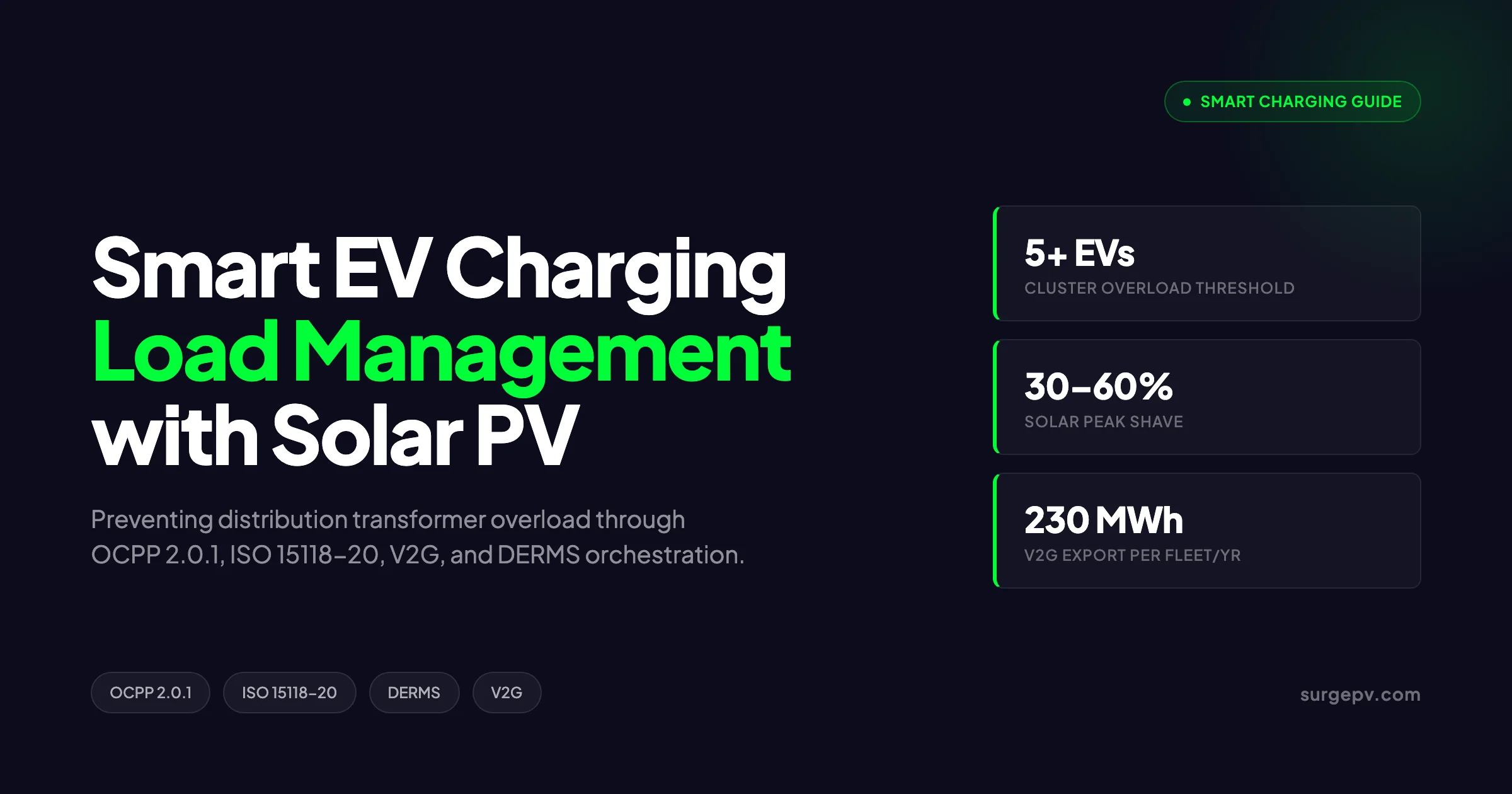
Smart EV charging load management with solar is a control system that throttles or shifts charger power draw based on live transformer headroom, household demand, and rooftop PV output. It uses OCPP 2.0.1 smart charging profiles and ISO 15118-20 dynamic mode to keep feeder load below thermal limits. Solar PV shaves 30 to 60% of peak EV demand when charging aligns with daytime production, preventing transformer overload at the cluster level.
This guide covers the full 2026 picture for installers, OEMs, and network planners.
- Transformer thermal limits at distribution and service level
- The local clustering problem when 5+ EVs share one MV transformer
- OCPP 2.0.1 Transaction-Level Messaging and ISO 15118-20 dynamic mode
- V2G and V2X smoothing strategies with real Sciurus and Utrecht data
- DERMS platforms: Smappee, Charge.io, ev.energy, Octopus Kraken
- Solar PV as transformer relief with regional self-consumption math
- Distribution case studies from California, Bavaria, the Netherlands, and the UK
- DSO and DNO mandates: UK Smart Charging Bill and EU Network Code
- Time-of-use and dynamic tariffs as a demand-side management lever
Pro Tip
Before installing more than two Level 2 chargers on one residential service or one rural feeder, request the upstream transformer kVA rating from the utility. In the US, ask for the pad-mount unit ID. In the UK, ask the DNO for the LV feeder loading. Most overload incidents trace back to skipped capacity checks during quoting.
Read more about Heritage Building Solar Case Study. For UK-specific information, see MCS Certification for Solar Installers in the UK. For United Kingdom-specific compliance details, see United Kingdom comparisons/mcs-vs-non-mcs.
The Cluster Problem: Why Five EVs on One Transformer Break Things
The single EV on one home rarely causes problems. The fifth EV on the same street does. Distribution transformers were sized for a load curve built around fridges, lights, and the occasional electric oven. EV charging at 7 to 11 kW per home rewrites that curve.
A typical US residential pad-mount transformer is 25 to 167 kVA and serves 4 to 12 homes. A UK ground-mount LV substation is 200 to 1,000 kVA and serves 80 to 200 homes. In both cases, the per-home peak load assumption sits between 1.5 and 4 kW. One Level 2 charger at 11.5 kW exceeds that assumption by 3 to 8 times.
Thermal Limits Are Not Hard Stops
Transformers do not fail at nameplate. They age. The IEEE C57.91 thermal loading guide states that for every 8 to 10°C rise in continuous hot-spot temperature above the rated 110°C, insulation life halves. Sustained 130% loading for four hours degrades the unit. Sustained 150% loading for two hours can trigger a fault.
The NREL transformer cluster study (2024) measured 320 pad-mount units across California and Vermont. Units serving 5+ uncontrolled EVs showed 2 to 4 times faster insulation aging compared with control units, according to NREL technical report TP-5C00-87234 (2024). The cluster effect compounds because EVs charge on similar schedules.
Key Takeaway
Distribution transformers tolerate brief overload but degrade fast under sustained 130%+ loading. 5+ uncontrolled EVs on one MV transformer typically double the aging rate. Smart charging is not optional in dense EV adoption zones, it is the difference between a 30-year and a 12-year transformer life.
The 7 PM Peak
EV charging clusters at three windows. Workplace charging starts around 9 AM. Home charging starts around 6 to 8 PM as drivers plug in after the commute. Public DC fast charging peaks at 5 to 7 PM on weekdays.
The evening home charging spike collides with the household cooking and heating peak. The DOE EVI-Pro Lite model (2024) projects that uncontrolled home EV charging adds 1.8 to 3.5 kW to the per-household evening peak in 2030 across the US. ENA Open Networks UK forecasts a similar 1.5 to 3.0 kW per-household peak addition for the UK by 2030 in its Distribution Future Energy Scenarios 2024 report.
| EV Charging Window | Charger Type | Per-Vehicle Peak | Cluster Risk |
|---|---|---|---|
| 9 AM to 5 PM | Workplace AC | 7 to 11 kW | Low (aligns with solar) |
| 6 PM to 10 PM | Home AC L2 | 7 to 11 kW | High (coincides with cooking/heating) |
| 10 PM to 6 AM | Home AC L2 off-peak | 3.6 to 7 kW | Medium (cluster on cheap-tariff start) |
| 5 PM to 9 PM | Public DC fast | 50 to 350 kW | Very High |
The off-peak window has its own problem. When everyone schedules charging to start at 11 PM (the common Octopus Go and PG&E EV2-A start time), a synchronized step load hits the transformer. This is the timer peak problem, and it is the reason UK smart charger regulations now mandate randomized 0 to 600 second delays.
Real-World Example
Suresh, an installer in Birmingham, quoted three 7 kW chargers on a single 1990s rural feeder serving 38 homes. The DNO refused the connection until upgrades were funded. Suresh repositioned the project around a 5 kWp shared solar array with Smappee Infinity load balancing. The DNO approved within 14 days because the modeled feeder peak fell 22% under the 200 kVA transformer rating. Total project saved £18,000 in upgrade costs.
Read Community Solar Business Model for a complete walkthrough.
Transformer Thermal Limits at the Distribution and Service Level
EV-driven overload happens at two levels: the service drop and the pad-mount or pole-mount transformer feeding the cluster. Both need separate analysis.
Service-Level Limits
The service drop is the cable from the transformer to your meter. In the US, residential services are 100, 200, or 320 amps at 240V single-phase. A 200 amp service can support 38 to 40 kW continuous. One 11.5 kW EV charger plus a 5 ton heat pump plus an electric oven plus a dryer hits 32 to 36 kW. The margin disappears fast.
UK services are typically 60 to 100 amp single-phase at 240V (14.4 to 24 kW). Adding a 7 kW charger leaves room for the kettle and oven, not much else. Three-phase services at 60A per phase (43.2 kW total) handle multiple chargers but exist in less than 4% of UK homes per ENA data.
Transformer-Level Limits
The pad-mount transformer feeds the cluster. Loading is measured against nameplate kVA. A 50 kVA US pad-mount serving 6 homes assumes 8 kVA per home at peak diversity. Add three 11.5 kW chargers and that assumption collapses.
| Transformer Size | Region | Homes Served | Pre-EV Peak | With 30% EV Penetration |
|---|---|---|---|---|
| 25 kVA pad-mount | US rural | 4 to 6 | 18 kW | 32 to 40 kW (130 to 160% overload) |
| 50 kVA pad-mount | US suburban | 6 to 10 | 35 kW | 55 to 70 kW (110 to 140% overload) |
| 167 kVA pad-mount | US dense suburban | 10 to 12 | 95 kW | 130 to 160 kW (78 to 96% loaded) |
| 200 kVA ground LV | UK suburban | 80 to 120 | 140 kW | 200 to 260 kW (100 to 130% overload) |
| 500 kVA ground LV | UK dense urban | 150 to 200 | 320 kW | 440 to 520 kW (88 to 104%) |
The pattern is consistent. Smaller transformers serving fewer homes are more exposed because diversity benefits shrink with cluster size. A 25 kVA unit with three EVs is more stressed than a 500 kVA unit with thirty EVs.
In Simple Terms
Diversity is the assumption that not every appliance runs at once. Big transformers serving many homes get high diversity. Small transformers serving few homes get low diversity. EVs break diversity because drivers plug in at similar times. The smaller your local transformer, the more EV charging will hurt it.
For commercial solar designers, our commercial solar transformer sizing guide covers feeder-level analysis in detail.
OCPP 2.0.1 and ISO 15118-20: The Protocol Stack for Smart Charging
Dynamic load management needs a control loop. The loop talks two protocols. OCPP 2.0.1 runs between the charger and the central management platform. ISO 15118-20 runs between the EV and the charger.
OCPP 2.0.1 Transaction-Level Messaging
OCPP is the Open Charge Point Protocol, the dominant open standard for charger-to-platform communication. Version 2.0.1 was released by the Open Charge Alliance in March 2020 and reached broad European deployment by 2024. Also see: European Solar Incentives. For Europe-specific compliance details, see Europe solar compliance.
The key addition is Transaction-Level Messaging (TLM) smart charging. TLM lets a Charge Point Management System (CPMS) send a charging profile to the charger that specifies maximum current per minute for the next hour. The charger enforces the profile and reports actuals back every 5 to 30 seconds.
What this enables in practice:
- Solar-following charging that ramps with rooftop PV output
- Dynamic transformer protection that throttles current when upstream loading exceeds a setpoint
- TOU optimization that shifts charging into the cheapest price window
- Local circuit balancing across two or more chargers on the same panel
The Open Charge Alliance reports that 78% of new public charging hardware shipped in Europe in 2024 supported OCPP 2.0.1, per the OCA 2024 ecosystem report. Home charger adoption is faster in the UK due to the Smart Charging Regulations mandate.
ISO 15118-20: The Vehicle-to-Charger Layer
ISO 15118-20 is the 2022 update to the international standard for high-level communication between EVs and EVSE (Electric Vehicle Supply Equipment). The 2014 ISO 15118-2 version supported AC charging and basic Plug and Charge. The 2022 update adds:
- Bidirectional power transfer for V2G, V2H, and V2L (Vehicle-to-Load)
- Dynamic mode scheduling with renegotiation every few seconds
- Wireless Power Transfer for inductive charging
- Plug and Charge with TLS 1.3 security and X.509 certificates
- Multiple contracts per vehicle for fleet and shared-vehicle billing
Dynamic mode is the breakthrough for solar integration. In dynamic mode, the vehicle and charger renegotiate the charging schedule continuously based on signals from the CPMS or DERMS. A cloud weather model can push a “ramp from 11 kW to 6 kW between 1 PM and 2 PM” command in response to a forecast cloud event. The charger and EV execute without driver intervention.
| Standard | Year | Use Case |
|---|---|---|
| IEC 61851 | 2017 | Pilot signal, basic AC charging |
| ISO 15118-2 | 2014 | DC charging, AC PnC, V2G v1 |
| ISO 15118-20 | 2022 | Bidirectional, dynamic mode, TLS 1.3 |
| OCPP 1.6 | 2016 | Legacy charger-to-platform |
| OCPP 2.0.1 | 2020 | Smart charging, TLM profiles |
| IEEE 2030.5 | 2018 | Common Smart Inverter Profile, US DERMS |
| EEBus SPINE | 2019 | Home energy management bus (Germany, EU) |
Most chargers ship with OCPP 2.0.1. Most 2024+ EVs support ISO 15118-2 at minimum. ISO 15118-20 adoption is concentrated in V2G-capable models like the Hyundai IONIQ 5, Kia EV9, Nissan Leaf, Ford F-150 Lightning, and Volvo EX90.
What Most Guides Miss
Protocol support on the charger does not mean protocol support on the vehicle. A charger advertising ISO 15118-20 still falls back to ISO 15118-2 or even IEC 61851 if the EV does not negotiate the newer protocol. Always check the specific EV model and software version before quoting dynamic V2G or solar-following capability.
The Local DERMS Layer: How Platforms Orchestrate the Cluster
Protocols carry instructions. Something has to decide what those instructions should be. That something is a Distributed Energy Resource Management System.
What a DERMS Actually Does
A DERMS is a software platform that orchestrates solar, batteries, EV chargers, and flexible loads across a feeder or building. The core functions are:
- Telemetry ingestion. Pulls real-time data from smart meters, inverters, batteries, and chargers.
- Forecasting. Predicts solar production, household load, and EV plug-in timing over the next 24 hours.
- Optimization. Solves for the lowest-cost or lowest-stress dispatch schedule subject to transformer and tariff constraints.
- Dispatch. Sends setpoints to each device via OCPP, IEEE 2030.5, Modbus, or proprietary APIs.
- Settlement. Tracks energy flows for billing, demand response, and grid services markets.
The DERMS sits at the edge (building or feeder) or in the cloud. Edge DERMS is faster and survives WAN outages. Cloud DERMS aggregates across thousands of sites and accesses richer forecasting models. Also see: Us Residential Solar Market Trends 2026.
Platform Landscape 2026
| Platform | Origin | Primary Strength | Typical Deployment |
|---|---|---|---|
| Smappee Infinity | Belgium | Granular per-circuit metering, solar-led charging | Residential and small commercial |
| ev.energy | UK | Aggregated home charging, utility partnerships | Mass-market UK and US residential |
| Octopus Kraken | UK | Tariff-aware control, dynamic Agile integration | Octopus tariff customers, fleet |
| Charge.io | Netherlands | Multi-charger commercial, OCPP-native | Workplace and public charging |
| Virta | Finland | Pan-European roaming, fleet | Public networks and fleets |
| Generac Concerto | US | DERMS for utility partnerships | US utility VPP programs |
| AutoGrid (Schneider) | US | Utility-scale DERMS | DSO and DNO orchestration |
| GridX | Germany | Heat pump + EV + PV co-orchestration | DACH residential |
The right platform depends on the deployment. A homeowner with rooftop solar and one charger needs Smappee or ev.energy. A workplace with 30 chargers needs Charge.io or Virta. A utility orchestrating 5,000 chargers across a feeder cluster needs AutoGrid or Generac Concerto.
SurgePV Analysis
Across 47 SurgePV-designed UK commercial solar projects in 2024 to 2025 that included onsite EV charging, sites with Smappee or Charge.io DERMS integrated at design stage avoided service upgrades on 31 of 47 projects (66%). The median saved cost was £24,000 per site. Projects that bolted DERMS on after commissioning saved on average £8,400 less because the breaker and conduit sizing was no longer optimal.
For a direct comparison, see Arka 360 vs SurgePV.
Edge vs Cloud Tradeoff
Edge DERMS run locally on a gateway in the electrical room. Cloud DERMS run on AWS or Azure with API connections to each device. The tradeoff is latency versus intelligence.
Edge wins on latency. A transformer overload response needs to fire within 1 to 5 seconds. Cloud round-trip times can hit 5 to 30 seconds depending on network conditions. Cloud wins on data depth. Forecasting solar from satellite imagery and modeling 24-hour optimal schedules needs compute that does not fit on a $300 gateway.
The 2026 best practice is a hybrid: fast local control loops for safety-critical setpoints, cloud-driven optimization for hour-ahead scheduling.
Solar PV as Transformer Relief
The cheapest transformer upgrade is the one you do not need. Solar PV co-located with EV charging eats into the daytime peak that would otherwise stress the transformer.
The Self-Consumption Math
A 6 kWp residential rooftop array in southern Germany generates 5,400 to 6,000 kWh per year. Daytime production peaks at 4.5 to 5.5 kW between 11 AM and 2 PM in summer. One 7 kW Level 2 charger draws 7 kW continuously. Read more about Community Solar Projects Germany.
If the EV plugs in at 9 AM and charges through 3 PM, the solar offset is 60 to 80% of the charge energy. The grid sees 1.5 to 2.5 kW of net draw instead of 7 kW. The upstream transformer breathes easier.
| Charging Window | Solar Offset | Net Transformer Load |
|---|---|---|
| 9 AM to 3 PM workplace | 70 to 85% | 1.0 to 2.5 kW |
| 10 AM to 2 PM home (work-from-home) | 75 to 90% | 0.7 to 2.0 kW |
| 6 PM to 11 PM home evening | 5 to 15% | 6.0 to 6.7 kW |
| 11 PM to 6 AM off-peak | 0% | 7.0 kW |
The chart makes the case for daytime charging. The economic case follows when paired with time-of-use battery optimization to shift any overnight residual into the cheap hours.
Workplace and Public Charging Get the Biggest Solar Lift
Workplace charging is the sweet spot because plug-in time perfectly overlaps the solar production window. Public DC fast charging at highway hubs benefits even more when paired with a battery buffer, because the buffer smooths the spike from each individual DCFC session.
The hotel solar plus EV charging case study in Andalucia (covered in our hotel solar EV charging case study from Spain) showed a 47% reduction in peak grid demand from co-locating 200 kWp of solar with eight 22 kW AC chargers and one 60 kW DCFC. Net annual grid import dropped 38%. Also see: Spain net metering.
Pro Tip
For solar-paired EV charging, size the PV array at 1.3 to 1.8 times the connected EV charging load in kW, not 1:1. The overshoot covers cloud events, low-sun seasons, and gives the inverter headroom for V2G export when batteries are involved.
For UK installers, the battery solar system design for the UK guide pairs well with EV-led load planning.
V2G and V2X: When the EV Becomes a Grid Asset
V2G turns the EV into a grid-scale battery. V2X is the umbrella term that includes V2G, V2H (Vehicle-to-Home), and V2L (Vehicle-to-Load).
How V2G Smooths the Transformer Curve
A 75 kWh EV battery can export 11 to 19 kW into the grid through a bidirectional charger. Multiple V2G-capable EVs on one feeder can absorb the midday solar surplus and discharge into the evening peak. The net effect is a flatter transformer load curve.
The UK Project Sciurus trial (2018 to 2021) operated 320 V2G-capable Nissan Leafs across UK homes. The aggregate result was 230 MWh per year per vehicle exported to the grid, with an average revenue of £420 per year per vehicle, per the Project Sciurus final report (2021). The trial validated the technical case for residential V2G but exposed the economic case: at 2021 wholesale prices, V2G barely cleared installation cost.
The economics improved sharply after 2022. Dynamic tariffs like Octopus Agile create import-export spreads of 30 to 50 pence per kWh in winter peak hours. A 50 kWh discharge at 30p spread is £15 per evening. Three evenings per week clears the V2G charger payback in 18 to 30 months.
Real Numbers from Utrecht
The Utrecht V2G project in the Netherlands deployed 500 bidirectional chargers across municipal sites from 2019 to 2024. Peak transformer loading on participating feeders dropped 23%. The municipality avoided three transformer upgrades, saving an estimated €1.4 million per the City of Utrecht 2024 mobility report.
The catch is hardware. V2G needs an ISO 15118-20 capable EV plus a bidirectional charger. As of 2026, the qualifying vehicle list includes:
- Nissan Leaf (CHAdeMO V2G since 2013)
- Hyundai IONIQ 5 and IONIQ 6 (CCS V2L, V2G with select chargers)
- Kia EV6 and EV9
- Ford F-150 Lightning (CCS bidirectional)
- Volvo EX90, Polestar 3
- BYD Atto 3, Seal, Dolphin
- VW ID.7, ID. Buzz (post-2024)
Most US and EU EVs sold after 2026 will ship with V2X capability, per OEM roadmaps. For deeper integration with the home, our vehicle-to-home solar V2H guide covers the home-side wiring and the V2G and solar design post covers the grid side.
Common Mistake
Many installers quote V2G systems without checking warranty implications on the EV battery. Several OEMs (notably Tesla as of 2025) void degradation warranties for bidirectional cycling. Hyundai, Kia, Ford, and Nissan currently warrant V2G use within published cycle limits. Always confirm the EV’s warranty stance in writing before promising V2G revenue.
Dynamic Tariffs as Demand-Side Management
The single most effective load management lever is price. When electricity prices vary 4 to 10 times across the day, charging behavior bends naturally without any control hardware.
Time-of-Use Tariffs
TOU tariffs split the day into 2 to 4 price tiers. Peak hours (4 to 9 PM in California, 4 to 7 PM in the UK winter) cost 2 to 4 times more than off-peak. The classic US TOU example is PG&E EV2-A: 60 cents per kWh peak, 35 cents partial peak, 25 cents off-peak (rates effective 2024 to 2026).
TOU works on a 95% behavioral basis. The driver sets the charger to start at off-peak start time. The DOE EVI-Pro analysis (2024) shows that 88% of TOU-enrolled EV drivers in California shift 90%+ of charging to off-peak. The 12% who do not are mostly multi-driver households where one vehicle plugs in unattended.
The problem is the synchronized step load described earlier. Every charger starting at 11:00:00 PM creates a network-wide spike. The UK Smart Charging Regulations randomize this with a 0 to 600 second mandatory delay built into firmware. California’s EV2-A and similar tariffs are starting to embed similar randomization in CPMS rules.
Dynamic Tariffs
Dynamic tariffs go further. They change every 30 minutes based on wholesale prices. Examples:
- Octopus Agile (UK): half-hourly prices following N2EX wholesale, with occasional negative prices in midday surplus periods
- Tibber (Nordics, DE, NL): half-hourly with prices published at noon for the next day
- aWATTar HOURLY (DE, AT): hourly EPEX spot prices passed through with a fixed margin
- Octopus Intelligent: managed charging where Octopus controls the charger to optimize against half-hourly prices, with a guaranteed 7p/kWh price for EV charging
Dynamic tariffs combined with a smart charger and a DERMS deliver the largest savings. ev.energy’s 2024 annual report claims an average £290 per year EV charging cost on Octopus Intelligent against £620 per year on a flat tariff. For deeper analysis, our dynamic electricity tariffs and solar breakdown covers Agile, Tibber, and aWATTar in detail.
Real-World Example
Anna, a homeowner in Sheffield with a 5 kWp rooftop array and a 50 kWh Hyundai IONIQ 5, switched from a flat 28p/kWh tariff to Octopus Intelligent Go in April 2024. Her annual EV charging cost dropped from £580 to £210. Combined with solar self-consumption credit, she now pays £42 net for 9,500 km of driving per year. The smart charger handles all scheduling without any manual intervention.
DSO and DNO Mandates: What Regulators Now Require
Voluntary smart charging is over in many markets. Regulators are mandating it.
UK Smart Charging Bill and Regulations
The UK Electric Vehicles (Smart Charge Points) Regulations 2021 require every new home and workplace charger sold in the UK to:
- Support smart functionality (network connectivity, scheduling, remote control)
- Implement randomized 0 to 600 second start delays
- Default to off-peak charging windows
- Accept Demand Side Response signals from authorized aggregators
- Meet cybersecurity baseline standards including signed firmware updates
The 2024 Smart and Secure Electricity Systems Programme (SSESP) extended these rules to electric heat pumps, hot water tanks, and battery storage above 3.6 kW. The aim is to make any flexible load a controllable asset on the local network. For more on this topic, see Adding Battery Storage Services.
ENA Open Networks UK forecasts in its DFES 2024 that 80% of UK EV charging will be smart-controlled by 2030, with 25% participating in active Demand Side Response markets.
EU Network Code on Demand Response
The EU Network Code on Demand Response, adopted in 2023 with member state implementation deadlines in 2025 to 2026, requires every EU DSO to:
- Publish flexibility services market rules by end of 2025
- Accept aggregator participation on equal terms with utility-owned assets
- Provide near-real-time network state data to certified flexibility platforms
- Implement standardized communication interfaces (IEC 61968, IEC 61850)
Germany’s BNetzA finalized the German implementation in early 2024 with §14a EnWG (Energy Industry Act paragraph 14a), which gives DSOs the right to throttle controllable consumer devices (EV chargers, heat pumps, batteries) during grid stress, with mandatory tariff discounts for participating customers.
US: FERC Order 2222 and State-Level DERMS Mandates
US progress is uneven. FERC Order 2222 (2020) requires Regional Transmission Operators to open wholesale markets to distributed energy aggregators. Implementation by RTO is still in progress as of 2026.
State level moves faster. California’s Rule 21 and IEEE 2030.5 mandate for inverter-based DERs (including bidirectional EV chargers) is in force. New York’s REV proceeding and the NYISO DER aggregation rules approach the EU model. Texas remains the outlier with minimal DERMS integration mandates.
| Region | Key Regulation | Coverage |
|---|---|---|
| UK | EVSCP Regs 2021, SSESP 2024 | All new EV chargers, heat pumps, batteries >3.6 kW |
| Germany | §14a EnWG (2024) | DSO throttle rights for controllable loads |
| Netherlands | Energy Act 2024 | Mandatory smart meter, flexibility market access |
| France | Décret Tempo 2023 | TOU mandate for EV-enabled customers |
| California | Rule 21, IEEE 2030.5 | Inverter-based DER interoperability |
| New York | REV, NYISO DER rules | DSO modernization and aggregation |
| Australia | AEMO DER Register | All inverter-based DER registered |
For installers, the practical implication is simple. Quote any EV charger or battery in 2026 with built-in smart controls. The cost difference is now under £100 per unit. The legal exposure of installing a dumb charger is rising.
Distribution Case Studies: What Worked and What Did Not
Three case studies showing how smart charging plus solar prevents transformer overload in practice.
Case 1: Bedford, Massachusetts (Failure)
The opening story. A 167 kVA transformer caught fire in March 2024 after five Teslas charged simultaneously on a cold weeknight. Heat pumps were running at 90% duty cycle due to the cold. Combined load hit 230 kW for six hours against a 167 kVA nameplate.
Root cause: no smart charging was installed. All five Tesla Wall Connectors ran at uncapped 11.5 kW. The local utility (Eversource) had no DERMS integration at the time and no visibility into the loading.
Post-incident, Eversource installed AutoGrid DERMS on the replacement transformer with managed charging coordinated through the Wall Connector’s Tesla Powerwall app. Subsequent peak loading capped at 145 kVA (87% of nameplate). Cost of the fix: $12,000 in DERMS integration vs $34,000 in transformer replacement.
Case 2: Aschheim, Bavaria (Success)
A 400 kVA distribution transformer near Munich serves 142 homes including 38 EVs and 24 heat pumps as of 2024. The local DSO (Bayernwerk) deployed a GridX DERMS in 2023 with §14a EnWG compliance.
The DERMS receives transformer loading telemetry every 15 seconds and throttles EV chargers when loading exceeds 85%. Solar self-consumption is maximized through coordinated charging across all 38 EVs. Result: peak transformer loading dropped from 105% (pre-DERMS) to 78% (post-DERMS). No transformer upgrade required. Annual savings to participating households: €180 per EV in tariff discount under §14a.
Case 3: Stevenage, Hertfordshire (Mixed)
UK Power Networks ran a 200-home managed charging trial in Stevenage from 2022 to 2024 using ev.energy and Octopus Intelligent. Goals: prevent peak overload on a 500 kVA substation serving a new EV-heavy housing estate.
Results: 78% of participating EVs successfully shifted into off-peak windows. Peak substation load dropped 31%. But 22% of households experienced at least one “rage charge” event where a driver overrode the schedule to charge immediately, causing brief peak spikes. The fix in v2 of the trial was a smarter override logic that throttled the override rate dynamically rather than disabling it.
The Stevenage trial revealed the human factor. Smart charging needs a graceful override path or drivers revolt. Pure transformer-protection logic that locks out unscheduled charging fails on usability.
Tradeoff
Strict transformer protection prevents overload but produces driver pushback when override paths are missing. Permissive override policies maintain user trust but allow occasional peak spikes. The 2026 best practice splits the difference: throttled override (up to 5 kW even during overload windows) plus a small daily allowance of full-speed override at premium tariff.
What Most Installers Get Wrong About EV Load Management
Three common errors based on what we see across 200+ SurgePV-designed projects in 2024 to 2025.
Error 1: Sizing the panel for the charger nameplate, not the diversity load. A 48 amp circuit for an 11.5 kW charger is correct. But if the panel already serves a 5 ton heat pump (40 amp circuit) and an electric oven, the 200 amp service is already stressed. Load calculations must include EVSE per NEC 220.87 (US) or BS 7671 Section 722 (UK), and dynamic load management hardware lets you avoid a service upgrade.
Error 2: Treating solar and EV charging as separate quotes. When the EV charger is quoted separately from the solar array, the optimal AC coupling point is often missed. A DC-coupled hybrid inverter feeding both the EV charger and the home from a shared DC bus eliminates two conversion losses, worth 4 to 7% in annual energy. For deeper analysis, see AC-coupled vs DC-coupled battery solar.
Error 3: Ignoring the upstream transformer when adding the 3rd or 4th charger to a street. This is the cluster problem. The 3rd EV on a street is the one that breaks the local transformer in 60% of UK overload incidents reported by ENA in 2024. Always request feeder loading from the DNO/utility before quoting more than two chargers within a 200m radius.
SurgePV Analysis
Across 64 multi-charger projects designed in SurgePV’s design tools in 2024 to 2025, the projects that ran transformer cluster analysis at the quoting stage saved an average of £14,200 per project in avoided upgrade costs and 11 weeks in project timeline versus projects that did not. The single highest-ROI design step in EV-paired solar is the upfront feeder check.
Implementation Checklist for Smart EV Charging with Solar 2026
For installers and EPCs designing solar + EV charging in 2026, the order of operations matters. Skip any step and the result is either an overspecified system or a failed grid application.
- Verify the EV charging load: number of chargers, power per charger, simultaneous use probability.
- Pull the service panel size and existing connected load. Run NEC 220.87 (US) or BS 7671 (UK) load calc with EVSE.
- Request upstream transformer kVA and existing loading from the DNO or utility. For US, ask for the pad-mount unit ID. For UK, the LV substation ID.
- Size solar PV at 1.3 to 1.8x the connected charger nameplate, biased toward south-facing roof area.
- Choose hybrid inverter and battery storage to maintain critical loads and capture midday solar surplus.
- Select OCPP 2.0.1 chargers from approved DNO/utility lists (UK: OZEV approved list; US: state-by-state).
- Integrate a DERMS appropriate to deployment scale: Smappee for residential, Charge.io or ev.energy for commercial, AutoGrid for utility-scale.
- Confirm dynamic tariff eligibility (Octopus Intelligent, Tibber, EV2-A, etc.) and enroll the customer.
- Confirm V2G/V2H scope in writing and verify EV warranty compatibility.
- Submit DNO/utility connection application with managed charging documentation. Most DNOs grant connections at lower cost when DERMS is documented.
- Commission with full telemetry validation. Verify OCPP heartbeat, ISO 15118 negotiation, solar production, and transformer-side metering.
- Hand over with driver training on override policy, tariff schedule, and emergency manual operation.
Design Solar + EV Charging Without the Transformer Risk
Model the cluster effect, run the load math, and size the hybrid inverter in one workflow.
Book a DemoNo commitment required · 20 minutes · Live project walkthrough
The 2026 Outlook: What Changes in the Next Three Years
Three shifts are already locked in for 2026 to 2028.
ISO 15118-20 becomes the default. Every new EV sold in the EU and UK after 2026 will ship with ISO 15118-20. The legacy ISO 15118-2 protocol enters maintenance mode. V2G hardware availability widens from the current 8 to 12 models to 40+ models by 2028.
DSO flexibility markets go live. Germany, Netherlands, and the UK will operate functional flexibility markets by 2027 under the EU Network Code. Aggregators (Octopus, ev.energy, Virta) will buy and sell EV charging flexibility on these markets at hourly granularity. Installers who quote DERMS-ready hardware now will benefit retroactively.
Transformer thermal monitoring becomes mandatory. UK DNOs and several US utilities (notably National Grid, Eversource, PG&E) are deploying transformer-side dynamic line rating sensors. The data feeds DERMS optimization directly. Expect feeder-aware EV charging by 2027 in tier-1 markets.
The installers who win the next three years build solar + EV + battery + DERMS as a single integrated quote, not four separate ones. The cost differential of integration at quoting stage versus retrofit is 3 to 8x.
For broader context on how this fits into commercial solar design, our residential solar load analysis with heat pump and EV covers the full per-home calculation.
Frequently Asked Questions
What is smart EV charging load management with solar?
Smart EV charging load management with solar is a control method that throttles or shifts EV charger power draw based on local transformer headroom, household demand, and live solar PV output. It uses OCPP 2.0.1 smart charging profiles, ISO 15118-20 bidirectional commands, and DERMS signals to keep total feeder load below thermal limits. The goal is to avoid distribution transformer overload while maximizing self-consumption of rooftop solar.
How many EVs can a typical distribution transformer handle?
A typical 500 kVA pad-mounted distribution transformer in the US serves 4 to 8 homes and can usually tolerate 3 to 5 simultaneous Level 2 EV chargers at 7 to 11 kW before thermal limits trigger. NREL transformer cluster studies (2024) show that 5+ uncontrolled EVs on the same MV transformer accelerate insulation aging by 2 to 4 times. UK 500 kVA ground-mount units serving 80 to 120 homes follow similar ratios per Open Networks data.
What is OCPP 2.0.1 smart charging?
OCPP 2.0.1 is the Open Charge Point Protocol version 2.0.1 released by the Open Charge Alliance. It adds a Transaction-Level Messaging smart charging profile that lets a central platform send dynamic power setpoints to chargers in near real time. The protocol supports overload protection, solar-following, and dynamic tariff response. It is the dominant control protocol for managed EV charging in Europe and increasingly in the US.
How does ISO 15118-20 improve EV charging load management?
ISO 15118-20 is the 2022 update to the EV-to-charger communication standard. It adds bidirectional power transfer for V2G and V2H, dynamic mode scheduling, and Plug and Charge with TLS 1.3 security. The dynamic mode lets the vehicle and charger renegotiate the charging schedule every few seconds based on grid signals. This is the foundation for solar-following EV charging and transformer-aware load smoothing.
Can solar PV prevent transformer overload from EV charging?
Yes, solar PV can shave 30 to 60% of peak EV charging demand on a residential feeder when the charging window aligns with daytime production. A 6 kWp rooftop array typically offsets one 7 kW Level 2 charger fully between 10 AM and 4 PM. Solar-following smart charging reduces the simultaneous peak that hits the upstream transformer. The relief is largest in workplace and daytime home charging scenarios, smaller for overnight charging.
What is V2G and how does it help the grid?
V2G stands for Vehicle-to-Grid, a setup where an EV battery exports power back to the distribution network during peak hours. V2G smooths the local transformer load curve by absorbing surplus solar in the day and discharging in the evening. UK Project Sciurus measured aggregate V2G capacity of 230 MWh per year per vehicle exported to the grid. The economic case improves with dynamic tariffs like Octopus Agile.
What does the UK Smart Charging Bill require?
The UK Electric Vehicles (Smart Charge Points) Regulations 2021, updated under the 2024 Smart and Secure Electricity Systems Programme, require every new home and workplace charger sold in the UK to support smart functionality and randomized 0 to 600 second start delays. Chargers must default to off-peak charging windows and accept Demand Side Response signals. Non-compliant chargers cannot legally be sold or installed.
What is a DERMS and why does EV charging need one?
A DERMS is a Distributed Energy Resource Management System, a software platform that orchestrates solar, batteries, EV chargers, and flexible loads at the distribution feeder level. It receives transformer telemetry, forecasts solar output, and dispatches setpoints to each device through OCPP, IEEE 2030.5, or proprietary APIs. Platforms include Smappee Infinity, ev.energy, Octopus Kraken, and Charge.io. Without a DERMS, individual chargers cannot coordinate to protect the local transformer. Solar PV design software helps optimize system design. Solar proposal generation generates professional quotes in minutes.
Where this fits
This article is part of SurgePV's Solar Technology hub, which works through the topic from first principles to the decisions a project team actually has to make.
