

Quick Answer
European solar market growth in 2026 is led by Germany (15 GW added), Spain (8 GW), Poland (6 GW), and the Netherlands (5 GW). Total EU additions reached 65 GW in 2025. Key drivers: REPowerEU, RED III mandates, and national subsidy programs. The EU is on track for 750 GW by 2030.
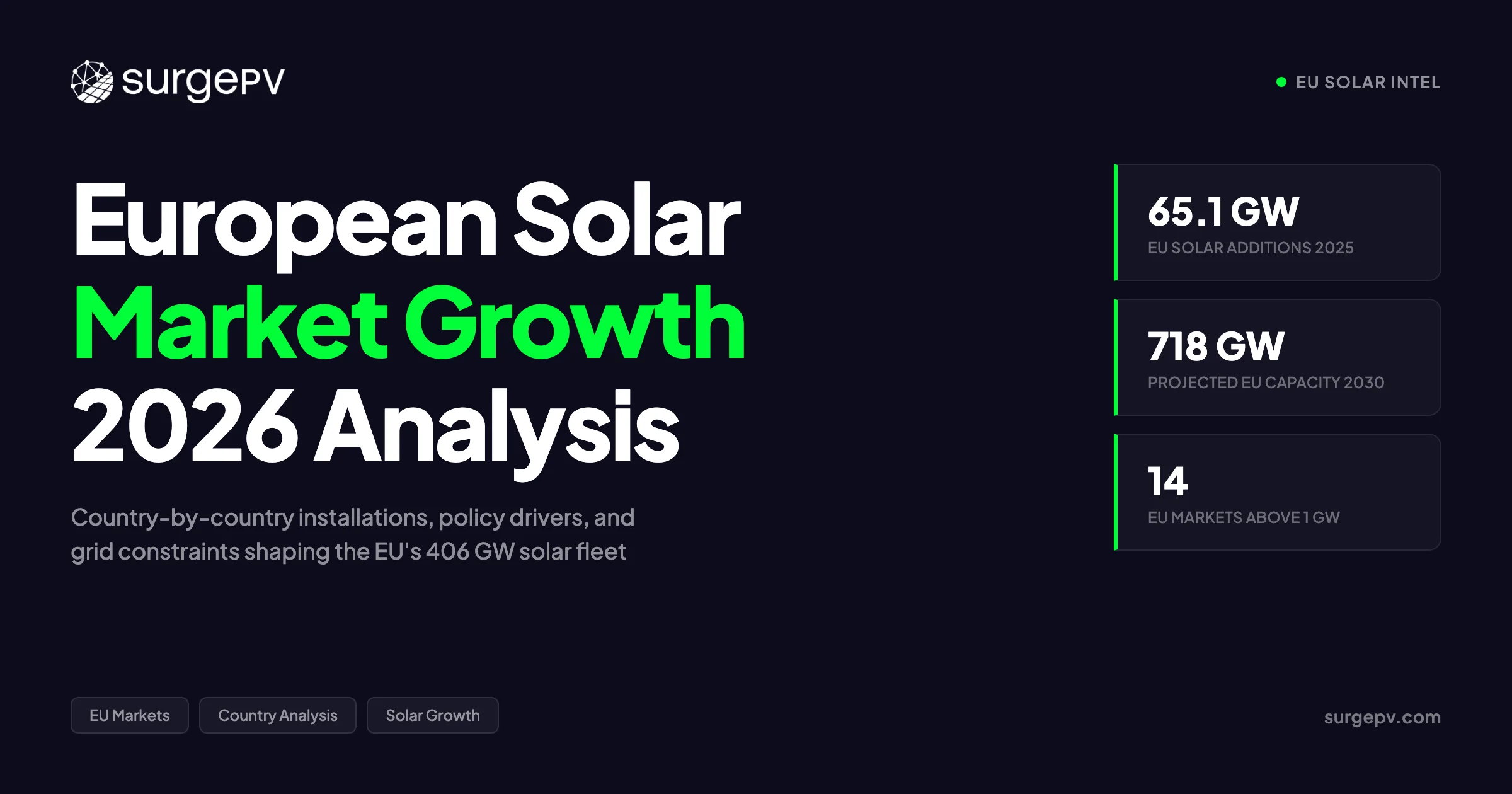
The European Union’s solar fleet crossed 406 GW at the end of 2025. That figure exceeds the EU Solar Strategy’s 400 GW milestone for 2025. Yet the mood across the industry is not celebratory. For the first time since 2016, the EU installed less solar than the year before: 65.1 GW in 2025 versus 65.6 GW in 2024. The contraction is small — 0.7% — but the signal is large. The boom years of 2021-2023, when EU solar grew 38%, 48%, and 51% year-on-year, are over. What replaces them will determine whether Europe hits its 750 GW REPowerEU target by 2030 or falls short by 30 GW or more. For Europe-specific compliance details, see Europe solar compliance.
European solar market growth in 2026 is led by Germany (15 GW added), Spain (8 GW), Poland (6 GW), and the Netherlands (5 GW). Total EU additions reached 65 GW in 2025. Key drivers: REPowerEU, RED III mandates, and national subsidy programs. The EU is on track for 750 GW by 2030. Also see: Germany solar subsidies. Also see: Spain net metering.
This guide examines the European solar market growth analysis country by country. It covers Germany, Spain, France, Italy, Poland, the Netherlands, and emerging markets. It explains why the residential segment collapsed, what grid constraints mean for project economics, and where growth will accelerate or stall through 2030. All data reflects conditions as of May 2026. Also see: solar panel ROI in Italy. For France-specific information, see Agricultural Solar Case Study.
Quick Answer — European Solar Market 2026
The EU reached 406 GW total solar capacity in 2025 but recorded its first annual installation decline in a decade (65.1 GW, down 0.7%). Germany leads with 117 GW total and ~16-17 GW added in 2025. Spain hit 50 GW. France set a record 5.9 GW. The 750 GW 2030 target is at risk: SolarPower Europe projects 718 GW in its medium scenario. Residential solar collapsed from 28% of additions in 2023 to 14% in 2025. Grid constraints and negative pricing now define project economics.
In this guide:
- European solar market snapshot 2026 — capacity table by country
- Germany — 117 GW, utility-scale shift, BNetzA data
- Spain — 50 GW milestone, grid congestion, lowest PPA prices
- France — record 5.9 GW, CRE tender reforms
- Italy — rooftop collapse after incentive phase-out
- Poland — RES auction dominance, curtailment risks
- Netherlands — saldering phase-out, SDE++
- REPowerEU and policy drivers
- Grid constraints and curtailment
- What most European solar reports get wrong
- 2027-2030 forecast
- Investment trends, tariffs, and module prices
- Practical implications for installers and developers
European Solar Market Snapshot 2026
The EU solar market in 2025-2026 is a story of two halves. Utility-scale solar farms grew to represent more than half of all new capacity for the first time. Residential rooftop solar, once the growth engine, contracted sharply across major markets.
EU Solar Capacity by Country — End of 2025
| Rank | Country | Cumulative Capacity (GW) | 2025 Additions (GW) | Market Segment Driver |
|---|---|---|---|---|
| 1 | Germany | 117.0 | 16.4-17.5 | Utility-scale + ground-mount |
| 2 | Spain | 50.0 | 8.7 | Utility-scale PPA projects |
| 3 | France | 31.1 | 5.9 | Commercial/industrial rooftop |
| 4 | Italy | 32.0* | 3.5-4.0 | Post-Superbonus reset |
| 5 | Netherlands | 33.3 | 2.5-3.0 | Pre-saldering rush |
| 6 | Poland | 25.5 | 3.6 | Auction-driven large-scale |
| 7 | Greece | 11.5 | 1.8 | Utility-scale + islands |
| 8 | Romania | 8.5 | 2.2 | Fastest growth rate in EU |
| 9 | Belgium | 10.5 | 1.5 | Residential + commercial |
| 10 | Bulgaria | 6.0 | 1.3 | Recovery fund deadlines |
Italy’s cumulative figure includes significant legacy capacity from the Conto Energia era. 2025 additions are estimates pending final GSE data.
Source: SolarPower Europe EU Solar Market Outlook 2025-2030, BNetzA, REE, RTE France, IEO Poland.
The Residential Collapse
The most important structural shift in the 2025 EU solar market is the collapse of residential installations. Residential solar accounted for 28% of new EU capacity in 2023. By 2025, that share had fallen to 14%.
| Year | Residential Share of EU Additions | Key Driver |
|---|---|---|
| 2021 | 35% | Post-COVID home improvement boom |
| 2022 | 32% | Energy crisis, high electricity prices |
| 2023 | 28% | Italy Superbonus peak, Netherlands saldering rush |
| 2024 | 19% | Italy Superbonus phase-out, Germany subsidy cuts |
| 2025 | 14% | Multi-country incentive exhaustion |
The decline is not cyclical. It is structural. Italy’s Superbonus 110% — which drove hundreds of thousands of residential installations — is closed for new PV-only applications. The Netherlands is phasing out net metering (saldering) from 100% in 2024 to 64% in 2025 and zero by 2031. Germany’s Solar Peak Act reduced rooftop subsidies, and small systems under 30 kW declined approximately 25% in 2025. For a deeper look at how policy shifts affect project economics, see our solar energy policies Europe analysis. Also see: Us Residential Solar Market Trends 2026.
Key Takeaway — Market Rebalancing
The EU solar market is rebalancing from residential-led to utility-scale-led growth. This shift has implications for installers, financiers, and policymakers. Utility-scale projects require longer development timelines, more capital, and grid connection certainty. The residential segment may not recover to 2023 levels without new incentive frameworks.
Germany: Europe’s Solar Anchor
Germany remains the EU’s largest solar market by a wide margin. BNetzA (Bundesnetzagentur) preliminary data shows 16.4 GW added in 2025, bringing cumulative capacity to 117 GW. BSW-Solar, the German solar association, estimates a higher 17.5 GW. Either figure makes Germany the clear leader.
Germany Solar by Segment — 2025
| Segment | 2025 Additions | Change vs. 2024 | Notes |
|---|---|---|---|
| Small rooftop (under 30 kW) | ~6.0 GW | -25% | Solar Peak Act impact |
| Commercial rooftop (30 kW-1 MW) | ~2.0 GW | -5% | Slower but stable |
| Ground-mounted solar parks | ~8.0 GW | +25% | Record tender awards |
| Balcony solar (Balkonkraftwerk) | ~0.5 GW | +3.2% | 430,000 new units |
| Total | 16.4-17.5 GW | Flat to slight decline |
Source: BNetzA January 2026 press release, BSW-Solar.
The shift from rooftop to ground-mount is the defining German solar story of 2025. In 2024, rooftop installations were roughly twice ground-mount volume. In 2025, the split was nearly even. This reflects both the residential slowdown and the success of BNetzA’s oversubscribed solar tenders.
Every solar and wind tender in Germany in 2025 was oversubscribed. Competition drove prices down. Onshore wind tenders cleared at 6.06 ct/kWh. Solar tender benchmarks were set at approximately €0.10/kWh for 2026 under EEG degression rules. The pipeline of ready-to-build projects is healthy. The constraint is no longer economics — it is grid connection.
Germany’s 2030 Gap
BNetzA President Klaus Müller stated in January 2026: “An annual average of 19.6 GW of solar capacity would have to be added in the coming years to achieve the expansion target for solar power of 215 GW by 2030.” Germany ended 2025 at 117 GW. To reach 215 GW requires 98 GW more over five years — nearly 20 GW per year.
Germany added 16-17 GW in 2025. The gap is 3-4 GW per year. Without acceleration, Germany will miss its national 2030 target. The bottleneck is not project economics or financing. It is grid infrastructure and permitting speed.
Pro Tip — German Market Entry
For developers entering Germany, focus on states with shorter grid queues. Bavaria added 4.5 GW in 2025 — the largest state contribution — but grid congestion is rising. Northern states (Schleswig-Holstein, Lower Saxony) have more transmission capacity relative to current solar penetration. The EEG Mieterstrom tenant-electricity framework, reformed under Solarpaket I, remains viable for multi-family buildings. See our community solar projects Germany guide for details on cooperative and tenant-electricity models.
See Community Solar Business Model for detailed guidance.
Spain: The PPA Price Leader
Spain reached 50 GW of total solar capacity in early 2026, crossing the milestone after adding approximately 8.7 GW in 2025. Solar alone now represents 33-34% of Spain’s total installed capacity. Combined with wind at 33.3 GW, renewables exceed 50% of national capacity for the first time.
Spain Solar by Region — 2025 Additions
| Region | New Capacity | Characteristics |
|---|---|---|
| Castilla y Leon | 2.03 GW | High irradiance, available land |
| Andalusia | 1.96 GW | Strong solar resource, grid constraints |
| Castilla-La Mancha | 1.25 GW | Central location, transmission access |
| Aragon | 636 MW | Emerging utility-scale hub |
| Extremadura | 582 MW | Lowest population density, land availability |
| Murcia | 270 MW | High irradiance, smaller scale |
Source: Red Electrica de España (REE), February 2026.
Spain’s solar market has a unique feature: it has the lowest PPA prices in Europe. LevelTen Energy reported Q4 2025 Spanish solar PPA prices at €32.50/MWh, down 3% quarter-on-quarter. The most competitive projects signed below €30/MWh.
European Solar PPA Price Comparison — Q4 2025
| Country | Solar PPA Price (€/MWh) | Position |
|---|---|---|
| Spain | 32.50 | Lowest in Europe |
| Portugal | 47.10 | Second lowest |
| Italy | 48.00-60.67 | Wide range by region |
| Germany | 49.77 | Mid-range |
| Greece | 52.50 | Growing market |
| France | 63.40 | Higher due to regulatory complexity |
| UK | 74.20-87.36 | Highest in major EU markets |
Source: LevelTen Energy PPA Price Index, Q4 2025.
These low PPA prices are a double-edged sword. They attract corporate buyers — Microsoft, Google, Amazon have all signed Spanish solar PPAs. But they also squeeze developer margins. When combined with rising curtailment and negative price hours, merchant solar projects in Spain face challenging economics.
Spain had never experienced negative electricity prices before 2024. In 2025, it logged 569 negative-price hours. On May 11, 2025, the Spanish market hit a historic low of -€15.00/MWh during the 16:00-17:00 hour. Spain’s solar generation coincided with negative prices 34% of the time from January to May 2025 — the highest share in Europe.
The grid access problem is acute. REE received 40 GW of grid connection requests in 2025. Only 4.5 GW was approved. Approximately 25 GW was rejected due to congestion. Another 8.5 GW remains under review. For developers, this means projects with land and permits may still wait years for grid connection.
For the full picture of Spain’s residential solar market, see our solar panels Spain guide and residential solar adoption Spain analysis. For accurate yield modeling in high-irradiance markets, solar shadow analysis software helps optimize system design before procurement.
France: The Quiet Achiever
France installed a record 5.9 GW of solar in 2025, overtaking Italy to become the EU’s third-largest solar market. Cumulative capacity reached 31.1 GW by year-end. The growth was driven primarily by the commercial and industrial segment (100-500 kW systems), which accounted for approximately 65% of new connections.
France Solar Growth Trajectory
| Year | Annual Additions (GW) | Cumulative (GW) |
|---|---|---|
| 2021 | 2.8 | 14.5 |
| 2022 | 2.6 | 17.1 |
| 2023 | 3.1 | 20.2 |
| 2024 | 4.6 | 24.8 |
| 2025 | 5.9 | 31.1 |
Source: RTE France, PV Magazine, Mercom India. Also see: Best Solar Design Software India. See our guide on 5kW Solar Panel Price in India for more. For India-specific compliance details, see India andhra-pradesh.
France’s Multiannual Energy Program (PPE3), published March 2025, targets 54 GW by 2030 and 65-90 GW by 2035. At the 2025 build rate of 5.9 GW, France would reach 54 GW by 2029 — ahead of schedule. But industry professionals caution that regulatory uncertainty around CRE tender timing and VAT eligibility for small installations could slow the pace.
CRE (Commission de Régulation de l’Énergie) oversaw France’s first simplified tender (AOS) for 100-500 kW rooftop systems in November 2025. It was significantly undersubscribed: only 43% of the 192 MW capacity was filled. The average bid price was €88.73/MWh, below the €95/MWh cap. The undersubscription suggests developers are cautious about the simplified process, or that grid connection timelines make project commitments risky.
The three leading regions for 2025 solar additions — Nouvelle-Aquitaine, Occitanie, and Auvergne-Rhône-Alpes — represented 46% of newly connected capacity. These southern and southwestern regions combine strong solar resource with available land and growing commercial demand.
For more on France’s solar policy framework, see our France feed-in tariffs guide and France green energy transition overview. When modeling commercial ROI across EU markets, the generation and financial tool at SurgePV automates LCOE and payback calculations with country-specific inputs. For a direct comparison, see Arka 360 vs SurgePV.
Italy: Post-Superbonus Reset
Italy’s solar market is recovering from the Superbonus 110% phase-out. The historic incentive — which allowed homeowners to claim 110% of solar costs as a tax deduction — drove a residential boom that peaked in 2022. When the Superbonus was phased down to 65% in 2025 and closed for new standalone PV in 2026, the residential segment contracted sharply.
Italy added approximately 6.8 GW in 2024 (a record) but 2025 additions are estimated at 3.5-4.0 GW — a significant decline. The market is resetting around three pillars: the 50% Detrazione Fiscale tax deduction, GSE-administered net metering (Scambio sul Posto), and the new CER (Comunità Energetiche Rinnovabili) energy community framework.
Italy Solar Incentive Transition
| Period | Primary Incentive | Residential Market |
|---|---|---|
| 2020-2022 | Superbonus 110% | Boom — 127% growth in 2022 |
| 2023 | Superbonus 90% | Still strong |
| 2024 | Superbonus 70% | Declining |
| 2025 | Superbonus 65% (legacy only) | Sharp contraction |
| 2026+ | Detrazione Fiscale 50% + CER | New equilibrium |
The CER energy community framework, introduced under the January 2024 CER Decree, is the most significant new mechanism. Energy communities receive up to €110/MWh on shared virtual self-consumption for 20 years. For apartment buildings that cannot install individual rooftop systems, CER provides a pathway to solar economics comparable to direct ownership.
Italy’s PNIEC (National Energy and Climate Plan) targets 52 GW by 2030, from approximately 32 GW in 2025. Meeting this requires 3-5 GW annually — a pace that is achievable without extraordinary incentives, given Italy’s strong solar resource and high electricity prices (€0.27-0.35/kWh retail).
For detailed Italy solar ROI analysis, see our solar panel ROI Italy guide. For incentive details, see Italy feed-in tariffs. For community solar models that share structural similarities with Italy’s CER framework, see our Germany guide.
Poland: Auction-Driven Growth
Poland added 3.6 GW of solar in 2025, bringing cumulative capacity to approximately 25.5 GW. Solar now represents 12.5% of Polish electricity generation (19.2 TWh). The market is driven almost entirely by RES auctions administered by URE (Urzad Regulacji Energetyki).
Poland RES Auction Results 2025
| Auction | Segment | Winning Bids | Capacity Awarded |
|---|---|---|---|
| AZ/7/2025 | Large-scale (>1 MW) | 73 PV, 3 wind | 1,623 MW solar |
| AZ/6/2025 | Small-scale (under 1 MW) | 53 solar | 47.7 MW solar |
| Total solar awarded | 126 of 129 bids | ~1.67 GW |
Source: URE, Taiyang News, Solarbytes.
Solar dominated the auctions: 97.7% of winning bids were PV projects. Wind secured only 83 MW across three projects. The auction clearing prices ranged from PLN 216.90-329.68/MWh ($59.60-90.50/MWh) for large-scale solar, well below the PLN 389/MWh cap.
However, the overall subscription rate was only 21% of available volume. Developers are cautious. Grid connection constraints, curtailment exceeding 1 TWh in 2025, and negative/low price hours during solar peaks are making project commitment risky. Poland has contracted 4.3 GW of battery storage through capacity market auctions through 2029, which should help integrate solar but adds cost. Read Adding Battery Storage Services for a complete walkthrough.
Poland’s 2030 target is approximately 40 GW. At 3.6 GW per year, the current pace is on track. But grid upgrades are necessary to sustain growth. The historical context is remarkable: Poland had virtually no solar in 2015. It reached 25.5 GW in a decade — one of the fastest solar buildouts in European history.
Netherlands: The Net Metering Cliff
The Netherlands illustrates how abruptly policy changes can reshape a solar market. The country has the highest per-capita solar capacity in Europe (1,467 W per person as of 2024) but ranked only eighth in 2025 additions. The reason is the saldering (net metering) phase-out.
Netherlands Net Metering Phase-Out Schedule
| Year | Net Metering Percentage | Effective Solar Export Value |
|---|---|---|
| 2024 | 100% | Full retail rate offset |
| 2025 | 64% | Partial offset |
| 2026 | 53-46% | Further reduction |
| 2027 | 43-28% | Sharp decline |
| 2028 | 34-9% | Near elimination |
| 2029-2031 | 27% to 0% | Complete phase-out |
The phase-out has created a pre-deadline installation rush. Dutch installers reported full calendars into Q3 2025 as homeowners rushed to install before further cuts. But payback periods are extending from approximately 7 years to 11 years post-phase-out. Battery attachment rates surged to 22% in 2024 — nearly triple 2023 levels — as households seek to maximize self-consumption.
The SDE++ subsidy scheme remains active for commercial and utility-scale projects. But even SDE++ is under pressure: the 2024 auction missed its 5 GW target by 18% due to grid connection bottlenecks, not capital constraints. The Dutch government plans to replace SDE++ with a Contracts for Difference (CfD) scheme by 2027.
Grid congestion is severe in Noord-Brabant, Limburg, and Gelderland. Connection queues exceed 36 months in some regions. For a market that built its solar success on residential rooftop, the transition to a C&I/utility-led model is uncertain.
For more on Netherlands solar, see our solar energy Netherlands guide. For European solar tax credits and VAT relief across the EU, see our dedicated overview.
REPowerEU and Policy Drivers
REPowerEU, launched in May 2022, set the 750 GW solar target for 2030. The plan was a response to Russia’s invasion of Ukraine and Europe’s dependence on Russian gas. It included faster permitting, mandatory solar on new buildings, and EU-wide rooftop mandates. For the latest details on UK, see Battery Solar System Design UK.
REPowerEU Solar Targets vs. Reality
| Milestone | Target | Actual | Status |
|---|---|---|---|
| 2025 cumulative | 400 GW | 406 GW | Achieved |
| 2025 annual additions | ~65 GW | 65.1 GW | Met |
| 2030 cumulative | 750 GW | 718 GW (projected) | At risk |
| 2030 annual additions needed | ~70 GW/year | 60-68 GW (projected) | Shortfall |
Source: SolarPower Europe EU Solar Market Outlook 2025-2030, medium scenario.
The EU achieved its 2025 milestone. But the trajectory to 2030 is concerning. SolarPower Europe’s medium scenario projects 718 GW by 2030 — 32 GW short of target. The NECP (National Energy and Climate Plans) aggregate target from member states is even lower at 701 GW.
To reach 750 GW, Europe needs to install nearly 70 GW annually from 2026 through 2030. The current projection is 60-68 GW per year. The gap is 2-10 GW annually — manageable with policy intervention, but widening without it. For installers tracking these shifts, solar software that models multi-country economics helps identify where opportunities remain strongest.
Key REPowerEU Measures Affecting Solar
-
EU Solar Rooftop Mandate (EPBD): The revised Energy Performance of Buildings Directive requires solar on all new public and commercial buildings by 2026, and on all new residential buildings by 2029. Implementation varies by member state.
-
Permitting acceleration: The Renewable Energy Directive sets maximum permitting timelines: 3 months for rooftop solar, 12 months for ground-mount projects in “renewables acceleration areas.”
-
Net-Zero Industry Act (NZIA): Promotes EU solar manufacturing. The International Solar Manufacturing Initiative (ISMI) aims to revive EU production capacity. However, EU module manufacturing remains minimal compared to Chinese imports.
-
EU Solar Standard: Sets quality and sustainability requirements for solar products procured with public funds.
Further Reading
For a detailed breakdown of solar incentives across EU member states, see our European solar incentives guide and European solar tax credits overview. For the broader policy context, see solar energy policies Europe.
Grid Constraints and Curtailment Issues
Grid infrastructure has become the binding constraint on European solar growth. Approximately 1,700 GW of renewable and hybrid projects are stuck in grid connection queues across the EU. That is more than triple the capacity needed to reach 2030 goals. Another 500 GW of ready-to-connect projects remains idle because transmission and distribution networks are not yet upgraded.
European Grid Constraint Overview — 2025
| Country | Grid Queue Size | Approved vs. Requested | Key Issue |
|---|---|---|---|
| Germany | ~150 GW renewables queued | Bottleneck in south-north transmission | Grid congestion costs: €2.9B (2024) |
| Spain | 40 GW requested | 4.5 GW approved, 25 GW rejected | Curtailment rising to >10% |
| Netherlands | 36+ month queues | Severe in 3 provinces | Connection backlog |
| Poland | Significant | Curtailment >1 TWh (2025) | Distribution network limits |
| Italy | Regional variation | South has capacity, north congested | Inter-regional transmission |
Source: SolarPower Europe, REE, BNetzA, RTE, various national regulators.
The Negative Price Surge
European electricity markets experienced record negative price hours in 2025. The following table shows the count by country:
| Country | Negative Price Hours (2025) | Solar Output During Negative Prices |
|---|---|---|
| Sweden (Zone 2) | 593 | High wind-solar overlap |
| Netherlands | 584 | 30% of solar generation |
| Germany | 576 | 28% of solar generation |
| Spain | 569 | 34% of solar generation |
| Belgium | 519 | 28% of solar generation |
| France | 513 | Moderate overlap |
Source: Bloomberg, Enervis, pv magazine, Carbon Credits.
On May 11, 2025, a historic price shock hit European markets. During the 16:00-17:00 hour, prices were: Spain -€15.00/MWh, Germany -€250.32/MWh, Netherlands -€350.00/MWh, Belgium -€462.33/MWh. These were not isolated events. They reflect structural oversupply during peak solar hours combined with insufficient demand, storage, or transmission capacity to absorb the generation.
The Cannibalization Effect
Analysts call this the “cannibalization effect”: solar and wind projects, by producing concurrently, displace each other and push down marginal prices. In Spain, solar PPA prices fell 5% in Q1 2025 due to this effect. In Germany, Enervis forecasts negative price hours peaking at approximately 1,300 in 2034.
The economic implications are serious. Merchant solar projects — those without long-term offtake contracts — become uneconomic when a significant share of generation occurs during negative-price periods. Developers must either:
- Add battery storage to shift generation to higher-price hours
- Sign long-term PPAs at fixed prices
- Accept lower returns and higher risk
- Locate in markets with less solar penetration and better grid access
Battery storage is the most discussed solution. But Europe’s storage deployment lags behind renewable growth. The EU needs a tenfold increase in storage capacity by 2030, according to industry estimates. Current deployment rates are insufficient.
What Most European Solar Reports Get Wrong
Most coverage of the European solar market makes three errors that distort decision-making for installers, developers, and investors.
Error 1: Treating the 750 GW Target as Probable
The EU’s 750 GW by 2030 target is treated as a baseline in most reporting. It is not. It is an aspiration. SolarPower Europe’s medium scenario projects 718 GW. The NECP aggregate from member states is 701 GW. Both are below target.
The gap is not small. To reach 750 GW requires 70 GW per year. No EU member state is currently installing at the pace required to hit that average. Germany needs 19.6 GW per year but added 16-17 GW in 2025. Spain needs roughly 7 GW per year but faces grid constraints that may limit future growth.
The 750 GW target was set in 2022, during an energy crisis, with extraordinary political momentum. That momentum has faded. Policymakers now face competing priorities: industrial competitiveness, defense spending, and budget constraints. Without a new policy push, 718 GW is the more realistic number.
Error 2: Ignoring the Geographic Concentration of Growth
The top 10 EU solar markets are projected to account for 80% of all new installations through 2030. The top three — Germany, Spain, and France — will represent nearly half. This concentration is rarely discussed.
What it means: the “European solar market” is not a single market. It is a collection of national markets with different regulations, grid conditions, and incentive structures. A strategy that works in Germany (oversubscribed tenders, strong utility-scale pipeline) will fail in Italy (post-incentive residential reset, complex bureaucracy). A PPA price that is attractive in Spain (€32/MWh) would be uneconomic in France (€63/MWh).
Installers and developers need country-specific strategies, not generic “EU solar” approaches.
Error 3: Underestimating the Grid Bottleneck Timeline
Most forecasts treat grid constraints as a temporary problem that will be solved by 2027-2028. The evidence suggests otherwise.
Germany’s grid expansion plan (Netzausbau) has been delayed repeatedly. The critical SuedLink transmission corridor — needed to move wind power from the north to industrial consumers in the south — is years behind schedule. Spain approved 4.5 GW of grid access out of 40 GW requested. The Netherlands has 36-month connection queues.
Grid infrastructure has 5-10 year lead times. Projects approved today may not be operational until 2030-2032. By then, solar capacity will have grown further, potentially making today’s grid plans insufficient for tomorrow’s generation.
The honest assessment: grid constraints will limit European solar growth through at least 2028, and possibly through 2030. Projects in markets with available grid capacity — Romania, Bulgaria, parts of France — may outperform projects in congested markets despite lower solar resource.
The Real Story
European solar is not slowing because of lack of ambition or capital. It is slowing because the physical infrastructure — grids, storage, permitting systems — cannot keep pace with the political targets. The 2026-2027 contraction is a infrastructure signal, not a demand signal. The projects exist. The capital exists. The grid does not.
Model European Solar Projects with Country-Specific Data
SurgePV’s solar design software includes irradiance data, grid tariff structures, and incentive models for Germany, Spain, France, Italy, Poland, and the Netherlands. Build accurate proposals that reflect local conditions — not generic assumptions.
Book a DemoNo commitment required · 20 minutes · Live project walkthrough
2027-2030 Forecast: Where Growth Slows and Accelerates
SolarPower Europe’s medium scenario provides the most credible forward view. Here is what it projects:
EU Solar Annual Additions Forecast
| Year | Projected Additions (GW) | Key Driver |
|---|---|---|
| 2025 | 65.1 (actual) | Baseline |
| 2026 | Under 62 | Continued residential contraction |
| 2027 | Just under 60 | Trough year |
| 2028 | 62-65 | Storage deployment improves economics |
| 2029 | 65-67 | Grid investments begin relieving constraints |
| 2030 | Nearly 68 | Return to 2025 levels |
Source: SolarPower Europe EU Solar Market Outlook 2025-2030, medium scenario.
The forecast shows a U-shaped recovery. The bottom is 2026-2027. Growth resumes in 2028-2029 as storage deployment, grid investments, and improved framework conditions take effect. But the EU does not return to 2025 installation levels until 2030.
Country-Specific Forecasts
Germany: BNetzA’s own forecast suggests 16.4 GW for 2025, below the 19.6 GW needed for the 2030 target. Without accelerated deployment, Germany will end 2030 at approximately 190-200 GW — 15-25 GW short of 215 GW. The Solar Peak Act and proposed subsidy cuts by Economics Minister Katherina Reiche risk further slowing rooftop growth.
Spain: REE projects continued strong utility-scale additions. The 76 GW PNIEC target by 2030 requires roughly 7 GW per year. Spain added 8.7 GW in 2025, ahead of pace. But grid constraints may limit future growth. The 40 GW of grid requests versus 4.5 GW approved is the critical bottleneck.
France: At 5.9 GW in 2025, France is ahead of its PPE3 trajectory. The 54 GW by 2030 target requires roughly 4.6 GW per year. If France sustains 5+ GW annually, it will exceed target. The risk is regulatory delay and CRE tender undersubscription.
Italy: The post-Superbonus reset will likely bottom in 2026-2027. CER energy communities and falling module costs should drive recovery by 2028. The 52 GW by 2030 target is achievable at 3-5 GW per year.
Poland: Auction-driven growth should continue at 3-4 GW per year. The 40 GW target by 2030 is within reach if grid upgrades keep pace. Battery storage deployment will be critical.
Netherlands: The saldering phase-out will suppress residential demand through 2027. Corporate PPAs and SDE++ (or its CfD successor) should sustain C&I/utility growth. The 60 GW target by 2031 is ambitious given grid constraints.
Emerging Markets to Watch
| Country | 2025 Additions | Why It Matters |
|---|---|---|
| Romania | 2.2 GW | Fastest growth rate in EU; grid capacity available |
| Bulgaria | 1.3 GW | Recovery fund deadlines driving deployment |
| Portugal | 1.2 GW | Strong PPA market; grid less congested than Spain |
| Greece | 1.8 GW | Island solar programs; high irradiance |
| Ireland | 0.4 GW | Emerging corporate PPA market; less solar saturation |
Romania is the most interesting emerging market. It has available grid capacity, strong solar resource, and EU funding through the National Recovery and Resilience Plan. For developers priced out of congested German or Spanish markets, Romania offers an alternative with lower competition and faster permitting.
Investment Trends, Tariffs, and Module Prices
Module Price Reversal
European solar module prices hit historic lows in late 2025, then reversed sharply. China’s Ministry of Finance announced on January 9, 2026, that VAT export rebates on solar modules and silicon wafers would be eliminated effective April 1, 2026. Solar cell rebates will phase from 9% to 6% in 2026 and to zero in 2027.
European Module Price Trends
| Period | Mainstream TOPCon (€/Wp) | Change |
|---|---|---|
| Late 2025 | 0.085-0.095 | Historic low |
| February 2026 | 0.095-0.115 | +15-18% rebound |
| Post-April 2026 (projected) | 0.105-0.125 | +8-10% from VAT cancellation |
Source: Rinnovabili, Joinsun, industry estimates.
The price increase affects project economics. A 100 MW utility-scale project using modules at €0.10/Wp rather than €0.085/Wp sees hardware costs rise by €1.5 million. For projects with tight margins, this is material.
The longer-term question is whether Chinese manufacturers will build more capacity in Europe, Southeast Asia, or the US to avoid export restrictions. The Net-Zero Industry Act and ISMI are designed to incentivize EU manufacturing. But building competitive solar module factories in Europe requires €500 million+ investments and 2-3 year timelines. Do not expect significant EU manufacturing before 2028-2029.
PPA Market Trends
Corporate PPAs are becoming the dominant financing mechanism for utility-scale solar in Europe. Europe signed 4.2 GW of solar PPAs in H1 2025 alone. Spain, Germany, and France lead.
But PPA prices are under pressure from the cannibalization effect. Spanish solar PPA prices at €32.50/MWh in Q4 2025 are barely above the LCOE of new projects. Developer margins are thin. Some projects that secured grid access and permits in 2023-2024 are now uneconomic at current PPA prices and are being sold rather than built.
The tradeoff for developers: sign a long-term PPA at a low but fixed price, or take merchant risk and hope for higher prices in the 2030s. Most are choosing PPAs. The merchant solar model is effectively dead in saturated markets like Spain and Germany.
Investment in Storage
Battery storage is the critical complement to solar. The EU needs a tenfold increase in storage by 2030. Current deployment is accelerating but from a low base.
| Country | BESS Contracted/Awarded | Timeline |
|---|---|---|
| Germany | Multiple GW in pipeline | 2025-2028 |
| Poland | 4.3 GW (capacity market) | Through 2029 |
| Spain | Growing but nascent | 2026-2030 |
| Netherlands | Emerging | 2026-2028 |
For solar developers, co-locating storage with solar projects is becoming standard. Storage allows shifting solar generation from midday (low prices, high curtailment) to evening peak hours (high prices). The economics depend on the spread between midday and evening prices, which varies by market.
Practical Implications for Installers and Developers
The 2026 European solar market requires different strategies than the 2021-2023 boom. Here are specific recommendations by stakeholder.
For Solar Installers
In Germany: Focus on commercial rooftop (30 kW-1 MW) and tenant-electricity (Mieterstrom) projects. The residential segment under 30 kW is contracting. Use solar proposal software that models EEG feed-in tariffs, Mieterstromzuschlag supplements, and Solarpaket I provisions.
In Spain: Target commercial and industrial clients with on-site consumption. Residential solar faces competition from low wholesale prices and grid constraints. Consider agri-PV projects in Castilla y Leon and Extremadura where land is available and irradiance is high.
In France: The 100-500 kW commercial segment is the growth engine. Simplified tender (AOS) participation is an option for larger projects. Focus on southern regions (Nouvelle-Aquitaine, Occitanie) with best solar resource.
In Italy: Position for the CER energy community wave. Apartment buildings and small municipalities are the target. The 50% Detrazione Fiscale remains viable for residential clients with sufficient tax liability.
In Poland: RES auction participation requires careful bid pricing. Grid connection timelines are the critical path. Partner with local developers who understand URE procedures.
In the Netherlands: Capitalize on the 2025 pre-saldering rush. Pivot to battery-integrated systems. Model post-saldering economics accurately for clients.
For Project Developers
Grid-first siting: In congested markets, available grid capacity is more valuable than solar resource. A project in northern Germany with grid access may outperform a project in southern Spain with better irradiance but no connection.
Storage as standard: Co-locate battery storage on all new utility-scale projects. The economics are improving as battery costs fall and price spreads widen.
PPA offtake: Secure long-term PPAs before construction. Merchant risk is too high in saturated markets. Corporate buyers (tech companies, industrials) are active and creditworthy.
Diversify geographically: Do not concentrate in one country. Romania, Bulgaria, and Portugal offer growth with less competition than Germany or Spain.
For Investors
Expect lower returns: The 2021-2023 era of 8-12% unlevered IRRs on European solar is over. Current projects target 5-7% unlevered IRRs, with some Spanish projects below 5%.
Focus on operational assets: Buying operational solar plants with existing grid connections and PPAs may offer better risk-adjusted returns than greenfield development.
Storage is the next growth sector: Battery storage deployment will grow faster than solar through 2028-2030. The investment opportunity is significant.
Narrative: A Romanian Developer’s First 100 MW
Mihai Ionescu founded SolarVolt Romania in 2019 with €50,000 and a belief that Romania’s solar potential was undervalued. In 2020, Romania had 1.4 GW of solar — mostly legacy projects from the 2010s feed-in tariff era. By 2025, Romania added 2.2 GW and entered the EU top 10 for the first time.
Ionescu’s first project was a 15 MW ground-mount plant near Craiova, commissioned in 2022. “The grid connection took 8 months,” he recalls. “In Germany, that same process was taking 2-3 years. We had available capacity on the 110 kV line, and the local DSO was cooperative.”
By 2024, SolarVolt had 85 MW operational and a 120 MW pipeline. Ionescu’s strategy was simple: avoid the saturated western markets, build relationships with Romanian grid operators, and use EU Recovery and Resilience Facility grants to reduce equity requirements.
“The economics are straightforward,” Ionescu says. “Romania has 1,450-1,550 kWh/m²/year irradiance. That is not as good as Spain, but grid access is available and permitting takes 6-12 months, not 3-5 years. Our last project — 45 MW near Pitesti — achieved grid connection in 10 months from application.”
SolarVolt’s projects sell power through corporate PPAs with Romanian manufacturers and through the centralized market. Average PPA prices are €45-55/MWh — higher than Spain’s €32/MWh but with lower development risk and faster timelines.
“The mistake I see western developers making,” Ionescu says, “is assuming Romania is risky because it is new. The real risk is in markets where you cannot connect. We have 200 MW of grid-approved projects sitting ready. In Spain, developers with 40 GW of requests got 4.5 GW approved. Where is the real risk?”
By early 2026, SolarVolt employed 28 people and had raised €35 million in project finance from Romanian banks and EU green bond programs. Ionescu is targeting 300 MW operational by 2028.
The lesson: in a market where grid constraints dominate, available infrastructure beats solar resource. Romania’s growth is not a fluke. It is a signal that the next phase of European solar will happen in markets with capacity to absorb it.
Conclusion
The European solar market in 2026 is at an inflection point. The headline achievement — 406 GW total capacity, exceeding the 2025 target — masks a more complex reality. Residential solar has collapsed. Grid constraints are binding. Negative price hours are rising. Module prices are rebounding after historic lows.
The 750 GW by 2030 target is at risk. SolarPower Europe projects 718 GW. The gap is 32 GW — roughly one year of installations at current rates. Without accelerated grid investment, storage deployment, and policy support, Europe will fall short.
But the fundamentals remain strong. Solar LCOE in southern Europe is below €0.04/kWh. Retail electricity prices are €0.25-0.40/kWh. The gap is structural and widening. Corporate demand for clean power is growing. EU policy — REPowerEU, EPBD, NZIA — supports deployment even if targets are missed.
Three actions for 2026:
- Prioritize grid-available markets — Romania, Bulgaria, and parts of France offer faster connections than saturated German or Spanish markets
- Integrate storage into all utility-scale proposals — battery co-location is no longer optional in markets with rising curtailment and negative prices
- Model country-specific economics — the “European solar market” is a fiction. Germany, Spain, France, Italy, Poland, and the Netherlands each require distinct strategies, pricing, and risk assessments
For solar professionals building proposals across European markets, solar PV design software with country-specific irradiance data, tariff structures, and incentive models is essential. SurgePV’s platform includes pre-loaded data for Germany, Spain, France, Italy, Poland, and the Netherlands — enabling accurate, localized proposals without manual research for every project.
For related reading, see our guides to European solar incentives, solar energy policies in Europe, and solar panel ROI in Italy. For proposal generation across markets, solar proposal software with multi-country templates accelerates the sales process.
Frequently Asked Questions
How much solar capacity did the EU install in 2025?
The EU installed 65.1 GW of solar in 2025 according to SolarPower Europe. This was a 0.7% decrease from 2024’s 65.6 GW, marking the first annual contraction in EU solar installations since 2016. Total EU solar fleet reached 406 GW, surpassing the EU Solar Strategy’s 400 GW target for 2025.
Which European country installed the most solar in 2025?
Germany remained Europe’s largest solar market in 2025, adding approximately 16.4 GW (BNetzA preliminary data) or 17.5 GW (BSW-Solar estimate) for a cumulative total of 117 GW. Spain was second with roughly 8.7 GW added, reaching 50 GW total. France overtook Italy for third place with a record 5.9 GW.
Will the EU meet its 750 GW solar target by 2030?
No, according to SolarPower Europe’s medium scenario, the EU will fall short. The most-likely projection is 718 GW by 2030, versus the 750 GW REPowerEU target. To hit 750 GW, Europe would need to install nearly 70 GW annually through 2030. The 2026-2027 slowdown, driven by residential market contraction and grid constraints, makes the target increasingly unlikely without major policy intervention.
Why is the European solar market slowing down in 2026?
Three factors drive the slowdown: (1) Residential solar collapsed from 28% of EU additions in 2023 to 14% in 2025 as incentive phase-outs hit Italy, the Netherlands, and Germany; (2) Grid constraints cause rising curtailment and negative price hours — Germany saw 576 negative-price hours in 2025 and 28% of solar generation occurred during negative-price periods; (3) Module prices rebounded 15-18% in early 2026 after China’s VAT export rebate cancellation.
What is REPowerEU and what does it mean for solar?
REPowerEU is the European Commission’s plan to end dependence on Russian fossil fuels and accelerate the clean energy transition. It set a target of 750 GW of solar PV capacity by 2030. The plan includes faster permitting for renewables, mandatory solar on new buildings, and EU-wide rooftop mandates. However, the 2025-2026 market contraction puts the 750 GW target at risk.
How do negative electricity prices affect solar projects in Europe?
Negative electricity prices are becoming common in solar-heavy markets. Germany logged 576 negative-price hours in 2025, Spain had 569, and the Netherlands 584. During these periods, solar generators must pay to export power. This “cannibalization effect” reduces project revenue, pushes PPA prices down to €30-42/MWh in Spain, and makes merchant solar projects uneconomic without storage or long-term offtake contracts.
Which European solar markets are growing fastest in 2026?
Romania was the fastest-growing EU solar market in 2025 and is projected to maintain strong growth. Bulgaria entered the top 10 for the first time, driven by national recovery funding deadlines. France set a record with 5.9 GW added. Among established markets, utility-scale solar in Spain and Germany continues growing even as residential segments contract. Portugal and Greece also show strong momentum.
What are the main grid challenges facing European solar?
Europe has approximately 1,700 GW of renewable projects stuck in grid connection queues — more than triple the capacity needed for 2030 goals. Germany’s grid congestion management costs reached €2.9 billion in 2024. Spain approved only 4.5 GW of grid access out of 40 GW requested in 2025. Poland curtailed over 1 TWh of solar and wind in 2025. These constraints cause project delays, increase costs, and force developers to add storage or accept lower returns.
Where this fits
This article is part of SurgePV's Solar Business & Operations hub, which works through the topic from first principles to the decisions a project team actually has to make.


