

Back to Blog
solar policy 28 min read

Solar Panels Spain 2026: Costs, Grants & Installation Guide

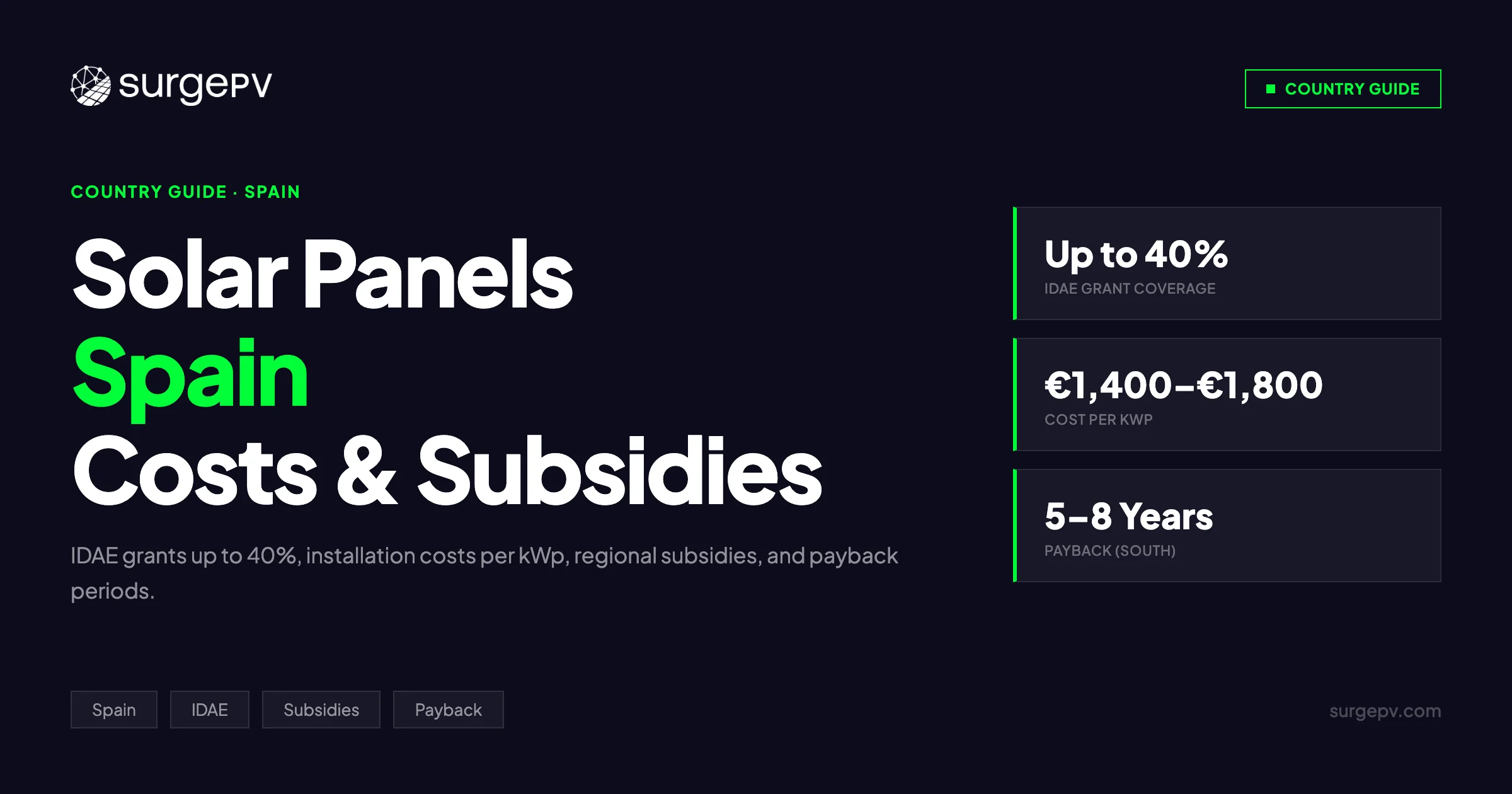
Solar panels in Spain: €1,400–€1,800/kWp, IDAE grants up to 80%, 3.5–9 yr payback by region. Complete 2026 guide to autoconsumo, IVA rules & regional subsidies.

Rainer Neumann

Written by

Rainer Neumann

Content Head · SurgePV

Keyur Rakholiya

Edited by

Keyur Rakholiya

CEO & Co-Founder · SurgePV

Published ·Updated

Spain reached 50.2 GW of total solar capacity in February 2026 according to Red Eléctrica de España, making it Europe’s second-largest solar market after Germany. Yet residential installations fell 17% in 2025 according to UNEF. This decline happened despite Spain having some of Europe’s best solar resources.

This guide covers grants cutting costs by up to 80%, regional payback periods from 3.5 to 9 years, and every legal step from RAIPEE registration to grid connection. Spain’s PNIEC 2030 plan targets 19 GW of self-consumption capacity. The current gap creates urgent national pressure to accelerate residential adoption. That pressure keeps grant programs open and aggressive. We break down exact costs, regional subsidies, and the paperwork sequence that trips up most first-time installers.

TL;DR — Spain Solar 2026

  • Spain 50.2 GW installed; residential solar pays back in 3.5–9 years depending on region and grants
  • IDAE grants cover 40–80% of costs; must apply BEFORE installation
  • Reduced IVA at 10% exists but only under strict conditions (binding ruling V0303-25); most pay 21%
  • Autoconsumo covers individual and collective self-consumption (up to 5 km radius since RD-Law 7/2025)
  • Compensación simplificada credits ~€0.05–€0.12/kWh with monthly caps and no rollover

In this guide:

  • Latest policy updates and grant program status for 2026
  • Complete cost breakdowns by system size with after-grant pricing
  • Solar irradiance maps by province and what they mean for your return
  • Step-by-step IDAE grant application process
  • IVA rules: when 10% applies and when 21% is mandatory
  • Autoconsumo and compensación simplificada explained
  • Community solar rules after RD-Law 7/2025
  • Regional grant programs across all major autonomous communities
  • Payback periods by province and grant scenario
  • Municipal IBI and ICIO incentives
  • Full installation process from site survey to grid connection
  • PNIEC 2030 target gap and what it means for future subsidies

Latest Updates: Spain Solar 2026

Spanish solar policy has been unusually active since 2024. Three major shifts shape the 2026 market: the restoration of standard 21% IVA, the expansion of collective self-consumption radius to 5 km, and continued pressure on grant budgets as residential demand fluctuates.

ProgramTypeStatusCoverageKey Condition
IDAE National Grants (standard)National subsidyOpenUp to 40%Pre-installation application
IDAE (low-income 60%)National subsidyOpenUp to 60%Means test required
IDAE (energy poverty 80%)National subsidyOpenUp to 80%BONO SOCIAL status
Andalusia AVENRegionalOpen20–30% additionalStackable with IDAE
Catalonia ICAENRegionalOpenUp to €3,000 + battery bonusStackable with IDAE
Madrid PIRRegionalOpenUp to 40% regionalStackable with IDAE
Valencia IVACERegionalOpenUp to 40% + IBIStackable with IDAE
Basque Country EVERegionalOpenUp to 40%Stackable with IDAE
IBI MunicipalLocal taxVariableUp to 50% discount3–10 years
ICIO MunicipalLocal taxVariableUp to 95% rebateApplied at license
Reduced IVA (10%)TaxConditional10% vs 21%Single contract for supply + install
Compensación SimplificadaBillingActive€0.05–€0.12/kWhMonthly cap, no rollover

Key changes since 2024 deserve attention. RD-Law 7/2025 extended the collective self-consumption radius from 500 m to 5 km, opening community solar to apartment blocks and rural neighbors who share a distributor zone. This is the most significant legal change for residential adopters since RD 244/2019 eliminated the sun tax.

The 17% residential decline in 2025 reflects grant exhaustion in several regions, bureaucratic delays of 4–12 weeks, and falling surplus compensation rates. Wholesale electricity prices dropped in 2024–2025, which reduced the value of compensación simplificada credits. Installers report that many homeowners postponed decisions waiting for clearer 2026 budget announcements.

IVA restoration to 21% on January 1, 2025 ended the temporary 10% rate that applied during 2022–2024. The binding ruling V0303-25 of March 2025 clarified that 10% still applies when a single contractor supplies and installs the system as an integrated obra. Most purchases now face 21%, but structured contracts can still qualify for 10%.

Grant Budgets Are Finite

IDAE and regional programs close when budgets exhaust. Andalusia’s AVEN program closed early in 2024 and 2025 due to oversubscription. Apply as soon as your technical study is complete. Do not wait for seasonal price drops.

Spain Solar Market Overview

Total Installed Capacity and Growth

Spain reached 50.2 GW of total solar capacity in February 2026 according to REE. Of this total, 9.3 GW serves self-consumption. Spain added 8.7 GW in 2025 alone. Solar now generates 18.4% of Spain’s electricity mix. The sector employs 146,764 people according to UNEF’s 2024 report.

Spain ranks second in Europe behind Germany. Utility-scale projects dominate the market. Residential self-consumption remains underdeveloped relative to Spain’s solar potential.

PNIEC 2030 Targets

Segment2025 Actual2030 TargetGap% Complete
Utility-scale~40.9 GW57.3 GW16.4 GW71%
Self-consumption~9.3 GW19.0 GW9.7 GW49%
Total solar~50.2 GW76.3 GW26.1 GW66%

The self-consumption gap is the urgent problem. Spain has installed less than half its 2030 self-consumption target with only five years remaining. Accurate site design using solar design software is central to any serious self-consumption project.

Market Dynamics

Utility-scale solar accounts for 71.9% of the Spanish market. Residential installations lag despite excellent irradiance. Three factors explain the 2025 residential decline:

Grant exhaustion hit several regions in Q2 and Q3 2025. Homeowners who delayed applications found budgets closed. Bureaucratic delays of 4–12 weeks at IDAE and regional portals frustrated early movers.

Falling surplus compensation reduced the attractiveness of larger systems. Hourly PVPC spot prices averaged lower in 2025 than 2024, cutting export credits. Installers shifted sales focus toward smaller systems with high self-consumption ratios.

Pro Tip

Spain needs to double self-consumption capacity in 5 years. Grant programs will remain aggressive until 2030 targets are secured.

Solar Panel Costs in Spain

Cost per kWp by System Size

System Size€/kWp RangeTotal Cost (€)After 40% GrantAfter 60% GrantEst. Payback (South)
3 kWp€1,500–€2,167€4,500–€6,500€2,700–€3,900€1,800–€2,6004–6 yrs
5 kWp€1,500–€2,100€7,500–€10,500€4,500–€6,300€3,000–€4,2003.5–5 yrs
8 kWp€1,400–€2,000€11,200–€16,000€6,720–€9,600€4,480–€6,4004–7 yrs
10 kWp€1,300–€1,850€13,000–€18,500€7,800–€11,100€5,200–€7,4004–7 yrs
15 kWp (commercial)€1,100–€1,500€16,500–€22,500€9,900–€13,5003–6 yrs
50 kWp (industrial)€800–€1,200€40,000–€60,000€24,000–€36,0003–5 yrs

National average costs hover around €1,061/kWp based on 2025 installer quotes. Southern regions like Andalusia often quote toward the lower end due to higher installer competition. Commercial and industrial systems benefit from economies of scale that residential buyers cannot access.

Cost Breakdown (6 kWp Example)

ComponentShare of TotalTypical Cost Range
Solar panels (mono TOPCon/PERC)25–35%€2,200–€3,800
Inverter (string or hybrid)15–20%€1,300–€2,200
Mounting and racking10–15%€870–€1,650
DC/AC cabling and protection10–15%€870–€1,650
Labor (2 electricians, 2–3 days)18–25%€1,570–€2,750
Grid connection, permits, legalization8–12%€700–€1,320

Using solar design software at the pre-sale stage eliminates the most common sizing errors. Oversized systems export more surplus at low compensation rates. Undersized systems miss savings during peak consumption hours.

Pro Tip

Always get 3 or more quotes. Prices vary by region and installer certification. The cheapest quote often excludes permit costs.

Battery Storage Add-On

LFP batteries of 5–10 kWh capacity add €3,000–€7,000 to system cost, or €500–€800/kWh of usable capacity. Batteries raise self-consumption from approximately 40% to approximately 65%. This improvement raises ROI by roughly 60% in most Spanish households.

Battery payback depends heavily on time-of-use tariffs. Afternoon and evening peak rates of €0.20–€0.28/kWh make stored solar energy valuable. Without a battery, homeowners sell noon production at €0.05–€0.12/kWh and buy evening power at €0.17–€0.24/kWh.

Solar Irradiance in Spain

Why Irradiance Determines Your Return

solar irradiance is the single most important variable in your financial return. It measures the solar energy hitting a surface per square meter per year, expressed in kWh/m²/yr. Peak sun hours translate this into daily production potential.

Spain ranges from 1,100 kWh/m²/yr in Galicia to 2,100 kWh/m²/yr in Almería. This near-doubling of resource has direct cost implications. Identical 5 kWp systems produce 5,500 kWh in Santiago and 8,500 kWh in Seville.

Spain Irradiance by Region

Region/ProvincekWh/m²/yrPeak Sun Hours/DayAnnual Production per kWpvs. Almería
Almería1,950–2,1005.3–5.81,700–1,850 kWhBaseline
Sevilla1,880–2,0005.1–5.51,600–1,750 kWh-5%
Murcia1,850–2,0005.1–5.51,600–1,750 kWh-5%
Valencia/Alicante1,750–1,9504.8–5.31,500–1,700 kWh-10%
Madrid1,700–1,8004.7–5.01,450–1,600 kWh-15%
Palma de Mallorca1,750–1,9004.8–5.21,500–1,650 kWh-10%
Barcelona1,550–1,7004.2–4.71,300–1,450 kWh-25%
Bilbao1,200–1,4003.3–3.81,000–1,200 kWh-42%
Santiago de Compostela1,100–1,4003.0–3.8950–1,200 kWh-44%

Production Benchmarks

A 5 kWp system in Seville produces 8,500–9,000 kWh/year. The same system in Bilbao produces 5,500–6,000 kWh/year. Seville generates roughly 45% more energy from identical hardware.

Shading from chimneys, trees, or neighboring buildings can reduce these figures by 20–40%. Solar shadow analysis software quantifies this precisely before installation.

Spain Solar Grants and Subsidies 2026

IDAE National Grants

TierCoverageEligibilityMax Grant CeilingCritical Condition
Standard residentialUp to 40%All owners€2,100/kWp for 1–3 kWpPre-installation application mandatory
Low-incomeUp to 60%Income threshold€1,800/kWp for 3–10 kWpMeans test required
Energy povertyUp to 80%BONO SOCIAL status€1,600/kWp for 10–100 kWpEnergy poverty certificate
SME / commercialUp to 40%Registered businessesProject-specificEnergy audit required
IndustrialUp to 30%Large enterprisesProject-specificState aid notification may apply
IDAE official grant portal

IDAE manages the national grant framework. Applications open through the autonomous community portals. Each CCAA administers its own IDAE allocation. Budgets are released annually and close when exhausted.

Standard residential applicants receive up to 40% of eligible costs. Low-income households qualify for 60%. Energy-poverty households with BONO SOCIAL status can receive up to 80%. These percentages apply to equipment, installation, project engineering, and applicable VAT.

Grant Application Process (Step by Step)

  1. Energy assessment and quote. Obtain a technical study from a certified installer.
  2. Submit pre-application via IDAE portal before ANY work begins. This is mandatory.
  3. Await resolution. Typical wait is 4–12 weeks depending on the autonomous community.
  4. Accept grant, sign commitment. You must formalize acceptance within the deadline.
  5. Execute installation within grant validity period. Usually 6–12 months.
  6. Submit justification documentation. Include invoices, boletín eléctrico, and photos.
  7. Receive payment. Direct transfer to your bank account.

Critical Rule

Installing before grant approval automatically disqualifies your application. This is the single most common mistake.

What the Grant Covers and Excludes

Covered costs include solar panels, inverters, mounting systems, cabling, protection equipment, installation labor, project engineering, and VAT at the applicable rate. Excluded costs include land purchase, building structural modifications, roofing work unrelated to mounting, and any work carried out before the approval date.

Grant ceilings are expressed per kWp and vary by system size tier. A 5 kWp system might face a ceiling of €1,800/kWp for the portion between 3–10 kWp. Check current IDAE tables for your exact system size.

Stacking Grants

IDAE national grants can be stacked with regional programs. The total aid cannot exceed the project cost. IDAE plus IBI property tax discounts plus ICIO construction tax rebates can be combined for maximum benefit.

A gestor energético can structure your applications to maximize stacking. Many installers offer grant management as an add-on service. The paperwork burden is real, and professional help often pays for itself.

IVA (VAT) on Solar Panels in Spain

The Two Rates

Spain applies two IVA rates to solar installations. The standard rate is 21%. This rate was restored on January 1, 2025 after a temporary reduction period. The reduced rate is 10% under specific conditions defined in binding ruling V0303-25 of March 2025.

When 10% IVA Applies

ScenarioIVA RateReasonRisk
Single contractor supplies AND installs10%Qualifies as “ejecución de obra”Low if structured correctly
Supplier sells panels separately; installer installs separately21%Two separate taxable servicesNone — correct rate
Homeowner buys panels direct, hires installer21%Supply of goods, not obraNone
Battery-only addition to existing system21%Supply of goods, not obraNone
Full system renovation by single contractor10%May qualify as obra; verify with gestorMedium

IVA Structuring Warning

The 10% rate requires a single unified contract for supply and installation. Hacienda scrutinizes artificially split contracts. Consult your gestor before structuring the purchase.

Practical Implication

On a €9,000 system, the difference between 10% and 21% IVA is €990. Correct structuring is worth the effort. Incorrect application risks penalties and back-tax demands from Hacienda. Most reputable installers understand the rules. Ask them to confirm the IVA treatment in writing before signing.

Net Metering and Autoconsumo

net metering in Spain operates under the autoconsumo framework. This system replaced the old sun tax regime and created a simplified billing credit mechanism.

RD 244/2019 Framework

Royal Decree 244/2019 eliminated the impuesto al sol completely. It created compensación simplificada, a simplified billing credit for surplus exports. The decree established two main categories: autoconsumo con compensación simplificada and autoconsumo sin compensación.

Systems up to 100 kWp qualify for compensación simplificada. Larger systems must sell surplus at wholesale rates or through power purchase agreements.

Compensación Simplificada Explained

Surplus electricity exported to the grid receives a credit on your bill. The credit rate equals the hourly PVPC spot price from OMIE. This typically runs €0.05–€0.12/kWh in 2025–2026.

The credit is capped monthly. It cannot exceed your energy consumption charge in the same billing period. Unused credits reset at month end. They do not roll forward.

CategoryMax System SizeCompensationRollover?Best For
Con compensación simplificadaUp to 100 kWp€0.05–€0.12/kWh spot creditNoResidential, small commercial
Sin compensación (sin excedentes)No limitNone — no export allowedN/ABuildings where export is blocked
Sin compensación (con excedentes)No limitWholesale/PPA agreementN/ALarger commercial with PPA contract

Why Self-Consumption Ratio Matters More Than Grant Size

Retail electricity rates in Spain run €0.17–€0.24/kWh, while export compensation earns only €0.05–€0.12/kWh. Every kilowatt-hour consumed directly avoids buying from the grid at full retail price. Exported kilowatt-hours earn less than half that value.

Use the generation and financial tool to model your hourly consumption versus production profile. Battery storage raises self-consumption from approximately 40% to approximately 65%. This shift improves project ROI more than grant percentage alone.

Time-of-Use Implications

Spanish 2.0TD tariff peaks from 10:00–14:00 and 18:00–22:00 on weekdays. Solar production peaks from noon–15:00. The overlap is partial. Morning and early afternoon production match the first peak period well.

The afternoon gap from 18:00–22:00 is where batteries earn their keep. Stored noon solar displaces evening peak purchases. Without a battery, evening consumption comes from the grid at P1 peak rates.

Community Solar in Spain (Autoconsumo Colectivo)

Spain expanded community solar rules in 2025. community solar Germany offers useful comparison, but Spanish rules now differ after recent reforms.

RD-Law 7/2025 Changes

RD-Law 7/2025 made three major changes. It extended the collective self-consumption radius from 500 m to 5 km in June 2025. It introduced the gestor de autoconsumo role for managing shared installations. It exempted facilities up to 500 kW from prior administrative authorization.

These changes open community solar to apartment buildings, urban neighborhoods, and rural clusters. Five kilometers covers most towns and suburbs within a single distributor zone.

Installing shared solar in a Spanish apartment building requires a formal process:

  1. Informal resident survey. Gauge interest before any official step.
  2. Call extraordinary junta de propietarios. The president must convene a meeting.
  3. Simple majority vote. The 2022 reform lowered the threshold from unanimity.
  4. Designate community representative. This gestor handles RAIPEE and utility communications.
  5. Commission technical study and grant application. The community applies as an entity.
  6. Assign coeficientes de reparto. Sharing coefficients fix each unit’s proportion.
  7. RAIPEE registration. Register as a collective installation.
  8. Billing split configuration. The distributor configures separate billing per unit.
RequirementIndividualCollectiveNotes
RAIPEE registrationSingle ownerDesignated community repRepresentative liability
Grant eligibilityIndividual ownerCommunity entityEach unit may claim share
Distance limitOn-site onlyUp to 5 km (since 7/2025)Same distributor zone
Voting requirementN/ASimple majorityNotarized minutes
Sharing coefficientN/APro-rated by unit size or useFixed in community agreement

Pro Tip

Conduct an informal survey of neighbors before calling the official junta. Three or four interested households are enough to begin a technical feasibility study at no cost.

Regional Solar Grants

RegionProgramStackable with IDAEAdditional AidApplication PortalLanguage
AndalusiaAVEN / JuntaYes20–30% additional; +20–40% vulnerableJunta de AndalucíaSpanish
CataloniaICAEN Prog. 4YesUp to €3,000 supplement + battery bonusICAEN portalCatalan/Spanish
MadridPortal PIRYesUp to 40% regional; Avalmadrid financingCAM portalSpanish
ValenciaIVACEYesUp to 40% + IBI up to 50% (many munis)IVACE portalValencian/Spanish
Basque CountryEVEYesUp to 40%; strong per-unit grantsEVE portalBasque/Spanish
Balearic IslandsCAIBYesVariable by islandCAIB portalCatalan/Spanish
Canary IslandsADERYesSpecial islands aid + REE limitationsADER portalSpanish

Andalusia runs the AVEN program through the Junta de Andalucía, offering 20–30% additional aid on top of IDAE grants. Vulnerable households receive an extra 20–40%. Andalusia’s high irradiance and competitive installer market make it Spain’s most attractive region for residential solar.

Catalonia manages subsidies through ICAEN Program 4, providing up to €3,000 supplements plus battery bonuses. Applications are available in Catalan and Spanish. Barcelona’s lower irradiance is partially offset by strong regional support.

Madrid operates the PIR portal with up to 40% regional aid. Avalmadrid offers financing for approved projects. Madrid’s high electricity demand and strong irradiance create solid payback periods.

Valencia combines IVACE grants with municipal IBI discounts of up to 50% in many municipalities. The region’s excellent solar resource makes it competitive with Andalusia for raw production.

The Basque Country offers EVE grants among Spain’s most generous per-unit amounts. Bilbao’s lower irradiance is partially compensated by strong regional support. EVE applications are available in Basque and Spanish.

The Balearic Islands manage programs through CAIB with variable aid by island; Mallorca receives the most support. The Canary Islands run ADER with special island provisions. Grid limitations on some islands affect system sizing.

Catalan and Basque application portals may require language assistance. Many gestores specialize in multi-regional applications.

MITECO official energy policy portal

Solar Panel Payback by Region

Payback periods vary dramatically across Spain. solar panel ROI Italy offers a useful Mediterranean comparison. solar design software helps model exact returns for your specific address.

ProvincekWh/m²/yrSystem CostNo Grant40% Grant60% Grant80% GrantBest Case
Almería2,050€8,7506.5 yrs3.9 yrs2.6 yrs1.3 yrs3.5 yrs with stacked grants
Sevilla1,940€8,7507.0 yrs4.2 yrs2.8 yrs1.4 yrs~4 yrs
Murcia1,925€8,5006.8 yrs4.1 yrs2.7 yrs1.4 yrs~4 yrs
Valencia1,800€8,7507.5 yrs4.5 yrs3.0 yrs1.5 yrs~4.5 yrs
Madrid1,750€9,0007.8 yrs4.7 yrs3.1 yrs1.6 yrs~5 yrs
Palma1,825€8,7507.3 yrs4.4 yrs2.9 yrs1.5 yrs~4.5 yrs
Barcelona1,620€9,0008.5 yrs5.1 yrs3.4 yrs1.7 yrs~5 yrs (ICAEN)
Bilbao1,300€9,00011.0 yrs6.6 yrs4.4 yrs2.2 yrs~7 yrs (EVE grant)
Santiago1,250€9,00012.0 yrs7.2 yrs4.8 yrs2.4 yrs~8 yrs

Assumptions: 30% self-consumption, retail rate €0.22/kWh, export compensation €0.08/kWh.

Northern Spain Still Beats Northern Europe

Even in northern Spain, solar payback (7–9 years with grants) beats most European northern markets. Germany’s northern states see similar irradiance with lower subsidies.

IBI and ICIO Municipal Incentives

IBI (Impuesto sobre Bienes Inmuebles) Discounts

Municipalities can reduce IBI property tax by up to 50% for properties with solar installations. The discount lasts 3–10 years depending on local ordinance. Applicants must submit a boletín eléctrico and formal request to the ayuntamiento.

Not all municipalities offer IBI discounts. Large cities are more likely to participate. Check your ayuntamiento’s ordenanzas fiscales before budgeting.

ICIO (Impuesto de Construcciones, Instalaciones y Obras) Rebates

ICIO rebates reach up to 95% of the construction and installation tax. The rebate applies at the time of building license approval. 65% of Spanish municipalities with more than 10,000 inhabitants participate according to Fundación Renovables.

CityPopulationIBI DiscountIBI DurationICIO RebateApplication
Madrid3.3M30%3 yearsYesAyuntamiento + boletín
Barcelona1.6M50%5 yearsUp to 95%Ayuntamiento
Sevilla688K50%3 yearsYesAyuntamiento
Valencia814KUp to 50%4 yearsYesAyuntamiento
Málaga580K50%3 yearsYesAyuntamiento
Bilbao352KAvailableVariableYesDiputación Foral
Zaragoza668KUp to 50%5 yearsYesAyuntamiento
Palma416KAvailableVariableAvailableConsell Insular

Design Your Spanish Solar System

Model production for any Spanish province — irradiance, shading, tariff structure — and generate a proposal in minutes.

Book a Demo

No commitment required · 20 minutes · Live project walkthrough

How to Install Solar Panels in Spain

  1. Site Assessment and System Design. Roof orientation, tilt angle, structural load, and shading obstacles determine system size and layout. South-facing roofs at 30–35° tilt perform best. Solar design software used by professional installers models 3D site conditions.

  2. Grant Application (Before Anything Else). Submit your IDAE portal application plus any regional program before ANY work begins. Never start installation before receiving the resolution.

  3. Installer Selection. Verify RAIPEE registration. Request at least 3 quotes. Check CIE certification. Verify panel and inverter warranties. Ask for reference projects in your province.

  4. Technical Documentation. A certified engineer must prepare the proyecto eléctrico. Structural reports are required if load-bearing capacity is in doubt.

  5. Installation Execution. Residential installs take 1–3 days. Grid disconnection requires coordination with your distributor. Work must comply with REBT (Reglamento Electrotécnico de Baja Tensión).

  6. Boletín Eléctrico. The authorized installer issues this certificate within days of completion. It is mandatory for all subsequent steps.

  7. RAIPEE Registration. Register your self-consumption installation in your autonomous community’s register. Each CCAA operates its own portal.

  8. CUPS Association. Link your installation to your electricity supply point code (CUPS). This ties production to your utility contract.

  9. Utility Contract Modification. Submit your compensación simplificada request to your distributor. They reconfigure your meter for bidirectional billing.

  10. Monitoring. Set up your inverter monitoring portal. Schedule an annual inspection. Clean panels biannually in dusty southern regions.

StepDocumentWho IssuesTimelineCritical?
Site designTechnical memory / specificationsInstaller/designerBefore grant applicationYes
Grant applicationIDAE pre-approval formIDAE/CCAA4–12 weeksYes (before install)
InstallationProyecto eléctricoCertified engineerBefore installationYes
Post-installBoletín eléctricoAuthorized installerWithin 10 daysYes
RegistrationRAIPEE certificateAutonomous community4–8 weeksYes
Grid contractCompensación simplificada agreementDistribution companyPost-registrationYes

Professional installers use solar proposal software to present full technical and financial documentation before any contract is signed.

Payment Structure

Never pay 100% upfront. Standard payment terms: 30% deposit, 60% at completion, 10% after legalization documentation.

Spain’s PNIEC 2030 Solar Target

Segment2025 Actual (GW)2030 Target (GW)Gap (GW)Required Annual Add (GW)2025 Rate (GW)On Track?
Utility-scale~40.957.316.43.3~7.6Ahead
Self-consumption~9.319.09.71.9~1.14Behind
Total solar~50.276.326.15.2~8.7Mixed
REE official statistics

Utility-scale solar is ahead of schedule. Spain added 7.6 GW of utility-scale capacity in 2025 against a required 3.3 GW annual pace. Large ground-mount projects benefit from streamlined permitting and international investment.

Self-consumption is the weak link. Spain added only 1.14 GW in 2025 against a required 1.9 GW per year. This gap drives ongoing policy support.

Spain’s response has been swift. RD-Law 7/2025 simplified collective self-consumption rules while maintaining aggressive IDAE budgets. EU Directive 2024/1275 mandates PV on new non-residential buildings above 250 m² by December 2026, and on all new residential buildings by 2030.

Buyers should expect grant programs to remain generous until self-consumption targets are secured. The 2026 and 2027 budgets are likely to match or exceed 2025 allocations. Waiting for better grants is risky — current programs may close early due to oversubscription.

Pro Tip

Spain needs to add approximately 2 GW of self-consumption per year to meet PNIEC targets. At current pace of 1.14 GW/year, policy incentives will stay strong.

Conclusion

Spain offers some of Europe’s most attractive conditions for residential solar. Three actions should guide your next steps.

First, check current IDAE and regional grant status before any design work. Grant budgets close without warning. Andalusia’s AVEN program closed early in both 2024 and 2025.

Second, get at least 3 quotes from RAIPEE-registered installers. Insist that quotes include full permit costs, grid connection fees, and post-installation paperwork. The lowest headline price often hides excluded services.

Third, model your specific province’s irradiance and self-consumption ratio before committing. Whether you are an installer or a homeowner, solar design software reduces the cost of mistakes in system sizing and shading assessment.

Southern Spain offers some of Europe’s fastest payback periods. A 5 kWp system in Almería can pay back in 3.5 years with stacked grants. Northern Spain still beats most of northern Europe — Bilbao’s 7-year payback with grants compares well to Germany’s typical 8–12 years. The right solar software makes all the difference in accurately modeling these regional variations before committing to a system size.

The PNIEC gap creates ongoing subsidy incentive. But grant windows close when budgets exhaust. The best time to apply is after your technical study is complete and before installation contracts are signed.

Frequently Asked Questions

How much do solar panels cost in Spain in 2026?

Solar panel installation in Spain costs €1,400–€1,800 per kWp for residential systems, with a national average of approximately €1,061/kWp based on 2025 installer quotes. A typical 5 kWp residential system runs €7,000–€9,000 before grants.

With a 40% IDAE grant, net cost falls to €4,200–€5,400. Southern regions like Andalusia often quote toward the lower end due to higher installer competition. Commercial systems of 15 kWp or larger benefit from economies of scale, dropping to €1,100–€1,500/kWp.

Industrial installations above 50 kWp can reach €800–€1,200/kWp. Always request itemized quotes that separate equipment, labor, permits, and taxes.

What solar grants are available in Spain in 2026?

Spain offers IDAE national grants covering 40% of installation costs for standard residential applicants, 60% for low-income households, and 80% for energy-poverty cases. Regional programs in Andalusia (AVEN), Catalonia (ICAEN), Madrid, Valencia (IVACE), and the Basque Country (EVE) provide additional funding stacked on top of IDAE grants.

Municipal IBI property tax discounts (up to 50%) and ICIO construction tax rebates (up to 95%) add further savings. IDAE applications must be submitted before any installation work begins. Regional programs have their own portals and deadlines.

A gestor energético can help stack multiple programs and manage paperwork across national, regional, and municipal levels.

Can I get free solar panels in Spain?

No fully free residential program exists for standard households. Energy-poverty households can receive grants covering up to 80% of costs, and when stacked with municipal IBI and ICIO rebates, net out-of-pocket costs can fall below €1,000 for small 3 kWp systems in some regions.

Some municipal pilot programs for social housing approach 100% subsidy, but these are rare and location-specific. The IDAE energy-poverty tier requires BONO SOCIAL status and an official energy poverty certificate.

Standard households should budget for 20–60% of system cost after grants. Free solar offers from third-party lease companies exist but are not grant programs — they typically involve long-term power purchase agreements that transfer ownership benefits to the leasing company.

What is autoconsumo in Spain?

Autoconsumo is the Spanish term for self-consumption — using solar energy produced on your own property directly. Royal Decree 244/2019 eliminated the so-called “sun tax” and created the current framework.

There are two categories: autoconsumo con compensación simplificada (with simplified net billing, where surplus exports are credited against your bill at market rates) and autoconsumo sin compensación (without billing credit, where all surplus is exported at wholesale rates or curtailed). Most residential systems use the first category.

Collective autoconsumo allows apartment buildings and neighbor groups to share a single installation, with a 5 km radius rule introduced in 2025. Each participant receives credits based on their assigned sharing coefficient.

Do solar panels increase home value in Spain?

Yes. Studies indicate a 3–4% increase in property values for homes with solar installations in Spain. The effect is stronger in high-irradiance southern regions where payback periods are shortest.

IBI property tax discounts (where available) partially offset any increase in taxable asset value. For apartments in a comunidad de vecinos with shared solar, value uplift is shared among all participating units.

Buyers increasingly view existing solar as a finished project that eliminates grant application paperwork. Homes with battery storage command additional premiums due to their independence from evening peak rates. Exact value uplift varies by neighborhood, property type, and local electricity costs.

Can expats install solar panels in Spain?

Yes. Expats have the same rights as Spanish citizens to install solar panels on property they own or rent with owner consent. An NIE (Número de Identificación de Extranjero) is required for utility contracts, grant applications, and RAIPEE registration.

The IDAE grant application process is available in Spanish only, so an advisor or gestor is recommended for non-Spanish speakers. All technical documentation must be in Spanish. Some regional portals offer Catalan, Basque, or Valencian but not English.

Expats should verify that their property deed (escritura) grants roof rights for solar installation. Renters need written owner consent and should clarify who receives grant payments and net metering credits.

Is solar worth it in northern Spain?

Yes, though payback is longer. The Basque Country, Galicia, and Cantabria receive 1,200–1,400 kWh/m²/yr — less than Andalusia’s 1,800–2,100, but still well above Germany (900–1,200 kWh/m²/yr).

With a 40% IDAE grant, payback in northern Spain runs 7–9 years, producing a strong 25-year ROI. The Basque Country’s EVE grants are among Spain’s most generous per-unit, partially compensating for lower irradiance.

Cloud cover in northern Spain is more frequent but rarely persistent enough to eliminate solar viability. Modern panels perform well in diffuse light conditions. Homeowners in Bilbao and Santiago should size systems conservatively and prioritize high self-consumption ratios over export capacity.

How does compensación simplificada work in Spain?

Under compensación simplificada (established by RD 244/2019), surplus solar energy exported to the grid is credited against your electricity bill at the hourly PVPC spot price, which typically runs €0.05–€0.12/kWh. The credit cannot exceed your energy consumption charge in the same billing period — any unused credit is lost at month-end, not rolled forward.

This is why self-consumption ratio is the most important financial variable: every kWh consumed directly avoids purchasing from the grid at €0.17–€0.24/kWh retail, while exported kWh earn only €0.05–€0.12/kWh. Distributors apply compensación simplificada automatically once your system is registered and your meter is configured for bidirectional measurement.

Most residential systems under 100 kWp qualify. Larger systems must negotiate wholesale or PPA arrangements.

About the Contributors

Author
Rainer Neumann
Rainer Neumann

Content Head · SurgePV

Rainer Neumann is Content Head at SurgePV and a solar PV engineer with 10+ years of experience designing commercial and utility-scale systems across Europe and MENA. He has delivered 500+ installations, tested 15+ solar design software platforms firsthand, and specialises in shading analysis, string sizing, and international electrical code compliance.

Editor
Keyur Rakholiya
Keyur Rakholiya

CEO & Co-Founder · SurgePV

Keyur Rakholiya is CEO & Co-Founder of SurgePV and Founder of Heaven Green Energy Limited, where he has delivered over 1 GW of solar projects across commercial, utility, and rooftop sectors in India. With 10+ years in the solar industry, he has managed 800+ project deliveries, evaluated 20+ solar design platforms firsthand, and led engineering teams of 50+ people.

Get Solar Design Tips in Your Inbox

Join 2,000+ solar professionals. One email per week - no spam.

No spam · Unsubscribe anytime
