

Mark posted a job ad for a journeyman electrician on a Tuesday morning. By Thursday he had 3 applicants. Two had never touched a solar module. The third had 6 months of residential experience but could not read a single-line diagram. Mark’s project in Phoenix needed 4 electricians within 3 weeks. He had zero qualified candidates.
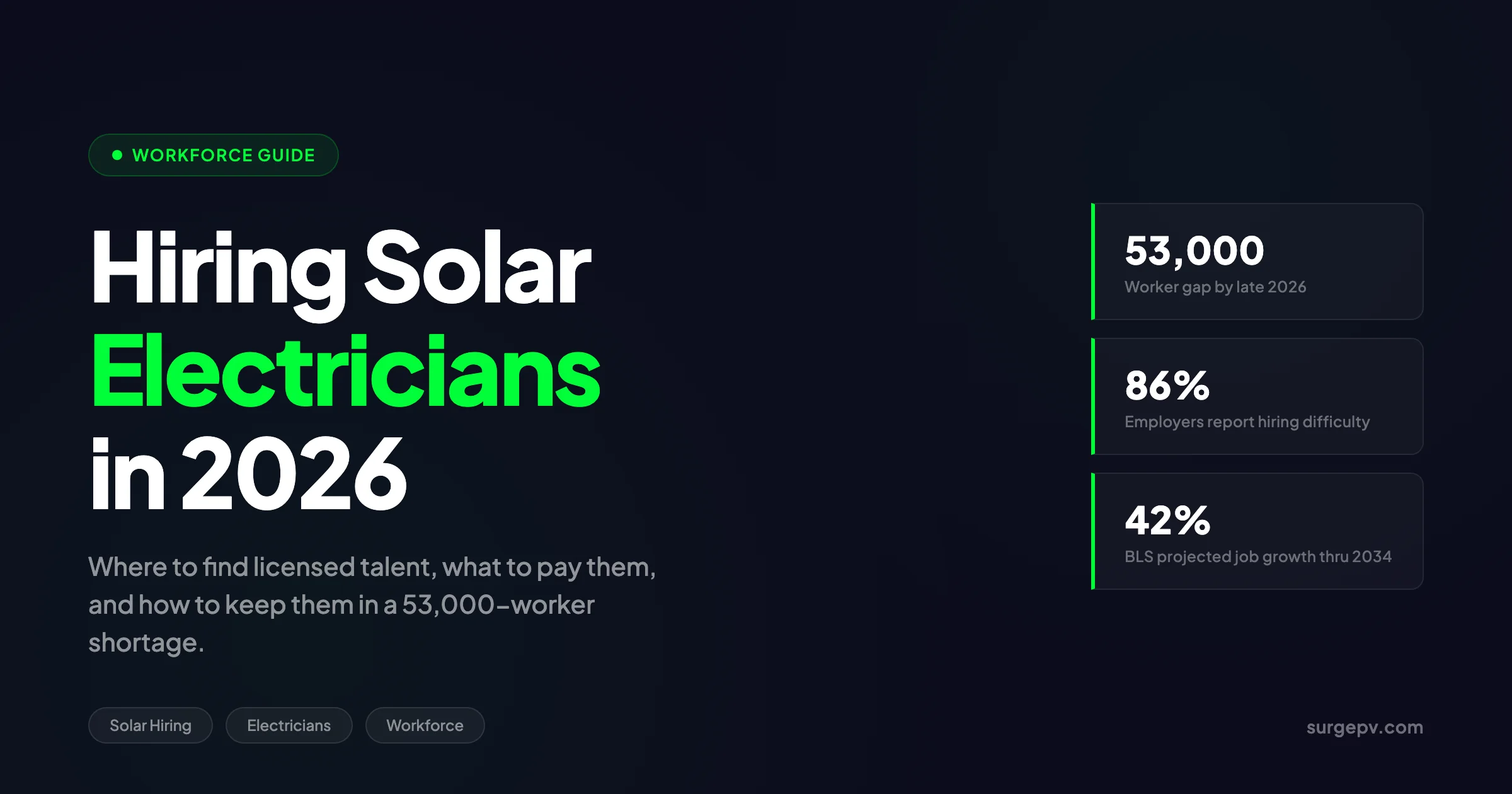
This story plays out across the United States every day. The solar industry employs roughly 280,000 workers. It needs 355,000 by late 2026. That gap — 53,000 workers — threatens deployment targets of 60-70 GW, according to PV Magazine. Also see: Us Residential Solar Market Trends 2026.
86% of solar employers report difficulty filling open positions, per the 2025 U.S. Energy and Employment Report. The shortage is not abstract. It is a daily operational crisis.
Quick Answer
Hiring solar electricians in 2026 means competing in the tightest labor market the industry has seen. Source candidates from NABCEP directories, IREC-accredited programs, union halls, and military transition pipelines. Verify state electrical licenses first. Test practical skills before making offers. Pay 15-25% above standard electrician rates. Retain talent through career pathways, training investment, and technical respect.
In this guide you will learn:
- Where to find licensed solar electricians in a 53,000-worker shortage
- Which licenses and certifications actually matter (and which do not)
- How to interview and test candidates for real-world competence
- What to pay solar electricians by state and experience level
- How to retain electricians when competitors poach constantly
- Which training programs produce job-ready candidates
- What most hiring managers get wrong about solar electrician recruitment
The 2026 Solar Electrician Shortage: By the Numbers
The solar workforce gap is not a future problem. It is a present crisis.
The U.S. solar industry added workers for 10 straight years. Employment grew 61% between 2014 and 2024. Then growth stalled. The industry added only 0.2% more workers in 2024 despite record capacity additions. Why? The pipeline of qualified electricians dried up.
IRENA’s 2025 Renewable Energy and Jobs report found that global solar PV employed 7.2 million people in 2024. China accounted for 4.6 million of those jobs. The United States employed 280,119. The gap between deployment targets and available workers is widening. For Global-specific compliance details, see Global net-metering-by-country. For Global-specific compliance details, see Global solar-permitting-speed-by-country.
Here is what the numbers say:
| Metric | Figure | Source |
|---|---|---|
| Current U.S. solar workforce | 280,119 | IRENA / 2025 USEER |
| Workers needed by late 2026 | ~355,000 | Industry projections |
| Projected gap | 53,000 workers | PV Magazine, April 2026 |
| Employers reporting hiring difficulty | 86% | 2025 USEER |
| Utility-scale firms calling hiring “very difficult” | 27% | 2025 USEER |
| Firms struggling to hire mid-level staff | 47% | 2025 USEER |
| Workforce with access to skills training | 43% | IREC Census |
| BLS projected job growth (2024-2034) | 42% | BLS, August 2025 |
The 42% job growth projection from the Bureau of Labor Statistics makes solar photovoltaic installers the second-fastest-growing occupation in the entire U.S. economy. Only wind turbine service technicians rank higher. But as BLS branch chief Emily Krutsch noted, fast growth does not mean lots of jobs. The occupation is small. The 42% growth translates to roughly 12,000 new positions over a decade.
The real pressure comes from a different direction. AI data centers now consume 45-70% of electrical construction budgets in some regions. Electricians who might have moved into solar are wiring server farms instead. The same skilled tradespeople are being pulled in multiple directions.
Key Takeaway
The 53,000-worker gap is not a single number. It is a structural shortage across every skill level. Entry-level installers are scarce. Journeyman electricians are scarcer. Master electricians with solar experience are nearly impossible to find. Companies that solve this problem will build a durable competitive advantage.
Why the Shortage Is Worse for Electricians Than Installers
The gap is not evenly distributed. The sharpest shortage hits licensed electricians specifically.
Anyone can learn to carry panels, attach racking, and run conduit. The electrical work — sizing conductors, calculating voltage drop, configuring inverters, grounding systems, commissioning — requires a licensed professional. In most states, a licensed electrician must sign off on the AC side of every solar installation. Read Solar Racking Design Guide for a complete walkthrough.
The electrical trades are also aging. Roughly 30% of union electricians are nearing retirement. The BLS projects 81,000 electrician openings annually through 2034. Solar competes for the same pool of candidates as commercial construction, industrial maintenance, and data center buildouts.
The result: solar companies pay a premium for licensed electricians. And they still lose candidates to other industries.
Where to Find Licensed Solar Electricians in 2026
Posting a job ad and waiting is not a strategy. It is a resignation. In a market where 86% of employers struggle to hire, you need multiple active sourcing channels.
Channel 1: NABCEP Certified Professional Directory
The North American Board of Certified Energy Practitioners maintains a public directory of PV Installation Professionals (PVIP). This is the single best source for pre-qualified solar electricians.
Search the directory by state or zip code. Filter by certification type. Contact candidates directly. PVIP-certified electricians have passed a rigorous exam, documented field experience, and committed to continuing education. They are not just licensed. They are solar-licensed.
The limitation: the directory is small. NABCEP has certified roughly 8,000 PVIPs since the program began. Not all are actively working. Not all are looking for jobs. But the ones who are represent the highest-quality candidate pool available.
Channel 2: IREC-Accredited Training Programs
The Interstate Renewable Energy Council accredits solar training programs across the country. Graduates of IREC-accredited programs have completed standardized curricula that align with NABCEP exam requirements.
Contact program directors directly. Many maintain job placement services for graduates. Offer to present at career days. Sponsor capstone projects. Build relationships before you need to hire.
Top IREC-accredited programs include:
- Hudson Valley Community College (NY)
- Central New Mexico Community College (NM)
- Colby Community College (KS)
- NC State University Renewable Energy Technologies
- San Diego State University Global Campus
Channel 3: Electrical Union Halls (IBEW)
The International Brotherhood of Electrical Workers operates training centers in every major U.S. market. Union apprentices and journeymen receive rigorous electrical training. Many IBEW locals now offer solar-specific modules.
Contact your local IBEW hall. Ask about apprentices nearing completion. Inquire about journeymen interested in solar specialization. Some locals maintain referral lists for contractors seeking licensed electricians.
Union electricians cost more. They also show up with verified training, documented safety records, and structured career progression. In a market where 47% of firms struggle to hire mid-level staff, union partnerships provide a reliable pipeline.
Channel 4: Military Transition Programs
The Solar Ready Vets Network connects transitioning service members with solar employers. Veterans bring discipline, safety consciousness, and technical aptitude. Many have electrical experience from military service.
Programs like Hire Our Heroes and the DOL Veterans Employment and Training Service offer structured pathways. Some provide funding for veterans to complete NABCEP training before entering the civilian workforce.
The advantage: veterans are not shopping 10 job offers simultaneously. They are making a single career transition decision. A clear pathway from military service to solar electrician to lead installer can win commitment that no signing bonus can buy.
Channel 5: Fossil Fuel Transition Workers
Coal plant closures and oil field layoffs produce experienced electrical workers. The Massachusetts Special Commission on Fossil Fuel Workforce Impacts documented successful transition programs. Workers from coal, oil, and gas bring high-voltage experience, safety training, and mechanical aptitude.
The transition requires solar-specific training. But the foundation is solid. These workers understand electrical theory, lockout/tagout procedures, and industrial safety culture. A 90-day solar bridge program can convert a coal plant electrician into a utility-scale solar technician.
Channel 6: Trade Schools and Community Colleges
Community colleges across the country offer solar technician certificates. Programs range from 3 months to 1 year. Costs run $1,295 to $3,490, according to Research.com.
These programs produce entry-level candidates. They are not ready to lead installations. But they are ready to apprentice. Pair them with licensed electricians and you satisfy the 15% apprenticeship mandate for federal tax credits while building a long-term pipeline.
Channel 7: Competitor Poaching (Use Sparingly)
Hiring directly from competitors is common in tight labor markets. It is also expensive and culturally corrosive. Poached employees often leave again within 12-18 months. They were bought, not convinced.
If you must poach, target electricians at companies with known quality or safety issues. A technician leaving a toxic workplace will stay longer than one leaving for a 10% raise. Focus on the narrative, not the money.
Pro Tip
Build a candidate pipeline 6 months before you need it. Contact NABCEP-certified electricians quarterly. Attend IREC program career days. Sponsor a local community college solar program. When the project ramp comes, you will have warm relationships, not cold job ads.
What Most Companies Get Wrong About Sourcing
Most solar companies post one job ad and wait. The ad sits for weeks. They lower standards. They hire the least-bad candidate. Six months later they are recruiting again.
The mistake is treating hiring as a transaction. In a 53,000-worker shortage, hiring is relationship-building. The companies that win are the ones that show up consistently — at training programs, union halls, military transition events, and industry conferences — before they have an urgent need.
Licensing and Certification: What Actually Matters
Not every credential carries equal weight. Some are legally required. Some are practically required. Some are nice-to-have. Knowing the difference saves time and prevents compliance disasters.
The Legal Foundation: State Electrical License
Every solar electrician must hold a valid state electrical license. No exceptions. Installing AC electrical work without a license is illegal in every state. It voids insurance. It triggers fines. It can result in criminal charges.
The license type varies by state:
| State Category | License Type | Examples |
|---|---|---|
| Dedicated solar license | C-46 Solar Contractor | California |
| Electrical + solar subclass | C-2g Photovoltaic | Nevada |
| Master Electrician + Contractor | Master Electrician + Electrical Contractor | Most states |
| General electrical only | Journeyman or Master Electrician | Texas, NY (local) |
ContractorLicenseRequirements.com maintains a state-by-state database. Verify every candidate’s license number through the state licensing board before extending an offer. Do not trust a photocopy.
The Industry Standard: NABCEP PVIP
NABCEP PV Installation Professional certification is technically voluntary. In practice, it is required by many utilities, incentive programs, and manufacturers.
NABCEP PVIP Requirements (2026):
| Requirement | Detail |
|---|---|
| Training | 58 hours of approved classroom instruction |
| Experience | 6 Project Credits of installation experience |
| Exam | 70 questions, 4 hours, passing score 70 |
| Cost | $500 (application + exam) |
| Pass rate | 60-70% first-time |
| Renewal | 30 CEUs every 3 years |
The NABCEP fee schedule lists current costs. The total investment including training courses runs $1,000 to $2,500. Candidates who have made this investment are serious about solar as a career.
The Safety Baseline: OSHA 10 or 30
OSHA 10-Hour Construction training is the minimum safety credential. OSHA 30 is preferred for lead electricians. These are not solar-specific. They are construction-wide. But solar work involves roof access, electrical hazards, and heavy lifting. Safety training is non-negotiable.
The Nice-to-Haves
- Manufacturer certifications (Enphase, SolarEdge, Tesla Powerwall): Useful for specific product lines. Not transferable between manufacturers.
- First Aid/CPR: Standard on most job sites. Easy to obtain.
- Working at Height certification: Required for rooftop work in some jurisdictions.
- NEC 2023 training: The National Electrical Code updates every 3 years. Current knowledge matters.
What Most Guides Miss
Many hiring managers treat NABCEP as optional. This is a mistake in 2026. Utilities in California, New York, Massachusetts, and Texas increasingly require NABCEP certification for interconnection approval. A non-NABCEP electrician can install the system. But the system may not get permission to operate. Verify your local utility’s requirements before hiring.
A Contrarian Take: Over-Certification Is a Real Problem
The solar industry has a credential inflation problem. Some employers demand NABCEP PVIP, OSHA 30, manufacturer certifications, and a master’s license for entry-level roles. This filters out good candidates.
A licensed journeyman electrician with 3 years of solar experience and OSHA 10 is often more valuable than a newly minted PVIP with no field hours. The PVIP exam tests knowledge. It does not test judgment. Judgment comes from hours on roofs, in attics, and in electrical rooms.
My recommendation: require the state electrical license. Require OSHA 10. Treat NABCEP as preferred, not mandatory, for non-lead roles. Then test practical skills in the interview. A 2-hour hands-on assessment reveals more than any stack of certificates.
The Interview Process: How to Test Real Competence
A resume tells you what a candidate claims. A 30-minute conversation tells you how they talk. Only a practical test tells you what they can actually do.
Stage 1: The Phone Screen (15 Minutes)
Verify basics. Confirm the state electrical license is active. Check for recent solar experience. Ask one technical question to filter out complete mismatches.
Good phone screen question: “Walk me through how you would size a DC disconnect for a 10 kW string inverter system with 400W modules.”
A qualified candidate answers in 30 seconds: calculate string voltage at lowest recorded temperature, apply 1.25 safety factor, select disconnect rated above that voltage with appropriate ampacity. A weak candidate talks about “checking the spec sheet” without specifics.
Stage 2: The Technical Interview (45 Minutes)
Use the STAR method for behavioral questions. Situation, Task, Action, Result. This prevents vague answers.
Behavioral questions that work:
- Describe a safety incident you prevented. What did you see? What action did you take? What was the outcome?
- Tell me about a time you found a design error during installation. How did you handle it?
- Give an example of working with an inspector who failed your installation. What was the issue? How did you resolve it?
Technical questions that reveal depth:
- How do you calculate voltage drop for a 150-foot DC homerun with 10 AWG wire and 8A per string?
- Explain the difference between equipment grounding and system grounding in NEC Article 690.
- A customer wants to add battery storage to an existing grid-tied system. What do you check first?
- How do you verify that an inverter is properly configured for the local grid voltage and frequency?
Stage 3: The Practical Test (2 Hours)
This is where most hiring processes fail. They skip the practical test. They rely on credentials and conversation. Then they discover 3 weeks later that the new hire cannot read a wiring diagram.
A proper practical test includes:
Exercise 1: Diagram Interpretation (30 minutes) Hand the candidate a single-line diagram for a residential solar system. Ask them to identify the main components, wire sizes, and protection devices. Ask what they would change if the roof were changed from asphalt shingle to standing seam metal.
Exercise 2: Voltage Drop Calculation (20 minutes) Give them a scenario: 12 modules in series, 400W each, 150 feet from array to inverter, 10 AWG wire. Ask them to calculate voltage drop and state whether it meets NEC recommendations.
Exercise 3: Troubleshooting Simulation (30 minutes) Present a system with a known fault: ground fault indication on the inverter, or a string showing zero current. Provide a multimeter and basic tools. Ask them to diagnose the problem.
Exercise 4: Safety Protocol Demonstration (20 minutes) Ask them to walk through lockout/tagout procedures for servicing a live inverter. Look for specific steps: notify personnel, isolate energy sources, apply locks and tags, verify zero energy state, test with meter.
Exercise 5: Tool Familiarity (20 minutes) Have them demonstrate proper use of a multimeter, torque wrench, and MC4 crimping tool. Watch for safety habits: checking meter settings before use, wearing insulated gloves, verifying tool calibration.
Pro Tip
Pay candidates for their time during practical tests. Two hours of skilled labor deserves compensation. It also signals that you value their expertise. The $100 you spend on a practical test saves thousands in replacement costs if you hire the wrong person.
What to Watch For During the Practical Test
Green flags:
- Checks meter settings before probing live circuits
- Asks about local AHJ requirements before answering code questions
- Explains reasoning out loud while working
- Identifies multiple possible causes before jumping to conclusions
- Mentions temperature coefficients when discussing voltage calculations
Red flags:
- Rushes through safety steps
- Cannot explain why a calculation matters (only how to do it)
- Has never used a torque wrench
- Gives one-word answers to technical questions
- Dismisses code requirements as “bureaucracy”
The Reference Check That Actually Works
Most reference checks are useless. “Would you hire this person again?” “Yes.” End of conversation.
Ask specific questions:
- What was the largest system they installed independently?
- How did they handle the last inspector failure on their work?
- Describe a time they disagreed with a design engineer. What happened?
- What safety equipment did they always carry? What did they sometimes forget?
- Would you trust them to commission a system without supervision?
The answers reveal character, not just competence.
Solar Electrician Compensation: What to Pay in 2026
Money is not the only factor in hiring. But it is the table stakes. In a market where 86% of employers struggle to fill positions, below-market pay guarantees a revolving door.
National Averages
| Source | Annual Salary | Hourly Rate | Date |
|---|---|---|---|
| ZipRecruiter | $61,380 | $29.51 | May 2026 |
| Glassdoor | $65,833 | — | 2026 |
| Payscale | — | $22.96 | 2026 |
| BLS (median) | $51,860 | — | May 2024 |
The BLS median of $51,860 reflects all solar photovoltaic installers, including non-electrician laborers. Licensed electricians command more. The ZipRecruiter and Glassdoor figures better represent licensed solar electrician compensation.
Solar Premium Over Standard Electrical Work
Solar electricians earn 15-25% more than standard electricians. In high-demand markets the premium reaches 30%.
| Category | Salary Range |
|---|---|
| Standard residential electrician | $55,000 – $68,000 |
| Solar electrician (general) | $68,000 – $95,000 |
| Solar electrician with NABCEP PVIP | $78,000 – $110,000 |
| Lead solar electrician / foreman | $90,000 – $120,000 |
| Master electrician with solar specialization | $100,000 – $140,000 |
State-by-State Breakdown
Compensation varies dramatically by location. Cost of living, union density, solar market size, and local demand all factor in.
| State | Avg. Electrician Pay | Solar Market Conditions | Solar Premium |
|---|---|---|---|
| California | $86,500 | Largest U.S. market; aggressive mandates | +20-30% |
| Massachusetts | $82,900 – $85,584 | Strong commercial; offshore wind crossover | +15-25% |
| New York | $85,800 | Union strength; high-rise complexity | +15-20% |
| Texas | $81,000 | Rapid utility-scale growth; ERCOT expansion | +15-25% |
| Illinois | $88,000 | Industrial demand; commercial solar growth | +10-20% |
| Washington | $84,000 | Data center competition; renewable policy | +10-15% |
| Nevada | $70,860 | Desert solar farms; lower cost of living | +15-20% |
| Arizona | $75,000+ | Excellent irradiance; utility-scale projects | +15-25% |
| Florida | $75,200 | Growing residential; hurricane recovery work | +10-15% |
| Oregon | $79,500 | Renewable energy policy; industrial base | +10-15% |
Data compiled from Zippia, ServiceTitan, and Workiz (2025-2026).
The Total Compensation Picture
Base salary is only part of the equation. Solar electricians in 2026 evaluate the full package:
| Component | What Top Candidates Expect |
|---|---|
| Base salary | At or above local market rate |
| Overtime pay | Time-and-a-half for hours over 40; double-time on Sundays in some markets |
| Health insurance | Medical, dental, vision; employer contribution 70%+ |
| Retirement | 401(k) with employer match |
| Paid time off | 2-3 weeks to start; increases with tenure |
| Tool allowance | $500-1,500 annually for personal tools |
| Vehicle or mileage | Company truck or mileage reimbursement |
| Training budget | Paid NABCEP courses, manufacturer training, code update classes |
| Safety equipment | Quality harnesses, helmets, gloves provided by employer |
| Performance bonus | Tied to project completion, quality metrics, or safety record |
SurgePV Analysis
Here is an original calculation: A solar company in Texas hiring 4 journeyman electricians at $75,000 base pays $300,000 annually in salary. Adding a 15% solar premium brings that to $345,000. Benefits and overhead add another 35%. Total annual cost per electrician: roughly $116,000 fully loaded. The cost of a bad hire — 3 months of salary, recruitment fees, training time, and project delays — runs $35,000 to $50,000 per failed hire. A rigorous interview process that prevents one bad hire pays for 50 practical tests.
For a direct comparison, see Arka 360 vs SurgePV.
The Tradeoff Nobody Talks About
Higher pay attracts better candidates. It also attracts job-hoppers. The electricians who chase the highest dollar move every 12-18 months. They never develop deep expertise with your systems, your team, or your customers.
The alternative is building a compensation ladder that rewards tenure. Start at market rate. Add a 5% raise at 6 months, 10% at 1 year, 15% at 2 years. Tie the top rungs to leadership roles — lead electrician, project manager, operations supervisor.
This approach costs more in year two. It costs less in year three and beyond. A retained electrician at $90,000 is cheaper than two hires at $75,000 with a 6-month gap between them.
Retention: Keeping Electricians When Everyone Wants Them
Hiring is hard. Retention is harder. The solar industry has historically treated installers as interchangeable labor. That model collapses in a 53,000-worker shortage.
Why Solar Electricians Leave
The reasons are predictable. Most are fixable.
| Reason | Frequency | Fixable? |
|---|---|---|
| Higher pay elsewhere | 35% | Partially — match or exceed market |
| No career progression | 28% | Yes — build pathways |
| Poor safety culture | 18% | Yes — invest in equipment and training |
| Inconsistent work | 12% | Partially — diversify project pipeline |
| Bad management | 7% | Yes — train supervisors |
The data comes from industry surveys and exit interview patterns. The dominant factor is not money. It is career stagnation. Electricians who see no path forward leave for any path at all.
Build Career Pathways
Map the progression from day one. Show every candidate the ladder before they climb it.
Sample Career Pathway:
| Level | Title | Requirements | Compensation |
|---|---|---|---|
| 1 | Apprentice | 0-2 years; OSHA 10; helper role | $18-24/hr |
| 2 | Journeyman Electrician | State license; 2+ years solar | $28-36/hr |
| 3 | Lead Electrician | NABCEP PVIP; 4+ years; team lead | $36-48/hr |
| 4 | Project Manager | 6+ years; manages multiple crews | $55-70/hr |
| 5 | Operations Manager | 8+ years; P&L responsibility | $80-110/hr |
The key is visibility. Every electrician should know exactly what stands between their current role and the next level. No guessing. No politics. Specific requirements, specific timelines, specific rewards.
Invest in Continuing Education
NABCEP requires 30 continuing education units every 3 years. Pay for them. Schedule work around conference attendance. Send electricians to the NABCEP CE Conference.
The investment is small. The signal is enormous. It tells electricians that you see them as professionals with a future, not as labor to be used and replaced.
Provide Quality Tools and Equipment
Nothing says “we do not value you” like cheap tools. A worn harness with frayed straps. A multimeter that reads 2% high. A company truck that breaks down monthly.
Quality safety equipment is non-negotiable. It is also a retention tool. Electricians talk. They know which companies provide Petzl harnesses and which provide no-name imports. They know which trucks have working AC in August.
Create Technical Ownership
The fastest way to lose a good electrician is to treat them as hands, not brains. “Just install what the engineer designed. Do not think. Do not question.”
Good electricians have opinions. They see things engineers miss. They know which roof pitches are problematic. They know which inverter configurations fail in summer heat. Give them a voice in design reviews. Let them flag issues before installation begins.
This requires humility from management. It pays off in quality, speed, and retention.
The Narrative: Raj’s Story
Raj joined a residential solar company in New Jersey as a journeyman electrician in 2023. He was licensed. He was competent. He was bored.
For 18 months he installed the same system type on the same roof type with the same crew. No new challenges. No new skills. No path forward.
A competitor offered $8,000 more. Raj took it. The new company put him on commercial projects within 3 months. He earned his NABCEP PVIP. Within 2 years he was lead electrician on a 500 kW ground-mount project.
Raj’s original employer spent $40,000 replacing him. They could have kept him for the cost of a training program and a conversation about his future.
What Most Companies Get Wrong
Retention is not a program. It is a daily practice. The companies that keep electricians do not have better HR policies. They have better supervisors. A foreman who asks “what do you need?” and means it prevents more departures than any retention bonus.
Training Programs: Building Your Own Pipeline
When external candidates are scarce, the solution is to grow your own. Training programs require upfront investment. They produce loyal, job-ready electricians who know your systems.
The Apprenticeship Model
The traditional electrical apprenticeship runs 4-5 years. It combines classroom instruction with paid on-the-job training. Graduates earn journeyman licenses and have documented hours across multiple skill areas.
For solar companies, the challenge is that standard electrical apprenticeships include minimal solar content. The solution is to partner with DOL-registered apprenticeship programs and add solar modules.
The federal government requires 15% of labor hours on tax-credit-eligible projects to come from qualified apprentices. This is not a burden. It is an opportunity. Every apprentice you train satisfies a regulatory requirement while building your future workforce.
The 90-Day Bridge Program
For licensed electricians from other trades, a focused 90-day program converts general electrical skills to solar-specific competence.
Week 1-2: Solar Fundamentals
- PV module operation and specifications
- Inverter types and selection
- NEC Article 690 (Solar PV Systems)
- Site assessment and shading analysis
Week 3-4: Installation Practice
- Racking systems and roof attachment
- DC wiring and grounding
- AC interconnection
- Commissioning procedures
Week 5-6: Advanced Topics
- Battery storage integration
- Smart inverter settings and grid interaction
- Troubleshooting common faults
- Utility interconnection requirements Read Adding Battery Storage Services for a complete walkthrough.
Week 7-8: Field Shadowing
- Pair with lead electrician on live projects
- Assist with commissioning
- Complete documentation
Week 9-10: Independent Work
- Lead small residential installations with supervision
- Conduct site assessments
- Prepare as-built drawings
Week 11-12: Evaluation and Certification
- Practical examination
- Written test on NEC Article 690
- NABCEP PV Associate exam preparation
Graduates of this program are not master electricians. They are competent solar electricians who can work independently on residential and small commercial projects.
Community College Partnerships
Partner with local community colleges that offer solar technician programs. Offer internships. Sponsor equipment. Guest lecture. Build a pipeline of candidates who know your company before they graduate.
Top programs to consider:
| Program | Cost | Duration |
|---|---|---|
| Hudson Valley Community College | ~$3,490 | 2 semesters |
| Central New Mexico Community College | $8,478 | 6-12 weeks |
| Colby Community College | ~$1,600 | 1 year |
| NC State Renewable Energy Technologies | $2,200-$3,400 | 40-120 hours |
| CSU San Bernardino Solar Panel Installer | $1,395 | 3 months |
Internal Mentorship
Pair every new hire with a senior electrician. The mentor checks work, answers questions, and provides feedback. The mentee gains confidence and competence faster than solo learning.
Mentorship works best when it is structured. Define the mentor’s responsibilities. Schedule weekly check-ins. Set 30-60-90 day milestones. Compensate mentors for their time — a $2,000 annual stipend is standard.
Pro Tip
Document everything your training program teaches. Build a company knowledge base: wiring diagrams for common system types, troubleshooting flowcharts, AHJ contact lists, equipment specification sheets. New hires ramp faster when they have reference materials, not just verbal instruction.
The Cost-Benefit of Training
A 90-day bridge program costs roughly $8,000-12,000 per candidate including wages, materials, and supervision time. A traditional recruitment search for an experienced solar electrician costs $5,000-15,000 in fees, ads, and management time. The trained candidate is loyal. The recruited candidate is shopping.
Over 3 years, the trained electrician who stays costs less than the experienced hire who leaves after 18 months. The math is simple. The discipline to invest upfront is hard.
Licensing Requirements by State: What Employers Must Know
Solar electrician licensing is a state-by-state patchwork. There is no federal standard. Hiring across state lines requires understanding each jurisdiction’s rules.
States with Dedicated Solar Licenses
| State | License | Requirements |
|---|---|---|
| California | C-46 Solar Contractor or C-10 Electrical | 4 years journey-level experience; pass CSLB exam |
| Arizona | CR-11 Solar | Pass trade exam; verify experience |
| Hawaii | C-60 Solar Power Systems or C-13 Electrical | State contractor license |
| Nevada | C-2 Electrical with C-2g PV subclass | Electrical contractor + photovoltaic endorsement |
| New Mexico | GS-3 Solar | State-specific solar contractor license |
| Utah | S202 Solar | Solar-specific contractor classification |
States Requiring Only Electrical Licenses
Most states do not have a dedicated solar license. They require a standard electrical contractor or master electrician license. Solar work falls under the electrical scope.
Examples: Texas, North Carolina, Georgia, Illinois, Indiana, Pennsylvania, New York (state level; NYC has additional requirements). Also see: Best Solar Design Software India. For India-specific information, see 5kW Solar Panel Price in India.
The Reciprocity Problem
License reciprocity between states is limited. A California C-10 electrician cannot work in Nevada without obtaining a Nevada license. Some states have reciprocal agreements with neighbors. Most do not.
For multi-state operators, this means maintaining licensed electricians in each state. Or partnering with local electrical contractors who hold the required licenses. The partnership model is common for EPC companies working across regions.
Verification Checklist
Before any electrician touches a project:
- Verify state license through official licensing board database
- Confirm license classification covers solar work
- Check for disciplinary actions or complaints
- Verify liability and workers compensation insurance
- Confirm NABCEP certification if required by utility or incentive program
- Check OSHA training status
- Review continuing education compliance
Common Mistake
Hiring managers often verify the license exists but not whether it covers the specific work. A residential electrical license may not authorize commercial solar installations. A journeyman license may not allow unsupervised work. Check the scope, not just the status.
The Misconception: “We Can Just Train General Electricians”
This is the most expensive misconception in solar hiring. Yes, a licensed electrician can learn solar. But the learning curve is steeper than most managers assume.
A general electrician understands AC circuits, conduit bending, and code compliance. Solar requires additional knowledge:
- DC system design and safety (DC arcs are more dangerous than AC arcs at the same voltage)
- Module-level power electronics (optimizers, microinverters)
- Grounding and bonding in PV systems (NEC Article 690 has unique requirements)
- Inverter configuration and grid interconnection
- Shading analysis and string sizing
- Battery storage integration and safety protocols
A general electrician needs 6-12 months of supervised solar work before working independently. During that period, they are less productive than a solar-experienced hire. They make mistakes that experienced solar electricians avoid. They require more supervision, more rework, and more patience.
The “just train them” approach works if you have 12 months and a senior electrician to provide daily supervision. It fails if you need someone productive in 3 weeks.
My recommendation: hire solar-experienced electricians for lead roles. Hire general electricians as apprentices and invest in their training. Do not confuse the two categories.
2026 Market Outlook: What Changes Next
The solar electrician labor market will shift significantly in the next 18 months.
The July 2026 Deadline
The One Big Beautiful Bill Act (OBBBA) set a July 4, 2026 construction deadline for full Section 45Y and 48E tax credits. Projects that break ground before this date qualify for the highest credit rates. Projects after July 4, 2026 face reduced or eliminated incentives.
This creates a hiring surge through mid-2026. Every developer rushes to staff projects before the deadline. Competition for electricians intensifies. Wages rise. Poaching accelerates.
After July 2026, demand may drop sharply. Projects planned for late 2026 and 2027 may be canceled or delayed. Some electricians will face layoffs. The companies that planned for this transition — building O&M service lines, diversifying into battery storage and EV charging — will retain their teams. The companies that hired only for the boom will lose theirs.
Technology Shifts Changing Skill Requirements
Three technology trends are reshaping what solar electricians need to know:
1. Battery Storage Integration Every major solar market is adding storage. Electricians who understand only PV modules and string inverters are becoming obsolete. Battery systems require knowledge of DC-DC converters, battery management systems, thermal management, and fire safety protocols.
2. Smart Inverters and Grid Interaction Modern inverters do more than convert DC to AC. They provide grid services, ride through voltage disturbances, and communicate with utility control systems. Electricians must configure these settings correctly. A misconfigured smart inverter can fail inspection or cause grid instability.
3. Higher System Voltages Utility-scale solar is moving to 1,500V DC systems. Commercial projects increasingly use 1,000V. These voltages require different safety protocols, different equipment, and different training than the 600V systems that dominated residential solar for years.
Design Systems Your Electricians Can Actually Install
The best solar designs account for installation reality. SurgePV’s platform lets engineers model systems with real equipment specs, voltage drop calculations, and code compliance built in. Your electricians get clear, buildable plans.
Book a DemoNo commitment required · 20 minutes · Live project walkthrough
Frequently Asked Questions
How much does a solar electrician make in 2026?
Solar electricians earn a national average of $61,380 to $65,833 annually according to ZipRecruiter and Glassdoor (2026). In high-demand states like California and Massachusetts, experienced solar electricians with NABCEP certification can earn $85,000 to $120,000. The solar specialization adds a 15-25% premium over standard electrical work.
What certifications should a solar electrician have?
At minimum, a solar electrician needs a state electrical contractor or journeyman license. NABCEP PV Installation Professional (PVIP) certification is the industry gold standard and is practically required by many utilities and incentive programs. OSHA 10 or 30 training is standard. Some states like California require a C-46 Solar Contractor or C-10 Electrical Contractor license.
Where is the best place to find solar electricians?
The best sources are NABCEP’s certified professional directory, IREC-accredited training program alumni networks, local electrical union halls (IBEW), military transition programs like Solar Ready Vets, and industry job boards including SolarJobs.com and the SEIA career center. Trade schools with solar programs also produce qualified entry-level candidates.
How long does it take to train a solar electrician?
A traditional electrical apprenticeship takes 4-5 years. For electricians already licensed, adding solar specialization through NABCEP-approved training takes 58 hours of classroom instruction plus field experience. Some employers run 90-day focused training programs for specific skills like battery storage or smart inverter installation.
What is the 53,000-worker gap in solar?
The U.S. solar industry currently employs about 280,000 workers but needs approximately 355,000 by late 2026 to meet deployment targets of 60-70 GW. This 53,000-worker shortage is driven by accelerated project timelines, a retiring electrical workforce, and competition from data center construction. 86% of solar employers report difficulty filling open positions according to the 2025 USEER.
Should I hire licensed electricians or train my own?
Hire licensed electricians for immediate project needs and compliance. Train your own for long-term workforce stability. The best approach is a hybrid: recruit licensed electricians as leads and pair them with apprentices to meet the 15% apprenticeship mandate for federal tax credits. This builds a pipeline while satisfying regulatory requirements.
What interview questions work best for solar electricians?
Use practical assessments, not just verbal interviews. Have candidates interpret a single-line diagram, calculate voltage drop for a given string length, or explain lockout/tagout procedures. Ask STAR-method behavioral questions about safety incidents and deadline pressure. A hands-on wiring test reveals more than any resume.
How do I retain solar electricians in a competitive market?
Retention requires more than pay. Offer clear career pathways from apprentice to lead installer to project manager. Invest in continuing education and NABCEP recertification. Provide quality tools and safety equipment. Build a culture where electricians have input on design decisions. The companies that retain talent treat electricians as technical partners, not labor.
Conclusion: Three Actions to Take This Week
The solar electrician shortage is not going away. The BLS projects 42% job growth through 2034. Data centers are absorbing electrical construction capacity. The July 2026 tax credit deadline is compressing timelines. Companies that act now build advantage. Companies that wait pay more for less.
Action 1: Audit your current hiring process. Do you post ads and wait? Or do you build relationships with NABCEP, IREC programs, union halls, and military transition offices? Shift from transactional to relational recruiting. Contact 3 new sourcing channels this week.
Action 2: Add a practical skills test to every electrician interview. Hand candidates a single-line diagram. Ask them to calculate voltage drop. Test their lockout/tagout knowledge. The 2 hours you invest in practical assessment saves months of rework and replacement costs.
Action 3: Map a career pathway for every electrician on your team. Show them the next level. Define the requirements. Set a timeline. The number one reason solar electricians leave is not money. It is the absence of a future. Give them one.
The 53,000-worker gap is a problem for the industry. It is an opportunity for individual companies. The ones that solve hiring, interviewing, and retention will execute projects faster, with higher quality, at lower total labor cost. The ones that do not will watch their best electricians walk out the door.
Related SurgePV Resources
Continue learning with these related guides for solar installers and EPCs:
- Managing Solar Subcontractors
- Seasonal Demand Planning for Solar
- Solar Crew Scheduling Optimization
- Solar Company Overhead Reduction
- OSHA Compliance Checklist for Solar Installers
For more solar business and marketing content, explore the full SurgePV blog or browse the SurgePV glossary for definitions of solar industry terms.
Solar Software Tools to Support This Work
Effective solar installer operations depend on integrated software. SurgePV’s solar design platform helps installers handle the upstream work that feeds every decision in this guide:
- Solar design software for system layouts, panel placement, and BOM generation
- Shadow analysis for site-specific irradiance and obstruction modeling
- PV generation and financial modeling for production forecasts and project ROI
- Solar proposal software for branded, customer-facing proposals
- Clara AI for automated design assistance and Q&A
Browse the full SurgePV platform to see how installers worldwide use the tools to design smarter, sell faster, and streamline every solar project.
Where this fits
This article is part of SurgePV's Solar Business & Operations hub, which works through the topic from first principles to the decisions a project team actually has to make.


