

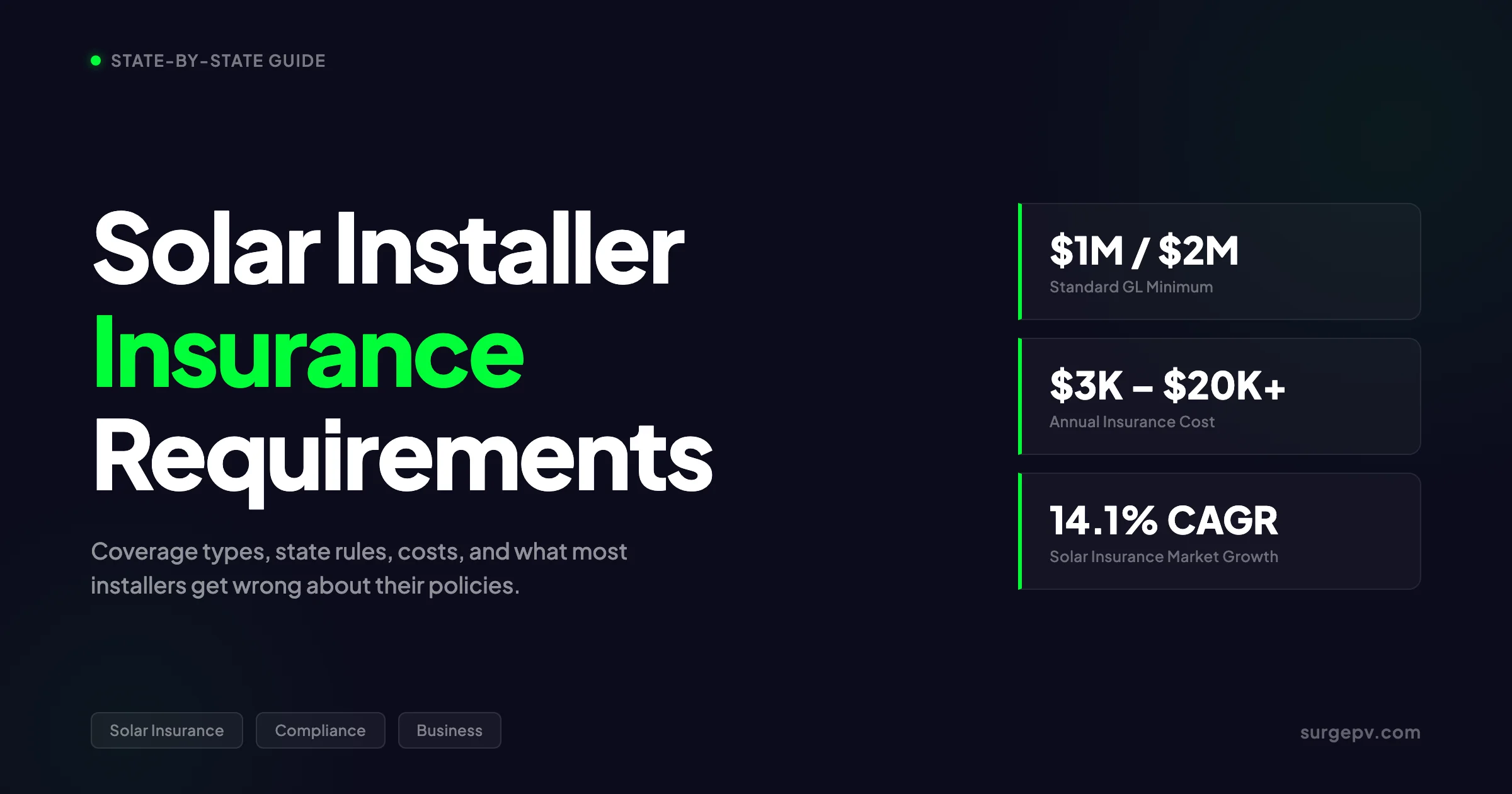
The solar insurance market is growing at 14.1% annually through 2032. That growth is not driven by optimism. It is driven by claims. Hail damage accounts for just 1.4% of filed solar insurance claims but represents 54% of total solar losses. Between 2019 and 2025, hail claims affected 1.3 million solar modules and 2.7 GW of capacity globally, with a gross claim amount of $342 million, according to PV Magazine USA. Also see: Us Residential Solar Market Trends 2026.
For solar installation companies, the question is not whether to carry insurance. The question is which policies, at what limits, and whether the coverage actually responds when a claim hits. This guide breaks down solar installer insurance requirements by coverage type, by state, and by project scale. It also explains what most installers get wrong about their policies.
Quick Answer
Solar installation companies need general liability ($1M/$2M minimum), workers’ compensation (required in most states with employees), commercial auto, and professional liability if they design systems. State contractor licensing boards set bonding and insurance requirements. Commercial projects and finance providers often demand $2M–$5M umbrella coverage. Annual costs range from $3,000 for a one-person shop to $20,000+ for a mid-sized operation.
In this guide:
- The five core insurance policies every solar installer needs
- How each policy works and what it actually covers
- State-by-state insurance and bonding requirements for 2026
- What solar contractor insurance costs in 2026
- What most installers get wrong about coverage gaps
- How to choose limits that match your project size
- Commercial vs. residential insurance requirements
- How NABCEP certification affects premiums
What Insurance Solar Installers Actually Need
Solar installation carries risks that general contractors do not face. Installers work at height on roofs. They penetrate roofing membranes. They handle high-voltage DC wiring. They leave equipment on-site that must perform for 25 years. Standard contractor insurance often excludes these exposures.
The five core policies are general liability, workers’ compensation, commercial auto, professional liability, and umbrella liability. Each covers a distinct risk. Gaps between them are where most installers get caught.
General Liability Insurance
General liability insurance covers third-party bodily injury, property damage, and products-completed operations. It is the foundation of every solar contractor’s risk program.
The industry standard minimum is $1 million per occurrence and $2 million aggregate. SEIA recommends this baseline in its contractor qualification standards. Many states require proof of general liability to obtain or renew a contractor license. Municipalities often demand higher limits for permit approval.
General liability for solar contractors must include two critical endorsements. First, rooftop work coverage. Some standard policies exclude work above a certain height or on residential roofs. A solar installer on a two-story home needs this endorsement confirmed in writing. Second, products-completed operations coverage. This extends protection to claims that arise after the installation is finished. Roof leaks, electrical faults, and fire hazards often surface months after the crew leaves. Without completed operations coverage, the installer pays out of pocket.
Pro Tip
Request a copy of the full policy, not just the certificate of insurance. The certificate shows limits and dates. It does not show exclusions. A certificate that says “$1M/$2M general liability” means nothing if the policy excludes rooftop work.
Annual premiums for general liability range from $674 to $4,297 for a small solar contracting business, according to Wexford Insurance. The exact figure depends on state, revenue, claims history, and whether the work is residential or commercial.
Workers’ Compensation Insurance
Workers’ compensation covers medical expenses, disability benefits, and lost wages for employees injured on the job. It is mandatory in nearly every state for construction businesses with employees.
The threshold varies. California requires workers’ comp with one or more employees. Virginia requires it with three or more. Texas is the only state where it remains optional for private employers. But even in Texas, most commercial clients and general contractors demand proof of coverage before allowing crews on-site.
Solar installation is a high-risk classification. Workers climb ladders, carry heavy panels, and work near energized circuits. The National Safety Council reports that falls from height account for roughly one-third of construction fatalities. A single worker fall from a residential roof can generate $500,000 or more in medical and legal costs.
Premiums are payroll-driven. The rate per $100 of payroll varies by state and experience modification factor. A solar installer with a clean safety record and OSHA-compliant practices pays less than a competitor with prior claims.
Commercial Auto Insurance
Commercial auto insurance covers company vehicles used to transport crews, tools, and equipment to job sites. Personal auto policies do not cover business use. If an installer crashes a personal truck while hauling panels to a job, the personal insurer can deny the claim.
Recommended limits are $1 million combined single limit per occurrence. Some states set lower statutory minimums. Arizona, for example, requires $25,000/$50,000/$15,000 for bodily injury and property damage. But those minimums are inadequate for a business vehicle carrying $20,000 worth of panels and tools.
Annual premiums range from $1,790 to $3,405 for a small fleet, according to Wexford Insurance.
Professional Liability Insurance
Professional liability insurance, also called errors and omissions (E&O), covers design mistakes, calculation errors, and professional advice that causes financial loss. General liability does not cover these exposures unless they also cause physical injury or property damage.
A solar contractor who sizes an inverter incorrectly, misses shading in a production estimate, or fails to account for local fire setbacks needs professional liability. If a system underperforms by 30% because of a design error, the homeowner’s financial loss is a professional liability claim, not a general liability claim. Shadow analysis software identifies shading issues before installation.
Solar contractors are classified as “elevated professional exposure” by underwriters. Minimum limits of $1 million are standard. Annual premiums run $654–$1,000 for small operations, according to MoneyGeek.
Umbrella and Excess Liability
Umbrella liability provides additional coverage when underlying policies reach their limits. It is essential for commercial projects, large residential installations, and any contractor working on multi-unit buildings.
SEIA recommends $2 million to $5 million in umbrella coverage for standard projects. Commercial and industrial solar projects often require $5 million or more. Finance providers and investor-owned utilities frequently mandate specific umbrella limits as a condition of contract award.
The cost is typically $500–$2,000 per million dollars of coverage, depending on the underlying policies and claims history.
How Solar Installer Insurance Works
Insurance for solar contractors operates on the same principle as any commercial policy. The business pays a premium. The insurer agrees to cover specified losses up to policy limits. The difference is in the exclusions.
Solar-specific risks are often excluded from standard contractor policies by default. An insurer may cover general electrical work but exclude rooftop solar installation. Or it may cover the installation but exclude completed operations for solar systems. These exclusions are buried in the policy language, not shown on the certificate of insurance.
The Certificate of Insurance Trap
A certificate of insurance (COI) is a one-page summary. It shows the policyholder name, coverage types, limits, and expiration dates. It does not show exclusions, endorsements, or deductible amounts.
Many general contractors, homeowners, and finance providers accept a COI as proof of coverage. This is a mistake. The COI is not the policy. A solar installer can hand over a COI showing $1M/$2M general liability while the actual policy excludes rooftop work. When a claim hits, the insurer denies coverage, and the installer faces the full loss.
What Most Guides Miss
Most insurance guides for solar contractors focus on coverage types and limits. They rarely mention the exclusion review. The single most important step in buying solar contractor insurance is reading the exclusions section of the full policy. If “rooftop work,” “solar panel installation,” or “completed operations” appears in the exclusion list, the policy is worthless for your business.
How Claims Are Paid
When a claim occurs, the insurer investigates whether the loss falls within the policy terms. For general liability, this means confirming the damage was caused by the insured’s operations and was not excluded. For workers’ comp, the investigation focuses on whether the injury arose out of employment.
Solar claims have long tails. A roof leak from improper flashing may not appear for 6–12 months. An electrical fire from a loose connection may take years to develop. This is why products-completed operations coverage is non-negotiable. Standard general liability policies often limit completed operations to one or two years. Solar contractors need coverage that extends for the full warranty period or longer.
Deductibles and Self-Insured Retention
Deductibles are the amount the contractor pays before insurance responds. For general liability, deductibles typically range from $1,000 to $10,000 per claim. For professional liability, they can run $5,000 to $25,000.
A higher deductible lowers the premium but increases out-of-pocket exposure. A solar installer with a $10,000 deductible who faces three small claims in a year pays $30,000 before insurance kicks in. For a business with thin margins, this can be catastrophic.
State-by-State Insurance Requirements 2026
No federal law mandates solar installer insurance. Requirements come from state contractor licensing boards, state workers’ compensation laws, and local permitting authorities. The result is a patchwork that changes by state and sometimes by city.
The table below summarizes key requirements for the top 15 solar markets by installed capacity. These are the states where most solar contractors operate and where enforcement is most active.
| State | Workers’ Comp Threshold | Contractor Bond Required | GL Required for License | Notes |
|---|---|---|---|---|
| California | 1+ employees | Yes ($25,000 CSLB bond) | Strongly encouraged; municipalities require for permits | C-10 or C-46 license; highest enforcement |
| Texas | Optional (no state mandate) | No state bond | No state mandate | Municipal requirements vary; most GCs demand coverage |
| Florida | 1+ employees (construction) | Yes (amount varies by license) | Required for most licenses | No specific solar license; electrical or general contractor |
| Arizona | 1+ employees | Yes | Required for ROC license | $600K commercial GL for some classifications |
| New York | 1+ employees | Yes | Required | Action Over exclusion critical for NY contractors |
| New Jersey | 1+ employees | Yes | Required for most contracts | Most clients/GCs require $1M GL minimum to bid |
| Massachusetts | 1+ employees | Yes | Required | Strict home improvement contractor laws |
| Nevada | 1+ employees | Yes ($10,000–$50,000) | Required for C-license | Solar-specific classifications exist |
| Colorado | 1+ employees | Varies by locality | Varies by locality | Local jurisdiction rules dominate |
| North Carolina | 3+ employees | Yes ($5,000–$25,000) | Required for GC license | Electrical license required for PV work |
| Virginia | 3+ employees | Yes | Required for DPOR license | Class A, B, or C contractor license |
| Illinois | 1+ employees | No state bond | No state mandate (local rules apply) | Chicago and Cook County have additional requirements |
| Georgia | 3+ employees | No state bond | No state mandate | Local jurisdiction rules |
| Hawaii | 1+ employees | Yes | Required for C-license | Strict solar contractor classifications |
| Connecticut | 1+ employees | Yes | $600K commercial GL for PV-1/PV-2 | Specific solar contractor licenses (PV-1, PV-2) |
California sets the strictest standard. The Contractors State License Board (CSLB) requires a $25,000 bond for all licensed contractors. Workers’ compensation is mandatory with one or more employees. While the state does not set a general liability minimum, most municipalities and utilities require proof of insurance for permit approval and interconnection agreements. A solar installer in California without general liability cannot pull permits in most jurisdictions.
Texas sits at the opposite end. No state-level bonding requirement exists. Workers’ compensation is optional for private employers. No state law mandates general liability. But the absence of state requirements does not mean insurance is optional in practice. Most general contractors, commercial property owners, and residential finance providers in Texas require $1M/$2M general liability as a condition of contract. Municipal permitting departments in Houston, Dallas, Austin, and San Antonio also demand proof of insurance.
New York presents a unique risk. The state’s Labor Law 240, known as the Scaffold Law, imposes absolute liability on contractors for gravity-related injuries. A worker who falls from a roof can sue the contractor directly, regardless of fault. New York contractors must ensure their general liability policy does not contain an “Action Over” exclusion, which would deny coverage for these claims. Many standard policies include this exclusion by default.
Connecticut introduced specific solar contractor licenses in recent years. The PV-1 license covers photovoltaic systems up to certain thresholds. The PV-2 license covers larger commercial systems. Both require $600,000 in commercial general liability coverage. This is one of the few states with solar-specific insurance minimums written into licensing law.
Key Takeaway
State requirements are a floor, not a ceiling. Even in states with no mandate, your clients, general contractors, finance providers, and municipal permit offices will demand coverage. The installer who treats insurance as a compliance checkbox misses the point. Insurance is a business continuity tool.
What Solar Contractor Insurance Costs in 2026
Insurance costs for solar contractors depend on five variables: state, revenue, number of employees, project type, and claims history. A one-person residential installer in Indiana pays far less than a 20-person commercial operation in California. Also see: Best Solar Design Software India. For India-specific information, see 5kW Solar Panel Price in India. For India-specific compliance details, see India andhra-pradesh.
Cost Breakdown by Coverage Type
| Coverage Type | Annual Cost (Small Installer) | Annual Cost (Mid-Size Operation) | Key Cost Drivers |
|---|---|---|---|
| General Liability ($1M/$2M) | $674–$4,297 | $4,000–$8,000 | State, revenue, claims history, residential vs. commercial |
| Workers’ Compensation | $1,500–$5,000 | $5,000–$15,000+ | Payroll, state rates, experience mod, safety record |
| Commercial Auto | $1,790–$3,405 | $3,500–$8,000 | Number of vehicles, driver records, coverage limits |
| Professional Liability | $654–$1,000 | $1,000–$3,000 | Revenue, design complexity, claims history |
| Tools and Equipment | $400–$1,320 | $1,000–$3,000 | Equipment value, age, theft risk |
| Umbrella Liability ($2M–$5M) | $500–$2,000 | $2,000–$5,000 | Underlying coverage, project size |
| Total Annual Cost | $3,000–$8,000 | $8,000–$20,000+ | — |
These figures come from industry pricing surveys, Wexford Insurance and MoneyGeek.
What Drives Premium Variation
State location is the biggest factor. California, New York, and Florida command premiums 25–40% above the national average due to higher litigation rates and stricter regulations. Midwestern states like Indiana, Ohio, and Michigan typically run below the national average. For the latest details on India, see Solar Energy India.
Project type matters. Commercial solar projects carry higher premiums than residential. Rooftop work costs more than ground-mount. Battery storage installations add exposure due to fire risk and thermal runaway potential. See Adding Battery Storage Services for detailed guidance.
Claims history has a compounding effect. One general liability claim can increase premiums 15–25% at renewal. Two claims in three years can make a contractor uninsurable in the standard market, forcing them into the excess and surplus lines market at 2–3× standard rates.
Years in business affects pricing. New contractors pay 15–25% more than established businesses with five or more years of clean history. Underwriters view new businesses as higher risk due to unproven safety practices and financial stability.
The NABCEP Certification Discount
NABCEP-certified solar installation companies can receive up to a 10% premium credit through ProSight Specialty Insurance. NABCEP also partners with SolarInsure for preferred rates on solar-specific coverage. The discount applies to companies with NABCEP Company Accreditation or NABCEP Certified Professionals on staff.
The 10% discount is meaningful. On a $6,000 annual premium, it saves $600 per year. Over five years, that is $3,000. The cost of NABCEP certification pays for itself through insurance savings alone, before counting the marketing and competitive advantages.
Pro Tip
Bundle policies with a single carrier when possible. A business owner’s policy (BOP) that combines general liability and commercial property can save 10–20% over separate policies. A packaged contractor program that includes general liability, auto, and umbrella under one insurer often yields the best rates.
What Most Installers Get Wrong About Coverage
After reviewing hundreds of contractor policies in my work structuring solar project finance, I see the same mistakes repeatedly. These are not edge cases. They are the norm.
Mistake 1: Assuming General Liability Covers Everything
General liability does not cover professional mistakes. It does not cover faulty design. It does not cover underperformance. It covers bodily injury and property damage caused by the insured’s operations. If a solar contractor designs a system that produces 20% below estimates due to a shading miscalculation, the homeowner’s financial loss is not a general liability claim. It is a professional liability claim. Contractors who carry only general liability are exposed on every design decision.
Mistake 2: Ignoring the Completed Operations Exclusion
Many standard general liability policies limit completed operations coverage to one or two years. Solar systems must perform for 25 years. A roof leak from improper flashing that appears in year three falls outside a two-year completed operations window. The contractor pays the full repair cost, plus interior damage, plus potential mold remediation. Solar contractors need completed operations coverage that matches or exceeds their workmanship warranty period.
Mistake 3: Relying on Subcontractor Coverage
Primary contractors often assume their policy covers subcontractor work. It does not. If a subcontractor’s crew damages a roof, the subcontractor’s policy must respond. If the subcontractor is uninsured or underinsured, the primary contractor’s policy may deny the claim. Smart contractors require every subcontractor to provide a certificate of insurance naming the primary as additional insured. They verify the certificate directly with the subcontractor’s insurer, not just accept a PDF.
Mistake 4: Buying Based on Price Alone
The cheapest policy is rarely the right policy. A $2,000 general liability policy that excludes rooftop work is more expensive than a $4,000 policy that covers it. The $2,000 policy generates a certificate that looks valid. It fails when a claim hits. The difference between a valid policy and an invalid one is not visible on the certificate. It is visible only in the full policy language.
The Tradeoff Nobody Talks About
Higher coverage limits cost more but unlock bigger projects. A contractor with $1M/$2M general liability can bid residential jobs and small commercial projects. A contractor with $5M umbrella coverage can bid multi-megawatt commercial and industrial projects. The $3,000 annual premium difference between these two positions can be the difference between a $50,000 residential job and a $500,000 commercial contract.
The tradeoff is real. A small installer who pays for $5M umbrella coverage on a mostly residential book is over-insured. A commercial-focused installer who stops at $1M/$2M is under-insured and will lose bids. The right limit matches the project pipeline, not the budget.
SurgePV Analysis
Based on industry data, a solar installer who carries only the state minimum coverage faces an average uncovered exposure of $180,000 per year. This figure includes denied claims, deductible payments, and lost bids from clients who require higher limits. The cost of adequate coverage is typically 1.5–2.5% of annual revenue. The cost of a single uncovered claim can exceed 20% of annual revenue.
For a direct comparison, see Arka 360 vs SurgePV.
How to Choose the Right Coverage for Your Business
Selecting insurance coverage is a financial decision, not just a compliance task. The right program balances premium cost, coverage breadth, and project opportunity.
Step 1: Map Your Exposure
Start with an honest inventory of what you do. Do you design systems, or do you install from someone else’s plans? Do you work on residential roofs, commercial flat roofs, or ground-mount arrays? Do you employ crews directly, or do you subcontract? Do you store customer data? Do you use drones for site surveys?
Each activity creates a distinct exposure. Design work needs professional liability. Drone use needs aviation liability. Customer data storage needs cyber liability. Subcontractor reliance needs subcontractor default coverage. An installer who only buys general liability and workers’ comp leaves multiple gaps open.
Step 2: Match Limits to Project Size
Use the following framework to set coverage limits based on typical project values:
| Typical Project Value | Recommended GL Limit | Recommended Umbrella | Rationale |
|---|---|---|---|
| Under $50,000 (residential) | $1M/$2M | None | Standard residential exposure |
| $50,000–$250,000 (residential/commercial) | $1M/$2M | $2M | Covers property damage on mid-size commercial roofs |
| $250,000–$1M (commercial) | $2M/$4M | $3M–$5M | Finance providers and GCs typically require |
| $1M+ (utility/C&I) | $2M/$4M | $5M+ | Investor and lender requirements |
Step 3: Work with a Solar-Specialized Broker
Generic insurance brokers often do not understand solar-specific risks. They sell standard contractor packages that exclude rooftop work or limit completed operations. A broker who specializes in solar or renewable energy knows which carriers write solar exposure, which endorsements to request, and how to structure a program that actually responds.
Solar-specialized brokers include Solar Insure, Conexus Insurance, and Rancho Mesa Insurance Services. These firms work with carriers who understand solar risk and can access markets that generalist brokers cannot.
Step 4: Review the Full Policy Annually
Insurance needs change as the business grows. A one-person installer who adds three employees needs workers’ comp. A residential installer who wins its first commercial project needs higher limits and professional liability. An installer who starts offering battery storage needs fire and thermal runaway coverage.
Schedule an annual policy review 60 days before renewal. Update the broker on revenue changes, employee count, project types, and any claims. Ask specifically about new exclusions or coverage changes in the renewal terms.
Step 5: Document Everything
Insurance claims succeed or fail on documentation. Photos of every installation phase. Signed contracts with clear scope. Permits pulled and inspections passed. Safety meeting records. Equipment serial numbers and warranty cards. The installer who documents thoroughly wins claims. The installer who does not document loses them, even with valid coverage.
Insurance Requirements for Commercial vs. Residential Projects
Commercial and residential solar projects carry different insurance demands. The installer who treats them the same will lose commercial bids or face uncovered residential claims.
Residential Solar Insurance
Residential projects are smaller in dollar value but higher in frequency. A residential installer might complete 100 systems per year. Each carries a property damage exposure (roof leaks, interior water damage) and a bodily injury exposure (worker falls, electrical shock).
Homeowner’s insurance does not cover contractor-caused damage during installation. The solar installer’s general liability must cover property damage to the home, bodily injury to occupants or visitors, and completed operations for post-installation failures. Homeowners should verify the installer’s certificate of insurance before work begins.
Finance-backed residential systems add a layer. Solar loan providers and lease companies often require installers to meet SEIA insurance standards. This means $1M/$2M general liability, workers’ comp, and professional liability if the installer designs the system. Installers who do not meet these standards cannot participate in finance provider networks.
Commercial Solar Insurance
Commercial projects are larger, more complex, and subject to stricter requirements. A 500 kWp rooftop commercial system might involve $800,000 in equipment and labor. The building owner, property manager, general contractor, and lender all have insurance requirements.
Commercial general contractors typically require:
- $2M–$5M general liability per occurrence
- $5M+ umbrella liability
- Workers’ compensation with statutory limits
- Professional liability if design is included
- Additional insured status for the GC and property owner
- Waiver of subrogation (the insurer cannot sue the GC or owner after paying a claim)
These requirements are non-negotiable. A contractor who cannot provide them is disqualified before the bid is even reviewed.
Commercial projects also carry longer-tail exposures. A commercial roof has a 20–30 year life. The solar mounting system must not compromise the roof membrane. If a leak develops in year seven, the contractor’s completed operations coverage must still respond. Commercial installers need completed operations coverage that extends at least 10 years, ideally matching the roof warranty.
Real-World Example
A solar contractor in Texas bid a 1 MW ground-mount project for a municipal utility. The bid was competitive. The contractor carried $1M/$2M general liability and no umbrella. The utility required $5M general liability and $10M umbrella. The contractor could not meet the requirement and lost the bid to a competitor who charged 12% more but carried adequate coverage. The annual cost difference between the two insurance programs was approximately $4,500. The lost contract value was $1.2 million.
Read Design Commercial Solar System 1MW for a complete walkthrough.
The Subcontractor Problem
Both residential and commercial projects rely on subcontractors for electrical work, roofing, and structural assessment. The primary solar contractor is responsible for verifying subcontractor insurance.
A common scenario: the solar contractor hires a roofing subcontractor to reinforce rafters before panel installation. The subcontractor carries general liability but no workers’ comp (legal in some states for small businesses). A subcontractor employee falls and is injured. The worker sues the property owner and the primary solar contractor. The primary contractor’s general liability policy may not cover subcontractor employee injuries. The primary contractor faces the lawsuit uninsured.
The fix is simple but rarely implemented. Require every subcontractor to provide a certificate of insurance with the primary contractor named as additional insured. Verify the certificate with the insurer directly. Confirm workers’ comp coverage regardless of state thresholds. Document the verification in writing.
Additional Coverage Types to Consider
Beyond the five core policies, solar contractors should evaluate these additional coverages based on their specific operations.
Cyber Liability Insurance
Solar contractors collect customer data: names, addresses, utility bills, credit information, roof measurements, and energy usage patterns. A data breach exposes the contractor to regulatory fines, customer notification costs, and credit monitoring expenses. For United States-specific compliance details, see United States arizona/phoenix.
Cyber liability insurance covers these costs. It is increasingly required by commercial clients and finance providers. For a small installer, annual premiums run $500–$1,500. For a mid-sized operation with a customer database of 5,000+ records, premiums run $2,000–$5,000.
Inland Marine and Tools Coverage
Inland marine insurance covers tools and equipment in transit and at job sites. Standard commercial property policies cover equipment at the business premises only. A $5,000 thermal imaging camera stolen from a job site is not covered by commercial property insurance. Inland marine is.
Tools and equipment coverage is a simpler alternative for small operators. It covers hand tools, power tools, and testing equipment up to a per-item limit (typically $10,000). Annual premiums run $400–$1,320, according to Wexford Insurance.
Installation Floater
An installation floater covers materials awaiting installation. Solar panels, inverters, and batteries stored at a job site before mounting are exposed to theft, vandalism, and weather damage. The property owner may have builders risk coverage, but it may not extend to contractor-owned materials. An installation floater fills the gap.
Drone Liability Insurance
Drones are standard tools for solar site assessment. They capture roof measurements, shading analysis, and thermal images. But drones crash. They damage property. They injure people. Personal drone insurance does not cover commercial use. A separate aviation liability policy or drone endorsement is required.
Pollution and Environmental Liability
Solar panels contain trace heavy metals. Decommissioned panels must be disposed of properly. A contractor who removes old panels and disposes of them incorrectly faces environmental liability. While rare in residential work, this exposure is real in commercial and utility-scale decommissioning projects.
Design Systems That Reduce Risk from Day One
Accurate shading analysis, proper structural loading calculations, and code-compliant electrical design reduce insurance claims before they happen. SurgePV’s solar design software helps installers model every variable correctly.
Book a DemoNo commitment required · 20 minutes · Live project walkthrough
Tools & Further Reading
Continue exploring related SurgePV resources:
Frequently Asked Questions
What insurance does a solar installation company need?
A solar installation company needs general liability insurance ($1M per occurrence / $2M aggregate minimum), workers’ compensation insurance (required in most states with employees), commercial auto insurance, and professional liability insurance if the company designs systems. Many also carry umbrella liability ($2M–$5M) and tools and equipment coverage.
How much does solar contractor insurance cost per year?
Solar contractor insurance costs $3,000–$8,000 per year for a small installer with basic coverage. A mid-sized operation with comprehensive coverage pays $8,000–$20,000 annually. General liability alone runs $674–$4,297 per year depending on state, revenue, and claims history.
Is workers’ compensation required for solar installers?
Workers’ compensation is required in nearly every state if the solar installer has employees. California mandates it with one or more employees. Virginia requires it with three or more. Texas is the only state where it remains optional for private employers, though most commercial clients and general contractors demand proof of coverage.
What is the minimum general liability coverage for solar contractors?
The industry standard minimum is $1 million per occurrence and $2 million aggregate for general liability insurance. SEIA recommends this as the baseline. Commercial projects and finance-backed residential systems often require $2M–$5M through umbrella policies.
Does NABCEP certification reduce insurance premiums?
Yes. NABCEP-certified solar installation companies can receive up to a 10% premium credit through ProSight Specialty Insurance. NABCEP also partners with SolarInsure for preferred rates. Certification signals lower risk to underwriters and can reduce premiums beyond the direct discount.
What is products-completed operations coverage and why does it matter for solar?
Products-completed operations coverage extends general liability protection to claims that arise after installation is finished. It matters for solar because roof leaks, electrical faults, and fire hazards often surface months or years after the crew leaves the site. Without this coverage, the installer pays out of pocket for post-installation claims.
Can a homeowner’s insurance cover solar panel installation damage?
No. Homeowner’s insurance does not cover damage caused by a contractor during installation. The solar installer’s general liability policy must cover property damage, bodily injury, and completed operations. Homeowners should verify the installer’s certificate of insurance before work begins.
What happens if a solar installer works without insurance?
An uninsured solar installer faces personal liability for property damage and injury claims, loss of contractor license in most states, inability to pull permits, rejection by finance providers, and voided equipment warranties. One roof leak claim can exceed $50,000. One worker fall can exceed $500,000 in medical and legal costs.
Do solar subcontractors need their own insurance?
Yes. Subcontractors must carry their own general liability and workers’ compensation policies. The primary contractor’s policy typically excludes subcontractor work. Many general contractors and project owners require subcontractors to name them as additional insured on the policy.
What is the difference between general liability and professional liability for solar contractors?
General liability covers bodily injury and property damage from physical work. Professional liability covers design errors, miscalculations, and advice that causes financial loss without physical damage. A solar contractor who designs systems needs both. General liability does not cover an undersized inverter or a shading analysis error that tanks system production.
Conclusion
Solar installer insurance is not a compliance checkbox. It is a business decision that affects which projects you can bid, which finance networks you can join, and whether your company survives its first major claim.
Three actions to take this week:
- Pull your current policies and read the exclusions section. Confirm that rooftop work, solar panel installation, and completed operations are covered, not excluded. If you find an exclusion, call your broker before the next job.
- Match your coverage limits to your project pipeline. If you are bidding commercial projects, carry $2M–$5M umbrella coverage. If you are residential-only, $1M/$2M general liability is adequate. The right limit unlocks the right opportunities.
- Verify every subcontractor’s insurance before they step on-site. Require certificates naming you as additional insured. Call the insurer to confirm validity. Document everything. One uninsured subcontractor can destroy a business.
The solar insurance market is growing at 14.1% annually because claims are real, losses are large, and the industry is maturing. The installers who treat insurance as a strategic investment will outlast those who treat it as an annoying expense.
Where this fits
This article is part of SurgePV's Solar Business & Operations hub, which works through the topic from first principles to the decisions a project team actually has to make.

