

Most solar installers never build a formal partner program. They rely on word of mouth, occasional roofer referrals, and paid leads that get more expensive every quarter. That is a missed opportunity. A solar partner program turns contractors, realtors, existing customers, and online publishers into a predictable source of qualified leads. In 2026, with customer acquisition costs rising and the U.S. residential market facing pressure after the Section 25D credit sunset, partners are one of the few channels that scale without scaling ad spend.
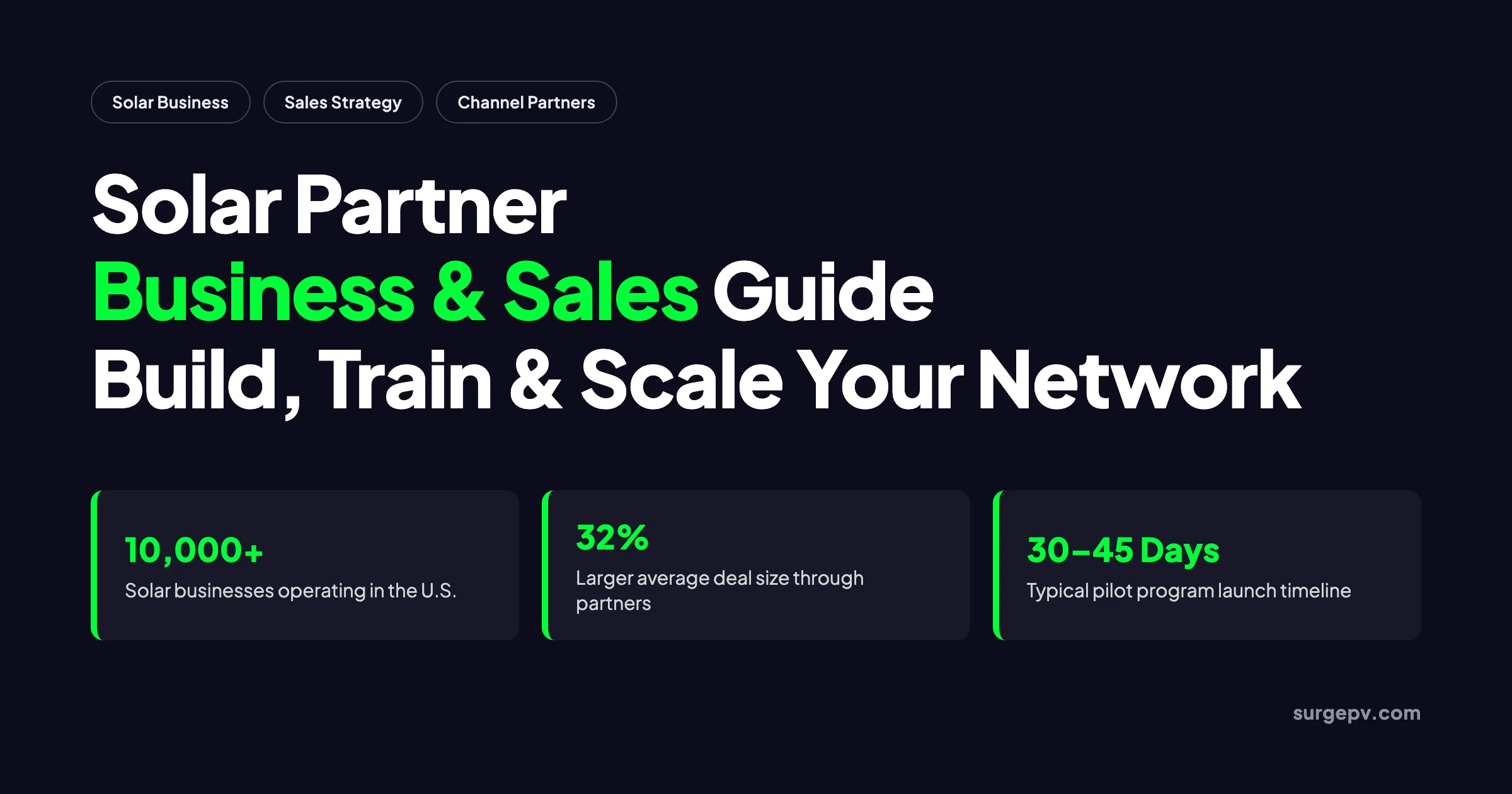
The U.S. solar industry installed 7.8 GWdc of capacity in the first quarter of 2026, according to the SEIA U.S. Solar Market Insight (2026). More than 10,000 solar businesses now operate in the United States, and the industry supports over 280,000 jobs. In a market this crowded, the installers that win are often the ones with the best network, not the biggest ad budget.
This guide is written for solar business owners, sales managers, and EPCs who want to design, launch, or improve a partner program. It covers program types, compensation models, common mistakes, and a practical launch plan you can use in the next quarter.
In this guide you will learn:
- What a solar partner program is and why it works now
- The five partner types that fit solar
- How to structure tiers, attribution, and training
- Compensation models that protect margins
- The biggest mistakes that waste partner budgets
- How to use SurgePV to arm partners with fast, professional proposals
Quick Answer
A solar partner program is a structured agreement that rewards third parties for referring, influencing, or selling solar projects on your behalf. It typically includes partner tiers, deal registration, training, co-branded materials, and a commission or referral fee tied to qualified leads, appointments, or installed systems.
What Is a Solar Partner Program?
A solar partner program is a formal system for working with people and companies outside your payroll who help you sell or install solar. The partner gets something in return, usually a fee, commission, discount, or leads. The solar company gets access to customers it would otherwise pay heavily to reach.
The word “partner” is important. A partner program is not a one-off referral bonus. It has rules, training, reporting, and a clear path for partners to grow. Partners know what a qualified lead looks like, how to register a deal, and when they get paid. The solar company knows which partners are worth the effort and which are draining time.
Most programs fall into one of three relationship types:
- Referral partners send leads and step back. They are often customers, realtors, or local business owners.
- Dealer or contractor partners do more of the sale. They may site visit, quote, and help close.
- Technology or integration partners add solar to an existing product or service, such as home energy audits or roofing packages.
A strong program usually mixes all three. The key is to match the reward to the work. A customer who forwards a neighbor deserves a different payout than a roofing company that closes five deals a month.
Why Solar Partner Programs Matter in 2026
Solar partner programs are not new, but they are becoming essential. Three market forces make 2026 a year when the right program can pull ahead of competitors.
Customer acquisition cost is rising. Lead prices from online marketplaces and paid ads have climbed as the residential market has matured. A referred lead from a trusted contractor or neighbor already has confidence in the recommendation. That shortens the sales cycle and reduces the cost per acquisition.
Partners close bigger deals. Ecosystem-led sales outperform direct sales in many B2B settings. Partner deals are 32% larger and have a 2.8X higher win rate, according to Introw (2025). Companies with partner programs are also up to 5x more likely to exceed expectations on key business metrics. Solar is a trust-heavy purchase, so a warm introduction from a credible partner carries extra weight.
Installers expect growth through partners. In an industry survey, 54% of installers expected to sell more solar in 2024 than in 2023. That is according to ITA Group (2024). The installers that grow fastest are usually the ones that train, motivate, and retain a partner network rather than chasing every lead themselves.
The exception is the brand-new installer with no track record. Partners want to represent companies that deliver on time, honor warranties, and pay promptly. If your operation is still inconsistent, fix fulfillment before you recruit partners. A bad partner experience travels fast.
Types of Solar Partner Programs
Not every partner fits the same mold. The best solar companies run multiple partner tracks, each with its own requirements and payouts.
| Partner type | Who they are | What they do | Typical reward |
|---|---|---|---|
| Customer referral | Homeowners who already bought solar | Recommend friends, family, and neighbors | Flat bonus per installed system, often around $500 |
| Contractor / dealer | Roofers, electricians, HVAC contractors, builders | Refer leads or sell systems with your brand | Commission per project, tiered by volume |
| Commercial referral | Facility managers, sustainability consultants, business brokers | Introduce C&I projects | 1% to 3% of project value or fixed fee |
| Online affiliate | Publishers, bloggers, comparison sites | Drive traffic and form fills | Cost per lead, cost per appointment, or cost per sale |
| Technology / integration | Energy auditors, home improvement platforms, financiers | Bundle solar into a broader service | Revenue share or referral fee |
Customer referral programs are the easiest to start. They reward loyalty and turn happy owners into advocates. The downside is scale. Most homeowners only know a handful of people who are ready for solar at any given moment.
Contractor and dealer networks deliver volume. A roofing company working on 50 roofs a month sees solar-ready homes every day. An electrician already has the trust of the homeowner and knows the panel. These partners need more training than customers, but they produce higher-quality leads.
Commercial referral partners operate differently. A single 500 kW rooftop project can be worth more than 20 residential jobs. The payout structure therefore rewards project value rather than a flat fee. The sales cycle is longer, and the partner may need help with financial modeling and proposal documents.
Online affiliates and marketplaces can flood the top of the funnel. The risk is quality. A lead from a comparison site is not the same as a lead from a roofer who inspected the roof. Programs that pay only for qualified appointments or installed systems protect margins better than broad cost-per-lead deals.
How to Structure a Solar Partner Program
A program that pays without structure quickly turns into a mess of duplicate leads, angry partners, and wasted commissions. Structure the program before you recruit.
Tiering and Credentialing
Most successful programs have at least three tiers:
- Registered partner: Anyone who signs up. Can submit leads. Gets a base commission.
- Certified partner: Has completed product and sales training. Can access co-branded materials and a dedicated support contact.
- Premier partner: Meets volume and quality targets. Gets higher commissions, lead sharing, and early access to promotions.
Tiering gives partners a reason to improve. It also protects your brand. A certified roofing partner can speak confidently about your system. A random affiliate cannot.
Deal Registration and Attribution
Deal registration is the heart of partner management. When a partner identifies a prospect, they register it in your system. If the same prospect later appears through another channel, the registered partner gets credit for a defined period, often 90 to 180 days.
Clear rules prevent the most common conflicts:
- First registered lead wins.
- Direct sales reps must accept or dispute a registration within a set window, usually 48 hours.
- Existing customers and active prospects are excluded from partner commissions unless agreed in writing.
- Partners cannot register leads they have no relationship with.
A simple CRM workflow is enough for a pilot. At scale, most companies use a partner relationship management (PRM) tool or a solar CRM with dealer-management features.
Training and Certification
Partners sell your reputation. They need to know what you install, how you price, and what you promise. A good onboarding program covers:
- Product basics: modules, inverters, warranties, and financing options
- Ideal customer profile: roof condition, credit requirements, and local incentives
- Sales process: how to register a lead, what the customer receives, and expected timelines
- Brand compliance: approved claims, logos, and marketing materials
Training does not have to be long. A 90-minute session plus a short certification quiz is enough for many referral partners. Dealer partners need deeper technical training, especially if they will size systems or discuss equipment.
Marketing and Co-Branding
Give partners materials they can actually use. That means proposal templates, one-page flyers, email copy, social graphics, and leave-behinds with both logos. The easier you make it for a partner to look professional, the more leads they will send.
For partners who sell directly, consider a co-branded proposal workflow. The partner collects site details, you generate the design and financial model, and the customer receives a polished proposal. A strong solar proposal template keeps messaging consistent. This is where customer-ready solar proposals and a solar design platform become force multipliers.
Technology and Reporting
Partners need visibility. At minimum, give them a dashboard that shows:
- Leads submitted and their status
- Deals won and commissions earned
- Payout schedule and history
- Training status and tier progress
If your partners are in India and handle PM Surya Ghar paperwork, WhatsApp follow-ups, and dealer territories, a mobile-first solar CRM like QuickEstimate can manage the entire partner workflow from lead capture to closed deal.
Partner Compensation Models That Work
The right compensation model depends on how much work the partner does and how much risk you are willing to take.
| Model | When to use it | Pros | Cons |
|---|---|---|---|
| Pay-per-lead | Online affiliates, high-volume publishers | Scales fast | Risk of low-quality leads |
| Pay-per-appointment | Contractors, realtors | Rewards qualified interest | Requires validation |
| Pay-per-sale | Customer referrals, trusted dealers | Low risk, high intent | Longer payout cycle |
| Revenue share | Commercial brokers, integration partners | Aligns on project size | Complex accounting |
| Hybrid | Mixed partner base | Balances scale and quality | More administration |
Pay-per-lead works for digital partners who drive form fills. Set strict validation rules: the homeowner must own the home, have a suitable roof, and meet a minimum utility bill. Without validation, you will pay for names that never answer the phone.
Pay-per-appointment is popular with contractors and realtors. The partner does the hard work of getting the homeowner to sit down with your sales team. You pay only when the meeting happens.
Pay-per-sale is the safest model for the solar company. You pay after the system is installed and paid for. This is the standard for customer referral programs and many dealer arrangements. The tradeoff is that partners may prefer faster payouts.
Revenue share makes sense for large commercial projects. A 1% to 3% fee on a $1 million project is meaningful for the partner and still profitable for you. Make sure the fee is tied to collected revenue, not contract value, in case the project is canceled or renegotiated.
A hybrid model often works best. For example, pay a small lead fee to contractors, a larger appointment fee, and a bonus at installation. This keeps partners engaged through the long solar sales cycle.
Here is a simple worked example. Imagine a roofing partner sends you 10 leads in a quarter. Four become appointments, and two close as 8 kW residential systems at $24,000 each. Under a hybrid model, you might pay $25 per registered lead, $75 per held appointment, and $400 per installed system. Total payout is $250 + $300 + $800 = $1,350. Your partner earned $675 per closed deal and stayed motivated through every stage. Your customer acquisition cost is under 6% of revenue, which is usually far below paid-lead channels.
Common Mistakes That Kill Partner Programs
Many solar companies launch partner programs and abandon them within a year. The failures usually come from the same mistakes.
Recruiting too fast. A partner program with 200 inactive partners is worse than one with 20 active ones. Start small, train well, and expand once you have proof of concept.
Paying for bad leads. If you reward volume without quality, partners will game the system. Define “qualified” in writing and enforce it.
Slow payouts. Partners talk. If your roofing partner waits four months for a commission, the next lead goes to your competitor. Pay on a clear schedule, ideally within 30 days of installation.
Skipping training. A partner who misrepresents your warranty or pricing creates liability. Make training a condition of tier advancement.
Ignoring attribution conflicts. When a direct sales rep and a partner both claim the same customer, someone loses. Have a written escalation path and stick to it.
Forgetting compliance. Partners must follow truth-in-advertising rules and local solar sales regulations. Review their marketing materials regularly. The FTC and state attorneys general do not care that the message came from a partner.
A Practical Partner Program Launch Plan
You do not need enterprise software or a legal team to start. A focused pilot can be live in 30 to 45 days.
Phase 1: Define the Program (Week 1)
Pick one partner type to start. Contractor partners are usually the best first test because they already know solar-ready homes. Define the tier, compensation, deal-registration rules, and ideal customer profile. Write a one-page partner agreement.
Phase 2: Recruit the First Partners (Weeks 2 to 3)
Start with partners who already know and trust you. That might be a roofing company you have worked with, a satisfied customer with a wide network, or an electrician who has referred business before. Recruit 10 to 20 partners for the pilot.
Phase 3: Onboard and Train (Week 4)
Run a live onboarding session. Cover the product, the sales process, the partner portal, and the compensation schedule. Give each partner a co-branded proposal template or a simple lead-registration link.
Phase 4: Optimize After the First Quarter (Weeks 5 to 12)
Track lead volume, conversion rate, cost per acquisition, and partner satisfaction. Cut partners who send junk leads. Double down on the top performers. Adjust compensation if you see partners dropping off at a specific stage.
If the pilot works, expand to customer referrals, online affiliates, or commercial brokers. Build playbooks for each partner type so onboarding scales without your direct involvement.
Key Metrics for a Solar Partner Program
You cannot improve what you do not measure. A partner dashboard should track both program health and partner behavior.
| Metric | Why it matters | Good target |
|---|---|---|
| Partner-sourced leads per month | Shows total pipeline contribution | 20% to 40% of total lead volume within 12 months |
| Lead-to-appointment rate | Reveals partner lead quality | Above 40% for contractor partners |
| Cost per partner-sourced acquisition | Compares partner channel to paid ads | 20% to 50% below blended paid-media CAC |
| Partner activation rate | Share of enrolled partners who sent a lead in the last 90 days | Above 30% |
| Time to first payout | Measures how fast partners see rewards | Under 60 days from first registration |
| Partner churn or dormancy | Flags partners who stop participating | Below 50% annually |
Track these metrics by partner tier and type. A roofing partner should produce high-intent leads. An online affiliate may produce volume with lower conversion. Treat them differently.
Review the data monthly with your top partners. Share benchmarks, celebrate wins, and coach laggards. Transparency builds trust, and trust is what keeps partners active when a competitor offers a higher commission.
How SurgePV Supports Partner-Led Solar Sales
Partners need to look credible fast. Nothing kills a referral faster than a delayed or amateur proposal. With SurgePV, your partners can move from site visit to professional proposal in minutes, not days.
The solar design platform lets you or your partner import roof imagery, run shadow analysis, and produce an accurate production estimate. Clara AI accelerates layout and system sizing. The solar financial analysis tool turns that design into a customer-ready financial model with payback, savings, and financing scenarios.
For partners who sell directly, the PV proposal software exports branded, consistent proposals. Your team controls the assumptions and pricing. Your partner controls the local relationship. The customer sees one professional message.
A partner program is only as good as the experience it creates for the end customer. If your partners can quote faster and more accurately than the competition, they will keep sending leads your way.
Arm Your Partners with Faster Proposals
See how SurgePV helps installers and their partners generate branded, financial-ready solar proposals in a few minutes.
Book a DemoNo commitment required · 20 minutes · Live project walkthrough
Solar Partner Program Examples in 2026
Real programs show how these principles play out. Large U.S. installers and marketplaces run a mix of referral and affiliate models.
SunRun, Tesla, and Palmetto have offered residential referral bonuses around $500 per installed system, according to Solar Genix (2026). SunPower has paid affiliates for qualified leads as well as installations, with lead payouts around $120 per confirmed appointment. EnergySage and SolarReviews operate marketplace affiliate programs. They pay for qualified homeowner leads, with cost-per-lead rates ranging from roughly $10 to $100 depending on quality and geography.
In India, Heaven Green Energy runs a channel partner program that gives partners co-branded materials, technical training, MNRE empanelment support, and commissions on every installation. Residential partners there typically earn ₹15,000 to ₹40,000 per installation, according to the Heaven Green Energy channel partner page. That structure works because it combines local relationships with centralized design, subsidy support, and fulfillment.
Equipment suppliers also use partner models. IBC SOLAR runs an installer program that offers preferential pricing, a designated sales representative, customized training, webinars, and system planning tools. That is according to the IBC SOLAR installer program page. This shows that partner programs are not limited to lead generation; they can also lock in loyalty across the supply chain.
The lesson from these examples is that payout size matters less than clarity. Partners stay loyal when they know exactly what they earn, when they get paid, and who to call for help.
Frequently Asked Questions
What is a solar partner program?
A solar partner program is a formal system that rewards third parties for sending, influencing, or closing solar sales. Partners can be customers, contractors, realtors, online publishers, or commercial brokers. The program defines tiers, deal registration, training, marketing support, and payouts tied to leads, appointments, or installed projects.
Who makes the best solar partners?
The best solar partners already have trusted access to your target customer. Roofers, electricians, HVAC contractors, realtors, energy auditors, and satisfied customers usually produce the highest-quality residential referrals. For commercial solar, facility managers, sustainability consultants, and business-service providers are stronger partners than general affiliates.
How much should a solar partner program pay?
Payouts depend on the model. Residential referral bonuses commonly range from $500 per installed system, according to published 2026 program data. Cost-per-lead programs for online affiliates range from roughly $10 to $100 per qualified lead. Commercial referral fees are often 1% to 3% of project value or a fixed bonus per closed deal.
What is the difference between a referral program and an affiliate program?
A referral program rewards existing customers or local contacts for word-of-mouth introductions. An affiliate program is more scalable and uses tracking links, dashboards, and compliance rules to pay publishers, influencers, or contractors for qualified leads or sales. Most solar companies can run both.
How do you prevent channel conflict between partners and direct sales?
Prevent conflict with clear deal-registration rules, first-touch attribution, and protected territories. Give direct sales a short window to accept or challenge a registered deal. Document every exception and avoid paying both a partner and a direct rep for the same customer.
What technology does a solar partner program need?
At minimum, you need a CRM that tracks partner-sourced leads, a deal-registration workflow, and a partner portal or dashboard. Larger programs add automated payouts, co-branded proposal tools, training libraries, and integration with design software so partners can quote without creating bottlenecks.
How long does it take to launch a solar partner program?
A focused pilot can launch in 30 to 45 days. The first two weeks are spent defining tiers, compensation, and legal terms. The next two to four weeks are spent recruiting and onboarding the first 10 to 20 partners. Expect to refine attribution and payouts after the first quarter of data.
What are the biggest mistakes in solar partner programs?
The most common mistakes are recruiting too many partners too fast, paying for unqualified leads, delaying payouts, failing to train partners, and ignoring brand compliance. These errors drain budget, create channel conflict, and damage the partner relationships that the program is meant to build.
A solar partner program is not a magic lead machine. It is a trust-and-incentive system that rewards people who already know your future customers. The companies that win in 2026 will treat partners as an extension of their sales team, not as an afterthought.
Start with three concrete actions:
- Choose one partner type and define a one-page pilot program before the end of the month.
- Set deal-registration and payout rules that protect both your margins and your partners.
- Give your partners the tools to quote professionally, starting with a fast design and proposal workflow on SurgePV.
Where this fits
This article is part of SurgePV's Solar Business & Operations hub, which works through the topic from first principles to the decisions a project team actually has to make.


