

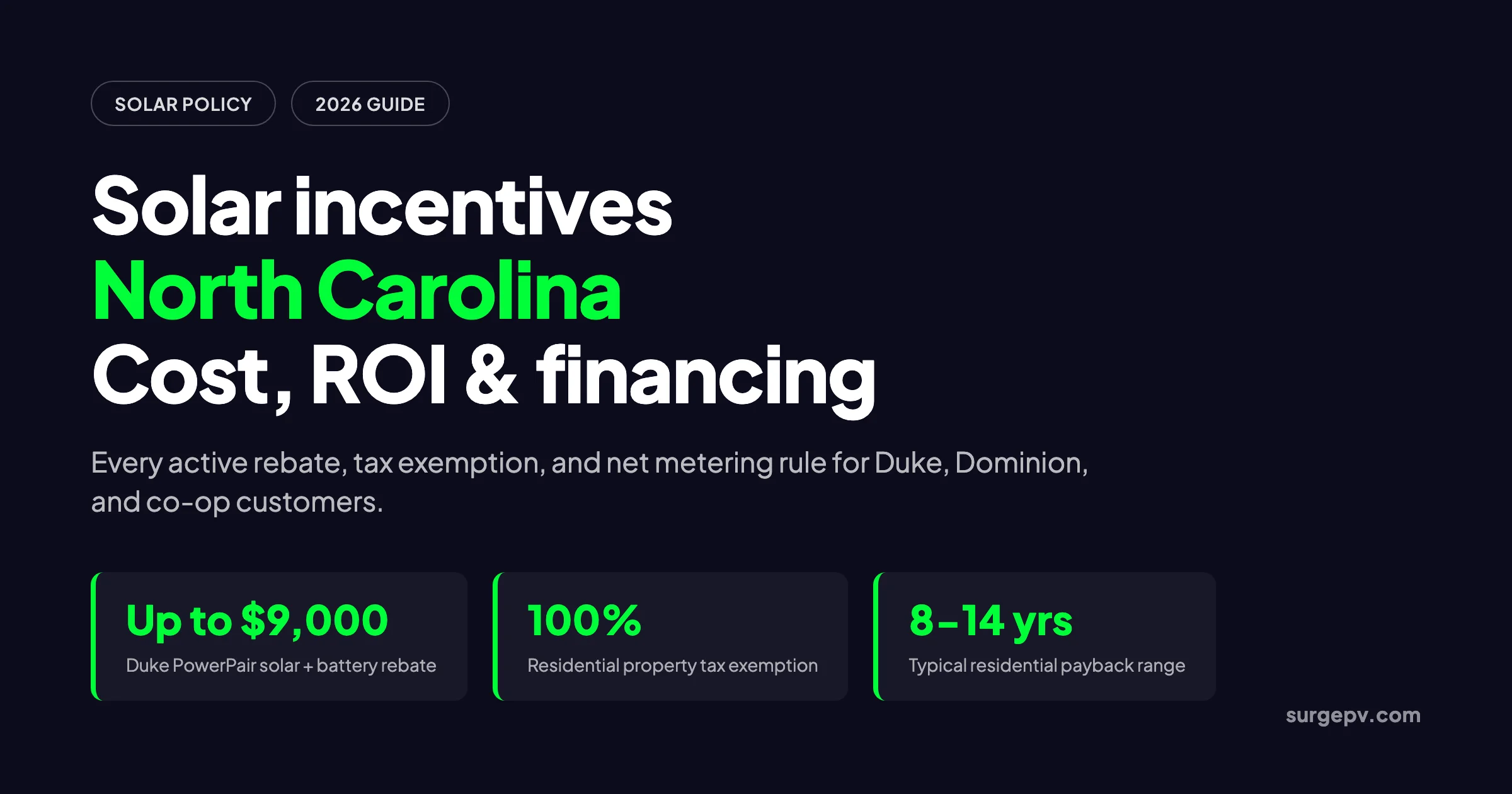
North Carolina is the fourth-largest solar state in the country by cumulative installed capacity, with more than 8.5 GW online by early 2026, according to SEIA’s 2025 Year in Review. The state combines strong solar resource, rising electricity rates, and a layered incentive stack that can still produce solid returns after the federal residential tax credit expired at the end of 2025.
This guide covers every active North Carolina solar incentive in 2026, the real dollar value of each, and how utility territory changes the math. For the broader national picture, see our solar incentives in USA 2026 guide and state solar incentives in the US overview. For installers who need to model Duke Energy tariffs, Dominion net metering, and PowerPair rebates in one place, SurgePV’s solar design software and solar financial analysis tool let you build accurate, territory-specific proposals. Generate solar proposals in minutes, then check pricing or book a demo.
Quick Answer
North Carolina’s 2026 solar incentives include Duke Energy’s PowerPair solar-plus-battery rebate up to $9,000, a 100% residential property tax exemption, a state sales tax exemption on solar equipment, and utility-specific net metering. Dominion Energy offers 1:1 retail net metering, while Duke Energy customers can access a transitional Bridge Rate through early 2027 before moving to avoided-cost export credits.
In this guide:
- Latest 2026 status of every active North Carolina solar incentive
- How the federal ITC expiration changes the math
- Duke Energy PowerPair rebates and battery control credits
- Net metering rules for Dominion, Duke, and electric cooperatives
- Property tax and sales tax exemptions
- Cost, ROI, and payback scenarios by utility territory
- Common mistakes and how to avoid them
North Carolina Solar Incentives at a Glance — 2026
North Carolina does not offer a single large state rebate. The value comes from stacking utility programs, tax exemptions, and export credits. Your utility territory is the single largest variable.
| Incentive | Type | 2026 Status | Typical Value |
|---|---|---|---|
| Duke Energy PowerPair | Utility rebate | Active, capacity-limited | Up to $9,000 for solar + battery |
| Battery control credits | Ongoing bill credit | Active | $23-$92 per month |
| Property tax exemption | Tax exemption | Active, automatic for residential | 100% of added home value exempt |
| Sales tax exemption | Tax exemption | Active, automatic | 4.75% state + local taxes waived |
| Dominion Energy net metering | Export credit | Active | 1:1 retail-rate credits |
| Duke Energy Bridge Rate | Transitional export credit | Active through January 1, 2027 | Better than avoided-cost rate, capped annually |
| Duke Energy Residential Solar Choice | Export credit | Default for new customers after Bridge closes | Avoided-cost export credits near $0.034/kWh |
| NC-RETS RECs | Performance credit | Active, low value | Minimal residential income |
| USDA REAP grants | Federal grant | Active for rural small businesses and farms | Up to 50% of project cost |
| Federal commercial ITC | Tax credit | Active for commercial/third-party-owned | Section 48E for eligible projects |
The most important rule for 2026 is to know your utility before you quote. A 9 kW system can pay back in 8 years in Dominion territory and 13 years on Duke’s Residential Solar Choice Rider.
Why North Carolina’s Solar Market Matters in 2026
North Carolina’s solar market is large and mature, but the incentive environment is shifting. The federal residential tax credit is gone. State tax credits have been gone since 2015. The remaining value is in utility rebates, tax exemptions, and export compensation that varies by service territory.
Market Size and Growth
North Carolina ranked fourth nationally in installed solar capacity with more than 8.5 GW online by early 2026, according to SEIA (2025). The state has enough solar to power roughly one million homes. Utility-scale projects dominate the total, but the residential market remains active because retail electricity rates have risen steadily.
Residential electricity rates in North Carolina averaged about 13.5 cents per kWh in 2024, up roughly 20% since 2020, according to Palmetto market data (2025). Duke Energy Progress and Duke Energy Carolinas have both filed rate cases seeking increases for grid investment, storm recovery, and nuclear plant work. Higher rates improve the value of every kilowatt-hour offset by solar.
Utility Territory Snapshot
| Utility | Service Area | 2026 Residential Rate Context | Net Metering Type |
|---|---|---|---|
| Duke Energy Carolinas | Central and western NC | ~13-14¢/kWh | Bridge Rate / Residential Solar Choice |
| Duke Energy Progress | Eastern NC, including Raleigh | ~13-14¢/kWh | Bridge Rate / Residential Solar Choice |
| Dominion Energy North Carolina | Northeastern NC | ~14¢/kWh | 1:1 retail net metering |
| Electric cooperatives | Rural areas statewide | Varies | Tariff-specific net metering or net billing |
| Municipal utilities | Select cities | Varies | Varies by city |
Always confirm the customer’s exact utility and tariff before modeling ROI. The same roof can produce very different financial outcomes across the street if the utility boundary changes.
Duke Energy PowerPair Rebate Program
PowerPair is the largest upfront rebate available to North Carolina homeowners in 2026. It requires a new solar-plus-battery installation performed by a Duke Energy-approved Trade Ally.
How PowerPair Works
The program pays two incentives that can stack:
- Solar rebate: approximately $0.36 per watt-AC, up to 10 kW-AC, for a maximum of $3,600.
- Battery rebate: approximately $400 per kWh of battery capacity, up to roughly 13.5 kWh, for a maximum of about $5,400.
Combined, the one-time rebate can reach up to $9,000, according to Duke Energy PowerPair (2026) and Southern Energy Management (2026).
Eligibility Requirements
Key rules for homeowners and installers:
- Must be a Duke Energy Carolinas or Duke Energy Progress residential customer.
- Must install new solar and new battery together; add-ons to existing systems do not qualify.
- Must use a Duke Energy-approved Trade Ally.
- Must submit a complete interconnection request before applying.
- Must maintain internet connection for system monitoring.
Why PowerPair Changes the Payback Math
A 10 kW-AC solar system paired with a 13.5 kWh battery might cost $38,000 before incentives. The $9,000 PowerPair rebate cuts the upfront cost by nearly 24%. Add the sales tax exemption and the battery control program credits, and the effective payback can drop by several years. For Duke customers, battery storage is no longer just a backup luxury; it is the key to making solar pencil after net metering changes.
Duke Energy Battery Control Programs
Beyond the upfront PowerPair rebate, Duke Energy pays ongoing bill credits to battery owners who allow the utility to dispatch their battery during peak demand events.
EnergyWise Home and Power Manager
The program name depends on the Duke utility:
- EnergyWise Home Battery for Duke Energy Progress customers.
- Power Manager for Duke Energy Carolinas customers.
Participants receive monthly bill credits estimated at $23 to $92 per month depending on battery size and event participation, according to Palmetto (2025). Duke notifies participants before each event. Homeowners can typically opt out of a limited number of events per year and remain enrolled.
Why This Matters for Solar-Plus-Battery Design
The combination of PowerPair upfront rebate plus monthly battery credits can make a battery cash-flow positive over its lifetime. A homeowner with a 13.5 kWh battery might earn $600-$1,000 per year in credits while also avoiding Duke’s low avoided-cost export rate by storing midday solar and discharging in the evening. The design implication is clear: size the battery for daily cycling, not just outage backup.
Net Metering in North Carolina: It Depends on Your Utility
Net metering is the single largest driver of residential solar value in most markets. In North Carolina, the rules are not uniform. They depend on which utility serves the home.
Dominion Energy North Carolina: Full Retail Net Metering
Dominion Energy serves northeastern North Carolina, including parts of the Outer Banks and northeastern counties. Dominion customers receive traditional 1:1 retail-rate net metering. Every kilowatt-hour exported to the grid earns a credit equal to the retail rate paid to import electricity. Credits roll forward month to month and offset future bills dollar for dollar.
This is the most financially favorable net metering arrangement in the state. For Dominion customers, solar economics in 2026 are similar to solar economics in many other strong net metering states before the federal ITC expired. A well-sized system with moderate export can pay back in 8-10 years.
Duke Energy: Net Metering Bridge Rate and Residential Solar Choice
Duke Energy Carolinas and Duke Energy Progress serve the majority of North Carolina. Duke’s net metering structure has changed significantly in recent years. New residential customers in 2026 face two main options.
Net Metering Bridge Rate
The Net Metering Bridge Rate is a transitional tariff that largely preserves the economic value of legacy net metering while avoiding the more complex Residential Solar Choice Rider. Key features include:
- Available for new customers through January 1, 2027, subject to annual capacity caps.
- The 2026 cap is roughly 43.5 MW-AC statewide, allocated between the two Duke utilities.
- Operates on a first-come, first-served basis through the interconnection queue.
- Once the cap fills, new customers must take the Residential Solar Choice Rider.
The Bridge Rate is valuable enough that timing the interconnection application can change project economics by thousands of dollars.
Residential Solar Choice Rider
After the Bridge Rate closes or fills, new Duke residential solar customers are placed on the Residential Solar Choice Rider. This tariff credits excess solar generation at Duke’s avoided-cost rate, roughly $0.034 per kWh according to Palmetto (2025). That is roughly 75-80% below the retail rate. Duke also imposes a monthly minimum bill, $22 for Duke Energy Carolinas and $28 for Duke Energy Progress, plus non-bypassable charges for storm recovery and grid investment.
The practical impact is large. A system that exports 40% of its production may see its effective value per exported kilowatt-hour drop from 13 cents to 3.4 cents. Storage becomes essential to capture value.
Legacy Net Metering Grandfathering
Duke customers with interconnection agreements approved before October 1, 2023 may remain on legacy 1:1 net metering for up to 15 years from their interconnection date. This grandfathering protects existing customers but is not available to new 2026 installations.
Electric Cooperatives and Municipal Utilities
North Carolina has 26 electric membership corporations and several municipal utilities. Each sets its own distributed generation tariff, subject to state law. Some co-ops offer retail-rate net metering. Others offer net billing at wholesale or avoided-cost rates. A few offer solar-specific loans or on-bill financing.
Blue Ridge Electric Membership Cooperative, for example, allows customers to choose between retail-rate net metering and wholesale net billing, according to Palmetto (2025). Piedmont Electric Cooperative and Randolph Electric Membership Corporation offer low-interest on-bill loans for solar and efficiency upgrades.
The rule for installers: never assume. Model the customer’s actual tariff, or the proposal will be wrong.
Property Tax and Sales Tax Exemptions
North Carolina offers two automatic tax benefits that reduce lifetime cost without requiring complicated paperwork.
Property Tax Exemption
Under NC General Statute § 105-275(45), residential solar energy systems are 100% exempt from property tax on the value they add to the home. Because a solar installation can add $20,000-$30,000 in assessed value, this exemption typically saves $250-$600 per year depending on local tax rates, according to Palmetto (2025).
The exemption is generally automatic for owner-occupied residential systems that are not used for business purposes. Commercial solar systems receive an 80% property tax exemption on the appraised value of the system.
There have been legislative discussions about modifying the residential property tax exemption starting in 2026 or 2027. Homeowners and installers should verify the current statute with their county tax assessor or the North Carolina Department of Revenue before quoting long-term savings.
Sales Tax Exemption
Under NC General Statute § 105-164.13(57a), solar energy equipment purchased for installation in North Carolina is exempt from the state’s 4.75% general sales tax and applicable local sales taxes. The exemption covers solar panels, inverters, racking, batteries when part of a solar-plus-storage system, and associated components.
On a typical $25,000 solar installation, the sales tax exemption saves roughly $1,000-$1,500 at the point of purchase. Reputable installers should already factor this exemption into quoted prices. If a quote includes sales tax on solar equipment, ask why.
Federal Context: What Changed in 2026
The 30% federal Residential Clean Energy Credit under Internal Revenue Code Section 25D expired for systems placed in service after December 31, 2025. This is the single biggest change for North Carolina homeowners in 2026. Systems installed and operational by the end of 2025 can still claim the credit, including carryforward of unused amounts.
However, federal incentives remain available for commercial and third-party-owned systems:
- Section 48E clean energy tax credit for commercial solar projects.
- Bonus depreciation restored for certain property acquired after January 19, 2025.
- USDA REAP grants and loan guarantees for rural small businesses and farms, covering up to 50% of project cost.
This is why leases and power purchase agreements can still offer competitive monthly payments in 2026. The financing company captures the commercial tax benefits and passes part of the value through to the homeowner.
Financing Options in North Carolina
How you pay for solar changes which incentives you capture.
Cash Purchase
Cash delivers the strongest lifetime return. The owner keeps all PowerPair rebates, battery control credits, property tax exemption, sales tax exemption, SREC or REC income, and long-term bill savings. Payback periods vary widely by utility territory, from roughly 8 years in Dominion territory to 12-14 years on Duke’s Residential Solar Choice Rider.
Solar Loan
Loans preserve ownership benefits while eliminating upfront cost. Monthly loan payments are often comparable to or lower than current utility bills. The main risk is interest cost, which extends payback. For PowerPair-eligible systems, the upfront rebate can cover a meaningful share of the down payment or principal.
Lease or Power Purchase Agreement
Leases and PPAs require no money down and include maintenance. However, the financing company usually keeps the PowerPair rebate, battery control credits, tax exemptions, and any REC income. Homeowners get predictable monthly savings but give up long-term ownership value. In 2026, with the federal ITC gone for direct ownership, leases can look attractive on a cash-flow basis.
Cooperative and PACE Financing
Some North Carolina electric cooperatives offer on-bill financing for solar and efficiency upgrades. Commercial PACE financing is available in participating localities for businesses, nonprofits, and industrial property owners. The loan is repaid through a property tax assessment and can transfer with the property.
Cost, ROI, and Payback in North Carolina
Installed costs in North Carolina vary by system size, roof complexity, and installer. Recent market data points to a range of $2.65-$2.95 per watt before incentives, according to EnergySage (2026) and Palmetto (2025).
Typical Residential System Economics
| Item | 8 kW System | 10 kW System |
|---|---|---|
| Gross cost at $2.80/W | $22,400 | $28,000 |
| Sales tax exemption savings | ~$1,100 | ~$1,400 |
| Net upfront cost | $21,300 | $26,600 |
| Annual production | ~11,200 kWh | ~14,000 kWh |
| Annual bill savings at $0.135/kWh | ~$1,512 | ~$1,890 |
| Simple payback (no battery, Dominion net metering) | ~8.4 years | ~8.2 years |
| Simple payback (no battery, Duke RSC Rider, 30% export) | ~13.2 years | ~12.8 years |
These figures assume cash purchase, a system sized to match annual usage, and no battery. Actual payback depends on roof orientation, shading, utility tariff, and financing cost.
Three Real-World Scenarios
The following examples use illustrative 2026 costs and incentive values. Actual figures depend on location, utility, roof conditions, installer quote, and program availability.
Scenario 1 — 8 kW Solar, Dominion Energy Customer
| Item | Amount |
|---|---|
| Gross installed cost | $22,400 |
| Sales tax exemption savings | -$1,100 |
| Net cost | $21,300 |
| Annual bill savings (14¢/kWh, 1:1 net metering) | $1,568 |
| Property tax exemption value (annual) | ~$300 |
| Payback | ~8.5 years |
Scenario 2 — 10 kW Solar + 13.5 kWh Battery, Duke Energy Progress Customer, PowerPair-Eligible
| Item | Amount |
|---|---|
| Gross installed cost | $43,000 |
| Sales tax exemption savings | -$2,100 |
| PowerPair rebate | -$9,000 |
| Net cost | $31,900 |
| Annual bill savings and peak demand reduction | $2,400 |
| Battery control credits ($60/month average) | $720 |
| Property tax exemption value (annual) | ~$450 |
| Payback | ~10.5 years |
Scenario 3 — 150 kW Commercial Rooftop, Duke Energy Carolinas
| Item | Amount |
|---|---|
| Gross installed cost | $390,000 |
| Sales tax exemption savings | -$19,000 |
| Section 48E tax credit (if eligible) | -$117,000 |
| 80% property tax exemption value (annual) | ~$4,500 |
| Annual bill savings and demand reduction | $48,000 |
| Payback | ~5.5 years |
For commercial projects, load profiling and PV shade analysis matter more than simple bill offset. SurgePV’s design platform models hourly production against time-of-use rates and demand charges.
Common Mistakes and Misconceptions
Even experienced installers lose money in North Carolina by misunderstanding how incentives interact.
Quoting the Expired Federal ITC
The most expensive mistake is telling a homeowner they can claim the 30% federal tax credit on a 2026 cash or loan purchase. Section 25D expired for homeowner-owned systems on December 31, 2025. Lease and PPA providers may still access commercial credits, but the customer does not receive a direct federal credit on a cash or loan purchase.
Ignoring Utility Territory
A 9 kW system in Dominion territory can have a completely different payback than the same system in Duke Energy Carolinas territory. The retail rate, net metering structure, and minimum bill all differ. Always model the customer’s actual utility and tariff, not a state average.
Missing the PowerPair Trade Ally Requirement
PowerPair rebates require a Duke Energy-approved Trade Ally. If the installer is not on the approved list, the homeowner cannot claim the rebate. Verify Trade Ally status before signing a contract.
Oversizing for Export on Duke’s Residential Solar Choice Rider
Under the Residential Solar Choice Rider, exported solar is worth only about $0.034 per kWh. A system sized to 120% of annual usage wastes the surplus value. Size for self-consumption, and add storage to shift midday solar to evening use.
Treating Battery Storage as Pure Backup
In Duke territory, a battery is most valuable as a daily cycling asset. It stores low-value midday solar and discharges during peak evening rates. It also earns PowerPair rebates and battery control credits. Designing a battery only for outage backup leaves money on the table.
Assuming Property Tax Exemption Is Permanent
The residential property tax exemption is well-established but has faced legislative review. Verify the current statute before claiming lifetime savings. Commercial systems receive only an 80% exemption, not 100%.
Conclusion
North Carolina solar incentives in 2026 are a stack, not a single rebate. The largest value drivers are Duke Energy’s PowerPair solar-plus-battery rebate, the 100% residential property tax exemption, the state sales tax exemption, and utility-specific net metering. Dominion Energy customers still enjoy full retail-rate net metering. Duke Energy customers face a transitional Bridge Rate through January 1, 2027, after which new customers move to the lower-value Residential Solar Choice Rider.
For installers and EPCs, the competitive edge is a proposal that models the customer’s actual utility, production, and incentive stack correctly. SurgePV’s solar design software, energy and financial modeling tool, and solar proposals help you do exactly that. Book a demo or view pricing.
Three actions to take now:
- Confirm utility territory and tariff before quoting. Dominion, Duke Bridge Rate, Duke Residential Solar Choice, and cooperative tariffs produce very different ROI.
- Interconnect before the Duke Bridge Rate closes. The transitional tariff is available through January 1, 2027, subject to annual capacity caps. After that, new Duke customers face avoided-cost export credits.
- Pair solar with battery storage in Duke territory. PowerPair rebates and battery control credits can make storage cash-flow positive while protecting against low export compensation.
Frequently Asked Questions
What solar incentives are available in North Carolina in 2026?
North Carolina offers Duke Energy’s PowerPair solar-plus-battery rebate up to $9,000, ongoing battery control bill credits of roughly $23-$92 per month, a 100% residential property tax exemption under NC General Statute § 105-275(45), and a state sales tax exemption on solar equipment under § 105-164.13(57a). Net metering terms vary by utility, with Dominion Energy offering full retail-rate credits and Duke Energy offering a transitional Bridge Rate. The federal residential tax credit expired in 2025.
Does North Carolina have a state solar tax credit in 2026?
No. North Carolina’s 35% state tax credit expired in 2015 and has not been renewed. The main financial incentives in 2026 are utility rebates, property and sales tax exemptions, and net metering.
Is the federal solar tax credit still available in North Carolina in 2026?
No. The 30% federal Residential Clean Energy Credit under Internal Revenue Code Section 25D expired for homeowner-owned systems placed in service after December 31, 2025. Commercial, third-party-owned, and leased systems may still qualify under Section 48E.
What is Duke Energy PowerPair in North Carolina?
PowerPair is Duke Energy’s solar-plus-battery rebate program for North Carolina homeowners. It pays about $0.36 per watt-AC of solar up to 10 kW and about $400 per kWh of battery capacity up to roughly 13.5 kWh. The combined one-time rebate can reach up to $9,000. Systems must be new solar-plus-battery installations performed by a Duke-approved Trade Ally.
How does net metering work in North Carolina in 2026?
Net metering in North Carolina depends on your utility. Dominion Energy customers in northeastern North Carolina receive full 1:1 retail-rate credits for excess solar. Duke Energy customers can enroll in the Net Metering Bridge Rate through January 1, 2027, subject to annual capacity caps. After the bridge closes or capacity fills, new Duke customers move to the Residential Solar Choice Rider, which credits exports at an avoided-cost rate near $0.034 per kWh. Many electric cooperatives offer their own net metering or net billing tariffs.
Are solar panels exempt from property tax in North Carolina?
Yes. Residential solar energy systems are 100% exempt from property tax on the value they add to a home under NC General Statute § 105-275(45). The exemption is generally automatic for owner-occupied residential systems. Commercial solar systems receive an 80% property tax exemption on the appraised value of the system.
Is solar equipment exempt from sales tax in North Carolina?
Yes. Solar energy equipment purchased for installation in North Carolina is exempt from the state’s 4.75% general sales tax and applicable local sales taxes under NC General Statute § 105-164.13(57a). The exemption applies at the point of purchase and should be reflected in the installer’s quoted price.
How much does solar cost in North Carolina in 2026?
Installed costs in North Carolina typically range from about $2.65 to $2.95 per watt before incentives. A typical 8-10 kW residential system costs roughly $21,200-$29,500 before incentives. Payback periods vary widely by utility territory and range from about 8 to 14 years after the federal residential tax credit expired.
What is the typical solar payback period in North Carolina in 2026?
Payback periods for well-designed residential solar systems in North Carolina typically range from 8 to 14 years in 2026. Dominion Energy customers with 1:1 net metering and Duke PowerPair-eligible battery systems tend to see the shortest paybacks. Duke Energy customers on the Residential Solar Choice Rider or customers in low-rate cooperative territories may see longer paybacks.
What is the most common mistake when sizing a solar system in North Carolina?
The most common mistake is ignoring utility territory. A system sized for Dominion Energy’s 1:1 net metering will have very different economics than the same system on Duke Energy’s Residential Solar Choice Rider. The safest approach is to model the customer’s actual utility tariff, size for self-consumption, and consider battery storage to capture Duke PowerPair rebates and reduce exports.
Where this fits
This article is part of SurgePV's Solar Incentives & Policy hub, which works through the topic from first principles to the decisions a project team actually has to make.
