

Answer
New Hampshire solar incentives in 2026 include Net Metering 2.0 credits at roughly 85% of the retail rate locked through 2041, the RSA 72:62 municipal property tax exemption adopted by about 150 towns, no state sales tax on solar equipment, Eversource ConnectedSolutions battery rebates of $230/kWh up to $3,000, and modest REC revenue. The federal residential solar tax credit expired on December 31, 2025.
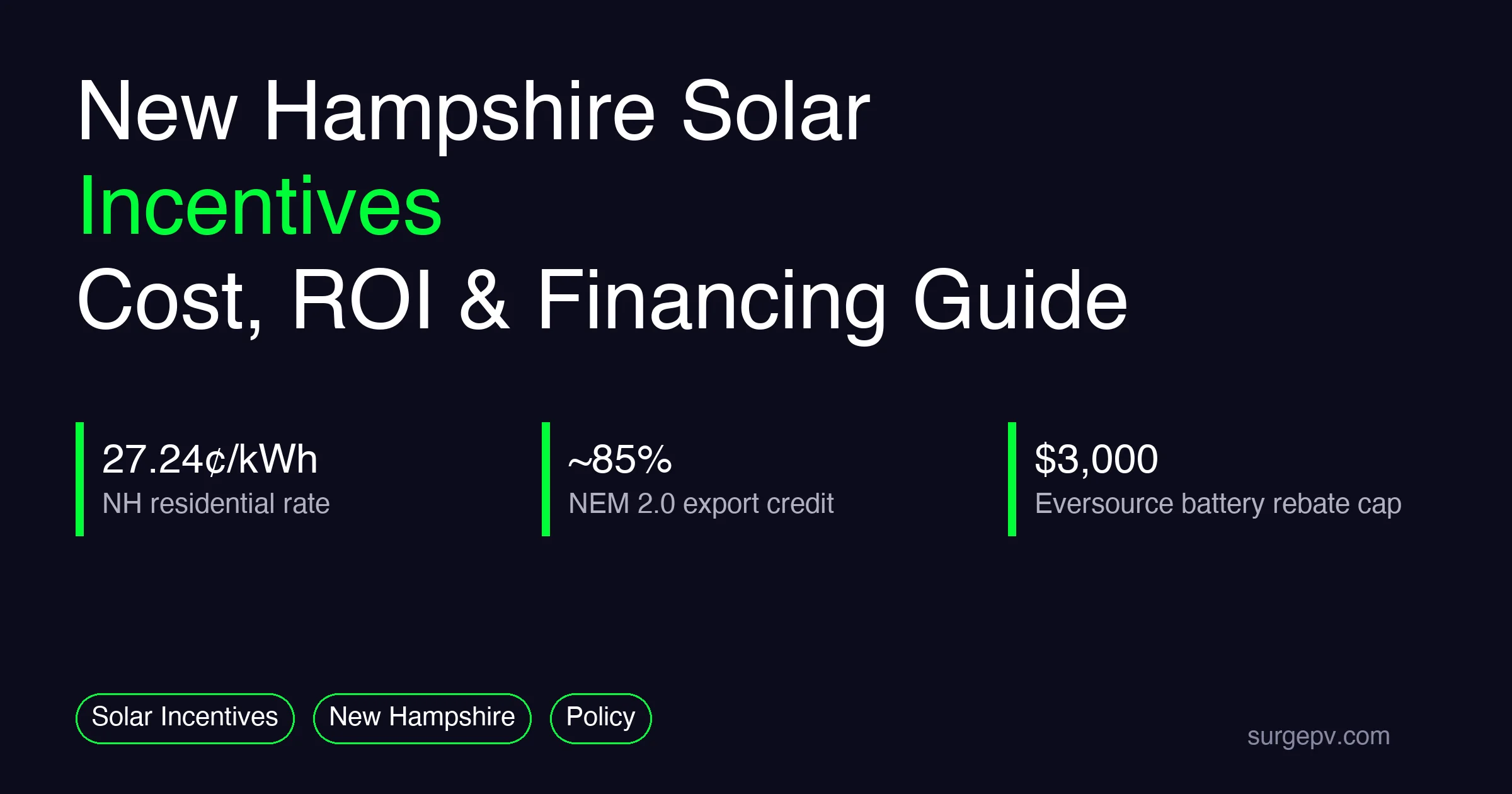
New Hampshire’s average residential electricity rate reached 27.24¢/kWh in April 2026, according to the U.S. Energy Information Administration. That is roughly 50% above the national average. For anyone researching solar incentives New Hampshire, that rate is the headline. Every kilowatt-hour your panels produce on-site avoids one of the most expensive grid purchases in the country. The DSIRE database maintains the full catalog of state and utility solar programs.
The state’s incentive stack is thinner than Massachusetts or Connecticut, but it is still meaningful. Net Metering 2.0 provides long-term bill credits. The property tax exemption protects home equity. The absence of state sales tax lowers upfront cost. Eversource customers can add a battery with a rebate. And Renewable Energy Certificates add a small revenue stream.
The biggest change in 2026 is the loss of the federal residential tax credit. The 30% Residential Clean Energy Credit under Section 25D expired on December 31, 2025, so cash and loan buyers no longer receive it. Third-party-owned systems under leases or power purchase agreements may still access the commercial credit under Section 48E if construction begins before July 4, 2026.
This guide explains every active New Hampshire solar incentive, how the math works, and what homeowners and installers should model before signing a contract. For the national picture, see our solar incentives in USA 2026 guide. For neighboring markets, see solar incentives Massachusetts and solar incentives Connecticut. For homeowners considering a system, our residential solar overview covers sizing, equipment, and financing basics. For installers who need to turn utility-rate data into accurate customer proposals, SurgePV’s solar financial modeling can pull New Hampshire rates, NEM 2.0 rules, and financing assumptions into one model.
Quick Answer
New Hampshire solar incentives in 2026 include Net Metering 2.0 credits at roughly 85% of the retail rate locked through 2041, the RSA 72:62 municipal property tax exemption adopted by about 150 towns, no state sales tax on solar equipment, Eversource ConnectedSolutions battery rebates of $230/kWh up to $3,000, and modest REC revenue. The federal residential solar tax credit expired on December 31, 2025.
In this guide:
- New Hampshire solar incentives at a glance — 2026 status table
- How Net Metering 2.0 works and why it is not 1:1 retail
- Property tax exemption rules under RSA 72:62
- Sales tax, REC, and battery incentives
- Federal tax credit status and Section 48E workaround
- Solar financing options in New Hampshire
- Real payback and ROI example for a typical home
- Common mistakes and misconceptions
- Step-by-step application process
- FAQ
New Hampshire Solar Market Context in 2026
New Hampshire is not the sunniest state, but it is one of the most expensive states for grid electricity. That combination makes solar economics work. A south-facing rooftop in Concord or Manchester receives roughly 4.5 peak sun hours per day on average, enough to generate meaningful production through the year. The value of that production is high because the avoided utility rate is high.
The state’s solar market has grown steadily. The Solar Energy Industries Association ranks New Hampshire in the middle tier for installed residential solar capacity. Most growth has come from homeowners paying cash or using loans, with third-party ownership playing a smaller role than in states like California or Arizona.
New Hampshire’s electricity supply depends heavily on natural gas and regional imports. Wholesale price volatility passes through to retail rates quickly. The state has also faced transmission constraints and winter supply risks. These factors make long-term rate escalation a reasonable assumption in financial models, typically 2.5% to 3.5% per year.
Compared to neighboring states, New Hampshire lacks a production-based incentive like Massachusetts SMART or Connecticut RRES. There is no per-kWh tariff for total solar generation. The incentive stack is therefore simpler and smaller. Installers must be precise about net metering credit value, property tax savings, and battery revenue. A proposal that overstates incentives will lose credibility quickly.
For homeowners, the decision in 2026 comes down to three numbers: the installed cost per watt, the net metering credit rate, and the expected rate of utility price growth. Get those right, and solar still pays back in under 11 years in most cases.
New Hampshire Solar Incentives at a Glance
The table below summarizes every major New Hampshire solar incentive available in 2026. We have separated production credits, tax benefits, utility programs, and revenue streams so you can see how they stack.
| Incentive | Type | Value | Term | Eligibility |
|---|---|---|---|---|
| Net Metering 2.0 | Bill credit | ~75% to 95% of retail rate | Locked through January 1, 2041 | Customers of Eversource, Liberty, Unitil, NHEC |
| RSA 72:62 property tax exemption | Tax exemption | 100% of added system value in most adopting towns | Ongoing while system is owned | Homeowners in participating municipalities |
| No state sales tax | Tax exemption | 0% state sales tax on equipment and labor | At purchase | All solar buyers |
| Eversource ConnectedSolutions battery rebate | Rebate | $230/kWh, capped at $3,000 | One-time upfront | Eversource residential customers |
| Renewable Energy Certificates | Production credit | Varies; often tens of dollars per MWh | Per MWh produced | Systems registered with NEPOOL GIS |
| Low-Moderate Income Solar Grant | Grant | Varies by solicitation | Project-based | Developers and organizations serving LMI households |
Several important details sit beneath this table. Net metering credits are not a cash payment. They reduce future utility bills. The property tax exemption is a local option, not automatic. The Eversource battery rebate is limited to one utility’s customers. REC prices are market-based and modest.
The total value of these incentives depends on system size, electricity usage, utility territory, financing method, and whether storage is included. A solar-only cash purchase in New Hampshire may pay back in 9 to 11 years. A solar-plus-battery system for an Eversource customer with optimized self-consumption may pay back in 8 to 10 years while also providing backup power.
Net Metering 2.0: How It Works in 2026
Net metering is the most important solar incentive in New Hampshire. It allows your utility meter to run backward when your panels produce more electricity than your home uses. The excess generation is credited against future bills.
Unlike Massachusetts, New Hampshire does not offer full 1:1 retail net metering. NEM 2.0 credits each bill component differently:
| Bill Component | Credit Rate | Typical Share of Bill |
|---|---|---|
| Supply (energy) | 100% | 45% to 55% |
| Transmission | 100% | 10% to 15% |
| Distribution | 25% | 30% to 40% |
The result is that exported solar is credited at roughly 75% to 95% of the full retail rate, depending on your utility. Eversource customers typically see ~84% of retail. Liberty customers see ~83%. Unitil customers see ~85%. New Hampshire Electric Cooperative customers see ~86%.
This formula is locked through January 1, 2041 under NH PUC Docket DE 16-576. That long rate lock is unusual and valuable. Even if future policy changes reduce net metering for new systems, existing NEM 2.0 systems keep their credit structure for the contract term.
Key Net Metering Rules
- System size cap: Net metering is available for systems up to 1 MW (1,000 kW). Most residential systems are 6 kW to 10 kW.
- Credit rollover: Unused credits roll over month to month indefinitely.
- Cash-out: When accumulated credits reach $100, the customer can request a cash payment.
- Participating utilities: Eversource, Liberty Utilities, Unitil, and New Hampshire Electric Cooperative all offer NEM 2.0.
- Municipal utilities: Some municipal utilities may have different rules or may not offer net metering.
Because NEM 2.0 credits exports at less than full retail, self-consumption is more valuable than export. A kilowatt-hour consumed on-site avoids the full retail rate of roughly 27¢. A kilowatt-hour exported earns roughly 21¢ to 23¢ in credits. This is why batteries, EV charging during solar hours, and load shifting improve project economics in New Hampshire.
For a deeper explanation of net metering mechanics, read our net metering glossary.
Property Tax Exemption Under RSA 72:62
New Hampshire allows cities and towns to exempt the added value of a solar energy system from local property tax assessments. The enabling statute is RSA 72:62. It is a local option, meaning each municipality must vote to adopt it.
As of 2026, approximately 150 of New Hampshire’s 234 cities and towns have adopted the exemption in some form. Many offer 100% exemption of the system’s assessed value. Others cap the exemption at amounts ranging from $5,000 to $50,000. A few offer partial exemptions. The New Hampshire Department of Revenue Administration maintains a list of participating municipalities.
For a typical 8 kW system that adds roughly $15,000 to $20,000 in home value, the exemption can save $400 to $700 per year in property taxes, depending on the local tax rate. Over a 25-year system life, that is worth $10,000 to $17,500 in avoided taxes.
How to Claim the Exemption
- Confirm your town has adopted RSA 72:62 by contacting the assessor’s office or checking the DRA list.
- Complete Form PA-29, Permanent Application for Property Tax Credit/Exemptions.
- Attach proof of system ownership and installation.
- File with the local Board of Assessors or Selectmen’s Office by April 15 of the year following installation.
The exemption does not happen automatically. Missing the filing deadline means waiting another year. Some towns have also extended the exemption to battery storage systems when they are part of the solar installation, but this varies. Always confirm with the local assessor.
No State Sales Tax on Solar
New Hampshire is one of five U.S. states with no statewide sales tax. This applies automatically to solar panels, inverters, batteries, racking, wiring, and installation labor. There is no application or exemption form.
On a typical $25,000 residential solar installation, the absence of sales tax saves roughly $1,500 to $2,000 compared with a state charging 6% to 8%. For a solar-plus-battery system costing $40,000, the savings can exceed $2,500.
This is a permanent, structural advantage. It does not expire, and it applies to equipment upgrades and replacements. Installers should make sure customers understand that this is a real upfront savings compared with neighboring markets.
Battery Incentives: Eversource ConnectedSolutions
Battery storage has become an important part of New Hampshire solar economics, especially for Eversource customers. The Eversource ConnectedSolutions program, administered through the New Hampshire Clean Energy Fund, offers an upfront rebate for enrolled battery capacity.
Program mechanics, as described on the Eversource NHCEF Home Battery page:
- Rebate amount: $230 per kWh of enrolled battery capacity.
- Residential cap: $3,000 per account.
- Commercial cap: $10,000 per account at $250 per kWh.
- Eligibility: Battery must be purchased on or after October 1, 2022.
- Commitment: Customer must participate in demand-response events for at least three years.
- Events: Typically occur on weekday afternoons between June 1 and September 30, from 3:00 PM to 8:00 PM. Customers can expect roughly 40 events per summer, each lasting up to three hours.
For a typical 13.5 kWh residential battery, the rebate works out to $3,105, but the cap limits the payment to $3,000. A 10 kWh battery receives $2,300. This rebate is paid by check after the battery receives permission to operate and is accepted into the program.
In exchange, Eversource may draw power from the battery during peak demand events. Customers can usually set a backup reserve level so the battery does not discharge below a chosen percentage. This preserves outage protection while still earning the rebate.
The ConnectedSolutions program is currently limited to Eversource customers. Liberty, Unitil, and NHEC customers do not have an equivalent utility battery rebate in 2026. For those customers, battery value comes mainly from self-consumption and backup power.
Renewable Energy Certificates and the RPS
New Hampshire’s Renewable Portfolio Standard includes a Class II solar carve-out. This requires electricity suppliers to source a portion of their power from solar. Residential solar owners can earn one Renewable Energy Certificate for every 1,000 kWh of production and sell those certificates to suppliers who need them for compliance.
RECs are traded through the NEPOOL GIS marketplace. Small residential systems usually sell through aggregators who bundle certificates from many systems. Prices are modest compared with earlier Massachusetts SREC markets, often in the range of tens of dollars per MWh.
For a typical 8 kW system producing 9,500 kWh per year, REC revenue might add $150 to $350 per year. Over 10 years, that is $1,500 to $3,500. This is not enough to drive the investment decision on its own, but it improves overall returns.
To participate, the system must be registered with NEPOOL GIS. Many installers and third-party aggregators handle registration and ongoing sales on behalf of homeowners.
Low-Moderate Income Solar Grant Program
The Low-Moderate Income Solar Grant Program is funded by New Hampshire’s Renewable Energy Fund under RSA 362-F:10. At least 15% of the fund must be allocated annually to programs benefiting low-to-moderate income residential customers.
This program is not designed for individual homeowners to apply directly. Instead, eligible entities such as affordable housing developers, community action agencies, nonprofits, and municipalities apply for grants to install solar on behalf of LMI residents. Projects must provide a direct benefit to at least five residential electric customers within the same utility service territory, with the majority being LMI households.
Note that pursuant to HB 2 (2025), rebate programs administered through the NH Department of Energy were closed to new projects until further notice as of mid-2025. Applications submitted on or before June 30, 2025 continue to be processed. Interested organizations should monitor the New Hampshire Office of Strategic Initiatives for new solicitations.
Federal Tax Credit Status in 2026
The biggest change for New Hampshire solar buyers in 2026 is federal. The 30% Residential Clean Energy Credit under Internal Revenue Code Section 25D expired for systems placed in service after December 31, 2025. Cash and loan buyers cannot claim it.
This is a significant shift. In 2024 and 2025, the federal credit typically reduced the net cost of a $25,000 system by $7,500. In 2026, that credit is gone for homeowner-owned systems.
There is one remaining workaround. Third-party-owned systems under leases or power purchase agreements may still access the commercial clean energy credit under Section 48E if construction begins before July 4, 2026. The financing company claims the credit and may pass part of the savings through to the homeowner as lower monthly payments. This makes lease and PPA pricing more competitive relative to cash purchase in 2026 than in previous years.
Installers should be careful not to promise the federal credit to cash or loan customers in 2026. The rules are clear: Section 25D is expired for new residential systems.
Solar Financing Options in New Hampshire
Most New Hampshire homeowners do not pay cash for solar. Financing determines who captures incentives and how payback is calculated. The main options are cash purchase, solar loan, lease, and power purchase agreement.
Cash Purchase
Cash purchase delivers the highest lifetime return. The homeowner owns the system, receives NEM 2.0 credits, claims the property tax exemption, sells RECs, and captures the Eversource battery rebate if eligible. Upfront cost for an 8 kW solar-only system typically ranges from $22,000 to $28,000 before incentives. Payback periods run 9 to 11 years depending on usage, utility, and rate growth.
Solar Loan
Solar loans spread the upfront cost over 10 to 25 years. Many New Hampshire installers offer $0-down loan options. The homeowner still owns the system and captures incentives. Monthly loan payments are often lower than the pre-solar electric bill, producing immediate cash flow savings. Interest rates and dealer fees vary widely, so comparing multiple financing offers matters.
Lease and PPA
Under a lease or PPA, a third party owns the system and sells electricity to the homeowner at a fixed rate. The homeowner does not pay upfront and does not receive incentives directly. The leasing company may pass through some savings via lower rates. In 2026, lease and PPA arrangements may still access the federal business credit under Section 48E, which can improve pricing compared with cash purchase for some customers.
Home Equity Line of Credit
Some homeowners use a home equity line of credit to finance solar. Rates are often lower than solar-specific loans, and the interest may be tax-deductible in some cases. This option requires sufficient home equity and good credit.
For a broader comparison of solar financing structures, read our solar financing options guide.
Real Payback and ROI Example
Let us walk through a concrete example for an Eversource customer in Concord, New Hampshire.
Assumptions:
- System size: 8 kW
- Installed cost: $3.00 per watt = $24,000
- First-year production: 9,500 kWh
- Electricity rate: 27.24¢/kWh
- NEM 2.0 credit value: 85% of retail = 23.15¢/kWh
- Self-consumption rate: 35%
- Annual utility rate escalation: 3%
- Property tax exemption: $500 per year
- REC revenue: $250 per year
Year 1 savings:
- Self-consumed solar: 3,325 kWh × $0.2724 = $906
- Exported solar: 6,175 kWh × $0.2315 = $1,429
- Property tax exemption: $500
- REC revenue: $250
- Total first-year benefit: $3,085
Simple payback: $24,000 ÷ $3,085 = 7.8 years
With 3% annual rate escalation, the cumulative 25-year savings are roughly $75,000 to $85,000. Net profit after recovering the initial investment is roughly $50,000 to $60,000.
Adding a 13.5 kWh Tesla Powerwall at $13,500 changes the math:
- Battery cost: $13,500
- Eversource rebate: $3,000
- Net battery cost: $10,500
- Total system cost: $34,500
- Increased self-consumption to 55% raises first-year savings to roughly $3,600
- Backup power value during outages: not quantified here but meaningful in rural areas
With the battery, simple payback stretches to roughly 9.6 years, but resilience and backup power add non-monetary value. For homeowners in areas with frequent winter outages, that tradeoff is often worth it.
These examples are illustrative. Actual results depend on roof orientation, shading, equipment choice, utility rate structure, and financing cost. Installers should model every project with site-specific inputs rather than rules of thumb.
Common Mistakes New Hampshire Solar Buyers Make
The most common error is assuming the old 30% federal tax credit still applies. It does not for cash or loan purchases in 2026. Another frequent mistake is assuming New Hampshire has 1:1 retail net metering. NEM 2.0 credits exports at roughly 85% of retail, not 100%.
Other mistakes include:
- Missing the property tax filing: The exemption is not automatic. File Form PA-29 by April 15 of the year after installation.
- Assuming all towns have the exemption: About 84 municipalities have not adopted RSA 72:62. Check with your assessor before quoting savings.
- Ignoring self-consumption: Because export credits are worth less than retail, maximizing self-consumption improves returns.
- Oversizing beyond usage: Without full retail net metering, exporting large surpluses is less valuable than consuming solar on-site.
- Assuming battery rebates apply to all utilities: The Eversource ConnectedSolutions rebate does not apply to Liberty, Unitil, or NHEC customers.
- Using outdated system size caps: NH net metering allows systems up to 1 MW, not the older 100 kW limit.
A well-built proposal should show year-by-year savings rather than only first-year projections. It should disclose which incentives the homeowner must apply for versus which are automatic.
How to Apply for New Hampshire Solar Incentives
The application process is installer-led for most programs.
- Get multiple quotes from New Hampshire-licensed installers.
- Confirm your utility territory and net metering eligibility.
- Choose financing: cash, loan, lease, or PPA.
- Submit interconnection paperwork through your installer to your utility.
- File Form PA-29 with your town assessor after installation for the property tax exemption.
- Enroll in ConnectedSolutions through your installer or battery app if you are an Eversource customer adding storage.
- Register with NEPOOL GIS for REC sales, usually through an aggregator.
For installers, SurgePV’s solar proposal platform can automate New Hampshire-specific NEM 2.0 modeling and produce customer-facing documents that clearly show bill credits, battery rebates, and payback by financing option. SurgePV’s solar design software also lets teams model roof layouts, shade impact, and system production before any paperwork is filed. See solar software pricing or book a demo to test the New Hampshire tariff and incentive workflow.
Conclusion: Is Solar Worth It in New Hampshire in 2026?
Yes, for most homeowners who pay full Eversource, Liberty, Unitil, or NHEC retail rates, solar remains a solid investment in 2026. The federal residential tax credit is gone, but New Hampshire’s combination of high electricity prices, NEM 2.0 credits locked through 2041, property tax exemptions, no state sales tax, and Eversource battery rebates still produces payback periods in the 8-to-11-year range for well-designed systems.
Three concrete next steps:
- Get at least three quotes from New Hampshire-licensed installers and ask each one to model NEM 2.0 credits using your actual utility rate structure.
- Confirm whether your town has adopted RSA 72:62 and understand the filing deadline.
- If you are an Eversource customer with high evening usage or outage risk, request a battery quote and confirm ConnectedSolutions enrollment eligibility.
Frequently Asked Questions
What solar incentives are available in New Hampshire in 2026?
New Hampshire solar incentives in 2026 include Net Metering 2.0 bill credits at roughly 85% of the retail rate, the RSA 72:62 municipal property tax exemption in about 150 towns, no state sales tax on solar equipment, Eversource ConnectedSolutions battery rebates of $230 per kWh up to $3,000, and Renewable Energy Certificate revenue. The federal Residential Clean Energy Credit under Section 25D expired for homeowner-owned systems after December 31, 2025.
How does New Hampshire net metering work in 2026?
New Hampshire Net Metering 2.0 credits exported solar electricity at 100% of the supply charge, 100% of the transmission charge, and 25% of the distribution charge. The result is roughly 75% to 95% of the full retail rate, depending on the utility. This credit formula is locked through January 1, 2041 under NH PUC Docket DE 16-576. Excess credits roll over month to month and can be cashed out when they reach $100.
Is the federal solar tax credit still available in New Hampshire in 2026?
No. The 30% federal Residential Clean Energy Credit under Internal Revenue Code Section 25D expired for systems placed in service after December 31, 2025. Cash and loan buyers cannot claim it. Third-party-owned systems under leases or power purchase agreements may still access the commercial credit under Section 48E if construction begins before July 4, 2026.
Does New Hampshire have a state solar tax credit or rebate?
No. New Hampshire does not offer a statewide income tax credit or production rebate for residential solar. The former Residential Renewable Electrical Generation Rebate Program, which paid roughly $0.20 per watt up to $1,000, was repealed by SB 303 in 2024. The main remaining state-level benefits are the optional property tax exemption and the absence of state sales tax.
Will solar panels increase my property taxes in New Hampshire?
Not if your town has adopted RSA 72:62. That statute lets municipalities exempt the added value of a solar energy system from local property tax assessments. About 150 of New Hampshire’s roughly 234 cities and towns have adopted the exemption, though terms and caps vary. Homeowners must file Form PA-29 with the local assessor by April 15 of the year following installation.
Does New Hampshire charge sales tax on solar equipment?
No. New Hampshire does not levy a state sales tax on any purchase, including solar panels, inverters, batteries, and installation labor. This saves roughly 6% to 7% compared with neighboring states that do charge sales tax.
What is the Eversource ConnectedSolutions battery rebate in New Hampshire?
Eversource residential customers in New Hampshire can receive an upfront rebate of $230 per kWh of enrolled battery capacity through the ConnectedSolutions program administered by the New Hampshire Clean Energy Fund. The rebate is capped at $3,000 per residential account and requires the battery to be purchased on or after October 1, 2022 and to participate in demand-response events for at least three years.
What is the typical solar payback period in New Hampshire in 2026?
A well-designed residential solar system in New Hampshire typically pays back in 8 to 11 years in 2026, assuming a cash purchase and no federal tax credit. High retail electricity rates, currently 27.24¢/kWh according to EIA April 2026 data, drive savings. Adding a battery with the Eversource rebate can shorten payback for homes with high evening usage or frequent outages.
Can I sell solar Renewable Energy Certificates in New Hampshire?
Yes. New Hampshire’s Renewable Portfolio Standard includes a Class II solar carve-out. Residential solar owners earn one Renewable Energy Certificate for every 1,000 kWh of production and can sell them through the NEPOOL GIS marketplace, usually through an aggregator. REC prices are modest, often adding a few hundred dollars per year to project economics.
Who qualifies for New Hampshire solar incentives?
Most New Hampshire homeowners with good rooftop solar potential qualify for net metering and the property tax exemption if their town has adopted RSA 72:62. Eversource ConnectedSolutions battery rebates are limited to Eversource customers. The Low-Moderate Income Solar Grant Program is aimed at developers and organizations serving LMI households rather than individual applicants.
Where this fits
This article is part of SurgePV's Solar Incentives & Policy hub, which works through the topic from first principles to the decisions a project team actually has to make.
