

Massachusetts consistently ranks among the top US states for solar adoption despite receiving less annual sunshine than California or Arizona. The reason is policy. High retail electricity rates, strong net metering rules, and layered state incentives have made rooftop solar financially attractive across the Commonwealth for more than a decade. In 2026, the policy picture shifted again: the federal residential clean energy credit expired, but Massachusetts state programs remain intact.
This guide covers every active Massachusetts solar incentive in 2026. We explain SMART 3.0 rates and adders, net metering rules, the state tax credit, battery incentives through ConnectedSolutions, community solar access, and the step-by-step application process. We also show real payback math for a typical residential system so you can separate headline incentives from actual dollars.
One important note before we begin: solar incentives are not static. SMART rates are set annually. Net metering rules are periodically reviewed. Tax credits depend on your specific tax situation. This guide reflects the rules as of June 2026. Always confirm current rates with your installer or the Massachusetts Department of Energy Resources before making a decision.
Whether you are a homeowner evaluating quotes or an installer refining proposals, the goal is the same: understand the full incentive stack, model it accurately, and avoid assumptions that cost money later.
If you are an installer designing Massachusetts proposals, accurate incentive modeling is essential. SurgePV includes regional tariff data and production modeling so you can quote SMART income, net metering value, and battery revenue in one workflow. Learn more about solar design software built for installers, or use our solar proposals tool to generate incentive-aware customer quotes.
Quick Answer
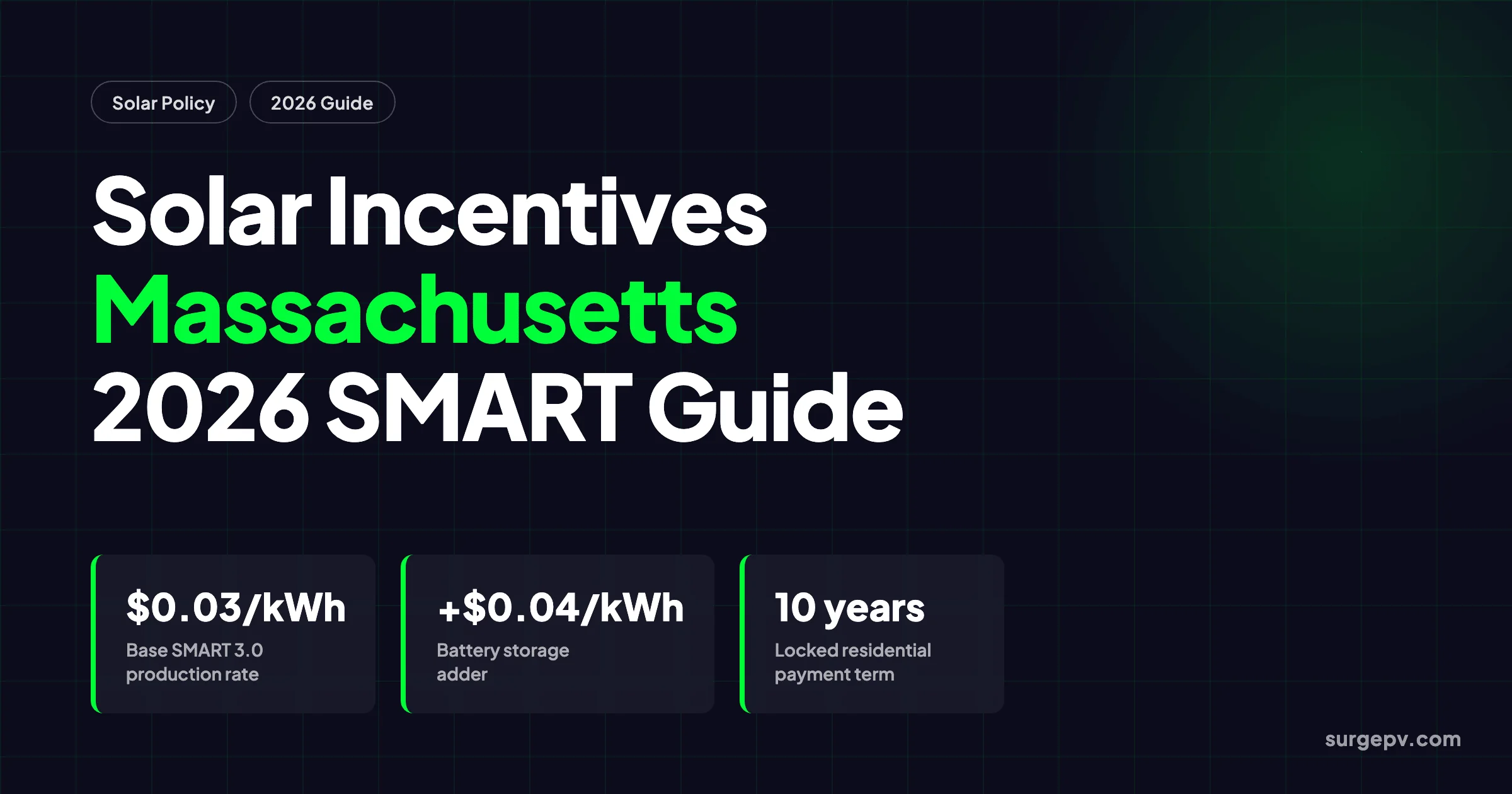
Massachusetts solar incentives in 2026 include SMART 3.0 production payments ($0.03/kWh base for 10 years), a 15% state tax credit up to $1,000, sales and property tax exemptions, 1:1 net metering, and ConnectedSolutions battery payments. Low-income households receive $0.06/kWh under SMART, and battery-paired systems add approximately $0.04/kWh.
In this guide:
- Massachusetts solar incentives at a glance — 2026 status table
- How SMART 3.0 works: rates, adders, and eligibility
- Net metering rules for residential systems
- State tax credits, sales tax exemption, and property tax exemption
- Battery incentives: ConnectedSolutions and the SMART storage adder
- Community solar access for renters and unsuitable roofs
- Who qualifies and who does not
- Step-by-step application process
- Real payback and savings example for a Massachusetts home
- Common mistakes and misconceptions
- FAQ
Massachusetts Solar Market Context in 2026
Massachusetts has built one of the most mature rooftop solar markets in the United States. The state passed 5 GW of total installed solar capacity several years ago and continues to add hundreds of megawatts annually. Unlike solar markets that depend on abundant sunshine, Massachusetts solar economics rely on high electricity prices and policy design.
Residential electricity rates in Massachusetts average roughly $0.30 to $0.35 per kWh all-in, among the highest in the continental United States. Every kilowatt-hour a solar system produces on-site avoids that full retail rate. This makes self-consumption valuable even when production is lower than in sunnier states. A south-facing rooftop in Worcester or Lowell may produce 1,150 to 1,250 equivalent peak sun hours per year, but the high avoided cost keeps payback periods competitive.
The state has also layered incentives deliberately. Net metering provides long-term bill savings. SMART provides predictable production payments. Tax exemptions reduce upfront and ongoing costs. Battery programs address grid reliability during New England winters and summer peaks. The result is a market where solar-plus-storage has become the default recommendation for homeowners who can afford the upfront investment.
Massachusetts also has an aggressive climate target. The state’s Clean Energy and Climate Plan aims for net-zero emissions by 2050. Solar deployment is a central pillar. Programs like SMART 3.0 and ConnectedSolutions are designed not only to reduce customer costs but also to shift peak demand, reduce reliance on fossil-fuel peaker plants, and improve grid resilience. Battery storage is particularly valuable because it stores midday solar production and discharges during evening peaks, when grid marginal emissions are often highest.
Compared to neighboring states, Massachusetts offers a deeper incentive stack. Connecticut has its Residential Renewable Energy Solutions program and energy storage incentives, but net metering rules are more restrictive. New Hampshire has net metering but limited state production incentives. Rhode Island has renewable energy growth programs but smaller scale. Vermont has strong incentives for batteries through Green Mountain Power but a smaller overall solar market. For Massachusetts homeowners and installers, the combination of SMART, net metering, tax exemptions, and ConnectedSolutions remains among the most attractive in New England.
For installers, this context changes how proposals are built. Customers need to understand system cost, incentive stacking, rate structure, and backup power value together. A proposal that only compares monthly loan payments to current electric bills misses the SMART income, ConnectedSolutions revenue, and property tax exemption. Good proposal software captures all of these line items.
Massachusetts Solar Incentives at a Glance
The table below summarizes every major Massachusetts solar incentive available in 2026. We have separated production incentives, tax benefits, utility programs, and access programs so you can see how they stack.
| Incentive | Type | Value | Term | Eligibility |
|---|---|---|---|---|
| SMART 3.0 | Production payment | $0.03/kWh base; $0.06/kWh low-income | 10 years residential | Eversource, National Grid, Unitil customers |
| SMART battery storage adder | Production adder | ~$0.04/kWh | 10 years | Battery paired with solar and enrolled in SMART |
| SMART building-mounted adder | Production adder | ~$0.02/kWh | 10 years | Rooftop-mounted systems |
| Net metering | Bill credit | Full retail rate | Indefinite | Systems up to 25 kW cap-exempt |
| MA Residential Renewable Energy Credit | State tax credit | 15% of cost, max $1,000 | One-time, carryforward 3 years | Primary residence owners |
| Solar sales tax exemption | Tax exemption | 6.25% waived | At purchase | All solar equipment buyers |
| Solar property tax exemption | Tax exemption | 100% of added value | 20 years | Residential property owners |
| ConnectedSolutions | Demand response | ~$225/kW summer performance | Annual, multi-year contract | Eversource, National Grid battery owners |
| Community Shared Solar | Bill credit | 10% discount market-rate; 20% low-income | Subscription term | Renters, shaded roofs, condo owners |
Several important details sit beneath this table. SMART 3.0 is not a rebate paid upfront. It is a production tariff paid over time based on metered generation. Net metering is a separate bill credit for exported energy. The state tax credit is claimed when you file your Massachusetts return. Sales and property tax exemptions apply automatically or through standard local assessment procedures.
The total value of these incentives depends heavily on system size, electricity usage, financing method, and whether storage is included. A solar-only cash purchase in Massachusetts may pay back in 9 to 12 years. A solar-plus-battery system with optimized ConnectedSolutions participation may pay back in 7 to 10 years while also providing backup power.
The key financial insight for 2026 is that Massachusetts incentives now favor solar-plus-storage over solar-only systems. The base SMART rate for standalone residential solar is modest, but the battery storage adder roughly triples the effective production incentive. ConnectedSolutions adds a separate annual revenue stream for battery discharge. Stacked together, a battery can pay for a meaningful portion of its own cost over five to ten years.
SMART 3.0 Program: How It Works in 2026
SMART stands for Solar Massachusetts Renewable Target. The program launched in 2018 to replace the earlier Solar Renewable Energy Certificate (SREC) market, which reached capacity and closed to new applicants on November 26, 2018. SMART pays system owners a fixed dollar amount for every kilowatt-hour their solar array generates, regardless of whether that electricity is consumed on-site or exported to the grid.
SMART 3.0 is the current program iteration. It took effect in 2025 and introduced several structural changes from earlier versions:
- Annual program years instead of fixed declining blocks. The Department of Energy Resources (DOER) reviews capacity and rates each year.
- Flat residential rates for systems 25 kW or smaller, making homeowner calculations simpler.
- Expanded equity requirements for community solar projects.
- Storage adders that increase the per-kWh rate for battery-paired systems.
For residential customers, the most practical change is predictability. Under the original SMART program, applicants worried about which block they would land in and whether rates would decline before their application was processed. Under SMART 3.0, the residential rate is set annually. Once your installer submits a Statement of Qualification Capacity and your utility issues a Final Statement of Qualification, your rate is locked for the contract term.
The program is administered by DOER. Applications are processed through CLEAResult, the program administrator, using the PowerClerk portal. Your installer handles the submission; you do not apply directly as a homeowner. Official program details are maintained by Mass.gov SMART 3.0 Program Details.
On May 19, 2026, the Massachusetts Department of Public Utilities approved the revised SMART 3.0 tariff. DOER began accepting Program Year 2026 applications on January 1, 2026, and began issuing Final Statements of Qualification after the tariff approval. This timing matters because SMART payments are not backdated to a project’s commercial operation date. Systems that start producing before final qualification still earn net metering credits, but SMART payments begin only after the Final Statement of Qualification is issued.
From SRECs to SMART 3.0
Understanding SMART 3.0 requires a brief look backward. Before 2018, Massachusetts used Solar Renewable Energy Certificates (SRECs) to incentivize solar. System owners earned one SREC for every megawatt-hour of production and sold those certificates into a state market. Prices were volatile but often high. The SREC-II program closed to new applications on November 26, 2018.
SMART 1.0 replaced SRECs with a declining-block incentive. Capacity was allocated into blocks. Early applicants received higher per-kWh rates. As each block filled, the rate dropped. By the early 2020s, many blocks were full or rates had declined sharply. SMART 2.0 adjusted the structure but retained the block concept.
SMART 3.0 removed the block structure for most residential applicants and replaced it with annual program-year rates set by DOER. Systems 25 kW and smaller receive a flat rate. Behind-the-meter systems up to 250 kW are also cap-exempt. This makes the program more predictable for homeowners, though installers must still monitor annual rate announcements.
The shift from SRECs to SMART reflects a broader national trend. As solar costs fell, states moved away from certificate markets toward performance-based tariffs. SMART 3.0 is designed to balance ratepayer impact, grid reliability, and continued solar deployment. It is less generous than early SREC pricing but more durable. For homeowners, the critical difference is that SMART payments are fixed at enrollment, while SREC prices fluctuated with market supply and demand.
SMART 3.0 Incentive Rates and Adders
SMART 3.0 uses different rate structures depending on system size, customer type, and project characteristics. For most homeowners, the residential flat rate applies.
Residential Flat Rates (Systems 25 kW or Smaller)
| Customer Type | Base Rate | Term |
|---|---|---|
| Standard residential | $0.03/kWh | 10 years |
| Low-income qualified | $0.06/kWh | 10 years |
The low-income rate is double the base rate. Eligibility is determined by income guidelines, usually aligned with federal low-income thresholds or participation in qualifying assistance programs. The Mass Clean Energy Center provides consumer guidance on current eligibility and disclosure requirements at MassCEC SMART 3.0 Guide.
These rates apply to Program Year 2026. DOER reviews rates annually, so future program years may have different base rates or adder values. Once your project receives a Final Statement of Qualification, your rate is locked for the contract term regardless of future changes.
SMART Adders
| Adder Type | Approximate Value | Applies To |
|---|---|---|
| Battery storage adder | ~$0.04/kWh | Solar paired with qualifying battery storage |
| Building-mounted adder | ~$0.02/kWh | Rooftop or building-integrated systems |
| Brownfield adder | Varies | Projects on cleaned brownfield sites |
| Agricultural dual-use adder | Varies | Solar co-located with active agriculture |
| Low-income community shared solar adder | Varies | Community solar projects serving low-income subscribers |
The battery storage adder is the most relevant adder for typical homeowners in 2026. It is added to the base rate, so a standard residential system with battery storage can earn approximately $0.07/kWh. A low-income household with battery storage could earn approximately $0.10/kWh. These adders make solar-plus-storage the financially preferred configuration under the current SMART framework.
Worked Example: 8 kW System in Springfield
An 8 kW rooftop system in Springfield, Massachusetts, produces roughly 9,500 kWh per year after accounting for orientation, tilt, and derating. The 10-year SMART income looks like this:
| Configuration | Effective Rate | Annual Payment | 10-Year Total |
|---|---|---|---|
| Solar only | $0.03/kWh | $285 | $2,850 |
| Solar + battery | $0.07/kWh | $665 | $6,650 |
| Low-income + battery | $0.10/kWh | $950 | $9,500 |
These payments are in addition to net metering savings and any tax benefits. They are taxable income at the federal level, so consult a tax professional when modeling after-tax returns.
Commercial and Larger Systems
Non-residential systems larger than 25 kW are calculated differently under SMART 3.0. Rates are not flat; they depend on system size, location, adders, and program-year capacity. Commercial systems often qualify for a 20-year SMART term rather than the 10-year residential term.
Commercial projects also benefit from different federal tax treatment. While the residential Section 25D credit expired for systems placed in service after 2025, the business energy credit under Section 48E remains available for commercial solar and storage projects through 2032, subject to domestic content and prevailing wage requirements. Commercial projects can also use MACRS depreciation, which improves after-tax returns.
Adders for commercial projects include brownfield sites, dual-use agricultural solar, and canopy installations. These can significantly raise the effective SMART rate for qualified projects. Developers should review DOER’s Annual Program Year Reports for current non-residential rates.
Commercial net metering works differently than residential net metering. Systems between 25 kW and 60 kW fall into Class I and may require cap allocation. Larger systems fall into Class II or Class III with different credit calculations. Commercial customers should work with an experienced solar developer or engineer to structure the project for maximum credit value.
Canopy and carport solar are popular commercial applications in Massachusetts. They produce power without consuming roof area or land. Under SMART 3.0, canopy projects may qualify for specialized adders. Carports also provide shade and weather protection, adding non-energy value for businesses.
Net Metering in Massachusetts
Net metering is the single most valuable solar incentive for many Massachusetts homeowners. It allows your utility meter to run backward when your panels produce more electricity than your home uses. Excess generation is credited at the full retail rate, which includes both supply and delivery charges. This is different from many states that credit exports at avoided-cost or wholesale rates.
Key Net Metering Rules for 2026
- 1:1 retail credit: Exported kWh offsets your bill at the same rate you would pay to buy that kWh from the grid.
- Credits never expire: Unused credits roll over month to month and year to year indefinitely.
- Cap-exempt residential systems: Systems up to 25 kW AC are cap-exempt and qualify automatically for residential customers.
- Three investor-owned utilities: Eversource, National Grid, and Unitil offer net metering under state regulations.
- Municipal light plants: MLPs are not required to offer net metering and may set their own rules.
The Massachusetts net metering guide maintained by the state explains credit calculation, cap allocation, and exemption rules at Mass.gov Net Metering Guide.
Net Metering Caps and Exemptions
Massachusetts net metering operates with statutory caps for larger projects. Each investor-owned utility has separate public and private caps. Once a cap is reached, new non-exempt projects must wait for legislative expansion or accept reduced credit values.
However, residential systems up to 25 kW AC are cap-exempt. This exemption was raised from 10 kW to 25 kW through recent regulatory updates, making most home solar installations unaffected by cap availability. Cap-exempt projects receive standard net metering credits equal to 100% of net excess generation valued at the full retail rate.
Municipal Light Plants
Roughly 50 Massachusetts communities receive electricity from municipal light plants (MLPs) rather than investor-owned utilities. MLPs are not subject to state net metering caps and are not required to offer SMART. Each MLP sets its own solar policy.
Some MLPs offer generous rebates or net metering programs. Others have limited or no solar incentives. If you serve customers in towns like Concord, Holyoke, or Taunton, verify the local MLP’s current solar tariff before designing a proposal. Do not assume SMART or ConnectedSolutions apply.
The combination of SMART production payments and net metering bill credits means Massachusetts homeowners earn money for total production and receive credits for exports simultaneously. This stacking is unusual and powerful. Read our net metering glossary entry for a deeper explanation of how credits are calculated.
One practical implication is system sizing. Because net metering credits do not expire, you can size a system to cover your annual usage without worrying about losing summer surplus. A well-sized array will build credits from May through September and draw them down from October through April.
Massachusetts State Tax Credits and Exemptions
Massachusetts offers three direct tax benefits for solar: a state income tax credit, a sales tax exemption, and a property tax exemption. These apply statewide and do not depend on your utility provider.
Residential Renewable Energy Income Tax Credit
The state credit equals 15% of the net cost of a qualifying solar energy system, up to a maximum of $1,000. Because most residential systems cost more than $6,700, nearly all homeowners receive the full $1,000 credit.
- Form: Massachusetts Schedule EC, Solar and Wind Energy Credit.
- Carryforward: Unused credit can be carried forward for up to three years.
- Primary residence requirement: The system must be installed at your primary Massachusetts residence.
- Ownership requirement: You must own the system. Lease and PPA customers do not claim this credit directly.
Sales Tax Exemption
Solar energy systems are exempt from Massachusetts sales and use tax. The state sales tax rate is 6.25%. On a $20,000 system, this exemption saves $1,250 at the point of purchase. The exemption applies to equipment and installation labor for qualifying solar energy systems.
Property Tax Exemption
Massachusetts law exempts the added value of a solar energy system from local property tax assessments for 20 years. This means your property taxes will not increase because you installed panels. The exemption is automatic in most municipalities, though you should confirm with your local assessor’s office that your installation was recorded correctly.
These three benefits stack with SMART and net metering. For a typical cash purchase, the state tax credit and sales tax exemption reduce upfront cost, while SMART and net metering generate ongoing returns.
How to Claim the State Tax Credit
The process is straightforward but requires documentation. After installation, obtain the itemized invoice from your installer showing total system cost, including equipment and labor. Download Massachusetts Schedule EC from the Department of Revenue website. Complete the form and attach it to your Massachusetts income tax return for the year the system was placed in service. If the credit exceeds your state tax liability, carry the unused portion forward for up to three years.
Keep copies of the installer invoice, interconnection approval, and any SMART approval documents. These support the credit amount and installation date if the return is reviewed.
Sales Tax Exemption Details
The Massachusetts sales tax exemption applies to solar energy equipment and related installation labor. The equipment must be part of a qualifying solar energy system. Batteries may qualify when installed as part of a solar-plus-storage system, but standalone battery purchases may be treated differently depending on configuration. Your installer should itemize the sales tax exemption on the contract.
Property Tax Exemption Nuances
While the property tax exemption is statewide, implementation is local. Assessors must exclude the value added by solar equipment from the property assessment for 20 years. Some towns require a simple form or a copy of the installation permit. Others apply the exemption automatically. Homeowners should confirm with their local assessor’s office within the first year to avoid any incorrect valuation.
Battery Incentives: ConnectedSolutions and SMART Storage Adder
Battery storage has become central to Massachusetts solar economics in 2026. Two programs specifically reward batteries: the SMART storage adder and ConnectedSolutions.
SMART Battery Storage Adder
When you pair a qualifying battery with your solar system and enroll in SMART, your production incentive rate increases by approximately $0.04/kWh. This adder applies to every kWh the solar system produces over the 10-year SMART term, not just the electricity discharged from the battery.
For the 8 kW Springfield example, adding a battery raises annual SMART income from $285 to $665. Over 10 years, the storage adder contributes about $3,800 in additional SMART payments. The battery must meet program technical requirements, including grid interconnection and approved inverter or battery hardware.
ConnectedSolutions
ConnectedSolutions is a demand-response program operated by Eversource and National Grid. It pays battery owners for discharging stored energy during peak demand events, typically hot summer afternoons when grid strain is highest.
Program mechanics:
- Enrollment: You enroll your battery through your installer or aggregator.
- Dispatch events: The utility sends a signal to your battery to discharge during peak hours.
- Performance measurement: Your average kW contribution during events determines your payment.
- Payment: Approximately $225 per kW of average summer performance, paid annually.
A typical 5 kW residential battery can earn $1,000 to $1,500 per summer season. Payments are typically locked in for a five-year contract term. Winter demand-response events may also be available at lower rates.
How ConnectedSolutions Dispatch Works
During a dispatch event, the utility sends a signal to the battery management system. The battery discharges to the home or the grid for two to three hours. Events usually occur on hot weekday afternoons between June and September. Most years have 30 to 60 events. The utility measures the battery’s average discharge capacity across all events and pays accordingly.
Homeowners can usually set a backup reserve percentage. If the reserve is 20%, the battery will not discharge below that level during events. This preserves backup power for outages. Some systems also have storm mode, which overrides dispatch events when severe weather is forecast.
Compatible Battery Equipment
Most major residential battery brands are eligible for ConnectedSolutions and the SMART storage adder. Commonly installed systems include Tesla Powerwall, Enphase IQ Battery, SolarEdge Home Battery, and FranklinWH. Each utility maintains an approved equipment list and firmware requirements. The battery must be able to receive dispatch signals from the utility or aggregator and report performance data.
For the SMART storage adder, the battery must be paired with a solar system, interconnected with the grid, and enrolled in SMART through the same customer account. Standalone batteries do not qualify for the SMART solar production adder because the adder is calculated based on solar production, not battery capacity.
Why Batteries Matter in Massachusetts
Massachusetts has cold winters and increasingly hot summers. Winter storms cause outages. Summer heat drives peak demand. A battery provides backup power during outages and earns revenue during peak events. In 2026, the economics improved because the federal residential clean energy credit expired for solar panels but battery storage paired with solar remains supported through state programs.
ConnectedSolutions is separate from SMART. You can enroll in both. The result is that a battery can generate revenue through SMART adders, ConnectedSolutions payments, and backup power value. For installers, this changes the sales conversation from “backup power” to “revenue asset.” Learn more about adding storage services in our guide to adding battery storage services.
Community Solar in Massachusetts
Not every Massachusetts resident can install rooftop solar. Renters, condo owners, and homeowners with shaded or structurally unsuitable roofs have an alternative: Community Shared Solar, also called community solar or virtual net metering.
Under Massachusetts SMART 3.0, community solar projects must enroll a minimum of 40% low-income subscribers. The program guarantees subscriber savings:
- Market-rate subscribers: Minimum 10% bill discount.
- Low-income subscribers: Minimum 20% bill discount.
Subscribers do not own equipment. They sign up for a share of a solar farm and receive credits on their utility bill. There is typically no upfront cost. Community solar is available to customers of Eversource, National Grid, and Unitil, though specific project availability varies by utility territory.
Community Solar Subscriber Math
Suppose a household uses 10,000 kWh per year and subscribes to a community solar farm that credits production at a 10% discount. If the farm credits the household for 8,000 kWh at $0.32/kWh, the bill credit is $2,560. The household pays the project $2,304, saving $256 per year. There is no installation, no roof work, and no maintenance.
Low-income subscribers save at least 20%. On the same 8,000 kWh, the credit is $2,560 but the payment is $2,048, saving $512 per year. These savings are modest but meaningful for households that cannot access rooftop solar.
For installers and developers, community solar design requires careful subscriber allocation modeling. SurgePV helps model community solar production, subscriber credit allocation, and revenue forecasts in a single platform. See our community solar design guide for more on shared solar project development.
Who Qualifies for Massachusetts Solar Incentives
Eligibility rules differ by program. Use this checklist before promising a customer specific incentives.
SMART 3.0 Eligibility
- Customer of Eversource, National Grid, or Unitil.
- System size 25 kW or smaller for residential flat rate.
- Construction started on or after June 20, 2025.
- Applicant has not previously received SMART or Renewable Portfolio Standard incentives.
- System is not served by a municipal light plant.
Net Metering Eligibility
- Customer of Eversource, National Grid, or Unitil.
- Residential system up to 25 kW AC is cap-exempt.
- System passes utility interconnection review.
- MLP customers follow their local utility’s rules.
State Tax Credit Eligibility
- System installed at primary Massachusetts residence.
- System is owned by the taxpayer, not leased or under PPA.
- Credit claimed on Massachusetts Schedule EC.
Battery Incentive Eligibility
- Battery must be on the utility’s approved equipment list.
- ConnectedSolutions requires enrollment and a communicating battery.
- SMART storage adder requires battery paired with solar and enrolled in SMART.
The most common disqualification is municipal light plant service. If your customer is served by an MLP, verify local programs before quoting SMART or ConnectedSolutions income.
Previous Incentive Recipients
Homeowners who received incentives under earlier SMART versions or the Renewable Portfolio Standard may not qualify for SMART 3.0. This rule prevents the same solar project from receiving multiple state production incentives. If a customer is expanding an existing solar array, the new capacity may still qualify if it is treated as a separate system and meets current program rules. Always disclose prior solar incentive history to your installer during the quote process.
Solar Financing in Massachusetts
Most Massachusetts homeowners do not pay cash for solar. Financing determines who captures incentives and how payback is calculated. The main options are cash purchase, solar loan, lease, and power purchase agreement (PPA).
Cash Purchase
Cash purchase delivers the highest lifetime return. The homeowner owns the system, claims the state tax credit, receives SMART payments, and earns net metering savings. Upfront cost for an 8 kW solar-plus-battery system typically ranges from $28,000 to $36,000 before incentives. Payback periods run 8 to 12 years depending on system size, electricity usage, and incentive stack.
Solar Loan
Solar loans spread the upfront cost over 10 to 25 years. Many Massachusetts installers offer $0-down loan options. The homeowner still owns the system and captures incentives. Monthly loan payments are often lower than the pre-solar electric bill, producing immediate cash flow savings. Interest rates and dealer fees vary widely, so comparing multiple financing offers matters.
Lease and PPA
Under a lease or PPA, a third party owns the system and sells electricity to the homeowner at a fixed rate. The homeowner does not pay upfront and does not receive SMART payments or tax credits directly. The leasing company may pass through some savings via lower rates. In 2026, lease and PPA arrangements may still access the federal business credit under Section 48E, which can improve pricing compared to cash purchase for some customers.
Mass Save HEAT Loans
Mass Save offers 0% interest HEAT Loans up to $25,000 for energy improvements, including battery storage installations in some cases. These loans can reduce the cost of borrowing for storage and are worth mentioning to customers considering batteries. Visit Mass Save for current program terms and eligible contractors.
For a broader comparison of solar financing structures, read our solar financing options guide.
Massachusetts Solar Proposal Best Practices for Installers
Massachusetts customers are policy-literate. They have often read about SMART, net metering, and battery incentives before the first sales call. A proposal that misstates incentive values or omits key programs loses credibility quickly. Here are best practices we follow when designing proposals for the Massachusetts market.
Show Year-One and Lifetime Value Separately
Year-one savings include avoided electricity purchases, SMART payments, and any ConnectedSolutions income. Lifetime value includes 25 years of net metering savings, property tax exemption, and residual system value. Separating the two prevents customers from judging solar on a single number.
Model Solar-Only and Solar-Plus-Battery Side by Side
Because the SMART battery adder and ConnectedSolutions change project economics, always show both options. Many customers initially ask for solar-only quotes. Presenting the battery upgrade as a revenue-positive option, not just a backup luxury, increases attachment rates.
Include Incentive Risk Disclaimers
Utility rates, SMART rates, and ConnectedSolutions rates can change. Net metering rules have been stable but are periodically reviewed. State tax credits require sufficient tax liability. A good proposal notes these dependencies without sounding evasive.
Use Site-Specific Production Estimates
Massachusetts irradiance varies by region. A system in Pittsfield produces less than the same system on Cape Cod. Use satellite imagery, lidar shading analysis, and local weather data to estimate production accurately. Overestimating production by 10% can shift payback by a full year.
Document Assumptions in Writing
When customers compare quotes, they often remember different numbers from different installers. Provide a one-page assumption summary: electricity rate escalator, production estimate, SMART rate, battery reserve setting, and financing terms. This reduces confusion and builds trust.
Train Sales Teams on Battery Value
In 2026, the strongest Massachusetts solar value proposition includes storage. Sales teams should be able to explain the SMART storage adder, ConnectedSolutions revenue, and backup power value in simple terms. Customers often object to battery cost until they see the combined incentive stack.
Track Program Changes
SMART 3.0 is designed to adapt annually. Rates and capacity may change each program year. Assign someone on your team to monitor DOER announcements, DPU dockets, and utility tariff updates. Outdated proposal assumptions are a leading cause of customer disputes.
Avoid Overpromising on Timeline
Permitting, utility interconnection, and SMART processing take time. In busy markets, the period from contract to Permission to Operate can stretch to three or four months. Set realistic expectations upfront. SMART payments do not begin until after Final Statement of Qualification, which adds additional time after interconnection.
How to Apply: Step-by-Step Enrollment
Most homeowners do not apply for incentives directly. The installer handles the paperwork. However, understanding the sequence helps you avoid delays and missing deadlines.
Step 1: Confirm Utility Territory and Roof Suitability
Verify whether the home is served by Eversource, National Grid, Unitil, or a municipal light plant. Confirm roof condition, shading, and electrical panel capacity.
Step 2: Sign a Contract with a Massachusetts Solar Installer
Choose a MassCEC-approved installer. The contract should disclose which incentives the installer will apply for and who owns any SMART payments. For direct ownership, SMART payments belong to the homeowner.
Step 3: Submit SMART Statement of Qualification Capacity
Your installer submits the SQC application through the PowerClerk portal. This locks in your SMART rate for the current program year. Apply before installation begins.
Step 4: Install the System and Obtain Interconnection Approval
The installer completes installation, passes local inspections, and receives Permission to Operate from the utility.
Step 5: Submit SMART Statement of Completion
Within six months of SQC approval, the installer submits proof of completion, including final inspection, interconnection date, system specifications, and production meter information.
Step 6: Enroll in Net Metering
Net metering is typically applied for alongside interconnection. For cap-exempt residential systems, approval is generally automatic.
Step 7: Enroll Battery in ConnectedSolutions
If you installed a battery, enroll it in ConnectedSolutions through your installer or the utility portal. Set backup reserve preferences so the battery retains enough charge for outages.
Step 8: Claim State Tax Credit
When filing your Massachusetts state income tax return for the year of installation, complete Schedule EC to claim the 15% credit up to $1,000.
Timeline Expectations
From contract signature to Permission to Operate, most residential projects take two to four months. Site assessment and design take one to two weeks. Permitting takes two to six weeks depending on the town. Installation takes one to three days. Utility interconnection review takes two to six weeks. SMART Final Statement of Qualification may take additional weeks after interconnection, especially during busy periods.
SMART payments typically begin one to three months after the Final Statement of Qualification is issued. Net metering credits begin as soon as the bi-directional meter is installed and the system is producing. ConnectedSolutions payments are issued after the summer demand-response season ends, usually in the fall.
Payback and Savings Example
Let’s model a cash-purchased 8 kW rooftop system with a 13.5 kWh battery for a home in Worcester, Massachusetts. The home uses 10,000 kWh per year and pays $0.32/kWh all-in.
System Assumptions
| Item | Value |
|---|---|
| System size | 8 kW DC |
| Annual production | 9,500 kWh |
| Upfront cost (solar + battery) | $32,000 |
| Self-consumption rate | 40% |
| Battery discharge through ConnectedSolutions | 5 kW average |
Incentive Stack
| Incentive | Value |
|---|---|
| Sales tax exemption (6.25%) | $2,000 saved |
| State tax credit | $1,000 |
| SMART solar + battery ($0.07/kWh × 9,500 kWh × 10 years) | $6,650 |
| ConnectedSolutions ($225/kW × 5 kW × 5 years) | $5,625 |
| Net metering savings (annual) | ~$1,800 |
Total first-year bill savings plus incentives: approximately $4,485. Net upfront cost after sales tax exemption and state credit: approximately $29,000. Simple payback is roughly 8 to 10 years, with continued net metering savings and battery backup value extending total returns.
Cash vs. Loan Comparison
The same system financed with a 20-year solar loan at 6.9% interest might have monthly payments of $210 to $240. If the pre-solar electric bill averages $265 per month, the customer sees immediate monthly savings even before accounting for SMART and ConnectedSolutions income. Over the loan term, total interest reduces net lifetime savings compared to cash purchase, but the customer avoids the large upfront outlay.
Cash purchase produces the highest lifetime savings because no interest is paid. Loan purchase improves cash flow and broadens the customer base. Lease and PPA require no upfront payment but transfer incentives to the third-party owner.
Sensitivity to Electricity Rate Escalation
Massachusetts electricity rates have risen faster than inflation over the past decade. If rates increase 3% per year, the lifetime value of net metering grows substantially. A customer who avoids $1,800 in year one saves over $3,000 annually by year 20 in nominal dollars. Conversely, if rates flatten, payback extends. Proposals should show a range of rate escalation scenarios.
This example is illustrative. Actual results depend on roof orientation, shading, utility rate changes, and battery dispatch settings. Installers should run production and financial models specific to each project. Use a generation and financial tool to model scenarios accurately.
Common Mistakes and Misconceptions
Massachusetts solar incentives are layered, which creates confusion. Here are the most common errors we see in the field.
Mistake 1: Assuming the Federal Tax Credit Still Applies
The federal Residential Clean Energy Credit under Section 25D is not available for residential solar systems placed in service after December 31, 2025, according to IRS FAQs on the One Big Beautiful Bill Act of 2025. Homeowners purchasing systems in 2026 should not count on a 30% federal credit. Commercial and third-party-owned systems may still access Section 48E.
Mistake 2: Quoting SMART Income Without Adders
At the $0.03/kWh base rate alone, SMART income is modest. Installers who present SMART as a major revenue line for solar-only systems can set unrealistic expectations. Present the storage adder and ConnectedSolutions together to show why batteries improve project economics.
Mistake 3: Missing the SQC Deadline
SMART rates are locked at the time of SQC approval. If an installer waits until after installation to apply, the project may fall into a later program year with different rates. Submit the SQC before construction begins.
Mistake 4: Serving MLP Customers with Investor-Owned Utility Assumptions
Municipal light plant customers are not eligible for SMART or standard net metering. Each MLP sets its own solar policy. Some offer rebates, others offer different net metering terms. Always verify the customer’s utility before quoting incentives.
Mistake 5: Ignoring Battery Backup Reserve Settings
ConnectedSolutions dispatches batteries during peak events. If the backup reserve is set too low, the battery may not have enough charge during an outage. Configure reserve settings based on the customer’s outage risk tolerance, not just maximum revenue.
Mistake 6: Oversizing Without Modeling Export Value
Massachusetts net metering credits never expire, but oversized systems still have upfront cost. A system that produces far more than annual usage may have a longer payback than a right-sized system because exported energy only offsets future bills, not immediate cash flow. Model consumption patterns, not just roof capacity.
Mistake 7: Forgetting Tax Treatment of SMART Income
SMART payments are generally taxable income at the federal level. When quoting after-tax returns, reduce SMART income by the customer’s marginal tax rate. Failing to account for taxes can overstate returns by 15% to 30%.
Next Steps: How to Use Massachusetts Solar Incentives in 2026
Massachusetts solar incentives remain strong in 2026, but the details matter more than ever. The federal residential tax credit is gone, so state programs carry the full weight of making solar affordable. SMART 3.0 is modest for solar-only systems but attractive for solar-plus-storage. Net metering continues to provide long-term value. ConnectedSolutions turns batteries into revenue assets.
If you are a homeowner, take these three actions:
- Confirm your utility territory. SMART, net metering, and ConnectedSolutions apply to Eversource, National Grid, and Unitil customers. MLP customers should check local programs.
- Get multiple quotes. Compare solar-only and solar-plus-battery options. Ask each installer to show year-one and 25-year value, including all incentives.
- Verify incentive assumptions in writing. SMART rates, ConnectedSolutions rates, and electricity rate escalators should be documented before you sign.
If you are an installer, take these three actions:
- Update proposal templates to reflect the 2026 federal tax credit expiration and current SMART 3.0 rates.
- Model storage on every quote. The battery adder and ConnectedSolutions often make storage the better financial choice.
- Use accurate production and financial software. Massachusetts customers compare quotes closely. Precision builds trust and reduces cancellations.
For help designing Massachusetts solar proposals with current incentives, explore SurgePV’s solar design platform or book a demo to see the Massachusetts incentive modeling workflow.
Key Takeaways
- SMART 3.0 pays $0.03/kWh for residential solar production over 10 years, with higher rates for low-income households and battery-paired systems.
- Net metering credits roll over indefinitely at full retail rate for cap-exempt residential systems.
- Massachusetts offers a 15% state tax credit up to $1,000, plus sales and property tax exemptions.
- ConnectedSolutions can pay $1,000 to $1,500 per year for a typical residential battery.
- The federal residential clean energy credit expired for systems placed in service after December 31, 2025.
- MLP customers should verify local programs because they are generally not eligible for SMART or standard net metering.
- Installers should update proposal templates quarterly as program rules and rates evolve.
FAQ
What is the SMART program in Massachusetts?
SMART stands for Solar Massachusetts Renewable Target. It is the state’s primary production-based solar incentive. In 2026, SMART 3.0 pays residential system owners a fixed $0.03/kWh for all solar electricity generated over a 10-year term. The rate is locked at enrollment and paid on top of net metering credits. Low-income households receive $0.06/kWh, and battery-paired systems can add approximately $0.04/kWh.
How much can I earn from SMART 3.0 in Massachusetts?
A typical 8 kW residential system in Massachusetts produces about 9,500 kWh per year. At the $0.03/kWh base rate, that generates roughly $285 per year, or $2,850 over the 10-year SMART term. Adding a qualifying battery raises the effective rate by about $0.04/kWh, increasing the 10-year total to roughly $6,650. Low-income households earn double the base rate.
Who qualifies for Massachusetts solar incentives?
Most Massachusetts homeowners with rooftop solar qualify for state incentives. SMART 3.0 and net metering require service from one of the three investor-owned utilities: Eversource, National Grid, or Unitil. Municipal light plant customers are generally ineligible for SMART but may access local rebates. Systems must be installed on or after June 20, 2025, and applicants cannot have already received SMART or Renewable Portfolio Standard incentives.
Does Massachusetts still have net metering in 2026?
Yes. Massachusetts net metering remains active in 2026. Residential systems up to 25 kW are cap-exempt and receive full retail-rate credits for excess electricity exported to the grid. Credits roll over month to month and year to year without expiration. This applies to customers of Eversource, National Grid, and Unitil.
What is the Massachusetts state solar tax credit?
Massachusetts offers a Residential Renewable Energy Income Tax Credit equal to 15% of the net cost of a solar energy system, capped at $1,000 per household. The credit is claimed on Massachusetts Schedule EC and can be carried forward for up to three years if it exceeds your state tax liability in the first year.
Can I get a federal tax credit for solar in Massachusetts in 2026?
No. The federal Residential Clean Energy Credit under IRS Section 25D is not available for residential solar systems placed in service after December 31, 2025, following changes enacted in the One Big Beautiful Bill Act of 2025. Commercial systems and third-party-owned residential systems under lease or PPA arrangements may still access the federal business credit under Section 48E.
What is ConnectedSolutions in Massachusetts?
ConnectedSolutions is a utility demand-response program that pays homeowners to discharge their battery storage systems during peak demand events. Eversource and National Grid customers can earn approximately $225 per kW of average summer performance. A typical residential battery can generate $1,000 to $1,500 per year over a multi-year contract.
What solar incentives are available for low-income households in Massachusetts?
Low-income households qualify for a higher SMART 3.0 base rate of $0.06/kWh, double the standard residential rate. Community solar projects must reserve at least 40% of capacity for low-income subscribers, who receive a minimum 20% bill discount. Income-qualified households may also access additional grants, financing assistance, and Mass Save incentives.
How do I apply for the SMART program?
Your solar installer applies for SMART on your behalf through the PowerClerk portal before installation. The process begins with a Statement of Qualification Capacity application to lock in your rate. After the system is installed, inspected, and interconnected, the installer submits a Statement of Completion. Payments typically begin after the utility issues a Final Statement of Qualification.
Is community solar available in Massachusetts?
Yes. Massachusetts community solar, also called Community Shared Solar, allows renters and homeowners with unsuitable roofs to subscribe to a local solar farm and receive bill credits. Under SMART 3.0, community solar projects must enroll at least 40% low-income subscribers. Market-rate subscribers receive at least a 10% bill discount, while low-income subscribers receive at least 20%.
Where this fits
This article is part of SurgePV's Solar Incentives & Policy hub, which works through the topic from first principles to the decisions a project team actually has to make.

