

Nebraska had roughly 226 MWdc of installed solar capacity by early 2026, enough to power about 30,000 homes, according to SEIA. The state ranks 50th nationally in cumulative solar and supports about 1,868 solar jobs across 30 companies. For anyone researching solar incentives Nebraska, that scale means a smaller installer market and a policy environment that is more modest than in leading solar states.
The incentive story changed on January 1, 2026. The federal Residential Clean Energy Credit under Section 25D expired for homeowner-owned systems. Nebraska homeowners can no longer subtract 30% of system cost from their federal taxes. Nebraska also lacks a state solar tax credit, a statewide sales tax exemption, and a property tax exemption. The real incentives that remain are net metering, the Lincoln Electric System capacity payment, low-interest state financing, and a handful of local programs.
For installers and EPCs, the shift means proposals must be built around utility territory first. A home in Lincoln Electric System territory can access a very different value stack than a home served by Omaha Public Power District, Nebraska Public Power District, or a rural cooperative. This guide explains every active 2026 incentive, the real dollar value of each program, and how to model payback accurately. For the national context, see our solar incentives in USA 2026 guide. For payback modeling, SurgePV’s energy and financial modeling tool can pull Nebraska utility rates and net metering rules into a single proposal.
Quick Answer
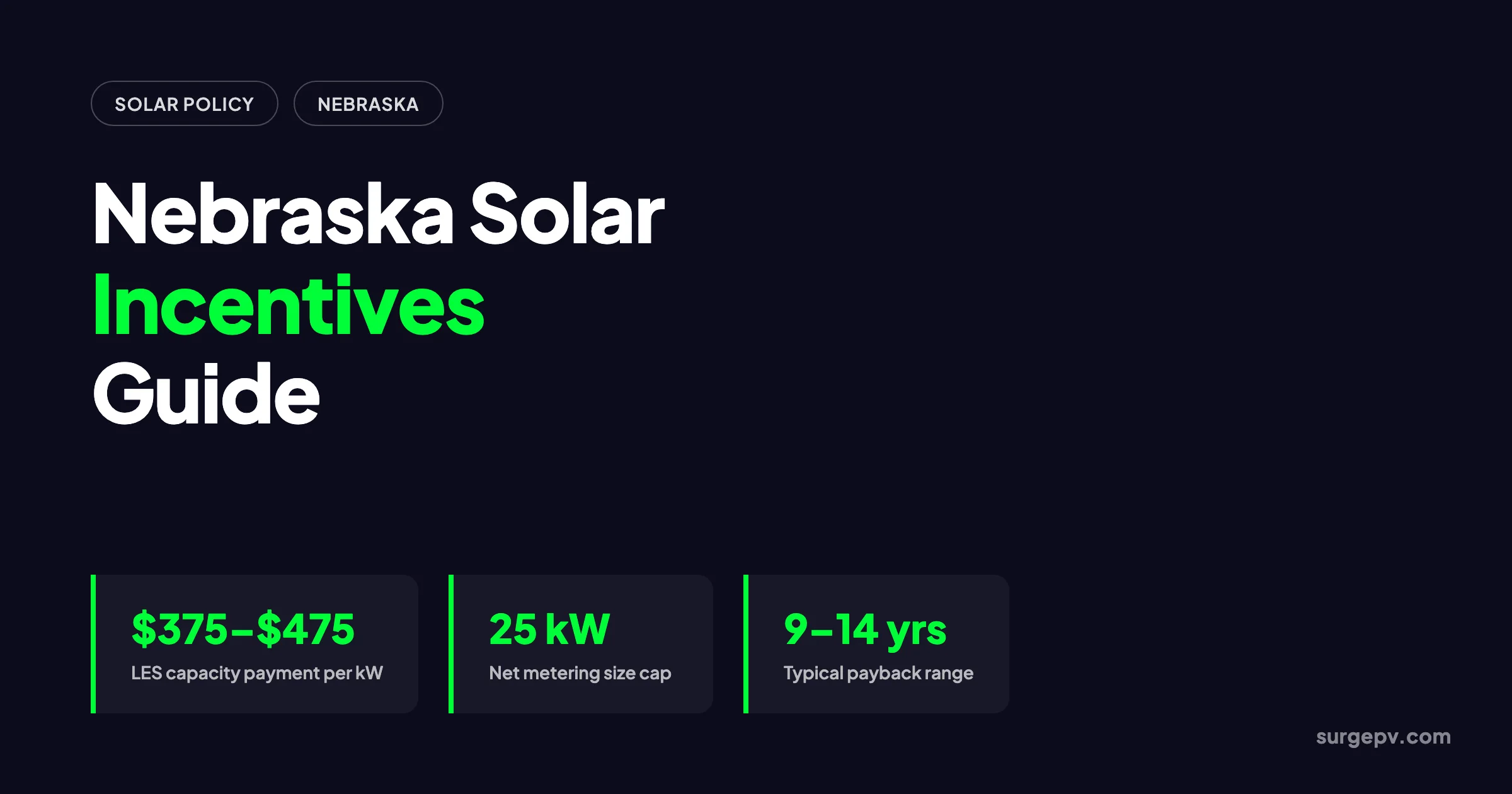
Nebraska solar incentives in 2026 are limited but meaningful. The state mandates net metering for systems up to 25 kW, though most utilities credit excess exports at avoided-cost rates. Lincoln Electric System offers one-time capacity payments of $375–$475 per kW for qualifying systems. The Nebraska Dollar and Energy Saving Loan program provides low-interest financing. There is no state solar tax credit, no statewide sales tax exemption, and no property tax exemption.
In this guide:
- Latest 2026 status of every active Nebraska solar incentive
- How the federal ITC expiration changes the math
- Net metering rules and export value by utility
- The Lincoln Electric System capacity payment
- Nebraska Dollar and Energy Saving Loans and PACE financing
- Real installed costs and payback scenarios
- Financing options and who should lease versus buy
- Common mistakes and how to avoid them
Latest Updates: Nebraska Solar Incentives 2026
Nebraska did not lose its solar incentives in 2026. It never had a large state-level incentive stack to begin with. The biggest change is the federal residential credit expiration. The programs that remain are durable but modest. They also vary by utility, so the first question in any Nebraska solar proposal is: who is the electric utility?
Nebraska Solar Incentive Status — June 2026
| Incentive | Type | Status | Key Terms |
|---|---|---|---|
| Federal residential ITC | Tax credit | Expired | Section 25D ended December 31, 2025 |
| Federal Section 48E | Tax credit | Active for commercial/TPO | 30% through 2027 with safe-harbor deadlines |
| Nebraska state solar tax credit | State tax credit | Does not exist | No statewide income tax credit for PV |
| Nebraska sales tax exemption | Tax exemption | Does not exist | Standard state and local sales tax applies |
| Nebraska property tax exemption | Tax exemption | Does not exist | Solar may increase assessed value |
| Nebraska net metering | Export credit | Active | Required by law; systems up to 25 kW; 1% aggregate cap |
| LES capacity payment | Utility rebate | Active | $375/kW south-facing; $475/kW west-facing/tracking |
| LES virtual net metering / SunShares | Community solar | Active | Purchase virtual panels; credits on bill |
| Dollar and Energy Saving Loans | State financing | Active | Low-interest loans up to $125,000 for residential |
| PACE financing | Local financing | Active in some cities | Repayment through property tax bill |
Key Changes Since 2025
Federal ITC expiration: The 30% residential Investment Tax Credit expired for systems placed in service after December 31, 2025, under the One Big Beautiful Bill Act. Homeowners who buy solar with cash or a loan in 2026 cannot claim it. Commercial, third-party-owned, and leased systems may still qualify under Section 48E, according to IRS guidance.
LES Tier 2 extension: Lincoln Electric System extended the Tier 2 renewable generation energy payment period to a maximum of 10 MWac or 15 years from the January 1, 2018 commencement date, whichever occurs earlier, according to LES Resolution 2026-4. This preserves the capacity payment and energy payment structure for new enrollees.
No new state tax exemptions: Nebraska lawmakers have not enacted a statewide solar sales tax or property tax exemption as of mid-2026. Installers should not assume these benefits exist.
Key Takeaway
2026 is a utility-territory year in Nebraska. The statewide incentive stack is thin. The Lincoln Electric System capacity payment is the largest upfront incentive for residential customers. Net metering is available everywhere but export credits are usually below the retail rate.
Why Nebraska’s Solar Market Matters in 2026
Nebraska is not the sunniest state, but it is not solar-poor either. The state receives roughly 4.5–5.5 average daily peak sun hours, with the western half sunnier than the eastern half, based on NREL solar resource data. Combine that with some of the lowest retail electricity rates in the country, and solar economics become a matter of careful sizing rather than automatic jackpot.
Market Size and Targets
Nebraska had 226 MWdc of installed solar capacity and about 4,030 installations by early 2026, according to SEIA. Solar supplied roughly 0.79% of the state’s electricity. The industry supports about 1,868 jobs and $343 million in investment. SEIA projects Nebraska will add another 530 MW over the next five years.
Utility Rate Snapshot — Spring 2026
The average residential electricity price in Nebraska reached 13.28¢/kWh in April 2026, according to the U.S. Energy Information Administration (2026). That is well below the national average. Low rates make solar payback longer because every kilowatt-hour offset by solar avoids a cheaper grid purchase. This is why incentives and financing terms matter more in Nebraska than in high-rate states.
| Utility | Service Area | Approximate Residential Rate (2026) |
|---|---|---|
| Omaha Public Power District (OPPD) | Omaha metro, eastern Nebraska | 12–14¢/kWh |
| Lincoln Electric System (LES) | Lincoln and vicinity | 12–14¢/kWh |
| Nebraska Public Power District (NPPD) | Central and north-central Nebraska | 11–13¢/kWh |
| Rural cooperatives | Statewide rural areas | 11–14¢/kWh |
Nebraska Net Metering: How It Works
Net metering is the most important ongoing solar incentive in Nebraska. It is also the most misunderstood. Nebraska became the 43rd state with a net metering law when Governor Dave Heineman signed LB 436 in May 2009, according to Perennial Power.
The Legal Framework
Nebraska Revised Statute 70-2002 requires utilities to offer net metering to customer-generators. Key rules include:
- System size cap of 25 kW AC at a single site
- Aggregate program cap of 1% of each utility’s peak demand
- Eligible technologies include solar, wind, biomass, hydro, methane, and geothermal
- Systems must be on premises owned, operated, leased, or controlled by the customer
- Customers must sign an interconnection agreement
How Credits Are Calculated
Utilities net the energy delivered to the grid against energy supplied by the grid each billing period. Self-consumed solar is worth the full retail rate because it displaces a grid purchase. Exported solar is typically credited at the utility’s avoided-cost rate, not the retail rate. Credits roll forward month to month. At year-end, remaining credits are usually paid out at the avoided-cost rate.
This is a critical distinction. In states with full retail net metering, an exported kilowatt-hour is worth the same as a consumed kilowatt-hour. In Nebraska, the exported kilowatt-hour is often worth 30–50% less. That makes system sizing important. A right-sized system that matches daytime consumption will pay back faster than an oversized system that exports most of its production.
Utility-Specific Net Metering Notes
Omaha Public Power District (OPPD) offers net metering for residential systems up to 25 kW. OPPD credits excess generation at its avoided cost rate. Credits roll forward monthly and are settled annually.
Lincoln Electric System (LES) offers the Renewable Net Metering Rider for systems up to 25 kW AC. The energy payment rate is set at 50% of the residential energy charge until Tier 2 closes, according to LES rate schedules. LES also offers a one-time capacity payment for qualifying systems.
Nebraska Public Power District (NPPD) and participating rural cooperatives offer net metering under similar statutory rules. Each utility sets its own avoided-cost rate and interconnection procedures.
Lincoln Electric System Capacity Payment and SunShares
Lincoln Electric System is the standout utility for Nebraska residential solar in 2026. It offers two programs that no other Nebraska utility matches at this scale: the capacity payment and virtual net metering through SunShares.
LES Capacity Payment
The LES capacity payment is a one-time incentive paid to the owner of a qualifying net-metered system. The amount depends on system orientation and tracking, according to the LES 2026 rate schedule:
| System Type | Capacity Payment |
|---|---|
| Predominantly south-facing fixed solar | $375/kWdc |
| Predominantly west-facing fixed solar | $475/kWdc |
| Single or dual-axis tracking solar | $475/kWdc |
| Other solar installations | No payment |
A typical 8 kW south-facing system receives $3,000. A west-facing or tracking system of the same size receives $3,800. To qualify, the system must be installed by a participant in the LES Solar Trade Ally Network and meet LES interconnection standards.
The capacity payment is valuable because it is one of the only upfront cash incentives available to Nebraska homeowners. Installers should confirm a contractor’s Trade Ally Network status before quoting the payment.
LES SunShares Virtual Net Metering
LES SunShares allows customers to buy “virtual” solar panels representing a portion of LES’s community solar facility. Participants receive bill credits based on the number of shares they own and the facility’s actual production. This is an option for renters, homeowners with unsuitable roofs, or anyone who prefers not to install panels on their property.
Nebraska Dollar and Energy Saving Loans and PACE Financing
Because Nebraska lacks upfront rebates or tax credits, financing becomes the primary way to make solar affordable. Two programs matter most: the state-backed Dollar and Energy Saving Loans and local PACE financing.
Dollar and Energy Saving Loans
The Nebraska Department of Environment and Energy (NDEE) offers Dollar and Energy Saving Loans for energy-saving improvements, including solar photovoltaic systems. Key terms, according to EnergySage (2026):
- Residential loans up to $125,000
- Simple interest rates of 5%, 3.5%, or less
- Terms up to 15 years
- Available for single-family, two-family, and some multi-family homes
These loans can reduce the monthly cost of solar below what a homeowner pays the utility, even without a federal tax credit. The exact savings depend on system cost, interest rate, and electricity usage.
PACE Financing
Nebraska’s Property Assessed Clean Energy Act, passed in 2016, allows municipalities to create programs that finance clean energy improvements through property tax assessments. Available programs vary by city. Columbus, Norfolk, and Omaha have had active PACE programs, according to Nebraska State Solar. Repayment is added to the property tax bill. PACE is typically better suited to commercial properties than residential because of lien and transfer considerations.
Cost, ROI, and Financing Scenarios
The federal credit expiration made financing structure and utility territory the most important levers in a Nebraska solar proposal. The same system can look very different depending on whether it is purchased with cash, financed with a loan, or leased.
Hypothetical 8 kW System in Lincoln
Consider a 2,000-square-foot home in Lincoln served by LES. The household uses 10,500 kWh per year and pays an average rate of 13¢/kWh. An 8 kW system is priced at $2.95/W, for a gross cost of $23,600.
| Cost Component | Amount |
|---|---|
| Gross system cost | $23,600 |
| LES capacity payment ($375/kW, south-facing) | -$3,000 |
| Net upfront cost | $20,600 |
| Estimated first-year production | 10,800 kWh |
| First-year utility savings | $1,404 |
| Simple payback | 14.7 years |
| 25-year savings (undiscounted) | ~$35,000 |
This is a hypothetical example for illustration. Actual production depends on roof orientation, shading, and equipment. The payback is longer than in high-rate states because Nebraska electricity is cheap.
Scenario Comparison by Utility Territory
| Scenario | Gross Cost | Incentives | Net Cost | Est. Payback |
|---|---|---|---|---|
| LES customer, cash purchase, 8 kW south-facing | $23,600 | $3,000 | $20,600 | 12–15 years |
| OPPD customer, cash purchase, 8 kW | $23,600 | None | $23,600 | 14–17 years |
| Rural co-op customer, cash purchase, 8 kW | $23,600 | None | $23,600 | 14–18 years |
| LES customer, Dollar and Energy Saving Loan, 8 kW | $23,600 | $3,000 | $20,600 financed | Positive cash flow possible |
| Lease/PPA, any territory | $0 | Passed to lessor | Monthly payment | Immediate savings, lower lifetime total |
The LES customer sees the shortest payback because of the capacity payment. The OPPD and rural co-op customers rely entirely on bill savings and net metering. The low Nebraska retail rate makes all scenarios slower than in states like California or Colorado.
Financing Options
Cash purchase captures every available incentive and produces the highest lifetime savings. It requires the most upfront capital.
Solar loan spreads the cost over 10–15 years. The homeowner owns the system and keeps the LES capacity payment, but loan interest reduces net savings. The Dollar and Energy Saving Loan program can offer lower rates than unsecured personal loans.
Lease or power purchase agreement requires no upfront payment. The leasing company owns the system and may claim Section 48E. Savings appear as lower monthly bills from day one, but the homeowner does not receive the capacity payment or low-interest financing directly. Leases make sense for customers with limited tax appetite or cash flow, but they surrender long-term value.
Third-Party Ownership and Section 48E
Commercial projects and third-party-owned residential systems can still claim the 30% Clean Electricity Investment Credit under Section 48E. To qualify, construction must begin by July 4, 2026, or the system must be placed in service by December 31, 2027. This is why lease and PPA providers can still advertise lower payments in 2026: they own the system and capture the credit.
Common Mistakes and How to Avoid Them
Nebraska’s thin incentive stack makes errors more costly. The most expensive mistakes are usually assumptions, paperwork, or sizing problems.
Assuming Nebraska Has a State Solar Tax Credit
Many national solar sites still list Nebraska as having a state tax credit or sales tax exemption. Those claims are outdated or incorrect. Nebraska has no statewide income tax credit, sales tax exemption, or property tax exemption for residential solar.
Oversizing Beyond Consumption
Because most Nebraska utilities credit excess exports at the avoided-cost rate, an oversized system leaves value on the table. The safer design rule is to size for 90–100% of annual consumption and treat exports as a bonus.
Missing the LES Solar Trade Ally Network Requirement
The LES capacity payment only applies to systems installed by contractors in the LES Solar Trade Ally Network. Homeowners who use a non-network installer cannot receive the payment, even if the system is otherwise eligible.
Ignoring Property Tax Impact
Unlike many states, Nebraska does not shield the added value of a solar system from property taxation. In some counties, the system may increase assessed value and annual property taxes. Installers should mention this in proposals.
Waiting Too Long to Apply for Financing
Dollar and Energy Saving Loans and PACE financing require approval before installation begins. Waiting until after the contract is signed can delay the project.
Commercial and Agricultural Considerations
Commercial and agricultural customers in Nebraska have additional tools. The Section 48E credit can cover 30% of project cost for projects that meet the construction or placed-in-service deadlines. Businesses can also use MACRS depreciation, which front-loads tax deductions over five years.
Rural small businesses and agricultural operations may qualify for USDA REAP grants and loan guarantees. REAP can cover up to 50% of project cost, but applications must be submitted before construction begins. This makes early planning critical.
For commercial project modeling, SurgePV’s solar design software can size arrays, run shade analysis, and export production and financial reports. The solar proposals feature can package the incentive stack into a client-ready document.
Frequently Asked Questions
What solar incentives are available in Nebraska in 2026?
Nebraska offers mandatory net metering for systems up to 25 kW, the Lincoln Electric System capacity payment of $375–$475 per kW for qualifying systems, low-interest Dollar and Energy Saving Loans through the Nebraska Department of Environment and Energy, and local PACE financing in some municipalities. There is no state solar tax credit, no statewide sales tax exemption, and no property tax exemption.
Is the federal solar tax credit still available in Nebraska in 2026?
No. The 30% federal Residential Clean Energy Credit under Internal Revenue Code Section 25D expired for homeowner-owned systems placed in service after December 31, 2025. Commercial projects and third-party-owned residential systems may still qualify under Section 48E, with construction beginning by July 4, 2026, or placed in service by December 31, 2027.
Does Nebraska have a state solar tax credit for solar panels?
No. Nebraska does not offer a statewide income tax credit for residential solar photovoltaic systems. The main state-level support is the Dollar and Energy Saving Loan program, which provides low-interest financing rather than a tax credit or rebate.
How does net metering work in Nebraska in 2026?
Nebraska law requires utilities to offer net metering for customer-owned renewable systems up to 25 kW. Utilities net generation against consumption monthly. Most utilities credit excess generation at the avoided-cost rate, which is lower than the retail rate. Credits roll forward month to month, and any remaining annual surplus is typically paid out at the avoided-cost rate.
How much is the Lincoln Electric System solar capacity payment?
Lincoln Electric System offers a one-time capacity payment for net-metered systems installed by participants in its Solar Trade Ally Network. The payment is $375 per kW for predominantly south-facing fixed solar, $475 per kW for predominantly west-facing fixed solar, and $475 per kW for single or dual-axis tracking systems. A typical 8 kW south-facing system can receive $3,000.
Are solar batteries incentivized in Nebraska in 2026?
No statewide battery rebate or tax credit exists in Nebraska in 2026. Some municipal utilities or rural cooperatives may offer limited programs, but these are not guaranteed. Batteries paired with solar may still qualify for federal commercial incentives if the system is third-party owned or meets Section 48E deadlines.
Will solar increase my property taxes in Nebraska?
Yes, potentially. Nebraska does not have a statewide property tax exemption for residential solar energy systems. The added value of a solar installation may increase assessed value and property taxes, depending on the county assessor’s practice. Homeowners should factor this into long-term savings models.
Can I lease solar in Nebraska and still get incentives?
Leases and power purchase agreements do not pass net metering or financing incentives to the homeowner. The third-party owner keeps the incentives and may claim commercial tax benefits such as Section 48E. Homeowners who want the LES capacity payment, Dollar and Energy Saving Loans, or full net metering benefits should purchase the system with cash or a loan.
What is the typical solar payback period in Nebraska in 2026?
Payback periods for well-designed residential solar systems in Nebraska typically range from 9 to 14 years in 2026. LES customers who qualify for the capacity payment often see paybacks at the shorter end of the range. Customers in territories without upfront rebates and with lower export credit rates may see longer paybacks.
What is the most common mistake when applying for Nebraska solar incentives?
The most common mistake is assuming Nebraska has a state solar tax credit or property tax exemption. Another frequent error is oversizing a system beyond actual consumption, because excess exports are usually credited at the lower avoided-cost rate. Finally, LES customers sometimes miss the Solar Trade Ally Network requirement for the capacity payment.
Bottom Line
Nebraska solar in 2026 is a viable but patient investment. The economics do not rely on a generous incentive stack. They rely on low system costs, careful sizing, and the right financing. LES customers have a clear advantage with the capacity payment. Everyone else depends on net metering and bill savings.
Three actions will put you ahead:
- Confirm your utility territory first, because incentive value varies by service area.
- Use a Solar Trade Ally Network installer if you are in LES territory to capture the capacity payment.
- Size the system to actual consumption, not maximum roof area, because excess exports are credited at avoided-cost rates.
For installers, accuracy is the new competitive advantage. SurgePV’s PV generation and financial modeling lets you pull Nebraska utility rates, net metering assumptions, and incentive values into one proposal. Book a demo to see how it works, or check pricing for your team.
Where this fits
This article is part of SurgePV's Solar Incentives & Policy hub, which works through the topic from first principles to the decisions a project team actually has to make.
