

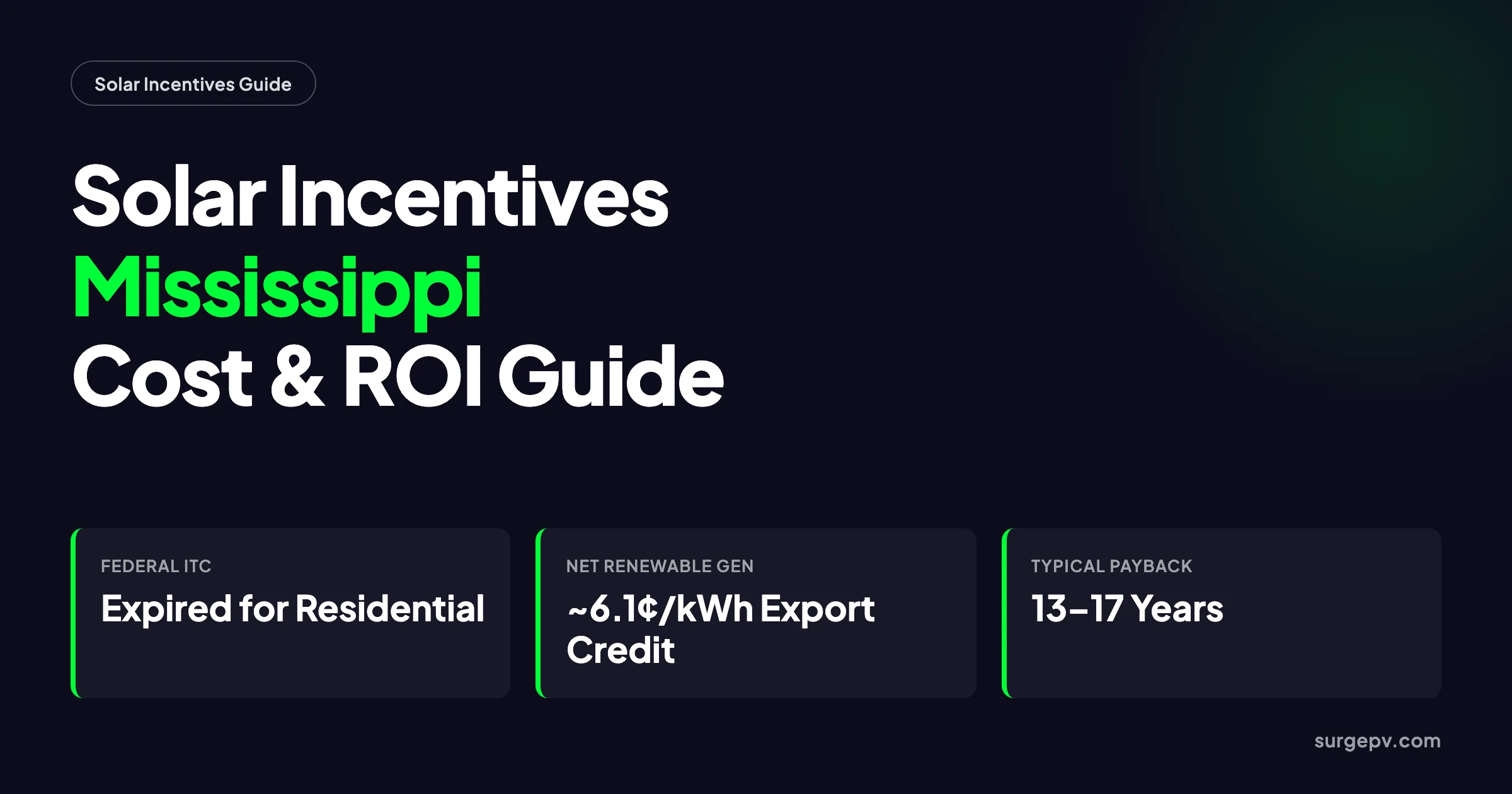
Mississippi homeowners paid an average residential electricity rate of about 14 cents per kWh in early 2026, according to the U.S. Energy Information Administration (2026). That is close to the national average, but Mississippi’s heavy dependence on air conditioning and above-average household usage means many residents face large annual bills. The state’s solar market is small. The Solar Energy Industries Association ranked Mississippi 35th nationally for installed solar capacity, according to SEIA’s Mississippi solar profile (2026).
This guide explains what solar incentives Mississippi actually offers in 2026. It covers the federal tax credit status, the net renewable generation rule, utility-specific rules for Entergy Mississippi and Mississippi Power, the reality for electric cooperative customers, and why financing choices now matter more than ever. For the national picture, see our solar incentives in USA 2026 guide and state solar incentives in the US overview. For installers, modeling the correct utility rate and export credit is the difference between a proposal that closes and one that gets rejected. SurgePV’s solar design software and solar yield and financial analysis let you model each incentive stream, utility rate, and financing scenario in one place.
Quick Answer
Mississippi solar incentives in 2026 are limited. The federal residential ITC expired at the end of 2025. Active benefits include net renewable generation for Entergy Mississippi and Mississippi Power customers, which credits excess solar at the utility’s avoided cost rate plus a 2.5 cent per kWh adder. Mississippi has no state solar tax credit, no property tax exemption, and no sales tax exemption.
In this guide:
- Mississippi solar incentive snapshot and what changed in 2026
- Federal tax credit status for residential and commercial projects
- How net renewable generation works and who qualifies
- Utility-specific rules for Entergy Mississippi, Mississippi Power, cooperatives, and TVA
- Property tax, sales tax, and other state rules
- Cost, ROI, and payback scenarios by system type
- Financing options and common mistakes
Mississippi Solar Incentives at a Glance — 2026
Mississippi is a low-incentive, sunshine-rich state. The economics work because of strong sun and high household usage, not because of big rebates. The table below summarizes the main programs active in 2026.
| Incentive | Type | 2026 Status | Typical Value |
|---|---|---|---|
| Federal residential ITC (Section 25D) | Tax credit | Expired | $0 for cash or loan residential purchases placed in service after 2025 |
| Federal Section 48E | Commercial tax credit | Active, deadlines apply | 30% for eligible commercial, lease, or PPA systems |
| Mississippi state solar tax credit | Tax credit | Not available | $0 |
| Mississippi property tax exemption | Tax exemption | Not available | Standard property tax applies |
| Mississippi sales tax exemption | Tax exemption | Not available | 7% state sales tax applies |
| Net renewable generation (Entergy Mississippi) | Bill credit | Active | Avoided cost + 2.5 cents/kWh; roughly 6.1 cents/kWh standard in 2026 |
| Net renewable generation (Mississippi Power) | Bill credit | Active | Avoided cost + 2.5 cents/kWh; check current rate with utility |
| Low-income adder | Bill credit adder | Active for first 1,000 qualifying customers | Extra 2 cents/kWh for 15 years |
| Program cap | Capacity limit | Active | 3% of each IOU’s maximum demand |
| Residential system size cap | System size limit | Active | 20 kW for IOU net renewable generation |
| Electric cooperative net metering | Varies | Not mandated | Set by each co-op; often lower credit rates |
| HOA solar access | Legal protection | Limited | No comprehensive statewide law |
The biggest misconception is that Mississippi offers traditional 1:1 net metering. It does not. The real money for new systems is self-consumption, avoided utility rate increases, and the federal commercial credit captured by lease or PPA providers. The biggest risk is designing a system for export credits that pay far less than the retail rate.
What Changed in 2026: Federal Tax Credit and Net Renewable Generation
Three changes shape Mississippi solar proposals in 2026. Two of them are federal. The third is a state rule that is now mature but still widely misunderstood.
The Federal Residential Tax Credit Expired
The 30% Residential Clean Energy Credit under Internal Revenue Code Section 25D expired for homeowner-owned systems placed in service after December 31, 2025, under the One Big Beautiful Bill Act. Homeowners who buy solar with cash or a loan in 2026 cannot claim it.
For Mississippi homeowners, this removes the largest single incentive from the equation. In 2024 and 2025, installers could lead with “30% federal tax credit plus net metering credits.” In 2026, the proposal has to stand on state rules and avoided utility costs. The math still works for many households because Mississippi has strong sun and rising electricity rates, but the payback period is longer than it was.
Commercial and third-party-owned residential systems still have a path. Section 48E, the Clean Electricity Investment Credit, offers a 30% base credit for projects that begin construction by July 4, 2026, or are placed in service by December 31, 2027. This is why solar leases and power purchase agreements can still advertise lower monthly payments in 2026. The system owner, not the homeowner, claims the credit.
Homeowners who want to claim any remaining federal benefit should consult a tax professional. The Internal Revenue Service publishes guidance on the Residential Clean Energy Credit at IRS Residential Clean Energy Credit (2026).
Net Renewable Generation Replaced Retail Net Metering
In 2016, the Mississippi Public Service Commission implemented the Mississippi Renewable Energy Net Metering Rule. It applies only to Entergy Mississippi and Mississippi Power, the state’s two investor-owned utilities. Under this rule, excess generation is credited at the utility’s avoided cost rate plus a commission-approved adder of 2.5 cents per kWh, according to the Mississippi Attorney General’s Solar Consumer Guide (2023).
The first 1,000 qualifying low-income customers receive an additional 2 cents per kWh credit for 15 years. The program caps total participation at 3% of each utility’s maximum demand. Residential systems are limited to 20 kW.
The practical result is simple. A kilowatt-hour you use directly from your panels offsets a full retail-rate kWh. A kilowatt-hour you export earns only a wholesale-style credit. The difference can cut your effective savings by 50% or more on exported power.
Mississippi State Solar Incentives
Mississippi offers no state tax credit, no property tax exemption, and no sales tax exemption for solar. The only meaningful state-level policy is the net renewable generation rule. That makes Mississippi one of the weaker states for direct solar incentives.
No State Solar Tax Credit
Mississippi does not offer a state income tax credit for residential or commercial solar installations. Several neighboring states, including Louisiana and Alabama, also lack state tax credits. The absence of a state credit means the payback math depends heavily on utility rates, self-consumption, and financing cost.
No Property Tax Exemption
Mississippi does not exclude the added value of a solar system from property tax assessments. A $30,000 solar installation could increase the assessed value of a home, though local assessor practice varies. Homeowners should ask their installer or county tax assessor how the system will be treated.
No Sales Tax Exemption
Mississippi charges a 7% state sales tax on solar equipment, with local taxes added in some jurisdictions. On a $30,000 system, the sales tax alone adds roughly $2,100. This is a real upfront cost that must be included in any accurate proposal.
Net Renewable Generation in Mississippi
Net renewable generation is the most important state-level solar policy in Mississippi. It is not traditional net metering. Understanding the difference is critical for accurate financial modeling.
How the Credit Rate Is Calculated
Under the Mississippi Public Service Commission rule, exported solar is credited at the utility’s avoided cost rate plus 2.5 cents per kWh. The avoided cost rate reflects what the utility would pay for wholesale power. In practice, this total is roughly half the retail rate or less.
Entergy Mississippi’s 2026 credit rates are about 6.1 cents per kWh for standard customers and 8.1 cents per kWh for qualifying low-income customers, according to DSIRE’s Mississippi net metering summary (2026). Mississippi Power sets its own avoided cost rate, so customers should confirm the current number with the utility.
Credits Roll Over Indefinitely
Unlike some states where unused credits expire at the end of a year, Mississippi credits roll over month to month with no expiration. This is helpful for customers whose solar production is heavily weighted toward summer months when air conditioning use is highest.
Low-Income Adder
The first 1,000 qualifying low-income customers receive an extra 2 cents per kWh on top of the standard credit rate for 15 years. Qualification is typically based on income at or below 250% of the federal poverty line. This adder can improve project economics substantially for eligible households.
Program Caps and Size Limits
Each investor-owned utility must accept net renewable generation systems until total participation reaches 3% of the utility’s maximum demand. Residential systems are capped at 20 kW. Commercial systems have higher limits but must still comply with utility-specific rules.
Utility-Specific Rules for Mississippi Solar Customers
Mississippi has a fragmented utility landscape. The rules depend entirely on who sells you electricity.
Entergy Mississippi
Entergy Mississippi is the state’s largest investor-owned utility. It operates the net renewable generation program under Mississippi Public Service Commission rules. Customers receive a monthly kWh credit for excess generation at the avoided cost plus 2.5 cents per kWh. In 2026, the standard credit rate is about 6.1 cents per kWh.
Entergy charges a one-time non-refundable interconnection fee of $95 to $135, according to Entergy Mississippi’s net metering page (2026). The utility also requires a bi-directional meter and approved interconnection application. Systems must be sized to no more than 20 kW for residential customers.
Mississippi Power
Mississippi Power, a subsidiary of Southern Company, also operates under the Mississippi Public Service Commission net renewable generation rule. The credit structure is the same avoided cost plus 2.5 cents per kWh, but the actual avoided cost rate may differ from Entergy’s. Customers should request the current rate before signing a contract.
Electric Cooperatives
Most of Mississippi is served by electric cooperatives, not investor-owned utilities. The Mississippi Public Service Commission net renewable generation rule does not apply to co-ops. Each cooperative sets its own distributed generation tariff.
Some co-ops offer net metering or power purchase agreements at avoided cost rates. Others offer much lower compensation or no compensation at all for exported power. For example, one cooperative distributed generation tariff pays roughly 4.5 cents per kWh for excess energy, according to a Coast Electric distributed generation agreement (2023). This variability means co-op customers must verify the specific tariff before designing a system.
Tennessee Valley Authority
A small portion of northeastern Mississippi is served by the Tennessee Valley Authority through local power companies. TVA offers its own Green Power Providers program and distributed generation credits, but these programs are separate from Mississippi’s net renewable generation rule. TVA customers should check the current TVA solar program terms, which can change annually.
Cost, ROI, and Payback Scenarios for Mississippi
Solar economics in Mississippi depend on four variables: system cost, electricity rate, self-consumption rate, and export credit rate. Because the federal residential tax credit is gone, payback periods are longer than in prior years.
Typical System Cost
A typical 9 kW residential solar system in Mississippi costs roughly $27,000 to $33,000 before any incentives, based on national and state pricing data from EnergySage Mississippi Solar Incentives (2026). Mississippi’s average cost per watt tends to be above the national average, partly due to lower installer competition.
Production Estimate
A 9 kW system in Mississippi typically produces 12,500 to 14,500 kWh per year, depending on roof orientation, shading, and location. The state receives about 4.5 to 5.5 peak sun hours per day on average.
Payback Math: Cash Purchase
Assume a 9 kW system costs $30,000, produces 13,500 kWh per year, and the household uses 60% of that production directly. The household offsets 8,100 kWh at the retail rate of 14 cents per kWh, saving $1,134 per year. The remaining 5,400 kWh is exported at 6.1 cents per kWh, earning $329 per year. Total first-year savings are roughly $1,463.
Without the federal tax credit, simple payback is $30,000 divided by $1,463, or about 20.5 years. That is long. The system still produces positive lifetime savings over 25 years, but the margin is thin.
If the same household uses 80% of production directly, the numbers change. Direct offset becomes 10,800 kWh at 14 cents, saving $1,512 per year. Exported production drops to 2,700 kWh at 6.1 cents, earning $165 per year. Total first-year savings are $1,677, and payback drops to about 17.9 years.
Payback Math: Lease or PPA
A solar lease or power purchase agreement in Mississippi can offer lower monthly payments because the system owner captures the federal Section 48E credit. However, lifetime savings are usually lower than ownership. Homeowners should compare the lease payment to their current average electric bill and understand escalator clauses.
The Role of Batteries
Because exported power earns less than the retail rate, batteries can improve economics by shifting solar production to evening hours. A battery adds $8,000 to $15,000 to the project cost but increases self-consumption. Whether the extra cost pays off depends on the specific rate structure, battery size, and usage pattern.
Financing Options for Mississippi Solar
The loss of the federal residential tax credit makes financing choice more important than ever. The wrong loan can erase the savings from solar.
Cash Purchase
Cash delivers the highest lifetime savings but requires full upfront capital. Without the federal tax credit, the payback period is 14 to 20 years for well-designed systems. Cash buyers should focus on maximizing self-consumption and minimizing cost per watt.
Solar Loan
Solar loans keep ownership and any available incentives with the homeowner. In 2026, the main benefit is ownership of the system and the ability to capture long-term utility savings. Interest rates on unsecured solar loans typically range from 7% to 12%. A high-interest loan can extend payback beyond the system warranty period.
Home Equity Line of Credit
A HELOC or home equity loan often offers lower interest rates than unsecured solar loans. Homeowners with available equity should compare this option carefully. The interest may also be tax-deductible in some cases, though tax professionals should confirm.
Lease or Power Purchase Agreement
Leases and PPAs require no upfront payment and can still benefit from federal Section 48E credits captured by the system owner. Monthly payments are typically set below the current electric bill. The tradeoff is lower lifetime savings and no ownership of the system or incentives.
Common Mistakes Mississippi Solar Buyers Make
Mississippi’s thin incentive stack means there is little room for error. These are the most common mistakes.
Designing for Export Instead of Self-Consumption
Because exported power earns roughly half the retail rate or less, systems should be sized for consumption, not maximum production. A larger system that exports heavily will have worse economics than a smaller system that covers daytime load.
Assuming Net Metering Applies to Co-ops
Many Mississippi residents are served by electric cooperatives that are not covered by the state net renewable generation rule. Customers must verify the specific co-op tariff before proceeding.
Ignoring Sales Tax
Mississippi’s 7% sales tax adds real cost. A quote that excludes sales tax will understate the true upfront investment. Buyers should ask installers to confirm whether tax is included.
Overlooking the 20 kW Residential Cap
The net renewable generation program caps residential systems at 20 kW. Larger systems must use a different tariff or sell power under a separate power purchase agreement.
Taking a High-Interest Loan
With payback periods already stretched by the loss of the federal tax credit, a high-interest loan can make the project cash-flow negative for years. Buyers should compare the loan payment to expected monthly savings.
FAQ: Mississippi Solar Incentives 2026
What solar incentives are available in Mississippi in 2026?
Mississippi solar incentives in 2026 are limited. The federal residential tax credit expired for homeowner-owned systems placed in service after December 31, 2025. Active programs include net renewable generation for Entergy Mississippi and Mississippi Power customers, which credits exported solar at the utility’s avoided cost rate plus 2.5 cents per kWh. Mississippi has no state solar tax credit, no property tax exemption, and no sales tax exemption.
Does Mississippi have net metering for solar in 2026?
Mississippi has a net renewable generation program, not traditional 1:1 net metering. The program applies only to Entergy Mississippi and Mississippi Power customers. Excess generation is credited monthly at the utility’s avoided cost rate plus a 2.5 cent per kWh commission-approved adder. Credits roll over indefinitely. Residential systems are limited to 20 kW, and the program is capped at 3% of each utility’s maximum demand.
What is the federal solar tax credit status in Mississippi in 2026?
The 30% federal Residential Clean Energy Credit under Internal Revenue Code Section 25D expired for homeowner-owned systems placed in service after December 31, 2025. Commercial systems and third-party-owned residential arrangements such as leases and power purchase agreements may still qualify for a 30% credit under Section 48E if construction begins by July 4, 2026, or the system is placed in service by December 31, 2027.
Does Mississippi have a state solar tax credit?
No. Mississippi does not offer a state income tax credit for residential or commercial solar installations. The only state-level program is the net renewable generation rule administered by the Mississippi Public Service Commission for customers of Entergy Mississippi and Mississippi Power.
Does Mississippi have a property tax exemption for solar panels?
No. Mississippi does not provide a statewide property tax exemption for residential solar energy systems. Homeowners should expect the added value of a solar installation to be included in their property tax assessment, though local assessor practice can vary.
Does Mississippi have a sales tax exemption for solar equipment?
No. Mississippi does not exempt residential solar equipment from the state’s 7% sales tax. Local taxes can add to that total. Installers should include sales tax in the quoted system price.
What is the typical solar payback period in Mississippi in 2026?
A cash-purchased residential solar system in Mississippi typically pays back in 13 to 17 years in 2026, assuming no federal residential tax credit. The exact range depends on system cost, electricity rate, self-consumption, and whether the customer qualifies for the low-income adder under net renewable generation. Higher self-consumption shortens payback because exported energy earns less than the retail rate.
How does net renewable generation work for Entergy Mississippi customers?
Entergy Mississippi customers receive a monthly kilowatt-hour credit for excess solar generation. The credit rate equals the utility’s avoided cost rate plus a 2.5 cent per kWh adder. In 2026, the standard credit rate is about 6.1 cents per kWh, while qualifying low-income customers receive roughly 8.1 cents per kWh. Credits never expire and can offset future bills.
Do Mississippi electric cooperatives offer net metering?
Mississippi electric cooperatives are not required by the Mississippi Public Service Commission net renewable generation rule to offer net metering. Many co-ops have their own distributed generation tariffs, but credit rates, system size limits, and interconnection rules vary. Customers served by electric cooperatives should contact their co-op directly before designing a system.
Can an HOA ban solar panels in Mississippi?
Mississippi does not have a comprehensive statewide solar access law that prohibits HOAs from banning solar panels. Homeowners should review their subdivision covenants and association rules before signing a contract. Some local ordinances may offer limited protections.
Bottom Line
Mississippi solar incentives in 2026 are thin, but solar can still work for the right household. The keys are accurate self-consumption modeling, a competitive installed price, and financing that does not erode the energy savings.
If you are an installer, the margin for error is small. A proposal that overstates export credits or assumes a tax credit that no longer exists will destroy trust. SurgePV’s solar design software and solar yield and financial analysis let you model Mississippi utility rates, incentives, and financing scenarios in one workflow. You can then generate professional solar proposals and check pricing or book a demo.
Three actions to take now:
- Confirm your utility territory and current export credit rate before sizing a system.
- Model payback with no federal residential tax credit and realistic self-consumption assumptions.
- Compare cash, loan, and lease options using the true all-in cost including Mississippi sales tax.
Where this fits
This article is part of SurgePV's Solar Incentives & Policy hub, which works through the topic from first principles to the decisions a project team actually has to make.
