

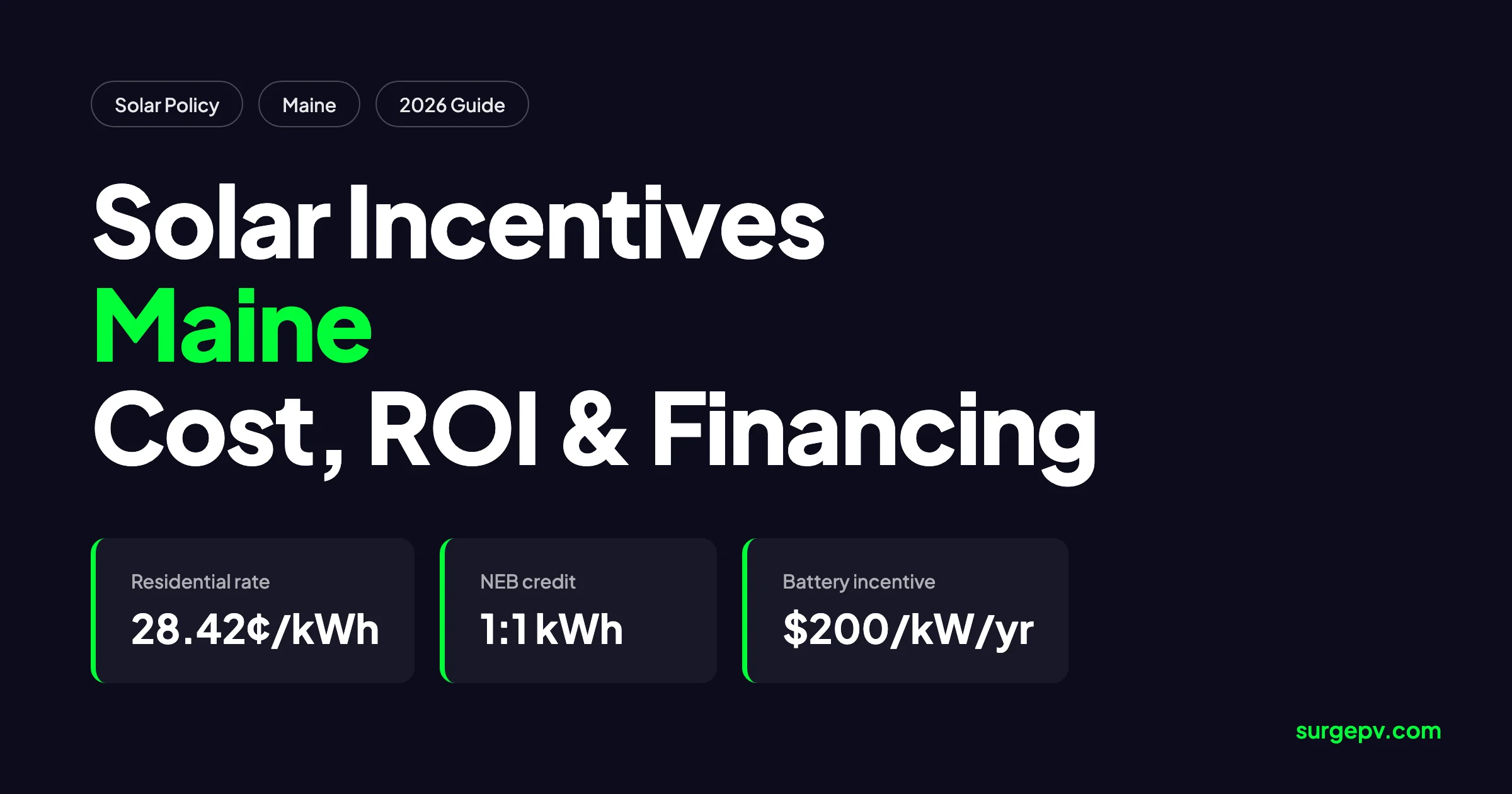
Maine’s residential electricity rate reached 28.42¢/kWh in April 2026, according to the U.S. Energy Information Administration. That is one of the highest statewide averages in the country. For anyone searching for solar incentives Maine, that rate is the starting point. Every kilowatt-hour your panels produce avoids an expensive grid purchase.
Maine’s incentive stack is smaller than some neighboring states, but it is durable. Net Energy Billing still offers retail-rate kWh credits. Solar and battery equipment is fully exempt from property tax. The state sales tax does not apply to solar equipment. Efficiency Maine runs performance-based battery programs. The missing piece is a state tax credit, and the federal residential credit expired at the end of 2025.
This guide covers every active Maine solar incentive in 2026. It explains Net Energy Billing rules, tax exemptions, battery incentives, and federal options for commercial or third-party-owned systems. It also shows how to model real payback without the federal residential credit. For the national picture, see our solar tax credit 2026 guide and our state solar incentives US overview. For installers, SurgePV’s solar yield and financial analysis models Maine rates, Net Energy Billing, and storage value in one workflow.
Quick Answer
Maine solar incentives in 2026 include Net Energy Billing with full retail kWh credits, a statewide property tax exemption for solar and storage equipment, a 5.5% sales tax exemption, Efficiency Maine battery performance payments, and USDA REAP grants for rural businesses. There is no state solar tax credit, and the federal residential credit expired in 2025.
In this guide:
- Latest 2026 status of every active Maine solar incentive
- How Net Energy Billing works and why utility territory matters
- Property tax and sales tax exemptions
- Battery storage incentives through Efficiency Maine
- What happened to the Maine Energy Solar for All program
- Federal options for commercial and third-party-owned systems
- Real payback scenarios for Maine homeowners
- Common mistakes and how to avoid them
Maine Solar Incentives at a Glance
Maine does not have the deepest incentive pool in New England, but the programs it has are strong. The table below summarizes every active incentive as of mid-2026.
| Incentive | Type | Value | Who Qualifies |
|---|---|---|---|
| Net Energy Billing kWh Credit | Export credit | Full retail kWh credits; 12-month rollover | Residential, commercial, industrial customers with systems under 5 MW |
| Property tax exemption | Tax exemption | 100% of added value exempt from local assessment | All property owners with qualifying solar and storage equipment |
| Sales tax exemption | Tax exemption | 5.5% state sales tax waived on solar equipment | Purchasers of qualifying solar energy equipment |
| Efficiency Maine Small Battery Incentive | Performance payment | Up to $200/kW per year for peak demand dispatch | Residential and small commercial battery owners |
| Efficiency Maine ESS Project Program | Performance payment | $200/kW per year for up to 5 years | Commercial, nonprofit, institutional, and government demand-metered customers |
| USDA REAP grants and loans | Federal grant/loan | Grants up to 50% of cost; loans up to 75% | Agricultural producers and rural small businesses |
| Federal Section 48E | Tax credit | 30% for eligible commercial and TPO projects | Commercial, lease, and PPA owners |
Sources: Maine Department of Energy Resources; Versant Power Net Energy Billing; Efficiency Maine Energy Storage System Projects.
Key Changes Since 2025
Federal residential credit expired: The 30% Residential Clean Energy Credit under Internal Revenue Code Section 25D ended. It no longer applies to homeowner-owned systems placed in service after December 31, 2025. Cash and loan buyers in Maine no longer receive a federal tax credit.
MESA funding terminated: The U.S. EPA terminated Maine’s $62.1 million Solar for All award in August 2025. The program was expected to help over 20,000 low-income households access solar and storage. Its future is uncertain as of mid-2026.
Residential rooftop NEB protected: Legislative changes in 2026 affected community solar and shared NEB arrangements, but residential rooftop Net Energy Billing was not impacted. Rooftop credits remain fully protected.
Key Takeaway
Maine’s 2026 solar economics depend on high electricity rates and Net Energy Billing, not on tax credits. Installers should stop leading with federal credit assumptions and start with rate offset math.
Net Energy Billing: Maine’s Most Valuable Solar Incentive
Net Energy Billing is the foundation of Maine’s solar market. It works like traditional net metering but uses kWh credits rather than dollar credits. For every kilowatt-hour your system exports to the grid, you receive a credit that offsets one kilowatt-hour of future use.
How the kWh Credit Program Works
The kWh Credit Program is available to all electric utility customers in Maine. It covers residential, commercial, and industrial projects with renewable generators under 5 MW. Customers may own the system themselves or share in a larger project, commonly called community solar.
Your meter tracks net energy each billing period. When your solar array produces more than you use, the surplus becomes a kWh credit on your account. When you use more than you produce, the credits offset your usage. Any credits you do not use roll forward for up to 12 months. After 12 months, unused credits expire without compensation. This makes system sizing important. A system that produces a large annual surplus wastes value at the true-up date.
Retail-Rate Value
Because credits are denominated in kWh, they offset the full retail rate. Maine’s average residential rate of 28.42¢/kWh means every exported kWh avoids 28.42¢ of future purchases. That is higher than the export compensation in most states with net billing. It is the main reason solar-only systems still pay back well in Maine without the federal credit.
CMP vs. Versant Power
Maine has two investor-owned transmission and distribution utilities. Central Maine Power serves roughly 70% of the state, including Portland, Augusta, and the midcoast. Versant Power serves eastern and northern Maine, including Bangor and the Maine Public District. Both utilities offer Net Energy Billing, but total bills differ because delivery rates and standard offer supply rates vary.
The 2026 Standard Offer supply rate is 12.72¢/kWh for CMP residential customers. For Versant Maine Public District residential customers, it is 14.87¢/kWh, according to a November 2025 Maine PUC announcement. Total residential rates are approximately 27¢/kWh for CMP and 32¢/kWh for Versant, based on utility tariff filings.
Community Solar Note
Shared NEB arrangements, often marketed as community solar, faced legislative changes in 2026 under LD 1777. These changes limited certain shared financial interests in distributed generation facilities. Residential rooftop systems were not affected. If you are subscribing to a shared solar project, ask the developer how the 2026 rules changed subscriber protections and credit allocation.
For a deeper explanation of export compensation mechanics, see our net metering savings calculator and the net metering glossary.
Property Tax Exemption
Maine law exempts solar and wind energy equipment from local property tax assessment. The exemption took effect statewide on April 1, 2020. It is one of the stronger property tax protections in the country because it applies in every municipality.
What Qualifies
Eligible equipment includes solar panels, mounting racks, inverters, wiring, charge controllers, and battery storage used to store solar-generated electricity. The exemption covers both new installations and existing systems that have not yet claimed it. Equipment must be used on-site or connected to the grid through Net Energy Billing.
How Much It Saves
A typical 9 kW residential solar system might add $20,000 to $25,000 in value to a home. At Maine’s average effective property tax rate of roughly 1.3%, that is $260 to $325 in avoided property taxes per year. Over 25 years, the exemption can be worth $6,500 to $8,000 in present value.
How to Claim
Homeowners must file a one-time application with their local town or city assessor’s office by April 1 of the first year they want the exemption. The process is usually simple, and most installers help with the paperwork. Once approved, the exemption stays in place as long as you own the equipment.
Sales Tax Exemption
Maine exempts solar energy equipment from the state’s 5.5% sales and use tax. The exemption applies to solar panels, inverters, racking, wiring, and other directly related system components. Installation labor tied to the system is also exempt.
Immediate Savings
On a $25,000 solar installation, the 5.5% exemption saves $1,375 upfront. Most installers apply the exemption automatically at the point of sale. Homeowners should confirm on the contract that sales tax is not included.
What Is Not Covered
The exemption does not cover roofing work, tree removal, electrical panel upgrades that are not part of the solar system, or general construction. Itemized invoices help avoid disputes about which costs qualify.
Battery Storage Incentives in Maine
Maine has two distinct battery incentive pathways through Efficiency Maine. Neither is an upfront rebate. Both pay for performance during peak demand events.
Small Battery Incentive Program
The Small Battery Incentive Program pays battery owners up to $200 per kW per year. Payments are for allowing the battery to discharge during summer peak demand events. The program is open to standalone batteries and solar-plus-storage systems. Solar generation is not required.
Participation runs through approved Program Partners, typically battery manufacturers or installers who sign agreements with Efficiency Maine. Partners receive $200 per kW per year on behalf of participants. As of early 2026, partner enrollment was still ramping up, so availability depends on your installer or battery vendor.
For a 5 kW residential battery, the annual payment could reach $1,000. Over five years, that is $5,000 in performance payments. The actual amount depends on how often the battery is called and whether it is available to discharge.
Energy Storage System Project Program
The ESS Project Program targets demand-metered commercial, nonprofit, institutional, and government customers. Eligible systems must be at least 20 kW, UL-listed, able to transmit 15-minute interval data, and carry a 10-year manufacturer warranty.
Participants sign a five-year performance agreement. They receive $200 per kW per year based on verified summer peak demand reduction. Annual payments range from $4,000 to $600,000 per project. The battery must reduce facility load during called events; systems configured only for grid export do not qualify.
Does a Battery Make Sense in Maine?
Batteries are not essential for good solar economics in Maine because Net Energy Billing is generous. However, batteries add value when:
- The home has frequent power outages.
- Evening electricity use is high.
- The customer wants backup for critical loads.
- The Efficiency Maine small battery incentive is available through a participating installer.
For installers sizing storage correctly, battery storage design software helps match capacity to backup needs and self-consumption goals.
MESA and Low-Income Solar Programs
The Maine Energy Solar for All program was expected to become a major low-income solar pathway in 2026. Its status changed in 2025.
What MESA Was Supposed to Do
In April 2024, the U.S. EPA awarded Maine $62.1 million through the federal Solar for All program. The Maine Governor’s Energy Office planned to use the funding for rooftop solar, multifamily solar, cooperatively owned community solar, and workforce training. The program was projected to help over 20,000 low-income households save $380 to $1,400 per year.
Termination of Federal Funding
In August 2025, the EPA terminated the Solar for All award to Maine. The agency cited the revocation of the national grant program under the One Big Beautiful Bill Act. The Maine Department of Energy Resources stated it would review all options to preserve the program. New federal funding was not available as of mid-2026.
What Low-Income Options Remain
Without MESA, low-income Maine households must rely on the standard incentive stack. Net Energy Billing, property tax exemption, and sales tax exemption apply regardless of income. Some municipal programs and community action agencies may offer additional assistance, but these are local and limited.
This is a real gap. Installers working with income-qualified customers should not promise MESA benefits unless the program is officially restored.
Federal Incentives and Commercial Options
The federal residential tax credit is gone for homeowner-owned systems in 2026. Two federal pathways remain relevant for Maine.
Section 48E Clean Electricity Investment Tax Credit
Commercial projects and third-party-owned residential systems can still claim a 30% federal tax credit under Section 48E. Projects qualify if construction begins by July 4, 2026, or if systems are placed in service by December 31, 2027. Bonus adders for domestic content, energy communities, and low-income projects can increase the credit.
This is why leases and power purchase agreements can still look attractive in 2026. The financier owns the system and claims the credit. Savings pass through as lower monthly payments. Homeowners do not own the system, so they cannot claim the property tax exemption directly, but the exemption still benefits the project economics.
USDA Rural Energy for America Program
REAP provides grants and guaranteed loan financing to agricultural producers and rural small businesses. Grants can cover up to 50% of eligible project costs. Loans can finance up to 75% of total costs. The two can be combined.
Eligible applicants include farmers, ranchers, and rural small businesses in areas with populations of 50,000 or fewer. Solar PV systems of any size are eligible. REAP is one of the most accessible federal funding sources for Maine farms and rural businesses. Applications are accepted on a rolling basis through USDA Rural Development.
Solar Costs and ROI in Maine 2026
Without the federal residential credit, every proposal in Maine must be built from real numbers. The good news is that high electricity rates and Net Energy Billing keep many projects attractive.
Typical System Costs
Industry pricing for Maine residential solar in 2026 ranges from roughly $2.80/W to $3.00/W installed, based on market surveys. A typical 8 kW system therefore costs about $22,400 to $24,000 before incentives. The sales tax exemption removes 5.5% of that cost immediately.
Scenario A: Cash Purchase, No Battery
Assume an 8 kW system costing $24,000 before incentives. It produces about 9,800 kWh per year in Maine. The household consumes 40% of production directly and exports 60%.
- Sales tax exemption savings: $1,320.
- Net system cost: $22,680.
- Annual self-consumption value: 3,920 kWh × $0.2842 = $1,114.
- Annual export credit value: 5,880 kWh × $0.2842 = $1,671.
- Gross annual savings: $2,785.
- Simple payback: 8.1 years.
Scenario B: Cash Purchase With Battery
Assume the same 8 kW system plus a 5 kW / 13.5 kWh battery costing $9,000, raising total cost to $33,000. Self-consumption rises to 60%.
- Sales tax exemption savings: $1,815.
- Efficiency Maine small battery incentive: $1,000/year × 5 years = $5,000.
- Net system cost: $26,185.
- Annual self-consumption value: 5,880 kWh × $0.2842 = $1,671.
- Annual export credit value: 3,920 kWh × $0.2842 = $1,114.
- Gross annual savings: $2,785.
- Plus battery incentive: $1,000/year.
- Total annual value: $3,785.
- Simple payback: 6.9 years.
The battery improves payback only if the Efficiency Maine incentive is available and the battery is dispatched regularly. Without the performance payment, the battery payback stretches.
Key Takeaway
Maine’s high retail electricity rate does most of the work. A well-sized solar-only system can pay back in 8 to 10 years. A battery can shorten payback if the Efficiency Maine incentive is captured, but it is not required for a strong project.
Common Mistakes Maine Solar Buyers Make
The most common error is assuming the old federal residential tax credit still applies. It does not for cash or loan purchases in 2026. Another frequent mistake is oversizing a system beyond annual usage and losing kWh credits at the 12-month true-up.
Other mistakes include:
- Ignoring utility territory: CMP and Versant have different delivery and supply rates. A proposal modeled on CMP rates will understate costs for a Versant customer.
- Missing the property tax filing: The exemption is statewide, but homeowners must still file with the local assessor.
- Assuming MESA is available: The program’s federal funding was terminated. Do not count on it unless it is officially restored.
- Oversizing the system: Net Energy Billing credits expire after 12 months. Size the system to match annual usage, not maximize production.
- Forgetting fixed charges: kWh credits offset energy usage, not monthly meter or customer charges. Those still appear on the bill.
How to Apply for Maine Solar Incentives
The application process is installer-led for most programs.
- Get multiple quotes from Maine-licensed installers.
- Confirm utility territory and current Standard Offer or competitive supply rate.
- Size the system to match historical annual usage.
- Submit interconnection paperwork through your installer to CMP or Versant Power.
- Apply for the property tax exemption with your local assessor after installation.
- Confirm sales tax exemption is applied on the installer invoice.
- Enroll in battery incentives through an Efficiency Maine Program Partner if adding storage.
For installers, SurgePV’s solar proposal software can automate Maine-specific Net Energy Billing modeling and produce customer-facing documents that show net cost and payback. SurgePV’s solar design software also lets teams model roof layouts, shade impact, and system production before any paperwork is filed.
Model Maine Incentives Accurately in Every Proposal
Net Energy Billing credits, Versant vs. CMP rates, and battery incentives change the math on every project. SurgePV’s financial modeling applies the right state and utility incentives so your customer sees real net cost and payback.
Explore Financial ModelingNo commitment required · 20 minutes · Live project walkthrough
Conclusion: Is Solar Worth It in Maine in 2026?
Yes, for most homeowners who pay full CMP or Versant retail rates, solar remains a solid investment in 2026. The federal residential tax credit is gone. Maine still has high electricity prices, retail-rate Net Energy Billing, and strong tax exemptions. Together, these produce payback periods of 9 to 13 years for well-designed systems.
Three concrete next steps:
- Get at least three quotes from Maine-licensed installers and ask each one to model Net Energy Billing using your actual utility rate.
- If your home has frequent outages or high evening usage, request a battery quote and confirm whether your installer is an Efficiency Maine Program Partner.
- Use a detailed financial tool or ask your installer to show year-by-year savings, including the 12-month kWh credit true-up, before signing.
For installers looking to model these moving parts accurately, SurgePV combines solar design, shading analysis, and incentive-aware financial modeling in one platform. For a broader view of New England programs, see our solar incentives Massachusetts guide.
Frequently Asked Questions
What solar incentives are available in Maine in 2026?
Maine offers Net Energy Billing with full retail kWh credits, a statewide property tax exemption for solar and battery equipment, a 5.5% state sales tax exemption, Efficiency Maine small battery performance payments, commercial Energy Storage System incentives, and USDA REAP grants for agricultural producers and rural small businesses. The federal Residential Clean Energy Credit under Section 25D expired for homeowner-owned systems after December 31, 2025.
Is there a Maine state solar tax credit?
No. Maine does not offer a statewide income tax credit for residential solar installations. The main state-level financial benefits are Net Energy Billing, the property tax exemption, the sales tax exemption, and Efficiency Maine storage programs.
How does Net Energy Billing work in Maine?
Maine’s Net Energy Billing program gives customers kilowatt-hour credits for excess solar generation sent to the grid. These credits offset future electricity usage on a one-to-one basis. Unused credits roll over month to month and expire after 12 months. The program applies to residential, commercial, and industrial customers with systems under 5 MW.
What is the difference between CMP and Versant Power for solar customers?
Central Maine Power serves roughly 70% of the state, including Portland, Augusta, and the midcoast. Versant Power serves eastern and northern Maine, including Bangor and the Maine Public District. Both utilities participate in Net Energy Billing, but total residential rates differ. Customers should confirm their utility before modeling savings.
Are solar panels exempt from property tax in Maine?
Yes. Maine law fully exempts solar panels, battery storage, inverters, racking, and related renewable energy equipment from local property tax assessment. The exemption applies statewide and does not require annual renewal once approved by the local assessor.
Is there a battery storage incentive in Maine?
Yes. Efficiency Maine offers a Small Battery Incentive Program. It pays up to $200 per kW per year for residential and small commercial batteries dispatched during summer peak events. A separate Energy Storage System Project Program offers commercial and institutional customers $200 per kW per year for up to five years.
Can I still claim the federal solar tax credit in Maine in 2026?
The federal Residential Clean Energy Credit under Section 25D expired for homeowner-owned systems placed in service after December 31, 2025. Commercial projects and third-party-owned residential systems may still qualify for a 30% credit under Section 48E. Qualifying leases and power purchase agreements must begin construction by July 4, 2026, or be placed in service by December 31, 2027.
What happened to the Maine Energy Solar for All program?
Maine was awarded $62.1 million in federal Solar for All funding in April 2024 to launch the Maine Energy Solar for All program. In August 2025, the U.S. EPA terminated the award, citing the revocation of the national grant program. The Maine Department of Energy Resources stated it is reviewing options to preserve the program, but new federal funding is uncertain as of mid-2026.
What is the typical payback period for solar in Maine in 2026?
Well-designed residential solar systems in Maine typically pay back in 9 to 13 years in 2026. High electricity rates, currently 28.42¢/kWh according to EIA, and strong Net Energy Billing credits support the economics even without the federal residential tax credit.
Do I need a solar installer to apply for Maine incentives?
Most Maine solar incentives are installer-led. The installer handles the Net Energy Billing interconnection application and helps file the property tax exemption. Homeowners do not apply directly for Net Energy Billing or sales tax exemption. Battery incentives through Efficiency Maine require participation by an approved Program Partner.
Where this fits
This article is part of SurgePV's Solar Incentives & Policy hub, which works through the topic from first principles to the decisions a project team actually has to make.
