

Anyone researching solar incentives Indiana in 2026 should start with one number: 17.9 cents per kWh. That was Indiana’s average residential electricity rate in April 2026, according to the U.S. Energy Information Administration (2026). The rate has climbed sharply in recent years, up from about 16.9 cents per kWh one year earlier. That rising cost is the main reason solar remains attractive in the Hoosier State even after the federal Residential Clean Energy Credit expired.
The state’s incentive stack is different from neighboring Illinois or Michigan. Indiana does not offer a large state rebate or income tax credit. Instead, it combines a strong property tax exemption, a sales tax exemption, and a net billing program for export credits. Local rebates vary by city. For installers, the winning proposal is the one that models the customer’s actual utility, rate schedule, and self-consumption correctly.
This guide covers every active Indiana solar incentive in 2026, how the Excess Distributed Generation (EDG) program changes ROI, and how to stack the programs without overpromising. For the national picture, see our solar incentives in USA 2026 guide and state solar incentives in the US overview. SurgePV’s solar design software and PV generation and financial modeling let installers model utility-specific credits and financing in one place. You can build accurate, territory-specific proposals. Generate professional solar proposals in minutes, then check pricing or book a demo.
Quick Answer
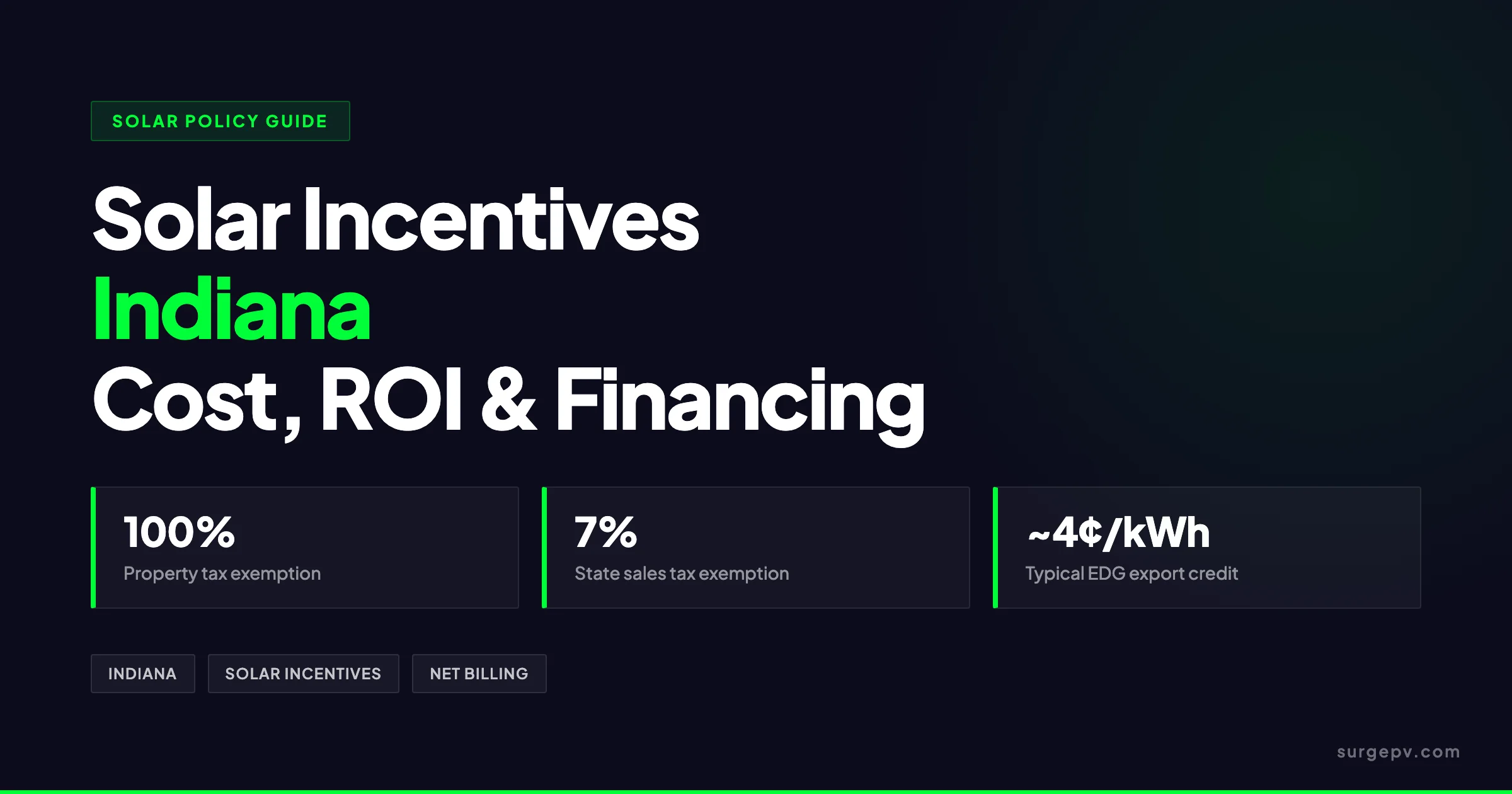
Indiana’s 2026 solar incentives include a 100% property tax exemption, a 7% state sales tax exemption, the Excess Distributed Generation net billing program, and local rebates such as Bloomington’s Green Home Improvement Program. The federal residential tax credit expired after 2025.
In this guide:
- How Indiana’s Excess Distributed Generation program replaced net metering
- State tax exemptions and how much they save
- Utility-specific programs and grandfathering rules
- Federal credit status and who can still claim Section 48E
- Cost, ROI, and payback scenarios by utility territory
- Financing options including loans, leases, and USDA REAP
- Common mistakes and how to avoid them
Indiana Solar Incentives at a Glance — 2026
Indiana is not a one-size-fits-all solar market. The same 8 kW system can have very different economics in Indianapolis, South Bend, Bloomington, or Evansville because the utility export credit and local rebates differ. The table below summarizes the main programs active in 2026.
| Incentive | Type | 2026 Status | Typical Value |
|---|---|---|---|
| Federal residential ITC | Tax credit | Expired | $0 for cash or loan residential purchases |
| Federal Section 48E | Commercial tax credit | Active, deadlines apply | 30% for eligible commercial, lease, or PPA systems |
| Indiana property tax exemption | Tax exemption | Active | 100% of added system value excluded |
| Indiana sales tax exemption | Tax exemption | Active | 7% state sales tax not charged on qualifying equipment |
| Excess Distributed Generation (EDG) | Bill credit | Active | Credits roughly $0.035–$0.045/kWh |
| Legacy net metering | Bill credit | Grandfathered only | Full retail credit through 2032 or 2047 |
| NIPSCO Feed-In Tariff | Production incentive | Closed to new applicants | $0.13–$0.17/kWh for enrolled systems |
| Bloomington BGHIP | Local rebate | Active | 20–40% of project cost, up to $10,000 |
| USDA REAP grants | Rural grant | Active | Up to 50% of eligible project cost for farms and rural small businesses |
Indiana ranked 25th nationally in installed solar capacity by early 2026, with enough solar to power more than 200,000 homes, according to the Solar Energy Industries Association (2026). Growth is steady, but the market is highly sensitive to utility-specific export credit rules.
Key Takeaway
Indiana solar works in 2026, but the math is driven by retail rates, the EDG export credit, and local rebates. The federal residential tax credit is gone, so accurate utility-specific modeling matters more than ever.
The Federal ITC Is Gone for Homeowners. What Still Works?
The 30% federal Residential Clean Energy Credit under Internal Revenue Code Section 25D expired on December 31, 2025. Homeowners who buy solar with cash or a loan in 2026 cannot claim it. This is the single largest change in Indiana’s solar math.
Commercial, third-party-owned, and leased systems may still access the federal Investment Tax Credit under Section 48E. The usual safe-harbor rules apply: construction must begin before July 4, 2026, or the system must be placed in service by December 31, 2027. Lease and power-purchase-agreement providers can pass a portion of that credit through as lower monthly payments. That makes third-party ownership more attractive in Indiana now than it was when the residential ITC was available.
For cash and loan buyers, the federal credit is gone. The rest of the stack must carry the project. That means every installer proposal in Indiana should lead with the property tax exemption, sales tax exemption, EDG credits, and any available local rebate. Do not lead with a federal tax credit that no longer exists.
Indiana State Tax Exemptions
Indiana offers two statewide tax benefits that reduce the effective cost of solar for homeowners and businesses. They are not as visible as a rebate, but they are reliable.
Property tax exemption
Indiana law exempts the added value of a solar energy system on residential property from property tax assessments. The exemption covers systems installed after December 31, 2011, and applies to both residential and commercial installations. It is established under Indiana Code § 6-1.1-12-26, according to the Indiana Department of Local Government Finance (2026).
At Indiana’s average property tax rate of about 0.75%, a $28,000 solar system adds meaningful assessed value. Without the exemption, that could add roughly $125 to $200 per year in property taxes. Over 20 years, the exemption saves about $2,500 to $4,000. Property owners must file Form 18865 with their county auditor. The exemption does not require annual renewal once approved.
Sales tax exemption
Indiana does not charge the 7% state sales tax on qualifying solar energy systems installed for residential use. The exemption applies to solar panels, inverters, racking, wiring, and related components when sold as part of a qualifying solar energy system. On a $28,000 system, that saves $1,960 at the point of purchase. The installer typically applies the exemption at sale using Indiana General Sales Tax Exemption Certificate Form ST-105, according to Palmetto (2026) and EnergySage (2026).
How Indiana’s Excess Distributed Generation Program Works
Indiana replaced traditional net metering with the Excess Distributed Generation (EDG) program under Senate Enrolled Act 309 (2017). The transition completed across the five largest investor-owned utilities by 2022, according to the Indiana Utility Regulatory Commission (2026).
Under EDG, every kilowatt-hour your solar system produces is used in your home first. Any surplus is sent to the grid and credited at the EDG rate. The EDG rate is set at 125% of the utility’s average avoided-cost or wholesale rate from the prior calendar year. That typically works out to 3.5–4.5 cents per kWh for the major utilities. This is well below the retail rate of 14–18 cents per kWh.
| Utility | Approximate EDG Credit | Retail Rate Range | Notes |
|---|---|---|---|
| AES Indiana (Indianapolis) | ~$0.039/kWh | ~$0.14/kWh | Highest interconnection volume in the state |
| CenterPoint Energy (Evansville) | ~$0.039/kWh | ~$0.17/kWh | First IOU to end net metering |
| Duke Energy Indiana | ~$0.041/kWh | ~$0.13/kWh | Serves central and southern Indiana |
| Indiana Michigan Power (I&M) | ~$0.036/kWh | ~$0.16/kWh | Serves northeast Indiana including Fort Wayne |
| NIPSCO (Northern Indiana) | ~$0.038/kWh | ~$0.18/kWh | Also offers the closed Feed-In Tariff |
Source: Solar United Neighbors Indiana EDG guide (2025) and utility filings (2026).
Program caps and sizing rules
EDG applies to renewable energy systems up to 1 MW in capacity. That covers virtually every residential installation and most small commercial systems. The aggregate statewide net metering cap under the old rules was 1.5% of each utility’s peak load, but new EDG customers are not subject to that cap.
System sizing still matters. Because exported energy is credited at a lower rate than consumed energy, a system sized to 120% of annual usage may leave money on the table. Installers should model hourly or interval usage against solar production to maximize self-consumption.
Legacy net metering customers
Customers who installed solar before the end of 2017 keep full retail net metering until July 1, 2047. Customers who installed between 2018 and each utility’s transition date keep full retail net metering until July 1, 2032. After those dates, they also transition to EDG. These grandfathered rules make existing solar homes in Indiana unusually valuable.
Utility Rebates and Local Incentives
Indiana’s most valuable cash incentives are utility-specific or municipal. They also change the most frequently, so verify current funding before quoting a project.
NIPSCO Feed-In Tariff
NIPSCO’s Feed-In Tariff (FIT) is one of the best-known Indiana solar programs. It pays eligible customers for total solar generation, not just exports. Systems between 5 kW and 10 kW earned roughly $0.15–$0.17 per kWh. Systems above 10 kW earned about $0.13–$0.15 per kWh.
As of 2026, the program is closed to new applicants, according to DSIRE (2026). Existing participants continue to receive their contracted rates. FIT earnings are considered taxable income and must be reported.
Bloomington Green Home Improvement Program
The City of Bloomington offers one of the strongest local rebates in Indiana. The Bloomington Green Home Improvement Program (BGHIP) provides cash rebates to Bloomington homeowners who install solar panels or battery storage systems.
- Solar panels: 20% of project cost up to $5,000 for general applicants; 40% up to $10,000 for low-income households.
- Battery storage: 25% of project cost up to $5,000 for general applicants; 40% up to $8,000 for low-income households.
A key advantage is that a simultaneous installation of solar panels and a battery storage system qualifies for both rebates. A low-income Bloomington homeowner who installs both could receive up to $18,000 in combined rebates. Applications must be submitted before the project begins, according to the City of Bloomington (2026).
Rural electric cooperatives and municipal utilities
Customers served by rural electric member cooperatives (REMCs) or municipal utilities are not subject to SEA 309. Some of these providers still offer full retail net metering or more favorable buyback terms. Policies vary by provider, so contact the specific utility before finalizing a system design.
Financing Options in Indiana
Most Indiana homeowners finance solar with one of four structures. Each changes incentive ownership and long-term value.
Cash purchase
A cash purchase preserves full ownership of EDG credits, utility rebates, and any local incentives. It also delivers the highest lifetime savings if the homeowner can afford the upfront cost. The main downside is the longer payback without a federal tax credit.
Solar loan
A solar loan also preserves incentive ownership. Many installers partner with lenders offering solar-specific loans with terms of 10 to 25 years. Because the federal ITC is no longer available, loan payments in 2026 are not offset by a large tax credit. Homeowners should compare the loan payment to their current average electric bill.
Lease or power purchase agreement
A lease or PPA transfers system ownership to a third party. The provider may claim the Section 48E credit and pass part of the savings through as lower monthly payments. The trade-off is that the homeowner usually does not own the EDG credits or local rebates. Always check the contract to see who keeps the incentives and whether the escalator is capped.
USDA REAP for rural farms and small businesses
The USDA Rural Energy for America Program provides grants for agricultural producers and rural small businesses installing solar or solar-plus-storage. IRA-funded rounds can cover up to 50% of eligible project costs, with a typical project cap of $1 million. This is one of the strongest federal incentives still available for rural Indiana properties in 2026.
For a deeper comparison of financing structures, see our solar financing options guide.
Indiana Solar Cost, ROI, and Payback Scenarios
The following examples use illustrative 2026 costs and incentive values. Actual figures depend on location, utility, roof conditions, installer quote, and whether the homeowner qualifies for local programs. The scenarios assume a 25-year system life and 3% annual electricity escalation.
Scenario 1 — 8 kW residential, no local rebate, EDG export
| Item | Amount |
|---|---|
| Gross installed cost ($2.99/W) | $23,920 |
| Indiana sales tax exemption savings | -$1,674 |
| Net cost | $22,246 |
| Annual bill savings (~10 MWh, mostly self-consumed at $0.17/kWh) | $1,530 |
| Annual EDG credits (~1.5 MWh exported at $0.04/kWh) | $60 |
| Payback | 14.0 years |
This scenario shows why self-consumption matters. The same system with a battery that raises self-consumption from 75% to 90% can shorten payback by 1 to 2 years.
Scenario 2 — 8 kW residential, Bloomington BGHIP low-income rebate
| Item | Amount |
|---|---|
| Gross installed cost ($2.99/W) | $23,920 |
| Indiana sales tax exemption savings | -$1,674 |
| BGHIP low-income rebate (40% up to $10,000) | -$9,568 |
| Net cost | $12,678 |
| Annual bill savings plus EDG credits | $1,590 |
| Payback | 8.0 years |
Bloomington’s rebate changes the project entirely. It is one of the few Indiana local incentives that can compete with the former federal ITC.
Scenario 3 — 8 kW residential, REMC territory with retail net metering
| Item | Amount |
|---|---|
| Gross installed cost ($2.99/W) | $23,920 |
| Indiana sales tax exemption savings | -$1,674 |
| Net cost | $22,246 |
| Annual bill savings plus retail net metering credits (~10 MWh) | $1,700 |
| Payback | 13.1 years |
This scenario assumes the customer is served by a rural electric cooperative that still offers retail net metering. The payback is only slightly better than the EDG scenario because Indiana retail rates are moderate.
Scenario 4 — 150 kW commercial rooftop, Section 48E eligible
| Item | Amount |
|---|---|
| Gross installed cost ($2.20/W) | $330,000 |
| Section 48E tax credit (if eligible) | -$99,000 |
| Indiana sales tax exemption savings | -$23,100 |
| Net cost | $207,900 |
| Annual bill savings and demand reduction | $42,000 |
| Annual EDG credits | $4,500 |
| Payback | 4.5 years |
Commercial projects in Indiana can still be very attractive because they can use Section 48E and the sales tax exemption. Demand charge reduction also adds value for commercial customers.
How to Stack Indiana Solar Incentives in the Right Order
The order in which you apply incentives matters. The correct sequence is:
- Confirm federal credit eligibility. For 2026 residential cash or loan purchases, the Section 25D credit is not available. Leases and PPAs may still benefit from Section 48E claimed by the system owner.
- Apply for local rebates before installation. Bloomington BGHIP requires pre-approval. Retroactive applications are usually void.
- Subtract upfront rebates before calculating any commercial tax credit. The tax credit basis is generally the amount paid after rebates.
- Claim the sales tax exemption at purchase. Most installers handle this automatically with Form ST-105.
- File Form 18865 for the property tax exemption after installation. The county auditor excludes the added value once the form is processed.
- Enroll in the EDG program after interconnection. The utility will switch the meter to a bidirectional meter and start crediting exports.
Common Mistakes and Misconceptions
Indiana’s patchwork incentive structure means mistakes are costly. Here are the most common errors we see from installers and customers.
Quoting the expired federal ITC
The most expensive error is telling a homeowner they can claim the 30% federal tax credit on a cash or loan purchase in 2026. Section 25D ended on December 31, 2025. Only commercial, lease, or PPA structures can still access federal credits.
Treating NIPSCO FIT as available
The NIPSCO Feed-In Tariff is closed to new applicants. Do not promise FIT rates in a 2026 proposal unless the customer is already enrolled.
Oversizing for export
Indiana’s EDG program credits exports at a lower rate than retail electricity. A system sized to 120% of annual consumption may look good in a simple production estimate but leaves value on the table. Size for what the household uses.
Ignoring utility territory
An 8 kW system in NIPSCO territory can have a materially different payback than the same system in Duke Energy Indiana or AES Indiana territory. The retail rate and EDG credit both differ. Always model the customer’s actual utility and rate schedule.
Missing the Bloomington application deadline
Bloomington BGHIP requires pre-approval. Homeowners who install first and apply later may be denied. Submit the application before work begins.
Assuming all co-ops offer net metering
Some rural electric cooperatives offer retail net metering, but others do not. Contact the specific cooperative before promising export credit value.
Conclusion
Indiana’s solar incentive stack in 2026 is a mix of stable statewide benefits and limited local programs. The federal residential tax credit is gone. The value now comes from the property tax exemption, sales tax exemption, EDG credits, and local rebates like Bloomington BGHIP.
For solar professionals, the competitive edge is the ability to model each utility territory correctly. The proposal that wins in Indiana shows the homeowner exactly how the EDG credit, local rebates, and financing structure interact. Model these factors over 25 years.
SurgePV’s solar design software and generation and financial tool let you build Indiana-specific proposals. They reflect real utility rates, EDG credits, and rebate values. For installers scaling in the state, our guide for solar installers covers proposal automation and compliance workflows.
Three actions to take now:
- Confirm utility territory and current EDG rates before every quote — territory drives payback more than panel choice.
- Apply for local rebates before installation begins — most programs reject retroactive applications.
- Size for self-consumption, not maximum export. The EDG export credit is lower than the retail rate, so every exported kWh is worth less than one used on site.
Frequently Asked Questions
What solar incentives are available in Indiana in 2026?
Indiana homeowners can use a 100% property tax exemption on added system value, a 7% state sales tax exemption on qualifying solar equipment, and the Excess Distributed Generation (EDG) net billing program. Local programs include the Bloomington Green Home Improvement Program, which offers 20–40% rebates. The federal residential tax credit expired for systems placed in service after December 31, 2025.
Does Indiana have net metering for solar in 2026?
Traditional 1:1 net metering is no longer available for new customers of Indiana’s five largest investor-owned utilities. It was replaced by the Excess Distributed Generation (EDG) program, which credits exported solar at roughly 125% of the utility’s avoided-cost rate. Customers of municipal utilities and rural electric cooperatives may still offer net metering. Systems installed before 2018 keep full net metering until July 1, 2047, and systems installed between 2018 and each utility’s transition date keep it until July 1, 2032.
Is the federal solar tax credit still available in Indiana in 2026?
No. The 30% federal Residential Clean Energy Credit under Internal Revenue Code Section 25D expired for homeowner-owned systems placed in service after December 31, 2025. Commercial, leased, and power-purchase-agreement systems may still qualify for Section 48E. Construction must begin before July 4, 2026, or the system must be placed in service by December 31, 2027.
How does Indiana’s Excess Distributed Generation program work?
Indiana’s EDG program credits solar customers for surplus electricity sent to the grid at 125% of the utility’s average avoided-cost or wholesale rate. For the five large investor-owned utilities, this typically works out to roughly 3.5–4.5 cents per kWh. The credit is lower than the retail electricity rate, which makes self-consumption more valuable than export. Credits roll over month to month. System size is capped at 1 MW.
What is the NIPSCO Feed-In Tariff program?
NIPSCO’s Feed-In Tariff (FIT) was a performance-based program that paid solar customers for total generation, not just exports. Systems between 5 kW and 10 kW earned roughly $0.15–$0.17 per kWh, while larger systems earned about $0.13–$0.15 per kWh. As of 2026, the program is closed to new applicants. Existing enrolled participants continue to receive their contracted payments.
Does Indiana have a state solar tax credit?
No. Indiana does not offer a state income tax credit for residential solar. The main state-level benefits are the 100% property tax exemption on added home value and the 7% sales tax exemption on qualifying solar equipment. Some local utilities and municipalities offer additional rebates.
Will solar panels increase my property taxes in Indiana?
No. Indiana Code § 6-1.1-12-26 exempts the added value of a solar energy system from property tax assessments. The system can still add market value to the home, but the added assessed value is excluded. Property owners must file Form 18865 with their county auditor to claim the exemption.
What is the Bloomington Green Home Improvement Program?
The Bloomington Green Home Improvement Program (BGHIP) offers rebates to Bloomington homeowners who install solar panels or battery storage. The general population receives 20% of solar project cost up to $5,000, while low-income households qualify for 40% up to $10,000. Battery rebates are also available. Applications must be submitted before the project begins.
What is the typical solar payback period in Indiana in 2026?
Payback periods for well-designed residential solar systems in Indiana typically range from 9 to 14 years in 2026 without the federal residential tax credit. Systems in territories with better export credits or local rebates can pay back closer to 8 to 10 years. Results depend on utility territory, system size, self-consumption rate, and financing cost.
What is the most common mistake when sizing a solar system in Indiana?
The most common mistake is oversizing for export. Because Indiana’s EDG program credits exported electricity at a lower rate than retail electricity, excess production is worth less than self-consumed production. The safer design rule is to size the system for roughly 90–100% of annual usage and treat exports as a bonus. Pairing solar with battery storage can increase self-consumption.
Where this fits
This article is part of SurgePV's Solar Incentives & Policy hub, which works through the topic from first principles to the decisions a project team actually has to make.
