

Quick Answer
Portugal's 2026 solar incentives focus on self-consumption under the UPAC framework. Active tools include Environmental Fund/PRR grants (when open), an IRS exemption on surplus income up to €1,000/year, a 50% IMI discount for renewable-energy buildings, and net billing at 90% of MIBEL prices. The reduced 6% VAT expired in July 2025, so residential solar now carries 23% VAT.
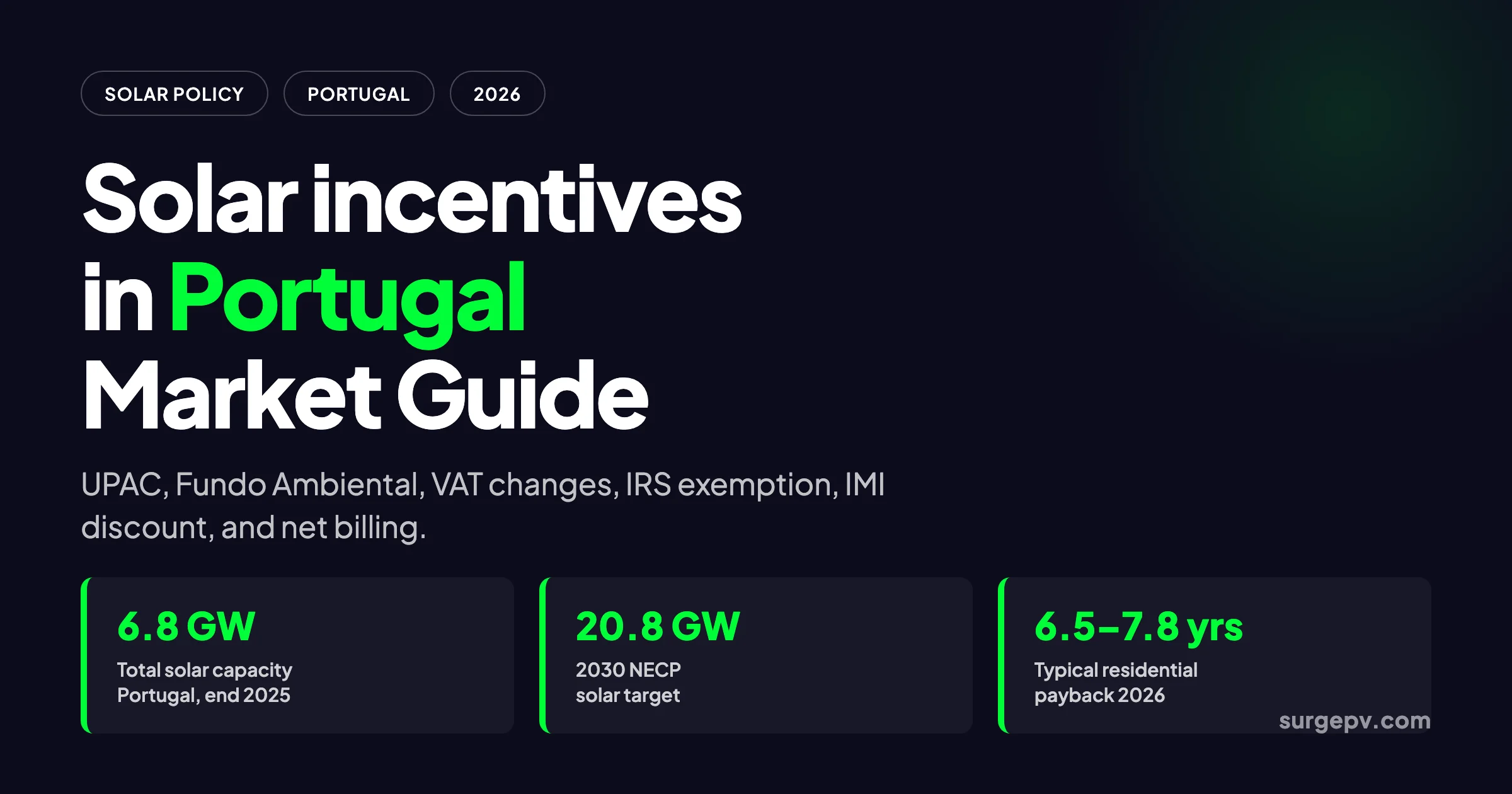
Portugal’s solar market reached 6.8 GW by the end of 2025, up from roughly 5.7 GW a year earlier. The country now gets about one-sixth of its electricity from solar, and the government wants 20.8 GW by 2030. Yet the incentive story is not one of endlessly generous subsidies. It is a story of transition: generous capital grants have closed, the reduced VAT rate has expired, and the real financial advantage in 2026 increasingly comes from designing for self-consumption, not from chasing headline rebates.
This guide is a market-focused manual for homeowners, installers, EPCs, and investors who need to understand what is actually active in Portugal in 2026. It covers the UPAC legal framework, the Environmental Fund and Recovery and Resilience Plan programs, tax incentives, net billing mechanics, commercial and industrial options, and the common mistakes that cost money. For the technical side of Portuguese project documentation, see our guide to solar drafting services in Portugal. For the broader European picture, see our European solar incentives guide.
If you are sizing systems or preparing proposals for Portuguese clients, a solar design platform with local tariffs and incentive modeling can save hours on every project. Model payback, self-consumption ratios, and tax effects automatically, then generate solar proposals in minutes. Check pricing or book a demo to see how SurgePV handles Portugal.
Quick Answer
Portugal’s 2026 solar incentives center on self-consumption under the UPAC framework. Active tools include Environmental Fund/PRR grants (when calls are open), an IRS exemption on surplus income up to €1,000 per year, a 50% IMI discount for renewable-energy buildings, and net billing at 90% of MIBEL prices. The reduced 6% VAT expired in July 2025, so residential solar now carries 23% VAT.
In this guide:
- Latest 2026 status of every active Portuguese solar incentive
- The legal foundation: UPAC, Decree-Law 162/2019, and net billing
- Environmental Fund and Recovery and Resilience Plan programs
- Tax incentives: VAT, IRS, and IMI
- Commercial, industrial, and utility-scale support
- Three real-world stacking examples with payback impact
- Common mistakes and how to avoid them
Latest Updates: Portugal Solar Incentives 2026
The Portuguese solar policy environment changed materially in 2025. The reduced VAT rate expired, the main residential capital-grant program closed, and the government announced a new voucher-style support mechanism for 2026. For installers and homeowners, the practical effect is that proposals must now be built around the current tax rules and self-consumption economics, not around grant assumptions that may no longer exist.
Portugal Solar Incentive Status — June 2026
| Incentive | Type | Status | Key Terms |
|---|---|---|---|
| UPAC self-consumption framework | Regulatory | Active | Decree-Law 162/2019, updated by DL 15/2022 |
| Net billing surplus compensation | Market-based credit | Active | 90% of MIBEL price, typically 3.6–5.4 ct/kWh |
| IRS exemption on surplus income | Income tax break | Active | Up to €1,000/year, systems up to 1 MW |
| IMI discount for renewable-energy buildings | Property tax break | Active where adopted | 50% discount under Article 44-A of EBF |
| Edifícios +Sustentáveis capital grant | Capital grant | Closed to new applications | Reimbursed up to 85%, capped at €2,500 per system |
| New voucher-style solar support | Capital grant | Announced, not yet open | Announced January 2026, details pending |
| E-LAR efficient equipment program | Equipment voucher | Active | Electric cookers, ovens, water heaters; not PV panels |
| Bairros +Sustentáveis | Building renovation grant | Active for eligible entities | Up to 100% for social housing, municipalities, IPSS |
| CER / collective self-consumption PRR grant | Capital grant | Active for approved projects | Up to 100% public, 70% residential, 50% services; €500k cap |
| Reduced 6% VAT on residential solar | VAT break | Expired July 2025 | Standard 23% VAT now applies |
Key Changes Since 2025
July 2025 — VAT rate change. The reduced 6% VAT rate for residential solar installations expired. Most standalone residential solar systems are now subject to the standard 23% VAT. This is the single biggest change in household solar economics and adds roughly €600–€900 to a typical 5 kW system.
2024 — Closure of Edifícios +Sustentáveis. The Programa de Apoio a Edifícios +Sustentáveis, which reimbursed up to 85% of solar panel costs capped at €2,500, closed to new applications. The government focused remaining funds on clearing the backlog of already-submitted applications.
January 2026 — New voucher program announced. The Minister of Environment and Energy announced a new voucher-style support program for residential solar self-consumption, similar in format to the E-LAR program. No opening date, budget, or grant level had been published at the time of writing.
Ongoing — Energy community funding. The Environmental Fund continues to disburse Recovery and Resilience Plan funding for Renewable Energy Communities and collective self-consumption. The focus is shifting from individual household rebates toward shared, community-scale projects.
Key Takeaway
2026 is a post-grant transition year for household solar in Portugal. The most reliable incentives are now the IRS exemption on surplus income, the IMI property-tax discount, and net billing value. Anyone planning a project should verify the current VAT rate and check fundoambiental.pt for open calls before assuming a grant is available.
Why Portugal’s Incentive Stack Matters in 2026
Portugal has some of Europe’s best solar resources, with annual solar irradiation ranging from 1,500 kWh/m² in the north to over 2,000 kWh/m² in the Algarve and Alentejo. The country also has a young, fast-growing distributed generation market. The gap between resource and deployment is increasingly a question of financing, administrative clarity, and installer capability rather than sunlight or technology.
The contrast between regions is sharp. A 5 kWp south-facing rooftop in Faro can produce 1,900–2,100 kWh per kWp per year. The same system in Porto or Braga might produce 1,300–1,500 kWh per kWp per year. That 40% production difference directly affects payback, yet many national incentive discussions treat Portugal as a single market. Installers who model by location close more business.
Market Size and Targets
Portugal reached 6.8 GW of total solar capacity by the end of 2025, an increase of more than 1 GW during the year, according to IEA-PVPS (2026). Solar PV generated about 8.7 TWh, roughly 16% of total electricity generation and close to one-fifth of renewable generation.
Between December 2024 and May 2025 alone, Portugal added 499 MW of solar, split between 264 MW of utility-scale capacity and 235 MW of distributed systems, according to APREN data reported by PV Magazine (2025). Distributed generation is expanding steadily, but the pace is not fast enough to meet the 2030 target.
Portugal’s National Energy and Climate Plan 2030 (DGEG, 2024/2025) targets 20.8 GW of installed solar PV by 2030. With roughly 6.8 GW already online, Portugal must add about 2.6 GW per year for the next five years. That is more than double the 2025 installation rate.
What the Transition Means for Incentives
The shift from capital grants to self-consumption and community-scale support is deliberate. Capital grants are expensive and politically vulnerable. Net billing, tax exemptions, and community programs scale more predictably and align household behavior with grid needs.
For installers, this means proposals must emphasize avoided retail electricity purchases rather than grant reimbursement. A kWh consumed on site is worth 16–24 cents. A kWh exported to the grid is worth 3.6–5.4 cents. The financial case rests on self-consumption ratio, not system size.
For homeowners, the message is similar: the best 2026 incentive is a correctly sized system paired with time-of-use awareness. A solar design platform that models Portuguese bi-horário and tri-horário tariffs alongside UPAC net billing can show the real payback, not a grant-dependent estimate.
The Legal Foundation: UPAC and Decree-Law 162/2019
Every Portuguese solar incentive is built on the same legal base: Decree-Law 162/2019, updated by Decree-Law 15/2022. This law created the UPAC (Unidade de Produção para Autoconsumo) framework and replaced an earlier regime that was slower and less favorable to small prosumers.
What Decree-Law 162/2019 Changed
| Before DL 162/2019 | After DL 162/2019 |
|---|---|
| Heavy administrative licensing for most systems | Simplified prior notification for systems up to 30 kW |
| No clear surplus compensation rule | Net billing at 90% of MIBEL price |
| Limited collective self-consumption | Collective self-consumption and energy communities enabled |
| High connection barriers | Simplified grid connection for small systems |
UPAC Size Categories and Registration
UPAC registration thresholds determine how much paperwork a project needs. The rules are administered by DGEG (Direção-Geral de Energia e Geologia) through the SERUP portal.
| System Size | Procedure | Key Requirements |
|---|---|---|
| Up to 700 W, no grid export | Exempt from prior control | Optional registration; simple installation record |
| 700 W to 30 kW | Mera Comunicação Prévia (prior notification) | Certified installer, SERUP notification, usually no fee |
| 30 kW to 1 MW | Registo Prévio + operating certificate | Full technical documentation, inspection |
| Above 1 MW | Production license + capacity title | Full licensing, environmental opinions, grid allocation |
For most residential systems, the process is a simple prior notification submitted by the certified installer. The homeowner does not need to hire an engineer or pay a DGEG fee. Systems above 30 kW enter a more formal regime with inspection and certification requirements.
Net Billing in Practice
Under DL 162/2019, surplus solar energy is settled at 90% of the Iberian Electricity Market (MIBEL) day-ahead price, as described by the European Commission Clean Energy for EU Islands portal. When market prices were 4–6 cents per kWh, surplus remuneration ranged from 3.6 to 5.4 cents per kWh.
Retail electricity prices in Portugal typically range from 16 to 24 cents per kWh depending on the tariff and supplier. This gap means self-consumption is worth roughly three to five times more than export. A system sized to maximize self-consumption will usually deliver a shorter payback than a larger system that exports heavily.
The export settlement is handled by the electricity supplier, not DGEG. The prosumer signs a surplus purchase contract or uses a market facilitator. Unused credits generally do not roll over beyond the settlement period defined in the supply contract.
Environmental Fund and Recovery and Resilience Plan Programs
Portuguese solar grants flow mainly through the Environmental Fund (Fundo Ambiental), now managed by the Agência para o Clima. Most recent programs are financed by Portugal’s Recovery and Resilience Plan (Plano de Recuperação e Resiliência, PRR).
Programa de Apoio a Edifícios +Sustentáveis (Closed)
The best-known residential solar grant in Portugal was the Programa de Apoio a Edifícios +Sustentáveis. It reimbursed up to 85% of eligible investment costs, with a cap of €2,500 for solar PV systems and higher caps when storage or other efficiency measures were included. The program was massively oversubscribed and closed to new applications in 2024.
Some applications submitted before closure are still being processed. Homeowners who already applied should track their status on fundoambiental.pt. New applicants must look elsewhere.
New Voucher-Style Solar Support (Announced 2026)
In January 2026, the government announced a new support program for residential solar self-consumption. Early indications are that it will use a voucher format similar to the E-LAR program, where beneficiaries receive an electronic voucher and redeem it with qualified installers.
At publication date, the following details were not yet released:
- Opening date for applications
- Total budget
- Grant percentage or absolute caps
- Eligibility criteria (income, property type, system size)
- Whether storage is included
The safe assumption is that the program will be oversubscribed quickly, like previous Environmental Fund calls. Homeowners should prepare documentation in advance and apply as soon as the call opens.
Programa E-LAR
E-LAR is active but does not directly subsidize photovoltaic panels. It provides vouchers for efficient electric equipment that replaces gas appliances: electric cookers, ovens, and water heaters. The program aims to reduce gas consumption and is part of the same PRR energy-efficiency component that funded solar in previous years.
Homeowners bundling solar with a heat-pump water heater may benefit from E-LAR for the water heater while using other mechanisms for the PV system. The programs are separate and must be applied for separately.
Bairros +Sustentáveis
The Bairros +Sustentáveis program targets energy-poverty alleviation in social housing, historic districts, and urban rehabilitation areas in the Lisbon and Porto metropolitan areas. It is aimed at municipalities, municipal housing companies, IPSS (social solidarity institutions), and resident associations, not individual homeowners.
Eligible interventions include insulation, efficient windows, heat pumps, and solar panels. Funding can reach up to 100% of eligible costs, capped at €15,000 per dwelling. Individual homeowners cannot apply directly, but residents of eligible neighborhoods can encourage their municipality or association to apply.
Renewable Energy Communities and Collective Self-Consumption
The strongest remaining direct grant pathway for solar in Portugal is through Renewable Energy Communities (CER) and collective self-consumption (autoconsumo coletivo) projects funded by the PRR. These programs support shared generation among households, businesses, and public buildings.
Support rates under the CER/ACC call, according to the Energy Communities Facility country fiche (2025), are:
| Building Type | Maximum Grant Share | Notes |
|---|---|---|
| Public buildings | Up to 100% | Includes PV and storage |
| Residential buildings | Up to 70% | Includes PV and storage |
| Service buildings | Up to 50% | Includes PV and storage |
| All project types | Maximum €500,000 per production unit | Studies capped at 10%, software/platforms at 25% |
| Former coal regions | +15% bonus | Applies to projects in regions such as Sines |
The program also allows up to 10% of eligible investment for studies and consulting, and up to 25% for software and smart platforms. A 15% bonus is available for projects in former coal regions, supporting Portugal’s coal phaseout strategy.
For installers and community organizers, CERs represent a growing segment. A shared rooftop system serving 20 apartments can access higher grant rates than individual systems and reduce per-unit fixed costs. Tools that model multi-owner energy sharing and shadow analysis at the building level are increasingly useful here.
Tax Incentives
Tax relief is now the most stable part of the Portuguese solar incentive stack. The three main tools are VAT treatment, IRS exemption on surplus income, and the IMI property-tax discount.
VAT: The Big Change
The most important tax fact for residential solar in 2026 is that the reduced 6% VAT rate expired in July 2025. The standard 23% VAT now applies to most standalone residential solar installations.
On a typical 5 kW system costing €8,000 before tax, the difference between 6% and 23% VAT is €1,088. That single change can add 1–2 years to simple payback.
Some installers continue to quote the 6% rate or structure invoices to try to capture the lower rate. The Portuguese tax authority can reassess invoices that do not meet the legal conditions. Homeowners should ask for the legal basis in writing and confirm it with a tax advisor before proceeding.
IRS Exemption on Surplus Income
Individual self-consumers and small businesses with renewable-energy systems up to 1 MW can exempt income from surplus electricity sales from personal income tax (IRS), up to €1,000 per year. This measure was introduced in the 2023 State Budget and remains active.
The exemption applies only if the surplus energy sold does not exceed the energy purchased from the grid during the same period. In practice, this means most properly sized residential systems will not hit the cap. A system that exports more than it imports loses the exemption on the excess.
This is not a capital grant. It is a tax shield on small export revenues. For a system that exports 1,500 kWh per year at 4.5 cents per kWh, the annual export income is €67.50, well below the €1,000 threshold. The exemption is valuable but modest in absolute terms.
IMI Discount for Renewable-Energy Buildings
Under Article 44-A of the EBF (Estatuto dos Benefícios Fiscais), buildings used for renewable-energy production can qualify for a 50% discount on IMI, the annual municipal property tax. The discount must be adopted by the municipal assembly; it is not automatic in every municipality.
IMI rates for urban properties range from 0.3% to 0.45% of the property’s taxable value (VPT). A 50% discount on a property with a VPT of €200,000 and a 0.3% rate saves €300 per year. Over 10 years, that is €3,000, comparable to the old Edifícios +Sustentáveis grant cap.
Homeowners should check with their câmara municipal whether the discount ordinance has been passed and how to apply. The application is usually submitted through the municipal tax office or the Finanças portal.
Corporate Tax Considerations
Commercial and industrial solar assets can be depreciated under standard corporate tax (IRC) rules. Companies can also deduct input VAT on business installations. For C&I projects, these tax effects are often more significant than the household IRS exemption.
Larger projects may also benefit from regional investment incentives in interior areas or former industrial zones. These are project-specific and require advance structuring with a tax advisor.
How to Apply for Residential Solar Incentives in Portugal
The application sequence matters. Getting the order wrong can void eligibility or delay reimbursement by months. The following steps apply to a standard residential UPAC system between 700 W and 30 kW.
Step 1 — Confirm Eligibility and System Size
Start with an accurate load profile. Collect 12 months of electricity bills to understand annual consumption, peak demand, and time-of-use patterns. A system sized to cover 70–80% of annual consumption will usually maximize self-consumption ratio without excessive export.
Check whether the property is in a municipality that has adopted the IMI discount ordinance. This is a separate check from the solar installation itself but can be worth hundreds of euros per year.
Step 2 — Choose a Certified Installer
Portuguese law requires a certified installer for UPAC systems above 700 W that connect to the grid. The installer assumes technical responsibility and submits the SERUP notification. Ask for:
- DGEG installer registration number
- Proof of professional liability insurance
- Reference projects of similar size
- Written quote separating equipment, labor, and VAT
An uncertified installer can invalidate insurance, grid connection, and future grant eligibility.
Step 3 — Verify VAT Treatment
Confirm whether the quoted VAT rate is legally supportable. For most standalone residential solar systems, the correct rate is 23%. The reduced 6% rate expired in July 2025. If the installer quotes 6%, ask for the specific legal basis and confirm with a tax advisor.
Bundled projects that include broader energy-efficiency works may qualify for different VAT treatment, but the conditions are strict. Do not assume a bundled quote automatically qualifies.
Step 4 — Submit the UPAC Notification
For systems up to 30 kW, the installer submits the Mera Comunicação Prévia through the DGEG SERUP portal. The notification includes technical data on the panels, inverter, capacity, and connection arrangement. Homeowners should receive a registration confirmation.
Systems above 30 kW require full registration and an operating certificate. Systems above 1 MW require a production license.
Step 5 — Arrange Grid Connection and Metering
After SERUP notification, E-REDES (or the relevant distribution operator) installs or configures a bidirectional smart meter. For most low-voltage residential customers, this is done without direct cost. The old meter must be replaced before surplus export can be measured correctly.
Without this step, injected energy may be counted as consumption, increasing the bill instead of reducing it.
Step 6 — Apply for Grants and Tax Discounts
If a grant call is open, submit the application before or immediately after installation, depending on the program rules. The old Edifícios +Sustentáveis program required pre-approval before works began. Future voucher programs will likely follow the same pattern.
After installation, apply for the municipal IMI discount if the local ordinance exists. The application is typically submitted to the câmara municipal or through the Finanças portal with proof that the system produces renewable energy.
Step 7 — Set Up Surplus Settlement
Choose an electricity supplier or market facilitator for surplus compensation. Net billing pays 90% of MIBEL, but the actual contract terms, settlement period, and minimum thresholds vary by supplier. Compare offers from at least two suppliers before signing.
Step 8 — Track Annual Tax Effects
The IRS exemption on surplus income up to €1,000 per year is declared on the annual tax return. Keep records of export volume, grid purchases, and supplier payments. If surplus exports exceed grid purchases, the exemption is lost on the excess.
Pro Tip — Prepare Before the Call Opens
Environmental Fund calls often close within days or weeks due to high demand. Prepare the property deed, NIF, recent electricity bills, installer quote, and technical system specification in advance. The speed of submission frequently determines whether a project receives funding.
Commercial, Industrial, and Utility-Scale Incentives
Residential self-consumption gets the most attention, but the majority of Portuguese solar capacity is utility-scale. C&I and large-scale projects operate under different incentive logic.
C&I Self-Consumption Growth
The distributed generation segment added 235 MW between December 2024 and May 2025, according to APREN. C&I rooftops are a major part of that growth. These projects typically size systems to match daytime load and avoid the low export values of net billing.
Available tools for C&I projects include:
- UPAC registration up to 1 MW
- IRS exemption on surplus income up to €1,000 per year per taxpayer
- IMI discount for renewable-energy buildings
- Accelerated depreciation under IRC
- Full VAT deduction on business installations
- Power purchase agreements (PPAs) for off-site supply
For C&I installers, the financial model is built around avoided grid consumption and hedged electricity prices, not grants. Accurate load profiling and shading analysis are essential before committing capital.
Utility-Scale Solar
Utility-scale projects above 1 MW require a production license, environmental impact assessment if thresholds are crossed, and grid-capacity allocation. They do not use the UPAC self-consumption framework. Revenue comes from merchant market sales, corporate PPAs, or auction-based contracts for difference.
Portugal has held competitive auctions for solar capacity, with some projects awarded without subsidy. Auction winners typically receive a contract for difference or a guaranteed tariff for a defined period. Merchant projects sell directly into the MIBEL wholesale market and are exposed to price volatility.
Corporate PPAs are becoming a major route to offtake. A factory or data center without suitable rooftop space can sign a long-term PPA with a solar park and receive a fixed or indexed price per MWh. The buyer does not own the asset and does not register a UPAC, but it secures price certainty.
Major plants include the 220 MWp Solara 4 in Alcoutim and the 1,200 MW Fernando Pessoa project under development by Iberdrola and Prosolia Energy. These projects require bankable yield studies, environmental licenses, and grid connection agreements that can take several years to finalize.
Storage Incentives
Portugal is also scaling battery storage. A 2024 PRR call supported around 500 MW of new storage with roughly €99.75 million in grants, and an additional €60 million was allocated in 2025, according to the Lexology/Macedo Vitorino energy storage overview (2025). A 750 MVA system-services auction was planned for early 2026.
For residential and C&I solar-plus-storage projects, storage is not directly subsidized by an open universal program in 2026, but it can be included in CER/ACC grants and in some municipal or PRR efficiency programs.
How to Stack Incentives: Three Real-World Scenarios
The following examples are illustrative, based on typical 2026 costs and incentive rates. Actual figures depend on system size, location, installer quote, electricity tariff, and whether the new voucher program is open.
Scenario 1 — 5 kWp Residential, Lisbon
| Item | Amount |
|---|---|
| Gross installed cost (excl. VAT) | €8,000 |
| VAT at 23% | €1,840 |
| Total invoice | €9,840 |
| Annual electricity bill saving | €1,100 |
| Annual surplus export income (€0.045/kWh × 800 kWh) | €36 |
| Annual IMI discount (50% of €250) | €125 |
| IRS exemption on surplus | Full, below €1,000 cap |
| Effective first-year benefit | €1,261 |
| Simple payback | 7.8 years |
Without the IMI discount, payback stretches to roughly 8.5 years. If the new voucher program opens at €1,500 for a 5 kW system, payback drops to approximately 6.6 years.
Scenario 2 — 5 kWp Residential, Algarve
| Item | Amount |
|---|---|
| Gross installed cost (excl. VAT) | €7,500 |
| VAT at 23% | €1,725 |
| Total invoice | €9,225 |
| Annual electricity bill saving | €1,350 |
| Annual surplus export income (€0.045/kWh × 700 kWh) | €32 |
| Annual IMI discount (50% of €200) | €100 |
| Simple payback | 6.5 years |
Higher irradiance in the Algarve produces more self-consumed kWh and shortens payback by roughly 1.3 years compared with Lisbon, all else equal. This is why location-specific yield modeling matters in Portuguese proposals.
Scenario 3 — 100 kWp C&I Rooftop, Porto
| Item | Amount |
|---|---|
| Gross installed cost (excl. VAT) | €85,000 |
| VAT at 23% | €19,550 |
| Recoverable VAT | −€19,550 |
| Net upfront cost | €85,000 |
| Annual avoided electricity cost | €22,000 |
| Annual surplus export income | €1,200 |
| IRC depreciation benefit (year one, illustrative) | −€8,500 |
| IMI discount (50% of €1,500) | −€750 |
| Net effective cost after tax effects | €75,750 |
| Simple payback | 3.4 years |
C&I projects rely less on household-style subsidies and more on avoided cost, tax depreciation, and full VAT deductibility. Payback can be under 4 years for a well-matched load, even without a capital grant.
Common Mistakes and Misconceptions
Even experienced installers lose money on Portuguese projects by mishandling the incentive sequence. Here are the most common errors.
Assuming the 6% VAT Rate Still Applies
This is the most frequent post-2025 mistake. The reduced rate expired in July 2025. Any proposal that assumes 6% without a specific legal basis will create a pricing dispute. The safe assumption for standalone residential solar is 23%.
Oversizing for Export
Because net billing pays only 3.6–5.4 cents per kWh while retail rates are 16–24 cents per kWh, every oversized kWp wastes capital. A system sized for 70–80% self-consumption ratio usually outperforms a larger system with high export.
Missing DGEG Registration
Systems between 700 W and 30 kW must be registered through the SERUP portal before exporting to the grid. Without registration, E-REDES may not validate export, and the old meter may count injected energy as consumption. Registration is the installer’s responsibility, but the homeowner should request the registration confirmation.
Applying for Closed Programs
The Edifícios +Sustentáveis program is closed to new applications. Any installer still marketing it as an active grant is either misinformed or misleading. Always verify the current call status on fundoambiental.pt.
Ignoring the IMI Discount
Many homeowners apply for grants but forget to request the IMI discount from their municipality. The discount requires a separate application after installation and can be worth several thousand euros over the system lifetime.
Underestimating Export Settlement Timing
Surplus income is settled according to the supply contract, not instantaneously. Some suppliers pay monthly, others quarterly. The IRS exemption also applies per tax year. Homeowners should model cash flow conservatively and not treat export income as immediate reimbursement.
Portugal Solar Incentives Outlook for 2026–2027
The next 18 months will determine whether Portugal’s residential solar market accelerates or stalls. Three factors are worth watching closely.
The New Voucher Program
The voucher-style solar support announced in January 2026 is the most important near-term variable. If the budget is large and the application process is simple, it could reignite residential growth. If the budget is small or the process is complex, the market will continue its post-grant adjustment. The key signal will be the grant cap per kW or per system and whether storage is included.
Grid Integration and Storage
The April 2025 blackout and subsequent grid-stability discussions have pushed storage up the policy agenda. Portugal committed over €400 million to grid modernization and plans to scale battery capacity from 13 MW to 750 MW through a system-services auction. For distributed solar, this could eventually create new revenue streams for battery owners who provide grid services, though the residential framework is not yet mature.
Energy Communities
Renewable Energy Communities are the structural bet. Portugal aims for CERs to generate 21% of the country’s solar energy by 2030, up from 8% in 2024. If that target is taken seriously, future funding will shift from individual household rebates toward community-scale grants. Installers who learn to structure shared projects, split benefits among members, and navigate CER governance will be better positioned than those focused only on single-family rooftops.
Conclusion
Portugal’s solar incentive framework in 2026 is leaner than it was two years ago, but it is still structurally supportive. The capital-grant era of Edifícios +Sustentáveis has ended, the reduced VAT rate has expired, and the next wave of support is likely to come through vouchers and community-scale programs. The strongest household projects will combine a correctly sized UPAC system, the IRS surplus exemption, the IMI property-tax discount, and a design that maximizes self-consumption.
For solar professionals, the competitive edge is no longer just installation price. It is the ability to model Portuguese tariffs, net billing, VAT, and tax effects accurately, then present them in a clear proposal. Tools like Clara AI and SurgePV’s generation and financial tool can automate that workflow for Portuguese projects.
Three actions to take now:
- Verify VAT and grant status before quoting — assume 23% VAT for standalone residential solar and check fundoambiental.pt for open calls.
- Size for self-consumption — in Portugal, avoided retail kWh are worth far more than exported kWh under net billing.
- Register correctly and claim the IMI discount — DGEG SERUP registration and municipal IMI applications are separate steps that many homeowners miss.
For the broader European context, see our European solar incentives guide. For Spanish-specific rules, see solar incentives in Spain. For Italian incentives, see Italy Superbonus solar.
Frequently Asked Questions
What solar incentives are available in Portugal in 2026?
Active solar incentives in Portugal for 2026 include Environmental Fund/PRR grants (when calls are open), an IRS income-tax exemption on surplus solar income up to €1,000 per year, a 50% IMI property-tax discount for buildings used for renewable-energy production, and net billing that pays 90% of the MIBEL market price for exported kWh. A new voucher-style solar support program was announced in January 2026 but had not opened for applications at publication date.
Did the 6% VAT on solar panels end in Portugal?
Yes. The reduced 6% VAT rate for residential solar installations in Portugal expired in July 2025. Since then, most residential solar systems are invoiced at the standard 23% VAT rate, adding roughly €600 to €900 to a typical 5 kW system and extending simple payback by 1–2 years. Some installers still quote the old rate, but invoices issued under the expired rate can be reassessed by the tax authority.
What is UPAC in Portugal?
UPAC (Unidade de Produção para Autoconsumo) is the Portuguese self-consumption framework created by Decree-Law 162/2019 and updated by Decree-Law 15/2022. It defines how grid-connected solar systems are registered, how surplus energy is compensated, and the thresholds that determine whether a project needs simple notification, full registration, or a production license.
How does net billing work for solar in Portugal?
Under Decree-Law 162/2019, surplus solar energy exported to the grid is settled at 90% of the Iberian Electricity Market (MIBEL) day-ahead price. In 2024–2025, this translated to roughly 3.6–5.4 cents per kWh. Because retail electricity prices are typically 16–24 cents per kWh, self-consumed kWh are worth three to five times more than exported kWh.
Can I get a grant for solar panels in Portugal in 2026?
Grant availability depends on timing. The Programa de Apoio a Edifícios +Sustentáveis, which reimbursed up to 85% of solar costs, closed to new applications in 2024. A new voucher-style solar support program was announced in January 2026 but had not opened at publication date. Energy communities and collective self-consumption projects can still access Recovery and Resilience Plan funding through the Environmental Fund. Check fundoambiental.pt for current open calls.
What is the maximum solar system size for simplified registration in Portugal?
Residential and small commercial systems up to 30 kW use a simplified prior-notification procedure called Mera Comunicação Prévia through the DGEG SERUP portal, usually with no administrative fee. Systems between 30 kW and 1 MW require full registration plus an operating certificate. Systems above 1 MW require a production license and grid-capacity allocation.
Are solar energy communities subsidized in Portugal?
Yes. Renewable Energy Communities (CER) and collective self-consumption projects can access Recovery and Resilience Plan funding through the Environmental Fund. Support covers up to 100% of eligible costs for public buildings, 70% for residential buildings, and 50% for service buildings, with a maximum incentive of €500,000 per project. A 15% bonus is available for projects in former coal regions such as Sines.
What is the most common mistake when applying for Portuguese solar incentives?
The most expensive mistake is assuming old incentive rules still apply. The 6% VAT rate ended in July 2025, the Edifícios +Sustentáveis grant closed in 2024, and many applicants miss the separate IMI property-tax discount or fail to register the UPAC correctly in the DGEG SERUP portal before exporting to the grid.
What is Portugal’s 2030 solar target?
Portugal’s revised National Energy and Climate Plan 2030 targets 20.8 GW of installed solar PV capacity by 2030. The country reached approximately 6.8 GW by the end of 2025, so it must add roughly 2.6 GW per year through 2030 to meet the goal.
Is the IRS exemption on solar surplus income still active in Portugal?
Yes. Income from the sale of surplus solar energy is exempt from personal income tax (IRS) up to €1,000 per year, provided the installation capacity does not exceed 1 MW and the surplus sold does not exceed the energy purchased from the grid. This exemption applies to individual self-consumers and small businesses.
