

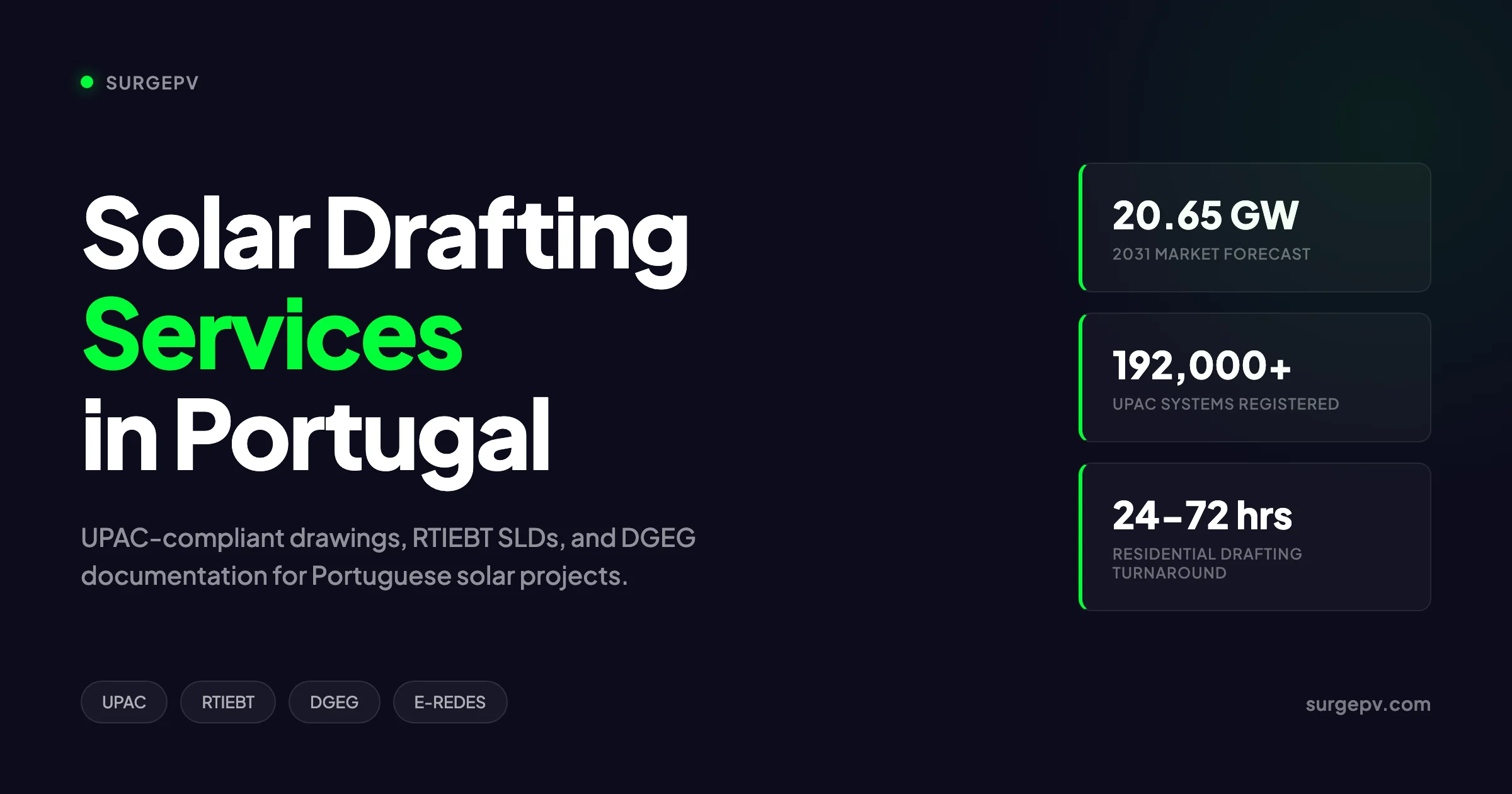
Portugal’s solar market reached 6.81 GW of installed capacity in 2025 and is forecast to grow to 20.65 GW by 2031 at a 20.31% CAGR. The country added 499 MW between December 2024 and May 2025 alone. Residential self-consumption is the fastest-growing segment, with 192,000 UPAC systems registered by the end of 2024. Every one of those systems needed a drawing before it could be installed.
For Portuguese solar professionals, the question is no longer whether to produce technical documentation. It is whether to hire a solar drafting service, buy PV design software, or combine both. This guide answers that question with real numbers, Portuguese regulatory context, and a decision framework built on 10+ years of EPC experience across European markets.
In this guide, you will learn:
- What solar drafting services in Portugal actually deliver
- Which Portuguese regulations (UPAC, RTIEBT, DGEG) shape every drawing
- How CAD and BIM standards apply to Portuguese solar projects
- What typical deliverables look like and what they cost in 2026
- When manual drafting beats software, and when software wins
- How to choose a provider without overpaying for scope you do not need
Quick Answer
Solar drafting services in Portugal are specialized technical design providers that create UPAC-compliant electrical drawings, single-line diagrams (SLDs), and DGEG documentation for photovoltaic projects. Portuguese EPCs use them for projects that require custom civil engineering, utility-scale grid studies, or when in-house design capacity is limited. The market is shifting: automated solar design software now handles 80% of residential and commercial drafting in a few minutes, while manual services remain essential for complex projects above 1 MW. Costs range from EUR 60-250 per project for basic drafting to EUR 400-1,800 for full engineering documentation with structural calculations and DGEG submission packages.
What Are Solar Drafting Services in Portugal?
Solar drafting services in Portugal are technical providers, usually staffed by an electrical engineer, technical drafter, or CAD designer, who produce the drawings and documentation required to permit, finance, and connect a photovoltaic system to the Portuguese grid.
These services sit between the sales conversation and the physical installation. A homeowner or business owner agrees to a solar project. The EPC or installer then needs a plan set that proves the system is safe, compliant, and economically viable. That plan set is what drafting services produce.
Who Provides Solar Drafting in Portugal
The Portuguese market has four categories of drafting providers:
- Independent technical studios — Small firms of 2-5 drafters who serve multiple EPCs on a per-project basis. Common in Lisbon, Porto, and Braga.
- EPC in-house design teams — Larger EPCs like Voltalia, SOLARTEC Group, or Omexom Portugal employ full-time drafters who handle everything from residential rooftops to utility-scale ground mounts.
- Freelance drafters on platforms — Individual drafters listed on Portuguese engineering marketplaces or general freelance platforms. Rates vary widely. Quality control is the buyer’s responsibility.
- Software-enabled design services — Platforms like SurgePV that combine automated drafting with human review for complex projects. This hybrid model is growing fastest in 2026.
What Makes Portuguese Solar Drafting Different
Portuguese solar drafting is not generic CAD work. Three factors make it distinct:
UPAC compliance is mandatory. Every grid-connected self-consumption system must be registered correctly under Decree-Law 162/2019. The documentation must show capacity, connection type, self-consumption assumptions, and surplus arrangement. A drafter who has only worked on Spanish or French projects will miss details that DGEG flags immediately.
RTIEBT electrical compliance is non-negotiable. The Portuguese technical rules for low-voltage electrical installations require compliant single-line diagrams, protection coordination, and wire sizing. Distributors like E-REDES reject non-compliant SLDs.
Post-VAT economics changed the design brief. The reduced 6% VAT rate for residential solar expired in July 2025, returning to the standard 23% rate. This added roughly EUR 600 to a typical 5 kW system and extended payback beyond 7 years. Every design must now optimize for self-consumption and accurate ROI, not just maximum production.
Why Solar Drafting Matters in Portugal’s 2026 Market
Portugal’s solar market is at a transition point. The country needs roughly 2.6 GW of annual additions to reach its 20.8 GW NECP target by 2030. The gap will be filled by faster project execution, and faster execution starts with faster design.
The Bottleneck Is Not Installation
Portuguese EPCs can install a residential rooftop in 1-2 days. The bottleneck is paperwork. DGEG registration via Portal SERUP takes time. E-REDES grid connection approval can take 2-6 weeks for smart meter installation. Municipal permits add another layer. Every delay in drafting delays everything downstream.
A drafting service that turns around a residential plan set in 24 hours instead of 72 hours can compress the total project timeline by 5-10%. At 25 projects per month, that is 1-2 extra projects completed per month without adding installation crews.
The C&I Segment Is Driving Demand
The commercial and industrial segment grew 26.6% in 2024. C&I projects are more complex than residential. They often involve:
- Multiple roof planes with different tilts and orientations
- Structural calculations for industrial buildings with non-standard load capacities
- Medium-voltage connections requiring specialized studies
- Battery storage integration for peak-shaving and self-consumption optimization
- Bankable yield reports for financing through Portuguese banks
Each of these requirements adds deliverables to the drafting scope. A simple layout plan is no longer enough. C&I EPCs need drafting partners who can produce full engineering packages, or they can use a customer-ready solar proposals platform that combines technical drawings with financial modeling.
Utility-Scale Projects Need Specialist Drafters
Utility-scale projects above 1 MW dominate the Portuguese market with 84.5% of installed capacity in 2025. Major projects include the 220 MWp Solara 4 plant in Alcoutim and the 1,200 MW Fernando Pessoa project under development by Iberdrola and Prosolia Energy. These projects require:
- Full civil and geotechnical drawings
- Medium-voltage substation design
- Environmental impact assessments
- Bankable P50/P90 simulations, usually produced in PVsyst
- Grid connection studies with E-REDES and REN coordination
No single software platform handles all of this. Utility-scale EPCs in Portugal typically use a hybrid model: software for preliminary layout and yield analysis, specialist drafting firms for civil and electrical engineering, and external consultants for grid studies. For large commercial solar projects, the same principle applies—software handles the design and financial modeling, while manual drafters cover structural and MV work.
Portuguese Regulations and Standards for Solar Drafting
Portuguese solar drafting does not happen in a regulatory vacuum. Four standards and three agencies govern every drawing.
UPAC: The Self-Consumption Framework
Decree-Law 162/2019, partially transposing EU Directive 2018/2001, created the UPAC (Unidade de Produção para Autoconsumo) framework. Decree-Law 15/2022 further streamlined installation and registration.
| System Size | Registration Requirement | Key Documentation |
|---|---|---|
| ≤ 700 W | No registration | Simple installation record |
| 700 W – 30 kW | Prior notification via Portal SERUP | Technical sheet, SLD, layout |
| 30 kW – 1 MW | Registration + operating certificate | Full technical documentation |
| > 1 MW | Full licensing + grid capacity allocation | Production license, capacity title, environmental opinions |
For most residential systems under 30 kW, the process is “simples comunicação prévia” via Portal SERUP. The drafting package must include a layout plan, single-line diagram, and equipment specifications.
RTIEBT: Electrical Installation Rules
The Regulamento Técnico de Instalações Elétricas de Baixa Tensão (RTIEBT) defines the technical rules for low-voltage electrical installations in Portugal. For solar drafters, the practical impact is:
- Protection devices must be correctly sized and coordinated
- SLDs must show main switch, circuit breakers, surge protection, and inverter connections
- Wire sizing must account for voltage drop and current-carrying capacity
- Grounding and equipotential bonding must be documented
E-REDES and other distributors review these drawings for grid connection approval. Non-compliant submissions are returned for revision, adding days or weeks to the project timeline.
DGEG and E-REDES
DGEG (Direção-Geral de Energia e Geologia) is the national energy regulator. It manages UPAC registration, production licenses for large plants, and capacity titles for grid connection.
E-REDES is the main distribution system operator. It reviews connection projects, installs bidirectional smart meters, and validates technical documentation for grid-connected systems.
For projects above 1 MW, REN (Redes Energéticas Nacionais) coordinates transmission grid connections.
Municipal and Environmental Rules
Building permits fall under municipal jurisdiction. Installations within the building coverage area and under 1 meter in height may be exempt from municipal control. Larger ground-mounted projects require construction licenses or prior communication requests.
Environmental Impact Assessment (AIA) applies to projects above 20 MW in sensitive areas or 50 MW generally. The Environmental Impact Study typically takes 3-6 months, with public consultation adding another 4-6 months.
What Solar Drafting Services Deliver in Portugal
A Portuguese solar drafting package has three tiers. The right tier depends on project size, complexity, and whether the project needs financing.
Tier 1: Basic Residential Package
Typical cost: EUR 60-250 per project Turnaround: 24-72 hours
| Deliverable | Purpose |
|---|---|
| Roof layout plan | Shows panel placement, orientation, and tilt |
| Single-line diagram | Proves RTIEBT compliance for E-REDES |
| Stringing configuration | Documents panel-to-inverter wiring |
| Equipment schedule | Lists modules, inverter, mounting, and protection devices |
| SERUP notification support | Helps installer submit UPAC registration |
This tier covers the majority of Portuguese residential systems under 10 kW. It is the sweet spot for small installers who need fast, repeatable documentation.
Tier 2: Commercial and Industrial Package
Typical cost: EUR 400-1,200 per project Turnaround: 5-10 business days
| Deliverable | Purpose |
|---|---|
| Site plan and array layout | Roof or ground-mounted system design |
| Structural calculations | Verifies roof load capacity and mounting feasibility |
| Three-line diagram | Detailed electrical schematic for larger systems |
| Protection coordination study | Ensures RTIEBT compliance across multiple inverters |
| Cable and conduit sizing | Documents wire sizing and routing |
| DGEG registration package | Full technical documentation for 30 kW – 1 MW systems |
| Basic yield report | Annual production estimate for customer proposal |
C&I projects in Portugal often fall in the 30 kW to 1 MW range, where full DGEG registration is required. The drafting package must be more comprehensive than a simple residential plan set.
Tier 3: Utility-Scale Engineering Package
Typical cost: EUR 5,000-25,000+ per project Turnaround: 3-6 weeks
| Deliverable | Purpose |
|---|---|
| Topographic survey drawings | Terrain modeling for tracker or fixed-tilt layout |
| Civil and geotechnical plans | Foundation design, earthworks, drainage |
| MV substation design | Connection infrastructure above 1 MW |
| Protection and control philosophy | Grid code compliance documentation |
| Bankable P50/P90 report | Financing-grade yield analysis |
| Environmental documentation | AIA/REAI support materials |
| As-built drawings | Records actual installed system |
This tier is typically handled by engineering firms rather than standalone drafting services. Tools like Aplitop tcpMDT Photovoltaic are used for terrain analysis and tracker layout on large Portuguese projects like Solara 4.
Solar Drafting Costs in Portugal: 2026 Pricing Guide
Pricing depends on project size, complexity, and whether the provider is local or offshore. The table below reflects mid-2026 market rates for Portuguese-focused drafting.
| Service Level | Price Range | Best For |
|---|---|---|
| Basic residential plan set | EUR 60-250 | Single-family homes under 10 kW |
| Residential with battery | EUR 150-400 | Solar-plus-storage systems |
| Commercial 30-250 kW | EUR 400-1,200 | Rooftop C&I with DGEG registration |
| Commercial 250 kW – 1 MW | EUR 1,000-2,500 | Larger rooftops, carports, ground mounts |
| Utility-scale >1 MW | EUR 5,000-25,000+ | Full engineering and bankable reports |
| Monthly retainer (25+ projects) | EUR 1,200-5,000 | High-volume installers and EPCs |
What Drives Cost Differences
Project complexity. A simple south-facing residential roof with a single string inverter is fast. A multi-inverter commercial system with battery storage and export limitation takes more time.
Turnaround time. Rush delivery in 24 hours typically costs 50-100% more than standard 3-5 day delivery.
Provider location. Local Portuguese studios charge more than offshore drafting firms in India or Eastern Europe, but they offer better understanding of DGEG and E-REDES requirements.
Software vs. manual. Software-generated drafts cost a fraction of manual drafting for standard projects. Manual drafting is still required for custom engineering.
Manual Drafting vs. Solar Design Software in Portugal
The choice between manual drafting and software is not binary. Most successful Portuguese EPCs use both.
When Manual Drafting Wins
- Utility-scale projects above 1 MW require civil, geotechnical, and MV engineering that software cannot fully automate.
- Custom structural work for older Portuguese buildings with non-standard roofs needs engineer review.
- First-of-a-kind projects like floating solar on Alqueva or agrivoltaic pilots need bespoke documentation.
- Lender requirements sometimes specify manually stamped drawings from a registered engineer.
When Software Wins
- Residential projects under 30 kW are highly repeatable. Software can generate layout, SLD, and yield report in minutes.
- Commercial rooftops under 1 MW benefit from automated shading analysis and financial modeling.
- High-volume installers need consistent output without hiring a large drafting team.
- UPAC and Fundo Ambiental modeling are faster when the software has Portuguese-specific rules built in.
SurgePV is one platform that targets this segment. It claims to generate RTIEBT-compliant SLDs in 5-10 minutes, model UPAC self-consumption under DL 162/2019, and handle simples, bi-horário, and tri-horário tariff analysis. For Portuguese installers doing 10+ projects per month, that automation can replace much of the manual drafting workload.
Hybrid Model: The Practical Choice
Most mid-size Portuguese EPCs use software for 80% of residential and small commercial work, and manual drafters or engineering firms for the remaining 20% of complex projects. This keeps per-project costs low while preserving the ability to take on larger or unusual work.
How to Choose a Solar Drafting Service in Portugal
Not every provider is a good fit. Here is a checklist for evaluating Portuguese solar drafting services.
Verify Regulatory Knowledge
Ask specific questions:
- Can you produce RTIEBT-compliant SLDs?
- Do you understand UPAC registration thresholds and SERUP submission?
- Have you worked with E-REDES grid connection documentation?
- Can you model simples, bi-horário, and tri-horário tariffs?
A provider who only knows generic solar CAD will create delays at the registration stage.
Check Deliverable Quality
Request a sample plan set. Look for:
- Clear panel layout with dimensions and orientation
- Complete single-line diagram with all protection devices
- Equipment schedule with manufacturer part numbers
- Wire sizing calculations
- Structural notes for rooftop systems
Evaluate Turnaround and Communication
Portuguese installers often work with tight customer timelines. Ask:
- What is your standard turnaround for a 5 kW residential system?
- Do you offer expedited delivery?
- How do you handle revision requests?
- What are your working hours and language capabilities?
Compare Total Cost, Not Hourly Rate
The cheapest per-project rate may not be the cheapest total cost. Factor in revision cycles, registration delays, and the time your team spends managing the provider. A EUR 150 draft that needs three revisions can easily cost more than a EUR 250 draft that is approved on the first submission.
Key Portuguese Solar Market Data for 2026
Understanding the market helps drafters and EPCs prioritize the right segments.
| Metric | Value | Source |
|---|---|---|
| Installed capacity 2025 | 6.81 GW | Mordor Intelligence |
| Forecast 2031 | 20.65 GW | Mordor Intelligence |
| CAGR 2026-2031 | 20.31% | Mordor Intelligence |
| Capacity added May 2025 | 499 MW (6 months) | PV Magazine / APREN |
| Residential CAGR | 24.30% | Mordor Intelligence |
| UPAC systems by end 2024 | 192,000 | Industry reports |
| C&I growth 2024 | 26.6% | Industry reports |
| Utility-scale share | 84.5% | Mordor Intelligence |
| 2030 NECP target | 20.8 GW | Portuguese government |
| VAT on residential solar | 23% (from July 2025) | Portuguese tax rules |
This data shows a market that is growing fast across all segments. Residential growth is the most rapid, but utility-scale still accounts for the majority of capacity. Drafting services that can serve both ends of the market—or partner with software for the high-volume residential segment—are best positioned.
Major Solar Projects and Companies in Portugal
Portugal has several landmark projects that illustrate the scale of drafting and engineering work required.
| Project | Capacity | Location | Developer | Notes |
|---|---|---|---|---|
| Solara 4 | 220 MWp | Vaqueiros, Alcoutim | Krinner / Hanwha | Largest subsidy-free solar plant in Europe at completion; used Aplitop tcpMDT |
| Fernando Pessoa | 1,200 MW | Santiago do Cacém | Iberdrola / Prosolia | Expected online 2025 |
| Cerca | 202 MWp | Not specified | EDP Renováveis | Largest EDP solar plant in Europe |
| Alcoutim | 219 MW | Alcoutim | Various | Major Alentejo project |
| Pinhal Novo | 11.8 MW | Setúbal | Voltalia | Voltalia Portugal project |
| Alqueva Floating Solar | 5 MW | Alqueva | EDP | Largest floating solar on a European dam |
Major EPCs and developers active in Portugal include EDP Renováveis, Iberdrola, Voltalia, Greenvolt, Acciona, CJR Renewables, Q ENERGY, Renvolt Energy, Omexom Portugal, and SOLARTEC Group. These companies employ in-house drafting teams or work with specialized engineering firms.
Speed Up Portuguese Solar Drafting
SurgePV generates RTIEBT-compliant SLDs, UPAC self-consumption models, and Portuguese tariff analysis in one cloud platform. Cut drafting time from days to minutes.
Book a DemoNo commitment required · 20 minutes · Live project walkthrough
Software Tools Used for Solar Drafting in Portugal
Portuguese drafters and EPCs use a mix of general CAD, specialized solar tools, and all-in-one platforms.
| Tool | Primary Use | Typical User |
|---|---|---|
| AutoCAD | 2D/3D electrical and layout drawings | Drafters, EPCs |
| PVsyst | Bankable yield simulations | Engineers, lenders |
| Helioscope / Aurora | Commercial and residential design | Mid-size installers |
| PVcase | AutoCAD automation for C&I/utility | Large EPCs |
| Aplitop tcpMDT | Terrain analysis, tracker layout, earthworks | Utility-scale developers |
| SurgePV | All-in-one design, SLDs, UPAC modeling, proposals | Installers and EPCs |
The trend is toward integration. EPCs want fewer tools and fewer file handoffs. A platform that combines design, electrical documentation, and financial modeling in one workflow reduces errors and saves time.
Common Drafting Mistakes in Portugal
Even experienced drafters make mistakes that delay Portuguese projects. Here are the most common ones.
Wrong UPAC Category
A system designed as a 25 kW UPAC may actually need full registration if the inverter capacity or connection arrangement pushes it above 30 kW. Drafters must verify the exact category before submitting documentation.
Ignoring Tariff Structure
Portugal has simples, bi-horário, and tri-horário electricity tariffs. A design that ignores time-of-use rates will produce inaccurate savings calculations and unhappy customers.
Undersized Conduit or Cable
RTIEBT has specific requirements for voltage drop and current-carrying capacity. Undersized cables are a common reason E-REDES rejects connection applications.
Missing Export Limitation
Some municipalities or grid operators require export limitation for larger residential systems. The SLD must show the export control device and settings.
Outdated VAT or Incentive Assumptions
The 6% VAT rate ended in July 2025. Proposals that still assume the old rate create pricing disputes. Similarly, Fundo Ambiental subsidies have specific eligibility rules that must be reflected in documentation.
Conclusion: Build the Right Drafting Stack for Portugal
Portugal’s solar market is growing at over 20% annually. The bottleneck is not installation capacity. It is the design, documentation, and registration work that must happen before panels go on the roof.
For most Portuguese installers and EPCs, the right approach is a hybrid stack:
- Use solar design software for residential and small commercial projects where speed and repeatability matter.
- Use manual drafting services or engineering firms for utility-scale, custom structural, or MV projects.
- Verify that every provider understands UPAC, RTIEBT, DGEG, and E-REDES requirements.
The EPCs that win in Portugal over the next five years will be the ones that turn drawings around faster than competitors without sacrificing compliance. Whether that means hiring a local drafting studio, building an in-house team, or adopting automation, the decision should be driven by project mix and volume—not by habit.
Frequently Asked Questions
What are solar drafting services in Portugal?
Solar drafting services in Portugal are specialized technical providers that create UPAC-compliant electrical drawings, single-line diagrams (SLDs), layout plans, and DGEG documentation for photovoltaic installations. They are typically staffed by electrical engineers or technical drafters who understand Portuguese grid codes, RTIEBT requirements, and E-REDES connection rules.
How much do solar drafting services cost in Portugal?
Basic residential drafting costs EUR 60-250 per project. Full engineering documentation with structural calculations, RTIEBT-compliant SLDs, and DGEG submission packages runs EUR 400-1,800. Monthly retainers for EPCs with 25+ projects range from EUR 1,200-5,000.
What is UPAC and why does it matter for solar drafting?
UPAC (Unidade de Produção para Autoconsumo) is the Portuguese legal framework for self-consumption systems under Decree-Law 162/2019. It defines registration thresholds, metering rules, and surplus compensation. Solar drafting must reflect UPAC capacity limits, connection type, and self-consumption assumptions because DGEG registration depends on accurate technical documentation.
Can solar design software replace manual drafting services in Portugal?
For residential and commercial projects under 1 MW, yes. Software like SurgePV generates RTIEBT-compliant SLDs in a few minutes at roughly EUR 3-5 per project. Manual drafting remains essential for utility-scale projects, custom civil engineering, and MV grid studies above 1 MW.
What deliverables should I expect from a Portuguese solar drafting service?
Standard deliverables include a site layout plan, single-line diagram with RTIEBT protection schemes, stringing configuration, equipment schedule, structural calculations for rooftop systems, DGEG/SERUP registration documentation, and bankable yield reports for projects above 100 kW.
How long does solar drafting take in Portugal?
A basic residential plan set takes 24-72 hours. Commercial projects with structural calculations require 5-10 business days. Utility-scale projects with full MV studies and bankable reports take 3-6 weeks. Software-generated drafts are same-day.
Which entities review solar drafting documentation in Portugal?
DGEG (Directorate-General for Energy and Geology) handles UPAC registration and production licenses for systems above 1 MW. E-REDES is the main distribution system operator for grid connection approval. Municipal councils review urbanistic conformity and building permits.
What is the difference between solar drafting and solar design software?
Solar drafting services produce manual technical drawings, usually in AutoCAD, for a per-project fee. Solar design software automates layout, shading, electrical design, and financial modeling through a subscription. In Portugal, the critical difference is RTIEBT SLD automation: some software generates compliant diagrams instantly, while manual drafters charge separately for each SLD revision.
Where this fits
This article is part of SurgePV's Solar Design hub, which works through the topic from first principles to the decisions a project team actually has to make.


