

Answer
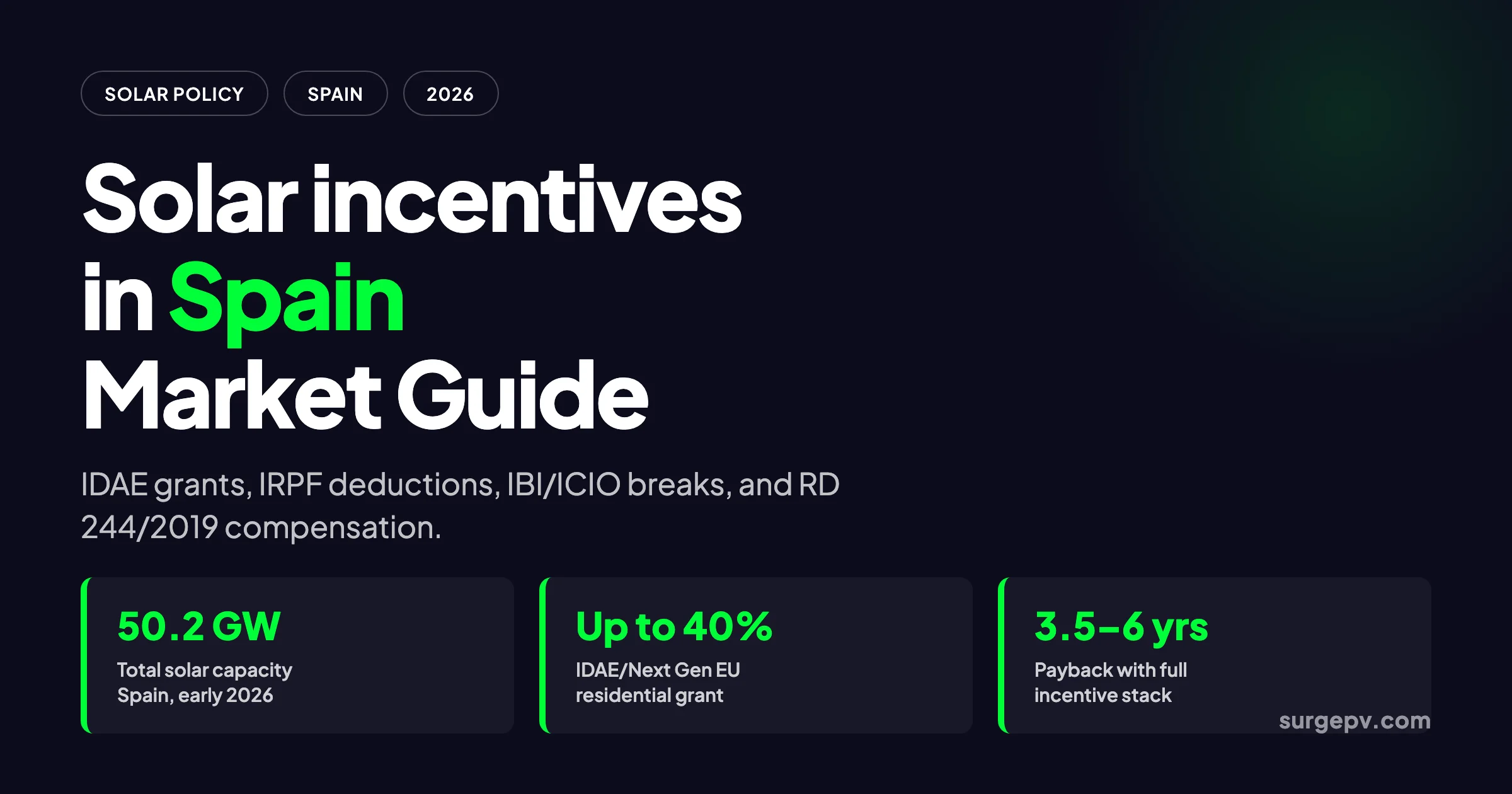
Spain's 2026 solar incentives include IDAE/Next Generation EU capital grants (up to 40% for standard homes, 60–80% for vulnerable households), a new 10–20% federal IRPF deduction, municipal IBI reductions up to 50% and ICIO exemptions up to 95%, plus simplified surplus compensation under RD 244/2019. Stacked correctly, they cut payback to 3.5–6 years in high-sun regions.
Spain’s solar market is at an inflection point. The country reached 50.2 GW of total solar capacity in early 2026, making it Europe’s second-largest solar market, yet residential self-consumption growth slowed in 2025. For installers, EPCs, and property owners, the opportunity now lies less in waiting for a single generous subsidy and more in stacking every available incentive layer correctly. That is where the real 2026 advantage is.
This guide is a market-focused incentive manual, not a cost or installation tutorial. It covers the legal framework, the full 2026 incentive stack, regional variations, and the common errors that cost homeowners and businesses thousands of euros. For the mechanics of net metering, see our dedicated Spain net metering guide. For cost and payback data, see Solar panels Spain 2026.
If you are sizing systems or writing proposals for Spanish clients, a cloud solar design platform with built-in Spanish tariffs and incentive scenarios can save hours on every project. Model payback, self-consumption ratios, and stacked incentives automatically, then generate solar proposals in minutes. Check pricing or book a demo to see how SurgePV handles Spain.
Spain’s 2026 solar incentive stack can cut net project cost by 45–65% when layered correctly. Active tools: IDAE/Next Generation EU capital grants, a new federal IRPF deduction, municipal IBI and ICIO breaks, and RD 244/2019 surplus compensation. The key is applying in the right order and before installation begins.
TL;DR — Solar Incentives in Spain 2026
Active programs: IDAE/Next Generation EU grants up to 40% (60–80% for vulnerable households), a new 10–20% federal IRPF deduction capped at €5,000/year, municipal IBI reductions up to 50% and ICIO exemptions up to 95%, plus compensación simplificada under RD 244/2019. Apply before installing. Collective self-consumption now allows distances up to 5 km under RD-Law 7/2026.
In this guide:
- Latest 2026 status of every active Spanish solar incentive
- The legal foundation: RD 244/2019, autoconsumo, and compensación simplificada
- IDAE/Next Generation EU grants — rates, eligible costs, and application rules
- Federal and municipal tax incentives: IRPF, IBI, ICIO, and VAT nuances
- Regional and community-scale programs, including energy communities
- Commercial and industrial incentives beyond the residential stack
- Three real-world stacking examples with payback impact
- Common mistakes and how to avoid them
Latest Updates: Spain Solar Incentives 2026
The Spanish solar policy environment changed noticeably in early 2026. A new federal income-tax deduction was introduced, collective self-consumption distances were expanded, and several regional grant programs entered their final funding windows.
Spain Solar Incentive Status — June 2026
| Incentive | Type | Status | Key Terms |
|---|---|---|---|
| IDAE/Next Generation EU residential grant | Capital grant | Active, budgets depleting | Up to 40% standard; 60–80% vulnerable |
| Federal IRPF deduction for self-consumption | Tax deduction | Active for 2026 | 10% individual / 20% residential building; €5,000 base cap |
| Municipal IBI reduction | Property tax break | Active where adopted | Up to 50% for 3–7 years |
| Municipal ICIO exemption | Construction tax break | Active where adopted | Up to 95% of solar works |
| Compensación simplificada (RD 244/2019) | Surplus credit | Active | Monthly cap, no rollover, hourly pricing |
| Reduced VAT 10% | VAT break | Narrow eligibility | Only within qualifying renovation |
| Collective self-consumption distance | Regulatory | Expanded | Up to 5 km under RD-Law 7/2026 |
| Regional CCAA top-ups | Capital grant | Varies by region | Check autonomous community portal |
Key Changes Since 2025
March 2026 — RD-Law 7/2026: Introduced a federal IRPF deduction for renewable self-consumption installations, confirmed IBI reductions up to 50% and ICIO exemptions up to 95%, and extended the maximum distance between generation and consumption points from 500 metres to 5 km for PV and wind systems up to 5 MW.
January 2026 — UNEF market data: Cumulative self-consumption capacity reached 9.3 GW after adding 1,139 MW in 2025. Residential installations declined 17% year-on-year, partly because earlier personal income-tax deductions for energy-efficiency renovations were not extended.
Ongoing — Grant exhaustion: Several autonomous communities exhausted their first rounds of Next Generation EU funds in 2024–2025. Replacement calls remain active in some regions but are increasingly competitive.
Key Takeaway
2026 is a transition year. The most reliable incentives are now the federal IRPF deduction and municipal IBI/ICIO breaks, because IDAE grant budgets are finite and vary by region. Anyone planning a project should secure grant pre-approval before ordering equipment.
Why Spain’s Incentive Stack Matters in 2026
Spain has some of Europe’s best solar resources, with 2,500–3,000 equivalent peak sun hours per year in many regions. Yet the residential self-consumption market remains underdeveloped relative to that potential. The gap is not technology or sunlight; it is administrative complexity, financing friction, and uncertainty about which incentives still apply.
Market Size and Targets
Spain reached 50.2 GW of total solar capacity in February 2026, according to Red Eléctrica de España data reported by PV Magazine (2026). Solar now represents roughly one-third of installed generation capacity and produced 18.4% of Spain’s electricity in 2025.
Self-consumption capacity reached 9.3 GW by the end of 2025, with 1,139 MW added during the year, according to UNEF (2026). The residential segment added 229 MW across 36,330 installations, a 17% decline from 2024. Industrial self-consumption, by contrast, grew slightly to 679 MW.
Spain’s National Integrated Energy and Climate Plan 2023-2030 (MITECO, 2024) targets 19 GW of self-consumption by 2030. With 9.3 GW already installed, Spain must add about 2 GW per year for the next five years. That shortfall keeps political pressure on grant programs and tax breaks.
What the Slowdown Means for Incentives
UNEF attributed the 2025 residential slowdown to two factors: the withdrawal of personal income-tax deductions linked to home energy-efficiency renovations, and lower compensation for surplus exports on free-market tariffs. The federal IRPF deduction introduced in 2026 is a direct response to the first factor. The second factor makes accurate self-consumption sizing more important than ever, because export credits are now small compared with avoided retail purchases.
For installers, this means proposals must show both gross savings and the full stacked net cost after grants, tax deductions, and municipal breaks. That is where a solar design platform with Spanish incentive templates becomes a competitive tool.
The Legal Foundation: RD 244/2019 and Autoconsumo
Every Spanish solar incentive is built on the same legal base: Real Decreto 244/2019 (BOE, 2019). It replaced the earlier RD 900/2015 regime, which had imposed the so-called “sun tax” and effectively blocked residential solar growth.
What RD 244/2019 Changed
| Before RD 244/2019 | After RD 244/2019 |
|---|---|
| Sun tax and backup charges applied | Sun tax eliminated |
| No surplus compensation | Compensación simplificada introduced |
| Collective self-consumption not allowed | Collective self-consumption legalised |
| Heavy administrative process | Simplified registration for systems up to 15 kW |
| Residential market stagnant | Market grew tenfold by 2023 |
Three Modalities of Autoconsumo
RD 244/2019 defines three configurations:
- Autoconsumo sin excedentes (no surplus): The system has anti-export control and never feeds energy into the grid. All generation is consumed on site. This is the simplest administrative route and suits factories or large homes with steady daytime demand.
- Autoconsumo con excedentes acogido a compensación (with simplified compensation): Surplus energy is credited on the monthly bill at hourly spot prices. Available for renewable systems up to 100 kW connected to low voltage. This is the standard residential and SME option.
- Autoconsumo con excedentes no acogido a compensación (without compensation): Larger or non-qualifying systems sell surplus under general producer rules, usually through bilateral contracts or the wholesale market.
Compensación Simplificada in Practice
Under compensación simplificada, exported kWh are valued at the hourly spot price and deducted from the energy component of the same month’s bill. The credit cannot exceed the value of grid electricity consumed in that billing period, and unused credits do not roll over.
Typical 2025–2026 export values ranged from €0.05/kWh to €0.12/kWh depending on the hour and season, while retail rates ranged from €0.17/kWh to €0.28/kWh. The ratio makes self-consumption roughly two to four times more valuable than export. Correct sizing therefore prioritises self-consumed kWh, not maximum generation.
For a deeper explanation of billing mechanics, see our Spain net metering guide.
IDAE and Next Generation EU Grants
The Instituto para la Diversificación y Ahorro de la Energía (IDAE) channels European Next Generation EU funds into residential, commercial, and public-sector self-consumption grants. The funds flow from the European Commission to Spain’s Plan de Recuperación, Transformación y Resiliencia (PRTR), then to IDAE, then to autonomous communities, and finally to applicants.
How the Funding Flows
- European Commission allocates Next Generation EU funds to Spain.
- IDAE sets national eligibility criteria and minimum grant rates.
- Autonomous communities receive regional allocations and open their convocatorias.
- Homeowners apply through the regional energy portal, not directly to IDAE.
- Approved applicants install, submit completion documents, and receive payment.
2026 IDAE Residential Grant Rates
| Applicant Category | Typical Maximum Grant |
|---|---|
| Standard residential homeowner | Up to 40% of eligible CAPEX |
| System with battery storage included | Up to 45% |
| Low-income / energy-vulnerable household | Up to 60% |
| Household in energy poverty | Up to 80% |
Eligible costs usually cover modules, inverter, mounting, electrical protection, and in many regions a share of labour and engineering. Grant percentages apply to eligible cost ceilings per kWp, not necessarily to the full invoice. Typical ceilings are €1,500–€2,100/kWp for small systems and €1,300–€1,600/kWp for community-scale installations.
Application Process
The process is managed by each autonomous community. A typical sequence is:
- Check the active convocatoria on your CCAA energy portal.
- Confirm the installation has not started; most programs require pre-approval.
- Submit technical design, cost estimate, installer certification, and applicant documents.
- Wait for provisional approval, usually 4–10 weeks.
- Install within the deadline specified in the award.
- Submit the completion certificate, invoices, and proof of payment.
- Receive the grant disbursement, typically 4–8 weeks after accepted documentation.
Some calls accept retroactive applications for recently completed installations, but this is the exception. The safest rule is: apply first, install second.
Why Eligible Cost Ceilings Matter
A 40% grant does not always mean 40% off the invoice. Most autonomous communities cap the eligible cost per kWp. If your installer quotes €2,200/kWp but the ceiling is €1,800/kWp, the grant applies only to the ceiling.
Example: A 6 kWp system quoted at €13,200 (€2,200/kWp) in a region with a €1,800/kWp ceiling:
- Eligible base: 6 kWp × €1,800 = €10,800
- 40% grant: €4,320
- Effective grant on total invoice: 32.7%, not 40%
This is why competitive quoting matters. A €1,700/kWp quote from a certified installer can raise the effective grant share above 38% because the ceiling covers almost the entire invoice. Always model the grant against the regional ceiling, not the headline percentage.
What Happens When Regional Budgets Close
Several regions exhausted their first Next Generation EU allocations in 2024 and 2025. When a call closes, later applicants are placed on a reserve list or rejected. The practical response is to prepare the application package before the call opens, including the technical design, installer quote, and cadastral reference. Speed of submission often determines whether a project receives funding.
Federal and Municipal Tax Incentives
Beyond grants, Spain offers several tax layers that reduce either upfront cost or lifetime ownership cost.
Federal IRPF Deduction (2026)
Royal Decree-Law 7/2026 (BOE, 2026) introduced a federal personal income-tax deduction for renewable self-consumption systems installed between 1 January and 31 December 2026:
- 10% of amounts paid for systems installed in a property owned by the taxpayer.
- 20% for taxpayers who own homes in predominantly residential buildings where the installation is carried out.
- Annual deduction base capped at €5,000.
- The same installation cannot benefit from both percentages.
- Subsidised amounts must be subtracted from the deduction base.
This is a direct federal deduction, separate from any autonomous community top-ups that may still exist.
Example: Federal IRPF Deduction in Practice
Consider a homeowner in Madrid who pays €8,000 for a 5 kWp system in 2026 and receives no public grant:
- Deduction base: €8,000 (capped well below the €5,000 annual limit)
- 10% individual-property deduction: €800 tax saving
- If the same installation is carried out in a predominantly residential building and the homeowner qualifies for the 20% bracket: €1,600 tax saving
If the homeowner also receives a €3,000 IDAE grant, the deduction base falls to €5,000. The 10% deduction then saves €500, not €800. The grant and the deduction apply to different portions of the cost, so the combined benefit is still substantial but not a double discount on the same euros.
Municipal IBI Reduction
Under RD-Law 7/2026, municipal ordinances may grant an IBI property-tax reduction of up to 50% for buildings with solar thermal or photovoltaic systems. The reduction is usually applied for 3–7 years. Not every municipality has adopted the ordinance, so homeowners must check with their ayuntamiento.
Municipal ICIO Exemption
The same decree allows municipalities to exempt up to 95% of the Impuesto sobre Construcciones, Instalaciones y Obras (ICIO) on the portion of works that incorporate solar energy systems. This reduces the upfront construction tax on the installation.
Corporate Tax for Businesses
Companies can depreciate solar assets faster than standard accounting schedules and deduct the full VAT on business installations. For C&I projects, this is often more valuable than the residential IRPF deduction.
Reduced VAT and Other Tax Nuances
Spain applies the standard 21% VAT to most standalone solar self-consumption installations. A reduced 10% VAT is possible only in narrow circumstances, usually when the solar system is part of a broader renovation of a dwelling that meets strict conditions on material share, total cost ratio, and building age. Many installers advertise the reduced rate, but misapplication can lead to a tax agency reassessment.
For most residential buyers, the safer assumption is 21% VAT. If a promoter or contractor claims 10%, ask for the specific legal basis in writing and confirm it with a tax advisor.
What Not to Stack
You cannot double-count the same expense. If IDAE covers 40% of the installation cost, that subsidised portion must be subtracted from the IRPF deduction base. Similarly, if the installation is part of a broader renovation that already claims a higher energy-efficiency deduction, it may not also claim the self-consumption deduction for the same works.
Regional and Community-Scale Incentives
Autonomous communities often add their own top-ups to IDAE programs. The amounts, deadlines, and eligibility rules change frequently, so the only reliable source is the current convocatoria on each CCAA’s energy portal.
Examples of Regional Variation
| Region | Typical Top-Up (examples) |
|---|---|
| Catalonia (ICAEN) | Supplementary grants and collective-self-consumption support |
| Andalusia | Additional percentage for vulnerable households and high-irradiance municipalities |
| Valencian Community (IVACE) | Residential and community grants with storage bonuses |
| Madrid | IDAE pass-through plus municipal IBI discounts in many municipalities |
| Basque Country (EVE) | Regional calls for residential and business self-consumption |
Because regional budgets are often exhausted mid-year, the practical advice is to apply as soon as a call opens.
Where to Check Regional Calls
Applications are submitted through the autonomous community’s energy portal, not IDAE’s national website. The following table shows the main entry points for the largest markets:
| Region | Portal / Agency |
|---|---|
| Andalusia | Agencia Andaluza de la Energía |
| Catalonia | ICAEN (Institut Català d’Energia) |
| Madrid | Comunidad de Madrid energy portal |
| Valencian Community | IVACE |
| Basque Country | EVE (Ente Vasco de la Energía) |
| Galicia | Instituto Galego de Vivenda e Solo / Xunta de Galicia |
Each portal publishes active convocatorias, required documentation, and cost ceilings. Many require the installer to be registered as an empresa instaladora in that community. Verify this registration before signing a contract, because an unregistered installer can disqualify the entire grant.
Collective Self-Consumption and Energy Communities
RD 244/2019 legalised collective self-consumption, allowing multiple consumers to share one installation. RD-Law 7/2026 extended the maximum distance between generation and consumption points from 500 metres to 5 km for PV and wind systems up to 5 MW. This makes community solar, industrial parks, and rural energy communities far more viable.
For guidance on structuring shared installations, IDAE publishes a collective self-consumption guide (IDAE, 2023).
Spain is also transposing EU renewable energy community rules, though the detailed regulatory framework for Comunidades de Energía Renovable (CERs) is still being finalised. IDAE’s CE Implementa programme provides pilot grants for energy-community projects.
Commercial and Industrial Solar Incentives
C&I and industrial solar in Spain operate under the same RD 244/2019 framework but with different economics. Systems above 100 kW cannot use compensación simplificada and must sell surplus through market contracts or PPAs.
Industrial Self-Consumption Growth
Industrial self-consumption added 679 MW in 2025, the only segment to grow, according to UNEF (2026). These projects are usually larger, medium-voltage systems designed to reduce exposure to volatile wholesale and retail prices.
Available C&I Tools
- IDAE/Next Generation EU grants for businesses, often higher absolute amounts but capped per project.
- Regional SME programs, such as Avalmadrid solar financing or Andalusian business grants.
- ICIO exemptions on the construction or rooftop adaptation works.
- Accelerated depreciation under corporate tax rules.
- Direct lines and private wires, permitted under recent regional laws, allowing generation and consumption to be physically linked without using the public distribution network.
- Power purchase agreements (PPAs) for off-site solar supply.
For C&I installers, the financial model is usually built around avoided grid consumption and hedged electricity prices, not grant stacking. Accurate load profiling and shadow analysis are essential before committing capital.
Direct Lines and Private Wires
Several autonomous communities, including Andalusia and Aragón, have passed laws allowing direct lines and private wires for industrial self-consumption. Combined with the 5 km proximity extension in RD-Law 7/2026, a factory can now source solar from a nearby field or rooftop through a dedicated connection rather than selling to and buying back from the grid. This avoids network access charges and simplifies billing, but it requires a dedicated legal and metering structure.
Power Purchase Agreements
Off-site solar PPAs are increasingly common for Spanish corporates that lack suitable rooftops. The buyer signs a long-term contract with a solar park and receives a fixed or indexed price per kWh. The project is not on the buyer’s balance sheet, but it does not qualify for compensación simplificada or residential grants.
How to Stack Incentives: Three Real-World Scenarios
The following examples are illustrative, based on typical 2026 costs and incentive rates. Actual figures depend on the autonomous community, municipality, installer quote, and electricity tariff.
Scenario 1 — 6 kWp Residential, Seville
| Item | Amount |
|---|---|
| Gross installed cost | €9,000 |
| IDAE grant (40%) | −€3,600 |
| Net after grant | €5,400 |
| Federal IRPF deduction (10% of net eligible) | −€540 |
| IBI discount (30% over 5 years) | −€1,200 |
| Effective net investment | €3,660 |
| Annual savings + export compensation | €1,320 |
| Payback | 2.8 years |
Without incentives, the same system in Seville would pay back in roughly 7 years.
Scenario 2 — 20 kWp Collective System, Barcelona Apartment Building
| Item | Amount |
|---|---|
| Gross installed cost | €26,000 |
| IDAE grant (40%, capped) | −€9,600 |
| ICIO exemption (95% on solar works) | −€1,900 |
| Net after incentives | €14,500 |
| Shared across 10 apartments | €1,450 each |
| Annual collective savings | €4,200 |
| Collective payback | 3.5 years |
Collective systems reduce per-unit fixed costs and make rooftop solar accessible to apartment owners. The 5 km distance extension under RD-Law 7/2026 also allows neighbouring buildings to participate.
Scenario 3 — 250 kWp Industrial Rooftop, Madrid
| Item | Amount |
|---|---|
| Gross installed cost | €175,000 |
| IDAE/region SME grant (25%) | −€43,750 |
| Accelerated depreciation benefit (year one) | −€17,500 |
| Net effective cost | €113,750 |
| Annual avoided electricity cost | €32,000 |
| Payback | 3.6 years |
Industrial projects rely less on tax deductions and more on direct avoided cost. The value rises sharply when the facility has a high variable component in its electricity tariff.
Common Mistakes and Misconceptions
Even experienced installers lose money on Spanish projects by mishandling the incentive sequence. Here are the most common errors.
Installing Before Grant Approval
This is the single most expensive mistake. Most IDAE and autonomous-community programs require the application to be submitted before works begin. Starting installation first voids eligibility in most cases.
Oversizing for Export
Because compensación simplificada pays only €0.05–€0.12/kWh while retail rates are €0.17–€0.28/kWh, every oversized kWp wastes capital. A system sized for 75–85% self-consumption ratio usually outperforms a larger system with high export.
Assuming the 10% VAT Applies
Many installers quote 10% VAT to make a proposal look cheaper. Unless the project meets the strict renovation conditions, the correct rate is 21%. A later reassessment leaves the homeowner paying the difference plus interest.
Missing the Municipal Layer
Homeowners often apply for IDAE grants but forget to request the IBI reduction from their town hall or the ICIO exemption from the construction tax office. These require separate applications after installation.
Ignoring the New Distance Rules
Some installers still design collective projects around the old 500-metre limit. The 5 km extension under RD-Law 7/2026 opens new project structures, especially for industrial estates and rural communities.
Underestimating Processing Time
Grant approval can take 4–10 weeks, and disbursement another 4–8 weeks after completion. Municipal IBI reductions can take 2–6 weeks. A homeowner who schedules installation before approval is approved, or who expects the grant to pay the installer upfront, will face cash-flow problems. Treat grant funds as a reimbursement, not a deposit.
Conclusion
Spain’s solar incentive framework in 2026 is a stack, not a single subsidy. The strongest projects combine IDAE/Next Generation EU grants, the new federal IRPF deduction, municipal IBI and ICIO breaks, and a self-consumption design that minimises export. The market context is clear: Spain needs to double self-consumption capacity by 2030, and policy is pushing in that direction.
For solar professionals, the competitive edge is no longer just installation quality. It is the ability to model the full incentive stack accurately, apply before installation, and size systems for self-consumption rather than generation. Tools like Clara AI and SurgePV’s solar financial modeling can automate that workflow for Spanish projects.
Three actions to take now:
- Check every layer before quoting — IDAE grant, IRPF deduction, IBI/ICIO, and VAT status.
- Apply before installing — grant pre-approval is the gate that determines whether most incentives are available.
- Size for self-consumption — in Spain, avoided retail kWh are worth far more than exported kWh.
For the broader European context, see our European solar incentives guide. For installers looking to scale in Spain, our guide for solar installers covers proposal automation and compliance workflows.
Frequently Asked Questions
What solar incentives are available in Spain in 2026?
Spain’s 2026 solar incentives include IDAE/Next Generation EU capital grants (up to 40% of eligible CAPEX, 60–80% for vulnerable households), a federal IRPF income-tax deduction of 10% for individual properties and 20% for residential buildings, municipal IBI reductions up to 50%, ICIO construction-tax exemptions up to 95%, and monthly surplus compensation under Royal Decree 244/2019.
How much can IDAE grants cover for residential solar in Spain?
IDAE/Next Generation EU grants for residential solar typically cover up to 40% of eligible installation costs. Households that include battery storage can reach up to 45%, while low-income or energy-vulnerable households can qualify for 60–80%. Each autonomous community administers its own call and sets cost ceilings per kWp.
What is the 2026 IRPF deduction for solar panels in Spain?
Royal Decree-Law 7/2026 introduces a federal IRPF deduction for 2026: 10% of amounts paid for renewable self-consumption systems installed in a taxpayer’s own property, or 20% for installations in predominantly residential buildings. The annual deduction base is capped at €5,000.
Do municipalities in Spain offer property-tax discounts for solar?
Yes. Spanish municipalities can grant an IBI property-tax reduction of up to 50% for buildings with solar thermal or photovoltaic systems, usually for 3–7 years. They can also exempt up to 95% of the ICIO construction tax on the solar portion of the works. Each ayuntamiento must pass the corresponding ordinance.
What is compensación simplificada in Spain?
Compensación simplificada is Spain’s simplified surplus-compensation mechanism under Royal Decree 244/2019. Excess solar generation is credited against the monthly electricity bill at hourly spot-market values, but the credit cannot exceed the value of grid electricity consumed in the same month and unused credits do not roll over.
Can communities of owners install shared solar in Spain?
Yes. Royal Decree 244/2019 allows collective self-consumption (autoconsumo colectivo) for apartment buildings and other groups. Royal Decree-Law 7/2026 extended the maximum distance between generation and associated consumption from 500 metres to 5 km for PV and wind systems up to 5 MW, making community solar and renewable energy communities easier to structure.
What is the main mistake when applying for Spanish solar grants?
The most expensive mistake is starting installation before grant pre-approval. Most IDAE and autonomous-community programs require the application to be submitted and approved before works begin. Installing first usually voids the grant, and retroactive approvals are rare.
What is Spain’s 2030 self-consumption target?
Spain’s updated National Integrated Energy and Climate Plan (PNIEC 2023-2030) sets a target of 19 GW of self-consumption capacity by 2030. Cumulative self-consumption reached 9.3 GW by the end of 2025, so Spain must add roughly 2 GW per year through 2030 to meet the goal.
Are commercial and industrial solar projects eligible for incentives in Spain?
Yes. C&I and industrial self-consumption projects can access IDAE/Next Generation EU grants, regional programs, ICIO exemptions, accelerated depreciation, and simplified permitting for systems under 500 kW in many regions. Larger projects often use power purchase agreements or direct lines rather than the simplified compensation mechanism.
Does Spain apply reduced VAT to solar installations?
Most standalone residential solar installations in Spain are subject to the standard 21% VAT. A reduced 10% VAT applies only in narrow cases, such as when the solar system is part of a broader renovation of a dwelling that meets material-share, cost-ratio, and building-age conditions. Always confirm eligibility with a tax advisor before invoicing.
Where this fits
This article is part of SurgePV's Solar Incentives & Policy hub, which works through the topic from first principles to the decisions a project team actually has to make.

