

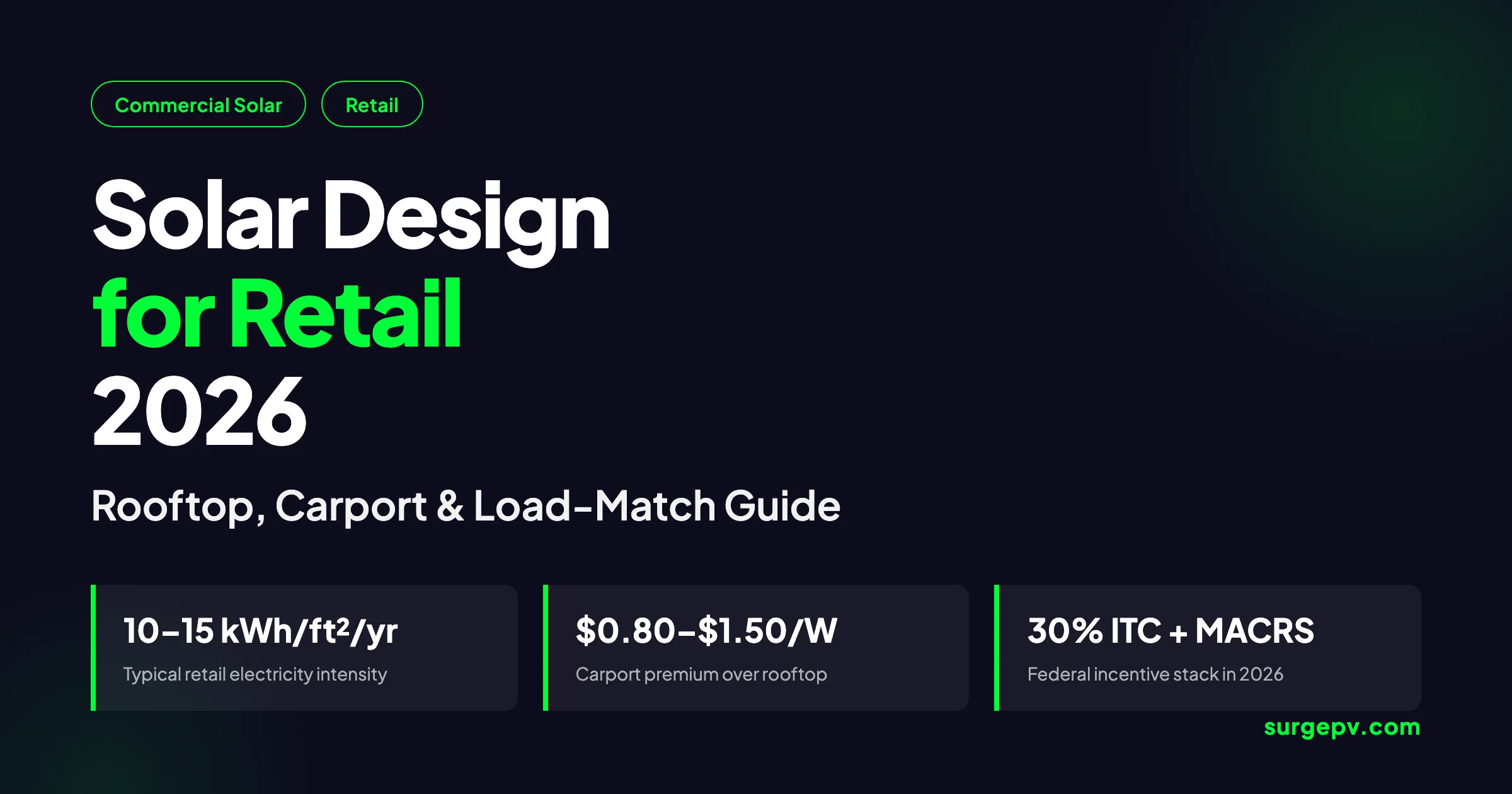
Retail buildings account for roughly 14 percent of all electricity used in U.S. commercial buildings, according to the U.S. Energy Information Administration (2023). That share translates into a large, addressable market for solar. Big-box stores, grocery chains, strip malls, and standalone shops share one advantage that factories and data centers lack: most of their electricity use happens during the day, exactly when solar panels produce power. The design challenge is that retail portfolios are not uniform. A 200,000 square foot grocery store has a different load shape than a 20,000 square foot auto dealership or a 50,000 square foot clothing retailer.
Solar design for retail starts with the operating hours and the lease structure, then moves to the roof plan. This guide covers the full 2026 workflow. We walk through load profiling and sizing. We compare rooftop, carport, and ground-mount options. We cover tenant versus owner-occupied finance, demand charges and net metering, incentives, storage and EV charging, and the mistakes that turn a promising retail project into a stranded asset.
SurgePV is an all-in-one solar software platform built for commercial solar workflows. If you are designing retail solar at scale, use a cloud solar design platform that imports interval data, runs shading analysis software, and exports permit-ready plans. The solar yield and financial analysis models retail-specific tariffs, incentives, and cash-flow structures in one place.
Quick Answer
Solar design for retail sizes the array to the store’s daytime load curve, not the roof. A typical retail store uses 10 to 15 kWh per square foot per year. Rooftop solar is cheapest, carports add shade and EV charging, and ground-mount works when land is available. Finance with the 30% federal ITC, MACRS, or a third-party PPA.
In this guide:
- Why retail solar design is a distinct engineering problem
- How retail subtypes change the design approach
- How to profile retail energy use and size the array
- Rooftop, carport, and ground-mount tradeoffs
- Tenant versus owner-occupied ownership models
- Demand charges, net metering, and self-consumption
- Financing models: ownership, PPA, lease, and green loans
- Incentive stack for retail solar in 2026
- Battery storage and EV charging integration
- Structural, fire-code, and safety requirements
- Common design mistakes and how to avoid them
- FAQ with 10 retail solar questions
Why Retail Solar Design Is Different
A retail store looks like a standard commercial solar rooftop job, but its load profile, stakeholder set, and site constraints differ from offices or warehouses. Retail buildings operate on a daily rhythm. Lights, HVAC, refrigeration, and point-of-sale systems run during posted hours. That rhythm is a solar design input, not a detail.
The median retail store benchmarked in ENERGY STAR Portfolio Manager has a site energy use intensity of 103.5 kBtu per square foot per year, according to ENERGY STAR (2024). The electricity-only portion typically falls between 10 and 15 kWh per square foot per year, depending on climate, refrigeration load, and operating hours. A 50,000 square foot store therefore uses roughly 500,000 to 750,000 kWh per year of electricity. Strip malls can run higher when tenant loads are included. Enclosed malls average 65.7 kBtu per square foot per year of site energy.
Retail also has unique stakeholders. The property owner cares about roof warranties and lease language. The tenant cares about utility savings and uninterrupted operations. The corporate sustainability team cares about renewable energy certificates and ESG reporting. The facilities manager cares about access for deliveries and maintenance. A good retail solar design answers all four audiences before construction starts.
Retail Subtypes and Their Design Drivers
Not all retail buildings behave the same way. The load shape changes the array size, the mounting choice, and the value of storage.
| Retail subtype | Typical EUI | Load shape | Best mounting | Storage value |
|---|---|---|---|---|
| Grocery store | 140–200 kBtu/ft²/yr | Flat, 18–24 hours | Rooftop + carport | Moderate; refrigeration backup |
| Big-box store | 80–120 kBtu/ft²/yr | Daytime peak | Rooftop | Low without EV charging |
| Strip mall | 100–230 kBtu/ft²/yr | Tenant-dependent | Rooftop + carport | Moderate for common areas |
| Auto dealership | 120–180 kBtu/ft²/yr | Daytime, high lighting | Carport + rooftop | Low |
| Restaurant/QSR | 200–350 kBtu/ft²/yr | Lunch and dinner peaks | Rooftop | Moderate for peak shift |
Grocery stores have the highest electricity intensity of common retail subtypes. Refrigeration and freezer loads run continuously, which flattens the load curve and improves solar self-consumption. Big-box stores have large roofs relative to their load, which often makes rooftop solar the cheapest path to a high offset. Strip malls must account for tenant meters and common-area allocations. Auto dealerships benefit from carport solar because the parking lot is both large and visible to customers.
How to Size a Solar System for Retail
The correct sizing sequence for retail solar is: measure load, benchmark intensity, model production, check net metering, then pick the kWp number. Residential rules of thumb will mislead you.
Step 1: Collect Interval Data and Building Information
Request 12 to 24 months of 15-minute or hourly interval data from the utility. Monthly bills hide the daily peaks and the weekend lull. You also need:
- Gross floor area and conditioned area
- Year of construction and roof age
- HVAC type, refrigeration load, and hours of operation by day
- Demand charge structure from the utility
- Any plans for EV charging, kitchen electrification, or store expansion
ENERGY STAR Portfolio Manager is the standard benchmarking tool. The median retail store source EUI is 120.0 kBtu per square foot per year, according to ENERGY STAR. Use the benchmark to sanity-check the utility data.
Step 2: Benchmark with EUI
Build a load curve by month and by day of week. A typical standalone retail store in a mixed climate might look like this:
| Day type | Approximate electric load (% of peak) | Notes |
|---|---|---|
| Weekday open | 100% | Midday cooling, lighting, refrigeration peak |
| Weekday closed | 25% | Security, refrigeration, overnight HVAC |
| Saturday open | 95% | Similar pattern, slightly shorter hours |
| Sunday open | 80% | Shorter hours, reduced staffing |
| Holiday closed | 20% | Baseline refrigeration and security only |
The weekday daytime peak drives the financial model. Retail stores with refrigeration, such as grocery stores, have a flatter nighttime load because coolers run continuously. Clothing or electronics stores have a steeper nighttime drop.
Step 3: Model Production and Size to Self-Consumption
Use a TMY3 weather file and a tool like NREL PVWatts for a first-pass production estimate. For a detailed layout with shading, stringing, and financials, use dedicated solar design software with satellite imagery and interval-data import.
Run three sizing scenarios:
| Scenario | Sizing target | Best for |
|---|---|---|
| Match annual load | Production equals 100% of annual kWh | Full net metering with annual true-up |
| Match daytime load | Production covers 80 to 95% of weekday daytime kWh | Net billing or demand-charge-heavy tariffs |
| Export-limited | Production equals 100% of on-site annual consumption | Strict export caps or zero-export rules |
A common mistake is to size to annual load without checking the midday export value. In a net billing state, that mistake can reduce effective solar value by 20 to 40 percent.
Rooftop, Carport, and Ground-Mount Options for Retail
Most retail sites have three real estate options. Each has a different cost, risk profile, and customer-facing payoff.
Rooftop Solar
Rooftop is usually the lowest-cost option and the most common. A typical 50,000 square foot big-box roof fits 250 to 500 kW after fire setbacks, HVAC exclusions, and structural limits.
Pros:
- Lowest installed cost per watt
- No new land use
- Fastest interconnection path
- Production aligns with daytime store load
Cons:
- Limited by roof age and structural capacity
- Fire setbacks consume 15 to 25 percent of gross roof area
- RTUs, skylights, and drains create exclusions
- Re-roofing later requires panel removal and reinstallation
Before committing to rooftop, get a structural letter. Most retail roofs built after 1990 can handle 4 to 6 psf of additional live load, but older buildings and stores in heavy snow regions need review. If the roof has fewer than 15 years of remaining life, bundle the solar with a re-roof or move to carport.
Solar Carports
Carports cost more per watt than rooftop, but they solve several retail-specific problems at once. They provide shaded parking, visible sustainability, no roof warranty conflict, and a natural home for EV charging. Read our deeper dive in the Solar Carport Design Guide.
Pros:
- Use parking-lot real estate the property already owns
- Provide customer and employee shade
- Easy to pair with EV charging stubs
- No roof structural limits
Cons:
- Higher cost per watt
- Foundation and civil work
- May require stormwater review
- Longer permitting timeline
For properties where the roof is old or small, carports often carry the project. A 100-space parking lot can host 100 to 150 kW depending on bay spacing and column layout. A 400-space big-box lot can support 400 to 600 kW.
Ground-Mount and Facade Solar
Ground-mount works for retail sites with unused acreage, often near loading docks or detention basins. It is the easiest to maintain and can be sized to portfolio scale, but it competes with land use and requires fencing.
Facade or building-integrated photovoltaics are occasionally used for retail flagship stores with strong sustainability branding. They typically produce less energy per square foot than rooftop or carport systems and cost more. Use facade solar for visibility, not for primary energy offset.
A practical portfolio-level design might put 300 kW on each store rooftop and 200 kW of carport solar at flagship locations, then aggregate production across the portfolio for ESG reporting.
Tenant vs Owner-Occupied: Who Owns the Array?
Retail solar projects often stall on the lease, not the engineering. Roughly half of retail floor space in the United States is leased, according to industry-observed estimates from the National Association of Realtors. The ownership model must match the lease structure.
Owner-Occupied Retail
When the retailer owns the building, the decision is straightforward. The owner captures the utility savings, the tax credits, and the property value increase. Ownership works best for grocery chains, big-box retailers, and auto dealerships that own their real estate.
Single-Tenant Net-Lease Retail
In a single-tenant net lease, the tenant pays utilities and the landlord owns the building. The array can be owned by either party. If the landlord owns the system, the tenant buys solar power through a lease addendum or a PPA-style rate. If the tenant owns the system, the lease must allow the equipment to remain or be removed at term end.
Multi-Tenant Strip Malls
Multi-tenant retail is the hardest case. Common area meters, tenant meters, and shared roofs complicate ownership and billing. Virtual net metering or meter aggregation, where allowed, lets the landlord allocate solar credits across multiple tenant meters. Without aggregation, the array usually powers only common areas, which represent 10 to 20 percent of total building load.
The practical rule is to resolve the ownership and billing model before the first site visit. A beautiful design with no contract path to the tenants is not a project.
Load Profiles, Demand Charges, and Net Metering
Retail solar economics depend on how much of the generated power the store uses on-site. The more solar consumed during business hours, the higher the effective value per kilowatt-hour.
Self-Consumption Rate
A well-sized retail array can achieve a self-consumption rate of 70 to 90 percent. Grocery stores with continuous refrigeration sit at the high end. Stores with steep nighttime drops sit in the middle. Oversized arrays that export most midday production sit at the low end.
Demand Charges
Many commercial retail tariffs include demand charges based on the highest 15-minute average demand in a billing period. These charges can range from $10 to $25 per kW per month. Solar reduces demand only when generation coincides with the peak. A store that peaks at 4 PM in summer may see limited demand-charge savings from solar alone. Battery storage can help by discharging during the peak.
Net Metering Structures That Matter
The financial value of surplus power depends on the net metering rules:
| Structure | How surplus is treated | Retail impact |
|---|---|---|
| Annual true-up, retail rollover | Credits carry forward at retail value | Best case: seasonal surplus offsets winter bills |
| Monthly settlement | Surplus cashed out at avoided-cost rate | Avoid oversizing |
| Net billing | Exports paid at hourly avoided-cost rate | Size to daytime load, add storage |
DSIRE tracks the current rules by state. In states with monthly settlement or net billing, size the array closer to the daytime load.
Financial Models and Incentives for Retail Solar in 2026
Retail solar in the United States is usually financed through ownership, a PPA, or a lease. The right structure depends on who pays taxes, who owns the roof, and who carries the debt.
Ownership with ITC and MACRS
A taxable retailer can claim the 30% federal Investment Tax Credit under Section 48E and 5-year MACRS depreciation. Bonus depreciation is 40% in 2026, with the remainder over 5 years.
Ownership works best when:
- The retailer has taxable income to absorb the credits
- The balance sheet supports the capital outlay
- The building is owned or the lease is long-term
- The roof is suitable and the project is simple
A 300 kW rooftop system at $2.00 per watt costs $600,000. The 30% ITC returns $180,000. MACRS depreciation provides additional tax benefit. Simple payback is typically 5 to 8 years with annual savings of $60,000 to $100,000 depending on local rates.
| Factor | Ownership | Solar PPA | Capital Lease |
|---|---|---|---|
| Upfront cost | High | None | Low to none |
| Tax credit capture | Owner | Developer | Owner, over time |
| Maintenance risk | Owner | Developer | Owner or lessor |
| Best for | Taxable retailers with balance sheet | Cash-constrained or leased buildings | Lease accounting preference |
| 25-year savings | Highest | Lower but predictable | Moderate |
Solar PPA and Lease
In a PPA, a developer owns the system and sells power to the retailer at a fixed rate below utility pricing. The developer captures the ITC and depreciation. PPA rates for retail solar in 2026 typically range from $0.07 to $0.13 per kWh depending on state, system size, and credit quality.
PPAs work best when:
- The retailer has no upfront capital
- The board prefers predictable operating expenses
- Maintenance and performance risk should sit with the developer
- The lease allows a third-party energy system
A capital lease transfers ownership to the retailer over time. An operating lease keeps the asset off the balance sheet. Both are common in net-lease retail.
Green Financing and State Incentives
Many states and utilities offer programs that improve retail solar economics. Options include:
- Solar renewable energy credits in states with renewable portfolio standards
- Green bank low-interest financing
- Utility rebates for commercial solar
- Property-assessed clean energy financing
- Sales and property tax exemptions
Use DSIRE to check current state incentives. The database is maintained by N.C. State University and is the most reliable single reference for U.S. solar policy.
Structural and Code Considerations
Retail solar carries standard commercial code requirements plus a few retail-specific wrinkles. The design must address structural loading, fire access, electrical safety, and ongoing maintenance.
Structural Review
Engage a licensed structural engineer early. The review should cover:
- Existing roof live-load and dead-load capacity
- Ballasted versus attached racking selection
- Wind and snow loads for the jurisdiction
- Seismic bracing requirements
- Roof membrane compatibility and warranty impact
Most retail roofs built after 1990 can support commercial solar with standard racking. Older buildings may need structural upgrades. If a re-roof is planned within 10 years, complete it before solar installation.
Fire and Electrical Code
Follow the local fire marshal’s requirements for setbacks and access paths. Common rules include:
- 6 to 8 foot perimeter setbacks on flat roofs
- Access paths to HVAC equipment and drains
- DC arc-fault protection and rapid shutdown
- Clear labeling of disconnects and conduit paths
Use module-level rapid shutdown for rooftop arrays. This keeps first responders safe and is required by NEC 690.12 in most jurisdictions.
Customer and Delivery Access
Carports and ground-mount arrays need fencing, bollards, and locked disconnect enclosures. Rooftop arrays need guarded roof hatches and fall-protection anchors. Plan construction around store hours and delivery schedules. A retail project that blocks loading docks during peak season will not be welcomed back.
Battery Storage and EV Charging
Retail solar is increasingly paired with storage and electric vehicle charging. Both change the load profile and the financial model.
Battery Storage
Battery storage does two useful things for retail stores. It shifts midday solar production into evening hours, and it reduces demand charges that solar alone does not address.
Size storage at 1 to 3 hours of the store’s peak demand. A 300 kW solar array paired with a 100 kW / 200 kWh battery can capture meaningful demand-charge savings in markets with $15 per kW or higher demand charges. Read our guide on Commercial Battery Storage Sizing for a deeper methodology.
Battery storage paired with solar qualifies for the 30% ITC. It also improves resilience by keeping refrigeration, security, and point-of-sale systems online during outages.
EV Charging
Retail parking lots are natural locations for EV charging. Customers can charge while they shop. A single Level 2 charger uses 7 to 19 kW, and a DC fast charger uses 50 to 150 kW. Solar carports are the ideal host because they combine generation, shade, and electrical infrastructure.
Design the service entrance and transformer with headroom for future chargers. Upgrading a 1,000 amp service after construction is far more expensive than sizing it correctly the first time.
Common Retail Solar Design Mistakes
Retail projects fail or underperform for predictable reasons. Here are the most common design mistakes and how to avoid them.
1. Sizing to Annual Load Without Daily Modeling
A 400 kW array that produces 110 percent of annual load sounds right until you see that 30 percent of midday production is exported at 4 cents per kWh. Model hour by hour, not year by year.
2. Ignoring Lease Expiration and Roof Timing
Installing panels on a roof that needs replacement in 8 years creates a $100,000-plus removal and reinstallation event. Either re-roof first or choose carport or ground-mount. For leased buildings, align the solar contract term with the lease term.
3. Accepting Net Billing Blindly
Net billing can reduce the value of exports by 50 to 80 percent compared to retail rates. If full net metering is not available, reduce array size, add storage, or focus on daytime self-consumption.
4. Treating Retail Like Residential
Residential soft-cost ratios, design margins, and financing structures do not apply. Use commercial design tools, commercial inverters, and commercial procurement.
5. Skipping Structural and Electrical Upgrades
A 500 kW array may require a service upgrade, new switchgear, or transformer work. Scope this in feasibility, not after permit submittal.
6. Forgetting Tenant Coordination
On multi-tenant properties, the array owner must have a clear billing path. Do not design for tenant meters you cannot legally credit.
Worked Example: 200 kW Strip Mall
Here is a worked example for a 40,000 square foot strip mall in a Midwestern state with annual true-up net metering.
Inputs:
- Annual electricity use: 520,000 kWh
- Weekday daytime use: 320,000 kWh
- Roof area available after setbacks: 38,000 sq ft
- Local electricity rate: $0.14 per kWh
- Utility export credit: $0.05 per kWh under annual true-up
Sizing:
The design targets 90 percent of annual load to capture most daytime consumption without excessive summer exports. A 200 kW DC system with a 1.3 specific yield produces 260,000 kWh per year. That covers 50 percent of annual consumption and roughly 80 percent of weekday daytime consumption.
Cost:
- 200 kW at $2.00 per watt = $400,000
- ITC at 30% = $120,000 tax credit
- MACRS depreciation benefit = approximately $60,000 at a 25% effective rate
- Net cost = approximately $220,000
Savings:
- First-year avoided energy cost: 260,000 kWh × $0.14 = $36,400
- Simple payback: $220,000 / $36,400 = 6.0 years
- 25-year savings: roughly $650,000 to $800,000 with 2.5% annual rate escalation
This is a conservative design. If carport solar is added for customer shade and EV charging, the payback lengthens but the marketing and amenity value increases.
FAQ: Solar Design for Retail
How do you size a solar system for a retail store?
Start with 12 to 24 months of interval data and the store’s gross floor area. A typical retail store uses 10 to 15 kWh per square foot per year of electricity. Size the array so midday solar production matches the daytime operating load. Then model the export value under local net metering rules before finalizing the kWp number.
How much does solar cost for a retail store in 2026?
Retail rooftop solar costs $1.50 to $2.50 per watt DC for systems above 100 kW. Solar carports cost $2.50 to $4.50 per watt, roughly $0.80 to $1.50 more than rooftop. A 200 kW rooftop system typically costs $300,000 to $500,000 before incentives. After the 30% federal ITC and MACRS depreciation, net cost falls sharply.
Should a retailer buy solar outright or use a PPA?
Ownership wins when the retailer has taxable income to use the 30% ITC and MACRS depreciation. A solar PPA wins when the retailer wants zero upfront capital, predictable operating expenses, and outsourced maintenance. A capital lease transfers ownership over time. The right choice depends on balance sheet, tax appetite, and lease structure.
What is the best mounting option for retail solar?
Rooftop is cheapest when the roof has 15-plus years of remaining life and adequate structural capacity. Carports cost more but unlock parking-lot real estate, provide customer shade, and pair with EV charging. Ground-mount works when the site has unused land. Many retail portfolios use a mix.
Do retail stores still save money with net billing instead of net metering?
Yes, if the array is sized for self-consumption. Retail stores consume most of their electricity during business hours, so solar production aligns well with load. Net metering at retail rates is best. Net billing pays avoided-cost rates for exports, which can reduce savings by 20 to 40 percent if the array is oversized.
What incentives are available for retail solar in 2026?
Federal incentives include the 30% Investment Tax Credit under Section 48E and 5-year MACRS depreciation. State and local options include net metering, solar renewable energy credits, green bank financing, utility rebates, and property-assessed clean energy programs. DSIRE tracks incentives by state.
How do you handle roof condition and structural loading for retail solar?
Engage a structural engineer to review live-load capacity, typically 4 to 6 psf for solar. A roof within 5 to 10 years of replacement should be re-roofed first or the project should move to carport. Use non-penetrating ballasted racking on flat roofs where allowed, and keep fire-code setbacks of 6 to 8 feet.
Can retail solar include battery storage and EV charging?
Yes. Battery storage sized at 1 to 3 hours of peak load shifts midday solar into evening demand and reduces demand charges. EV charging pairs naturally with solar carports. A Level 2 charger uses 7 to 19 kW, and a DC fast charger uses 50 to 150 kW. Size the electrical service with future chargers in mind.
What are the most common retail solar design mistakes?
The most common mistakes are sizing to annual load without checking daytime self-consumption, ignoring roof replacement timing, and accepting net billing that pays avoided-cost export rates. Other errors include using residential design rules, skipping structural review, and failing to coordinate with tenants on leased properties.
How long does a retail solar project take from feasibility to commissioning?
A typical retail solar project takes 8 to 18 months. Feasibility and energy audit take 1 to 2 months. Lease or ownership approval and financing close in 1 to 3 months. Design and permitting run 2 to 4 months. Utility interconnection approval takes 2 to 4 months. Construction lasts 1 to 3 months.
Next Steps for Your Retail Solar Project
Retail solar in 2026 is a mature play with clear design rules, strong incentives, and growing corporate demand. The projects that succeed treat the store as a daytime load. They match the mounting strategy to the site and finance around the ownership structure.
Three actions will move you forward today:
-
Pull interval data and benchmark the building in ENERGY STAR Portfolio Manager. The median retail store site EUI is 103.5 kBtu per square foot per year; use that benchmark to identify which stores in the portfolio are the best candidates.
-
Run a tariff-first design in solar design software. Model production hour by hour, then test three sizing scenarios against the local net metering rules before picking the kWp number.
-
Compare ownership with ITC and MACRS against a PPA using a solar proposal tool that handles tenant allocations, demand charges, and retail cash flow. If you want a hands-on walkthrough of retail financial modeling, book a SurgePV demo.
For complex retail portfolios that need detailed engineering or PE-stamped permit packages, engineering consultancies such as Heaven Designs provide solar design services, detailed engineering, and permit design support for EPCs that need extra capacity on commercial jobs.
Where this fits
This article is part of SurgePV's Solar Design hub, which works through the topic from first principles to the decisions a project team actually has to make.