

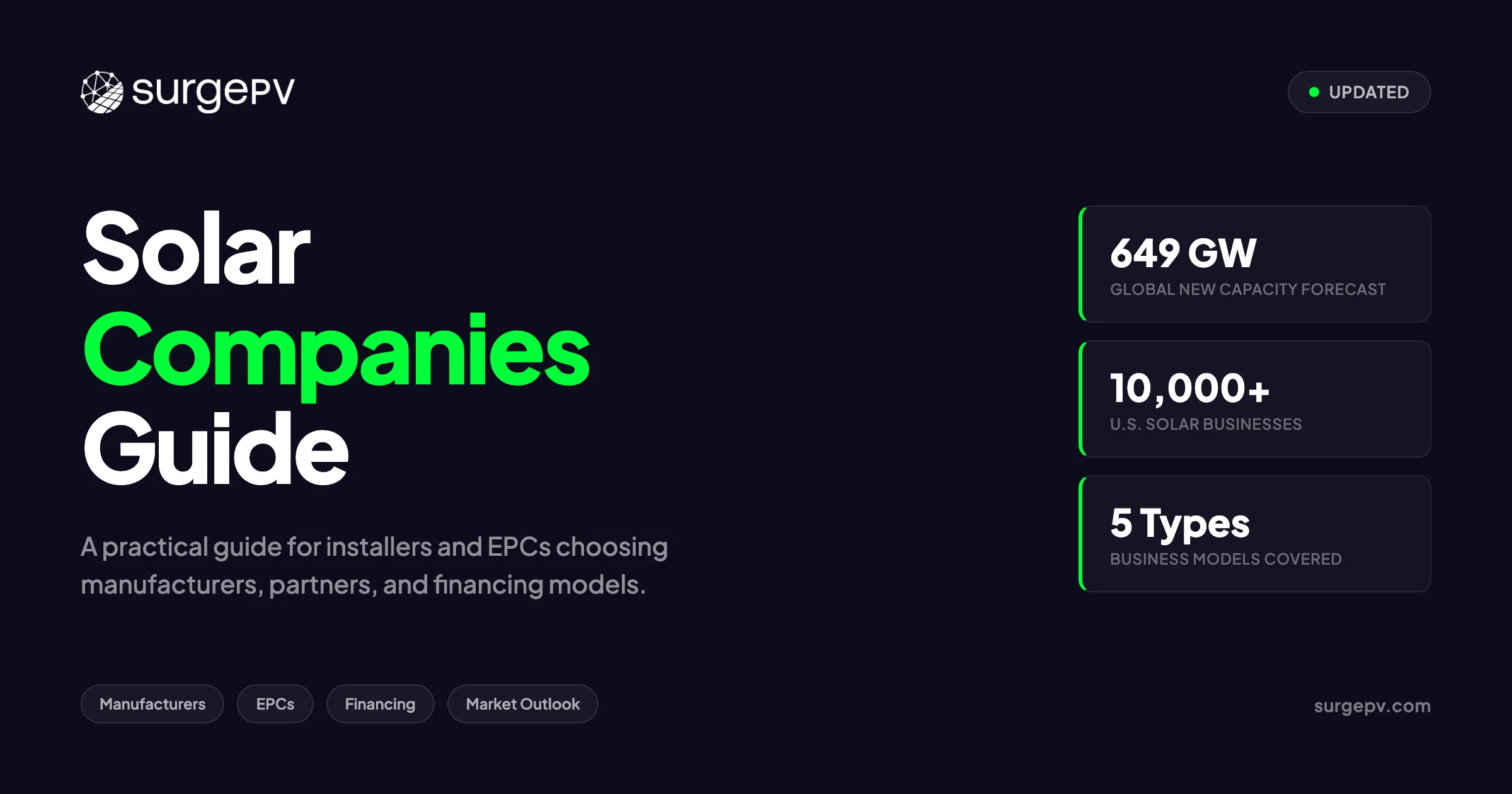
The solar industry reached 287.7 GW of installed capacity in the United States alone by early 2026, with more than 10,000 solar businesses and 280,119 workers in the market, according to SEIA. Globally, BloombergNEF expects 649 GW of new solar capacity in 2026, a slight dip from 655 GW in 2025 and the first slowdown in two decades. Those numbers matter because they change how every company in the value chain behaves — from module manufacturers cutting prices to installers fighting harder for each lead.
If you run an installation or EPC business, “solar companies” are not just competitors. They are potential suppliers, partners, financiers, and customers. Knowing how to read them saves money, reduces project risk, and helps you build a more stable pipeline.
In this guide, you will learn:
- The five business models that fall under the term “solar companies”
- How to evaluate module manufacturers, EPCs, and installers
- Which financing and ownership models make sense for different customers
- 2026 market signals that should change your sourcing and partnership strategy
- Red flags to watch when vetting any solar company
- A practical framework for choosing the right partner or supplier
Quick Answer
Solar companies include manufacturers, EPCs, installers, financiers, and software or service providers. The right partner depends on project size, geography, technology needs, and who will own the system. In 2026, low module prices and policy uncertainty make bankability, warranty strength, and local execution more important than ever.
The 5 Types of Solar Companies
The phrase “solar companies” covers a wide range of businesses. Treating them as one group leads to bad decisions. Here is how the value chain breaks down in practice.
Module and Component Manufacturers
These companies produce the physical equipment: solar cells, modules, inverters, racking, trackers, and batteries. The global market is highly concentrated. China controls roughly 80% of the solar supply chain, and the top five module manufacturers account for about 75% of global market share, according to industry estimates compiled in 2026 market reports.
Leading module manufacturers include JinkoSolar, LONGi Green Energy, Trina Solar, JA Solar, and Canadian Solar. In the United States, First Solar is the largest domestic thin-film manufacturer, while Qcells operates significant cell and module capacity in Georgia. Inverter and power electronics leaders include Enphase Energy, SolarEdge, Sungrow, and Huawei.
For an installer or EPC, the manufacturer decision is mostly about bankability, warranty, and delivery. A module with a great datasheet but weak balance sheet can become a liability if the company is not around to honor a 25-year warranty.
Engineering, Procurement, and Construction (EPC) Firms
EPCs design the system, buy the equipment, and build the project. They typically take full responsibility for schedule, cost, and performance. EPCs are common in utility-scale, commercial and industrial (C&I), and large community solar projects.
Examples include Bechtel, Mortenson, McCarthy, and specialty solar EPCs like Rosendin Electric and DEPCOM Power. Some developers, such as Cypress Creek Renewables and Recurrent Energy, also self-perform or tightly manage EPC work.
The EPC model matters because it transfers risk. If the project underperforms or runs over budget, the EPC contract usually defines who pays. That is why EPC selection is as much about contract terms and past performance as it is about price.
Local Solar Installers
Local installers are the companies most homeowners meet. They sell the project, handle permits, install the system, and manage commissioning. In the U.S., the residential market includes national installers like Sunrun and Sunnova, regional players like Freedom Forever and ION Solar, and thousands of independent local contractors.
Installers compete on customer acquisition, speed, and service quality. The best installers often use PV design software to produce accurate site models and solar proposal platform to close deals faster. For EPCs and developers, local installers can also serve as subcontractor partners in markets where direct labor is hard to scale.
Financing and Ownership Companies
Not every solar company touches a panel. Some specialize in owning systems and selling power. These include tax equity investors, yieldcos, lease and PPA providers, and green bond issuers. NextEra Energy, Brookfield Renewable Partners, and Clearway Energy are large public players that own and operate solar assets.
For installers, financing partners determine which products you can offer. A customer who cannot use the investment tax credit may prefer a lease or PPA. A customer with strong credit and tax appetite may prefer a loan or cash purchase. Your financing menu shapes your sales pitch.
Software and Service Providers
This category includes design and simulation platforms, drone inspection services, asset management software, and AI-based performance optimization tools. SurgePV sits here, along with companies like Aurora Solar, OpenSolar, Sitemark, and Raptor Maps.
Software companies matter because they determine how fast and accurately a project moves from lead to operation. A design platform that integrates shading analysis, yield simulation, and proposal generation can cut proposal time from days to hours.
How to Evaluate a Solar Panel Manufacturer in 2026
Module prices fell sharply over the past two years, which sounds good for buyers until you realize that price pressure has pushed weaker manufacturers toward insolvency. Choosing a module supplier in 2026 means looking past the wattage and price per watt.
Bankability and Tier-1 Status
BloombergNEF’s tier-1 list is not a quality certification. It means the manufacturer has supplied modules to at least six projects that received non-recourse financing from different banks in the past two years. That is a useful proxy for financial health and bank acceptance, but it does not guarantee field performance.
Ask for:
- Current BloombergNEF tier-1 status
- Audited financials or credit ratings
- Reference projects in your region
- Local warehouse or service presence
Warranty Terms
A 25-year product warranty and a 25-year linear power warranty are now standard for tier-1 modules. Read the fine print. Some warranties cover replacement only, not labor or shipping. Others have degradation caps that look similar on paper but differ in year-by-year guarantees.
For example, a common guarantee is 97.5% in year one and no more than 0.5% annual degradation thereafter, ending at 85% to 87% by year 25. Compare that curve across suppliers rather than trusting a headline number.
Technology and Application Fit
Most modules sold in 2026 are monocrystalline silicon, with n-type TOPCon and heterojunction (HJT) cells gaining share over p-type PERC. Bifacial modules now account for about 40% of utility installations because they capture reflected light from the ground.
Match the technology to the project:
| Project Type | Typical Module Choice | Why |
|---|---|---|
| Residential rooftop | 430–500 W mono PERC or TOPCon | Lightweight, high efficiency, good low-light performance |
| Commercial rooftop | 540–600 W TOPCon or HJT | Higher power density, lower BOS cost |
| Utility-scale ground mount | Bifacial 600 W+ | Albedo gain reduces LCOE |
| Carport or canopy | Frameless or custom-framed | Aesthetic and structural requirements |
Delivery and Local Support
Global supply chains are efficient but fragile. A manufacturer with local inventory can keep a project on schedule when ocean freight or customs delays hit. Ask about stock locations, lead times, and who handles warranty claims in your country.
How to Choose an EPC or Installation Partner
The right EPC or installer can make a project profitable. The wrong one turns a good design into a warranty nightmare.
Track Record in Your Segment
A residential installer with 5,000 rooftop systems is not automatically qualified for a 5 MW commercial carport. Ask for completed projects of similar size, technology, and geography. For EPCs, request references from project owners, not just the EPC’s own case studies.
Licenses, Insurance, and Safety
Verify licenses, bonding, and insurance. In the U.S., that means state electrical contractor licenses, NABCEP certifications for installers, and general liability plus workers’ compensation coverage. Ask for the certificate of insurance and confirm it names your project if required.
Safety records matter. A contractor with frequent OSHA incidents or a high experience modification rate will eventually cause delays and legal exposure.
Contract Structure
EPC contracts vary widely. A fixed-price, turnkey contract transfers the most risk to the EPC. A cost-plus contract gives the owner more visibility but less cost certainty. Time-and-materials contracts are common for small repairs or upgrades but risky for full construction.
Key clauses to review:
- Performance guarantees and liquidated damages
- Change order process and markup limits
- Warranty terms for workmanship and equipment
- Payment milestones tied to verifiable progress
- Force majeure and delay provisions
Subcontractor Management
Many EPCs subcontract electrical, civil, or racking work. Ask who will actually be on site and how the EPC vets those subcontractors. A strong EPC has long-term relationships and audits subs for safety, quality, and financial stability.
Financing and Ownership Models
Solar companies do not just sell hardware and labor. They also structure how the system is paid for and who owns it. The ownership model changes everything about incentives, maintenance, and customer economics.
Cash Purchase
The customer pays upfront and owns the system. This option captures the full value of incentives and energy savings but requires capital and, in some markets, the ability to use tax credits. After the U.S. residential investment tax credit expired at the end of 2025, cash purchases became more attractive for customers who can still claim commercial or business tax benefits.
Solar Loan
A loan lets the customer own the system while spreading payments over 10 to 25 years. The customer keeps incentives and savings. Loan products vary in interest rate, dealer fees, and prepayment terms. High dealer fees can inflate system prices without customers realizing it.
Solar Lease
In a lease, a third-party owner installs the system and the customer pays a fixed monthly amount. The third party keeps tax credits and depreciation. Leases work for customers with low tax appetite but often deliver lower lifetime savings than ownership.
Power Purchase Agreement (PPA)
In a PPA, the customer buys electricity at a per-kWh rate, usually lower than the utility rate. The PPA provider owns and maintains the system. PPAs are common in commercial solar because they let businesses lock in energy costs without capital expenditure.
Which Model Should Solar Companies Offer?
Most successful installers offer at least two options. In markets with strong net metering, cash and loan products dominate. In markets with high electricity rates and weak net metering, leases and PPAs can still win. The key is matching the product to the customer’s credit, tax position, and risk tolerance.
For accurate financial modeling across ownership models, use a solar financial analysis tool that can compare cash flow, payback, and net present value under different assumptions.
2026 Market Signals Operators Should Watch
The solar market in 2026 is not the same as 2024. Several structural shifts should influence how solar companies choose partners and plan growth.
Module Oversupply and Price Pressure
Global module manufacturing capacity far exceeds demand, which keeps prices low but squeezes margins across the supply chain. Low prices help project economics but increase counterparty risk. Manufacturers with weak balance sheets may exit the market, leaving warranty claims unpaid.
Policy Uncertainty in the U.S.
The U.S. residential ITC expired on December 31, 2025. Commercial projects may still have access to credits depending on project size and structure, but the overall incentive picture is more complex than in prior years. Tariffs on Chinese cells and modules, the Section 45X manufacturing credit, and state-level net metering changes all create uncertainty.
Installers should model projects under multiple policy scenarios and avoid overpromising savings based on incentives that could change.
Supply Chain Consolidation
China’s dominance in polysilicon, wafers, cells, and modules continues. U.S. manufacturing is growing — projected to expand eightfold by 2026 — but still represents a small share of global supply. For buyers, this means domestic modules may command a premium and have longer lead times during ramp-up.
Technology Transition
N-type TOPCon is replacing p-type PERC as the mainstream technology. HJT and perovskite-silicon tandems are moving from pilot to commercial scale. Bifacial modules are standard for utility projects. Installers should train crews on new module handling requirements and update design assumptions.
Africa and Emerging Markets
Africa was the fastest-growing solar region in 2025, with 26% capacity growth and 23.4 GW across more than 42,000 projects, according to AFSIA. Distributed solar, mini-grids, and commercial and industrial systems are driving growth. For companies looking to expand, Africa offers volume but requires different financing, logistics, and service models than mature markets.
Red Flags When Vetting Solar Companies
Whether you are choosing a module supplier, an EPC, a financing partner, or a software vendor, the same warning signs apply.
Vague or Missing Warranties
If a company cannot produce a clear warranty document or explain exactly what is covered, walk away. Warranty strength is only as good as the company behind it.
High-Pressure Sales Tactics
Legitimate solar companies do not demand a signature on the first call. Pushy closers, limited-time discounts, and claims that incentives are ending tomorrow are classic signs of a company more interested in signing contracts than delivering projects.
Large Upfront Payments
A reasonable deposit protects the contractor, but paying 50% or more before materials arrive creates unnecessary risk. Structure payments around milestones: contract signing, material delivery, mechanical completion, and final commissioning.
Mismatched Equipment
If the proposal lists one module but the contract allows substitutions “or equivalent,” ask for the exact approved alternates. Some companies bid with premium equipment and install lower-tier products.
Weak Financials
Public companies file financial statements. Private companies should provide references, bank references, or credit reports. A company that cannot pay its suppliers will eventually fail to pay its warranty obligations.
No Local Presence
For installation work, local knowledge matters. A company without experience in your jurisdiction may underestimate permitting timelines, interconnection costs, or local fire and electrical codes.
A Practical Selection Framework
Use this framework to compare solar companies side by side. Score each candidate 1 to 5, then weight the categories by what matters most for your project.
| Criterion | Why It Matters | Questions to Ask |
|---|---|---|
| Financial health | Determines warranty longevity | Tier-1 status? Audited financials? Bank references? |
| Segment experience | Reduces execution risk | How many projects like mine have you completed? |
| Local presence | Speeds service and permitting | Do you have staff or partners in my region? |
| Warranty terms | Protects long-term value | What is covered, for how long, and who pays labor? |
| Contract structure | Defines risk allocation | Fixed price or cost-plus? What are the milestones? |
| Technology fit | Ensures performance | Which modules and inverters do you recommend and why? |
| Financing options | Matches customer needs | What loan, lease, or PPA products do you offer? |
| Safety record | Reduces liability | What is your EMR and OSHA recordable rate? |
| References | Validates claims | Can I speak to three recent customers? |
For commercial and industrial projects, add a tenth criterion: energy modeling accuracy. A partner that uses shadow analysis and production modeling tools will produce more reliable forecasts than one relying on rules of thumb.
Design and Propose Solar Projects Faster
SurgePV helps solar companies move from site survey to signed proposal in one platform. Design, simulate, and finance — without switching tools.
Book a DemoNo commitment required · 20 minutes · Live project walkthrough
What This Means for Your Business in 2026
Solar companies are not interchangeable. A module manufacturer, an EPC, a local installer, a financier, and a software vendor each solve a different problem. The installers and EPCs that win in 2026 will be the ones that map each role clearly, vet partners with discipline, and avoid the temptation to chase the lowest price.
The market is also more uncertain than it has been in years. Incentive changes, supply chain consolidation, and technology transitions reward operators who stay close to their numbers and build relationships with stable partners.
If you are hiring or training salespeople to explain these differences to customers, see our guide on the solar sales career path. If you are thinking about adding battery storage to your service line, our post on adding battery storage services covers the operational side.
Frequently Asked Questions
What are the main types of solar companies?
The five main types are module and component manufacturers, engineering-procurement-construction (EPC) firms, local installation contractors, financing and ownership companies, and software or service providers. Each plays a different role in the value chain and carries different risks for project owners.
How do I choose a reliable solar panel manufacturer?
Check bankability ratings, tier-1 listings, warranty terms, local service presence, and module degradation rates. Tier-1 status from BloombergNEF indicates the manufacturer has been used in multiple financed projects, which is a proxy for bankability rather than a quality certification.
What is the difference between an EPC and a solar installer?
An EPC manages engineering, procurement, and construction end-to-end and often takes full project risk. A solar installer typically focuses on mounting, wiring, and commissioning under contract to an EPC or directly to a homeowner. EPCs are common in utility and commercial projects; installers dominate residential work.
Should solar companies offer leases, PPAs, loans, or cash sales?
The right model depends on customer credit, tax appetite, and local incentives. Cash and loans transfer ownership and incentive value to the customer. Leases and power purchase agreements (PPAs) let a third party own the system and sell power to the host. In the U.S., third-party ownership remains popular in states with high electricity rates.
What red flags should I watch when vetting a solar company?
Watch for unclear ownership of warranties, pushy sales tactics, requests for large upfront payments, lack of local licenses or insurance, and unrealistic production guarantees. Also verify that the quoted equipment matches what will actually be installed.
How is the solar industry changing in 2026?
Growth is slowing after two decades of expansion due to policy shifts in the U.S. and China. Module prices remain low, supply chains are consolidating around Chinese manufacturers, and bifacial and n-type TOPCon technologies are becoming standard. The U.S. residential ITC expired at the end of 2025, shifting buyer economics toward cash and loan products.
Where this fits
This article is part of SurgePV's Solar Business & Operations hub, which works through the topic from first principles to the decisions a project team actually has to make.


