

The smart solar power market is one of the few corners of the energy industry where the hardware is almost an afterthought. The panels are a commodity. The margin, the data, and the recurring revenue now sit in the electronics and software wrapped around them. That shift is why the market is growing faster than solar installations overall — and why it matters for any installer planning the next five years.
This guide breaks down the smart solar power market for solar professionals: the real numbers, the technology underneath the label, who leads, and what the move toward intelligent, connected systems means for how you design, sell, and service projects.
In this guide:
- Smart solar market size and growth forecasts for 2026 and beyond
- What actually makes a solar system “smart” — the four core layers
- The technologies driving the market: MLPE, smart inverters, AI, and storage
- Who leads the market and how the ecosystems are consolidating
- The honest tradeoff: when smart solar pays and when it does not
- What the shift means for installer business models
- How to design and quote smart systems accurately
Quick Answer
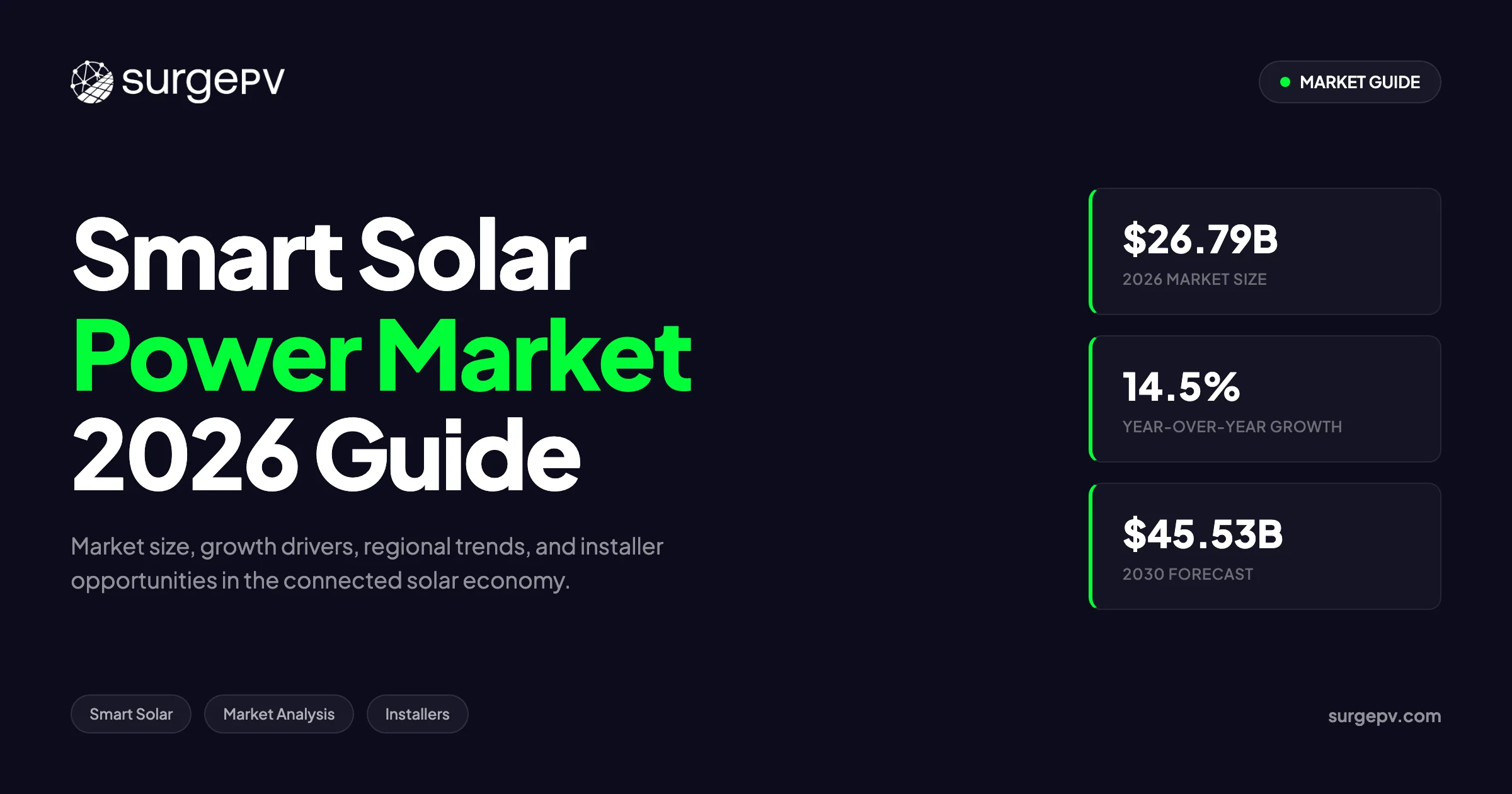
The smart solar power market reaches about $26.8 billion in 2026, up from $23.4 billion in 2025, at roughly 14.5% CAGR (Research and Markets, 2026). “Smart solar” means adding module-level electronics, real-time monitoring, and AI optimization to generation. For installers, the growth signals a shift from one-time hardware sales to recurring monitoring and service revenue.
Smart Solar Power Market Size in 2026
The smart solar market is expected to grow from $23.4 billion in 2025 to about $26.8 billion in 2026, a compound annual growth rate (CAGR) of 14.5%, according to Research and Markets (2026). That growth rate runs ahead of the broader solar power market, which most analysts put in the 8–12% range.
The reason is simple. Solar installations grow as more roofs and fields get covered. The smart solar segment grows for that reason plus a second one: a rising share of each installation now includes intelligent components that did not exist or were optional a decade ago.
Forecasts past 2026 vary widely because research firms define “smart solar” differently. The table below shows how the numbers spread.
| Source | Base value | Forecast | CAGR |
|---|---|---|---|
| Research and Markets (2026) | $23.4B (2025) | $26.8B (2026) | 14.5% |
| Acumen Research | $16.9B (2021) | $62.3B (2030) | 15.8% |
| Market Research Future | $51.0B (2025) | $133.5B (2035) | 10.1% |
| Market.us | — | — | 12.2% |
The spread tells you something useful. Firms that count only module-level electronics and monitoring report smaller numbers. Firms that fold in smart inverters, storage, and grid software report figures two to five times larger. When you read any smart solar market report, check the definition before you trust the headline.
What every source agrees on is direction. The market grows at double-digit rates through at least 2030, and the smart share of new installations keeps rising.
This matters for installers because it sets the competitive baseline. A company still selling basic string systems on every job is selling into a shrinking share of demand.
What Makes a Solar System “Smart”
“Smart solar” is a marketing label stretched across very different products. Strip away the branding and a smart system adds four layers on top of plain generation.
1. Module-level visibility. You can see the output of each individual panel, not just the array total. This comes from microinverters or DC optimizers, collectively called module-level power electronics (MLPE).
2. Automated optimization. The system reacts on its own to shade, soiling, faults, or grid signals. A string inverter with smart functions can curtail output when the grid asks. A microinverter isolates a failing panel without dropping the rest.
3. Remote monitoring. You track production, spot underperformance, and often diagnose the cause without sending a technician. This is the software layer — Enphase Enlighten, SolarEdge mySolarEdge, and similar platforms.
4. Grid interactivity. The system supports the grid rather than just feeding it. Smart inverters provide voltage and frequency support, ride through disturbances, and respond to utility commands.
A system needs at least the first three layers before “smart” means anything. A standard panel with a basic string inverter and no monitoring is not smart, no matter how the brochure reads.
The clearest way to understand the difference is per-panel independence. On a standard string, one shaded or faulty panel drags down every panel wired with it — this is module-level mismatch. Smart systems break that dependency.
The Technologies Driving the Market
Four technology groups account for nearly all smart solar market growth. Understanding them helps you read the market and quote the right system.
Module-Level Power Electronics (MLPE)
MLPE is the largest single driver. Microinverters convert DC to AC at each panel. DC optimizers condition each panel’s output before a central inverter. Both give per-panel control and visibility.
Smart panels with distributed power electronics and AI optimization deliver 15–25% more energy over a system’s lifetime than standard string setups on shaded or complex roofs, according to industry analysis reported by AltEnergyMag (2026). The gain is smaller — often near zero — on a simple, unshaded south-facing roof.
Smart Inverters
A smart inverter does more than convert DC to AC. It provides grid-support functions: voltage regulation, reactive power control, fault ride-through, and remote curtailment. In many markets these functions are now mandatory for grid connection.
SMA, Fronius, Huawei, and Sungrow lead this segment. Hybrid inverters, which manage solar and battery together, are the fastest-growing inverter category because they sit at the center of a smart home energy system.
AI and Predictive Software
AI has moved from pilot projects to core infrastructure. The main uses are predictive maintenance, fault detection, and production forecasting. An AI layer can flag a failing panel from a subtle output dip before it becomes a fault, and forecast next-day production for battery and grid planning.
For commercial fleets, this is where the real savings sit. Catching a string fault in two days instead of two months recovers energy that would otherwise be lost.
Battery and Storage Integration
Storage turns a solar array into a dispatchable asset. Smart systems pair generation, storage, and load management so the home or business uses, stores, and exports energy on its own schedule. Tesla, LG, and BYD anchor the battery side, and most pair with the inverter brand’s monitoring platform.
Together, these four groups explain the double-digit market growth. Each adds cost and capability that a basic panel-and-string-inverter system lacks.
Design smart solar systems that quote accurately
Model shade, strings, and module-level layouts in one place so your smart-system proposals reflect real yield.
Book a DemoNo commitment required · 20 minutes · Live project walkthrough
Who Leads the Smart Solar Market
The market is consolidating around full ecosystems — hardware plus software plus storage — rather than standalone parts.
| Segment | Leaders | What they own |
|---|---|---|
| MLPE + monitoring | Enphase, SolarEdge | Microinverters/optimizers, Enlighten, mySolarEdge |
| Smart string/hybrid inverters | SMA, Fronius, Huawei, Sungrow | Grid-support inverters, monitoring portals |
| Storage | Tesla, LG, BYD | Home and C&I batteries, energy management |
Enphase and SolarEdge are the most mature on the software side. Enphase Enlighten and SolarEdge mySolarEdge are the two unified platforms most installers already use, according to industry reporting from AltEnergyMag (2025).
The strategic pattern is lock-in. Each vendor wants you inside one ecosystem — its inverter, its battery, its app — because that maximizes recurring software value and switching cost. That is good for the vendor and a tradeoff for the installer, who gives up mix-and-match freedom for a cleaner integration.
For a deeper look at the broader market backdrop, see our global solar market forecast for 2026.
The Honest Tradeoff: When Smart Solar Pays
Here is where most market reports go quiet. Smart solar is not always the right call.
Smart components add roughly 8–20% to system hardware cost. On the right roof, that pays back. On the wrong roof, it is money spent for visibility you will rarely use.
Smart solar pays when:
- The roof has shade, dormers, multiple orientations, or partial obstructions
- The system is large or commercial, where a single undetected fault costs real money
- The owner values monitoring and is willing to pay for service
- Local rules require smart inverter functions anyway
Standard string systems still win when:
- The roof is simple, unshaded, and single-orientation
- Budget is the deciding factor and the owner will not pay for monitoring
- The site is remote with poor connectivity, limiting the value of remote diagnostics
The common mistake is treating “smart” as automatically better. On a clean south-facing roof in good sun, a quality string inverter can deliver 95%+ of a microinverter system’s yield at lower cost. The 15–25% yield advantage cited in most reports applies to shaded and complex roofs, not every roof.
The right question is not “is smart solar better?” It is “does this specific roof have enough shade, complexity, or service risk to justify the extra cost?” That answer comes from a proper design, not a sales script.
What the Shift Means for Installers
The smart solar market changes the installer business model more than it changes the panels on the roof.
Revenue moves from hardware to service. A smart system generates data, and data supports recurring monitoring and maintenance contracts. Installers who build a service practice around connected systems capture revenue long after the install. Those who only sell hardware compete on price for a one-time job. Our guide on commercial solar monitoring ROI metrics covers how to price and prove that service value.
Design complexity rises. Module-level systems need accurate shade and string modeling to quote honest yield. Promise a microinverter system 20% more output on a roof that does not have shade, and you have set up a disappointed customer. This is where solar design suite earns its keep — it models per-panel output and solar shading analysis so your proposal matches reality.
Sales conversations get more technical. Customers now ask about monitoring apps, fault alerts, and battery readiness. A sales team that can explain the smart layer in plain terms closes better than one reciting panel wattage.
Truck rolls drop. Remote monitoring lets you diagnose many faults from the office. For a company running a service fleet, fewer site visits is a direct cost saving — often the clearest financial case for selling smart systems in the first place.
The installers who win in this market are not the ones who buy the most advanced hardware. They are the ones who design it accurately, price the service correctly, and service it remotely.
How to Quote Smart Solar Systems Accurately
A smart system quote lives or dies on yield accuracy. Follow these steps to keep your proposals honest and your customers happy.
-
Model the actual shade. Use real shadow analysis for the site, not a generic derate. The case for MLPE rests entirely on shade and complexity, so measure it.
-
Compare both architectures. Quote the smart (MLPE) layout against a standard string layout for the same roof. Show the yield difference in numbers, not adjectives.
-
Separate hardware cost from service value. Break out the monitoring and service component so the customer sees what they pay for and why.
-
Set realistic yield expectations. Apply the 15–25% advantage only where shade or orientation justifies it. On a clean roof, say so.
-
Include the service plan. If you offer monitoring and maintenance, quote it as a line item from day one. Use a solar proposal tool to present hardware and service together cleanly.
Accurate quoting is the difference between a smart solar market that helps your reputation and one that produces refund requests. The technology only delivers its advantage when the design reflects the real roof.
Conclusion
The smart solar power market is growing because intelligence, not the panel, now carries the value. For solar professionals, three actions follow:
- Build a service practice. Treat monitoring and maintenance as recurring revenue, not an afterthought, since that is where the market’s growth concentrates.
- Design before you promise. Use real shade and string modeling so smart-system yield claims hold up. The 15–25% advantage is conditional, not automatic.
- Match the system to the roof. Quote smart components where shade, complexity, or service risk justify the cost — and recommend a quality string system where they do not.
Read more on the technology itself in our smart solar panels guide.
Frequently Asked Questions
What is the smart solar power market?
The smart solar power market covers solar systems that add digital intelligence to generation — module-level power electronics, real-time monitoring, AI-driven optimization, and grid-interactive controls. It includes microinverters, DC optimizers, smart inverters, monitoring platforms, and the software that ties them together. The market is valued at roughly $26.8 billion in 2026.
How big is the smart solar market in 2026?
The smart solar market is expected to reach about $26.8 billion in 2026, up from $23.4 billion in 2025, according to Research and Markets (2026). That represents a compound annual growth rate of roughly 14.5%. Long-range forecasts put the market between $62 billion and $133 billion by the early-to-mid 2030s, depending on the research firm and market definition.
What makes a solar system “smart”?
A solar system is “smart” when it adds three capabilities to basic generation: module-level visibility (you can see each panel’s output), automated optimization (the system reacts to shade, faults, or grid signals on its own), and remote monitoring (you track and diagnose the system without a site visit). Smart inverters, microinverters, and monitoring software provide these functions.
Are smart solar systems worth the extra cost?
Smart components add roughly 8–20% to hardware cost but can recover much of it through 15–25% higher lifetime energy yield on shaded or complex roofs, faster fault detection, and lower service costs. On a simple, unshaded roof, a standard string inverter may deliver better value. The decision depends on shading, roof complexity, and how much you spend on truck rolls.
What technologies drive the smart solar market?
The main drivers are module-level power electronics (microinverters and DC optimizers), smart inverters with grid-support functions, IoT monitoring sensors, AI-based fault detection and forecasting, and battery integration. Together these turn a solar array from a passive generator into a controllable, observable energy asset.
How does smart solar affect installers?
Smart solar shifts installer revenue from one-time hardware sales toward ongoing monitoring, maintenance, and performance services. It raises design complexity, because module-level systems need accurate shade and string modeling. It also rewards companies that can sell and service software-connected systems rather than just bolt panels to a roof.
What is the difference between smart solar and standard solar?
Standard solar uses a single string inverter for the whole array, so one shaded panel drags down the string and you have limited visibility into faults. Smart solar adds per-panel electronics and monitoring, so each panel works independently and you can see and diagnose problems remotely. Smart systems cost more but reduce mismatch losses and service trips.
Which companies lead the smart solar market?
Enphase and SolarEdge lead the module-level electronics and monitoring segment, with Enphase Enlighten and SolarEdge mySolarEdge the two most mature platforms. SMA, Fronius, Huawei, and Sungrow lead in smart string and hybrid inverters. Tesla, LG, and BYD anchor the battery side. The market is consolidating around full hardware-plus-software ecosystems.
Where this fits
This article is part of SurgePV's Solar Technology hub, which works through the topic from first principles to the decisions a project team actually has to make.

