

Quick Answer
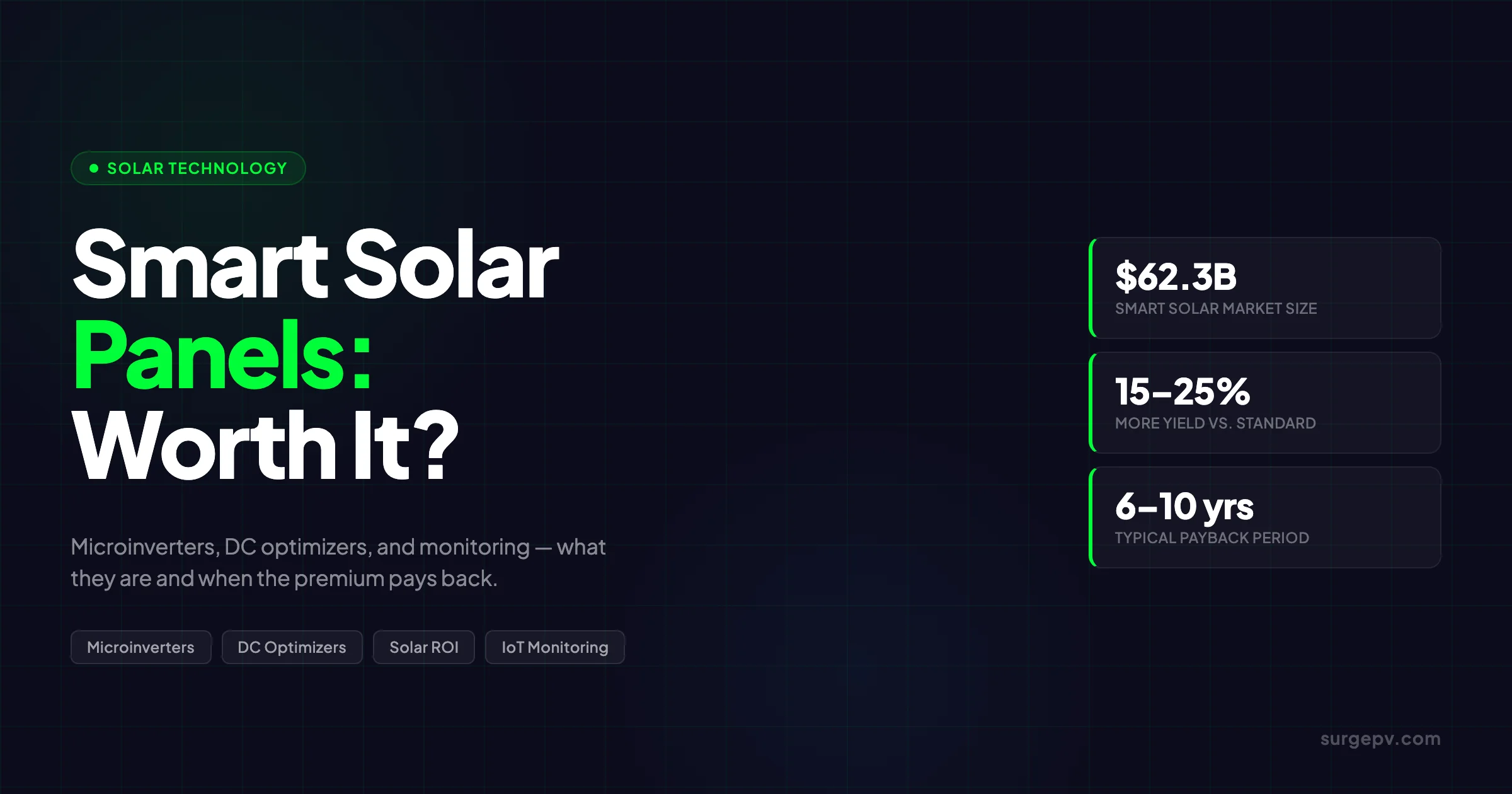
The result: 15–25% more energy over a 25-year system life compared to standard string-inverter setups, according to data compiled from Enphase and SolarEdge field deployments. The question every buyer and installer faces is whether the 10–25% cost premium is justified for their specific roof and energy goals.
Standard solar panels work well on a clear day with a clean, unshaded roof. Add a shadow from a chimney, a second roof plane, or a tree that grows for three years after installation — and a string-inverter system loses output from the entire array, not just the shaded panel. Smart solar panels solve this at the hardware level. By embedding independent power electronics at each module, they decouple every panel’s performance from its neighbors.
The result: 15–25% more energy over a 25-year system life compared to standard string-inverter setups, according to data compiled from Enphase and SolarEdge field deployments. The question every buyer and installer faces is whether the 10–25% cost premium is justified for their specific roof and energy goals.
The result: 15–25% more energy over a 25-year system life compared to standard string-inverter setups, according to data compiled from Enphase and SolarEdge field deployments. That gap is the core argument for smart solar. The question every buyer and installer faces is whether the 10–25% cost premium is justified for their specific roof and energy goals.
This guide gives a direct answer to both questions — what smart solar panels actually are and whether they are worth buying.
TL;DR — Smart Solar Panels
Smart solar panels embed microinverters or DC optimizers at the individual panel level, enabling panel-level performance optimization and real-time monitoring. They deliver 15–25% more yield than standard string systems on complex or partially shaded roofs. Cost premium: 10–25% upfront. Payback: 6–10 years in most US markets. For simple, unshaded roofs, the performance advantage narrows — standard string inverters may deliver comparable 25-year ROI at lower cost.
In this guide:
- What makes a solar panel “smart” — the hardware difference explained simply
- The three smart panel technologies: microinverters, DC optimizers, and smart modules
- Performance comparison: smart vs. standard panels with real data
- How real-time monitoring changes fault detection and system management
- Are smart solar panels worth the premium? A roof-by-roof decision framework
- What smart solar costs in 2026 — all-in pricing table by system size
- Brand comparison: Enphase vs. SolarEdge vs. Tesla vs. SMA
- Common mistakes buyers make when choosing smart solar hardware
What Are Smart Solar Panels?
A standard solar panel is a passive device. It converts sunlight into DC electricity and sends that power to a central string inverter via wires. The string inverter bundles all panels together — they rise and fall as a group. When one panel underperforms due to shade, soiling, or degradation, it limits output across the entire string.
Smart solar panels break that dependency. They embed active power electronics — either at the panel itself or directly behind it on the mounting rail — so each module operates independently. The three mechanisms are:
- Microinverters — convert DC to AC electricity at the panel. Every panel is its own power source with its own inverter.
- DC Optimizers — condition DC electricity at the panel level before sending it to a central inverter. Each panel finds its own peak output point.
- Smart Modules (AC Modules) — panels with a microinverter integrated directly into the module frame at the factory.
The “smart” label also covers software: cloud monitoring platforms that stream production data per panel, every 5–15 minutes, with automatic fault alerts and AI-driven analytics.
In 2026, the global smart solar market is valued at approximately $26.8 billion, growing from $16.9 billion in 2021 at a CAGR of 15.8% toward a projected $62.3 billion by 2030. Smart solar is no longer a premium upgrade — it is the default specification for residential solar in most of the US, UK, and Western Europe. Also see: European Solar Incentives. For UK-specific information, see Battery Solar System Design UK. For Global-specific compliance details, see Global net-metering-by-country.
The Three Smart Panel Technologies
Microinverters
A microinverter is a small inverter mounted on the back of — or directly behind — each solar panel. It converts DC electricity to AC at the module level. Every panel feeds independently into your home’s AC wiring.
How it changes performance: Because each panel has its own inverter, a shaded or underperforming panel produces only its own reduced output — not the reduced output of the entire array. A chimney shadow that would cut a 10-panel string system’s output by 30% might cut a microinverter system’s output by just 3%.
The market leader: Enphase Energy’s IQ8 series holds over 50% of the US residential microinverter market. The IQ8’s key feature is “grid-agnostic” operation — it can operate in limited form during a grid outage without a battery, a meaningful improvement over earlier generations.
Key advantages:
- No single point of string failure
- Panel-level real-time monitoring via the Enphase Enlighten app
- Safe low-voltage DC wiring on the roof (NEC rapid shutdown compliant)
- Straightforward battery integration (Enphase IQ Battery pairs directly)
- Each panel can be independently replaced or upgraded without system redesign
Key trade-off: Microinverters are the most expensive option. More components on the roof means more connection points, and while individual microinverters carry 25-year warranties, there is more hardware to potentially fail compared to a single central inverter.
See also: Microinverters vs. String Inverters vs. Power Optimizers — a detailed technical comparison. Read more about Agricultural Solar Case Study.
DC Optimizers
A DC optimizer is a power conversion device that attaches to each panel’s DC output, performs maximum power point tracking (MPPT) at the module level, and then sends optimized DC power to a single central string inverter. SolarEdge’s P-series optimizers paired with their HD-Wave string inverter are the benchmark system.
How it changes performance: Each panel independently finds its own maximum power point regardless of what its neighbors are doing. Partial shading on one panel does not pull down adjacent panels on the same string. The yield advantage over a plain string system is roughly comparable to microinverters — typically 10–20% better on complex or shaded roofs.
Key advantages:
- Panel-level MPPT and monitoring without full distributed inversion
- Lower upfront cost than microinverters (central inverter is cheaper than multiple micro-inverters)
- SolarEdge’s mySolarEdge monitoring app gives panel-level production data
- Rapid shutdown compliance for NEC 2017/2020 and later markets
- Compatible with SolarEdge battery and EV charger ecosystem
Key trade-off: The central inverter is a single point of failure. If it fails (typically at 10–15 years), the entire system stops producing. SolarEdge inverters carry a 12-year warranty (extendable to 25). The system is also more proprietary — SolarEdge optimizers require a SolarEdge inverter.
Smart Modules (AC Modules)
A smart module — also called an AC module — integrates the microinverter directly into the panel frame at the factory. The result is a single unit that plugs into standard AC wiring.
Enphase and SunPower (now rebranded as Complete Solaria) have both offered AC module variants. The appeal is installation simplicity: one product, one warranty, no separate optimizer procurement.
Key trade-off: Less hardware flexibility. Upgrading panels means upgrading inverters, and vice versa. AC modules are suited to new construction and straightforward replacements, but less common for retrofit or commercial projects.
Quick Comparison Table
| Feature | String Inverter | DC Optimizer | Microinverter |
|---|---|---|---|
| Performance on shaded roofs | Low | High | High |
| Panel-level monitoring | No | Yes | Yes |
| Upfront cost (8 kWp system) | $13,000–$16,000 | $15,000–$19,000 | $16,000–$21,000 |
| Warranty — inverter | 5–12 years | 12 years + 25-yr optimizer | 25 years |
| Single point of failure | Yes (inverter) | Yes (central inverter) | No |
| Battery integration | Standard | SolarEdge ecosystem | Native (Enphase) |
| Best for | Simple unshaded roof | Complex roof, moderate shade | Complex roof, maximum shade, expansion plans |
Smart vs. Standard Solar: What the Performance Data Shows
The performance argument for smart solar depends entirely on roof conditions. On a clear, unshaded, south-facing single-plane roof at optimal tilt, a standard string inverter delivers within 2–3% of its theoretical maximum. The advantage of panel-level electronics shrinks to near zero.
Change those conditions — and the gap opens fast.
Where Smart Panels Win
Partial shading: A single partially shaded panel in a string can reduce the entire string’s output by 20–50% depending on inverter MPPT behavior. With panel-level electronics, the shaded panel runs at its own reduced output while every other panel runs at full capacity.
Multi-orientation roofs: East-west split roofs, L-shaped roofs, and homes with panels on multiple faces all benefit. Each orientation produces its own peak production curve. String inverters force a compromise. DC optimizers and microinverters let every plane perform at its individual best.
Panel mismatch over time: As panels age at different rates — due to soiling patterns, uneven snow accumulation, or random cell degradation — a string system degrades faster than a smart system where each panel is individually managed.
Monitoring-driven maintenance: Smart systems detect failing panels, loose connections, and early-stage delamination through telemetry anomalies. Studies show this early detection reduces annual energy loss from maintenance issues by 3–8%.
The Numbers
| Scenario | Standard String (kWh/year, 8 kWp) | Smart System (kWh/year, 8 kWp) | Difference |
|---|---|---|---|
| Unshaded single plane | 8,900 | 9,100 | +2.2% |
| 10% roof shading | 7,200 | 8,500 | +18% |
| East-west split roof | 8,000 | 8,900 | +11% |
| Complex multi-plane | 7,600 | 9,000 | +18.4% |
| 15-year degradation (mixed) | 7,100 | 8,400 | +18.3% |
Estimates based on Enphase and SolarEdge published field performance comparisons. Actual results vary by location, panel specs, and local irradiance.
The average US residential electricity rate reached 18.05 cents/kWh in early 2026, a 5.4% jump from 2025. At that rate, 1,300 additional kWh per year from a smart system translates to $234 in additional annual savings — before accounting for any feed-in or net metering credit.
Where Standard Panels Are Competitive
A standard string inverter system is a rational choice when:
- The roof has a single, unobstructed plane facing within 20° of south
- No shading at any point during peak production hours (9 am–3 pm)
- System size is above 20 kWp (where the cost premium of panel-level electronics is proportionally higher)
- Budget is the primary constraint and monitoring is not a priority
Key Takeaway — Performance Gap
The 15–25% lifetime yield advantage of smart solar panels is real — but it is concentrated in shaded and complex-roof scenarios. On an ideal unshaded roof, the gap is 2–3%. Know your roof before deciding on hardware.
How Real-Time Monitoring Changes System Management
Every smart solar system includes cloud-connected monitoring as standard. What this means in practice:
Panel-level telemetry: Every panel reports voltage, current, temperature, and watt output every 5–15 minutes. The data streams to a cloud platform (Enphase Enlighten, SolarEdge mySolarEdge, SMA Sunny Portal) and is accessible via a mobile app.
Automatic fault detection: When a panel’s output drops below its expected range based on irradiance and temperature, the system flags it. Typical detections include: a bird nest blocking airflow, a connector loosening, a failing bypass diode, or early-stage glass delamination. These are caught in days — not months — compared to string systems where underperformance is only visible in aggregate production.
Installer access: Smart solar platforms let installers log in remotely to diagnose faults without a site visit. This cuts truck rolls and significantly reduces O&M cost per system. SurgePV’s solar design platform integrates with monitoring platforms to track post-installation performance against the original design simulation. For a direct comparison, see Arka 360 vs SurgePV.
Production guarantees: Because monitoring data is continuous and auditable, some installers offer energy production guarantees backed by the monitoring record. This is only viable with smart solar.
Historical analysis: Year-over-year production trends, degradation tracking, and seasonal yield comparison are all standard features. Homeowners who care about their system’s output check the app weekly. Many check daily.
Pro Tip
When evaluating smart solar quotes, ask specifically which monitoring platform is included and whether you retain access to the historical data if you change installers. Some platforms lock data to the original installer account.
Smart Solar and Whole-Home Integration
Smart solar panels are the foundation of a broader intelligent energy system. In 2026, most residential smart solar installations include one or more of the following integrations:
Battery Storage
Battery storage is the highest-value addition to a smart solar system. A battery stores solar surplus during midday and dispatches it in the evening, during peak tariff hours, or during grid outages. For more on this topic, see Adding Battery Storage Services.
How it connects: Enphase IQ Batteries connect directly to IQ8 microinverter systems with no additional inverter required. SolarEdge’s Home Battery pairs with its inverter ecosystem. Tesla’s Powerwall 3 integrates with both Tesla-brand systems and, in newer configurations, third-party inverters via a gateway.
When it pays: Battery storage has the strongest ROI on time-of-use (TOU) tariffs where grid electricity costs 2–3× more in evening peak periods than during midday solar production. Self-consumption rates typically rise from 30–40% (solar only) to 70–90% (solar + battery).
EV Charging
Smart solar systems can direct surplus production to an EV charger before exporting to the grid. This is called solar self-consumption-optimized EV charging. Enphase’s EV Charger and SolarEdge’s EV Charger both offer this as an integrated feature.
At $0.18/kWh average, charging an EV on solar surplus instead of grid power saves $300–$600 per year for a vehicle driven 12,000–15,000 miles annually.
Home Automation and Smart Grid Services
Smart solar platforms integrate with home energy management systems (HEMS). Enphase works with Google Home and Amazon Alexa; SolarEdge has partnerships with major HEMS providers. The practical benefit: the home’s largest loads (HVAC, water heater, dishwasher, dryer) can be scheduled to run when solar production is highest.
Some utilities offer demand response programs that pay solar owners to curtail or shift consumption during grid stress events. Smart solar systems automate this response, earning bill credits without manual intervention.
Are Smart Solar Panels Worth It? A Roof-by-Roof Analysis
The “worth it” calculation has two parts: the performance side (does the smart hardware actually produce more energy on your roof?) and the financial side (does that extra production justify the cost premium?).
Decision Framework by Roof Type
Scenario 1: Complex roof with multiple planes, dormers, or chimneys
Smart panels are clearly worth it. Multiple roof orientations mean each plane has a different peak production curve. Chimneys and dormers cast moving shadows throughout the day. A string inverter forces all panels to the same MPPT threshold — the system underperforms by 15–25% compared to its potential. DC optimizers or microinverters recover most of that loss.
Payback improvement over standard system: 1.5–3 years faster.
Scenario 2: Partial shading from trees, neighboring buildings, or utility infrastructure
Smart panels are worth it if shading exceeds 5% of total annual irradiance. Use a solar shadow analysis tool to quantify the shading loss on your specific roof before buying any hardware — this is the most important step before selecting an inverter type.
If shading is less than 5%, the premium may not fully recover.
Scenario 3: Simple south-facing unshaded roof
This is the one scenario where a standard string inverter competes. On a clean, single-plane south-facing roof with no shading, a quality string inverter (SMA, Fronius, Sungrow) operates within 2–3% of the theoretical maximum. The performance gap versus smart hardware is small.
Financial verdict: the smart premium adds $1,500–$3,000 to system cost and recovers $150–$300 per year in extra production. Payback on the premium alone is 5–20 years depending on electricity rate. Standard inverter is rational here.
Scenario 4: System designed for future expansion
Microinverters win on expandability. Adding panels to an existing microinverter system is straightforward — each new panel gets its own microinverter, no string recalculation needed. Expanding a string-inverter system may require an additional inverter or string redesign if the original system was sized to maximum input.
Worth It? — The One-Sentence Answer
Smart solar panels are worth the premium on any roof with shading, multiple orientations, or expansion plans. On a simple unshaded roof, a quality string inverter delivers comparable ROI at lower cost.
ROI Comparison Table
| Roof Scenario | Standard String ROI (25 yr) | Smart System ROI (25 yr) | Smart Premium Payback |
|---|---|---|---|
| Simple unshaded | $18,000–$22,000 | $19,000–$23,000 | 8–15 years |
| 10% partial shading | $13,000–$17,000 | $19,000–$24,000 | 3–5 years |
| Multi-plane east-west | $15,000–$19,000 | $20,000–$25,000 | 4–7 years |
| Complex multi-plane | $12,000–$15,000 | $20,000–$26,000 | 3–5 years |
Estimates for 8 kWp US residential system at $0.18/kWh average electricity rate. Includes panel cost, inverter, installation, and does not include battery storage.
For detailed financial modeling specific to your roof, SurgePV’s generation and financial tool runs production simulations for string, DC optimizer, and microinverter configurations side by side — giving installers and buyers a data-backed comparison before committing to hardware.
Model Smart vs. Standard for Your Next Project
SurgePV runs parallel simulations for string, DC optimizer, and microinverter configurations on the same roof — so you can show buyers exactly where the smart premium pays back.
Book a DemoNo commitment required · 20 minutes · Live project walkthrough
What Smart Solar Panels Cost in 2026
Pricing for smart solar systems varies by technology type, brand, and system size. Below are representative all-in installed costs for US residential systems in 2026.
Cost Table by System Size and Technology
| System Size | Standard String | DC Optimizer System | Microinverter System |
|---|---|---|---|
| 4 kWp (12 panels) | $7,500–$10,000 | $8,500–$11,500 | $9,500–$13,000 |
| 6 kWp (18 panels) | $11,000–$14,500 | $12,500–$17,000 | $14,000–$19,500 |
| 8 kWp (24 panels) | $14,000–$18,000 | $16,000–$21,000 | $18,000–$24,000 |
| 10 kWp (30 panels) | $17,000–$22,000 | $20,000–$26,000 | $22,000–$29,000 |
All-in installed pricing. Includes panels, inverter/optimizer/microinverter hardware, mounting, electrical, permit, and labor. Does not include battery storage.
What Drives the Cost Premium
The cost difference between a string system and a smart system breaks down into three components:
Hardware: Microinverters add $80–$150 per panel to hardware cost. DC optimizers add $50–$100 per panel. A 24-panel microinverter system adds $1,920–$3,600 in hardware alone versus a standard system.
Labor: Smart systems require connecting and configuring panel-level electronics, which adds 10–20% to installation time. This typically adds $500–$1,500 to labor on a residential job.
Monitoring setup: Most smart system brands include monitoring platform access in the hardware price. However, some installers charge an additional setup fee for cloud commissioning. Confirm whether monitoring is included before signing.
State and Local Incentives
The 30% federal residential Investment Tax Credit expired December 31, 2025. State-level incentives remain active in California (Self-Generation Incentive Program), New York (NY-Sun), Massachusetts, and several others. Many utilities also offer smart-inverter incentive rebates that may partially offset the smart system premium. Check the DSIRE database for current state and utility incentives in your area. Also see: Us Residential Solar Market Trends 2026.
Top Smart Solar Brands Compared
Enphase Energy (Microinverters)
Enphase is the dominant US microinverter brand, with over 50% residential market share. The IQ8 series is the current flagship — its “grid-agnostic” operation allows limited power generation during outages even without a battery, a feature no competitor offers at scale.
| Spec | Enphase IQ8+ |
|---|---|
| Per-panel power | Up to 295W DC input |
| Inverter efficiency | 97.5% weighted CEC |
| Monitoring | Enlighten app, panel-level every 15 minutes |
| Warranty | 25 years |
| Battery pairing | IQ Battery 5/10/15 |
| Grid-agnostic | Yes (IQ8 series only) |
Best for: Complex roofs, high shade environments, homeowners who want maximum panel-level granularity, systems that will grow over time.
SolarEdge Technologies (DC Optimizers)
SolarEdge is the leading DC optimizer brand globally. Its P-series optimizers paired with the HD-Wave string inverter and mySolarEdge monitoring platform dominate commercial and residential rooftop solar across the US and Europe. For Global-specific compliance details, see Global solar-permitting-speed-by-country.
| Spec | SolarEdge P730 Optimizer + HD-Wave Inverter |
|---|---|
| Per-panel power | Up to 480W |
| System efficiency | 99.5% optimizer + 99% HD-Wave |
| Monitoring | mySolarEdge, panel-level |
| Optimizer warranty | 25 years |
| Inverter warranty | 12 years (extendable to 25) |
| Battery pairing | SolarEdge Home Battery |
Best for: Cost-conscious buyers who want most of the smart system benefit at lower hardware cost; commercial projects where central inverter serviceability matters.
Tesla Energy (Powerwall + Solar Roof Ecosystem)
Tesla’s solar offering is most compelling as an integrated solar-plus-storage system. The Powerwall 3 includes a built-in 11.5 kW solar inverter, effectively combining the inverter and battery into one unit. Tesla’s solar panels are standard TOPCon modules, not particularly differentiated — the value proposition is ecosystem integration.
| Spec | Tesla Powerwall 3 + Solar (integrated) |
|---|---|
| Integrated solar inverter | 11.5 kW |
| Battery capacity | 13.5 kWh (per Powerwall) |
| Monitoring | Tesla app |
| Warranty | 10-year product + performance |
| Backup power | Whole-home backup capable |
Best for: Buyers who want solar + storage in a single system from one vendor; homeowners committed to the Tesla energy ecosystem.
SMA Solar (String Inverters with Smart Features)
SMA Solar, the German inverter manufacturer, occupies a middle position: their Sunny Tripower and Sunny Boy series include cloud monitoring, smart home integration, and grid services without full panel-level electronics. SMA is the dominant brand in Europe and common in larger US commercial systems. For Germany-specific information, see Community Solar Projects Germany. For more on this topic, see Community Solar Business Model.
| Spec | SMA Sunny Tripower 10.0 |
|---|---|
| System efficiency | 98.3% |
| Monitoring | SMA Sunny Portal |
| Warranty | 5 years (extendable to 10/20) |
| Smart home integration | SMA EV Charger, SMA Energy Meter |
| Panel-level monitoring | No (string-level only) |
Best for: Larger residential (10+ kWp) and commercial systems where per-panel electronics cost is prohibitive; Europe-based installations where SMA service infrastructure is established.
Smart Solar Cybersecurity: The Risk Nobody Discusses
Every smart solar system is a networked device. Your panels report data to cloud servers run by Enphase, SolarEdge, or Tesla. Your home router is the gateway. This creates a genuine, if low-probability, attack surface.
The real risks:
- Unauthorized access to your energy production and consumption data (privacy risk, not physical risk)
- Firmware vulnerabilities in inverter software — documented in SolarEdge (2023) and Enphase (2022) CVE disclosures
- Grid-destabilization research has shown that coordinated attacks on aggregated residential smart inverters could theoretically affect grid frequency (acknowledged by NREL and DOE)
What it means in practice: For residential buyers, the practical risk is low. Firmware vulnerabilities are patched via over-the-air updates — the same mechanism that created the risk. Ensure your installer enables automatic firmware updates as part of commissioning.
For commercial buyers with sensitive load profiles or utility grid services contracts, discuss cybersecurity with your integrator before selecting a monitoring platform.
Pro Tip
Ask your installer which network ports the monitoring system uses and whether the inverter is on a dedicated VLAN or your primary home network. Separating smart home and solar monitoring traffic is a low-cost, high-value security practice.
How to Get an Accurate Smart Solar Quote
Most homeowners receive quotes that compare panel brands. The hardware that actually drives performance differences — the inverter type — is often buried in the technical appendix or not discussed at all.
Questions to Ask Every Installer
1. What is the inverter configuration? Ask specifically: string inverter, DC optimizer, or microinverter? What brand and model? This is the most important hardware decision.
2. Can you show me a shading simulation for my roof? A good solar design suite will run a simulation showing production under the specific shading conditions of your roof at each proposed inverter configuration. If an installer cannot show you this comparison, you cannot evaluate their inverter recommendation.
3. What does the monitoring platform show and who controls the data? Confirm panel-level data access, mobile app access, and whether you retain the data if you switch installers.
4. What is the warranty structure? For microinverter systems: 25 years per microinverter is standard (Enphase). For DC optimizer systems: 25 years on the optimizer, 12 years on the central inverter (extendable). For string systems: 5–12 years on the inverter, depending on brand.
5. How is the inverter or optimizer connected to the monitoring cloud? Via Wi-Fi, cellular, or Ethernet. Cellular-connected systems (some Enphase configurations) work without home Wi-Fi — useful for commercial sites or homes with unreliable Wi-Fi.
How Solar Design Software Models Smart Systems
When using solar software suite to evaluate proposals, look for whether the tool runs separate production simulations for each inverter type. SurgePV’s design engine models shading loss at the module level and compares string, DC optimizer, and microinverter configurations for the same roof — showing the annual production difference in kWh and the financial delta over 25 years.
This simulation is what drives the installer’s recommendation. An accurate customer-ready solar proposals will show the payback period difference, not just the hardware cost difference.
Related: How Shading Affects Solar Panel Output — the technical mechanics of shading loss in string vs. smart systems.
Common Mistakes When Buying Smart Solar Panels
Mistake 1: Choosing hardware before analyzing shading
The inverter type decision should follow a shading analysis, not precede it. Buyers who purchase microinverters for a completely unshaded roof are paying a premium for a benefit they will never see. Buyers who choose string inverters for a shaded complex roof are leaving 15–20% of their system’s potential on the table for 25 years.
Use a shading analysis tool first. Then select hardware.
Mistake 2: Confusing panel efficiency with system intelligence
High-efficiency panels (22%+ monocrystalline TOPCon or HJT) and smart inverter electronics are independent upgrades. A high-efficiency panel on a string inverter still suffers from string shading loss. A standard-efficiency panel with a microinverter outperforms a high-efficiency panel on a string system in any partially shaded scenario.
See: Solar Panel Efficiency Rankings 2026 and TOPCon vs. HJT vs. Perovskite Panels for the panel efficiency discussion, separate from the inverter type decision.
Mistake 3: Over-indexing on brand
Enphase and SolarEdge both deliver excellent performance and have strong warranty records. For most residential systems, the choice between them matters less than the choice between smart electronics and no smart electronics. A SolarEdge DC optimizer system on a shaded roof outperforms an Enphase microinverter system on a shaded roof by only 1–3% — the two technologies are closely matched in field conditions.
Choose based on: battery integration preferences, ecosystem lock-in tolerance, and installer competency with the specific platform.
Mistake 4: Ignoring the central inverter replacement cycle
DC optimizer systems still rely on a central string inverter that will likely need replacement at year 10–15 of the system’s life. Budget $1,500–$3,500 for that replacement. Microinverter systems with 25-year warranties on every unit avoid this scheduled replacement — a genuine total cost of ownership advantage over a 25-year period.
Mistake 5: Skipping the monitoring setup
Panel-level monitoring is the primary ongoing value of smart solar hardware. Yet a significant percentage of systems are commissioned without verifying that every panel is reporting correctly. At installation, ask the installer to confirm that all panels appear in the monitoring app before they leave. Detecting a misconfigured microinverter at year one costs a service call. Detecting it at year five means five years of lost production.
For Deeper Technical Reference
For a full breakdown of the US and Europe smart solar market, brand-by-brand technical specifications, and market share data, see Smart Solar Panels Guide 2026: Technology, Market Size & Performance ROI.
For NPV, IRR, and payback period calculations for solar investments, see Solar NPV, IRR, and Payback Period Guide.
Conclusion
Smart solar panels are worth the premium on the majority of residential roofs installed today. Most homes have at least one of the three conditions that make smart hardware pay back — partial shading, multiple roof planes, or future expansion plans. The 10–25% cost premium translates to 15–25% better lifetime yield and 2–4 years faster payback in those scenarios.
On a clean, single-plane, unshaded roof, the decision is less clear. A quality string inverter from SMA, Fronius, or Sungrow delivers 97–98% of the theoretical maximum on an ideal roof. The smart premium recovery takes 8–15 years on that specific scenario.
Three actions before buying:
- Get a shading analysis first. Quantify the shading loss on your specific roof before selecting inverter type. Shadow analysis tools generate a roof-specific annual shading loss number that drives the hardware decision.
- Ask for a comparative simulation. Request a side-by-side production comparison for string vs. DC optimizer vs. microinverter on your roof. Any installer using modern design software can generate this in minutes.
- Think about the 25-year system. Monitoring, warrany terms, battery integration, and the central inverter replacement cycle matter as much as upfront cost. The cheapest system is rarely the best total-cost-of-ownership choice.
Frequently Asked Questions
What are smart solar panels?
Smart solar panels are photovoltaic modules paired with distributed power electronics — microinverters or DC optimizers — at the individual panel level. Unlike standard solar panels connected to a central string inverter, each smart panel operates independently. This eliminates the string effect where one shaded or underperforming panel drags down the whole array, and adds real-time monitoring, panel-level data, and remote fault detection.
Are smart solar panels worth the extra cost?
For most residential systems with any roof complexity, partial shading, or multiple roof planes, smart solar panels are worth the premium. They typically cost 10–25% more upfront but deliver 15–25% more energy over the system lifetime and carry longer warranties. On a simple, unshaded south-facing roof, the performance gap narrows and a standard string inverter may offer comparable ROI. The decision hinges on roof geometry and shading, not brand preference.
What is the difference between microinverters and DC optimizers?
Microinverters convert DC electricity to AC at each individual panel, making every panel a self-contained power source. DC optimizers condition DC power at the panel level before sending it to a single central string inverter. Both enable panel-level monitoring and eliminate string-shading losses. Microinverters (Enphase IQ series) cost more but add resilience and simplify battery integration. DC optimizers (SolarEdge P-series) deliver most of the performance benefit at lower upfront cost.
Do smart solar panels work during a power outage?
Standard smart solar panels with grid-tied inverters do not work during outages — they shut down for safety when the grid goes down. To maintain power during outages, the system needs a battery (such as a Tesla Powerwall, Enphase IQ Battery, or Franklin WH unit) paired with a hybrid or off-grid inverter. With battery backup, a smart solar system can power selected loads or the whole home during extended grid outages. Enphase IQ8 systems offer a partial exception — the IQ8 microinverter can produce limited power during the day without a battery, using its grid-agnostic operation mode.
Can I add smart technology to an existing solar system?
Yes, in most cases. DC optimizers can be retrofitted onto existing panels without replacing the string inverter in every situation — SolarEdge optimizers, for example, require a compatible SolarEdge inverter. Microinverters require replacing all existing inverters. The most practical upgrade path for an older system is often adding DC optimizers with a compatible inverter during an inverter replacement (inverters typically need replacement at 10–15 years). Consult an installer before assuming retrofitability.
How much more do smart solar panels cost?
A smart solar system (microinverter or DC optimizer) typically costs 10–25% more than an equivalent standard string-inverter system. For a 6 kWp US residential system, a standard string setup runs approximately $11,000–$14,500 all-in, while a microinverter system runs $14,000–$19,500. The cost gap narrows as system size increases. Over a 25-year system life, the yield advantage typically offsets the premium in most US markets where electricity rates are above $0.15/kWh.
What is the payback period for a smart solar system?
Smart solar systems typically achieve payback in 6–10 years in the US, compared to 8–12 years for conventional string-inverter systems. The faster payback comes from higher annual energy production (8–15% more kWh) and in many cases better financing terms due to the longer warranty. Actual payback depends on local electricity rates, roof orientation, shading, and whether battery storage is included. At the US average residential rate of 18.05 cents/kWh in 2026, payback is at the shorter end of that range for shaded systems.
Do smart solar panels require more maintenance?
No — smart solar panels typically require less reactive maintenance than standard systems. Panel-level monitoring detects faults, degradation, and shading issues automatically, often before they cause noticeable production loss. Planned maintenance is the same: annual cleaning and a visual inspection every few years. The monitoring app flags any panel that falls below expected output, so problems are caught early rather than discovered at the annual energy bill review.
Where this fits
This article is part of SurgePV's Solar Technology hub, which works through the topic from first principles to the decisions a project team actually has to make.
