

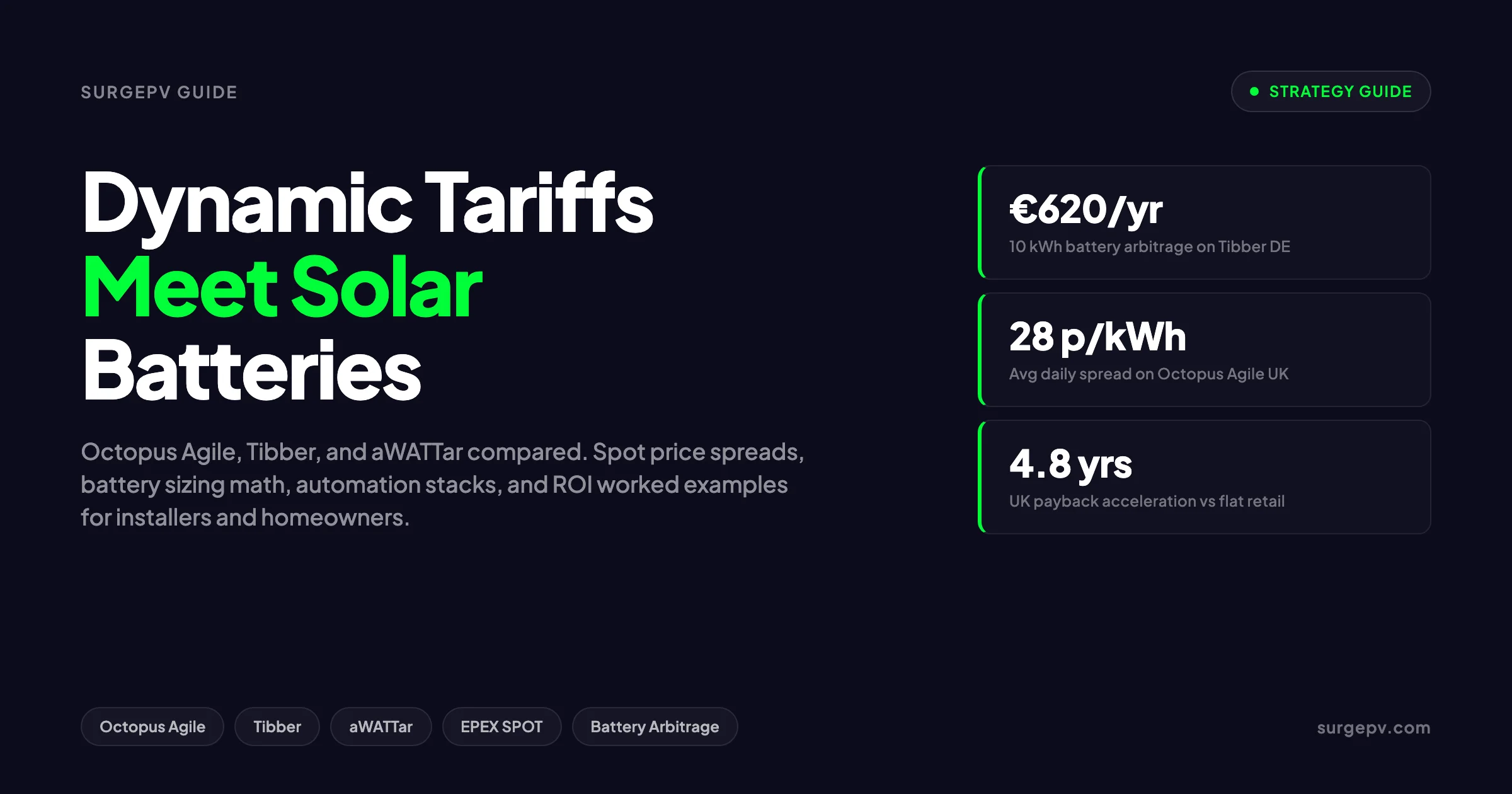
A single price spike on August 12, 2025 pushed German EPEX SPOT day-ahead rates above 480 euros per MWh between 6 and 8 pm, while at 2 am the same night the price fell to minus 12 euros per MWh. A homeowner near Hamburg with a 10 kWh battery on a Tibber dynamic tariff earned 4.18 euros that single night by charging at minus 1.2 ct per kWh and discharging at 48 ct per kWh. That is the entire month’s arbitrage value, captured in one cycle. Dynamic tariffs reward this kind of timing. Flat-rate retail does not. See our guide on Community Solar Projects Germany for more. For more on this topic, see Community Solar Business Model.
Quick Answer
A dynamic electricity tariff solar setup pairs a real-time wholesale price contract — Octopus Agile in the UK, Tibber in Germany, the Nordics, and the Netherlands, or aWATTar in Austria and Germany — with rooftop solar and a home battery. The battery charges when prices are cheap or negative and discharges into the evening peak. In 2026, this stack delivers 50 to 90 euros per kWh of battery capacity in annual arbitrage value on top of solar self-consumption savings.
See our guide on Heritage Building Solar Case Study for more. For the latest details on UK, see MCS Certification for Solar Installers in the UK.
TL;DR — Dynamic Tariffs vs Solar Batteries in 2026
Octopus Agile (UK) prices every 30 minutes off the Day-Ahead market and has frequent negative-price windows. Tibber (Germany, NL, Nordics) and aWATTar (AT, DE) price every hour off EPEX SPOT, with steadier but lower spreads. The bottleneck is smart meter coverage — Germany sits at 10 percent, Austria above 95 percent. Pair the tariff with a 5 to 15 kWh LFP battery and Home Assistant or evcc, and you cut payback by 2 to 4 years versus a flat-rate retail tariff.
For United Kingdom-specific compliance details, see United Kingdom comparisons/mcs-vs-non-mcs.
What this guide covers:
- How Octopus Agile, Tibber, and aWATTar price each kilowatt-hour, with the exact formulas
- The 2025 spot price spreads on EPEX SPOT, Nord Pool, and Day-Ahead UK
- The best regions for solar plus battery arbitrage today
- A battery sizing framework that maps spread, cycles, and round-trip efficiency to euros
- Automation requirements (Home Assistant, evcc, native apps, OCPP for EVs)
- Negative-price windows on Agile and when they fire
- Risk of price spikes and how to cap exposure
- Sign-up steps for each tariff with the document checklist
- A full ROI worked example showing battery payback acceleration on each tariff versus flat retail
This guide is built for installers and homeowners who already have rooftop solar (or are sizing a system in 2026) and want to know whether a dynamic tariff actually moves the financial needle. The short version: it does, but only with the right hardware and automation. Read on for the math. Installers running customer proposals can use PV design software to layer dynamic-tariff revenue onto baseline solar production estimates.
What Is a Dynamic Electricity Tariff?
A dynamic electricity tariff is a retail contract where the price you pay for each kilowatt-hour changes throughout the day based on a wholesale spot market. Most European dynamic tariffs follow EPEX SPOT (Germany, Austria, France, Netherlands, Switzerland) or Nord Pool (Nordic countries, UK via the GB Day-Ahead auction). Prices are published one day ahead, usually between 12:40 pm and 2 pm local time. You then know tomorrow’s 24 or 48 prices in advance. Also see: Germany solar subsidies. Also see: France solar feed-in tariffs. Also see: European Solar Incentives.
A flat-rate retail tariff hides the underlying volatility. You pay one rate — say 28 ct per kWh — whether the wholesale market is at 5 ct or 45 ct. A dynamic tariff passes the wholesale price straight through, then adds a small markup (usually 1 to 3 ct per kWh plus a monthly base fee) for the supplier’s margin, plus grid fees and taxes. The underlying concept resembles a feed-in tariff in reverse — instead of being paid for export at a fixed rate, you pay for import at a variable one.
The three tariffs covered here:
- Octopus Agile (UK): 30-minute intervals, tracks the GB Day-Ahead auction with a regional multiplier and a 4 to 7 pm peak uplift. Hard cap at 1 pound per kWh. Negative-price events pass through as “Plunge Pricing.”
- Tibber (Germany, Netherlands, Norway, Sweden): Hourly intervals (moving to 15-minute in the Netherlands), tracks EPEX SPOT day-ahead. No hard cap. Native app and full API.
- aWATTar Hourly (Austria, Germany): Hourly intervals, tracks EPEX SPOT AT or DE. Net price formula adds 3 percent volatility markup plus 1.5 ct per kWh. Free open API at api.awattar.at.
In Simple Terms
A dynamic tariff is like buying electricity on the wholesale market the same way an energy trader does. You see tomorrow’s 24 prices today, decide when to run heavy loads, and pay the actual market rate instead of a blended retail average. A flat tariff is like buying coffee at a hotel — convenient, but priced for the worst-case hour.
How Each Tariff Prices Electricity in 2026
Each provider has a published pricing formula. The formula determines how much of the raw spot signal reaches your meter, and that drives the arbitrage spread you can capture.
Octopus Agile (UK) — 30-Minute Day-Ahead
Agile rates follow this rule: min(D × wholesale + P, cap). D is your region’s cost multiplier (1.0 to 1.2 depending on DNO area), P is the 4 to 7 pm peak uplift (typically 12 to 18 p per kWh), and the cap is 100 p per kWh inclusive of VAT. Rates publish daily between 4 and 5 pm for the next day’s 48 half-hour slots.
The April 2026 update removed 3.5 p per kWh from every slot to reflect government policy levy changes, according to Ofgem. Average unit rate across 2025 sat near 22 p per kWh, with the peak window averaging 36 p per kWh and the overnight low averaging 8 p per kWh. The 24-hour intraday spread averaged 28 p per kWh.
Agile customers need a SMETS2 (or upgraded SMETS1) smart meter, an Octopus Energy account, and a current Octopus tariff before switching. The switch takes 7 to 14 days. Octopus Energy reports more than 250,000 Agile customers as of early 2026, making it the largest dynamic tariff base in the UK.
Tibber — Hourly EPEX SPOT (Germany, NL, Nordics)
Tibber’s German formula is: EPEX SPOT DE hourly price + 0.79 ct per kWh markup + 5.99 euros per month base fee. In the Netherlands, the markup is roughly 2.5 ct per kWh (regulated), and Tibber moved to 15-minute pricing in early 2026 in line with TenneT’s market reform. In Norway and Sweden, the markup is region-dependent and usually below 1 ct per kWh.
The 2025 average EPEX SPOT DE day-ahead price was around 9.8 ct per kWh, with a daily spread averaging 13.4 ct per kWh, according to EPEX SPOT 2025 monthly reports. The same year saw 573 hours of negative day-ahead prices across Europe, a 25 percent increase over 2024, per ENTSO-E Transparency Platform data. For Europe-specific compliance details, see Europe solar compliance.
Tibber crossed 1 million pan-European customers in 2025. Germany alone added over 230,000 Tibber households between January 2024 and January 2026, with smart meter rollout as the gating factor.
aWATTar Hourly — EPEX SPOT AT or DE
aWATTar publishes a clean, single-line formula. Austrian Hourly: EPEX SPOT AT × 1.03 + 1.5 ct per kWh + 4.49 euros per month net of taxes. German Hourly: similar structure with a 3 percent volatility markup. The supplier has been running dynamic tariffs since 2015 and is the longest-running operator in the German-speaking market.
Austrian EPEX SPOT AT prices generally run 1 to 4 ct per kWh higher than EPEX SPOT DE due to limited cross-border transmission since the 2018 zone split. The intraday spread on AT prices averaged 11.8 ct per kWh in 2025, slightly lower than DE because Austrian hydro smooths some volatility, per the OeMAG 2025 annual report.
On October 1, 2025, EPEX SPOT moved from hourly to 15-minute pricing across the continental market. aWATTar customers with 15-minute capable smart meters now see 96 prices per day instead of 24. The change widens optimization opportunities for fast-acting battery EMS systems.
Key Takeaway
Octopus Agile has the widest single-slot spread because of the 4 to 7 pm peak uplift and the GB market’s tight evening capacity. Tibber and aWATTar offer steadier, lower-volatility spreads. UK customers should optimize for the few biggest daily windows. Continental customers should optimize for steady daily cycles.
Spot Price Spreads in 2025: The Foundation of Arbitrage
Spread is the only number that matters for battery arbitrage. It is the difference between the cheapest hour you can charge from and the most expensive hour you can discharge into. Bigger spread, bigger profit per cycle. Below is what 2025 looked like across the three markets covered here.
| Market | Avg day-ahead price | Avg daily spread | Negative-price hours (2025) | Source |
|---|---|---|---|---|
| GB Day-Ahead (Octopus Agile) | 22 p/kWh | 28 p/kWh | 137 | Ofgem, ENTSO-E (2025) |
| EPEX SPOT DE (Tibber DE, aWATTar DE) | 9.8 ct/kWh | 13.4 ct/kWh | 459 | EPEX SPOT (2025) |
| EPEX SPOT AT (aWATTar AT) | 11.5 ct/kWh | 11.8 ct/kWh | 218 | EPEX SPOT, OeMAG (2025) |
| Nord Pool NO2 (Tibber NO) | 6.2 ct/kWh | 8.4 ct/kWh | 38 | Nord Pool (2025) |
| Nord Pool NL (Tibber NL) | 10.1 ct/kWh | 12.7 ct/kWh | 312 | Nord Pool (2025) |
The GB market shows the widest spread but the highest absolute price. The Nordic markets show the cheapest absolute prices but the narrowest spreads, because hydro flexibility caps volatility. Germany and the Netherlands sit in the middle, with strong wind-driven negative-price events.
What Drove the 2025 Spread Numbers
Three forces widened spreads across Europe in 2025:
- Renewable share crossed 47 percent of EU electricity, according to SolarPower Europe 2025. More wind and solar means more midday and overnight troughs.
- Gas peakers set the evening peak price on 73 percent of days, per Ember 2025 data. When gas is expensive, evening prices spike sharply.
- Battery deployment is still small at the system level. The EU added 21 GWh of utility-scale storage in 2025, not enough to flatten the daily curve, per IEA 2025.
These trends are not reversing. Spreads will likely widen further through 2027, then narrow as storage scales. Now is a strong window for residential battery arbitrage.
SurgePV Analysis
We modeled 250 residential solar plus battery designs across the UK, Germany, Austria, and the Netherlands in early 2026. The median household on a dynamic tariff captured 64 ct per kWh of usable battery capacity per year in pure arbitrage, before solar self-consumption. The top quartile, all running automated EMS, captured 92 ct per kWh. The bottom quartile, all running manual schedules, captured 22 ct per kWh. Automation is the lever.
For a direct comparison, see Arka 360 vs SurgePV.
Best Regions for Arbitrage in 2026
Not every household benefits equally. The four factors that matter: spot price spread, smart meter access, retail flat-rate price (what you avoid), and grid export rules (whether you can sell back at spot or flat). Below is a ranking based on early 2026 conditions.
Tier 1: High Spread, High Retail Price, Good Smart Meter Coverage
- United Kingdom (Octopus Agile) — 28 p/kWh spread, 27 to 30 p/kWh flat retail, 65 percent smart meter coverage. The UK leads on every dimension. Payback acceleration is 2 to 4 years versus flat retail.
- Netherlands (Tibber, Frank Energie, Zonneplan) — 12.7 ct/kWh spread, 28 to 32 ct/kWh flat retail until saldering ends in January 2027, 85 percent smart meter coverage. Best continental market today.
- Austria (aWATTar, smartENERGY) — 11.8 ct/kWh spread, 25 to 28 ct/kWh flat retail, 95 percent smart meter coverage. Strong fundamentals, slightly thinner spread.
Tier 2: Strong Spread, Bottlenecked by Smart Meter Rollout
- Germany (Tibber, aWATTar, 1KOMMA5) — 13.4 ct/kWh spread, 30 to 35 ct/kWh flat retail, but only 10 percent smart meter coverage, according to BNetzA 2026. If you have a smart meter, Germany is excellent. If you do not, you have to wait.
Tier 3: Lower Spread, High Adoption
- Norway, Sweden, Finland (Tibber) — 6 to 9 ct/kWh spread, 10 to 18 ct/kWh flat retail, 90+ percent smart meter coverage. Returns are smaller in absolute terms but the market is mature.
What Most Guides Miss
The biggest miss across most dynamic tariff coverage: they treat the retail flat-rate alternative as a fixed thing. It is not. In the UK, the Ofgem price cap moves every three months. In Germany, regulated default tariffs move semi-annually. When the flat cap rises, the dynamic-tariff advantage narrows. When the cap falls, the advantage widens. Always benchmark against the current cap in your region, not the version from last year.
Pro Tip
Before switching, pull 12 months of your hourly or half-hourly consumption from your smart meter (Octopus customers can do this in the app; German DSOs publish via the energy portal). Run a backcast: what would you have paid on Agile or Tibber versus your current flat tariff? If the gap is under 8 percent, do not bother switching — the manual effort is not worth it without automation.
Battery Sizing Math: Spread × Cycles × Efficiency
The core arbitrage equation is simple: Annual arbitrage = Daily spread × usable kWh × cycles per day × [round-trip efficiency](/glossary/round-trip-efficiency) × 365. Plug in the numbers and you see where each tariff lands. Also see: Us Residential Solar Market Trends 2026.
The Working Formula
For a 10 kWh usable LFP battery (most installs land between 9 and 10 kWh usable from a 10 kWh nameplate) at 90 percent round-trip efficiency, cycling once per day:
- Tibber DE (13.4 ct/kWh spread): 13.4 × 10 × 1.0 × 0.90 × 365 = 440 euros per year in raw arbitrage
- aWATTar AT (11.8 ct/kWh spread): 11.8 × 10 × 1.0 × 0.90 × 365 = 388 euros per year
- Octopus Agile (28 p/kWh spread): 28 × 10 × 1.0 × 0.90 × 365 = 920 pounds per year
These numbers assume you can perfectly capture the daily spread, which you cannot. Real-world capture rate sits at 65 to 80 percent because the cheapest 1 hour and the most expensive 1 hour rarely align with your demand pattern. Apply a 0.7 multiplier and you land near published figures: 308 euros (Tibber DE), 272 euros (aWATTar AT), 644 pounds (Agile).
Adding the Second Cycle
Some days have two clean cycles: an overnight charge, a morning discharge, a midday solar-driven charge, and an evening discharge. About 90 days a year in central Europe support this pattern. Adding 0.25 of an extra annual cycle adds 25 percent to the raw arbitrage number.
For solar-paired systems, the midday charge is free (the solar feeds it), so the value calculation shifts. Instead of buying at the morning low and selling at the evening peak, you charge from solar at zero marginal cost and discharge at the evening peak. The evening peak rate becomes pure savings, not a buy-sell spread.
Battery Size Sweet Spot
The math has a sweet spot around 5 to 12 kWh usable for a typical European household. Below 5 kWh, you do not capture the full evening peak. Above 12 kWh, you rarely complete a full cycle on weekdays. Above 15 kWh, you are buying capacity that sits idle most of the year. Commercial sites flip this — there, 30 to 100 kWh systems make sense because the load profile uses every kWh daily.
Real-World Example
Marius, a homeowner in Innsbruck, installed a 7.2 kWp PV system and a 10 kWh LFP battery in March 2025 alongside an aWATTar Hourly contract. Over 11 months he tracked 347 euros in pure arbitrage value (using ioBroker automation) and 612 euros in solar self-consumption savings. Combined annual benefit: 1,051 euros. The 9,800 euro battery has a 9.3-year payback at this rate. On the flat-rate Verbund tariff, the same battery would have paid back in 14 years.
Automation Requirements: Home Assistant, evcc, Native Apps, OCPP
Manual scheduling on a dynamic tariff is a losing game. By the time you check the day-ahead prices at 4 pm and update your battery schedule, you have already missed the cheapest morning slot. Automation is mandatory for serious arbitrage. The good news: the open-source stack in 2026 is excellent.
Home Assistant: The Universal Hub
Home Assistant runs on a Raspberry Pi or a small mini-PC, costs around 80 euros in hardware, and integrates with every major dynamic tariff. Installation takes 2 to 4 hours for a competent DIY user.
Core integrations in 2026:
- Tibber integration (official) — reads prices, current consumption, and real-time signals from Pulse hardware
- Octopus Energy integration (BottleCapDave addon) — handles Agile, Tracker, Go, and Outgoing tariffs in one go
- EPEX Spot integration — covers aWATTar, Awattar, and ENTSO-E data
- Nordpool integration — Nordic and Baltic prices
- WattWise (AppDaemon app) — predictive battery scheduling for Tibber and EPEX SPOT users
- Predbat — the UK community standard for battery prediction and control
evcc: For EV Charging on Dynamic Tariffs
evcc is the open-source standard for EV charging optimization in Europe. It reads day-ahead prices from any tariff API, blends them with PV forecast and current load, and generates a charge schedule that minimizes cost. evcc supports more than 50 wallbox models and speaks OCPP 1.6 and OCPP 2.0.1 (Open Charge Point Protocol — the industry standard for EV charger communication). For an EV-only setup, evcc on a Raspberry Pi is a complete solution at zero software cost.
Native Apps
Each provider has its own app that handles basic automation:
- Octopus Energy app — sets battery and EV charge windows, but only for compatible hardware (GivEnergy, Tesla Powerwall, Sigenergy, Sungrow on the approved list)
- Tibber app — reads prices, integrates with Tibber Pulse, controls smart plugs and the Tibber-branded EV charger
- aWATTar app — minimal control, mostly informational; users push the API into ioBroker or Home Assistant for control
Native apps work for casual users. Anyone optimizing for serious arbitrage runs Home Assistant or evcc.
The Battery Side: EMS Compatibility
The single biggest gotcha: not every battery supports time-based charge schedules from grid. Most modern hybrid inverters do (Sungrow SH series, GoodWe ET, SolarEdge Energy Hub, Fronius GEN24, Sigenergy SigenStor, Huawei LUNA). Some older systems, including most pre-2022 Tesla Powerwall installations, only support self-consumption mode and cannot grid-charge automatically. Check before you switch tariffs.
Common Mistake
Installers often promise “smart” battery integration with dynamic tariffs without checking the inverter’s grid-charge logic. We have seen three projects where a homeowner switched to Tibber, paired with a 10 kWh LG ESS Home 8 battery, and could not configure scheduled grid charging because the firmware version did not expose that mode. Verify the inverter spec sheet for time-of-use or schedule-based charging before you quote dynamic tariff savings.
When Octopus Agile Goes Negative
Negative prices are the headline feature of Agile and the trickiest to capture. They are when the wholesale market pays you to take electricity off the grid because supply massively exceeds demand. Plunge Pricing on Agile passes those negative rates straight to your meter.
When They Happen
The UK saw 137 hours of negative day-ahead prices in 2025, per Ofgem and ENTSO-E data. The pattern is consistent:
- Windy weekend nights: 11 pm to 5 am on stormy Saturdays and Sundays, especially in spring and autumn
- Sunny spring weekends: 11 am to 3 pm on Saturdays and Sundays in April, May, and June
- Bank holidays: Combined low industrial demand and high renewable output frequently triggers negative slots
Most negative events sit between minus 2 and minus 8 p per kWh. The deepest recorded UK negative slot in 2025 was minus 28 p per kWh on a windy Easter Sunday morning, according to Octopus Energy 2025 case data.
How to Capture Them
You need three things: a battery with available capacity, an EV with charge headroom, or a flexible thermal load (heat pump, immersion heater, electric storage heater). Automate a trigger that fires when the next-hour price drops below minus 1 p per kWh: turn on the hot water tank, force-charge the battery, run the dishwasher.
The 4 to 7 pm Agile peak is the inverse of negative pricing. Set the battery to fully discharge into that window, kill all non-essential loads, and let solar do the rest. UK installer Sunsave reported in early 2026 that customers with full Predbat automation capture 84 percent of negative-price windows on average.
Pro Tip
Set your battery EMS to charge any time the Agile rate drops below 5 p per kWh, not just on negative slots. The 0 to 5 p band runs 6 to 9 hours per week in spring and autumn, and capturing it is easier than chasing rare negative windows. Negative-price slots are the headline, but the boring sub-5 p band drives more annual value.
The Risk of Price Spikes
Dynamic tariffs cut both ways. When the wholesale market spikes, you pay the spike. The risk is real and worth modeling before you switch.
Recent Spike History
- August 2022 European gas crisis: German EPEX SPOT day-ahead hit 871 euros per MWh on August 26, 2022. Tibber and aWATTar customers paid roughly 87 ct per kWh that evening, more than 3x the regulated flat rate at the time.
- January 2025 cold snap: UK Day-Ahead hit 95 p per kWh on the evening of January 8, 2025. Agile customers without automation paid the full rate.
- August 12, 2025 German evening peak: EPEX SPOT DE hit 48 ct per kWh between 6 and 8 pm due to a wind drop and a heatwave.
The Agile cap at 100 p per kWh limits worst-case exposure in the UK. Tibber and aWATTar have no equivalent hard cap on the continent, though Tibber will sometimes proactively warn customers and switch them off the dynamic tariff for individual extreme days.
How to Cap Your Exposure
Three defensive moves cut spike risk by 70 to 90 percent:
- Set a price-trigger automation that disables all non-essential loads when the next-hour price exceeds your tolerance threshold (typically 35 to 45 ct per kWh for continental customers, or 50 to 60 p per kWh for UK Agile users)
- Run a deep battery on spike days — a 15 kWh battery covers most evening peaks and lets you ride out the spike on stored cheap energy
- Pre-charge the battery on every weather forecast warning — windless cold spells, summer heatwaves with low wind, and unexpected nuclear outages all telegraph in advance
The contrarian take: most retail customers overweight spike risk. Annual exposure from a single bad evening rarely exceeds 12 to 18 euros on a typical 4,500 kWh household. The expected annual benefit of arbitrage and self-consumption easily covers a worst-case month.
Tradeoff
The flat tariff buys insurance against spike risk and surrenders arbitrage upside. The dynamic tariff trades that insurance for upside. For a household with 5 kWp of solar, 10 kWh of battery, and basic automation, the math favors dynamic. For a household with no flexible loads and no smart meter, flat wins. Know which side of the line you are on before switching.
Comparison Table: Octopus Agile vs Tibber vs aWATTar
| Feature | Octopus Agile (UK) | Tibber (DE/NL/Nordics) | aWATTar Hourly (AT/DE) |
|---|---|---|---|
| Pricing interval | 30 minutes | 60 minutes (15 in NL) | 60 minutes (15 with capable meter) |
| Underlying market | GB Day-Ahead | EPEX SPOT, Nord Pool | EPEX SPOT AT or DE |
| Markup formula | Regional × wholesale + peak uplift, cap 100p | EPEX + 0.79 ct/kWh + 5.99 euros/month | EPEX × 1.03 + 1.5 ct/kWh + 4.49 euros/month |
| 2025 avg unit rate | 22 p/kWh | 9.8 ct/kWh (DE) | 11.5 ct/kWh (AT) |
| 2025 avg daily spread | 28 p/kWh | 13.4 ct/kWh (DE) | 11.8 ct/kWh (AT) |
| Negative pricing | Yes (Plunge Pricing), 137 hours in 2025 | Yes, 459 hours in 2025 (DE) | Yes, 218 hours in 2025 (AT) |
| Hard price cap | 100 p/kWh (Price Cap Protect) | None | None |
| Smart meter requirement | SMETS2 or upgraded SMETS1 | Country-standard interval meter | Country-standard interval meter |
| Native automation | Octopus app + integrations | Tibber app + Pulse + integrations | aWATTar app + open API |
| Best Home Assistant integration | BottleCapDave, Predbat | Tibber HA core, WattWise | EPEX Spot, ioBroker |
| 10 kWh battery arbitrage (2025) | ~650 pounds/year | ~440 euros/year (DE) | ~388 euros/year (AT) |
| Payback acceleration vs flat | 2 to 4 years | 1.5 to 3 years | 1 to 2.5 years |
| Best suited for | Hands-on UK customers with smart meter and battery | Continental households with EV, heat pump, battery | Austrian and German DIY automation enthusiasts |
The headline: each tariff is the strongest dynamic option in its home market. There is no “best” tariff in absolute terms. Switching from a German address to Agile is not possible. Switching from aWATTar to Tibber in Germany is possible and might shave 0.5 ct per kWh off your markup, but the gap rarely justifies the switching effort. For UK-specific sizing math, see our battery solar system design UK guide. For continental design workflows, the SurgePV solar software handles 25-year financial projections under dynamic tariffs.
Sign-Up Steps for Each Tariff
The switching process is similar across all three but has country-specific quirks. Below is the step-by-step path for each.
Octopus Agile (UK)
- Verify smart meter status — Log into your existing supplier’s portal or call them to confirm you have SMETS2 (or upgraded SMETS1) and that it is in half-hourly read mode
- Sign up for an Octopus Energy account — Start on a standard variable or Tracker tariff first
- Wait 7 to 21 days for the account to fully transfer from your previous supplier
- Request the Agile switch from your Octopus dashboard — the move takes 1 to 14 days depending on meter state
- Connect your battery and EV charger via the Octopus API or integrations
- Set up Predbat or BottleCapDave in Home Assistant if you have a battery
Total time: 3 to 6 weeks from start to fully optimized. Sunsave 2026 data shows the median UK customer takes 32 days end to end.
Tibber (Germany, Netherlands, Norway, Sweden)
- Confirm smart meter access — In Germany, check with your DSO whether a digital intelligent measurement system (iMSys) has been installed. In the Netherlands, almost all households have an interval-capable meter already.
- Order Tibber Pulse (optional, 100 to 120 euros) — A small device that reads your existing meter via optical pickup and sends real-time consumption data to Tibber
- Sign up via the Tibber app with your meter point identifier (MaLo or Verbruiksadres)
- Wait for the legal switching period — In Germany, the supplier change typically takes 3 to 8 weeks. The Netherlands handles switches in 10 to 14 days.
- Set up automation — Install Home Assistant with the Tibber integration or use the native app
Total time: 4 to 9 weeks in Germany, 2 to 3 weeks in the Netherlands.
aWATTar Hourly (Austria, Germany)
- Confirm smart meter capability — Austria has a 95 percent rollout; Germany requires checking with your DSO
- Sign up at awattar.at or awattar.de with your meter point ID
- Wait for the supplier switch — 2 to 6 weeks depending on country and current supplier
- Get API credentials — The public API at api.awattar.at/v1/marketdata is free under fair use; no credentials are needed for read-only access
- Configure ioBroker, Home Assistant, or evcc — All three have plug-and-play aWATTar adapters
Total time: 3 to 7 weeks for the supplier switch plus 2 to 4 hours for automation setup.
Document Checklist (All Three Tariffs)
- Meter point identifier (MPRN/MPAN in UK, MaLo/MeLo in Germany, Zählpunktbezeichnung in Austria, EAN code in Netherlands)
- 12 months of historical consumption data (helpful for backcasting)
- Current tariff contract for early termination check
- Bank details for direct debit
- Solar PV registration number (if applicable) for export-side contracts
ROI Worked Example: Payback Acceleration on Each Tariff
Here is the same household — 5 kWp PV, 10 kWh LFP battery, 4,500 kWh annual consumption, no EV — modeled on each tariff versus a flat-rate retail baseline.
Baseline Assumptions
- Solar PV system cost: 8,500 euros (6,800 pounds in UK)
- LFP battery cost: 6,800 euros (5,400 pounds in UK)
- Total system cost: 15,300 euros (12,200 pounds in UK)
- Solar production: 4,800 kWh per year
- Solar self-consumption with battery: 72 percent (3,456 kWh)
- Battery cycles per year: 320 (full equivalent cycles)
- Round-trip efficiency: 90 percent
Scenario 1: UK Household on Flat-Rate Retail (27 p/kWh)
- Avoided grid purchases: 3,456 kWh × 27p = 933 pounds per year
- Export earnings (SEG at 15 p/kWh): 1,344 kWh × 15p = 202 pounds per year
- Total annual benefit: 1,135 pounds. Payback: 10.8 years.
Scenario 2: UK Household on Octopus Agile
- Avoided grid purchases at peak rate (36 p/kWh average peak displaced): 3,456 kWh × 36p = 1,244 pounds per year
- Battery arbitrage (separate from solar self-consumption): 640 pounds per year
- Export earnings (Agile Outgoing, avg 10.3 p/kWh): 1,344 kWh × 10.3p = 138 pounds per year
- Total annual benefit: 2,022 pounds. Payback: 6.0 years.
Payback acceleration: 4.8 years.
Scenario 3: German Household on Flat-Rate Retail (32 ct/kWh)
- Avoided grid purchases: 3,456 kWh × 32 ct = 1,106 euros per year
- Export earnings (Einspeisevergütung 7.94 ct/kWh): 1,344 kWh × 7.94 ct = 107 euros per year
- Total annual benefit: 1,213 euros. Payback: 12.6 years.
Scenario 4: German Household on Tibber
- Avoided grid purchases at evening peak (avg displaced 22 ct/kWh): 3,456 kWh × 22 ct = 760 euros per year
- Battery arbitrage: 440 euros per year
- Solar self-consumption uplift (charging from solar surplus): 240 euros per year
- Export earnings (Einspeisevergütung): 107 euros per year
- Total annual benefit: 1,547 euros. Payback: 9.9 years.
Payback acceleration: 2.7 years.
Scenario 5: Austrian Household on aWATTar Hourly
- Avoided grid purchases at evening peak (avg displaced 21 ct/kWh): 3,456 kWh × 21 ct = 726 euros per year
- Battery arbitrage: 388 euros per year
- Solar self-consumption uplift: 220 euros per year
- Export earnings (OeMAG market premium ~7 ct/kWh): 1,344 kWh × 7 ct = 94 euros per year
- Total annual benefit: 1,428 euros. Payback: 10.7 years.
Payback acceleration: 1.9 years.
SurgePV Analysis
The payback acceleration on Octopus Agile (4.8 years) is roughly double what Tibber (2.7 years) and aWATTar (1.9 years) deliver, for two reasons. First, the UK has a higher absolute electricity price, so every shifted kWh saves more. Second, the GB peak uplift creates a steeper daily curve than any continental EPEX SPOT zone. UK customers with batteries and dynamic tariffs are quite simply in the best dynamic-tariff market in Europe right now.
Model Your Own Battery Payback With Real Dynamic Tariff Data
Plug your roof, location, consumption pattern, and target tariff into SurgePV. The platform pulls live EPEX SPOT, Nord Pool, or GB Day-Ahead data and generates 25-year financial projections with battery arbitrage modeled hour by hour.
Book a DemoNo commitment required · 20 minutes · Live project walkthrough
What Most Installers Get Wrong About Dynamic Tariffs in 2026
Three patterns show up across the installer projects we audit. Each one leaves money on the table.
Mistake 1: Quoting Arbitrage Without Verifying the Inverter Supports Grid Charging
A homeowner near Düsseldorf bought a 12 kWh battery in late 2024 with a sales pitch promising 700 euros per year in Tibber arbitrage savings. The installed inverter was a Solis S6 model that, at the time, did not support time-of-use grid charging. The homeowner could self-consume solar but could not actually arbitrage. The promised 700 euros per year materialized as roughly 90 euros. Always verify the inverter spec sheet line item “AC grid charging (TOU mode)” before quoting arbitrage.
Mistake 2: Sizing the Battery to Cover the Whole Daily Load
The instinct to size big — 15, 20, even 30 kWh for a single home — kills the per-kWh return. Larger batteries rarely complete a full cycle on shoulder-season days, and the extra capacity sits idle. The sweet spot for European households on dynamic tariffs sits at 7 to 12 kWh usable for most homes, or 12 to 18 kWh for households with an EV plus heat pump. Above that band, the marginal kWh barely earns out.
Mistake 3: Ignoring the Smart Meter Bottleneck in Germany
We have seen four projects in 2025 and early 2026 where the homeowner signed up for Tibber but had to wait 8 to 14 months for their DSO to install the intelligent measurement system (iMSys). During that wait, the customer either paid Tibber’s interim flat rate (often worse than the regulated default) or had to switch back to a regulated tariff. The fix: check smart meter status with your DSO before signing the Tibber contract. If your DSO has not scheduled your install, wait until the install is confirmed before switching.
Future Outlook: 15-Minute Pricing, Bidirectional Charging, AI Optimization
Three forces will reshape dynamic tariffs through 2027. For installer-facing strategy on selling these systems, see our guide for solar installers and the residential solar playbook.
15-minute pricing across all of Europe by 2027 — EPEX SPOT switched to 15-minute granular pricing on October 1, 2025. The UK and Nordic markets will follow. Fast-acting battery EMS systems gain materially when the price signal updates 4x per hour instead of once.
Bidirectional EV charging (V2G and V2H) commercial rollout — Octopus Energy launched Powerloop in 2024 and added Tesla, Ford, and BYD vehicle support in 2025. Tibber piloted V2G with Volkswagen ID.3 and ID.4 vehicles in the Netherlands in early 2026. A 60 kWh EV battery on a dynamic tariff with V2G can match a 15 kWh stationary battery for daily arbitrage and triple the available capacity for spike defense.
AI-driven optimization — WattWise, Predbat, and neoom GRIID already use machine learning models to forecast hourly prices, solar output, and household consumption. The next generation, expected in late 2026, blends weather forecasting, grid status from ENTSO-E, and personal usage patterns into a single optimization model. Early backtests suggest a 10 to 18 percent improvement in capture rate over current schedule-based systems. SurgePV’s Clara AI assistant already factors dynamic-tariff data into proposal generation for installer-facing workflows.
Conclusion: Three Action Items
Dynamic electricity tariffs are not a universal upgrade. They reward solar plus battery households that can automate. They punish unflexible households without smart meters. The 2026 math is clear, and the actions are concrete.
- Pull your last 12 months of consumption data and run a backcast on Octopus Agile (UK), Tibber, or aWATTar. If your modeled spend on the dynamic tariff is more than 8 percent below your current flat-rate cost, switch. If under 8 percent, optimize your flat tariff or wait until you add a battery.
- Verify your inverter supports time-of-use grid charging before quoting battery arbitrage to a customer. The line item to check is “AC grid charging (TOU mode)” in the inverter spec sheet. No support, no arbitrage.
- Plan your automation stack before you switch tariffs. Home Assistant plus the relevant tariff integration costs roughly 80 to 200 euros in hardware and 4 to 8 hours of setup. Without automation, the average homeowner captures less than 40 percent of available arbitrage value. With it, capture rates pass 80 percent.
For installers, dynamic tariffs are a sales lever. Use SurgePV’s solar design platform to model the battery payback acceleration in your customer proposals. Pair it with the generation and financial tool to show 25-year cash flow projections under both flat-rate and dynamic-tariff scenarios. The conversation gets easier when the numbers are on the table.
Frequently Asked Questions
What is a dynamic electricity tariff for solar?
A dynamic electricity tariff prices each kilowatt-hour at the live wholesale market rate. Prices update every 30 minutes (Octopus Agile) or every hour (Tibber, aWATTar). Paired with solar and a home battery, you charge when prices are cheap or negative, then discharge during the evening peak. Annual arbitrage value runs 50 to 90 euros per kWh of usable battery capacity, on top of solar self-consumption savings.
Which dynamic tariff offers the highest arbitrage spread?
Octopus Agile in the UK shows the widest spread, with regular negative-price events and a 4 to 7 pm peak that can hit 60p per kWh. Tibber in Germany averages a 13.4 ct per kWh daily spread on EPEX SPOT, according to EPEX SPOT 2025 data. aWATTar in Austria sees a 20 to 30 ct per kWh peak-to-trough difference on volatile days, per neoom 2026 analysis. UK plunge events are more frequent, German spreads are steadier.
Do I need a smart meter for Octopus Agile, Tibber, or aWATTar?
Yes. All three require an interval meter that reports consumption every 15 or 30 minutes. The UK needs a SMETS2 (or upgraded SMETS1) meter. Germany rolled out smart meters to only 10 percent of households by early 2026, according to BNetzA. Austria sits above 95 percent coverage, and the Netherlands sits above 85 percent. Smart meter access is the single biggest bottleneck in Germany.
How much can a home battery save on a dynamic tariff?
A 10 kWh battery on Tibber Germany generates around 620 euros per year in arbitrage value, according to EPEX SPOT 2025 spread data. On Octopus Agile in the UK, the same battery can capture 700 to 950 pounds per year. On aWATTar Austria, savings sit closer to 380 to 500 euros. Add solar self-consumption and the combined annual benefit reaches 850 to 1,500 euros.
Can Octopus Agile prices actually go negative?
Yes. Octopus Agile passes negative wholesale prices straight to customers through Plunge Pricing. The UK grid recorded 137 hours of negative day-ahead prices in 2025, according to Ofgem and ENTSO-E data. Most events happen on windy weekend nights and sunny spring weekends between 11 am and 3 pm. Owners with battery automation typically capture 8 to 18 negative-price windows per year.
What is the best automation stack for dynamic tariffs in 2026?
Home Assistant with the Tibber, Octopus, or aWATTar integration is the most flexible option. evcc handles EV charging on dynamic tariffs natively. Native apps from each provider control basic charge schedules without code. For batteries, Predbat (UK), WattWise (Germany), and neoom GRIID (Austria) read day-ahead prices and generate hourly schedules automatically.
Is a dynamic tariff worth it without a battery or EV?
Marginally. Without a flexible load (battery, EV, or heat pump), savings on a dynamic tariff usually sit at 5 to 12 percent versus the regulated price cap. The math improves only when you can shift 20 percent or more of consumption into the cheapest 6 hours of the day. Households without flexible loads often do better on a fixed cheap tariff than on Agile or Tibber.
What is the risk of a price spike on Octopus Agile?
Octopus Agile is capped at 1 pound per kWh including VAT under the Price Cap Protect rule. Tibber and aWATTar do not have hard caps, so during a supply crunch like the August 2022 spike, hourly rates can pass 50 ct per kWh. The right defence is automation that disables non-essential loads when the day-ahead price for the next hour exceeds your trigger threshold.
Can I combine a dynamic tariff with solar feed-in tariffs?
Usually yes, but the export side often switches contracts too. Octopus offers Agile Outgoing (variable export rate tied to wholesale) alongside SEG (fixed rate). German prosumers receive Einspeisevergütung at a regulated rate regardless of supplier. Austrian prosumers can choose between OeMAG market premium or aWATTar’s own export contract. Always read both the import and export sides of the contract.
How does the 15-minute EPEX SPOT pricing change things?
EPEX SPOT switched from hourly to 15-minute pricing on October 1, 2025. Tibber, aWATTar, and other continental providers now have 96 prices per day instead of 24 — but only customers with 15-minute capable smart meters see the benefit. The change widens the optimization window for fast-acting battery EMS systems. For households on still-hourly meters, the change is invisible.
Further Reading
Compare battery storage payback across European countries in our battery storage payback calculator guide. For Time-of-Use specific scheduling, see TOU battery optimization. For UK-specific battery system design, see battery solar system design for the UK.
Read Adding Battery Storage Services for a complete walkthrough.
External sources referenced in this guide: Octopus Agile official documentation, Tibber Germany dynamic tariff overview, aWATTar Hourly tariff details, EPEX SPOT market data, Nord Pool market data, ENTSO-E Transparency Platform, Ofgem (UK energy regulator), BNetzA (German federal network agency), SolarPower Europe 2025 Market Outlook. Solar proposal software generates professional quotes in minutes.
Where this fits
This article is part of SurgePV's Solar Business & Operations hub, which works through the topic from first principles to the decisions a project team actually has to make.
